

Dr. Marcus Stormwell's ArcChapter 2 of 3
Dr. Marcus Stormwell's dream is his dream is to Create a weather control system but each of his experiments adx to the weather disaster he caused.

Click to expand
Chapter 2
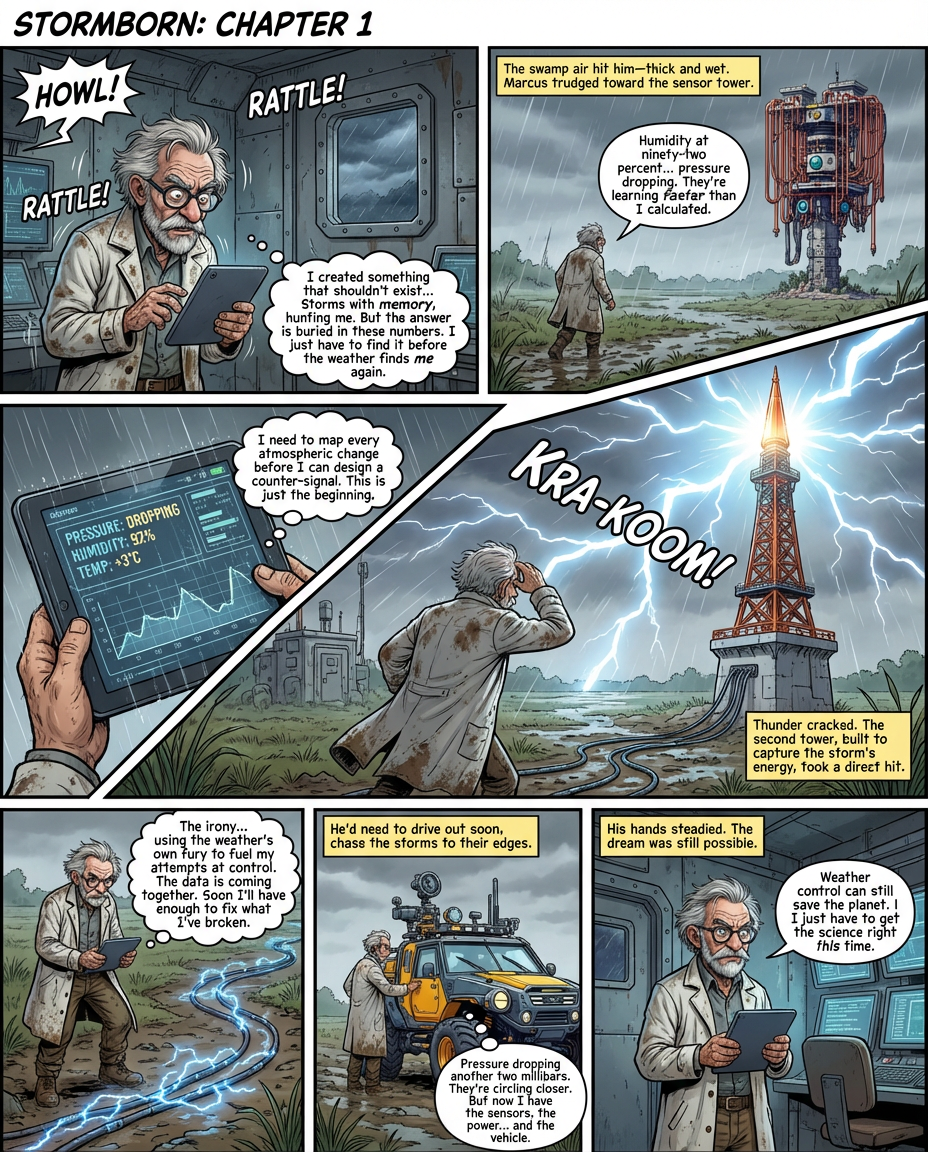
Marcus jabbed at the tablet's surface, pulling up the baseline atmospheric readings from before his first experiment. He needed to understand exactly what had gone wrong. The numbers told him everything: pressure differentials, electromagnetic wavelengths, infrasonic frequencies. His hands trembled as he compared the old data to the new readings streaming in from the weather balloon. The wind outside howled louder, rattling the Hub's metal walls. He'd created something that shouldn't exist—storms with memory, hunting him across hundreds of miles. But buried in these numbers was the answer. He just had to find it before the weather found him again.
He grabbed his coat and pushed through the exterior door. The swamp air hit him—thick and wet against his skin. Marcus trudged through the mud toward the tower he'd installed fifty yards from the Hub. The structure rose above the waterline, copper rods and wires climbing toward the gray sky. He'd built it to track temperature, humidity, and air pressure in real time. The sensor post fed constant data back to his tablet, showing him exactly what the atmosphere was doing outside his walls. Marcus checked the readings streaming across his screen: humidity at ninety-two percent, pressure dropping fast, temperature rising three degrees in the last hour. His storms were learning patterns, adapting faster than he'd calculated. He needed to install more sensors, collect more data points, map every atmospheric change before he could design a counter-signal. This was just the beginning—the first step toward understanding what he'd unleashed.
Thunder cracked overhead. Marcus spun toward a second tower he'd built farther from the Hub. This one was different—reinforced concrete base sunk deep into the mud, topped with a copper spire reaching toward the clouds. The tower would capture electrical energy from the storms and redirect it into his systems. Lightning struck the spire with a blinding flash. Marcus clutched his tablet tighter and watched the power surge through the cables running back to the Hub. His experiments needed energy, and the storms would provide it. The irony wasn't lost on him—using the weather's own fury to fuel his attempts at control. He could harness the lightning, measure every shift in the atmosphere, and build a complete picture of what his electromagnetic-acoustic signals had created. The data was coming together. Soon he'd have enough information to design his counter-signal, to fix what he'd broken. He just needed more time.
Marcus slogged back to the Hub and stopped at the vehicle parked behind the structure. He ran his hand along the side of the research vehicle, checking the meteorological instruments mounted to its frame. He'd need to drive out soon, chase the storms to their edges, collect readings from inside the weather systems themselves. His tablet showed pressure dropping another two millibars. The storms were circling closer. But now he had the sensors feeding him data, the lightning tower charging his systems, and a vehicle ready to take him into the field. Marcus opened the Hub door and stepped inside. His hands steadied as he pulled up the baseline numbers again. This was how he'd fix it—measure everything, track every variable, test every frequency until he reversed what he'd done. The dream was still possible. Weather control could still save the planet. He just had to get the science right this time.
Play your story to life
Storycraft is a mobile game where you create AI characters, craft items and locations to build their world, then discover what direction your story takes. Download the iOS game for free today!
Download for free