

Tom Tinkerton's ArcChapter 2 of 2
Tom Tinkerton's dream is rebuilding Santa's workshop into the world's most efficient toy factory.

Click to expand
Chapter 2
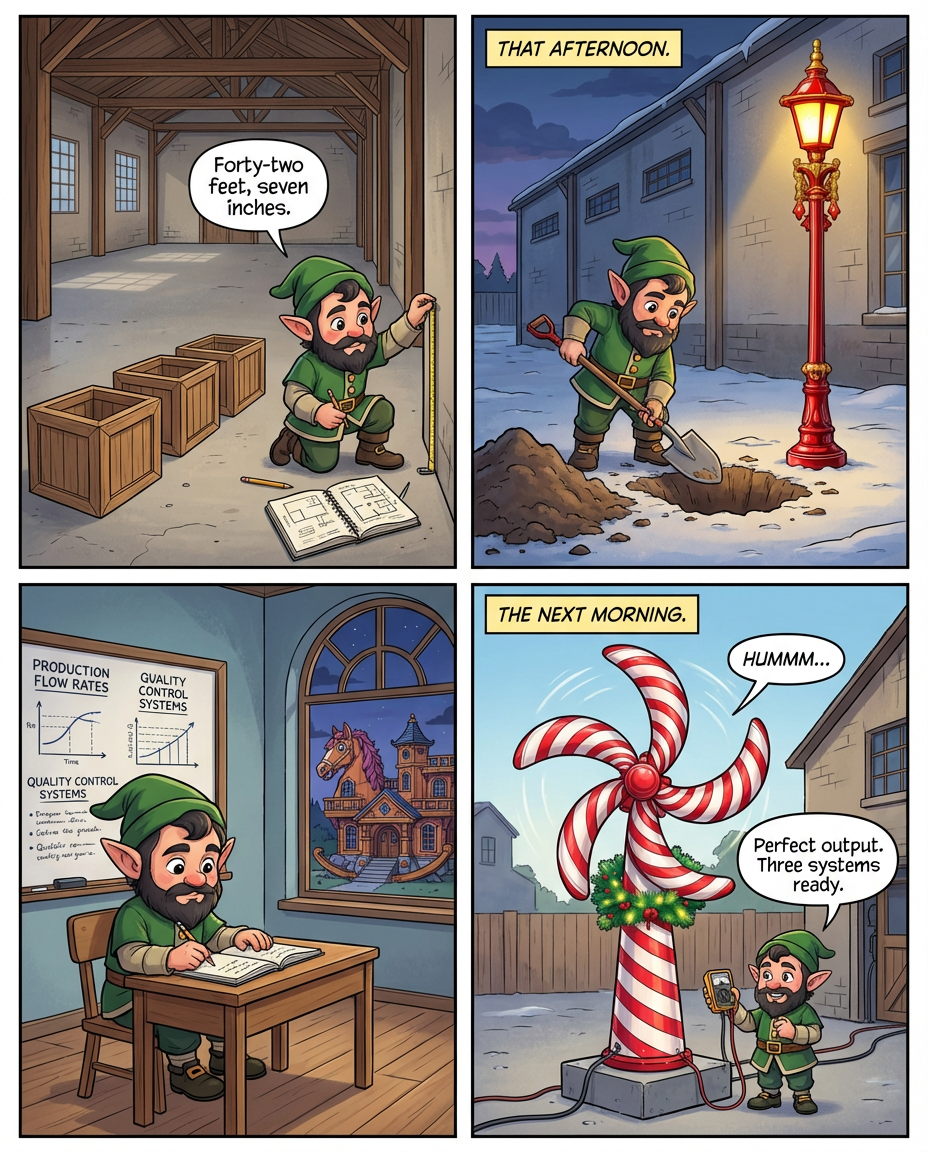
Tom lined up the three empty crates beside his measuring tools and notebooks. The factory floor stretched wide and bare before him. First, he needed to map every inch of this space. He pulled out his tape measure and started with the northeast corner, calling out numbers to himself: "Forty-two feet, seven inches." His notebook filled with sketches showing where each production station would go. The crates would hold sorted materials once workers arrived—nails in one, hinges in another, screws in the third. Everything organized. Everything tracked. By noon, his hands cramped from writing, but the floor plan was complete. He stood back and studied the measurements. The factory was taking shape, one precise number at a time.
That afternoon, Tom unpacked the tall red street light from its shipping crate. The gold accents caught the dim light filtering through the factory windows. He'd ordered it specifically for the loading area outside—workers would need to move materials safely after dark. He carried it to the rear entrance and studied the frozen ground. The installation would need to be exact. He measured three feet from the doorway and marked the spot with chalk. Then he began digging through the hard earth with his shovel, checking the depth every few minutes. Six inches. Twelve inches. Eighteen inches—perfect. He set the light's base into the hole and packed dirt around it, testing its stability with both hands. When he flipped the switch, warm light spread across the empty loading zone. The first piece of his efficiency system was in place.
Tom locked the factory door and walked toward the whimsical building shaped like a giant toy rocking horse. The Rocking Horse Toy University sat ready for evening classes, and he'd registered weeks ago. He needed more than measurements and floor plans—he needed the science behind toy design and modern factory management. Inside, he took his seat and opened a fresh notebook. The instructor began discussing production flow rates and quality control systems. Tom wrote down every word, his hand moving fast across the pages. His factory plans were solid, but this knowledge would make them unbreakable. When class ended three hours later, his notebook held seventeen pages of notes. He stepped back outside and looked up at the rocking horse structure against the dark sky. Learning this would take time, but that was fine. The workshop he'd build would be worth every lesson.
The next morning, Tom examined the turbine that had arrived on a flatbed truck. The candy cane blades spiraled around its center, and a festive wreath with small lights decorated its housing. It looked ridiculous, but the specifications promised enough power output for every machine he planned to install. He directed the delivery workers to the clearing beside the factory, pointing to the exact spot he'd marked yesterday. The turbine would generate all the electricity the workshop needed—no dependency on outside systems that could fail. He watched them bolt it to the concrete base he'd poured last week, checking each connection point with his level. When they finished and drove away, Tom flipped the activation switch. The candy cane blades began to turn, slow at first, then faster. A low hum filled the air. Power flowed into the factory's main panel. He checked his voltage meter: perfect output. Three systems now stood ready—lighting, education, and power. The foundation was set. Everything else would build from here.
Play your story to life
Storycraft is a mobile game where you create AI characters, craft items and locations to build their world, then discover what direction your story takes. Download the iOS game for free today!
Download for free