

Kai Torrent's ArcChapter 4 of 9
Kai Torrent's dream is dominating underground fight tournaments to prove ultimate physical superiority.

Click to expand
Chapter 4
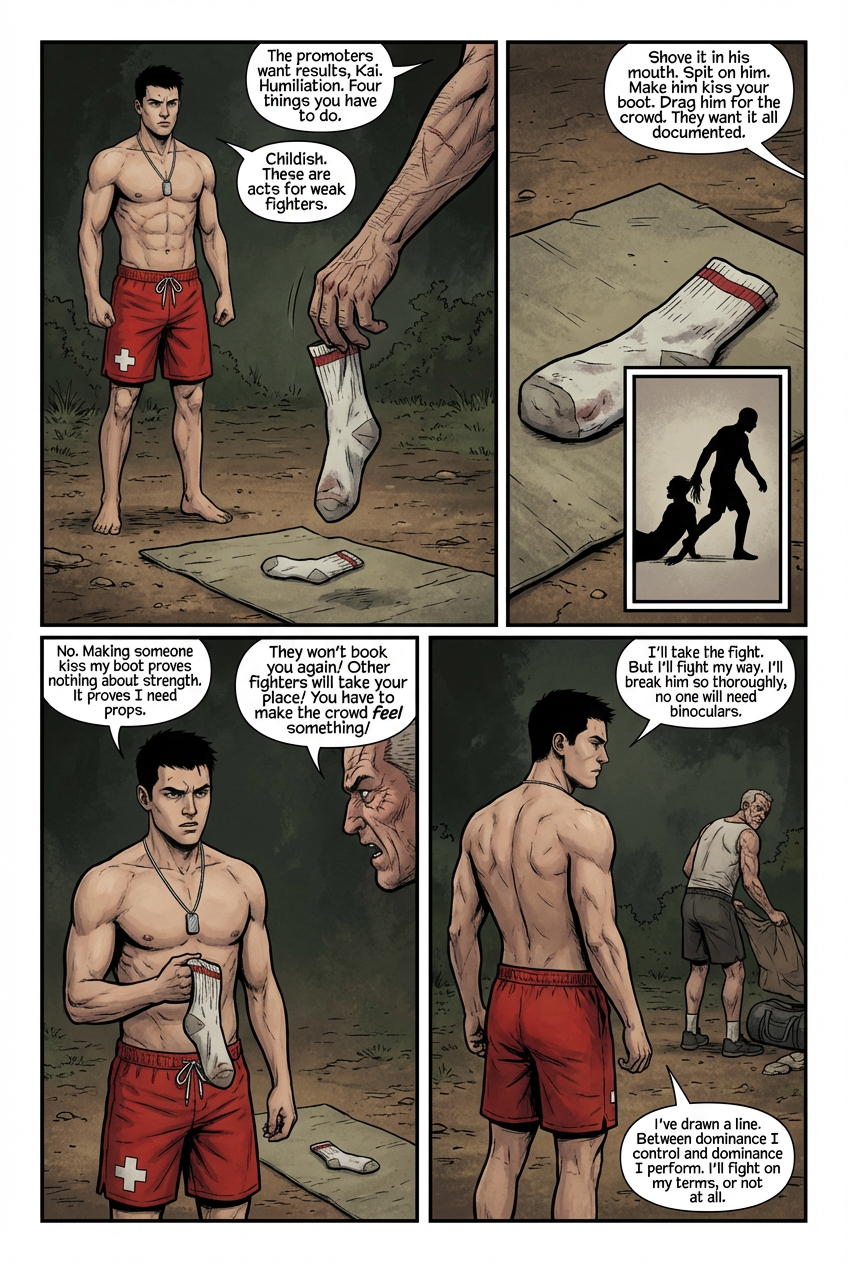
The promoter finds Kai three days after the mask fight, not with another contract but with something smaller and uglier. A job. They need him to fight again, but this time they want specific results. The opponent is undefeated, arrogant, someone the crowd loves. They don't want Kai to just win. They want him to humiliate the man. Break him in ways that make people look away. The trainer they send is older, with scarred knuckles and a voice like gravel. He meets Kai at a clearing near the old warehouse, where someone has laid out a worn yoga mat on the dirt. The trainer drops a gym sock on the mat, faded white with a red band, and tells Kai there are four things he has to do in the ring. Shove the sock in the opponent's mouth after he's down. Spit on his chest while he's pinned. Make him kiss Kai's boot before the final round. And drag him by the hair to each corner so the crowd can see his face up close. The trainer demonstrates each move on the mat, slow and deliberate, like he's teaching a child to tie shoes.
Kai watches without expression. The acts are childish, designed to strip dignity rather than test skill. They're the kind of things weak fighters do when they can't prove dominance any other way. The trainer explains that the venue has installed binoculars mounted on poles around the ring, angled so the crowd can zoom in on every detail. They want the humiliation documented, spread across the city like his water footage. Proof that Kai isn't just powerful—he's willing to degrade anyone who stands across from him. The trainer asks if Kai understands. Kai picks up the sock, feels the worn fabric between his fingers, and drops it back on the mat. He tells the trainer no. Not because he's afraid to do it, but because making someone kiss his boot proves nothing about who's stronger. It proves he needs props.
The trainer's face hardens. He says the promoters won't book Kai again if he refuses. That other fighters will take the spot, fighters who understand what the crowd wants to see. That dominance isn't just about winning—it's about making people feel something. Kai considers this. He could walk away, find other venues, keep fighting on his terms. But he knows what that means: smaller crowds, less attention, slower progress toward proving he's untouchable. He could accept the job, do the four acts, and cement his reputation as someone who breaks opponents completely. But he'd be performing someone else's idea of dominance, not his own. The choice should be simple. Take the fight and prove he'll do anything to win, or refuse and prove his dominance doesn't need theater.
Kai tells the trainer he'll take the fight. But he won't use the sock, won't make anyone kiss anything, and won't drag anyone by the hair. He'll break the opponent so thoroughly that the crowd won't need binoculars to see it. If the promoters don't like it, they can find someone else. The trainer stares at him, then picks up the sock and the mat without another word. After he leaves, Kai realizes what he's done. He's drawn a line. Not between winning and losing, but between dominance he controls and dominance he performs for others. It's the second compromise he's made, and this time he knows exactly what it costs. The promoters might cut him loose. The crowd might turn on him. But he'll fight the way he chooses, or he won't fight at all.
Play your story to life
Storycraft is a mobile game where you create AI characters, craft items and locations to build their world, then discover what direction your story takes. Download the iOS game for free today!
Download for free