

Varak Koltun's ArcChapter 3 of 4
Varak Koltun's dream is convincing the nomadic clans to establish a permanent winter market.

Click to expand
Chapter 3
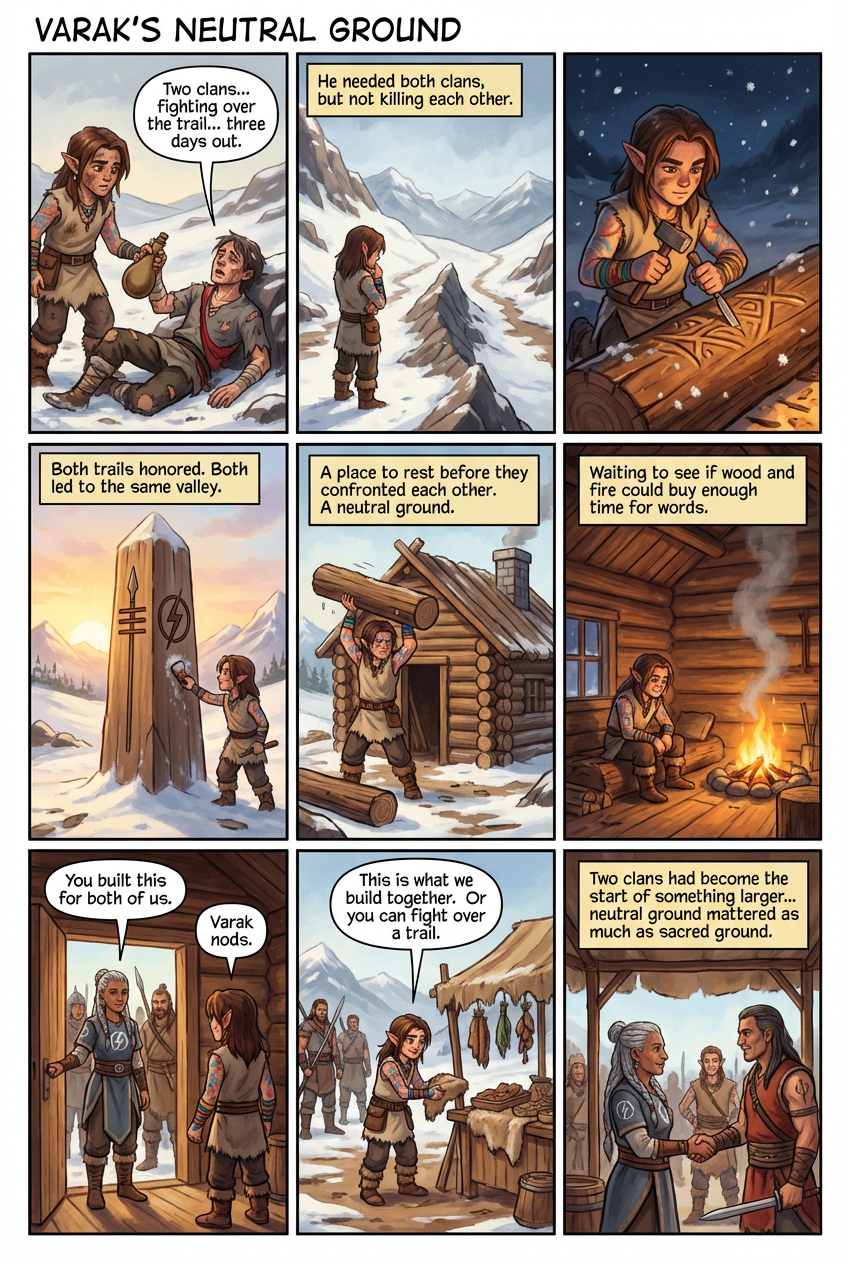
The runner collapsed near the altar on the seventh morning. His boots were torn, his face raw from wind. Varak brought water and waited while the man drank. Two clans were coming, the runner said. Three days out. But they were fighting over the same trail, each claiming the right to reach the valley first.
Varak walked the disputed trail that afternoon, studying where it split into two paths that wound around opposite sides of a rocky ridge before joining again at the valley's edge. He needed both clans to arrive, but not killing each other first. By sunset, he'd dragged a pine trunk to the fork and spent the night carving. He cut one face with the patterns the runner described for the first clan—three horizontal lines crossed by a vertical spear. On the opposite side, he carved the second clan's mark—a circle split by a lightning bolt. When he planted the obelisk at dawn, it stood taller than a man, each carved face looking down its own path. No clan could claim the marker favored the other. Both trails were honored. Both led to the same valley. He brushed snow from the carvings and walked back to his fire. The clans would see it and know someone had made space for their anger without choosing sides. They'd arrive separately, but they'd arrive.
But the obelisk wouldn't stop them from fighting once they reached the valley. Varak spent the next day hauling logs to the disputed fork. He built a cabin there, small but solid, with a hearth at its center and doors facing both paths. He stacked firewood against the walls and hung dried meat from the rafters. When the clans arrived, they'd find shelter waiting. A place to rest before they confronted each other. A neutral ground where both could warm themselves and remember they were tired, not just angry. On the ninth morning, smoke rose from the cabin's chimney. Varak sat inside and waited. He'd carved the marker to honor both clans. He'd built the shelter to slow their rage. Now he'd see if wood and fire could buy enough time for words to matter. The passes would close in two days. If the clans killed each other at his doorstep, the winter market would die with them.
The first clan arrived at midday, weapons drawn. They stopped at the obelisk, staring at their symbol carved into the wood. Their leader, a woman with gray braids, walked to the cabin and pushed open the door. Varak stood from the fire. She looked at the dried meat, the stacked wood, the second door that faced the other trail. "You built this for both of us," she said. Varak nodded. "The valley has room for everyone. Fighting over who arrives first wastes the time you need to prepare for winter." She studied his face, then sat by the fire. When the second clan appeared an hour later, Varak built a market stall outside while both groups watched from opposite doors. He hung hides he'd cured over the frame and laid out the first trade goods—his own stores, small but real. Dried fish. Preserved berries from Mika. Three fur pelts. The leaders came out slowly, drawn by what the stall represented. "This is what we build together," Varak said. "Or you can fight over a trail and arrive at an empty valley alone." The woman with gray braids looked at the other leader, then back at the stall. "We'll talk," she said. Varak stepped back and let them begin. Two clans had become the start of something larger, and he'd learned that neutral ground mattered as much as sacred ground. The market needed both.
Play your story to life
Storycraft is a mobile game where you create AI characters, craft items and locations to build their world, then discover what direction your story takes. Download the iOS game for free today!
Download for free