

Arzath the Red's Arc
5 Chapters
Arzath the Red's dream is establishing a secret printing press to spread banned resistance writings.

Arzath the Red stood in the shadowed doorway of an abandoned warehouse, his crimson coat drawn tight against the cold. The City of the Black Flame stretched before him, its streets crawling with soldiers who burned any book they found. He carried a leather satchel filled with metal type pieces, smuggled through three checkpoints. His dream kept him moving through the danger—a secret printing press that would spread the truth the Empire tried to bury. He needed a base, somewhere the authorities would never think to look. The building before him rose like a dark monument, its black stone walls thick and forgotten. No one came here anymore. The gothic structure had been abandoned for years, its rooms empty and silent. Arzath stepped inside and felt the weight of possibility settle over him. This shadowy sanctuary would house his press. Outside, lampposts lined the streets, their black flames casting strange light across the cobblestones. Arzath studied one near the warehouse entrance. The ornate base had space inside, hidden behind decorative panels. He could leave supplies there, messages too. The authorities would never notice. They walked past these lampposts every day without a second glance. But he couldn't work alone. He needed contacts, people who believed in the cause. The Black Cask sat three streets over, a dark tavern where workers gathered after their shifts. Arzath pushed through the heavy door into warm air and low voices. Shadowy wood beams crossed the ceiling. Patrons hunched over their drinks, speaking in whispers. This was where resistance began—in quiet conversations, in trust built over time. Arzath ordered ale and listened. His press would give voice to every whisper in this room.
Arzath returned to the warehouse the next morning with a notebook and pencil. He needed to understand the basics before risking everything. His fingers traced the metal type pieces in his satchel, feeling each raised letter. A printing press required more than courage—it demanded knowledge. He sat on the dusty floor and sketched designs from memory, trying to recall diagrams he'd seen years ago. The mechanics escaped him. He needed a teacher, someone who knew the craft. Standing, he brushed off his coat and headed back toward the streets. The Black Cask would have answers if he asked the right questions. The barkeep pointed him toward a man at the corner table. The stranger wore ink-stained gloves and smelled of chemicals. He asked for coin first, then leaned close. Paper would be the hardest thing to secure. The mills tracked every sheet they produced. Arzath needed a supplier outside the city's control. Three days later, a cart arrived at the warehouse entrance. The driver unloaded stacks bound in dark leather, each bundle wrapped tight. Gothic patterns decorated the covering. Arzath carried them inside and counted. Enough paper for a hundred pamphlets, maybe more. Working in darkness drew too much attention. Arzath needed light that wouldn't alert the patrols. He returned to the Black Cask and asked about alternatives. A woman at the bar mentioned a trader who dealt in strange goods. Arzath found him two streets over. The man pulled out a glass orb that glowed with soft light. Shadows and brightness mixed together inside it. Perfect for night work without the telltale flicker of torches. Arzath bought two. Storage presented another problem. He couldn't keep everything inside the warehouse. If soldiers searched the building, they'd find it all. Arzath walked the streets looking for something ordinary, something that belonged. He found it outside a shuttered shop—a black metal newspaper box with gothic details carved into the sides. He bought it from the owner and placed it where he needed it most. The box had space beneath the false bottom. Ink bottles fit perfectly inside, along with extra paper. To anyone passing by, it looked like it had always been there. Arzath had his materials now. The press itself would come next.
Arzath needed iron and wood, the skeleton of his press. The forges in the industrial quarter worked day and night, their hammers ringing through the smoke-filled air. He couldn't buy a press whole—the transaction would be recorded, reported, traced back to him. Instead, he searched for parts scattered across the city. A machinist sold him gears from a broken loom. A blacksmith offered scraps of iron frame, asking no questions when Arzath paid in silver. Each piece brought him closer to his goal. The City of the Black Flame tried to crush resistance, but its own workshops would forge the weapon against it. Walking back toward the warehouse, Arzath noticed a poster board covered in layers of announcements. The black surface held notices about curfews and work schedules. He stopped and peered closer. Beneath the peeling edges, someone had carved symbols into the wood. Coded marks that meant nothing to soldiers but spoke clearly to those who understood. Here was proof that others resisted, that sympathizers existed in the city. Arzath traced one symbol with his gloved finger. His press would reach people like this, give them words instead of cryptic scratches. The next morning, he passed through the central square. A speaker's stand dominated the space, its gothic carvings dark against the morning sky. Officials used it to announce new laws and restrictions. But Arzath saw something else. He imagined standing there himself one day, reading from pamphlets his press had created. The structure reminded him that words spoken publicly held power. Right now, only the Empire's voice rang out. His press would change that, filling hands with pages that people could carry home and read in private. That afternoon, Arzath discovered a theater with black walls and a red sign above the entrance. The building drew crowds each night for performances approved by the authorities. He bought a ticket and went inside. The actors spoke carefully, avoiding banned topics, but the audience leaned forward anyway. People craved stories, needed them. Arzath understood then that his press wasn't just about political writings. It could print plays, poems, anything that made people think beyond their fear. The city itself showed him what he needed—places where minds gathered, where ideas could spread like fire through dry grass.
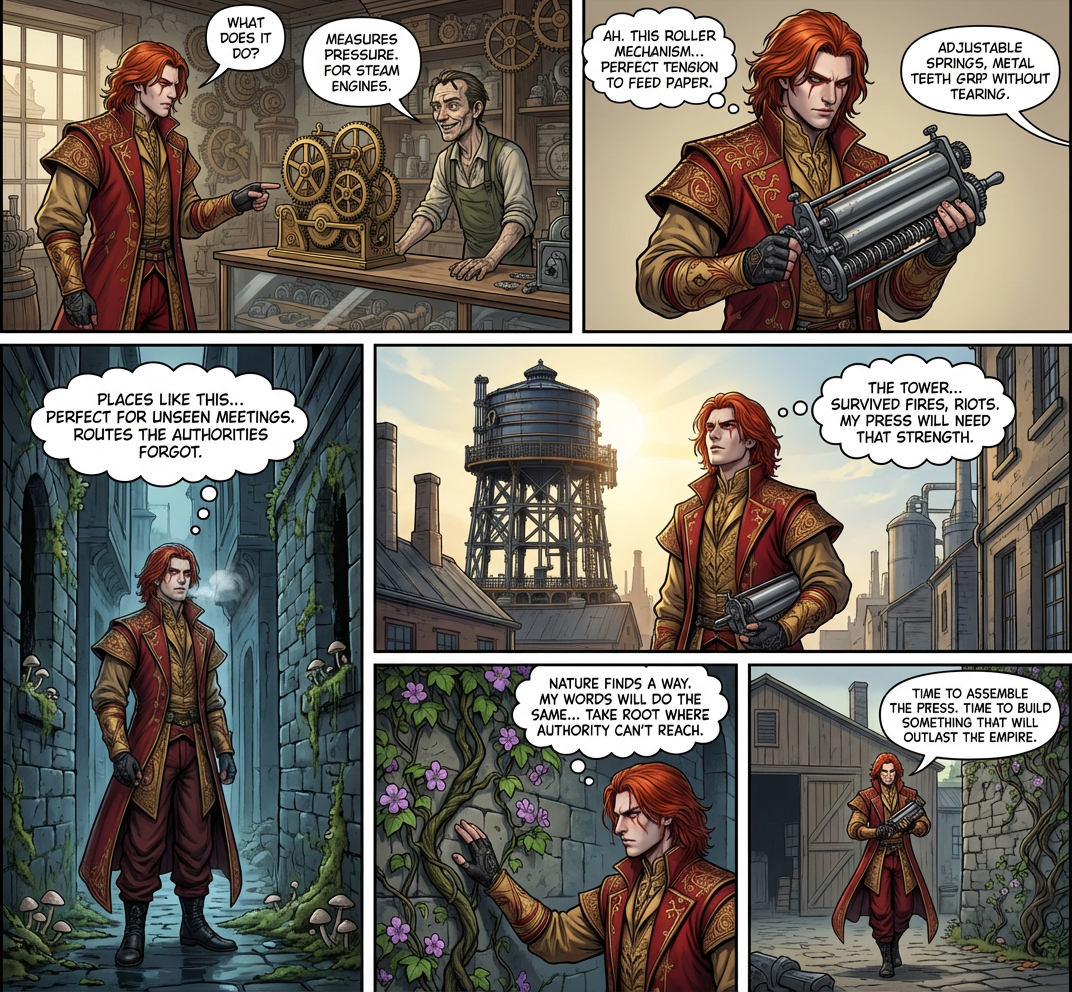
Arzath stepped into a shop filled with strange mechanical devices. Gears turned behind glass cases, clicking in rhythm. The owner, a thin man with oil under his nails, watched him from behind the counter. Arzath pointed to a brass apparatus with interlocking wheels. "What does it do?" The man smiled. "Measures pressure. For steam engines." Arzath nodded and moved along the shelves. Everything here served a purpose in the city's machines. He studied a roller mechanism with adjustable tension. His press needed something similar to feed paper through evenly. The shopkeeper explained how the springs worked, how metal teeth gripped without tearing. Arzath bought the piece and tucked it into his coat. Outside, he walked toward the warehouse district. A water tower rose above the rooftops ahead, its dark metal tank catching the afternoon light. The structure stood on riveted legs with a viewing platform wrapped in iron railings. Workers had built it decades ago, back when the city was smaller. Now it marked the edge of the industrial quarter, a landmark everyone knew. Arzath paused beneath it, looking up at the weathered metal. The tower had survived fires, riots, and countless regime changes. His press would need the same strength. He continued walking, the roller mechanism heavy against his ribs, ready to add another piece to his growing collection. The streets narrowed as he moved deeper into the old quarter. Arzath turned into an alley where buildings pressed close together. The walls rose high on both sides, blocking most of the sunlight. Moss grew thick in the damp corners where water dripped from broken gutters. Mushrooms sprouted from cracks in the stone, their pale caps pushing through shadows. Few people walked here. The city's patrols rarely checked these forgotten spaces. Arzath stopped and looked around, his breath fogging in the cool air. Places like this could hide more than fungi. A meeting could happen here without drawing eyes. A package could be passed between hands unseen. He memorized the turns he'd taken, the way the buildings leaned, the iron drainpipe bent at the entrance. When the time came to distribute his pamphlets, he would need routes the authorities had forgotten. The city offered them freely to those who looked. He emerged from the alley into dim light. A vine covered the wall across from him, its dark stems twisted around crumbling mortar. Small purple flowers dotted the growth, thriving despite the shade and cold. The plant climbed three stories high, spreading across stone like veins across skin. Arzath touched one of the thick stems. It held firm against the building, rooted deep in cracks. The city tried to control everything, but nature found its own way. His words would do the same—spread through hidden spaces, take root where authority couldn't reach. He pulled his coat tighter and headed back toward the warehouse. The press parts waited for assembly. The city had shown him its forgotten places, its enduring landmarks, its stubborn life. Now he would use that knowledge to build something that would outlast the Empire's grip.
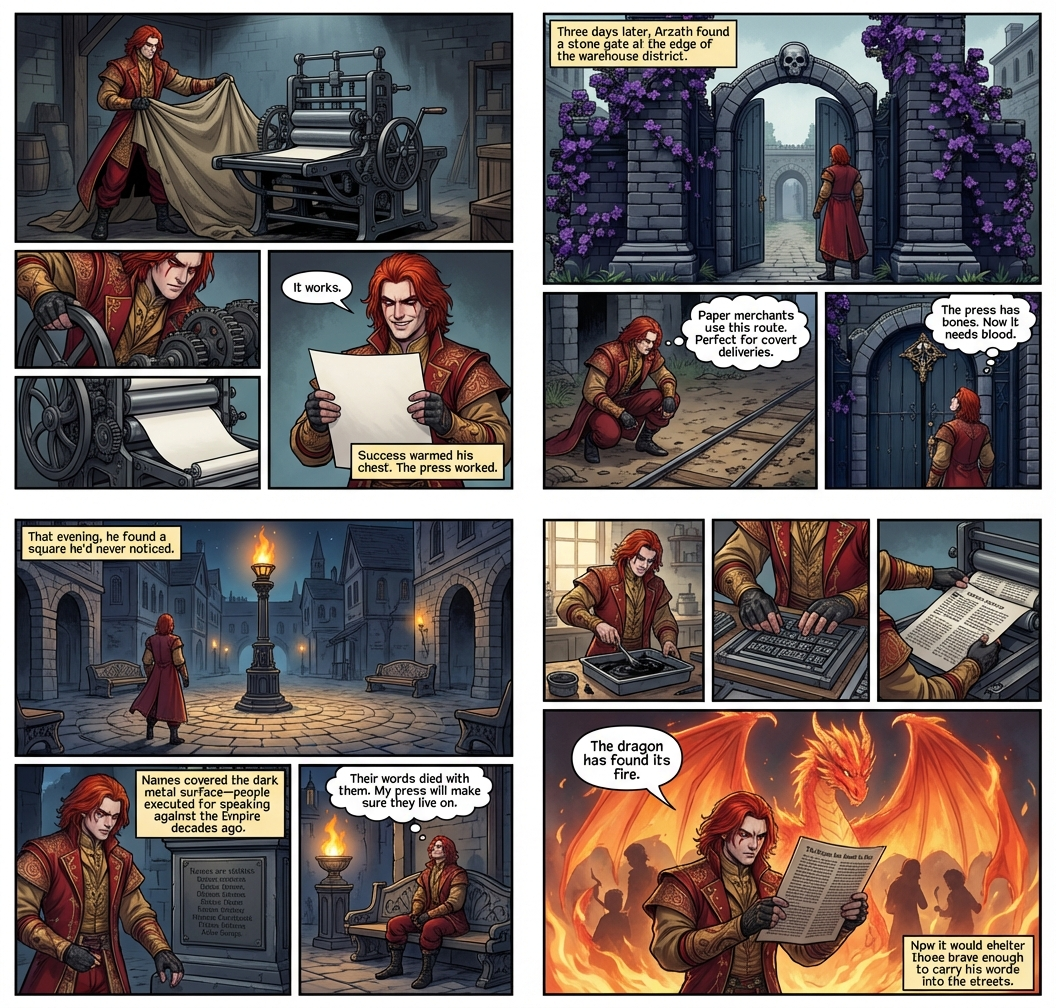
Arzath stood in the warehouse and pulled back a canvas tarp. The press frame sat assembled before him, iron gears fitted into place, rollers mounted and ready. He turned the main wheel. Metal clicked against metal as the mechanism moved smoothly. The parts he'd gathered across weeks now formed something real. He reached into his coat and pulled out a sheet of paper. The blank surface waited for ink, for words that would spread through the city. He fed the paper between the rollers and cranked the wheel again. The mechanism gripped without tearing, pulling the sheet through in one clean motion. Success warmed his chest. The press worked. Three days later, Arzath found a stone gate at the edge of the warehouse district. Black gothic arches rose on either side, carved skulls watching from the pillars. Dark purple flowers grew up the brick, their vines thick and twisted. The gate framed a courtyard where carts delivered supplies each morning. Arzath stood beneath the arch and looked through to the open space beyond. Paper merchants used this route. He could arrange deliveries here, collect reams without suspicion. The skulls stared down at him as he smiled. Even the city's decorations seemed to approve of his work. He walked through the gate and counted the cart tracks in the dirt. By next week, his own supplies would roll through this entrance. The press had bones. Now it needed blood—ink and paper to make it speak. That evening, Arzath walked through the old quarter and found a square he'd never noticed. A tall metal statue stood at its center, a figure holding a torch high above its head. Stone benches circled the monument in careful rows. He moved closer and read the plaque at the base. Names covered the dark metal surface—people executed for speaking against the Empire decades ago. The city had built this place to remember them, though few visited now. Arzath sat on one of the benches and stared up at the flame. These people had died for their words. His press would make sure their sacrifice meant something. He traced one name with his finger, then stood and walked back toward the warehouse. The monument reminded him why he worked in secret, why each small success mattered. The press was ready. The delivery route was secure. Soon, words would flow through the city again, and the dead would have their answer. Morning light broke through the warehouse windows. Arzath mixed his first batch of ink, the black liquid thick in the metal tray. He set type for a single line—a quote from a banned philosopher about freedom. His hands moved carefully, placing each letter backward in the frame. He rolled ink across the surface and pressed a sheet down. When he lifted the paper, dark words stared back at him. Real. Readable. Ready to be copied a hundred times over. He held the page up and read the sentence aloud. His voice echoed in the empty space. The dragon had found its fire. Now it would shelter those brave enough to carry his words into the streets.
Play your story to life
Storycraft is a mobile game where you create AI characters, craft items and locations to build their world, then discover what direction your story takes. Download the iOS game for free today!
Download for free