

Henry Flint Whitehorse's Arc
5 Chapters
Henry Flint Whitehorse's dream is uncovering which relative sabotaged my inheritance claim to the land.

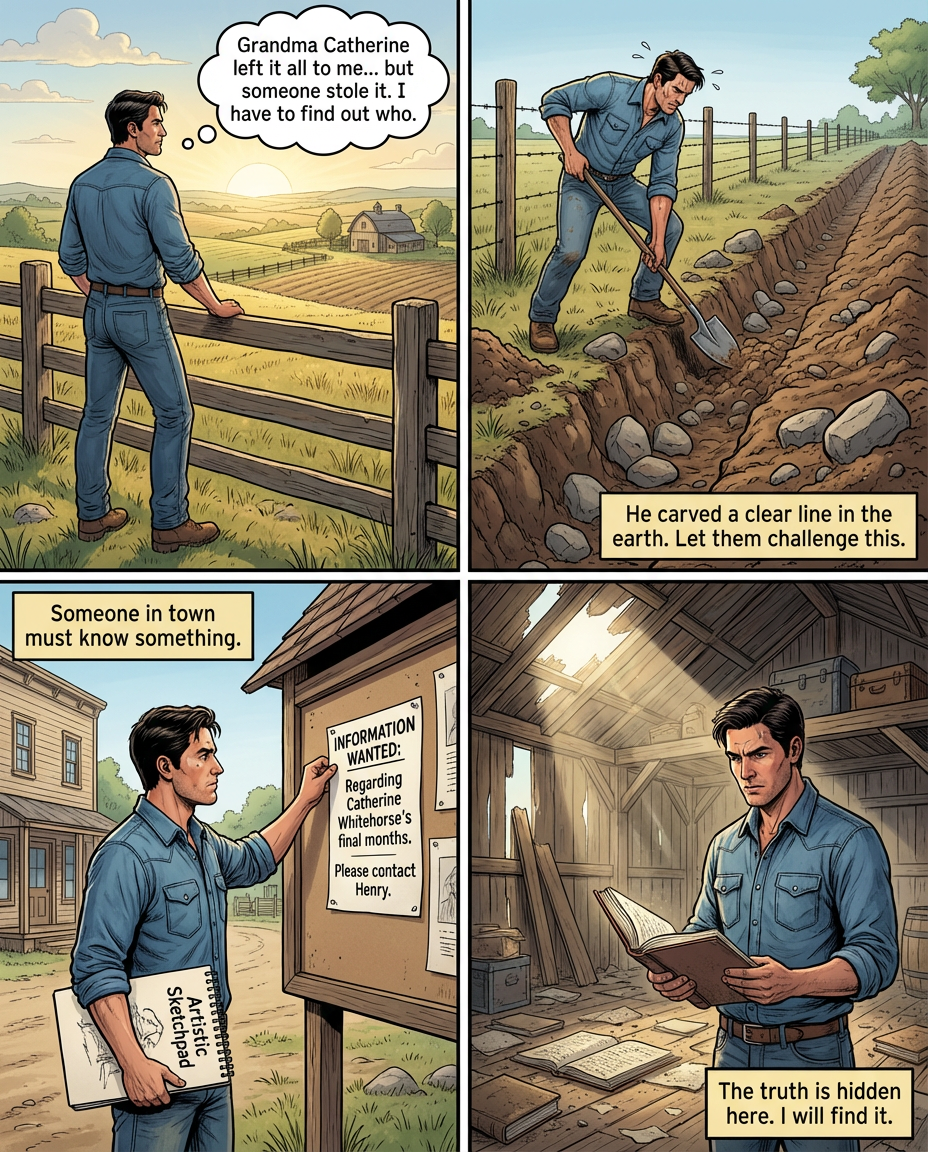
Henry stood at the fence line of his grandmother's farm, staring at the land that should have been his. Catherine Whitehorse had left everything to him in her will, but someone in the family had forged documents claiming the property instead. He needed to find out which relative had stolen his inheritance. The morning sun cast long shadows across the disputed acres. Henry pulled a shovel from his truck and walked to where the property lines blurred into neighboring fields. He started digging a trench along what the original survey maps showed as the boundary. Sweat soaked through his blue shirt as he worked. He lined the ditch with rocks from the field, making the border impossible to miss. If someone wanted to challenge his claim, they'd have to face this clear line he'd carved into the earth. By afternoon, Henry drove into town with a sketchpad tucked under his arm. He'd drawn up a simple notice asking locals for information about his grandmother's final months. The pad's thick paper held his careful handwriting well. He posted copies at the general store, the post office, and the diner. Someone in this small community had to know something about the forged documents. The last stop was the old storage barn at the edge of the family property. Henry had avoided it since the funeral, but he couldn't wait any longer. He pushed through the broken wooden doors and found ledgers scattered across the dusty floor. Trunks filled the loft above. Somewhere in this mess of family records lay the truth about who had betrayed him. He picked up the first ledger and began to read.
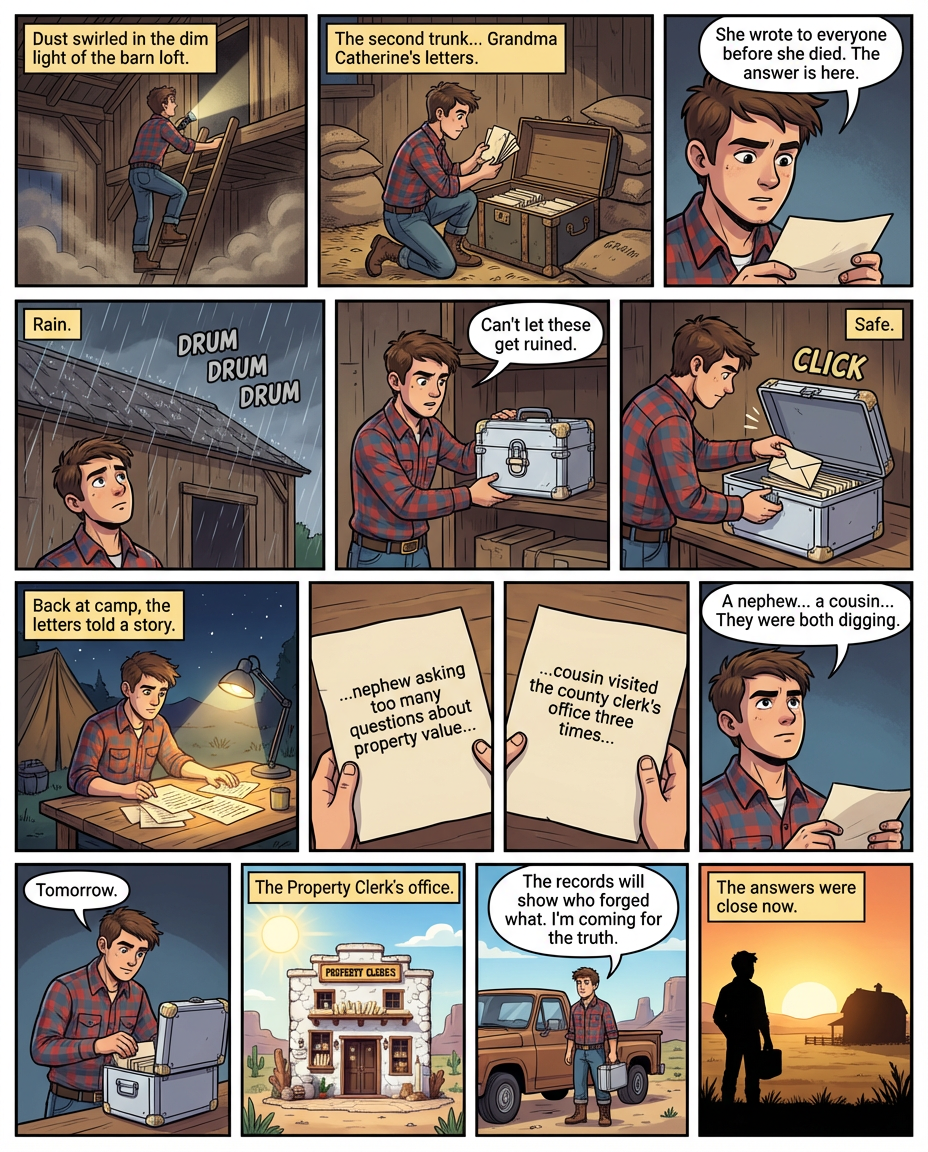
Henry climbed the wooden ladder to the barn loft, dust swirling in the dim light. The first trunk held old farming receipts and seed catalogs from the 1960s. Nothing useful. The second trunk sat beneath a stack of grain sacks. He dragged it into the open and lifted the lid. Inside lay his grandmother's handwriting on dozens of letters, all addressed to different family members. He pulled out the first bundle and started reading. Catherine had written to everyone in the months before she died. Someone in these letters would reveal themselves. Rain started drumming on the barn roof. Henry grabbed a metal lockbox from the corner shelf and transferred the most important letters inside. The rust-resistant latch clicked shut, sealing the papers from the moisture that dripped through the old wood above. He carried the box down the ladder and set it on his truck's passenger seat. These documents needed proper examination, not a quick scan in a dusty loft. Back at his campsite near the property line, Henry set up a work desk under the tarp he'd strung between two trees. The integrated lights cast a warm glow across the wooden surface as darkness fell. He spread the letters out in chronological order. His grandmother had written about land boundaries, family disagreements, and her plans for the will. One letter mentioned a nephew who'd asked too many questions about the property value. Another referenced a cousin who'd visited the county clerk's office three times in one week. Henry packed the letters back into the lockbox. Tomorrow he'd drive to the property clerk's building in town. The whitewashed stone structure held all the official inheritance documents and land deeds. If someone had forged papers, there would be records of who'd filed what and when. He turned off the desk lights and stared at the dark outline of his grandmother's farm. The answers were close now. He just had to follow the paper trail.
Henry spread the county clerk's photocopies across the hood of his truck, the morning wind trying to steal them from under his hands. Three different signatures appeared on documents filed within days of his grandmother's death, but only one matched the handwriting from the barn letters. His uncle had visited the clerk's office to file a boundary dispute the same week the will went through probate. The timing felt wrong, too calculated. Henry needed to see the original documents, not these copies, but the clerk's building only opened to the public twice a week. He folded the papers and tucked them into his shirt pocket, feeling their weight against his chest like proof of betrayal. The land stretched out before him, red dirt and scrub brush marking generations of family work. This ground held answers in its soil, in the fence posts his grandmother had set, in the irrigation ditches that followed property lines drawn a century ago. Tomorrow he'd walk every acre with the survey maps and look for signs someone had moved markers or changed boundaries. The forger had made mistakes somewhere, and the land itself would show him where. Henry drove into town and parked near the old general store and post office. The weathered building held the charm of another era, its wooden facade faded by decades of sun. Inside, townspeople browsed shelves stocked with tools, canned goods, and supplies. He picked up fence wire and a box of survey stakes, items he'd need for tomorrow's boundary walk. Two women talked near the counter about a family selling off land parcels. Henry moved closer, pretending to examine rope spools. One mentioned the Whitehorse property and how strange the will process had been. He paid for his supplies and left before they noticed him listening. This place held more than goods. It held the conversations that revealed what everyone in town really knew. On his way back to the property, Henry spotted a wooden sign post he'd never seen before. Bold red letters declared "Henry's Property Manager" above a painted arrow. The sign looked old, the wood weathered, but the lettering stood clear. Someone had put this up years ago, maybe his grandmother or even further back. The arrow pointed toward a small building set back from the road. Henry followed the direction and found a clerk's office his grandmother must have used for managing tenant agreements and land records. He tried the door. Locked. But through the dusty window he could see filing cabinets and a desk covered in papers. This was where his grandmother had kept her own records, separate from the county's files. Tomorrow he'd break the lock if he had to. The truth about who forged those documents was waiting inside. Henry drove back through town and stopped at a small monument near the courthouse. Leather gloves hung from bronze hooks on the stone base. A plaque honored families who'd fought legal battles to keep their land. He read the names carved into the granite. Three generations of ranchers who'd defended their property rights in court. His grandmother's name wasn't there yet, but it should have been. She'd fought her whole life to keep the farm together. He touched the worn leather of one pair of gloves and made a silent promise. When he proved the forgery and claimed his rightful inheritance, he'd see her name added to this monument. The land would return to family hands, and everyone would know justice had been done.
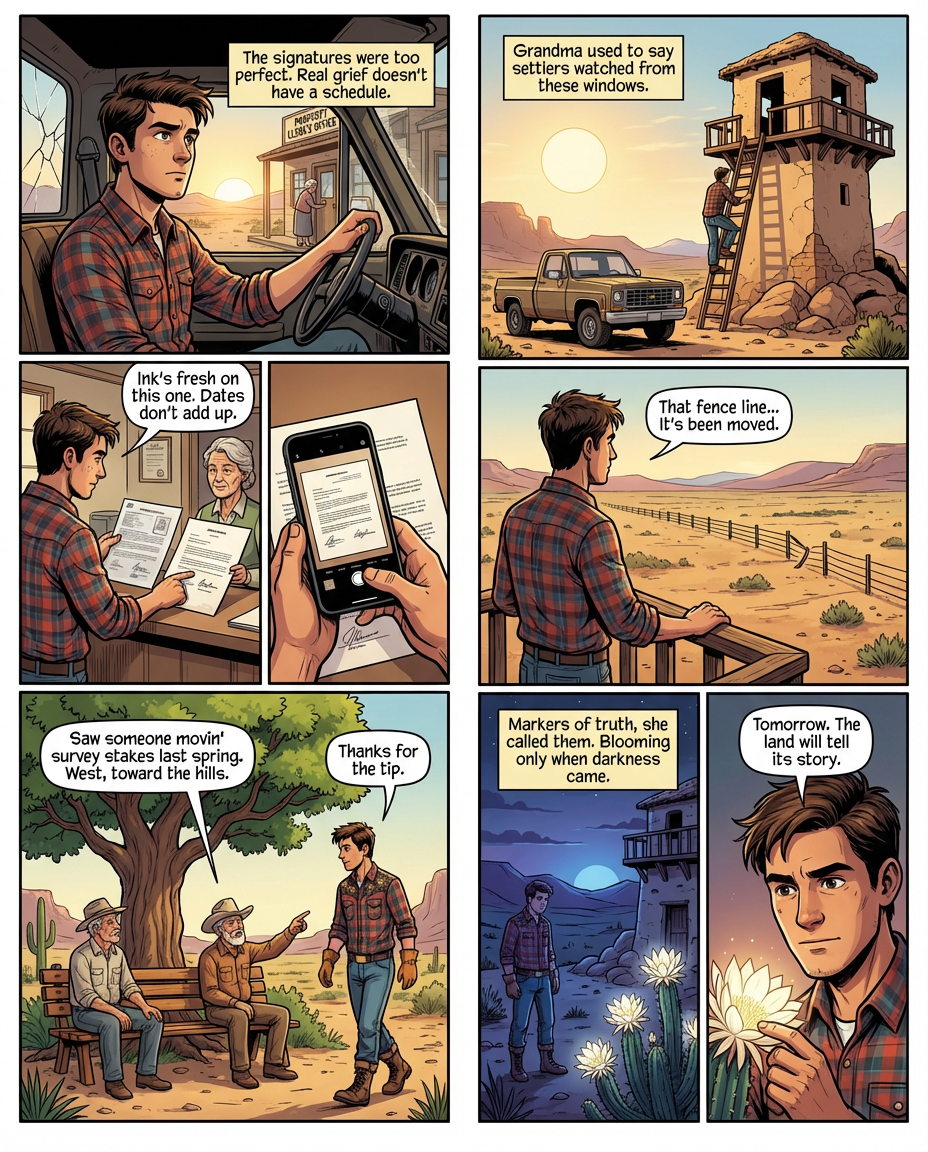
Henry sat in his truck outside the property clerk's building, waiting for it to open. The morning air felt cool through his cracked window. He'd studied the photocopies until he could see them with his eyes closed. His uncle's signature appeared on three separate filings, all dated within the same week. The pattern was too clean, too perfect. Real grief didn't work on schedules like that. He drummed his fingers on the steering wheel and watched an old woman unlock the front door. Time to see the originals. Inside, the clerk pulled three folders from the archive room. Henry laid the documents side by side on the counter and compared them to his photocopies. The ink on one form looked fresher than the others, like it had been signed months after the date claimed. He photographed each page with his phone and thanked the clerk. Back outside, he walked to a large tree where several locals sat on benches beneath its shade. They nodded at him as he passed. One man mentioned seeing someone at the old ranch boundary markers last spring, moving survey stakes. Henry stopped and asked which direction. The man pointed west toward the hills. Henry drove out past the property line where an old adobe guard tower stood on a rise overlooking the valley. His grandmother had told him stories about this place when he was young. Settlers used to watch for travelers from the narrow windows cut into the thick walls. He climbed the stone steps and looked out across the land. From up here, he could see the fence lines that marked family property. One section ran crooked where it should have been straight. Someone had moved posts to steal acreage, probably the same person who'd filed those documents. The sun dropped behind the hills as Henry walked back to his truck. White blooms opened on a cactus near the tower entrance, their pale petals glowing in the dusk. His grandmother had called these flowers markers of truth, blooming only when darkness came. Henry touched one of the petals and felt the cool silk texture. He had enough evidence now to challenge the inheritance claim. Tomorrow he'd confront his uncle with the photographs and the witness statement from town. The land would tell its story, and the forgery would be exposed.
Henry walked into the county courthouse with his phone full of photographs and a witness who'd agreed to give a statement. The clerk examined his evidence—the mismatched ink dates, the crooked fence line visible from the guard tower, the testimony about moved survey stakes. She nodded slowly and pulled a red folder from her desk. Inside were complaints filed against his uncle two years ago for similar boundary disputes on adjacent properties. The pattern was clear now. Within an hour, she stamped his petition to reopen the inheritance case. Henry stepped outside into the bright morning, feeling the weight lift from his chest. The land was coming back to family hands, one document at a time. The clerk led him to a back office where a craftsman was finishing work on a plaque. The Whitehorse Family Ranch Plaque showed adobe buildings and cattle carved into dark wood, each detail precise and permanent. The clerk explained that successful petitioners received recognition for defending their legal rights. Henry ran his fingers over the engraved letters of his family name. This would hang in the courthouse as proof that justice had been served. The craftsman wrapped it carefully and handed it to Henry with a firm handshake. By afternoon, Henry stood in the town square where an iron bell tower rose above the old storefronts. The clerk had told him about the tradition—when someone won an important legal battle, the bell rang three times. Henry pulled the rope and the first strike echoed across the square. Shopkeepers stepped outside to listen. The second ring carried across the desert air. By the third, a small crowd had gathered, nodding their approval. An old woman smiled at him and said his grandmother would be proud. Henry sat on a bench outside the adobe courthouse, the plaque resting beside him. The Texas star above the entrance caught the late sun. He'd proven the forgery and cleared the path to reclaim what belonged to his family. The case would take time to finalize, but the hard part was done. His uncle's scheme had unraveled in front of witnesses and officials. Henry felt the old songs humming in his chest again, the ones from his dreams. The land had called him home to set things right, and he'd answered. Tomorrow he'd start the paperwork to transfer the deed. Today, he'd sit here and let the victory settle into his bones.
Play your story to life
Storycraft is a mobile game where you create AI characters, craft items and locations to build their world, then discover what direction your story takes. Download the iOS game for free today!
Download for free