

Quinn's Arc
2 Chapters
Quinn's dream is becoming the most admired window display artist in the city.

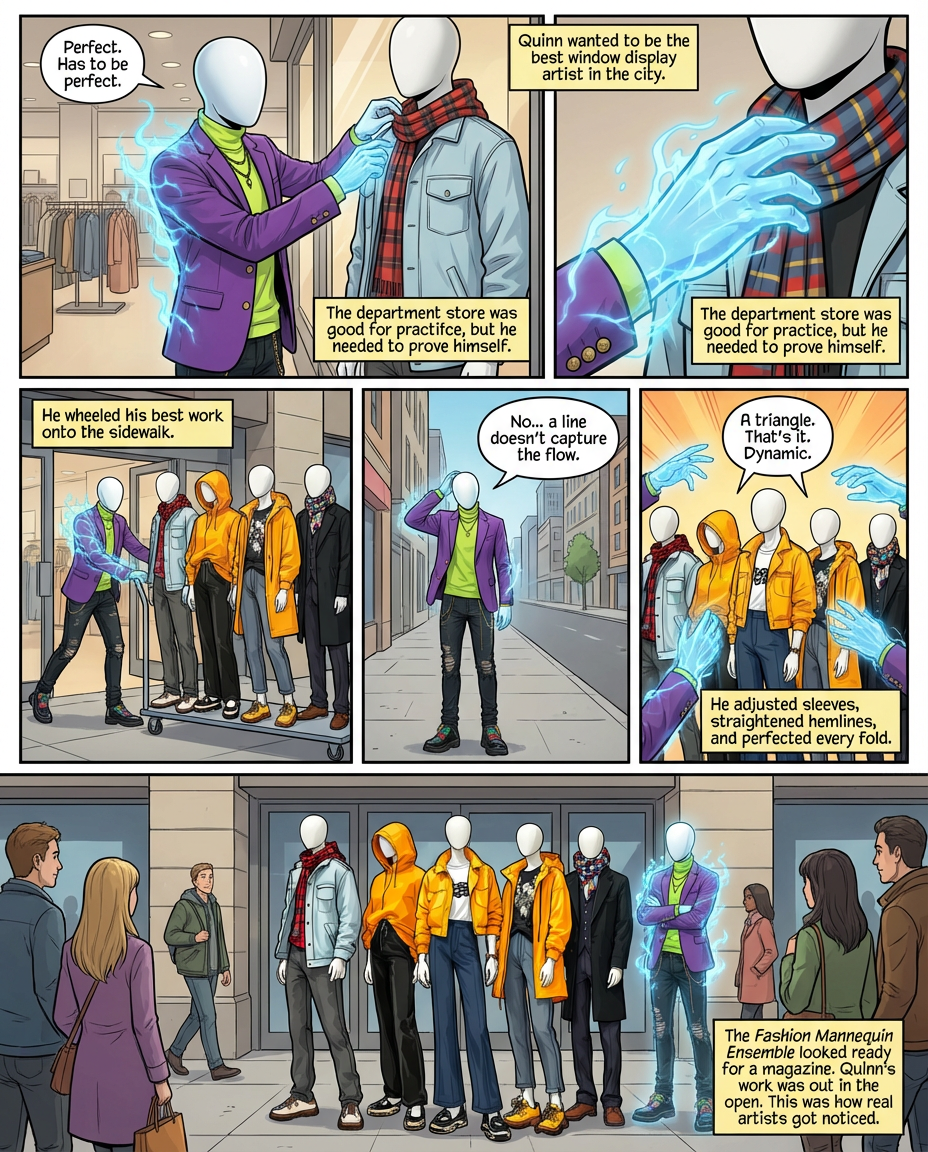
Quinn adjusted the mannequin's collar for the third time, stepping back to check the angle. The window display had to be perfect. Every fold, every shadow, every piece had its place. He wanted people to stop and stare. He wanted them to press their faces against the glass. More than anything, he wanted to be the best window display artist in the city. His transparent fingers caught the morning light as he reached for a scarf, the blue glow trailing behind his hand like smoke. He tilted his head, studying the arrangement. The department store windows were good for practice, but they weren't enough. Real display artists worked for multiple stores. They had clients. They had a reputation beyond one building. Quinn needed to prove himself somewhere new. He wheeled five mannequins through the front entrance and onto the sidewalk. Each one wore a different outdoor outfit—jackets, boots, hats arranged just right. Quinn positioned them in a line, then changed his mind. He moved them into a triangle. Better. He adjusted sleeves and straightened hemlines until the Fashion Mannequin Ensemble looked ready for a magazine. Passersby could see his work now, out in the open. This was how real artists got noticed. This was how they built their name. Quinn stepped back one final time, his ghostly form flickering with satisfaction. The displays were perfect.
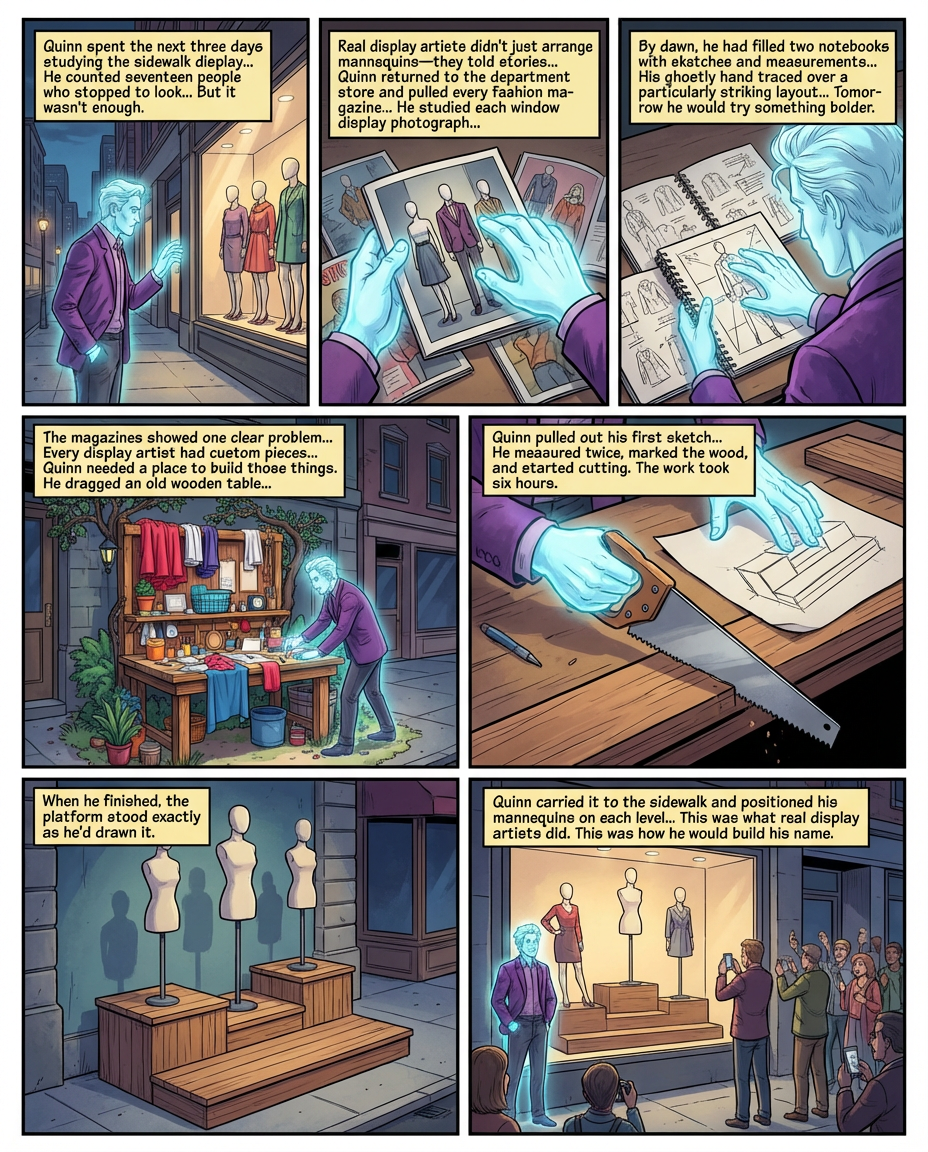
Quinn spent the next three days studying the sidewalk display from across the street. He counted seventeen people who stopped to look. Four of them took photographs. That meant his work was getting attention, but it wasn't enough. Real display artists didn't just arrange mannequins—they told stories that made people feel something. He needed to learn more techniques, find new ways to catch the eye. Quinn returned to the department store and pulled every fashion magazine from the racks, spreading them across the floor in neat rows. He studied each window display photograph for exactly seven minutes, noting the lighting angles and color combinations. By dawn, he had filled two notebooks with sketches and measurements. His ghostly hand traced over a particularly striking layout—three mannequins positioned at different heights, creating depth and movement. Tomorrow he would try something bolder. The magazines showed one clear problem. Every display artist had custom pieces—wooden platforms, painted backdrops, fabric arrangements that didn't exist in stores. Quinn needed a place to build those things. He dragged an old wooden table from the loading dock and set it up outside the department store entrance. The surface was sturdy enough for his tools and materials. He arranged fabric scraps in one corner, sketches in another, scissors and tape in neat rows across the middle. His transparent fingers tested the height—perfect for working. Quinn pulled out his first sketch, a stepped platform design that would let him position mannequins at three different levels. He measured twice, marked the wood, and started cutting. The work took six hours. When he finished, the platform stood exactly as he'd drawn it. Quinn carried it to the sidewalk and positioned his mannequins on each level. The arrangement had depth now, movement. This was what real display artists did. This was how he would build his name.
Play your story to life
Storycraft is a mobile game where you create AI characters, craft items and locations to build their world, then discover what direction your story takes. Download the iOS game for free today!
Download for free