

Dr. Shoji Chen's Arc
3 Chapters
Dr. Shoji Chen's dream is searches, unsuccessfully, for a cure to the virus she created.

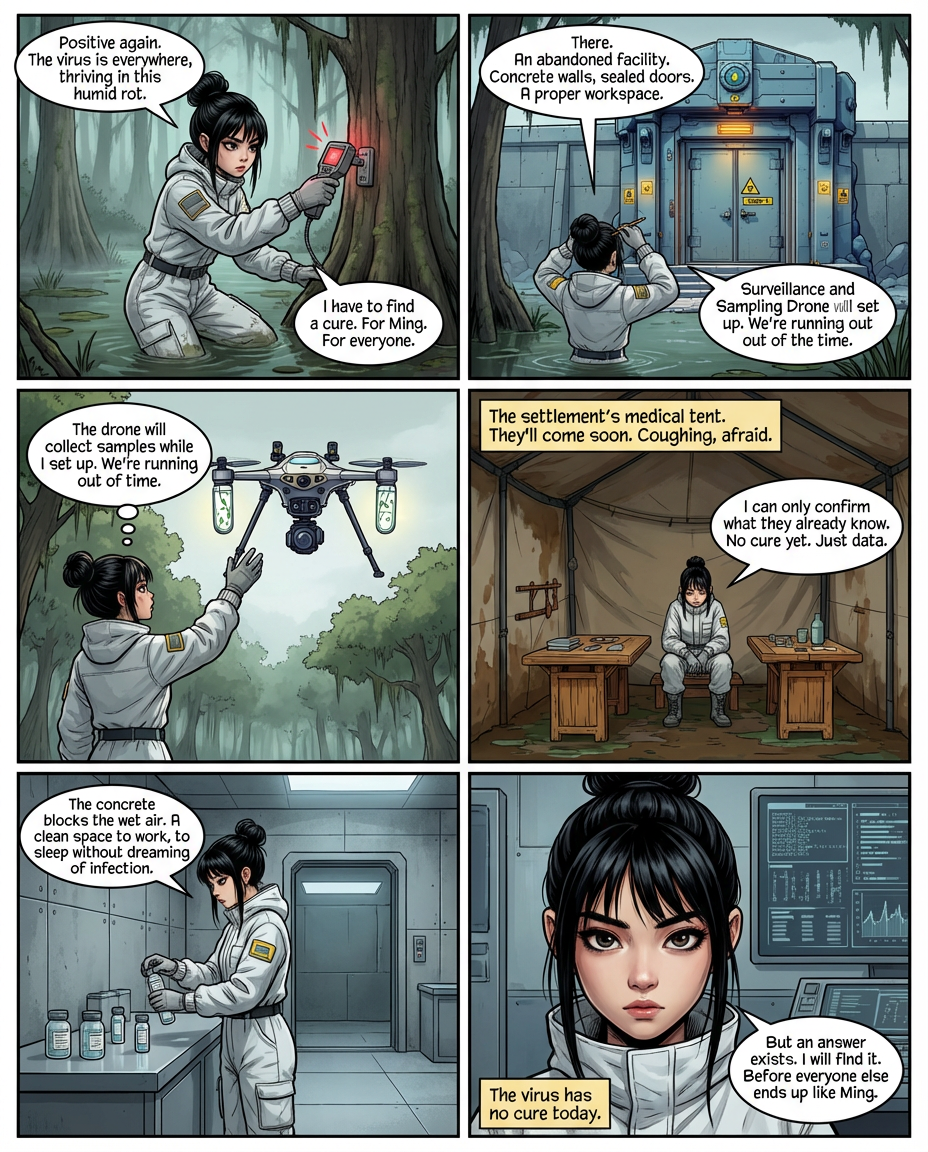
Dr. Shoji Chen pressed the handheld sensor against the bark of a cypress tree and watched the screen flicker red. Positive again. She moved deeper into the swamp, boots sinking into mud with each step. The virus she had created was here, spreading through the wetlands faster than she could track it. Her life goal was simple now: find a cure before more people died like Ming had. But every test came back the same. Every sample showed the pathogen thriving in the humid air. She adjusted the pencil holding her bun in place and marked the location on her worn map. Somewhere in this maze of water and rot, a mutation might exist that could lead her to an answer. She needed a proper workspace. The swamp offered nothing but contamination and decay. Two miles back, she'd spotted an abandoned facility with sealed doors and thick concrete walls. The entrance looked fortified enough to contain her work. She could set up equipment there, run proper tests, maybe sleep for an hour without dreaming of infection patterns. The drone she'd launched that morning would collect air and water samples while she worked. Glass vials already hung from its frame, waiting to capture what killed in silence. The medical tent waited at the settlement's edge when she returned. Canvas walls sagged with moisture and brown water stains. Wooden tables inside held her basic screening tools. People would come soon, coughing and afraid. She would test them, mark their symptoms, send them away with nothing but confirmation of what they already knew. No cure yet. No treatment. Just data that led nowhere. Chen sealed the lab entrance behind her and set down her sensor. The concrete walls blocked out the wet air and the sound of dying. She laid out her samples on the metal counter. Tomorrow she would return to the swamp. Tomorrow she would test more trees, more water, more mud. She would search until her body gave out or until she found what she was looking for. The virus had no cure today. But somewhere in the mutations, in the way it changed and spread, an answer had to exist. She just had to find it before everyone else ended up like Ming.
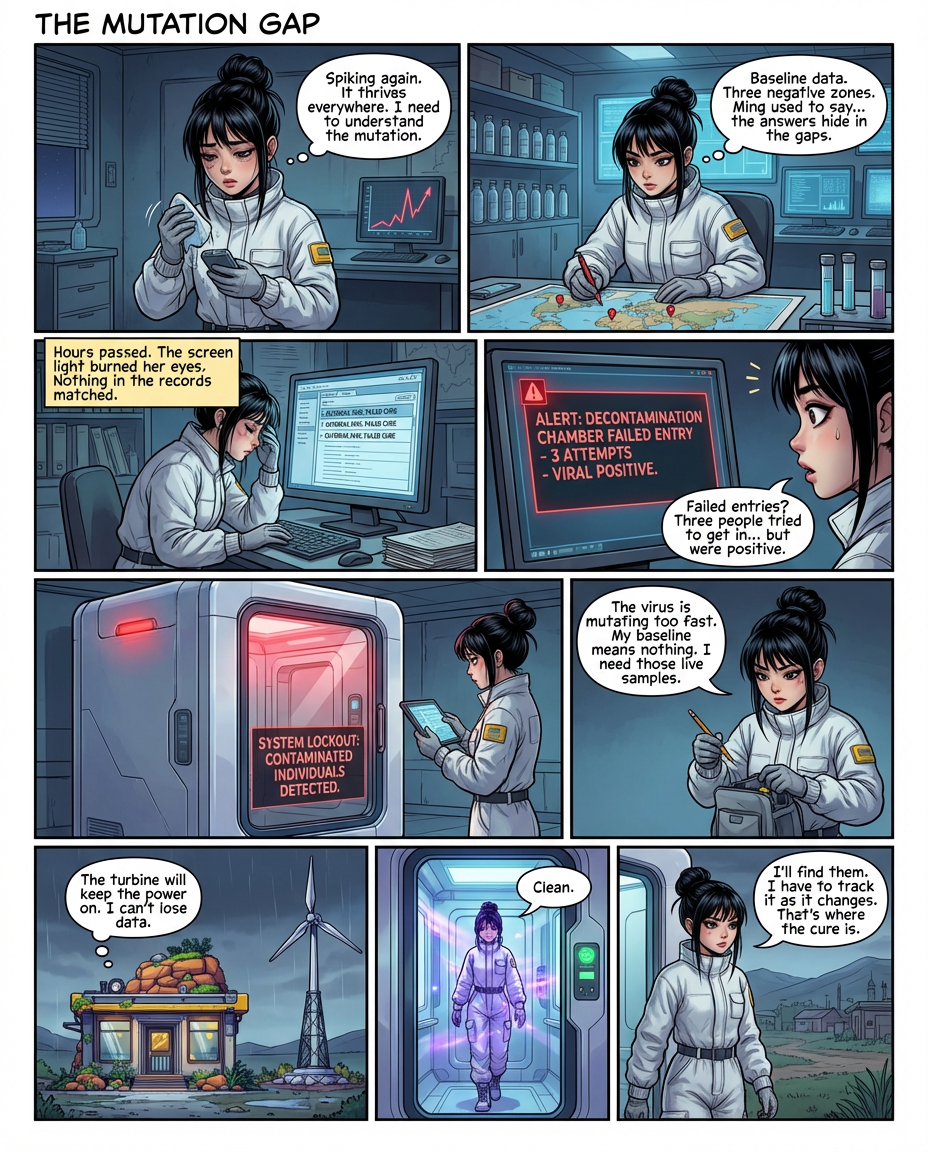
Chen wiped condensation from her sensor and watched the numbers spike again. The virus thrived in every sample. She needed to understand how it mutated, how it survived, how it could be stopped. Her first step was simple: collect baseline data from uninfected zones. She marked three points on her map where the readings stayed negative. The pattern made no sense yet, but patterns never did at first. Ming used to say that answers hid in the gaps between data points. Chen folded the map and checked her vials. Tomorrow she would return to those clean zones and see if they stayed that way. The field laboratory office sat exactly where her contacts said it would be. Glass vials lined the shelves in neat rows. Computer terminals hummed against the far wall. Chen sat down and logged into the health records database. Her fingers moved across the keyboard, pulling up files from previous outbreaks. Each mutation had been documented. Each failed cure was listed with test results and dates. She read through case after case, searching for anything that matched what she'd created. Hours passed. The screen light burned her eyes. Nothing in the records showed a pathogen that spread this fast or mutated this way. She pulled up wildlife migration data next. Some animals carried the virus without dying. If she could find which ones, she might understand why they survived. The computer processed her query. Results loaded slowly. Chen reached up and adjusted the pencil in her bun. Her hand shook from lack of sleep. A red notification flashed on screen. The viral decontamination chamber outside had logged three failed entries in the past week. People had tried to enter the lab but tested positive at the threshold. The chamber's automated system had locked them out, recorded their readings, sent them away. Chen pulled up the data. Each person showed different viral loads. Different mutation markers. The virus was changing faster than she'd thought. She downloaded the chamber's logs onto a portable drive and shut down the terminal. Her baseline data meant nothing if the pathogen evolved this quickly. She needed live samples from those three people. She needed to see how their infections differed from each other and from what she'd first created. Chen stood and packed her sensor. The gaps between data points weren't enough anymore. She had to track the virus as it moved, as it changed, as it killed. Outside, she checked the metal blade wind turbine installed next to the building. Its blades turned slowly in the damp air. The device would keep power running to her equipment if the main supply failed. She couldn't afford to lose data or refrigerated samples. Not when every reading mattered. Chen walked to the decontamination chamber and stepped inside. The transparent panel showed her reflection as ultraviolet lights swept over her suit. The system beeped green. Clean. She exited and started back toward the settlement. Three infected people were out there somewhere, carrying different versions of what she'd made. She would find them, test them, and use their blood to understand what came next. The cure wouldn't come from old records or clean zones. It would come from watching the virus evolve and learning to stop it one mutation at a time.
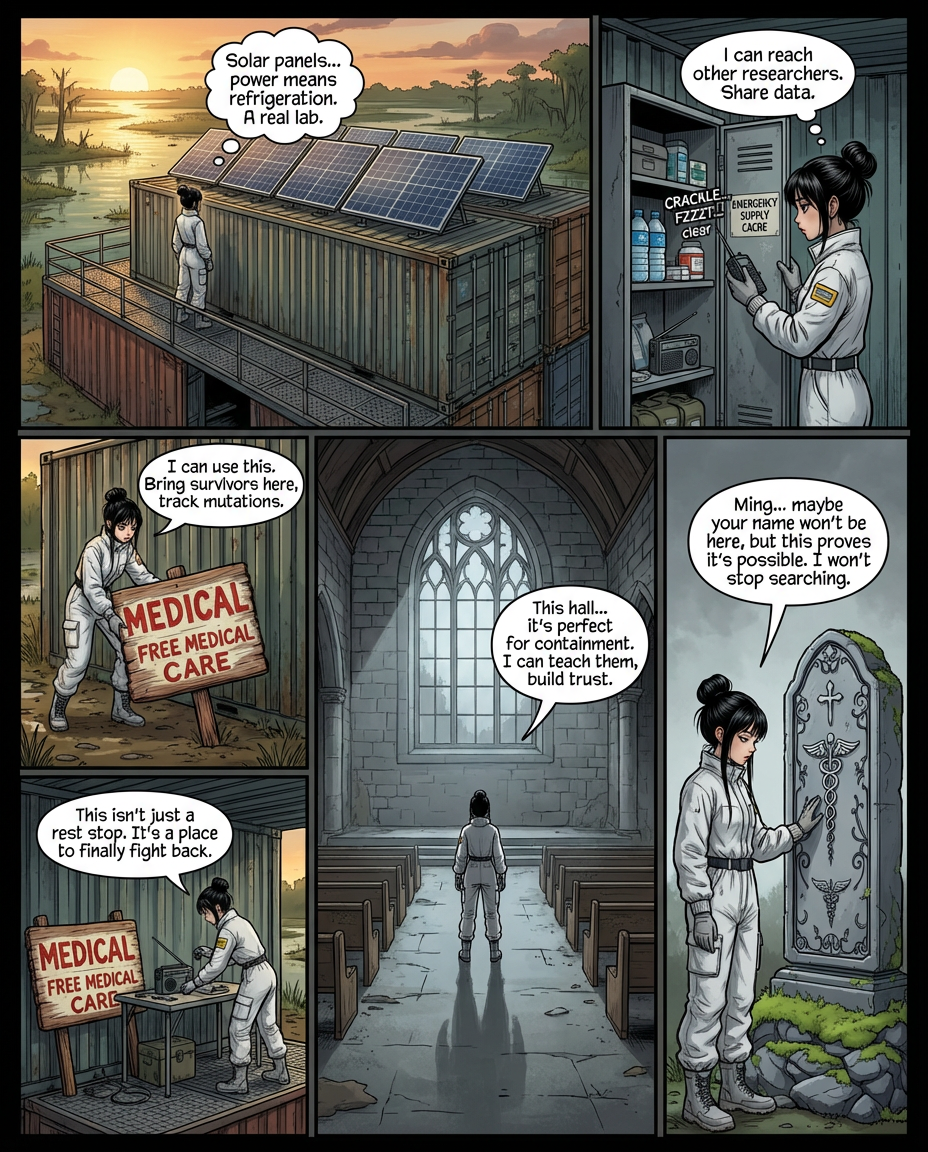
Chen's boots hit dry ground for the first time in days. The elevated platform stretched ahead, built from old shipping containers welded together. Solar panels lined the roof, feeding power to something inside. This wasn't marked on any of her maps. Someone had built a working station out here, hidden between the water and the trees. She checked her sensor. The air read clean. No viral markers within fifty meters. She approached the nearest container and found the door unsealed. Inside, a wall of storage lockers stood empty except for one. A faded label read "Emergency Supply Cache." She opened it. Medical gloves, sealed water bottles, and a working radio transmitter sat waiting. Whoever built this place knew what mattered. Chen tested the radio. Static crackled, then cleared. Frequencies scrolled across the small screen. She could reach other researchers from here, share data, maybe learn if anyone else had found mutations worth studying. She set the radio down and looked at the solar panels again. Power meant refrigeration. Refrigeration meant preserving samples long enough to test them properly. This platform could become more than a rest stop. It could become the place where she finally had time to work without the swamp rotting everything she touched. She walked the platform's edge and spotted a weathered wooden sign nailed to a post below. The hand-painted letters were faded but readable: "Free Medical Care." Someone had tried to help people here. Chen pulled the sign up and studied it. The wood was solid enough to reuse. She could set it up near the containers, let people know testing was available. If infected survivors came through, she could collect samples from different stages of illness. Track the mutations in real time instead of chasing old data. The radio could alert her when others passed through the area. She carried the sign back and leaned it against the container wall. Past the platform, a stone building stood half-hidden by trees. Chen approached and pushed open the heavy wooden door. Inside, large windows let in gray light. The space was empty but intact. Rows of benches lined the walls. This had been a meeting hall once, built to last. She walked to the center and turned slowly. The stone foundation kept the floor dry. The windows could be covered for containment. She could bring people here, explain what the virus did, teach them how to recognize symptoms early. Build trust before asking for blood samples. The platform had equipment. This hall had space. Together they gave her what the medical tent never could—a place to work that didn't feel like waiting for death. Chen adjusted the pencil in her bun and walked back outside. For the first time since Ming died, she had the tools to do more than just watch people get sick. Beyond the hall, a stone monument rose from the ground. Medical symbols covered its surface, carved deep into the rock. Moss grew thick at its base. Chen stopped and stared at it. Someone had built this to celebrate scientists who cured diseases. People who succeeded where she kept failing. She ran her fingers over the carved symbols. Her name would never appear on something like this. Not after what she'd done. But the monument proved that cures were possible. That someone, somewhere, had faced a deadly pathogen and won. She turned back toward the platform. The radio, the sign, the hall—they gave her what she needed to keep searching. The monument reminded her why it mattered. Chen walked back to the containers and began setting up her workspace. This place wasn't a lab or a medical tent. It was something better. A place where she could finally work toward an answer instead of just documenting how many people died.
Play your story to life
Storycraft is a mobile game where you create AI characters, craft items and locations to build their world, then discover what direction your story takes. Download the iOS game for free today!
Download for free