

Malak Warhammer's Arc
6 Chapters
Malak Warhammer's dream is training a fierce army capable of defending every lowland settlement.

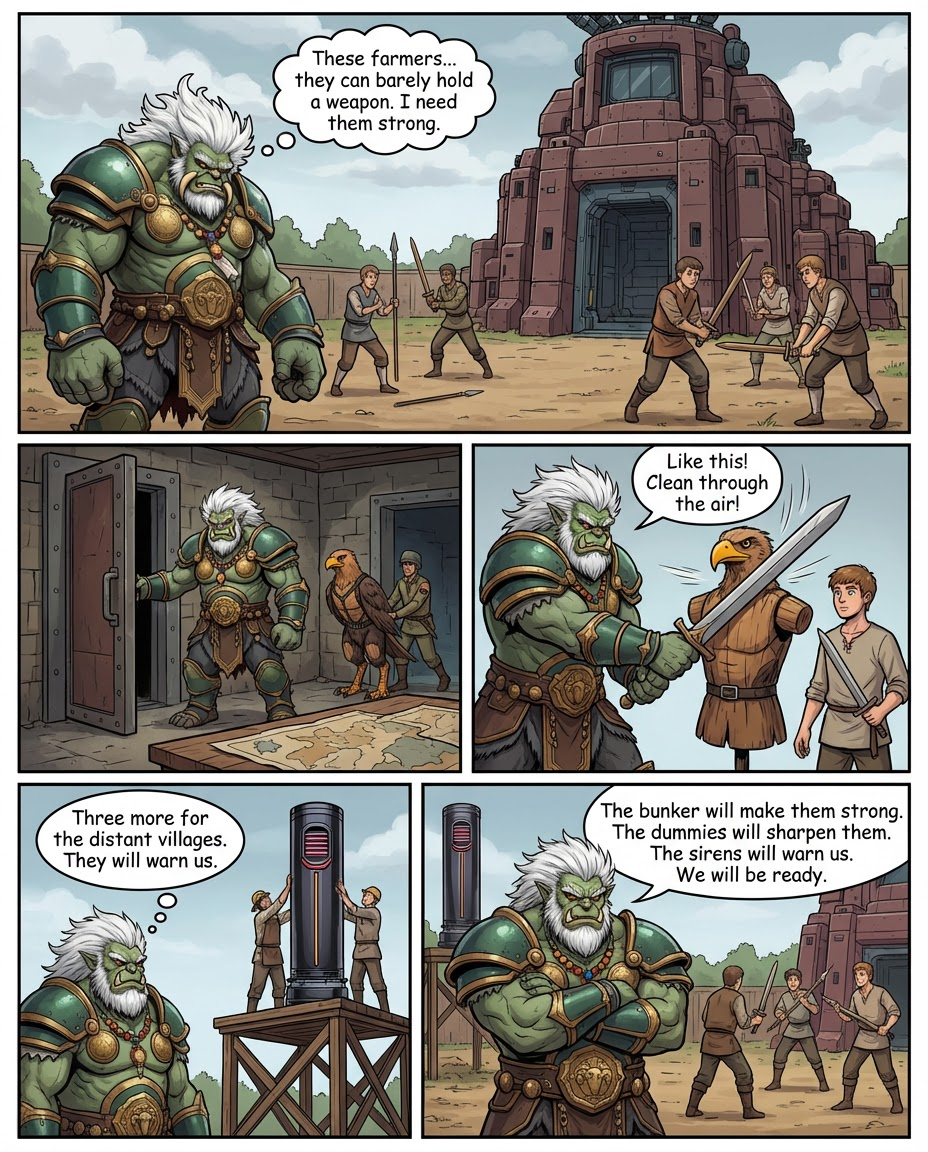
Malak Warhammer stood in the dirt courtyard and watched his recruits fumble their weapons. The green-skinned warrior had seen too many lowland villages burn. He dreamed of building an army strong enough to protect them all. But these farmers and merchants could barely hold a sword straight. He turned and walked toward the massive structure behind him. The brownish burgundy bunker rose from the earth like a fortress. Its thick walls would shelter his army during training. Inside, officers could plan defenses for every lowland settlement. Malak pushed open the heavy door and stepped into the dim interior. Maps covered the wooden tables. Weapon racks lined the stone walls. This command center would be where weakness turned into strength. He nodded once, satisfied. His army would train here until they were ready to defend their people. A soldier dragged something into the room behind him. Malak turned to see a training dummy shaped like a massive bird. Its feathers looked real in the torchlight. Sharp talons jutted from its base. The warrior grabbed a practice sword from the rack and handed it to the nearest recruit. He pointed at the dummy. The young man swung hard and the blade bounced off the target's chest. Malak demonstrated the proper strike, his weapon cutting clean through the air. The recruits would practice on these dummies until their arms ached. They would learn to fight the threats that haunted the lowlands. One day, his army would stand ready. Outside, workers hauled a black siren onto a wooden platform. Malak stepped through the doorway to watch them secure it. The device would warn every settlement when danger came. He had ordered three more built for the distant villages. When raiders appeared on the horizon, the alarm would scream across the lowlands. His soldiers would have time to respond. Farmers would have time to hide. Malak crossed his thick arms and stared at the recruits still practicing in the yard. They looked weak now, but they would become defenders. The bunker would make them strong. The training dummies would sharpen their skills. The sirens would give them warning. Everything was finally in place.
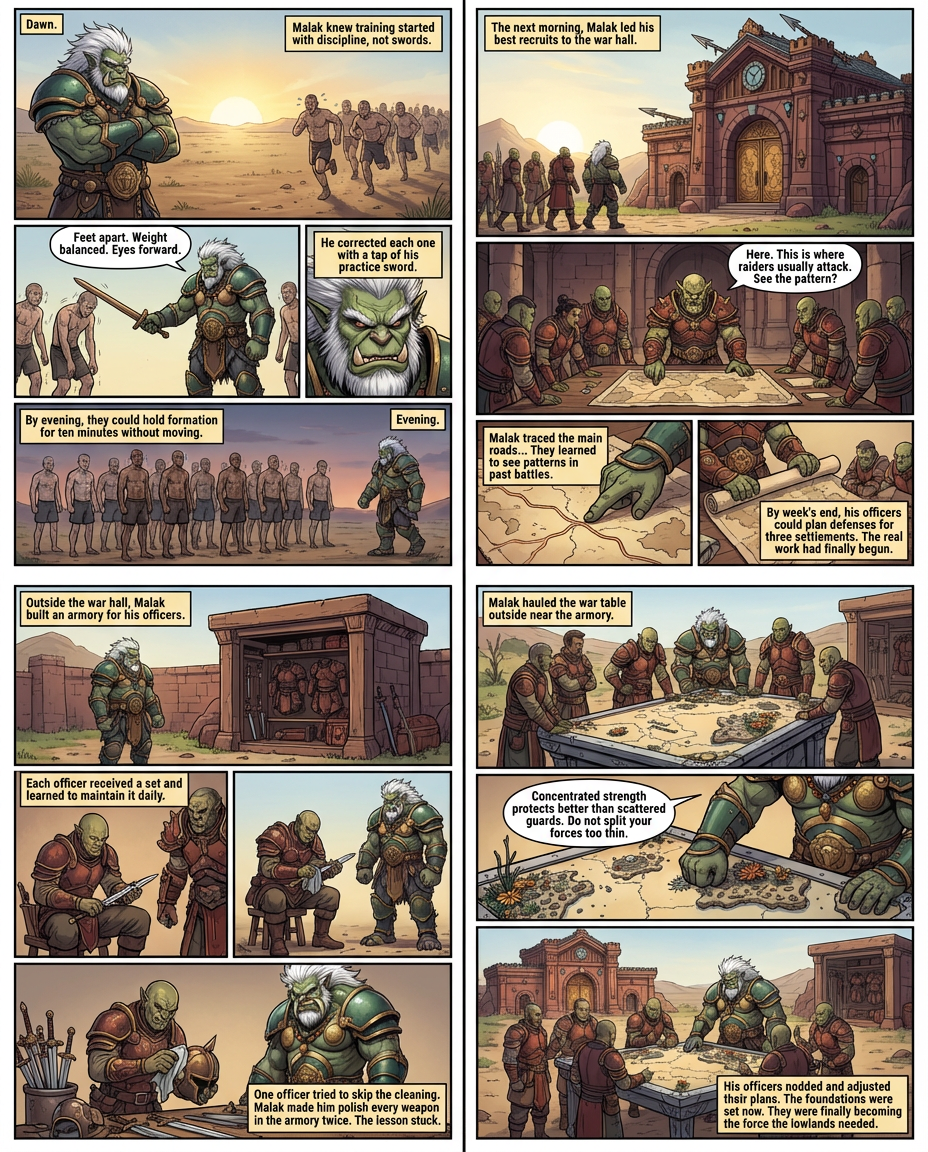
Malak knew training started with discipline, not swords. He lined up the recruits at dawn and made them run. Their boots pounded the dirt until their legs shook. Some collapsed after the first mile. He stood watching with his thick arms crossed. When they finished, he taught them to stand properly. Feet apart. Weight balanced. Eyes forward. The farmers hunched and swayed. He corrected each one with a tap of his practice sword. By noon, sweat soaked their shirts. By evening, they could hold formation for ten minutes without moving. The next morning, Malak led his best recruits to the war hall. The brownish burgundy stone walls rose before them, harpoons mounted on the roof. He pushed open the metal doors, their etched surfaces catching the light. Inside, thick wooden tables held maps of the lowlands. He spread out the largest map and pointed to the villages scattered across the territory. His officers gathered close. Malak traced the main roads with one thick finger. He showed them where raiders usually attacked. The recruits learned to see patterns in past battles. They studied which formations had failed and which had held. By week's end, his officers could plan defenses for three settlements. Malak rolled up the maps and looked at the faces around him. These men would lead squads. They would protect the lowlands. The real work had finally begun. Outside the war hall, Malak built an armory for his officers. The compact cubby held armor and weapons in the same brownish burgundy hue as the hall itself. Each officer received a set and learned to maintain it daily. They cleaned rust from blades and checked leather straps for wear. Malak inspected their gear every evening before dismissal. One officer tried to skip the cleaning. Malak made him polish every weapon in the armory twice. The lesson stuck. His officers understood that readiness meant survival. They would lead by example when the real fighting came. The lowlands needed defenders who respected their tools and their duty. Malak hauled the war table outside near the armory. The metal surface gleamed in the afternoon sun. Etched details showed every lowland settlement he had to protect. Strange alien plants marked the borders where danger lurked. He gathered his officers around the table and traced supply routes between villages. They learned to count travel days and position squads where they could respond fastest. One officer suggested splitting forces too thin. Malak tapped the table hard with his knuckle. He showed them how concentrated strength protected better than scattered guards. His officers nodded and adjusted their plans. The foundations were set now. His army knew how to stand, how to study battles, and how to plan defenses. They were finally becoming the force the lowlands needed.
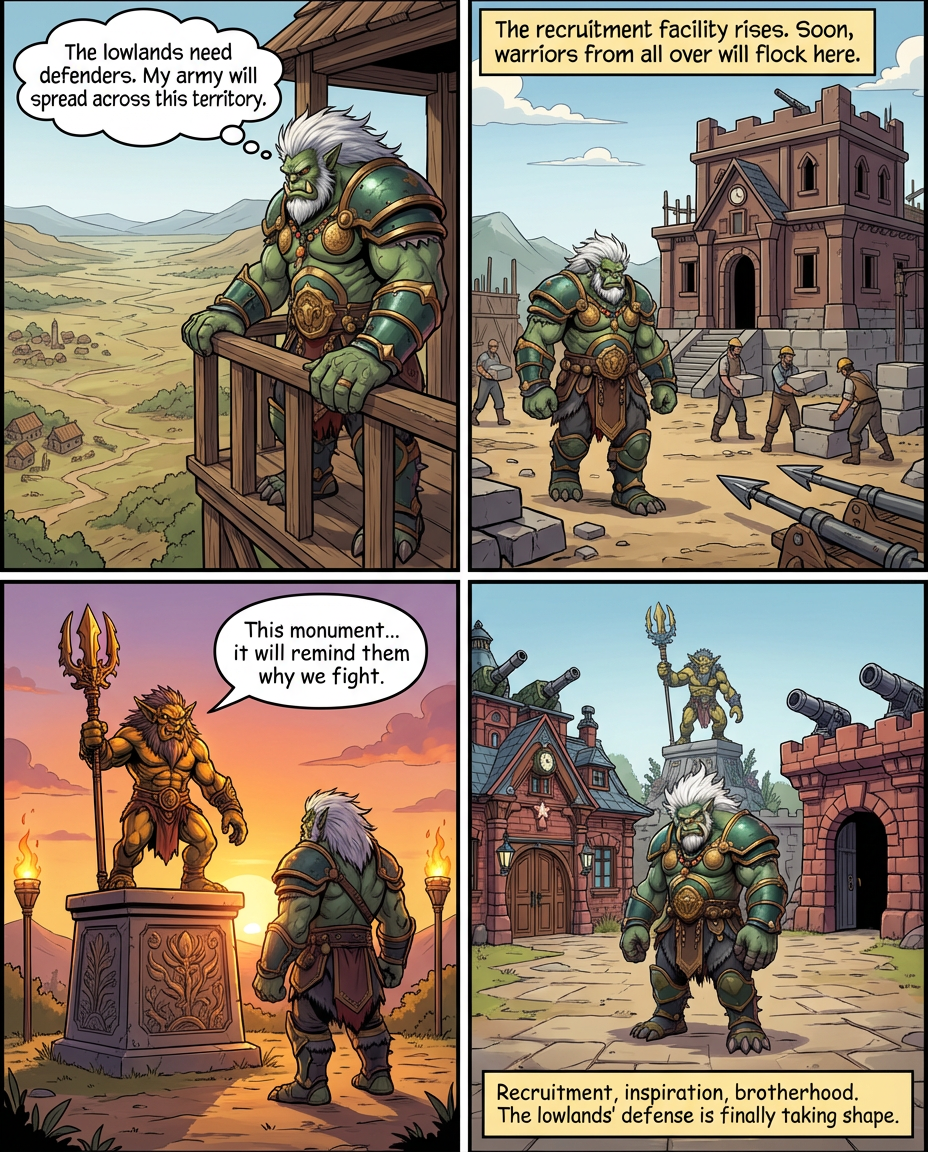
Malak climbed the watchtower at the edge of camp and scanned the lowlands. Villages dotted the valleys below, small and exposed. Each one needed defenders. He gripped the wooden railing and made his choice. His army would spread across this territory. He descended the ladder and headed toward the construction site at the center of camp. Workers hauled stone blocks into position, stacking them into thick walls. The brownish burgundy facade rose higher each day. Harpoon launchers sat ready on the ground, waiting to be mounted on the roof. This recruitment facility would draw warriors from across the lowlands. They would see its strength and want to join. Malak walked through the unfinished entrance and examined the interior. Long benches lined the walls where recruits would wait to enlist. A desk stood at the far end for his officers to interview candidates. The stone kept the space cool even in midday heat. He stepped back outside and studied the empty courtyard. His army needed something visible, something that would stir pride in anyone who approached. A monument to past victories would remind new soldiers why they fought. By evening, workers unveiled the bronze statue in front of the facility. The troll figure stood twice Malak's height, weapon raised toward the sky. Carvings of strange plants wrapped around the pedestal, marking the alien threats his defenders had already beaten back. Malak circled the statue slowly. Torchlight made the bronze glow like fire. Any warrior who saw this would know the lowland army had already won battles worth remembering. They would want to add their own victories to that legacy. Malak turned toward the barracks across the yard. The structure matched the recruitment facility, same stone and harpoon launchers for defense. Inside, his soldiers would eat together and share stories after training. Trust built in moments like those, not just on the battlefield. He walked between the three buildings and pictured the army they would create. The recruitment facility would bring in fighters. The statue would inspire them. The barracks would forge them into brothers. Everything the lowlands needed was finally taking shape.
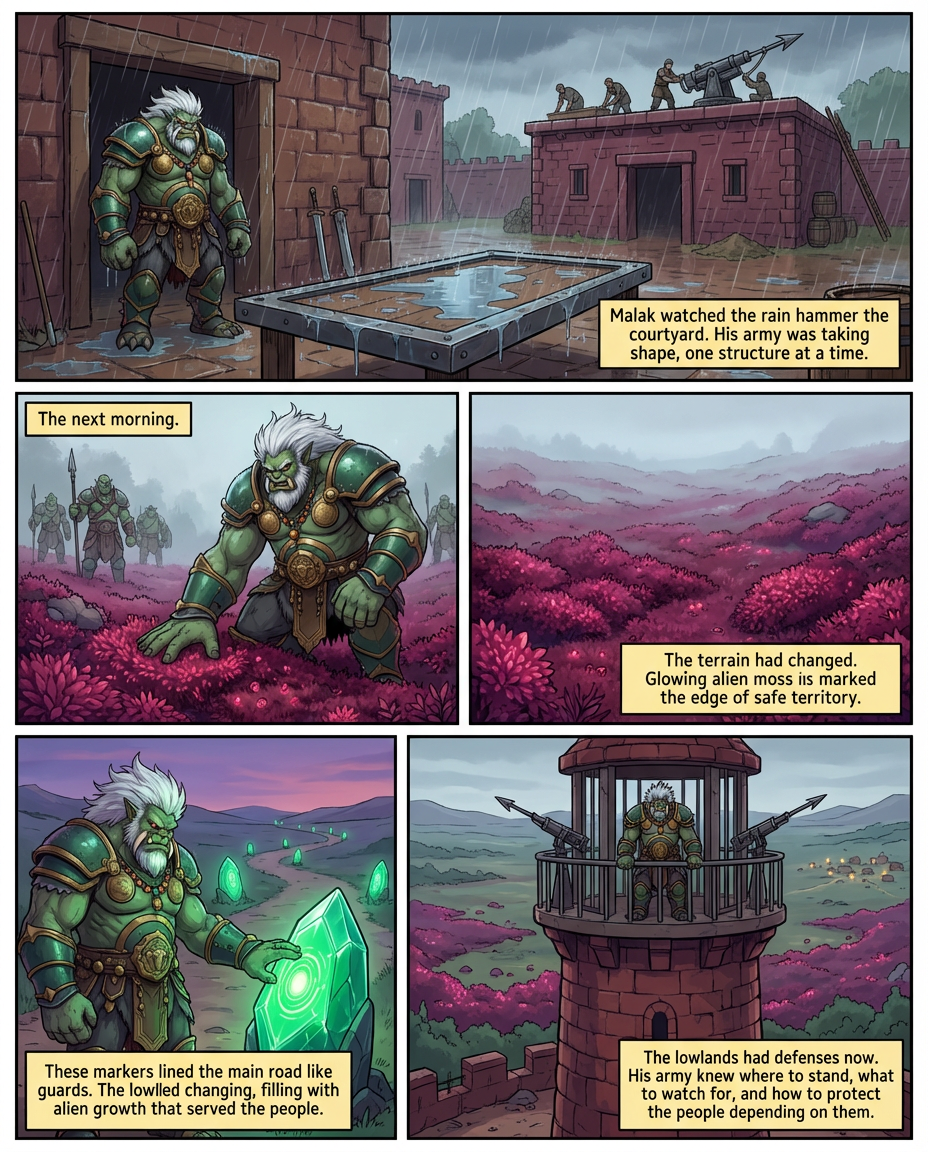
Malak stood in the armory doorway and watched rain hammer the courtyard. Water pooled around the war table outside, dripping off its etched metal edges. His officers would need shelter for planning sessions. He turned and walked toward the construction site near the barracks. Workers had finished the walls yesterday. Now they mounted the final harpoon launcher on the roof. This new structure would give his commanders a place to meet when weather turned foul. Inside, they could spread maps and argue strategy without getting soaked. The brownish burgundy stone matched every other building in camp. His army was taking shape, one structure at a time. The next morning, Malak led a patrol beyond the camp walls to survey the lowland borders. The terrain had changed since his last patrol. Dense moss covered the ground in thick carpets that glowed faintly burgundy in the dim light. The stuff grew in layered sheets, each one thin as paper but packed together in masses. He crouched and pressed his hand against the surface. It felt damp and spongy. The glow pulsed softly under his palm. This alien growth spread across entire hillsides now, marking the edge of safe territory. His patrols would need to recognize these boundaries. Any recruit who wandered past the glowing moss would face threats the lowlands couldn't afford to lose soldiers to. Malak stood and studied the landscape. The moss made the borders clear. His army would know exactly where their watch ended and danger began. The patrol continued toward the settlement paths that connected villages. Malak noticed stone markers rising from the ground at regular intervals. Their surfaces were crystalline and green, pulsing with soft light. He stopped beside one and ran his fingers across the smooth face. The pulse matched a slow heartbeat. These markers hadn't been here last month. They lined the main road like guards, their glow bright enough to see by after dark. His soldiers wouldn't need torches anymore when moving between outposts. The settlements were spreading these markers across their territories. Malak counted seven more along the next mile of path. The lowlands were changing, filling with alien growth that served the people living here. His army would learn to use every advantage this strange land offered. He turned back toward camp, satisfied that the borders were now clear and the paths were lit. Three days later, Malak climbed the guard tower on the western edge of lowland territory. The brownish burgundy stone walls rose thick beneath his boots. He reached the caged observation platform and gripped the railing. Harpoon launchers sat ready on both sides, their mechanisms oiled and waiting. From this height, he could see across miles of moss-covered ground. Villages clustered in the valleys below, small but visible. The tower stood as a warning to anything that came from the wilds. His soldiers manned posts like this one at every border now. They watched the glowing moss line and reported anything that crossed it. Malak scanned the horizon once more, then descended the ladder. The lowlands had defenses now. His army knew where to stand, what to watch for, and how to protect the people depending on them.
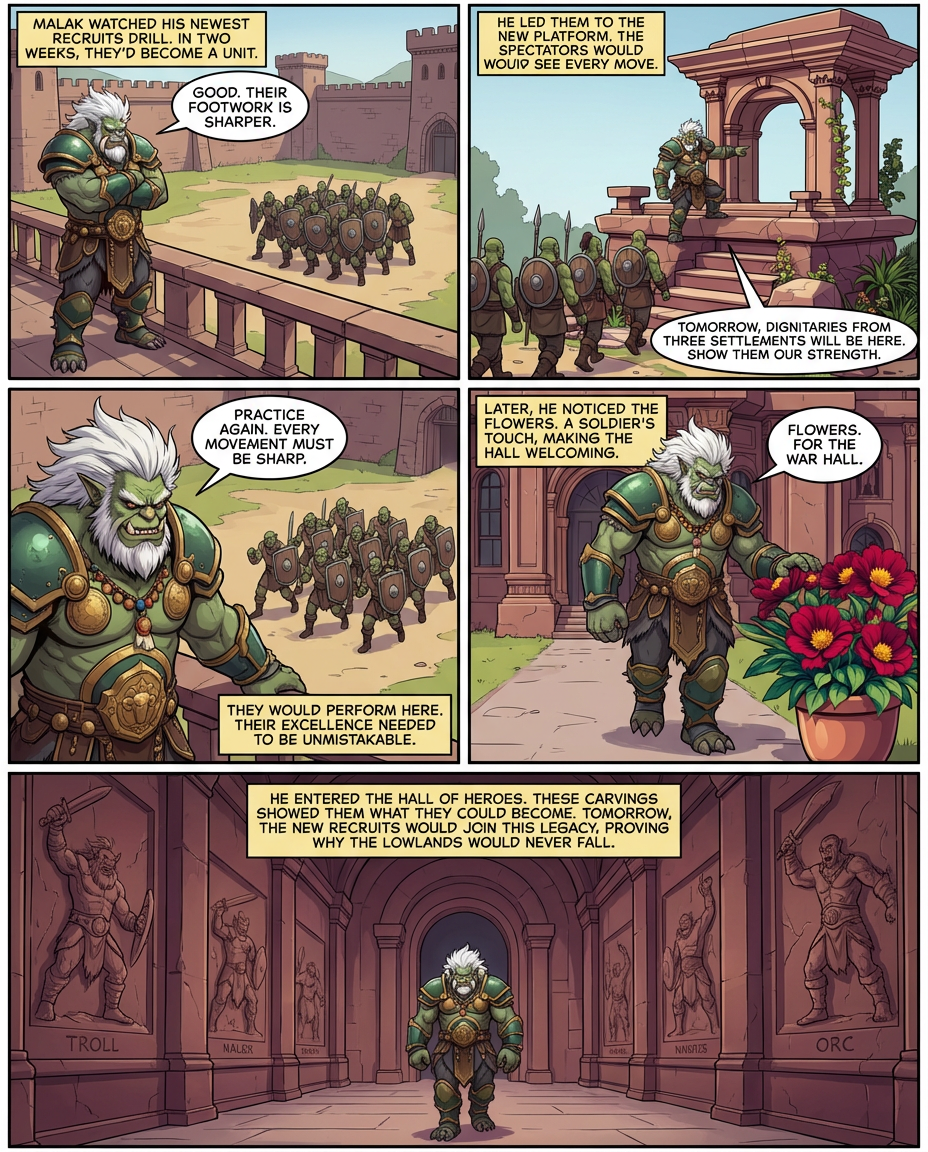
Malak watched his newest recruits run drills in the courtyard. They moved in formation now, shields locked tight. Their footwork had improved in just two weeks. He nodded as they executed a clean pivot without breaking the line. Progress. He led the squad toward the new observation platform beyond the training grounds. The brownish burgundy stone rose from the earth in wide steps, its surface smooth and level at the top. Malak climbed first, his boots finding easy purchase on the carved edges. The recruits followed, shields still strapped to their backs. From this height, they could see the entire courtyard spread below them. Malak gestured toward the space where tomorrow's visitors would stand. Dignitaries from three settlements would watch combat demonstrations here. His soldiers needed to show their strength, prove the training worked. The platform gave spectators a clear view of every strike and block. He turned to the recruits and told them to practice their formations again. They would perform here tomorrow, and every movement had to be sharp. That afternoon, Malak walked toward the War Hall entrance and stopped at the row of potted flowers someone had placed along the path. Burgundy petals surrounded bright gold centers, vivid against the stone walls. He hadn't ordered decorations, but someone in camp understood what visiting soldiers needed to see. The War Hall wasn't just a place for battle planning. It was where warriors from different villages came together, where they decided to join his army or return home. The flowers made the entrance feel less like a fortress and more like a place worth defending. Malak touched one of the petals, then continued inside. The hall stretched long and high, its burgundy stone walls carved with figures of troll and orc warriors. Each carving showed a moment of victory, weapons raised or enemies defeated. Names were etched beneath each scene, marking soldiers who had earned their place in this parade of heroes. Malak walked the length of the hall, studying faces he recognized and some he didn't. His current soldiers came here between training sessions to see what they could become. The carvings showed them that excellence had a reward, that their efforts would be remembered. Tomorrow, when the dignitaries arrived and watched his recruits perform on the observation platform, they would see an army already worth joining. And when those new soldiers entered this hall for the first time, they would see why the lowlands would never fall.
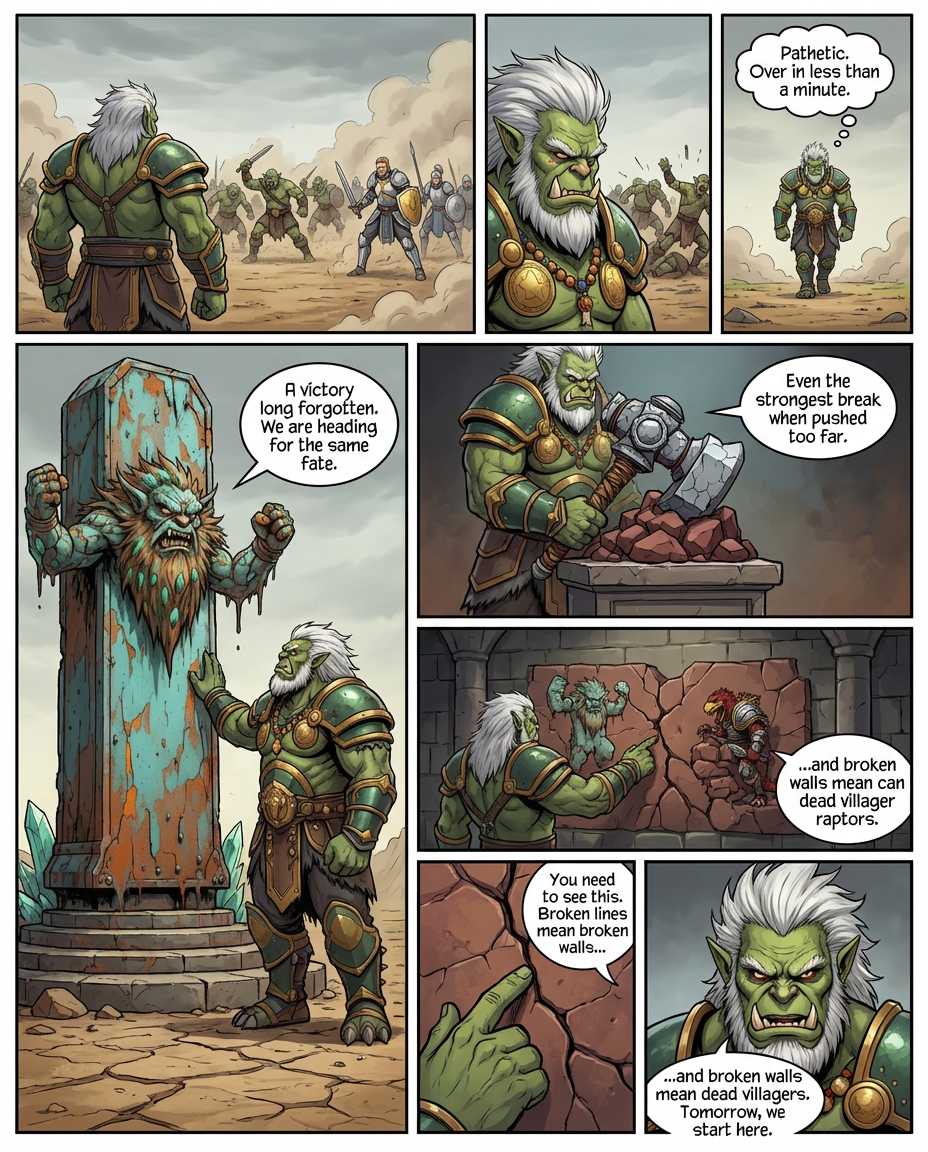
Malak stood at the edge of the training field and watched his best squad face off against a group of visiting warriors. The guests had arrived from a northern settlement, their armor polished and their confidence clear. His soldiers moved into formation, shields raised. The visitors charged. Within seconds, Malak's line broke. His troops scattered, stumbling over each other as the northerners drove through them like paper. The demonstration ended in less than a minute. Malak dismissed both groups and walked alone toward the War Hall. Outside its entrance stood the old victory monument, its iron panels peeling and spotted with rust. Green crystalline corrosion crawled across the troll figure's raised weapon. He stopped and stared at it. The monument honored a battle won generations ago, but no one had maintained it. Time had eaten away at the metal until the warrior's face was barely visible. His own army was heading toward the same fate if he couldn't fix what was broken. He continued past the monument to a stone pedestal that held a shattered warhammer mounted on brownish burgundy rock. The weapon's head had split clean through, its handle snapped in two places. Someone had placed it here as a relic, a reminder of some forgotten battle. Malak touched the broken metal. Even the strongest weapons failed when pushed past their limits. His soldiers had looked just as broken on the training field today. Inside the hall, he walked past the carved figures of ancient warriors until he reached a section of damaged wall. The brownish burgundy stone showed a crack running from floor to ceiling. On one side, a troll warrior stood ready for battle. On the other, an armored raptor lunged forward. The crack split them apart, showing what happened when defenses failed. Malak traced the gap with his finger. His recruits needed to see this. They needed to understand that broken lines meant broken walls, and broken walls meant dead villagers. Tomorrow's training would start here, at this crack, so every soldier knew exactly what failure looked like.
Play your story to life
Storycraft is a mobile game where you create AI characters, craft items and locations to build their world, then discover what direction your story takes. Download the iOS game for free today!
Download for free