

Madame Clarabelle Fitzgerald's Arc
4 Chapters
Madame Clarabelle Fitzgerald's dream is tracking down the daughter she gave up fifteen years ago.

Clara woke early and sat by the window. Sunlight cut through the dusty glass and warmed her hands. She'd come back to Gritstown with one purpose: to find her daughter. The town hadn't changed much in fifteen years, but somewhere in these streets, her girl was living. Clara reached for the photo book on the nightstand and held it close. Today she would begin her search. She dressed quickly and tucked the photo book into her bag. The streets were quiet as she walked toward the town square. She remembered a wooden booth near the general store—a place where people got their photographs developed. Maybe they could help her make copies of the old pictures she had. Maybe someone there would recognize the adoption papers or remember a family. Clara's boots kicked up dust as she walked faster. The old photo development booth came into view, its painted sign faded but still readable. She pushed open the door and stepped inside, pulling out her only picture of the baby girl she'd held for just one hour fifteen years ago. The booth smelled like chemicals and paper. A bell rang above the door. Clara set the photograph on the counter and opened her photo book beside it. The sepia-toned pages showed images of Gritstown from years past, but one picture stood out—the tiny face she'd kissed goodbye. She traced the edge with her finger. The man behind the counter looked up and nodded. He could make copies, he said. It would take a few days. Clara agreed and paid him. She left the booth with the photo book tucked back in her bag. Now she had a base to work from. She'd return here each week to pick up copies and ask questions. Someone in this town knew where her daughter was, and Clara would find them. The afternoon heat pushed down on her shoulders as she walked toward the town center. A weathered mailbox stood near the hitching posts. Its paint peeled in strips, but the metal box still opened and closed. Clara pulled out one of her old photographs and a piece of paper. She wrote a simple message asking if anyone knew of a girl adopted fifteen years ago. She mentioned the date and the name of the woman who'd handled the papers. Clara folded the note around the photograph and placed it inside the mailbox. Other notices hung on a board beside it—requests for work, announcements of town meetings. Her message would sit there until someone read it. She closed the mailbox door and stepped back. This was her start. The photo booth would give her copies to share. The mailbox would spread her questions. And Clara would wait, watch, and listen until someone gave her the answer she needed.
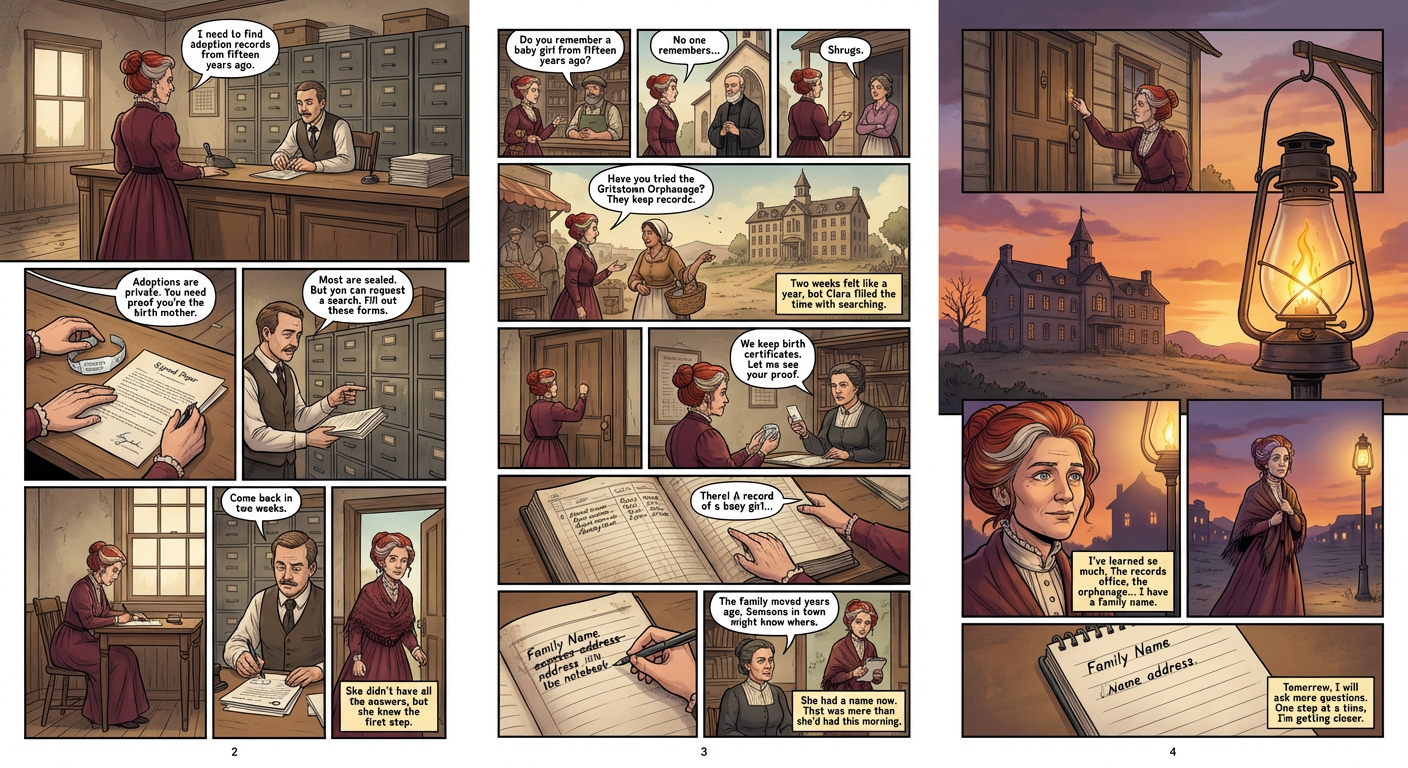
Clara walked into the public records office and set her bag on the wooden counter. She needed to learn how to search for adoption records—what forms existed, where they were kept, and who had access. The clerk glanced up from his desk but said nothing. Clara cleared her throat and asked about records from fifteen years ago. He pointed to a row of filing cabinets along the back wall and told her adoptions were private. She would need proof she was the birth mother. Clara pulled out her old hospital bracelet and the paper she'd signed the day she gave her daughter away. The clerk studied them, then nodded. He opened a drawer and showed her how the files were organized by year and month. Most adoption records were sealed, he explained, but she could request a search if she filled out the right paperwork. Clara took the forms he handed her and sat at a small table near the window. Her pen moved slowly across each line. She wrote her name, the date of birth, and the town where it happened. When she finished, she returned the papers to the clerk. He stamped them and told her to come back in two weeks. Clara thanked him and walked outside. She didn't have all the answers yet, but now she knew the first step. She would wait, and when the time came, she would return. Two weeks felt like a year, but Clara filled the time with more searching. She asked at the general store, the church, and the boarding house. No one remembered a baby girl from that time. Then she heard about the Gritstown Orphanage from a woman at the market. The building stood at the edge of town, tall and gray against the dusty sky. Clara walked up the front steps and knocked. A woman answered and listened as Clara explained what she needed. The orphanage kept birth certificates and adoption documents, the woman said. Clara showed her hospital bracelet again. The woman led her inside to a small office lined with shelves. She pulled down a ledger from the year Clara's daughter was born. Clara's hands shook as she turned the pages. There—a record of a baby girl, born on the right date. The adoption papers listed a family name, but the address was crossed out. Clara copied the name into her notebook. The woman told her the family had moved years ago, but someone in town might know where they went. Clara thanked her and left. She had a name now. That was more than she'd had this morning. The sun was setting when Clara left the orphanage. An old lamp post stood near the front steps, its flame flickering inside a glass bulb. The light grew brighter as the sky darkened. Clara stopped and looked back at the building. She had learned more in two weeks than she'd hoped. The public records office taught her how adoption files worked. The orphanage gave her a family name and a date. Someone in Gritstown knew where that family went. Clara pulled her shawl tighter and started back toward town. The lamp post glowed behind her. Tomorrow she would ask more questions. She would show people the name in her notebook. One step at a time, she was getting closer.
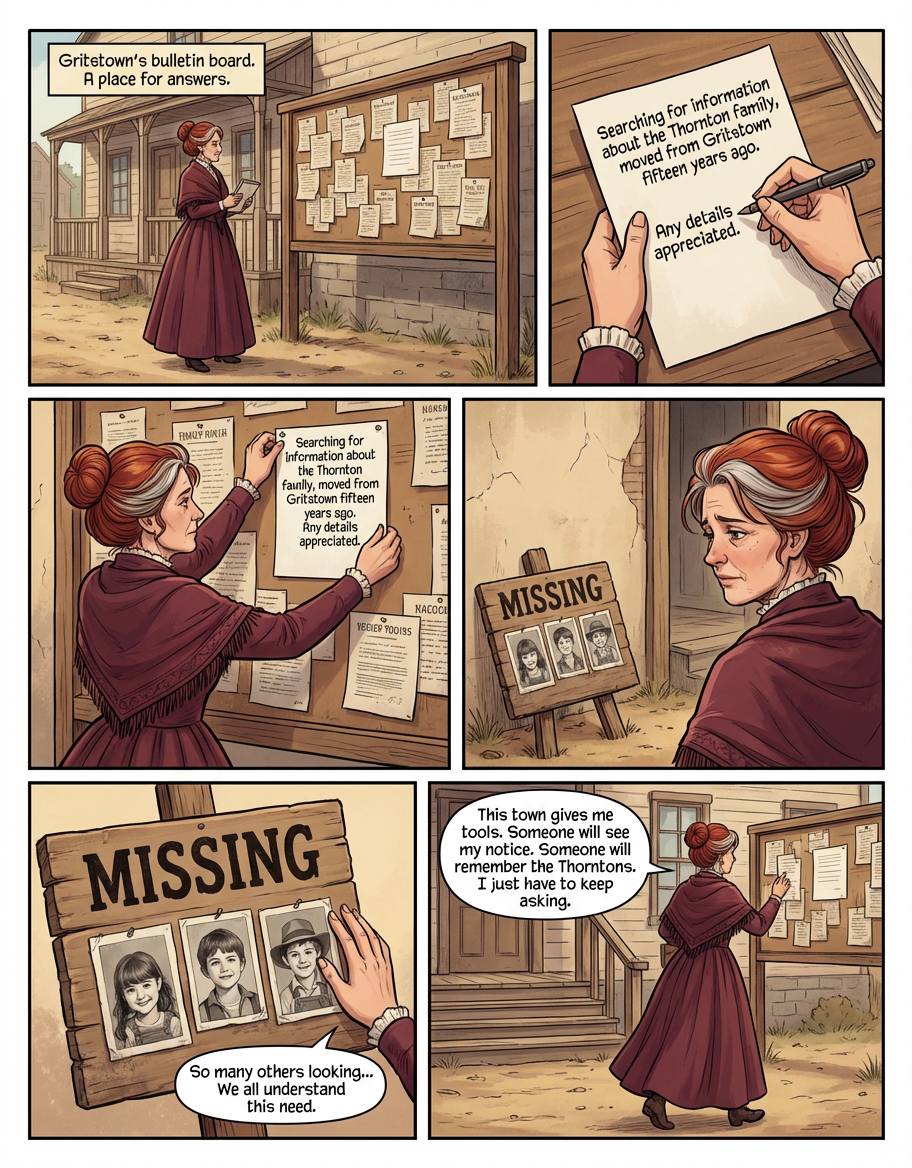
Clara stood in front of the town hall and studied the bulletin board mounted on its outer wall. Notices overlapped each other—work requests, sale announcements, and meeting times all pinned in layers. She pulled out the family name from her notebook and read it again. The board was full, but people checked it every day. She could post her own notice here—ask if anyone knew the family or remembered a girl adopted fifteen years ago. Clara unpinned an old work request and made space in the center. She pulled a fresh paper from her bag and wrote in clear letters: "Searching for information about the Thornton family, moved from Gritstown fifteen years ago." Below that, she added: "Any details appreciated." She pinned it to the board and stepped back. Her message sat right in the middle where everyone would see it. A weathered wooden sign leaned against the wall near the steps. Black and white photos of children covered its surface, their faces faded but still visible. Clara walked closer and read the word "Missing" painted across the top. The sign showed other searches, other families looking for children who'd disappeared. Her chest tightened. These people understood what it felt like to need answers. Clara touched the edge of the sign and then looked back at the bulletin board. This town had places for people to search and ask questions. The photo booth made copies. The records office kept files. The orphanage held ledgers. And here, in the center of town, anyone could post a notice and wait for help. Clara adjusted her shawl and walked down the steps. Gritstown might be dusty and worn, but it gave her tools to keep searching. Someone would see her notice. Someone would remember the Thornton family. She just had to keep asking.
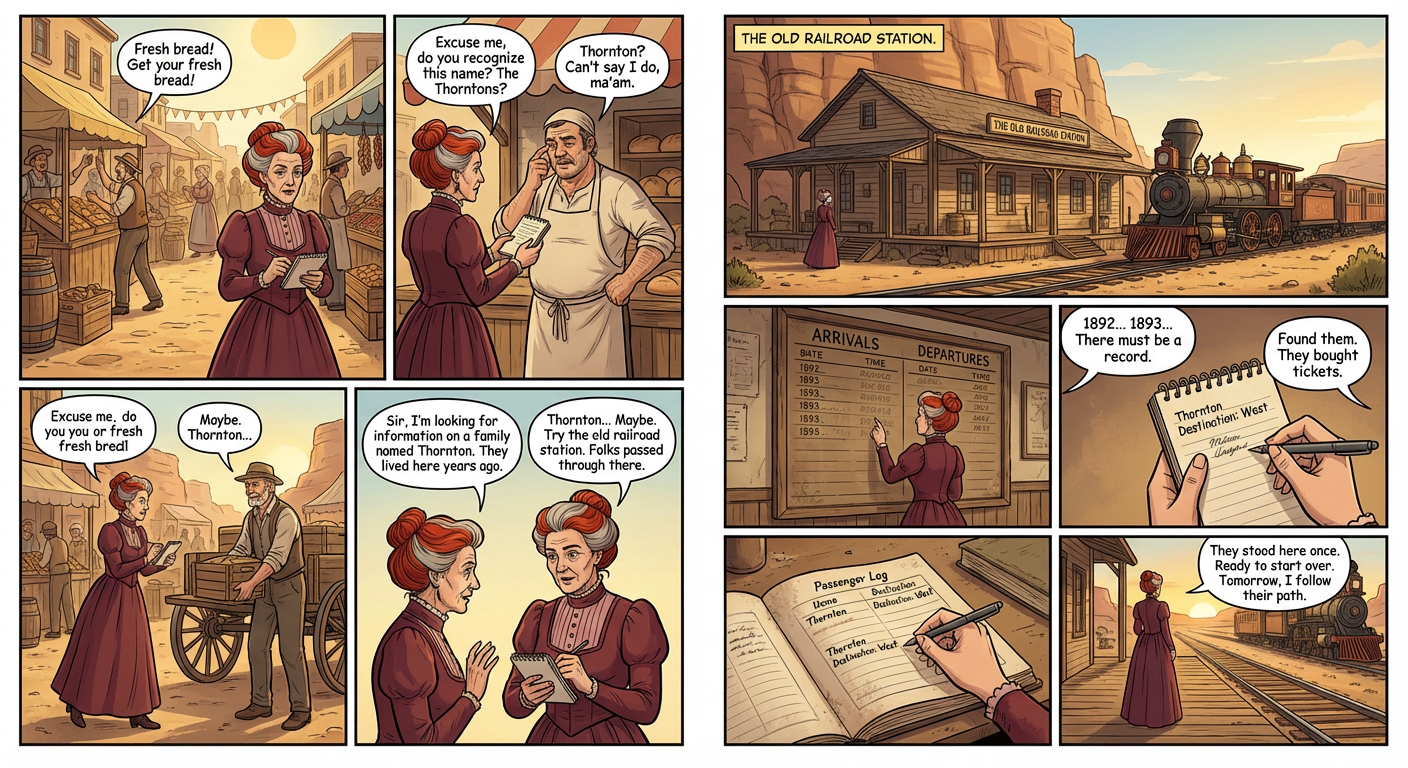
Clara walked through the market square as vendors called out their prices. Flour, nails, rope—all the ordinary goods people needed to live. She stopped at a fabric stall and ran her fingers over a bolt of cotton. The woman behind the table smiled and asked if she was making something new. Clara shook her head and moved on. Every person she passed could be someone who knew the Thorntons. Every conversation was a chance to ask. She bought bread from the baker and showed him the name in her notebook. He squinted at it, then shrugged. Clara thanked him anyway. At the edge of the square, she noticed a man loading crates onto a wagon. He looked older, the kind of person who'd lived in Gritstown a long time. She approached and asked if he remembered a family by that name. He paused, wiped his hands on his pants, and said maybe. Years back, he thought. Clara wrote down what he told her—a street name, a general direction. It wasn't much, but it was something. She tucked her notebook away and kept walking. Each small answer built on the last. Each conversation brought her closer. The man mentioned the old railroad station. People passed through there, he said. Someone might remember the family leaving town. Clara followed the directions he'd given her until she found it—a building that looked like it belonged in the dusty old west, with worn wooden beams and a platform that stretched along the tracks. A vintage train sat silent on the rails. She climbed the steps and walked inside. The station was quiet, but a board on the wall listed arrivals and departures from years past. Clara ran her finger down the dates, searching for the year the Thorntons left. She found records of families who'd bought tickets, their names written in faded ink. Some had noted their destinations. She pulled out her notebook and copied what she could read. The station keeper's desk sat empty, but papers stacked on top showed passenger logs. Clara checked each page carefully. When she finished, she looked out at the platform where so many people had said goodbye. The Thorntons had stood here once, ready to start over somewhere new. Clara closed her notebook. She had more names now, more dates. Tomorrow she would visit the next place on her list.
Play your story to life
Storycraft is a mobile game where you create AI characters, craft items and locations to build their world, then discover what direction your story takes. Download the iOS game for free today!
Download for free