

Ricardo Rios's Arc
3 Chapters
Ricardo Rios's dream is building a bustling cultural center where tourists learn authentic Venezuelan traditions.

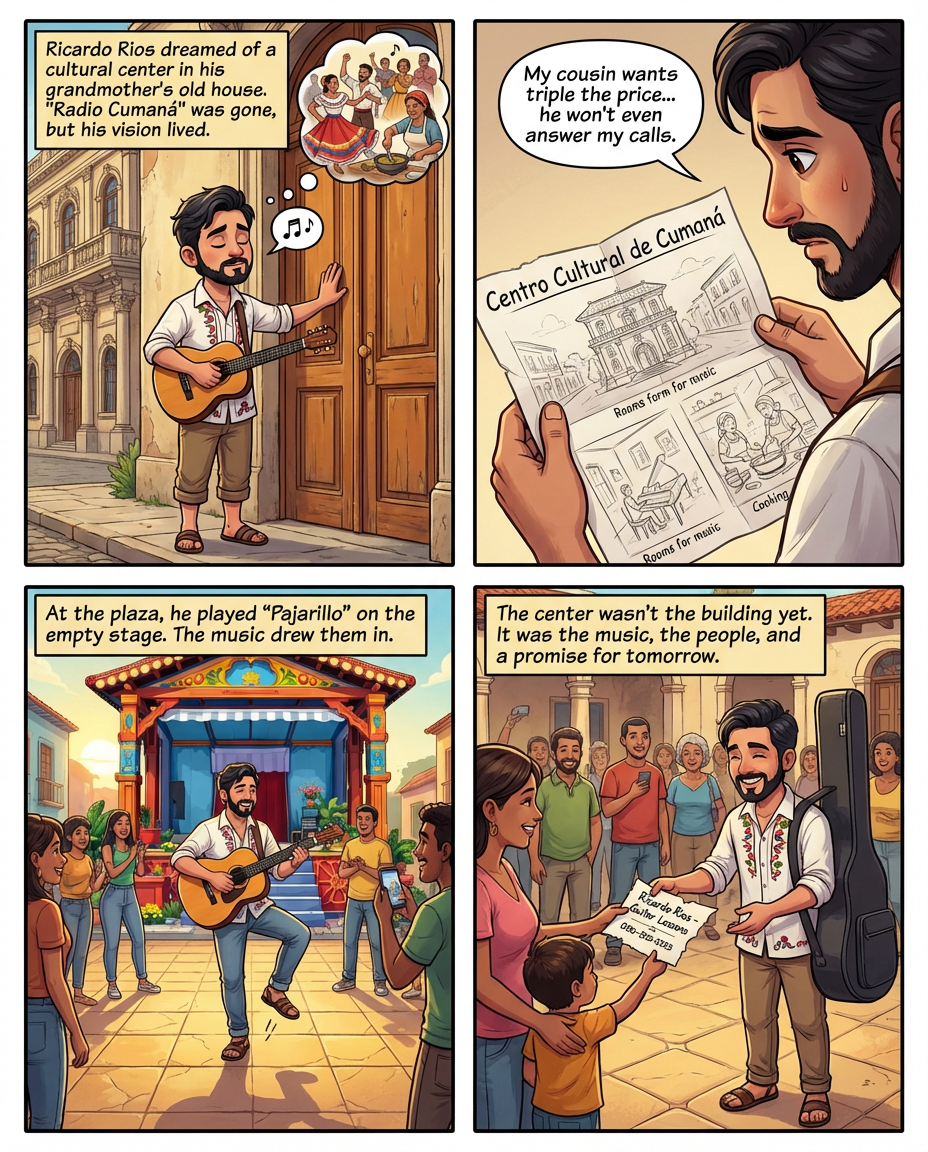
Ricardo Rios counted the pesos in his pocket outside the empty building that used to be his grandmother's house. Twenty-three years at Radio Cumaná had ended when the station closed, but his dream hadn't died with it. He wanted to fill these rooms with tourists learning Venezuelan songs, watching traditional dances, tasting real hallacas made the way his grandmother had taught him. A cultural center where the old stories would live again. His cousin owned the deed now and wanted triple what the place was worth. Ricardo pressed his hand against the weathered door and hummed the opening notes of 'Alma Llanera.' The wood felt warm under his palm, still holding heat from the afternoon sun. He walked away from his grandmother's house and headed toward the plaza. His fingers traced the outline of a folded paper in his shirt pocket. The sketch showed what he wanted to build—a proper cultural center with clean white walls and carved details above the doorways. Centro Cultural de Cumaná, he'd written across the top. Inside would be rooms for cooking classes, space for guitar lessons, walls covered with old photographs of the town. But the sketch was just paper, and his cousin wasn't answering his calls. Ricardo stopped at the edge of the plaza and pulled out his guitar. A small stage sat empty in the corner, painted bright colors that reminded him of the shirts fishermen wore on festival days. He climbed onto it and started playing 'Pajarillo.' Three people walking past slowed down. One pulled out her phone. Ricardo sang louder, his voice carrying across the open space. A golden sandstone floor stretched out in front of the stage, smooth and flat enough for dancing. He stamped his foot twice on the wood, keeping rhythm. By the time he finished the song, twelve people had gathered. A woman asked if he taught lessons. A man wanted to know where tourists could hear more traditional music. Ricardo wrote his phone number on the back of his sketch six times, tearing the paper into pieces. The cultural center existed in his head and on torn scraps handed to strangers. It wasn't his grandmother's house yet, but it was something. He packed his guitar and walked toward the harbor, already planning tomorrow's songs.
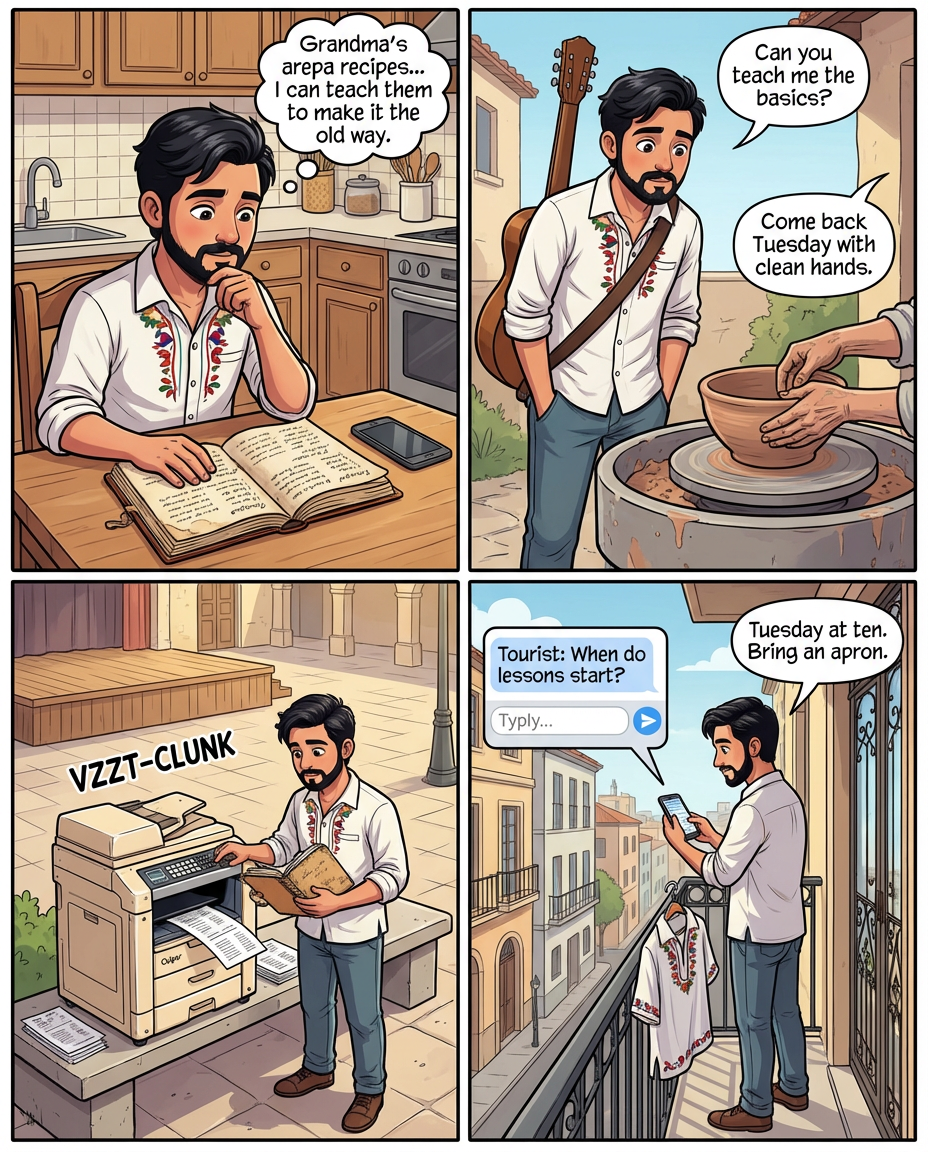
Ricardo slipped his phone back into his pocket and counted the new contacts. Six people wanted lessons, but none had called yet. He needed to show them something real, not just songs in the plaza. His grandmother's notebook sat on his kitchen table at home, filled with recipes written in her slanted handwriting. He could teach tourists to make arepas the old way, with their hands instead of machines. First, though, he had to learn how to turn strangers into students. He walked three blocks to where an old woman shaped clay bowls outside her workshop. Her hands moved fast, thumbs pressing into the wet earth as the wheel spun. Ricardo watched her create a rim, then smooth it with one finger. She'd been making pottery for forty years, the same techniques her mother had taught her. He asked if she would teach him the basics so he could pass them on. She nodded and told him to come back Tuesday with clean hands. The next morning, Ricardo found a beige copy machine sitting behind a repair shop. The owner said it still worked but took up too much space. Ricardo carried it six blocks to the plaza, his arms burning. He set it on a bench and plugged it into an outdoor outlet near the empty stage. He fed his grandmother's arepa recipe into the machine and made twenty copies. Each sheet showed her handwriting, her measurements, her notes about kneading until the dough felt like an earlobe. Back at his apartment, Ricardo opened the glass doors that led to his small balcony. He hung his performance shirt on a hanger and let the breeze move through it. The embroidered flowers needed air between shows or they'd hold sweat and fade. He looked down at the street below and imagined a bigger space, rooms where pottery wheels spun and recipe sheets covered tables. His phone buzzed. One of the tourists from the plaza wanted to know when lessons started. Ricardo typed back: Tuesday at ten. Bring an apron.
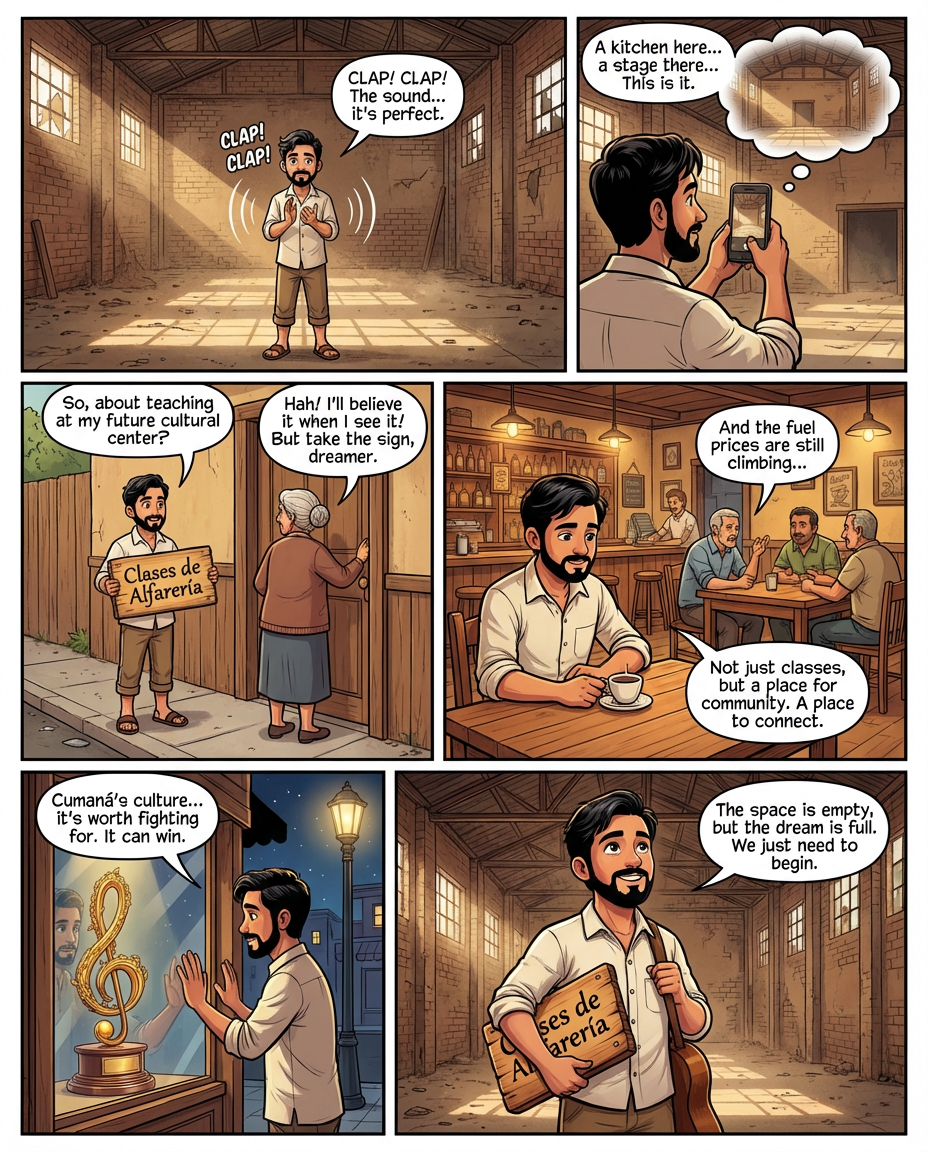
Ricardo walked past his grandmother's house without stopping and headed toward the old tobacco warehouse on the edge of town. The brick building had been empty for two years, its windows broken and doors hanging loose. He'd heard the owner lived in Caracas now and never visited. Inside, dust covered the concrete floor, but the space stretched wide enough for fifty people. High ceilings meant sound would travel well. He stood in the center and clapped twice. The echo came back clean and strong. A cultural center needed a home, and his cousin's price would never drop. This place could work if he could find the owner. Ricardo pulled out his phone and took three pictures of the empty room, already imagining where the cooking stations would go. He walked back toward the harbor district and noticed a wooden sign leaning against a wall outside an art supply shop. "Clases de Alfarería" it read, with pottery class times painted in blue letters. The owner came out and said she was closing the workshop. Too few students, too many bills. Ricardo asked if she'd consider teaching at his cultural center once he found a space. She laughed and said she'd believe it when she saw walls and a roof. He took the sign anyway, promising to return it if his dream stayed just a dream. Two blocks from the plaza, Ricardo found Bodegón Catipal tucked between a pharmacy and a closed butcher shop. The traditional bar smelled like coffee and fried plantains. Four men sat at wooden tables, talking about fishing permits and fuel prices. Ricardo ordered a coffee and asked the bartender if many tourists came through. The man shook his head. Tourists wanted beaches and hotels, not conversation. But the locals needed somewhere to gather, and Ricardo realized his cultural center would need this too—a place where townspeople and visitors could sit together. Not just classes and performances, but simple moments over drinks. That evening, Ricardo stopped outside a music school near the cathedral. In the window sat a golden trophy, its treble clef catching the streetlight. "Best Music Ensemble" was engraved on the base. He pressed his palm against the glass and imagined a display like this at his cultural center someday. Awards that proved the traditions weren't dying, that tourists had learned real Venezuelan songs, that his grandmother's recipes had crossed oceans. The warehouse was still empty and he didn't have the owner's number yet. But Cumaná had everything he needed—teachers ready to share, spaces waiting to be filled, and proof that culture could still win something worth keeping.
Play your story to life
Storycraft is a mobile game where you create AI characters, craft items and locations to build their world, then discover what direction your story takes. Download the iOS game for free today!
Download for free