

A. Tree's Arc
10 Chapters
A. Tree's dream is helping anyone who needs an apple.

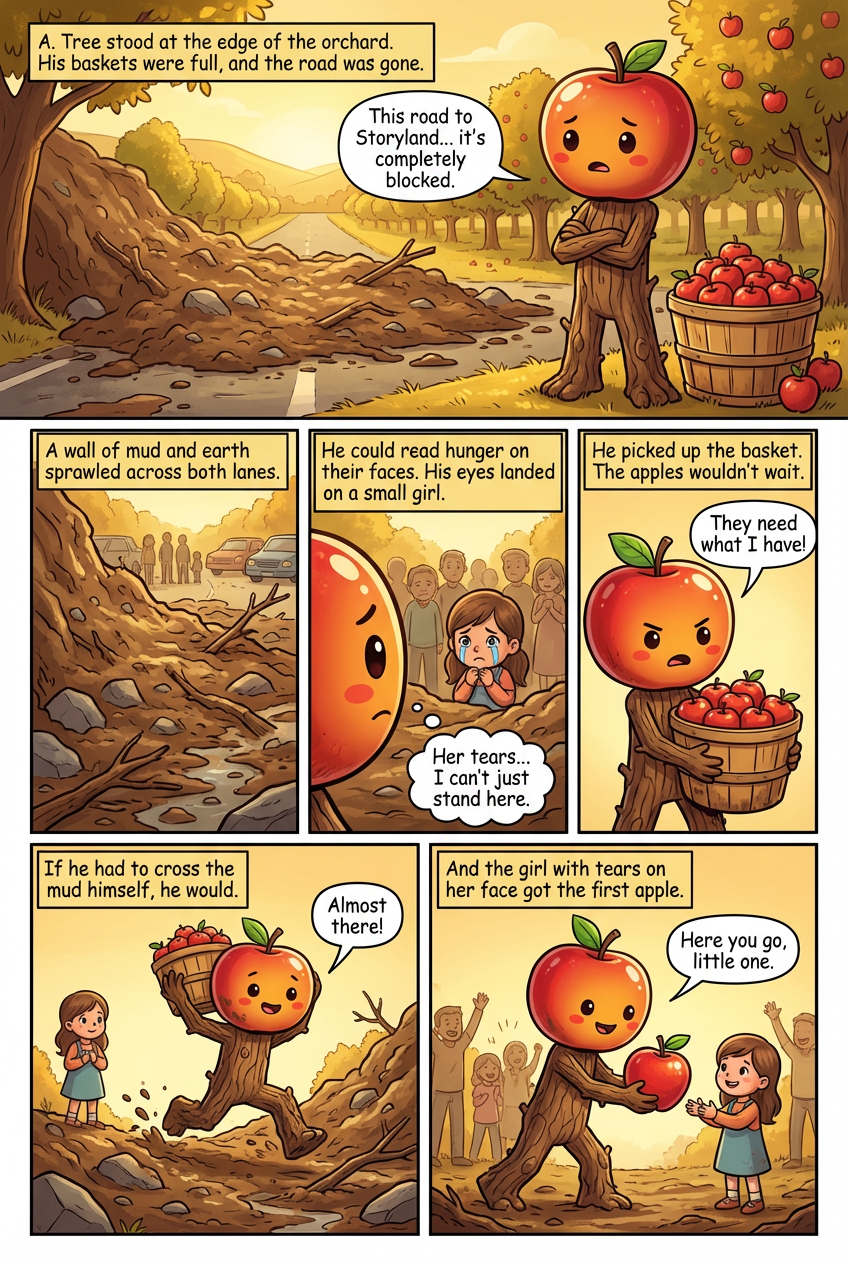
A. Tree stood at the edge of the orchard, staring down the empty road. His baskets were full, packed tight with apples that wouldn't last another day in the heat. The road into Storyland was the only way through, and something had blocked it completely. He walked closer and saw it: a wall of mud and earth sprawled across both lanes. Water still dripped from the edges. Rocks jutted out like broken teeth. Behind the slide, he could make out shapes—people waiting, cars stopped. They were trapped on the other side, just as he was trapped on this one. A. Tree set down his basket and studied the faces across the gap. He could read hunger from a distance now, after years of watching. His eyes moved from person to person until they landed on a small girl standing near the front. Her cheeks were streaked with tears. She looked maybe six years old. The sight of her pulled something tight in his chest. He picked up the basket again and started toward the mudslide. The apples wouldn't wait, and neither could he. If he had to cross through the mud himself, he would. Those people needed what he had, and the girl with tears on her face would get the first apple before she even had to ask.
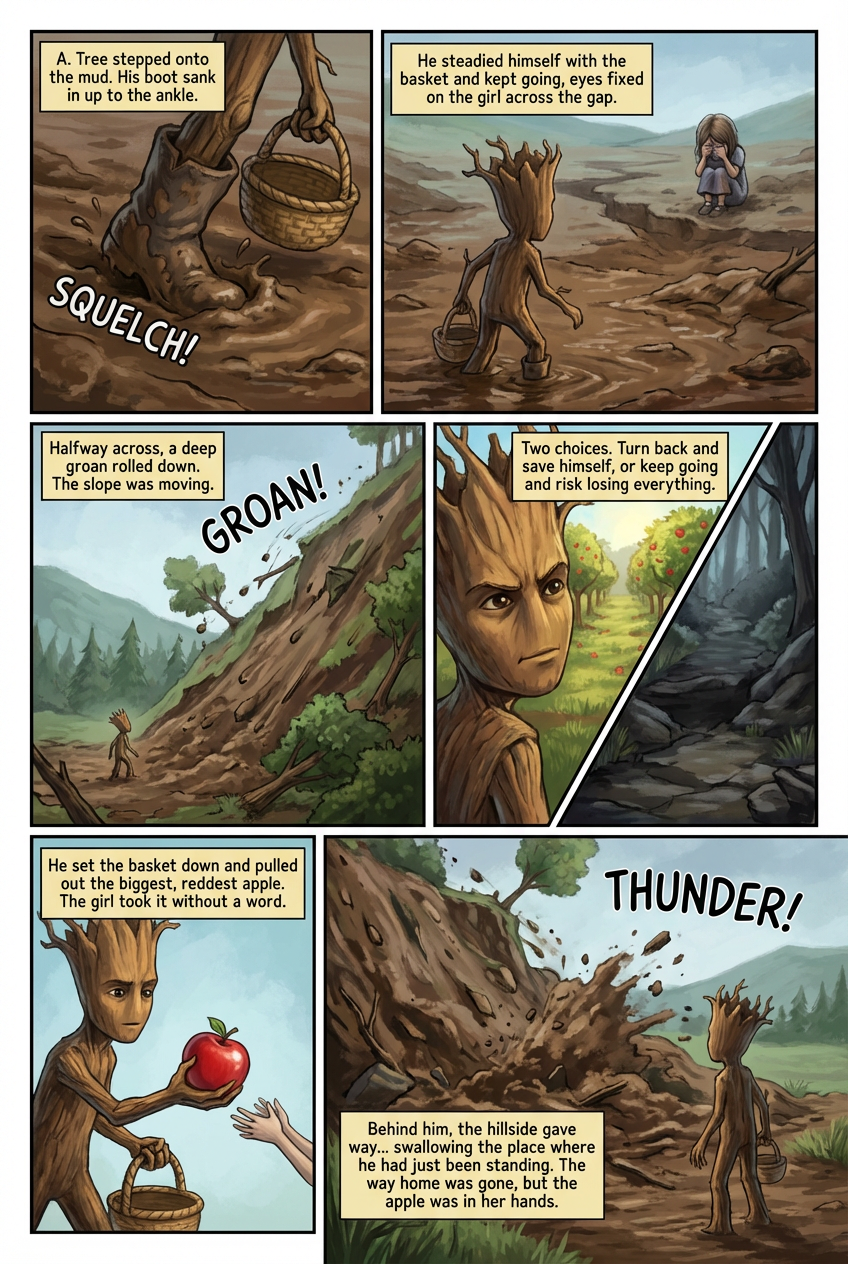
A. Tree stepped onto the mud. His boot sank in up to the ankle. He pulled it free with a wet sucking sound and took another step. The ground shifted beneath him. He steadied himself with the basket and kept going, eyes fixed on the girl across the gap. Halfway across, a deep groan rolled down from the hillside above. He looked up. The slope was moving. Mud slid over broken trees that had already fallen, coating their twisted branches. The whole face of the hill sagged forward like wet cloth. If it came down, it would bury the road behind him completely. The path back to his orchard would be gone. He had two choices. Turn back now and save himself, or keep going and risk losing everything. The girl was still crying on the other side. Her face was the kind of hungry he had learned to recognize years ago. Behind him, the hillside groaned again, louder this time. A sheet of mud peeled away and slumped down toward the road. A. Tree took three more steps through the mud and reached solid ground on the other side. He set the basket down and pulled out the biggest, reddest apple from the top. The girl looked up at him as he held it out to her. She took it without a word. Behind him, the hillside gave way with a sound like thunder. Mud poured across the road, swallowing the place where he had just been standing. The way home was gone, but the apple was in her hands.
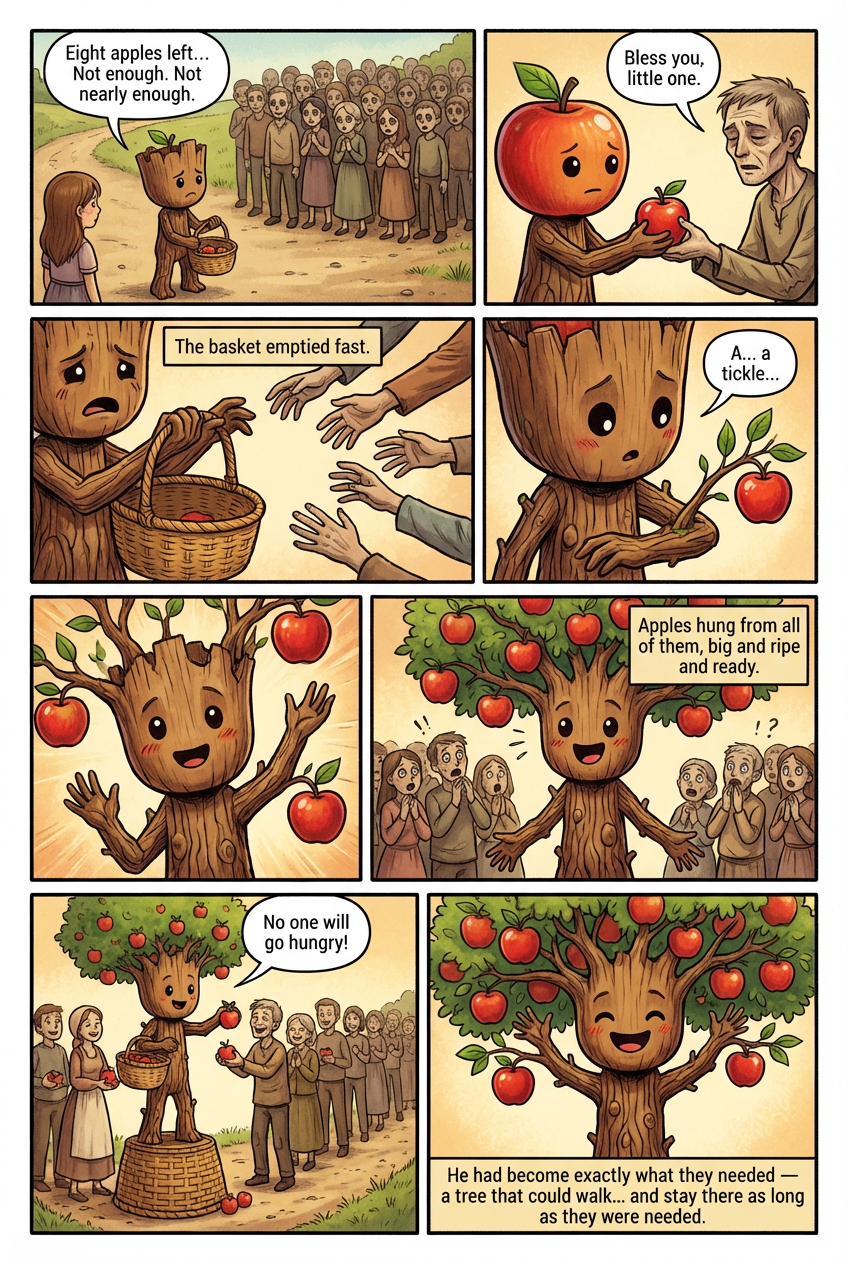
A. Tree turned from the girl and saw them. Twenty people, maybe thirty. They lined the edge of the road behind her, watching him with eyes that asked the same question. He looked down at his basket. Eight apples left. Not enough. Not nearly enough. He stepped forward anyway and started handing them out. One to a man with hollow cheeks. One to a woman holding a baby. One to a boy who looked about ten. The basket emptied fast. He reached in for the last apple and saw five more people pushing closer, hands reaching. His chest tightened. This was the moment he had feared every autumn in the orchard — the moment someone went without because he hadn't brought enough. Then he felt it. A tickle in his shoulder, like something pushing through from inside. He looked down and saw a branch growing from his arm, thin and green. An apple swelled at its tip, red and perfect. He stared at it. Another branch sprouted from his other shoulder. Then one from his chest. Apples hung from all of them, big and ripe and ready. The crowd gasped, but A. Tree didn't wait. He pulled the fruit from his own limbs and kept handing them out, one after another, as fast as they grew. The basket sat empty on the wooden platform someone had dragged over for him to stand on. He didn't need it anymore. People lined up in front of him now, and he gave each one an apple grown fresh from his own body. No one would go hungry. No one would be missed. He had become exactly what they needed — a tree that could walk to where the apples were wanted most, and stay there as long as they were needed.
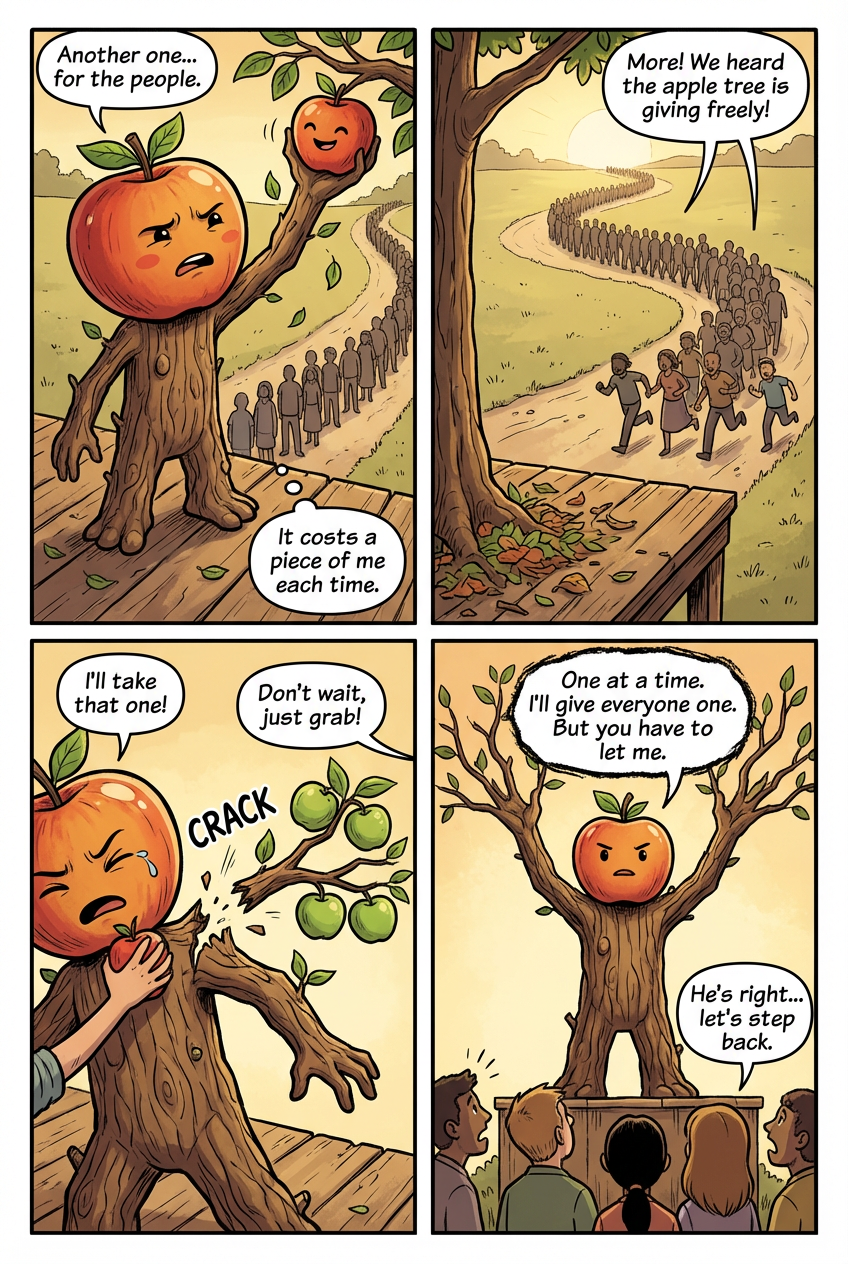
A. Tree kept pulling apples from his branches and handing them out. The line stretched longer now, winding down the road past the wooden platform. More people had come when they saw what he could do. He reached up and plucked another apple from his shoulder. But each apple he pulled took something with it. A small tear opened where the stem broke free, and bright green leaves fell to the ground at his feet. He looked down and saw them scattered around the platform — dozens of leaves mixed with broken twigs and stems, a carpet of what he was losing. His left shoulder ached where a branch had snapped off clean. He touched the spot and felt rough bark instead of skin. The crowd pressed closer. Hands reached from every direction, grabbing at the low-hanging fruit before he could offer it properly. Someone yanked an apple hard and a whole branch cracked, falling to the platform with three unripe apples still attached. A. Tree stumbled but steadied himself. He scanned the faces pushing forward and saw hunger, yes, but also something else — urgency that had turned greedy. They weren't waiting anymore. They were taking. He raised both arms high above his head, branches and all, pulling the remaining apples out of reach. The crowd went quiet. A. Tree spoke for the first time since the transformation, his voice rough like wind through bark. "One at a time. I'll give everyone one. But you have to let me." A woman in front nodded and stepped back. Others followed. The line reformed, slower this time, and A. Tree lowered his arms. He would keep giving, but only at a pace that wouldn't break him completely. He had learned the difference between generosity and surrender.
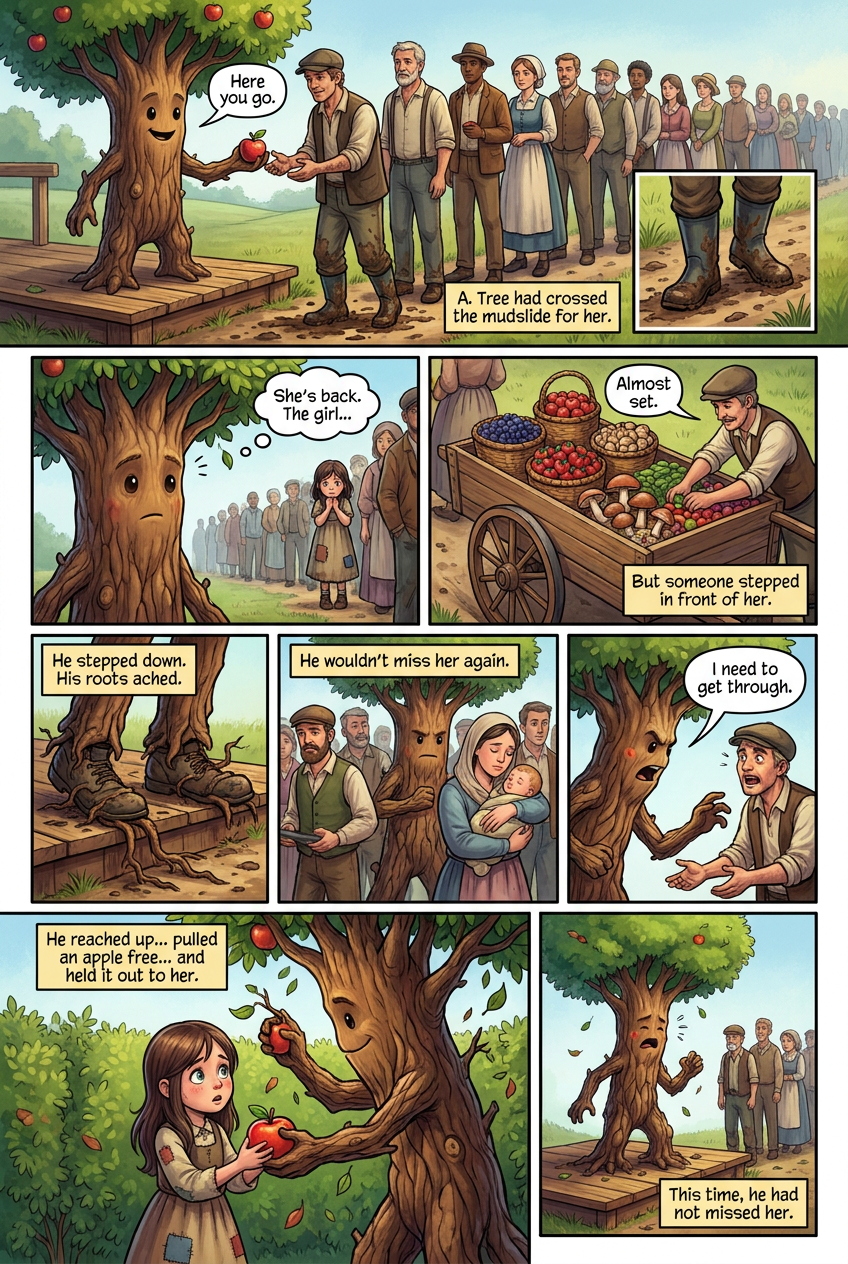
A. Tree handed another apple to a man with mud on his boots, then turned back toward the line. The six-year-old girl stood at the far end now, behind at least a dozen people. She had returned. His branches trembled as he spotted her — the same shy posture, the same way she hung back from the crowd. He had crossed the mudslide for her. He had promised himself he would hand her an apple before she even got close, without making her ask. But someone stepped in front of her, blocking his view completely. A wooden cart piled high with baskets of mushrooms and berries sat between them, its owner busy arranging produce while talking to the person ahead. The cart blocked the entire width of the path near an old stone monument where the line curved. A. Tree craned forward, trying to see past it, but thick hedges had grown up along both sides of the road where the crowd had trampled everything else flat. The girl was trapped back there, boxed in by the cart, the monument, and the press of bodies. He could lose sight of her again. He could miss her a second time. A. Tree stepped down from the wooden platform. His roots ached where they had pushed through his shoes, but he moved forward anyway, walking past the people waiting in line. Someone called out behind him, asking where he was going. He didn't answer. He pushed through the gap between two men and squeezed past a woman holding a sleeping baby. The cart owner looked up, startled, as A. Tree reached the wooden wheels. "I need to get through," A. Tree said. His voice came out rough. The cart owner stepped aside without a word, pulling the cart backward to clear the path. A. Tree moved past the monument and saw her standing there, pressed against the hedge, watching him with wide eyes. He reached up to his shoulder, pulled an apple free — felt the bark tear, ignored it — and held it out to her. She took it with both hands. A. Tree stayed there for a moment, breathing hard, leaves falling from his arms. Then he turned and walked back to the platform. The line waited. But this time, he had not missed her.
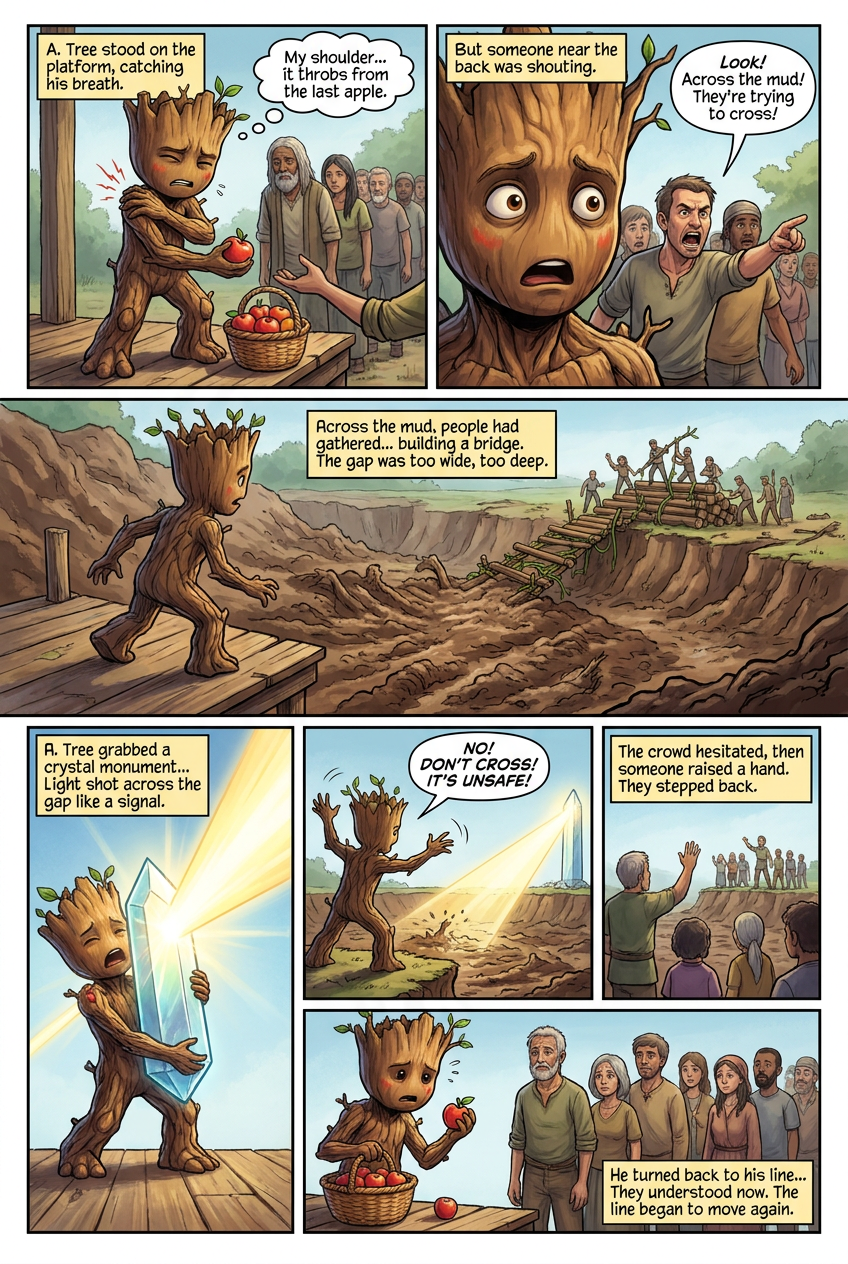
A. Tree stood on the platform, catching his breath. His shoulder throbbed where he had torn the apple free. The line stretched ahead of him again, patient now, faces watching and waiting. He lifted another apple from the basket at his feet and handed it forward. But someone near the back was shouting. A. Tree looked up and saw a man pointing toward the mudslide, toward the far side where the gap still gaped wide and empty. A. Tree followed the gesture and his branches went cold. Across the mud, people had gathered — twenty, maybe thirty of them, maybe more. They had stacked logs and vines into a crooked pile that reached halfway down the slope. They were building a bridge. They were going to try to cross. A. Tree stepped off the platform and moved toward the edge. The gap was fifty feet of liquid earth, too wide to jump and too deep to wade. But the crowd on the far side didn't know that. They only saw him here with apples, and they were hungry enough to risk it. He needed to stop them before someone stepped onto those logs and disappeared beneath the mud. A. Tree grabbed the tall crystal monument that stood near the road's edge — someone had placed it there weeks ago, back when the road was whole. He dragged it forward until it caught the last slant of afternoon sun. Light shot across the gap in a clean beam that swept over the far side like a signal. The people on the other side stopped moving. A. Tree waved both arms, branches creaking, and pointed down at the mud. He shook his head hard. No. Don't cross. The crowd hesitated, then someone raised a hand in return. They stepped back from the log pile. A. Tree pulled the monument away from the edge and let the light fade. His roots ached and his bark was cracked in three new places, but the far side was still. The log pile sat abandoned on the slope. He had reached them before they tried. He turned back toward his line, where faces watched him with new quiet. They had seen what he'd done. They understood now that he wasn't just handing out apples — he was keeping people alive on both sides of the mud. A. Tree walked back to the platform and picked up another apple. The line began to move again.
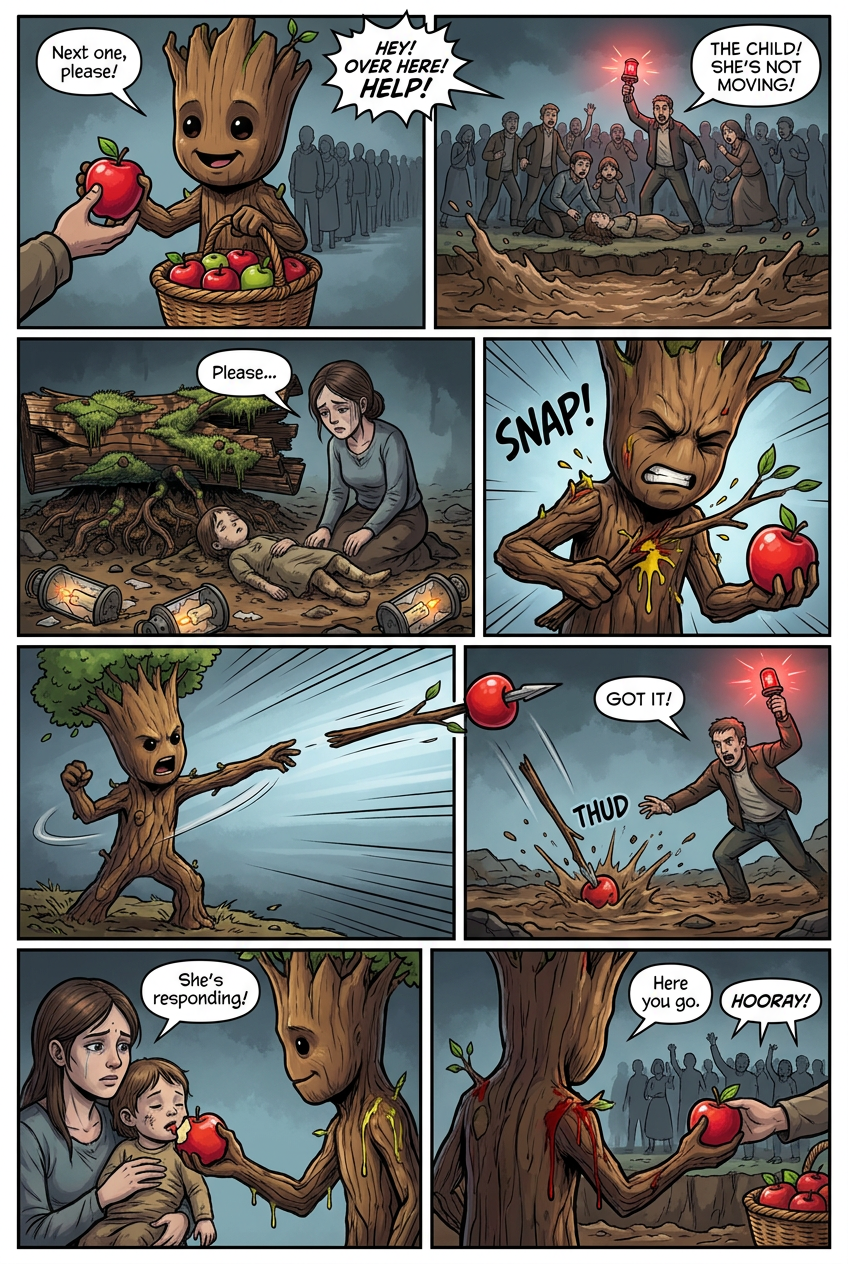
A. Tree had just handed an apple to the next person in line when a sound carried across the gap. It was high and panicked, a chorus of voices all at once. He turned. On the far side, the crowd had broken apart and clustered around something on the ground. A man stood at the front of the group waving a tall red beacon over his head, its light flashing hard against the gray sky. The man swung it back and forth and pointed down at his feet. A. Tree moved to the edge of the mud. He squinted across the fifty feet of soft earth. A child lay on the ground beside a fallen log, the kind with moss along its back and dark roots torn loose from the soil. The child was small and still. People had set down lanterns around the body in a rough circle, some tipped over with broken glass, candles guttering in the wind. They had emptied their hands of everything they carried so he would see. A woman knelt by the child's head and looked across the gap at him. Her face was the face he had spent a year trying to forget. A. Tree could not cross. He knew that. He had stopped them from crossing for the same reason. But the child needed something now, and an apple was the only thing he had. He reached up to his chest and snapped a branch free. The bark tore wide and sap ran down his trunk. He shaped the branch fast, stripping leaves until only a straight shaft remained, and pushed the reddest apple from his shoulder down onto its sharpened end. He stepped back, planted his roots, and threw. The branch arced over the mud. It came down hard in the soft earth two feet from the child. The apple held. The man with the beacon dropped it and lunged for the branch. He yanked the apple free and pressed it to the child's mouth. For a long moment nothing happened. A. Tree's bark ached where the branch had torn loose, and he could not breathe. Then the child's hand moved. The child bit. The crowd on the far side made a sound A. Tree felt in his roots. The woman lifted her daughter against her chest and looked across at him and nodded once. A. Tree nodded back. He turned to his line. They had all stopped to watch. He picked up the next apple from the basket and held it out to the next waiting hand. His shoulder was bleeding sap, and the gap was still there, and the child was breathing. That would have to be enough for today.
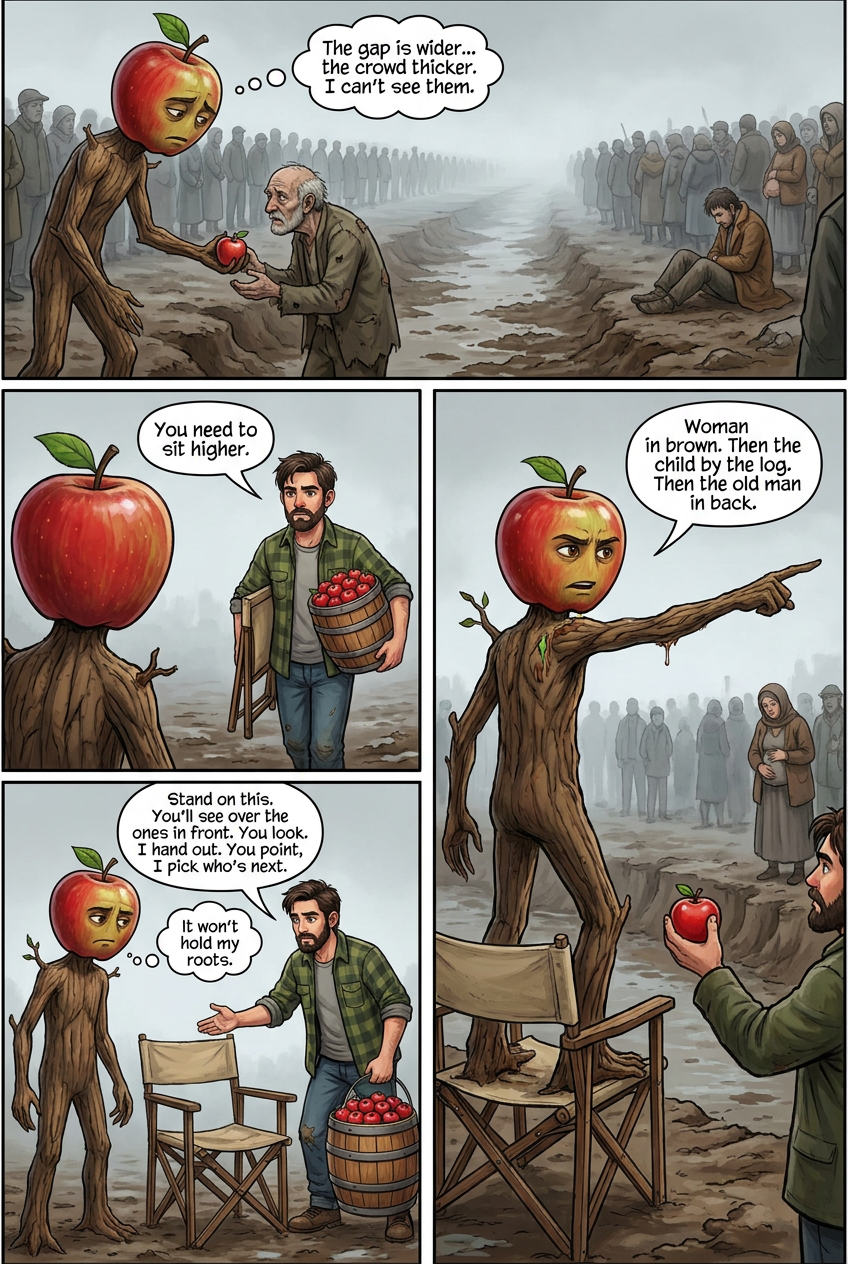
The next morning A. Tree's line stretched long again, and the mud gap looked wider than it had the day before. He handed an apple to a bent old man and then straightened up to scan the far side. The far crowd was thick. Heads bobbed behind heads. Someone in a brown coat sat down hard and did not get up, but A. Tree could not tell if the person was tired or sick. His eyes were good for the orchard, not for fifty feet of gray air. He kept losing faces in the crush. A hunger he might have caught in a second up close became a guess across the gap. He passed out three more apples and missed a boy sitting behind a woman's skirt entirely. The boy only stood up when his mother pulled him forward. A. Tree felt the old stone settle in his roots. He could not keep working like this. Someone would fold onto the mud before he saw them. "You need to sit higher." The voice came from behind him. A. Tree turned. Jerome stood at the edge of the line with a folding chair under one arm and a wooden barrel braced against his hip. The barrel was heaped with apples from the last picking A. Tree had done before the slide. Jerome had walked it up from wherever he had been keeping it. His flannel was dark at the shoulders from the weight. "Higher," Jerome said again. He set the barrel down. He shook the chair open and locked its wooden arms. The canvas was worn soft. "Stand on this. You'll see over the ones in front." A. Tree looked at the chair. "It won't hold my roots." "It'll hold long enough to look." Jerome pressed a boot on the seat to show it. "You look. I hand out. You point, I pick who's next." A. Tree understood. He stepped onto the canvas. The wood creaked but held. His head rose above the line, above the cart, above the crowd on his side. Across the gap the far crowd opened up like a map. He saw the person in the brown coat clearly now — a woman, gray-faced, holding her stomach. He saw a child with cracked lips near the log. He saw an old man behind two taller men, waiting without complaint. "Woman in brown," A. Tree said. "Then the child by the log. Then the old man in back." Jerome already had an apple in his hand. He walked to the barrel, chose the reddest, and held it up for A. Tree to throw. A. Tree pulled a branch from his shoulder, shaped it, and drove the apple across. It landed a foot from the woman's boot. "Next," Jerome said. A. Tree scanned. He did not miss anyone now. His shoulder bled sap onto the canvas, and he kept looking.
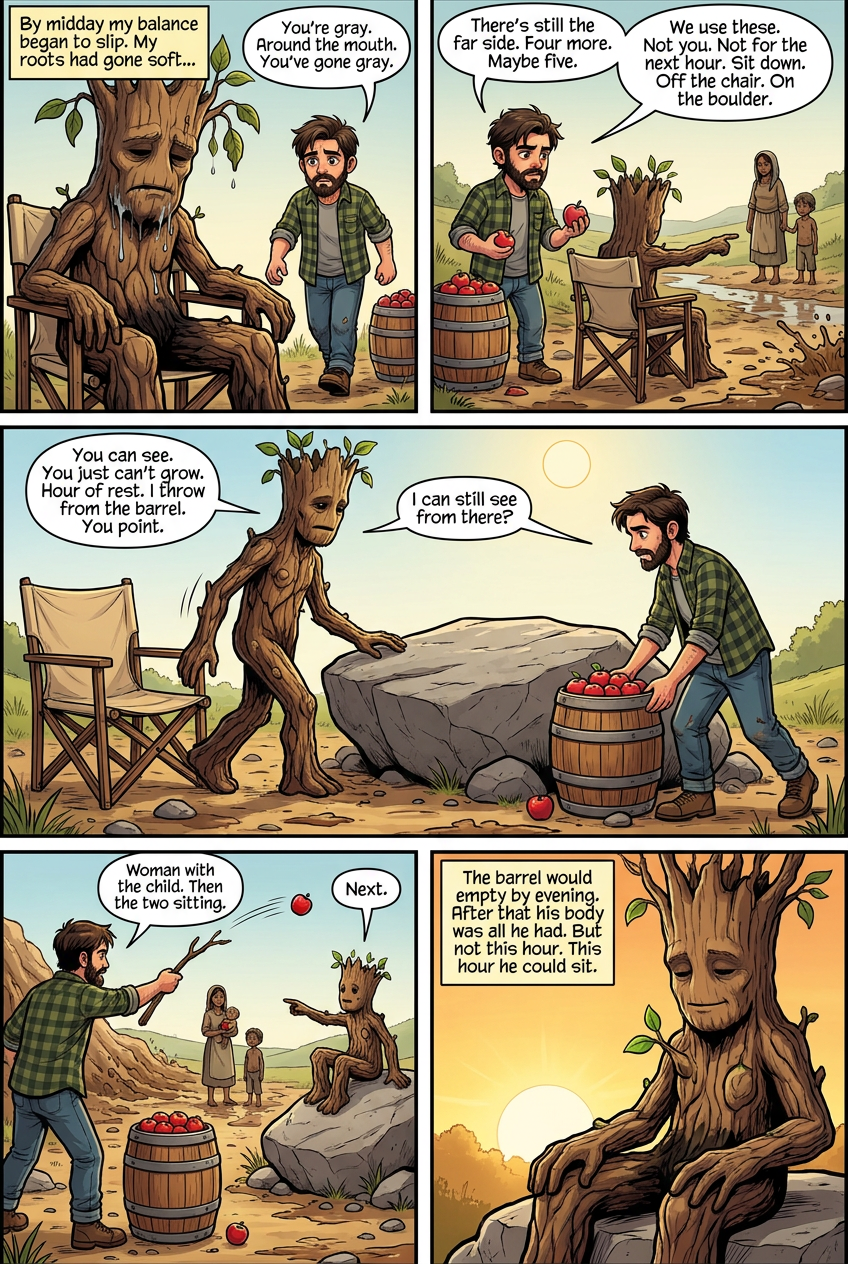
By midday A. Tree's balance began to slip on the folding chair. His roots had gone soft where they gripped the canvas. Every apple he tore from his chest left a wet gouge that did not close. Sap ran down his trunk and darkened his bark below the ribs. He had grown thirty apples since sunrise. His leaves were falling in slow spirals around Jerome's boots. Jerome noticed before A. Tree did. He caught the barrel just as A. Tree swayed and grabbed the chair arm to steady himself. "You're gray," Jerome said. "Around the mouth. You've gone gray." "There's still the far side." A. Tree pointed across the mud. A woman was holding up a thin child. Two more people sat on the ground behind her. "Four more. Maybe five." "You grow one more apple, you go down." Jerome set the barrel on the ground. He looked into it. There were still apples inside from the last orchard picking — real ones, red and heavy, forty or so left. "We use these. Not you. Not for the next hour." "They're for the ones I miss later. When the barrel's empty I have nothing to fall back on." "You'll have nothing to fall back on if you fall." Jerome picked out an apple and weighed it in his palm. "Sit down. Off the chair. On the boulder." A. Tree looked where Jerome pointed. A flat-topped rock sat six feet off the path, half sunk in the grass. He had not noticed it before. It was low enough to climb and wide enough to hold him. "I can still see from there?" "You can see. You just can't grow. Hour of rest. I throw from the barrel. You point." A. Tree stepped down. His bark scraped the canvas and left a smear. He walked to the boulder and lowered himself onto it. The stone was cool through his roots. He felt the pull in his chest ease for the first time since sunrise. Jerome came over with the barrel and set it beside the rock. He pulled a branch A. Tree had shaped earlier from the grass and held it up. "Woman with the child," A. Tree said. "Then the two sitting. Then the man in the brown coat came back — behind the log." Jerome nodded. He fitted an apple to the branch and threw. The apple crossed the gap and landed in the woman's hands. She sat down hard and pressed it to the child's mouth. "Next," Jerome said. A. Tree pointed. The sap on his chest began to thicken and crust. A small green leaf pushed out of the bark near his collarbone. He watched it unfurl and understood he would keep going tomorrow. The barrel would empty by evening. After that his body was all he had. But not this hour. This hour he could sit.
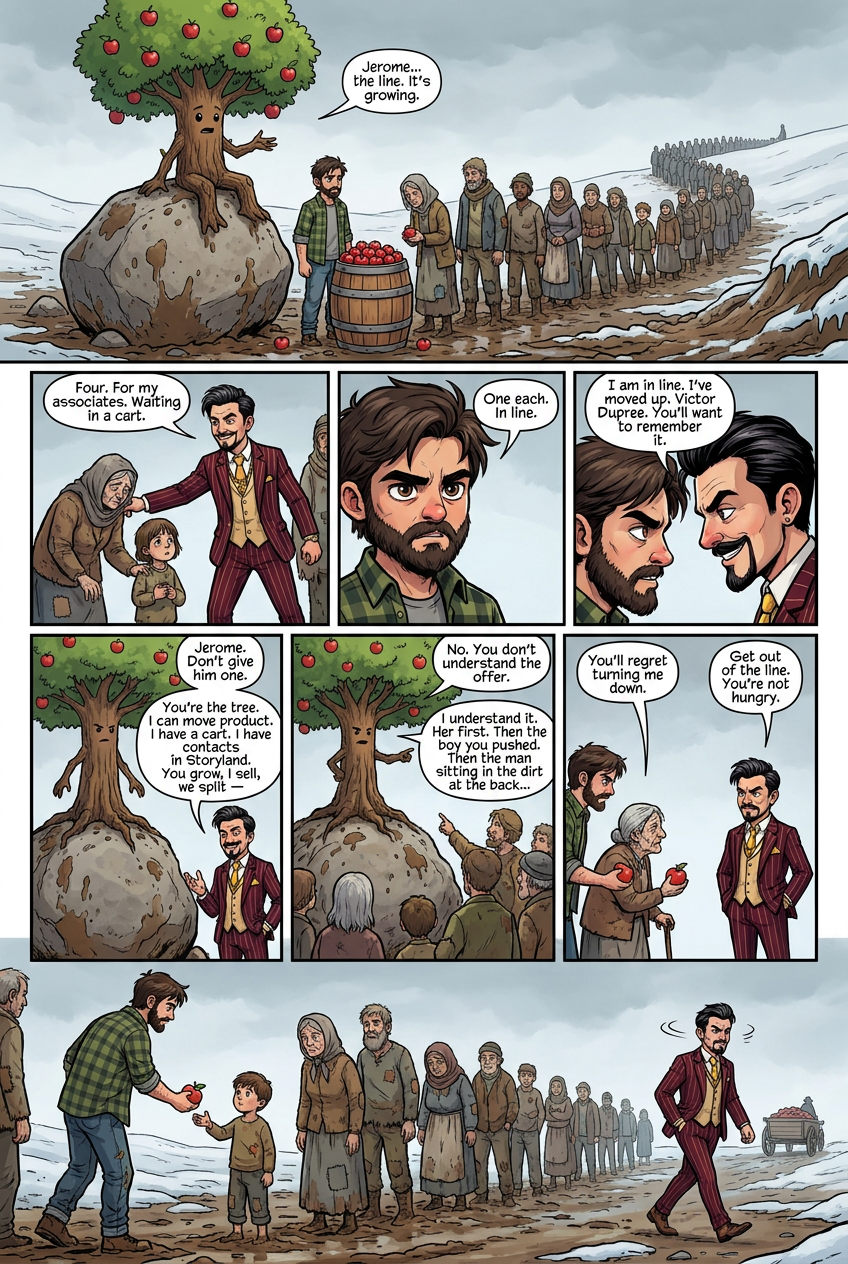
A. Tree sat on the boulder while Jerome worked the barrel. The rest was helping. The gray around A. Tree's mouth had faded to a dull green. But the line on the near side had grown. Word had spread. People pushed in from the road, and the ones at the back could not see who was at the front. A man in a maroon pinstripe suit stepped out of the line and walked its length like he owned it. His mustache was waxed into two points. A gold watch chain swung at his vest. He clapped a thin woman on the shoulder and slid past her. He pushed a boy sideways with his hip. He reached the front and held out both hands to Jerome. "Four," the man said. "For my associates. They're waiting in a cart down the road. Can't leave the horses." Jerome looked at him. "One each. In line." "I am in line. I've moved up." He smiled at Jerome the way a man smiles at a dog he plans to kick. "Victor Dupree. You'll want to remember it." Behind Dupree, an old woman had been knocked to one knee. A child was crying without sound. A. Tree saw a thin man at the back sit down in the dirt because he could not push anymore. "Jerome," A. Tree said. Jerome looked up at the boulder. "Don't give him one." Dupree turned. He saw A. Tree on the rock — the bark, the wet gouges, the leaves in the grass — and his smile widened. "You're the tree," Dupree said. "I'll speak to you, then. I can move product. I have a cart. I have contacts in Storyland. You grow, I sell, we split —" "No," A. Tree said. "You don't understand the offer." "I understand it." A. Tree stood up on the boulder. His roots gripped the stone. From up there he could see the whole line, all the way back, every face. He pointed past Dupree at the old woman on her knee. "Her first. Then the boy you pushed. Then the man sitting in the dirt at the back. Then the woman with the gray scarf. Then the child behind her." Jerome was already moving. He walked around Dupree as if Dupree were a post in the ground. He put an apple in the old woman's hands and helped her stand. Dupree's smile stayed but his eyes went flat. "You'll regret turning me down." "Get out of the line," A. Tree said. "You're not hungry." A few people in the line looked at Dupree then. Not many. But enough. He felt it and stepped back onto the road, brushing his sleeve where the boy had touched him. Jerome worked down A. Tree's list. The desperate ones ate. A. Tree watched Dupree walk toward the cart on the road and knew he had not gone far.
Play your story to life
Storycraft is a mobile game where you create AI characters, craft items and locations to build their world, then discover what direction your story takes. Download the iOS game for free today!
Download for free