

Dorothea Puentes's Arc
9 Chapters
Dorothea Puentes's dream is earning complete trust from the suspicious social worker investigating complaints..

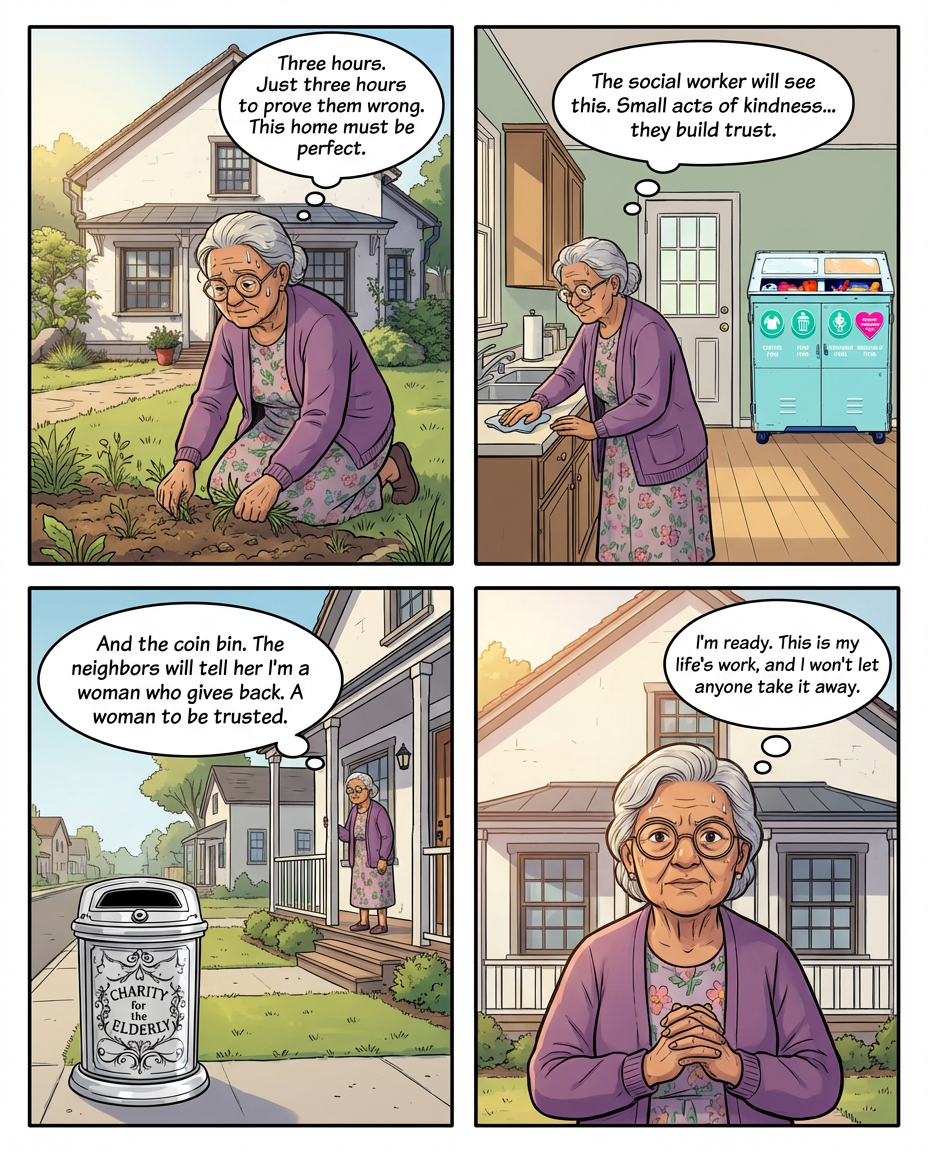
Dorothea pulled weeds from the garden bed, her knees pressed into the soft dirt. She wanted the social worker to see a perfect home. Trust was everything now. If she could prove the complaints were wrong, maybe life would settle down again. The white boarding house stood behind her, quiet in the morning light. Each window needed washing. The porch steps needed sweeping. She had three hours before the visit. Three hours to show she ran a good place. Three hours to prove the neighbors were mistaken about her. She pushed herself up from the dirt and brushed off her floral dress. Her glasses had slipped down her nose from the work. The social worker would ask questions about her tenants. About the meals she cooked. About how she managed the house alone. Dorothea had answers ready. Simple answers. Honest answers. The boarding house was her life's work, and she wouldn't let anyone take it away. She picked up the garden basket and walked toward the front door. Time to make everything shine. Inside, she wiped down the kitchen counters and checked the donation bin by the back door. The metal container held three sections marked with labels. Clothes on the left. Food in the middle. Household items on the right. She collected items from her tenants each week and took them to families who needed help. The social worker should know about this. It showed she cared about the community. It showed she wasn't the person from the complaints. Dorothea straightened the labels and made sure everything looked organized. Small acts of kindness mattered. They built trust, one piece at a time. She walked to the front porch and looked down the street. The charity coin bin sat near the corner, its metal surface catching the sunlight. She had placed it there two months ago to collect money for elderly folks who needed help with medicine and food. The bin had intricate designs carved into the sides, and people stopped to drop coins in every day. Dorothea managed the donations herself, making sure every penny went where it was needed. At least, that's what everyone believed. The social worker would hear about it from the neighbors. They would tell her that Dorothea Puentes was a woman who gave back. A woman who could be trusted. And that's exactly what she needed them to say.
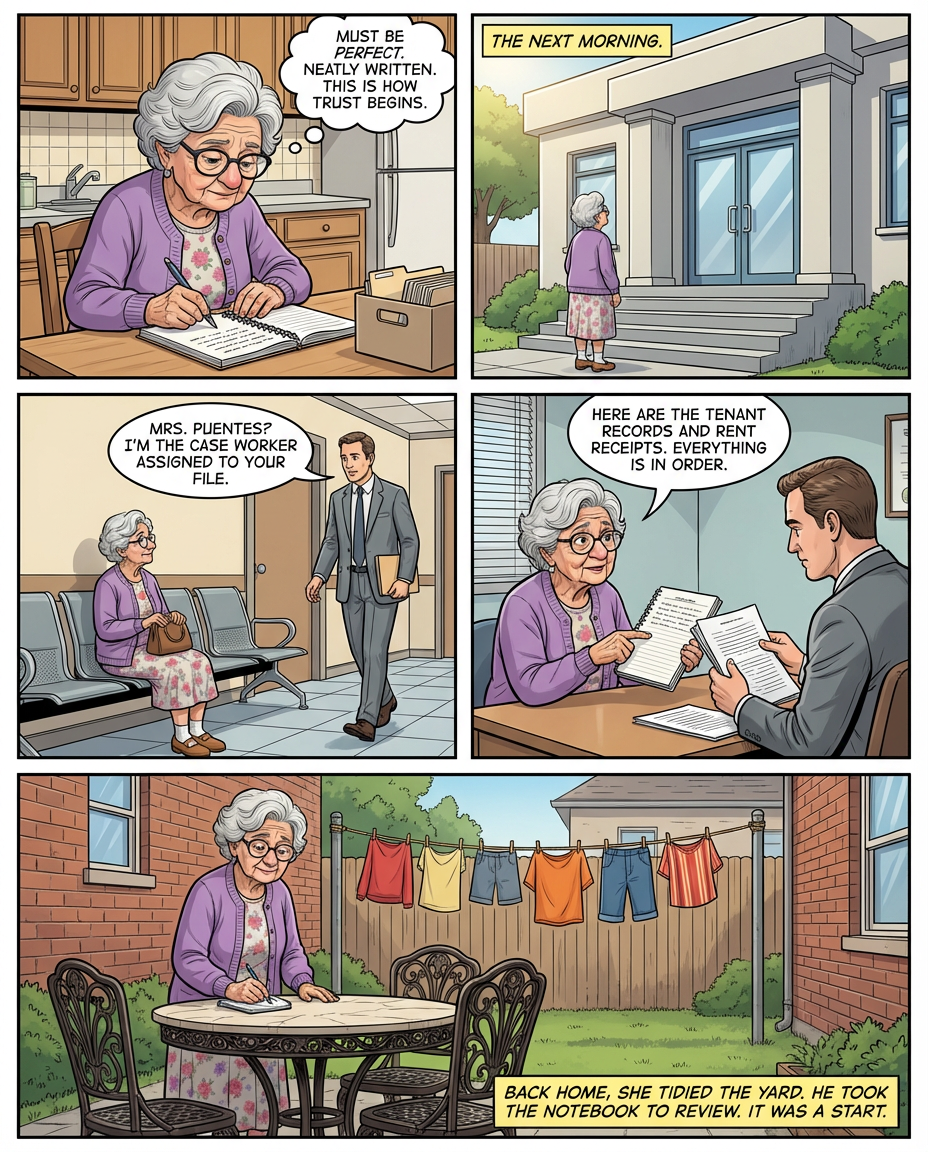
Dorothea sat at her kitchen table with a spiral notebook open in front of her. She needed to prepare for the social worker's questions. The first step was writing down every tenant's name and their room number. She clicked her pen and started the list. Mr. Chen in room three. Mrs. Wallace in room five. Each name had to match perfectly with the rent receipts in her file box. She couldn't let anything look messy or confused. The social worker would check everything. Dorothea wrote slowly, making sure her handwriting stayed neat and clear. This was how trust began—with perfect records and honest answers. She closed the notebook and tucked it into her purse. Tomorrow she would go to the social services office herself. Waiting for another home visit felt wrong. Taking action showed she had nothing to hide. The next morning, Dorothea stood at the bottom of the concrete steps. The social services office rose in front of her, all glass doors and clean lines. She pushed through the entrance and walked to the front desk. A woman looked up and asked how she could help. Dorothea gave her name and said she wanted to speak with whoever handled the complaint about her boarding house. The woman made a phone call, then pointed to a row of chairs against the wall. Dorothea sat down and placed her purse on her lap. Her notebook was inside, ready. She had taken the first real step toward fixing this problem. She would show them her records. She would answer every question. And she would prove that the complaints were wrong. A door opened down the hall. A man in a gray suit walked toward her carrying a folder. He introduced himself as the case worker assigned to her file. Dorothea stood and shook his hand firmly. He led her to a small office with two chairs facing each other across a desk. She sat down and pulled out her notebook before he even asked. The man looked surprised. She opened to the first page and showed him the list of tenants with their room numbers. Then she showed him the receipts she had brought. He flipped through the papers slowly, his face giving away nothing. Dorothea kept her hands folded in her lap and waited. Back at the boarding house that afternoon, Dorothea walked into the backyard. She needed to do something normal after the meeting. The wrought iron table and chairs sat near the back door, their marble top catching the afternoon light. She wiped down the surface and arranged the chairs evenly. A laundry line stretched between the buildings, rope pulled tight between two steel posts. One of her tenants had hung shirts there this morning. The sleeves moved slightly in the breeze. Everything looked orderly. Everything looked cared for. The social worker had taken her notebook and said he would review her records. He hadn't smiled, but he had thanked her for coming in. That was something. That was a beginning.
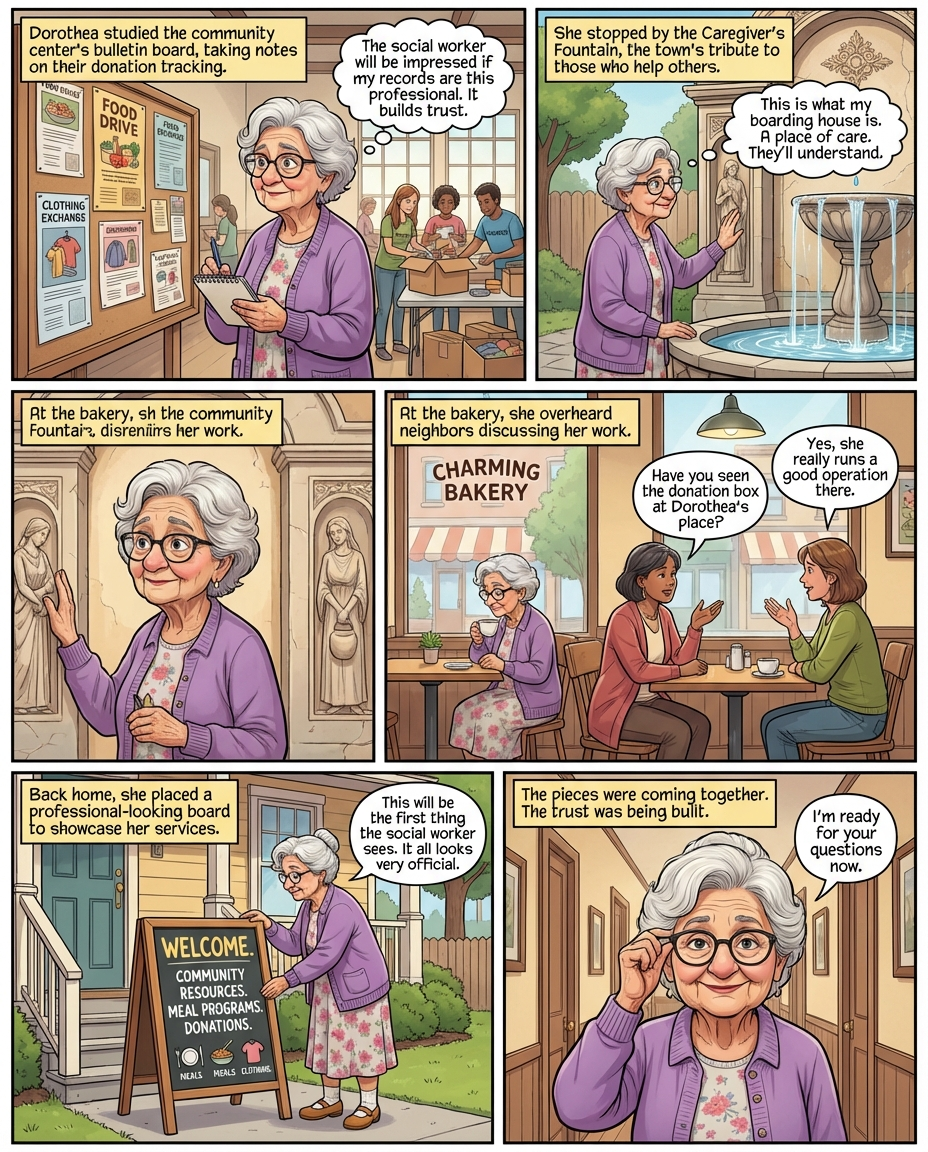
Dorothea stood in the community center's main hall, watching volunteers sort through donation boxes. She had come here to learn how other people organized their charity work. The social worker might ask about her donation bin and the coin collection, so she needed to show she understood proper procedures. A bulletin board covered one wall, filled with flyers about food drives and clothing exchanges. She studied each notice, reading the details about how they tracked donations and kept records. One flyer explained a system using colored tags to mark different types of items. Another showed a chart for logging cash contributions. Dorothea pulled a small notepad from her purse and copied down the information. If she could prove her charity work followed real guidelines, the social worker would see her boarding house as part of something bigger. She wasn't just some landlord collecting rent—she was someone who helped her community. That's what would build trust. Outside, the carved stone fountain caught her attention. Water flowed over relief scenes showing people caring for others. The fountain honored those who dedicated their lives to helping the elderly and vulnerable. Dorothea stood watching the water cascade down the stone. This was what she wanted the social worker to understand about her. The boarding house wasn't just a business. It was her way of serving people who needed help. She touched the cool stone and traced one of the carved figures with her finger. The town recognized caregivers with this fountain. They valued people like her. She walked down the street and stopped at a bakery with bright painted signs in the window. Through the glass, she could see neighbors sitting at small tables near a brick oven. They talked over coffee and pastries, catching up on neighborhood news. This was where people gathered every morning. This was where they would talk about her charity work. Dorothea pushed open the door and stepped inside. The smell of fresh bread filled the air. She ordered coffee and sat down near the window. Two women at the next table discussed a food drive. One of them mentioned the coin collection box on Dorothea's corner. "That woman runs a good operation," one said. Dorothea kept her eyes on her coffee cup, but she listened carefully. These conversations would reach the social worker eventually. Back at the boarding house, Dorothea placed a colorful welcome board near her front steps. The painted wood frame held information about services she offered and resources for people who needed help. Icons showed meal programs and donation collections. The board looked professional and inviting. When the social worker visited again, this would be one of the first things he saw. Dorothea stepped back and checked that the board stood straight. Everything she had learned today was coming together. The proper tracking systems. The town's respect for caregivers. The neighbors who spoke well of her work. These pieces would build the trust she needed. She straightened her glasses and walked back inside, ready for whatever questions came next.
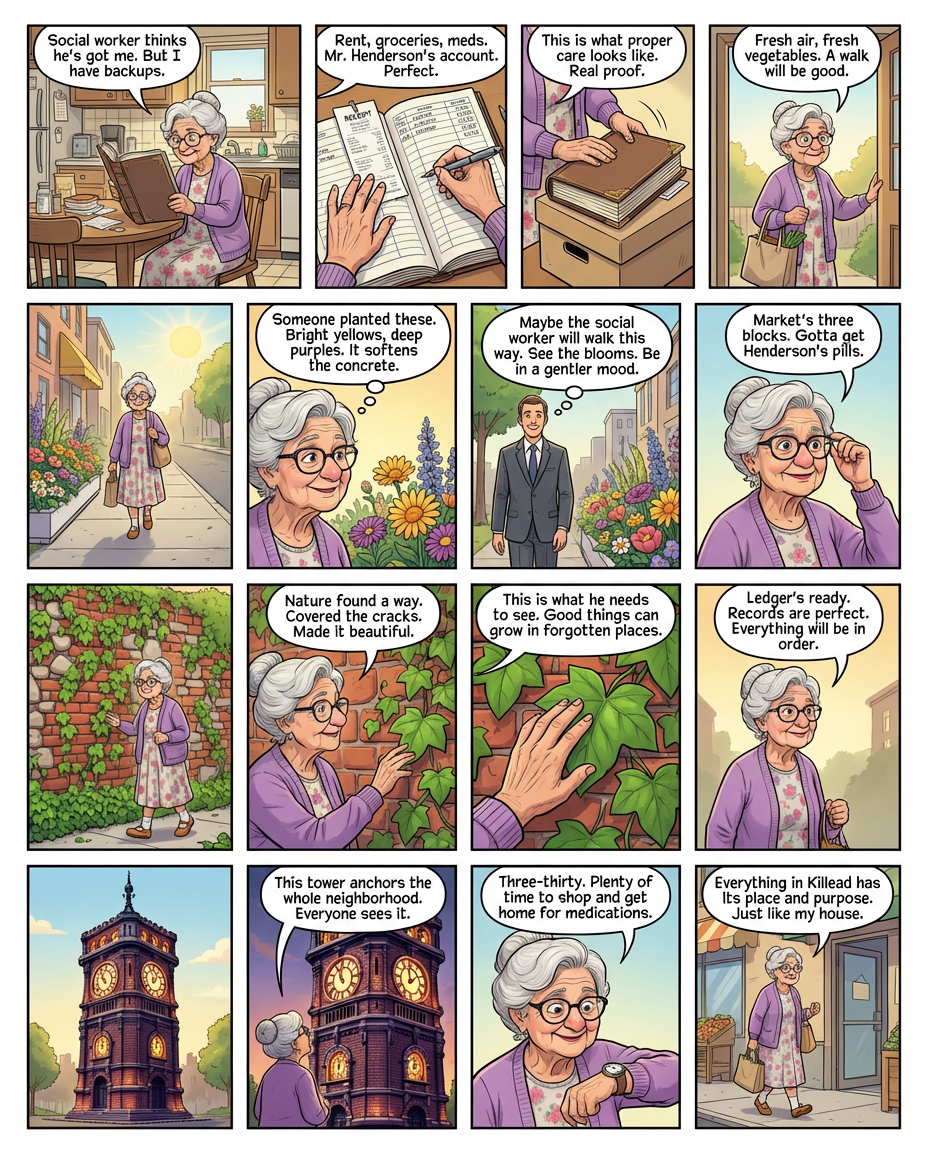
Dorothea pulled the heavy ledger from her office shelf and carried it to the kitchen table. The social worker had kept her notebook, so she needed backup records ready for his next visit. She opened the book and ran her finger down the columns of numbers—rent payments, grocery expenses, medication costs. Every dollar had its place. Every transaction had a date. She turned the page and checked Mr. Henderson's account against the receipt stapled to the corner. The numbers matched perfectly. This was what proper care looked like. Real documentation. Real proof. She closed the ledger and placed it on top of her file box, right where she could grab it quickly if needed. The afternoon sun had warmed the kitchen enough to make her restless. Dorothea grabbed her canvas shopping bag and headed outside. She needed fresh vegetables for tonight's dinner, and a walk would clear her head. The sidewalk stretched ahead, lined with colorful flowers in modern planters. Someone had planted them recently—bright yellows and deep purples that hadn't been there last week. She slowed her pace to look at them. The flowers softened the concrete and made the street feel less harsh. For a moment, she imagined the social worker walking this same route to her house, seeing these cheerful blooms, arriving with a gentler mood. She straightened her glasses and kept walking. The market was three blocks away, and she still had Mr. Henderson's blood pressure pills to organize before dinner. The flowers stayed behind her, a small bright spot in an otherwise ordinary day. Two blocks later, she passed an old brick wall where ivy pushed through the mortar. Green tendrils covered half the surface, reaching into every crack and gap. Dorothea stopped to examine how the leaves wound around the bricks. Nature had found its way into this corner without anyone's help or permission. The ivy had simply claimed the space and made it beautiful. She touched one of the leaves and felt the cool, waxy surface against her fingertips. Maybe this was what the social worker needed to see—that good things could grow even in forgotten places, even where people expected nothing but neglect. She pulled her hand back and continued toward the market. The ledger was ready. The records were perfect. And now she had seen two things that made Killead look gentler than it was. When the social worker returned, everything would be in order. At the corner, the brick clock tower rose above the buildings. Its four clock faces glowed in the afternoon light, showing half past three. Dorothea had walked past this tower hundreds of times, but today she noticed how it anchored the whole neighborhood. People used it to find their way around town. Visitors noticed it first when they arrived. The social worker would have seen it too. She stood at its base and looked up at the worn bricks and the steady movement of the clock hands. This tower had been here longer than her boarding house. It had watched the town change and grow. She turned toward the market, checking the time one more time. Three thirty-five. She had enough time to shop and get home before the evening medications were due. Everything in Killead had its place and its purpose, just like everything in her house. The social worker would understand that soon enough.
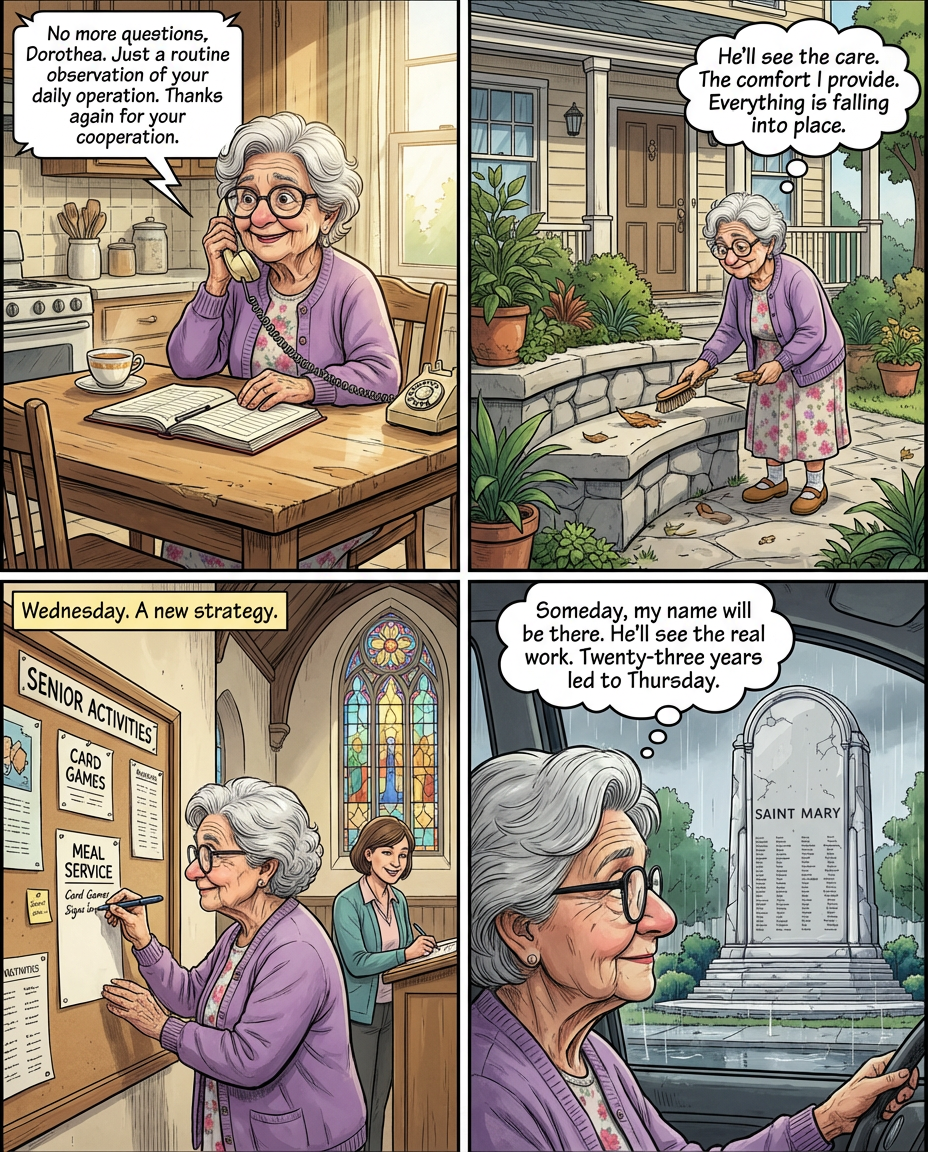
The social worker's voicemail came through at nine in the morning. His tone was friendly, almost warm. He thanked Dorothea for her cooperation and said her records had been very helpful. He wanted to schedule another visit, but this time just to observe her daily routine with the tenants. No more questions about the accounts. No more requests for documentation. Just a chance to see how smoothly things ran. Dorothea played the message three times, listening for any hint of doubt or suspicion. She found none. Her chest felt lighter than it had in weeks. The ledger had worked. The proper systems had proven themselves. She set her phone down and smiled at the kitchen wall. Progress. Real, solid progress. She called him back and scheduled the visit for Thursday afternoon. After she hung up, she walked outside to check the front entrance. The curved stone planter seating she'd placed near the office door last week looked perfect—smooth edges, potted plants on each side. The social worker would see it when he arrived. He'd notice she cared about making her tenants comfortable, about giving them a peaceful spot to sit. She brushed a few dried leaves off the stone surface and adjusted one of the planters. Everything was falling into place. The records were clean. The house was organized. The social worker's voice had sounded pleased, almost satisfied. She straightened her glasses and headed back inside. Thursday would prove what she'd known all along—that her boarding house ran better than any other place in Killead. By Wednesday afternoon, Dorothea had decided to add one more piece to her strategy. She drove to the church with the large community room and spoke to the coordinator about their senior activities program. They needed volunteers for their weekly card games and meal service. Dorothea signed up for both. The coordinator thanked her and wrote her name on the schedule board. When the social worker asked about her dedication to elderly welfare, she would have this to show him. Real volunteer work at a real community building. She walked back to her car and felt the weight of the past weeks lifting. The suspicion was ending. The trust was building. Thursday afternoon would be the final step, and everything was ready. On her drive home, she passed the town square and spotted the monument she'd seen months ago but never really noticed. The stone memorial stood tall, its surface carved with names of people who had helped others. Rain and weather had worn the stone smooth over the years. She slowed the car and read the inscription at the base—dedicated to those who cared for the vulnerable. Her name wasn't there, but it could be someday. The social worker would learn what kind of person she was. He would see past the complaints and recognize her true work. She pulled away from the square and headed home. Twenty-three years of running the boarding house had led to this moment. Thursday would show him everything.
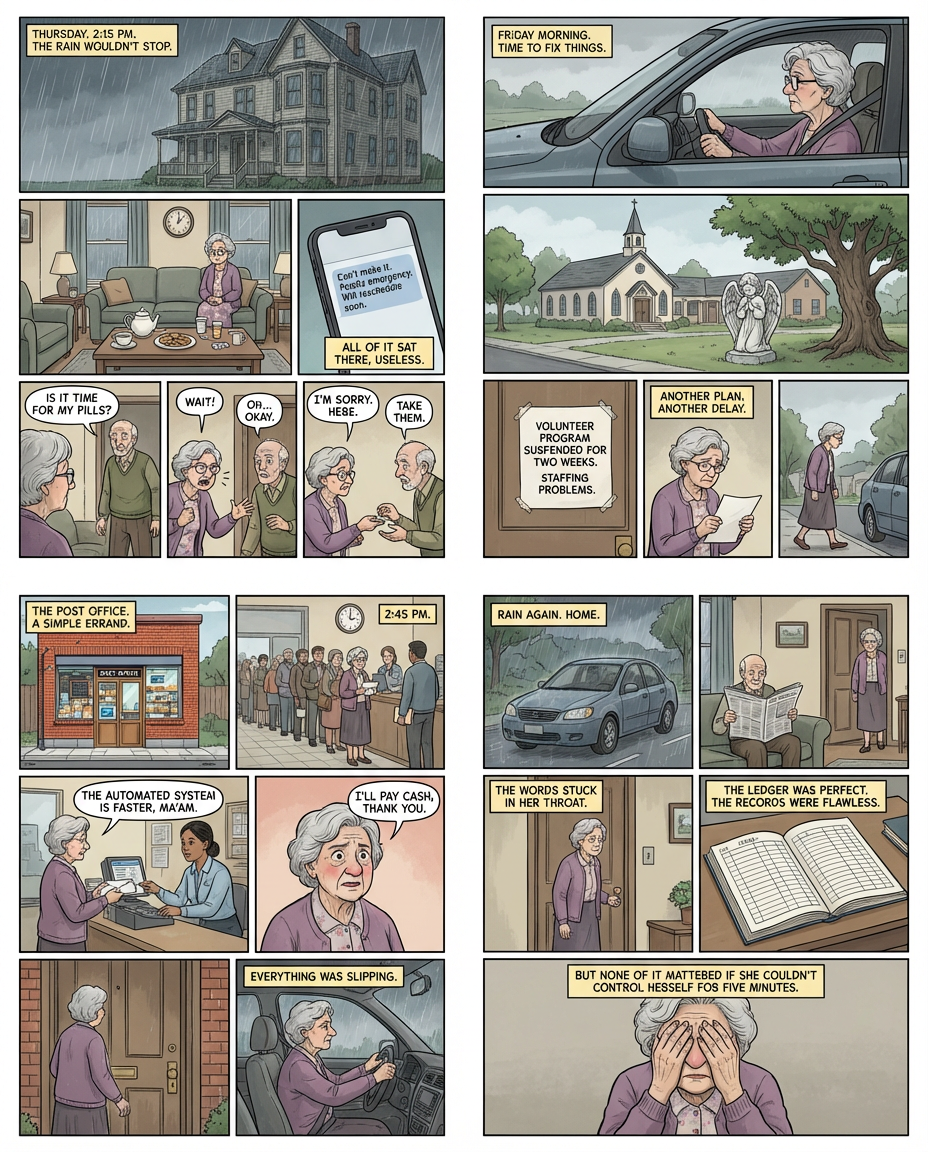
Thursday arrived with heavy rain that drummed against the boarding house windows. Dorothea had set out tea and cookies in the front room where the social worker could observe her afternoon medication routine. She checked the clock—two fifteen. He was supposed to arrive at two. She straightened the pillows on the couch and waited. By two thirty, her phone buzzed with a text message. He couldn't make it today. A family emergency had come up. He'd reschedule soon. Dorothea read the message twice, her jaw tightening. She looked at the tea she'd prepared, the cookies arranged on her best plate, the medication cups lined up perfectly on the tray. All of it sat there, useless. Mr. Henderson shuffled into the room and asked if it was time for his pills. She snapped at him to wait, her voice sharp enough to make him step back. The moment hung between them, awkward and tense. She took a breath and softened her tone, apologizing. But the damage was done. He looked at her differently now, uncertain. She handed him his pills and watched him leave. The social worker hadn't seen her careful preparations. He'd only seen nothing at all. By Friday morning, Dorothea needed to fix things. She drove through Killead, past the church with the large community room where she'd signed up to volunteer. The building looked peaceful in the morning light. A white praying angel sculpture stood near the entrance, hands folded and wings curved gently. An old gnarled elm tree framed the other side, its twisted branches and gray bark weathered by decades. She parked and went inside to confirm her volunteer schedule. The coordinator wasn't there. A note on the desk said the program had been suspended for two weeks due to staffing problems. Dorothea stared at the paper. Another plan, another delay. She walked back outside and got in her car. She drove to the brick post office to mail her utility payments. The line stretched long inside, filled with people holding packages and envelopes. She waited twenty minutes, watching the clock above the counter. When she finally reached the front, the clerk told her the automated payment system was faster. Dorothea's face flushed. She pushed her envelopes across the counter anyway and paid in cash. Outside, she sat in her car and gripped the steering wheel. Everything was slipping. The social worker had cancelled. The volunteer program was suspended. Even the simple act of mailing bills had made her look foolish. She drove home slowly, the rain starting again. Mr. Henderson was in the front room when she arrived, reading a newspaper. He glanced up at her but didn't speak. She wanted to explain that she'd been tired yesterday, that she hadn't meant to snap at him. But the words stuck in her throat. Instead, she walked to her office and shut the door. The ledger sat on her desk, perfect and organized. The records were flawless. But none of it mattered if she couldn't control herself for five minutes when things went wrong. She pressed her palms against her eyes and tried to think of what came next.
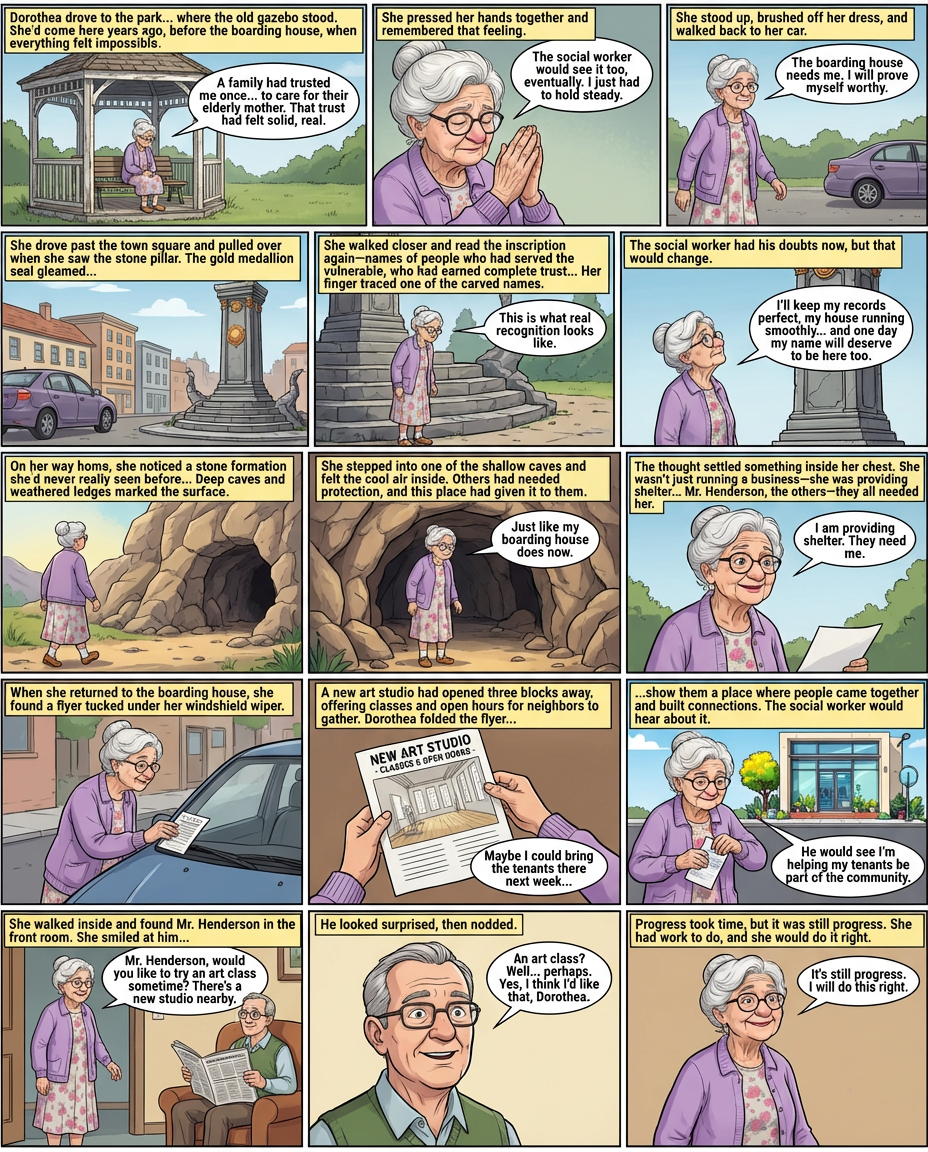
Dorothea drove to the park on the edge of Killead where the old gazebo stood. She'd come here years ago, before the boarding house, when everything felt impossible. The white paint had faded to gray now, and the wooden bench inside sagged in the middle. She sat down and looked out at the empty grass. A family had trusted her once, long ago, to care for their elderly mother when no one else would. She'd organized that woman's medications, balanced her accounts, made sure she had three meals a day. The woman had smiled at her every morning and called her an angel. That trust had felt solid, real. Dorothea pressed her hands together and remembered that feeling. The social worker would see it too, eventually. She just had to hold steady. She stood up, brushed off her dress, and walked back to her car. The boarding house needed her, and she would prove herself worthy of that need. She drove past the town square and pulled over when she saw the stone pillar standing at the corner. The gold medallion seal gleamed even in the afternoon light. Granite steps led up to the monument, worn smooth by years of visitors. She walked closer and read the inscription again—names of people who had served the vulnerable, who had earned complete trust from those they helped. Her finger traced one of the carved names. This was what real recognition looked like. The social worker had his doubts now, but that would change. She would keep her records perfect, keep her house running smoothly, and one day her name would deserve to be here too. On her way home, she noticed a stone formation she'd never really seen before, set back from the road. Deep caves and weathered ledges marked the surface. She parked and walked closer. The rock had sheltered people once, long before the city grew around it. She stepped into one of the shallow caves and felt the cool air inside. Others had needed protection, and this place had given it to them. Just like her boarding house did now. The thought settled something inside her chest. She wasn't just running a business—she was providing shelter to people who had nowhere else to go. Mr. Henderson, the others—they all needed her. She stepped back into the sunlight and headed for her car. When she returned to the boarding house, she found a flyer tucked under her windshield wiper. A new art studio had opened three blocks away, offering classes and open hours for neighbors to gather. High ceilings, tall windows, space for painting and conversation. Dorothea folded the flyer and put it in her pocket. Maybe she could bring the tenants there next week, show them a place where people came together and built connections. The social worker would hear about it. He would see that she wasn't just managing accounts—she was helping her tenants be part of the community. She walked inside and found Mr. Henderson in the front room. She smiled at him and asked if he'd like to try an art class sometime. He looked surprised, then nodded. Progress took time, but it was still progress. She had work to do, and she would do it right.
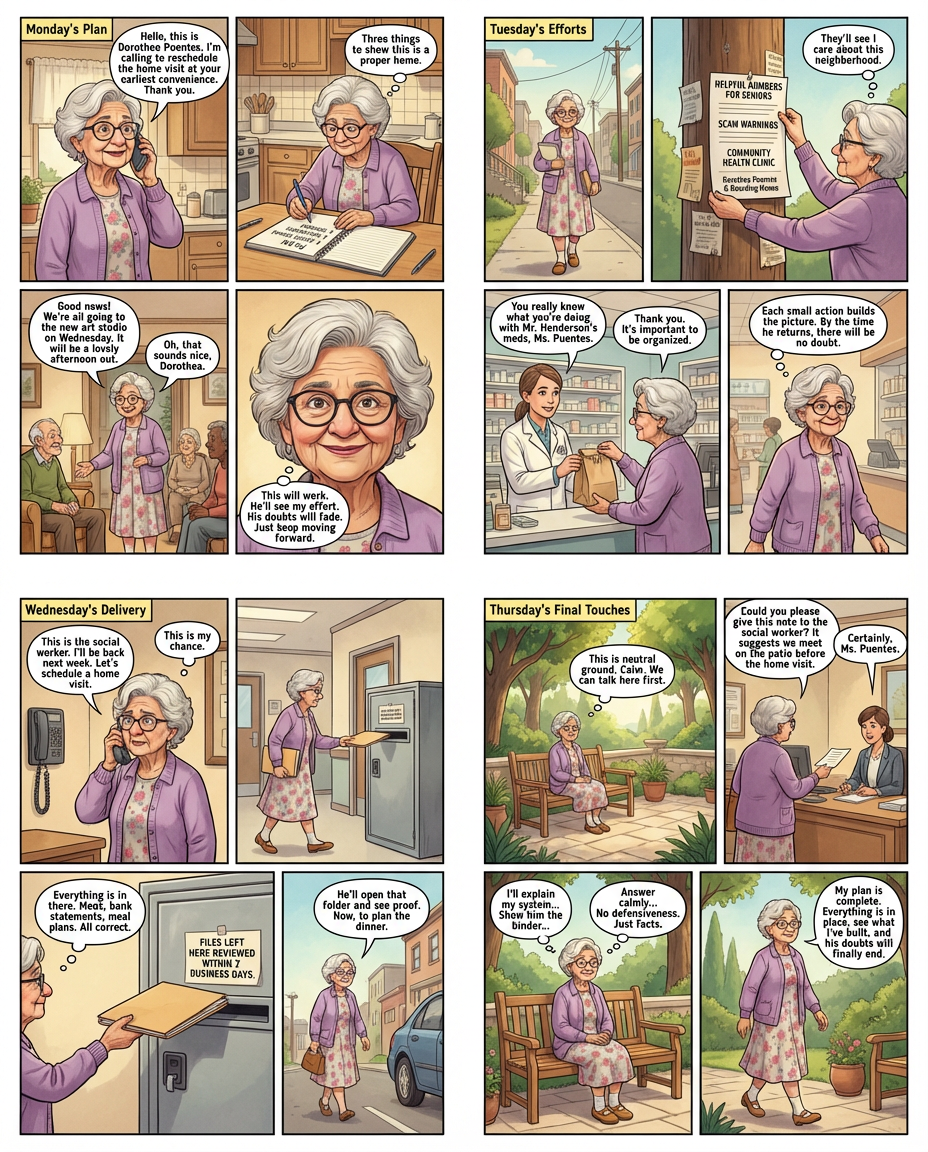
Dorothea called the social worker's office Monday morning and left a voicemail asking when he could reschedule. She kept her voice steady and polite. Then she sat at her kitchen table and wrote out a plan in her notebook—three things she could do this week to show she ran a proper home. First, she'd take the tenants on an outing so they could be seen in public, happy and cared for. Second, she'd organize the medication schedule into a binder the social worker could review whenever he returned. Third, she'd invite him to dinner at the boarding house so he could see everyone together, calm and comfortable. By noon, she'd called Mr. Henderson and two other tenants into the front room and told them they'd be going to the new art studio on Wednesday. Mr. Henderson smiled and said that sounded nice. She felt something loosen in her chest. This would work. The social worker would see her effort, see her tenants thriving, and his doubts would fade. She just had to keep moving forward. Tuesday afternoon, she walked three blocks down with a small stack of flyers under her arm. A wooden power pole stood on the corner, already covered with announcements about yard sales and lost cats. She tacked up her own notice—a list of helpful phone numbers for seniors, warnings about common scams, and a reminder about the upcoming community health clinic. Her name and the boarding house address sat at the bottom. Anyone who walked past would see she cared about the neighborhood, that she looked out for people who needed help. On her way back, she stopped at the pharmacy to pick up Mr. Henderson's refill and chatted with the pharmacist about proper storage. The pharmacist nodded and said she clearly knew what she was doing. Dorothea thanked her and left with the prescription bag in hand. Each small action built the picture she needed the social worker to see. By the time he returned, there would be no doubt left. Wednesday morning, she checked her voicemail and found a message from the social worker's office. He'd be back next week and wanted to schedule a home visit. Her hand tightened around the phone. This was her chance. She walked to the social services building that afternoon with a folder of tenant records under her arm. The secretary wasn't at the desk, so Dorothea left the folder in the metal cabinet by the entrance where the night drop slot sat. The cabinet had a heavy lock, the kind meant for sensitive documents. She slipped her folder through the slot and heard it land inside. A note taped to the cabinet said files left here would be reviewed within two business days. She stepped back and looked at the building. The records showed everything—medication schedules, bank statements, meal plans. All organized, all correct. The social worker would open that folder and see proof that she ran her house the right way. She walked back to her car and drove home, already planning the dinner she'd serve when he arrived. Thursday morning she drove back to the social services building. She needed to suggest meeting outside the boarding house first, somewhere neutral where the social worker could ask questions without the tenants listening. A stone patio sat beside the building, cream-colored with benches arranged under shade trees. She walked across it and tested one of the benches. Solid and comfortable. The trees would keep them cool even in summer. She went inside and left another note at the front desk, suggesting they could meet here before the home visit if he preferred. The secretary took the note and said she'd pass it along. Dorothea stepped back outside and sat on one of the benches, rehearsing what she'd say. She'd explain her system, show him the binder, answer every question calmly. No defensiveness, no sharp words. Just facts and proof. She stood and walked back to her car, her plan complete. Everything was in place now. The social worker would see what she'd built, and his doubts would finally end.
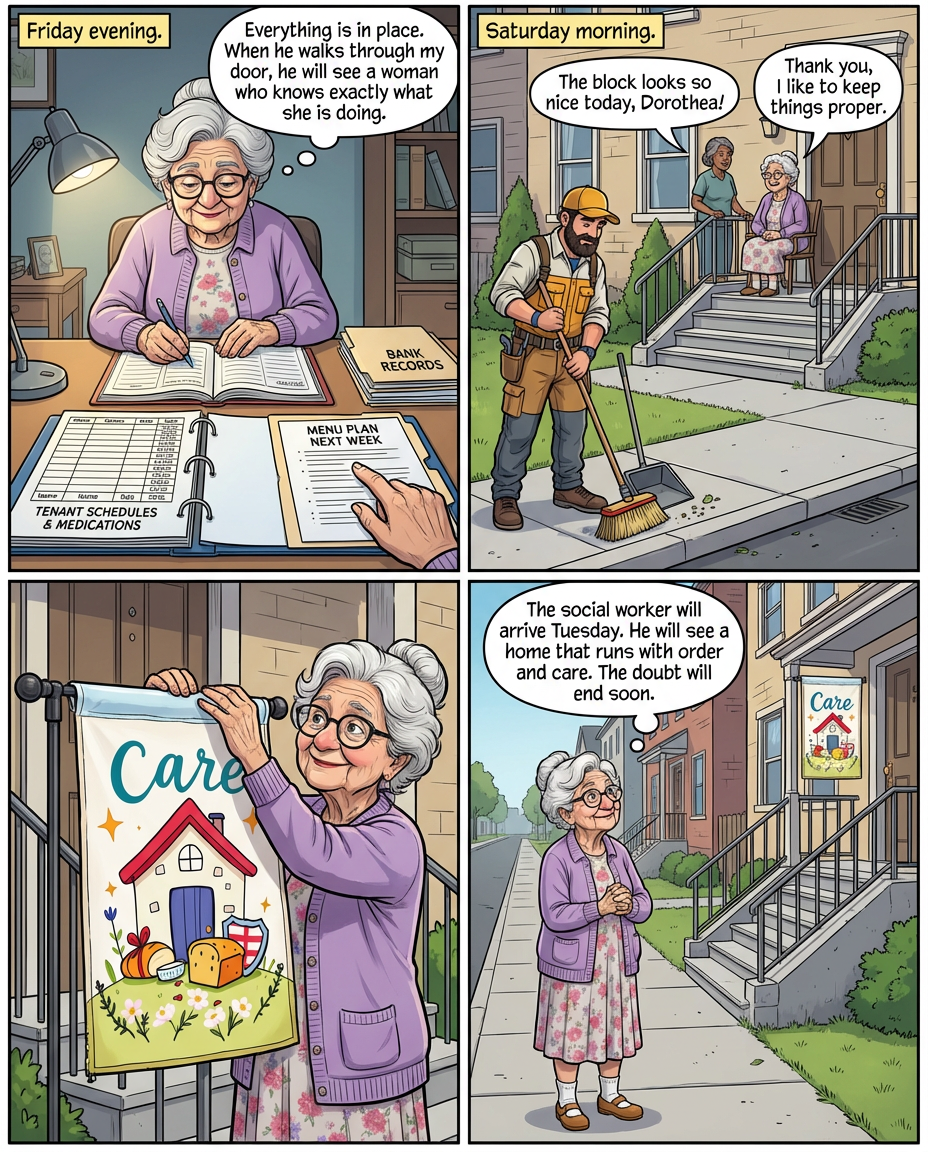
Dorothea sat at her desk Friday evening and laid out everything she'd prepared. The medication binder sat open, each page labeled with a tenant's name and schedule. Her bank records filled a neat folder beside it. The menu plan for next week's dinners covered a single typed sheet. She ran her finger down each document, checking for mistakes. Nothing was out of place. The social worker's visit was four days away, and she had done everything right. She closed the binder and stacked the papers in order. When he walked through her door, he would see a woman who knew exactly what she was doing. She locked the office and walked to the kitchen. Tomorrow she'd bake cookies for the tenants and make sure the front room looked welcoming. But tonight, the work was finished. She had built her case, piece by piece, and now all she could do was wait. The doubt in his voice from their first meeting still echoed in her mind, but she pushed it away. Facts would speak louder than suspicion. She turned off the light and headed upstairs, ready for what came next. Saturday morning, she hired a man to sweep the street in front of the boarding house. He arrived at eight with a broom and dustpan, dressed in a clean uniform. She watched from the concrete stoop as he worked his way down the sidewalk, clearing away dirt and leaves. Two neighbors walked past and nodded their approval. One stopped to chat, saying how nice the block looked. Dorothea smiled and offered them a seat on the stoop. They sat together for twenty minutes, talking about the weather and the upcoming summer. When they left, she went inside and pulled out a hand-stitched yard flag she'd ordered weeks ago. The fabric showed simple images—a house, a plate of food, a pair of hands held together. She carried it outside and hung it from the post by the front steps. The banner moved slightly in the breeze, visible to anyone passing by. She stepped back and looked at her boarding house. The swept street, the welcoming stoop, the flag that announced what she offered here. Everything was in place. The social worker would arrive Tuesday morning, and he would see a home that ran with order and care. Her tenants were safe, fed, and looked after. The neighborhood knew her as someone who kept things clean and proper. She had prepared every detail, answered every question before it could be asked. The doubt would end soon. She walked back inside, closed the door behind her, and felt ready.
Play your story to life
Storycraft is a mobile game where you create AI characters, craft items and locations to build their world, then discover what direction your story takes. Download the iOS game for free today!
Download for free