

Dr. Rowan Moss's Arc
4 Chapters
Dr. Rowan Moss's dream is to fully observe and document the lifecycles of all the biodome's animal species, with her main focus on the endangered ones. She wants to ensure their behaviors and survial are understood, not guessed.

Dr. Rowan Moss crouched beside the observation window, her pencil moving across the notepad in quick strokes. Inside the habitat, a family of red pandas climbed through bamboo stalks. She needed to document everything—feeding times, social patterns, breeding behaviors. The biodome held the last populations of dozens of endangered species. Her life's work was simple: observe and record their true nature, not guess from old data or assumptions. She adjusted her glasses and watched the mother panda groom her cub. Every detail mattered. One day, these records might be all that stood between extinction and survival. The red pandas settled into their afternoon routine, and Rowan stood. Her legs ached from hours of crouching. She packed her notepad into her satchel and headed outside. Across the biodome's interior landscape, a massive structure rose above the canopy. The Mechanical Tree Observation Tower stretched skyward, its brass and steel frame wrapped in flowering vines and crystal formations. She'd heard the engineers finished it last week. From the top platform, she could see every habitat zone at once. No more walking between scattered observation posts. No more missing behaviors because she was in the wrong place. Rowan pulled her coat tighter and started toward the tower's base. If she could watch all the animals from one location, her documentation would finally be complete. The tower was the answer she'd been waiting for. Rowan reached the tower entrance and climbed the spiral staircase inside. Her boots clanged against metal steps. At the top, she pushed through the access door onto the observation platform. Wind brushed her face. The entire biodome spread out below her—forests, wetlands, grasslands, all under the curved glass ceiling. Through the tower's mounted telescopes, she spotted a herd of deer in the northern zone. A flash of movement caught her eye in the eastern sector. She grabbed her binoculars. Three wolves prowled through the underbrush. She opened her notepad and started writing. But then she paused. The wolves vanished into thick vegetation. Even from up here, she couldn't see everything. She needed something that could go where she couldn't. Something that could fly above the canopy and track animals through dense cover. Rowan lowered her binoculars and looked at the sky. A drone—something that moved like a bird—could reach the places the tower couldn't show her. She'd need to speak with the engineers again. Two weeks later, Rowan stood on the platform and watched the engineers test the new drone. Its brass wings beat in smooth, mechanical strokes. Feather-like panels caught the light as it rose above the trees. The device looked nothing like the clunky machines she'd seen before. This one moved like a real bird, quiet and graceful. She held the control box in her hands and guided it toward the western marshlands. Through the viewing screen, she watched herons wade through shallow water. The drone stayed steady, its bioluminescent accents dim so the birds wouldn't startle. But when she tried to leave it hovering in place, the battery warning flashed. The drone could fly, but it couldn't stay. She needed cameras that would wait and watch without her constant control. Cameras that could sit in the habitats day and night, capturing moments she'd never see in person. Rowan landed the drone and turned to the engineers. There was one more piece missing. One more tool that would let her document everything. She explained what she needed, and they nodded. They could build it.
Rowan knelt on the mossy ground and opened her field kit. Inside lay her first real tools—a handheld measuring tape, a basic thermometer, and a stack of blank data sheets. She pulled out the thermometer and held it near the ground. The reading showed sixty-eight degrees. She wrote it down. Then she stretched the tape across a deer track in the mud. Four inches wide. She recorded that too. These were simple measurements, but they mattered. Temperature affected when animals moved. Track size revealed age and health. She had spent years studying in classrooms, but now she needed to learn what the biodome itself could teach her. Every habitat had patterns. Every species had rhythms. If she wanted to document their true lives, she had to start with the basics—watching, measuring, and writing it all down. She stood and brushed dirt from her knees. Ahead, something caught her eye near the edge of the clearing. A structure rose from the ground, different from anything else in the biodome. Living roots twisted around reinforced brass poles, forming a tall beacon. Amber lights pulsed slowly along its frame, then shifted to warning orange. Rowan walked closer and circled it. The design was clear—this was meant to signal something urgent. She pulled out her notepad and sketched its position relative to the deer trail. If endangered animals needed help, this beacon would alert her no matter where she worked. She touched the brass surface. It was warm. The lights dimmed back to amber, then held steady. Rowan wrote down the location and added a note: check signal range from tower. She couldn't watch every habitat at once, but now the biodome could call to her when it mattered most. Rowan continued deeper into the habitat zone. She needed a better system for handling samples in the field. Carrying specimens back to the tower wasted time and risked contamination. Near a cluster of ferns, she found what the engineers had left for her. A mobile cart sat waiting, its frame built from polished brass and burnished steel. Glass specimen containers lined the upper shelf. Below them, drawers held tools and collection supplies. She wheeled it closer and tested the wheels. They moved smoothly even over roots and uneven ground. She placed her field kit on the work surface and opened one of the glass containers. The seal was tight. Good. She could collect fur samples, measure plant specimens, and prepare data sheets right here instead of hiking back each time. Rowan pulled out a blank sheet and labeled it with the date and location. The work was just beginning, but now she had the tools to do it right. The endangered animals in this biodome deserved accurate records, not guesses. She would give them that. Back at the tower, Rowan climbed to the research alcove on the third level. Brass shelves lined the walls, filled with reference books and specimen guides. Glass cases displayed preserved samples from previous studies. A wooden desk sat beneath a window that looked out over the canopy. She set down her field notes and pulled a thick volume from the shelf—Species Identification and Behavioral Patterns. The pages were worn from use by researchers before her. She opened to the section on deer and compared her track measurements to the charts. Her numbers matched a young adult, likely two years old. She smiled and made a note in her journal. The field work gave her data, but this space gave her context. She needed both. Understanding came from watching the animals and learning what others had already discovered. Rowan turned another page and started reading about feeding patterns. Tomorrow she would return to the clearing with new questions. Each day would build on the last, one observation at a time, until she knew these animals as they truly were.
Rowan stepped into the biodome's central archive building, where brass doors opened to reveal rows of filing cabinets and climate-controlled storage. This place held decades of research from scientists who came before her. She needed to understand what they'd already learned. She walked between tall shelves and ran her fingers along labeled drawers. Each one held field notes, specimen records, and behavioral observations from researchers who'd spent years in these habitats. She pulled open a drawer marked "Predator Patterns 2089-2094" and lifted out a stack of papers. The handwriting was neat and precise. Someone had documented wolf pack movements through every season. She carried the papers to a reading table and sat down. The information was valuable, but something felt missing. These notes came from one person's perspective. What about the locals who maintained the habitats? What about the engineers who built observation posts? They saw things too. Rowan closed the file and stood. Down the hall, past the storage rooms, she found what she was looking for. A panel system stretched across the wall, built from warm wood and brushed brass with glass sections that glowed softly. Small lights illuminated different segments, ready to guide a conversation. This was where knowledge could be shared, not just stored. She pictured herself standing here, asking questions while habitat workers and other researchers sat facing her. They could talk about animal sightings, unusual behaviors, anything that didn't make it into formal reports. The panel had space for notes, diagrams, even mounted specimens. It was designed for exchange, not lecture. Rowan touched the smooth wood surface and smiled. Her observations mattered, but so did everyone else's. If she wanted complete records of the endangered species, she needed to listen as much as she watched. This room would help her do that. She pulled out her notepad and wrote down ideas for the first meeting. The archive held the past. This panel would help her build the future. She left the meeting room and walked through the main corridor toward the visitor center. If she wanted support for her work, people needed to see why it mattered. Near the entrance, a large monitor hung on the wall. Its ornate brass frame gleamed under the lights, dark metal scrollwork wrapped around the edges. The screen showed a grid of faces—visitors from across the biodome asking questions during live sessions. Rowan stopped and watched. One viewer pointed at something off-screen. Another leaned closer, eyes wide. She could use this. She could show them the red pandas, the wolves, the deer. She could display footage from her drone and explain what each behavior meant. If people saw the endangered animals up close, they would understand why documentation mattered. Rowan stepped closer to the monitor and made a note of its location. The panel would gather knowledge. This screen would share it. Together, they gave her everything she needed to make her work matter beyond field notes and data sheets. Outside, Rowan followed a path toward the eastern gardens. She had the tools to gather information and the places to share it. But people needed to remember why this work existed at all. Past the flowering shrubs, she found a structure standing in an open space. Ornate brass and metal formed an elaborate display frame. Inside it, illustrated panels showed tropical ecosystems—simplified drawings of animals and plants arranged like pages from a storybook. Each section highlighted a different conservation success. One showed deer populations recovering. Another displayed breeding pairs of red pandas. This wasn't just decoration. It was proof. When she documented new behaviors or confirmed breeding cycles, those achievements could be added here. Visitors would see that endangered species weren't lost causes. They were success stories still being written. Rowan traced her finger along the brass edge and pictured her own discoveries displayed here someday. The biodome gave her everything she needed—a place to learn, a place to share, and a place to celebrate each step forward. Her dream wasn't just possible here. It was already beginning.
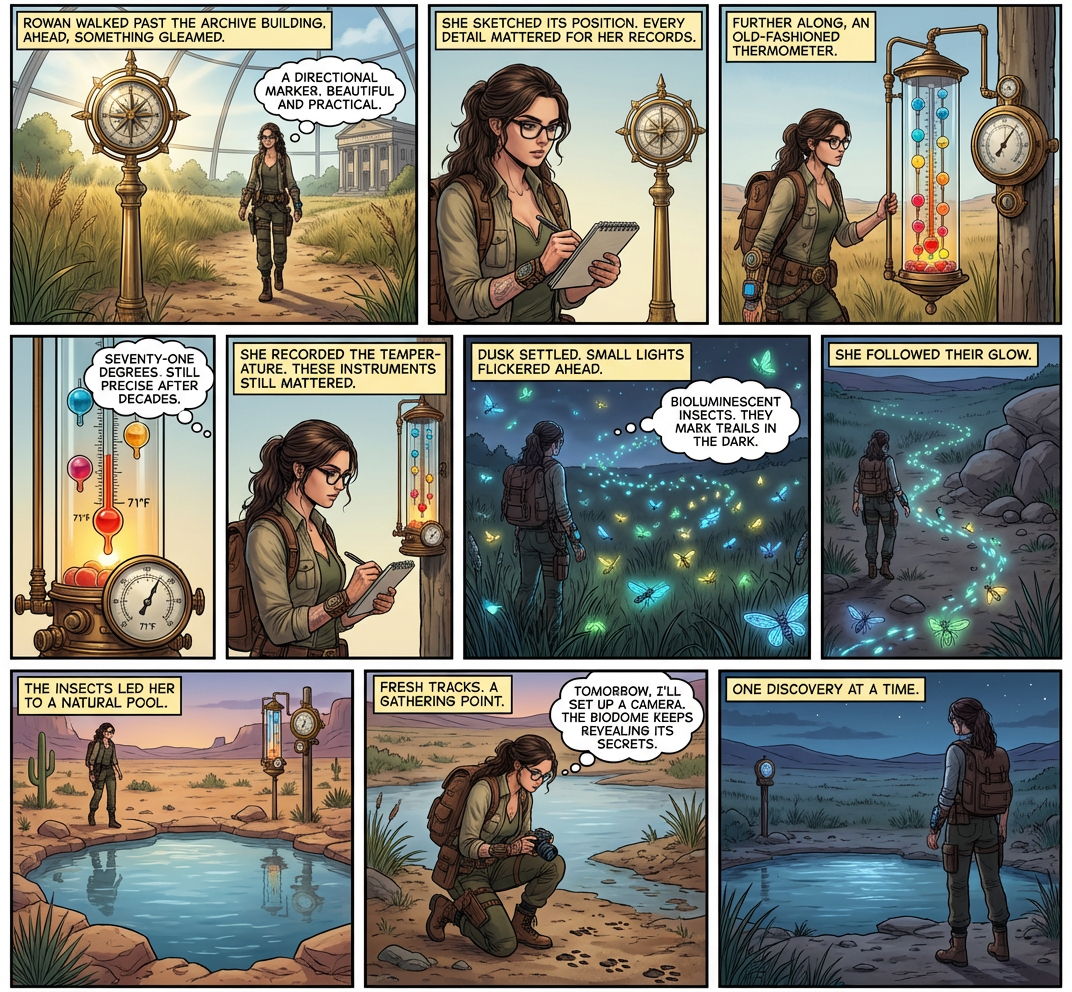
Rowan walked past the archive building toward the northern sector. She wanted to check the habitat boundaries before starting her next round of observations. The path curved between tall grasses and maintenance sheds. Ahead, something gleamed in the afternoon light—a tall decorative pole topped with an ornate brass compass. The needle turned slowly, catching the breeze. She stopped and studied it. The design was beautiful but practical too. Engineers had placed directional markers throughout the biodome so workers wouldn't get lost in the larger sectors. Rowan pulled out her notepad and sketched its position. When she tracked animal movements across habitats, these markers would help her map exact locations. Every detail mattered when building complete records. She continued along the path and spotted another structure mounted on a weathered post. Glass bulbs floated inside a tall tube, each one a different color. Brass and copper fittings wrapped around the frame, and a circular gauge sat fixed to its side. The colored bulbs shifted position slightly as she watched. This was a thermometer—old-fashioned but precise. The barometer next to it showed steady pressure. Rowan stepped closer and read the temperature from the lowest floating bulb. Seventy-one degrees. She wrote it down and checked the date on her notes. Scientists had placed instruments like this throughout the biodome decades ago when they first began studying how the climate worked inside the dome. The device still functioned, still measured, still mattered. Rowan added a note to check this spot weekly. Temperature changes affected breeding seasons and migration patterns. If she wanted complete records of the endangered species, she needed to track the environment that shaped their lives. The biodome held answers everywhere—in the animals, in the land, and in the tools left behind by those who came before her. Dusk settled over the sector as she finished her boundary check. Rowan turned back toward the main path and stopped. Small lights flickered in the grasses ahead. She moved closer and watched insects rise from the vegetation. Their bodies glowed—blue, then green, then pale yellow. They moved together, hundreds of them, creating patterns in the darkening air. She'd read about bioluminescent species in the biodome but hadn't seen them active yet. Rowan pulled out her notepad and sketched what she saw. These insects marked trails through the habitat. At night, when her eyes couldn't track animals in darkness, she could follow these glowing paths instead. The insects would show her where nocturnal animals moved. She wrote down the location and time. Tomorrow she would return after sunset with her camera. The biodome taught her something new every day—not just about the endangered species she came to study, but about all the small pieces that made their world work. The insects drifted toward a cluster of rocks in the distance. Rowan followed their glow and found a natural pool nestled at the base of eroded sandstone. Water sat still and clear in the basin. Animal tracks pressed into the mud around its edge—deer, small rodents, maybe wolves. Brass instruments mounted on nearby posts measured humidity and wind direction. She knelt and examined the tracks more closely. Fresh prints, less than an hour old. The endangered species came here to drink, especially at dusk when the heat faded. She set her equipment bag down and photographed the tracks from three angles. This watering hole was a gathering point, a place where observation would give her the most information. She added it to her map and circled it twice. Tomorrow she would set up a camera on one of the posts. The biodome kept revealing its patterns—where animals moved, where they rested, where they returned. Her records were growing, one discovery at a time, exactly as they should.
Play your story to life
Storycraft is a mobile game where you create AI characters, craft items and locations to build their world, then discover what direction your story takes. Download the iOS game for free today!
Download for free