

Estes's Arc
3 Chapters
Estes's dream is exposing the crime families who corrupt this nation's great cities.

Estes adjusted his round glasses and studied the grainy photograph pinned to his office wall. Las Calaveras sprawled before him like a sleeping beast, its towers hiding secrets in every shadow. He wanted to expose the crime families that poisoned this city from within. The newsroom buzzed with the hum of old equipment. A bulky television set flickered in the corner, its rabbit ears wrapped in aluminum foil. Vintage cameras lined the shelves, their leather cases cracked with age. The whole place had the feel of a frontier outpost mixed with modern machinery. Estes ran his finger along the edge of his desk and smiled. This was where he would do it—where he would gather evidence, write his stories, and publish the truth. The crime families thought they could hide forever, but he would drag their secrets into the light. One investigation at a time, he would show the city who really controlled its streets. His headquarters was ready. Now the real work could begin. He grabbed his coat and hat from the rack. The first lead wouldn't come from sitting behind a desk. Estes needed sources—people who saw things, heard things, knew things. He locked the office door and walked three blocks until he spotted what he was looking for. A phone booth stood on the corner, its glass panels reflecting the afternoon sun. Metal framing gleamed under the streetlights. Estes stepped inside and pulled the folding door shut. The booth smelled like cigarettes and old coins. He dropped a nickel into the slot and dialed the number he'd memorized. Anonymous calls meant no paper trail. The crime families couldn't trace what they couldn't see. The line rang twice before someone picked up. Estes spoke quickly and kept his voice low. He asked about shipments, about meetings, about names that appeared in police reports. The voice on the other end gave him three addresses and a warning. He thanked them and hung up. Through the glass panels, the city looked the same as always. But Estes knew better now. He had his first real lead, his headquarters ready, and a method to gather information safely. The investigation had officially begun.
Estes sat at his desk and opened his first case file. The three addresses from the phone booth tip lay written on a scrap of paper before him. He needed to learn how these crime families operated—their patterns, their people, their weaknesses. The city wouldn't change unless he understood the system first. He pulled out a pencil and began mapping connections on a fresh sheet. Names led to locations. Locations led to meetings. Each detail mattered. This was the foundation. Without it, exposure meant nothing. Hours passed. The sun dropped below the buildings outside. Estes kept working, his pencil scratching across page after page. He circled names and drew lines between them. One address connected to a warehouse. Another sat near the docks. The third matched a restaurant that stayed open late. Patterns started to form. He would need to visit each location and watch who came and went. Through the window, he noticed the streets growing dark. The lamppost near the entrance flickered on, its wrought iron frame casting long shadows on the wooden base below. Estes stood and stretched his back. Tomorrow he would start surveillance on the first address. Tonight he had built the map. He gathered his papers and locked them in his desk drawer. The investigation was moving forward, one careful step at a time. Morning came with questions Estes couldn't answer from his desk. The connections he'd drawn needed proof—real documents that showed money changing hands and deals being made. He grabbed his coat and walked across Las Calaveras until he reached the government building. The structure looked solid, built to handle the desert heat and dust. Inside, rows of filing cabinets held decades of permits, licenses, and city records. Estes signed the visitor log and started searching. He pulled folders marked with the addresses from his tip. Property transfers showed names he recognized from the newspapers. Building permits had signatures that matched known associates. One restaurant permit listed an owner who also owned the warehouse. The pieces fit together on paper now. Estes copied what he needed and left the archive with evidence tucked under his arm. He had learned the most important lesson—corruption left tracks. Now he could follow them. Back at the newsroom, Estes found a small metal lockbox sitting by the entrance. It was shaped like a raccoon, with detailed features that made it look almost alive. He picked it up and examined the craftsmanship. Someone had left it for him—a signal that sources were watching his work. He carried it inside and set it near the window where the lamppost's glow would reach it at night. Anyone who wanted to share information could leave it there without being seen. Estes opened his case file and added the copied documents to his growing collection. He had the basics now—a method for gathering tips, access to official records, and connections mapped on paper. The crime families operated in the open because they thought no one was paying attention. Estes was. And soon, everyone else would be too.
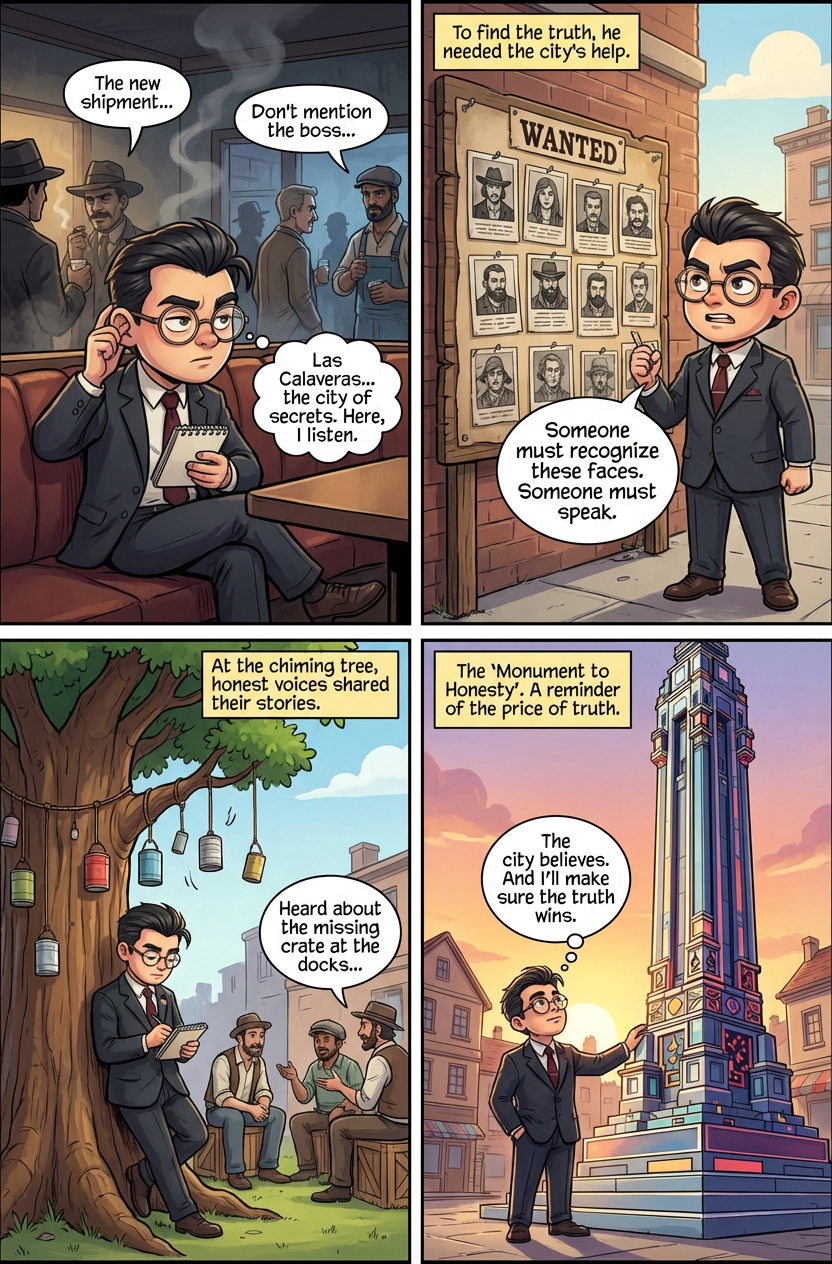
Estes needed a place where information flowed freely, where secrets slipped out between drinks and card games. The crime families controlled the docks and the government offices, but they couldn't control everything. He walked until he found it—a social club where businessmen and dock workers mixed, where deals happened in corners and favors changed hands across tables. This was where the city revealed itself, where he could listen and learn who really ran Las Calaveras. Estes stepped inside, ordered coffee, and found a seat near the back. The room hummed with conversations about shipments, contracts, and names he'd seen in his files. He pulled out a small notebook and began writing. Every word brought him closer to the truth he would one day publish for everyone to read. After two hours of listening, Estes walked back to his newsroom with four new leads written down. But gathering information wasn't enough. He needed people to come forward, to share what they knew about the families. The citizens of Las Calaveras had to see that someone was fighting back. He found a rugged wooden board in the storage room and dragged it outside. Then he printed photographs from his files—faces of crime family members, their associates, their known locations. He pinned each wanted poster to the board with careful precision. The display told a story anyone could read. These were the people poisoning the city. These were the criminals he was tracking. Estes stepped back and studied his work. The board would draw attention. People who recognized these faces might finally speak up. His investigation needed sources, and sources needed to know someone was listening. The display stood as proof that the truth was coming, one documented crime at a time. The next morning, Estes walked through a different part of the city. He needed to find where regular people talked without watching their words. His sources had to come from somewhere ordinary, somewhere the families didn't control. He turned a corner and spotted a tree stump on a small patch of dirt. Tin cans hung from strings tied to its branches, tinkling softly when the breeze passed through. A few locals sat on crates nearby, waiting and chatting while someone sharpened a blade on a whetstone. Estes listened as they talked about neighborhood news—a missing shipment, a new face at the docks, a business that closed without warning. He made mental notes of everything. This gathering spot gave him what he needed most—honest conversation from people who lived in the city's shadows. The crime families built their power on silence and fear. But here, where tin cans chimed and people waited for their turn, the city still talked. Estes would keep coming back to listen. That afternoon, he discovered something else the city offered him. A tall sculpture stood in a square where several streets met. Its gleaming surfaces caught the sunlight and reflected it across the buildings. He walked closer and read the plaque at its base. This was a monument to honesty, built to remember everyday people whose lives the crime families had destroyed. Names were carved into the metal—shopkeepers who wouldn't pay protection money, witnesses who disappeared, workers crushed by dock accidents that weren't accidents at all. Estes touched the cold surface and felt the weight of what he was doing. These people had paid the price for telling the truth or refusing to lie. Their monument reminded him why his investigation mattered. Las Calaveras gave him everything he needed—places to gather information, ways to recruit sources, and proof that people still believed in justice. The city was built for someone like him to succeed. He just had to keep working until the whole truth came out.
Play your story to life
Storycraft is a mobile game where you create AI characters, craft items and locations to build their world, then discover what direction your story takes. Download the iOS game for free today!
Download for free