

“Twiggy” The Singing Bush's Arc
6 Chapters
“Twiggy” The Singing Bush's dream is discovering why the buried city's acoustic chambers amplify only certain songs.

Twiggy pressed their twisted roots against the stone floor of the buried city's main chamber. The hollow space hummed back—a low note that rattled their smallest branches. For three seasons now, Twiggy had wandered these underground halls, testing each room with different melodies. Some songs vanished into the dark. Others bounced back stronger, clearer, as if the walls themselves wanted to sing along. Why did the chambers choose? What made one tune worthy and another worthless? Twiggy's yellow eyes glowed brighter in the shadows. The answer lived somewhere in these ancient stones, and they would find it. The desert wind called Twiggy upward through the tunnels. Sunlight burned hot as they emerged from the buried city. Ahead stood an amphitheater, its weathered bricks half-buried in sand. The structure curved like a giant ear pressed against the ground. Twiggy shuffled forward, their roots leaving trails in the dust. This place was built for sound—for voices that needed to reach every listener. They settled into the center of the amphitheater and began to hum. The ancient walls caught the melody and threw it back, louder than before. Twiggy's branches trembled with excitement. Here they could test every song they knew. Here they would learn which melodies the chambers loved and why. Days passed as Twiggy sang into the crumbling walls. High notes died quickly. Low notes lasted longer but felt weak. Middle tones—the ones that matched the city's own hum—those rang clear and strong. Twiggy needed to test more. They spotted a wooden bridge in the distance, stretching between two tall sandstone plateaus. The ropes looked old but sturdy. If they climbed high enough, they could sing across the open air and see how far different melodies traveled. The buried city chose songs that matched its voice. Now Twiggy needed to understand what that voice truly was—and why it mattered. The bridge swayed under Twiggy's weight as they made their way across. Wind rushed through the gap between the plateaus, carrying their test notes in all directions. Some melodies scattered and faded. Others cut through the air like arrows. Twiggy stopped in the center and looked down at the town below. They needed a better way to capture sounds—not just their own voice, but the natural tones of the desert itself. Back in the town, Twiggy found a phonogram decorated with cacti and desert flowers carved into its surface. The machine could record the wind, the sand, the distant calls of desert creatures. If Twiggy could match these sounds to the frequencies that worked in the amphitheater, they would know what the buried city wanted to hear. They would crack the mystery that had pulled them here, season after season, song after song.
Twiggy carried the phonogram back to their hollow in the buried city's upper tunnel. The machine sat heavy against their twisted bark. They needed to start simple—learn the basics before testing grand theories. First, they would record their own voice singing the same note at different pitches. Then they would play each recording in the amphitheater and measure which ones the walls amplified. Twiggy turned the phonogram's crank and hummed into the horn. The needle scratched across the cylinder, capturing the sound. They stopped, rewound, and listened. Their voice came back thin but clear. This would work. Tomorrow they would return to the amphitheater with a collection of recordings. One frequency at a time, they would discover what made the ancient chambers sing. But the recordings meant nothing if Twiggy couldn't track the results. They needed somewhere outside the amphitheater to compare what worked and what failed. Near the desert's edge, they found what they needed—a metallic tuning fork mounted next to a stone cabinet. Desert flowers and cacti decorated the cabinet's surface. Twiggy tested the fork. It rang clean and true at a single pitch. They could use it to check their recordings before each test. The stone cabinet had wide drawers that pulled out smooth. Twiggy placed their first cylinder inside and marked it with scratches in the stone. Tomorrow they would fill these drawers with proof. Each test would bring them closer to understanding why the buried city chose certain songs and rejected others. The desert sun beat down harder each day. Twiggy's instruments couldn't survive long in that heat. They needed shelter—something to protect the phonogram and cylinders during the long hours of testing. They built a gazebo from desert wood and stone. Cacti and desert flowers grew around its edges, providing shade without blocking the breeze. Inside, the air stayed cool enough to keep the cylinders from warping. Twiggy arranged their workspace beneath the gazebo's roof. The tuning fork stood within reach. The cabinet sat ready to store each new recording. Everything had its place now. The real work could begin. But Twiggy realized something important. They had tools to test sounds, but they knew nothing about who built the chambers or why. The city's past held answers they couldn't ignore. Twiggy ventured further into the desert and found an unfinished construction site half-buried in sand. Desert plants grew between broken walls and scattered building materials. In the center stood a partially collapsed structure filled with stone tablets and faded scrolls. Twiggy brushed sand from the nearest tablet. Strange symbols covered its surface—words they couldn't read yet. But some tablets showed drawings of the amphitheater and the chambers below. The builders had left instructions behind. Twiggy gathered what they could carry and brought the tablets back to the gazebo. They had their testing equipment ready and now they had the city's history within reach. The answers were waiting. They just needed to learn how to see them.
Twiggy stared at the tablets spread across the gazebo floor. The symbols meant nothing yet, but the drawings showed something clear—pipes running beneath the amphitheater, connecting to chambers deep underground. The builders wanted sound to travel specific paths. Twiggy traced a root along one diagram. The pipes didn't just carry sound—they filtered it. Only certain frequencies could pass through the narrow channels. That's why the chambers chose some melodies and rejected others. The ancient engineers built the whole system on purpose. They wanted control over which sounds reached the deepest rooms. But why? What made specific songs worth preserving? Twiggy needed to find where these builders were remembered. Someone in this desert town must honor the ones who shaped sound itself. The answer stood in the town square—a glass blowing station decorated with metalwork and surrounded by desert flowers and cacti. Heat shimmered from the furnace even though no one worked there now. Twiggy approached slowly. Carved into the metal frame were the same symbols from the tablets. Below them, words in the common tongue: "Those who taught stone to sing." This monument celebrated the sound engineers. The glasswork itself told their story—bulbs and tubes bent at precise angles, just like the pipes in the diagrams. The builders understood that shape controlled sound. They crafted glass to show others how air moved through curves and chambers. Twiggy pressed a branch against the nearest tube. It rang clear and pure. The monument was teaching them even now. The buried city amplified songs that matched its designed frequencies. The engineers built it to preserve specific melodies—songs that mattered enough to encode in stone and pipe and chamber forever. But which melodies? Twiggy needed more than diagrams and monuments. They needed the stories behind the songs—the reasons the builders chose to preserve them. Down a narrow street stood a club with cacti and desert flowers growing against its walls. The door stood open. Inside, dim light filled a space lined with tables and a small stage. This was where locals gathered. Twiggy shuffled through the entrance. The walls held faded paintings of figures holding instruments. Old melodies hung in the air even when no one played. Twiggy settled near the stage and listened. A group at the corner table shared stories about songs their grandparents sang—work songs, celebration songs, warnings passed down through generations. One story mentioned a melody sung during sandstorms to help travelers find their way home. Another told of builders who hummed while they worked, their voices matching the rhythm of hammers on stone. These weren't just songs. They were tools for survival and memory. The buried city preserved the melodies that helped people live in this harsh desert. Now Twiggy understood what to search for—not the prettiest songs, but the ones that mattered most. Twiggy left the club with purpose in every step. They needed to share what they'd learned—to invite others to hear the connection between ancient songs and the chambers below. Back near the amphitheater, they found a rainstick leaning against sandstone rocks. Cacti and desert flowers grew around it. Twiggy lifted the instrument and tilted it. Water sounds rushed through the hollow tube—a rhythm that matched the wind patterns in the desert. They carried it to the edge of town and positioned it where travelers would pass. When the breeze moved through it, the rainstick sang with the same frequencies that worked in the buried city. People would hear it and wonder. They would follow the sound and ask questions. Twiggy returned to the gazebo as the sun set. The tablets waited there, along with the phonogram and tuning fork. Tomorrow they would test the survival songs—the melodies that helped people endure sandstorms and find their way home. The buried city would answer. It had to. The chambers were built to remember what kept a community alive.
Twiggy's roots ached from days of research and testing. The tablets taught them about pipes and frequencies. The monument showed them how the builders shaped glass and stone. The club revealed which songs mattered enough to preserve. But knowing wasn't enough—Twiggy needed to feel the city's purpose in their bark. They left the gazebo and wandered into the buried tunnels, past the amphitheater, deeper than before. The air grew cool and damp. Their branches brushed against carved walls that hummed faintly with old vibrations. This place wasn't just built to amplify sound. It was built to keep memories alive when everything else turned to dust. Twiggy understood now. The chambers chose songs that helped people survive—melodies that meant home, safety, and hope. The buried city was a guardian of what mattered most. Twiggy emerged from the tunnels as dawn broke across the desert. They needed to mark their progress somehow—to track the hours spent searching and the hours still needed. Their branches caught the first rays of light filtering through the sand. Something ahead drew their attention. A temple stood half-buried in the dunes, its walls open to the sky. Sunlight poured through tall windows carved in precise patterns. At the center sat a flat stone marked with lines and symbols. A shadow fell across it, pointing to carved notches along the edge. Twiggy watched the shadow shift as the sun climbed higher. The builders used light itself to measure time. This temple tracked every hour without any sound at all. The city's people understood more than just melodies—they understood the rhythms that ruled survival in the desert. Twiggy stepped inside the temple and let the cool shadows fall across their bark. The day's heat would come soon, but for now the stone walls held the night's chill. They looked at the shadow moving across the marked stone, steady and certain. Time passed whether they solved the mystery or not. But now they had proof that the builders thought about more than sound. They built systems to track light, to mark hours, to remember. The acoustic chambers were just one piece of something bigger. The buried city preserved what helped people live—songs, time, memory. Twiggy's branches rustled with understanding. They would return to the chambers tomorrow with new questions. But today they would rest here and watch the sun move across stone, just as the builders once did. A rattlesnake shifted in the grass outside the temple entrance, its tail creating a dry rhythm against the sand. The sound matched the wind patterns Twiggy had studied in the chambers. Even the desert's creatures added their voices to the music of survival. Twiggy settled against the temple wall and closed their eyes. The city was teaching them in ways they hadn't expected. Every system, every sound, every shadow worked together. Tomorrow they would test more frequencies, but today they had learned something just as important—the builders saw the whole desert as one connected rhythm. Twiggy woke when the sun reached its highest point. The shadow on the sundial had moved to mark midday. Outside, wind whistled through the temple windows and stirred the desert grass. A wooden pole stood near the entrance, a long red ribbon tied to its top. The fabric twisted and snapped in the breeze, reaching down like it wanted to touch the sand below. Twiggy walked closer and noticed how deep the pole was planted. Its base disappeared far into the ground—much deeper than needed to hold it steady. The ribbon danced and pointed downward, almost like a marker. Twiggy pressed their roots against the earth. They felt the familiar hum of the chambers below. This pole connected the surface to the buried city. Someone had placed it here on purpose, a sign that the past still reached up through the sand. The temple measured time above ground while the chambers preserved memory below. Both systems worked together, just like the songs and the frequencies. Twiggy finally saw the full picture. The buried city wasn't separate from the desert—it was part of it. Every structure, every sound, every marker tied the people to their home. The acoustic chambers amplified songs that helped them survive because survival meant staying connected to this place. Twiggy had their answer now. The city chose songs that bound people to the desert and to each other.
Twiggy returned to the amphitheater with new understanding. The survival songs from the club needed testing. They positioned the tuning fork against the chamber entrance and struck it firmly. The note rang clear and traveled down into the darkness. A moment later, the chambers answered back with the same pitch, amplified and pure. Twiggy's branches trembled with excitement. They hummed the sandstorm melody next—the one that helped travelers find home. The acoustic pipes caught it immediately, sending it deeper and stronger through the underground halls. Success felt like sunshine on their bark. The system worked exactly as the builders intended. Each correct frequency proved Twiggy was closer to understanding the full purpose of this place. Word needed to spread. Twiggy ventured into the desert beyond the town's edge, where wind-carved stone rose from the sand. There, towering rock formations stood in natural columns and pipes, shaped by centuries of sandstorms. Desert flowers bloomed between the stones in bright clusters. Twiggy studied the formations and realized what they could become—a place where others could hear the songs that mattered. They sang the sandstorm melody into the natural pipes. The rock caught the sound and sent it echoing across the open desert, clear and strong. People would come here. They would sing the old songs and hear them amplified by stone, just like the buried city amplified them below. Twiggy had found the answer they'd been searching for. The chambers preserved songs that helped people survive because those melodies connected them to this harsh, beautiful place. Now others could experience that connection too. Twiggy needed to mark this breakthrough somehow. They gathered desert twigs and bound them together into a flat board. Using sand and crushed petals from the nearby flowers, they drew musical notes across its surface—the exact frequencies that made the chambers respond. Each note represented a melody the city had chosen to remember. Twiggy planted the board near the base of the rock formation, among the cacti and blooming desert plants. The board showed what they had learned through weeks of testing and listening. The sandstorm melody sat at the top, its pattern clear and simple. Below it, other survival songs waited to be tested. This was proof. The buried city wasn't random or broken. It was built with purpose, and Twiggy had cracked its code. The celebration needed sound and water together. Twiggy found a drum decorated with old designs near the rocks. They positioned it where wind could catch its surface. Then they poured water from their canteen onto the stretched hide in small amounts. When the breeze moved across the wet drum skin, it created low musical tones that mixed with the desert wind. The sound matched the frequencies the chambers loved best. Twiggy struck the drum once, then again, creating a rhythm that the rock formations caught and sent across the sand. This was how the builders must have felt—turning the desert itself into an instrument. The chambers below preserved the songs, and now the surface could play them too. Twiggy's research had opened a door between past and present. Anyone could come here now and hear how the ancient melodies were meant to sound.
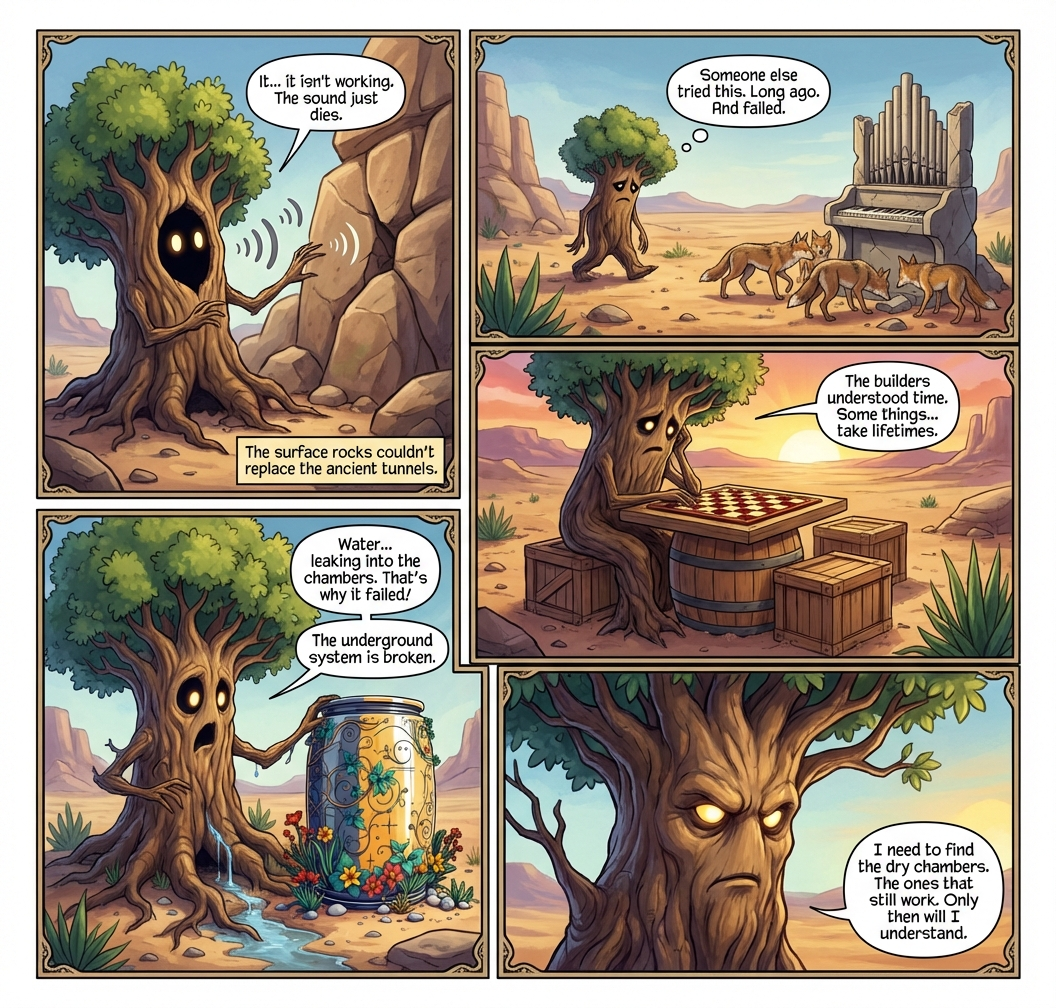
Twiggy returned to the rock formations the next morning, eager to share their discovery. But when they tried to sing the sandstorm melody into the natural pipes, nothing happened. The sound fell flat against the stone and died in the open air. They tried again, louder this time, adjusting their pitch to match what worked in the buried chambers. Still nothing. The rock formations looked similar to the acoustic pipes below, but they didn't work the same way at all. Desert wind couldn't replace carefully designed tunnels. Natural stone couldn't match carved chambers built with exact measurements. Twiggy's branches drooped with disappointment. They had been so certain this would work—that they could bring the buried city's music to the surface for everyone to hear. But the desert didn't care about their plans. The ancient songs belonged underground, and no amount of testing or hoping would change that. Twiggy pulled the marked board from the sand and tucked it under their roots. Their answer felt incomplete now, like they'd only learned half the truth. They wandered away from the formations, deeper into the empty desert. A pack of coyotes moved between the rocks ahead, their bodies low and alert. The animals paused near a weathered stone sculpture—something old and cracked that time had nearly destroyed. Twiggy recognized the shape. It was supposed to be a pipe organ, carved to match the ones underground. Someone else had tried this same experiment long ago and failed. The sculpture sat abandoned, proof that bringing the chambers' music to the surface was impossible. The coyotes sniffed at the broken stone, then moved on without interest. Twiggy stood there for a long time, staring at the failed attempt. Maybe the buried city kept its secrets on purpose. Maybe some questions weren't meant to be answered completely. They turned back toward town, carrying both their discovery and their defeat. The chambers amplified certain songs, yes—but only in darkness, only underground, only where the builders intended. That would have to be enough. Near the edge of town, Twiggy found a checkers game set up on a wooden barrel. Wooden crates served as seats around it. A colorful blanket draped over one crate. The setup looked permanent, like it had been there for years. Sand had collected in the corners of the game board but the pieces remained in place. Someone had started a match and never finished it. Twiggy set their marked board against the barrel and sat down. The unfinished game reminded them that some things took longer than one lifetime to complete. The builders understood that. They created chambers that would last through generations, amplifying songs for people who wouldn't be born for centuries. Twiggy's failure today didn't erase what they had learned. The chambers chose survival songs and amplified them in specific conditions. That knowledge mattered, even if they couldn't bring those songs to the surface. They would keep searching for the rest of the answer, however long it took. Movement near the old well caught Twiggy's attention. A water collector stood there, its patterns matching desert flowers carved into metal. The device looked ancient but still worked, catching moisture from the air and funneling it down into storage. Twiggy approached and noticed cracks along its base where water had leaked for years. The ground below was damp and dark. They pressed their roots against the wet sand and felt something wrong. The water had seeped down into the chambers below, filling some of the acoustic tunnels. That's why the surface tests failed—the underground pipes were damaged, blocked with water and sand. The chambers couldn't amplify songs correctly anymore. Twiggy's branches shook with the realization. Their experiments had been flawed from the start. They had been testing a broken system and treating the results as truth. Everything they thought they understood about which songs the chambers chose might be wrong. The buried city's secrets remained hidden, but now for a different reason. Twiggy would need to find the dry chambers first, the ones still working as the builders intended. Only then could they learn why certain songs mattered enough to amplify.
Play your story to life
Storycraft is a mobile game where you create AI characters, craft items and locations to build their world, then discover what direction your story takes. Download the iOS game for free today!
Download for free