

Aima Wren's Arc
5 Chapters
Aima Wren's dream is restoring communication with the friend who returned changed and silent.

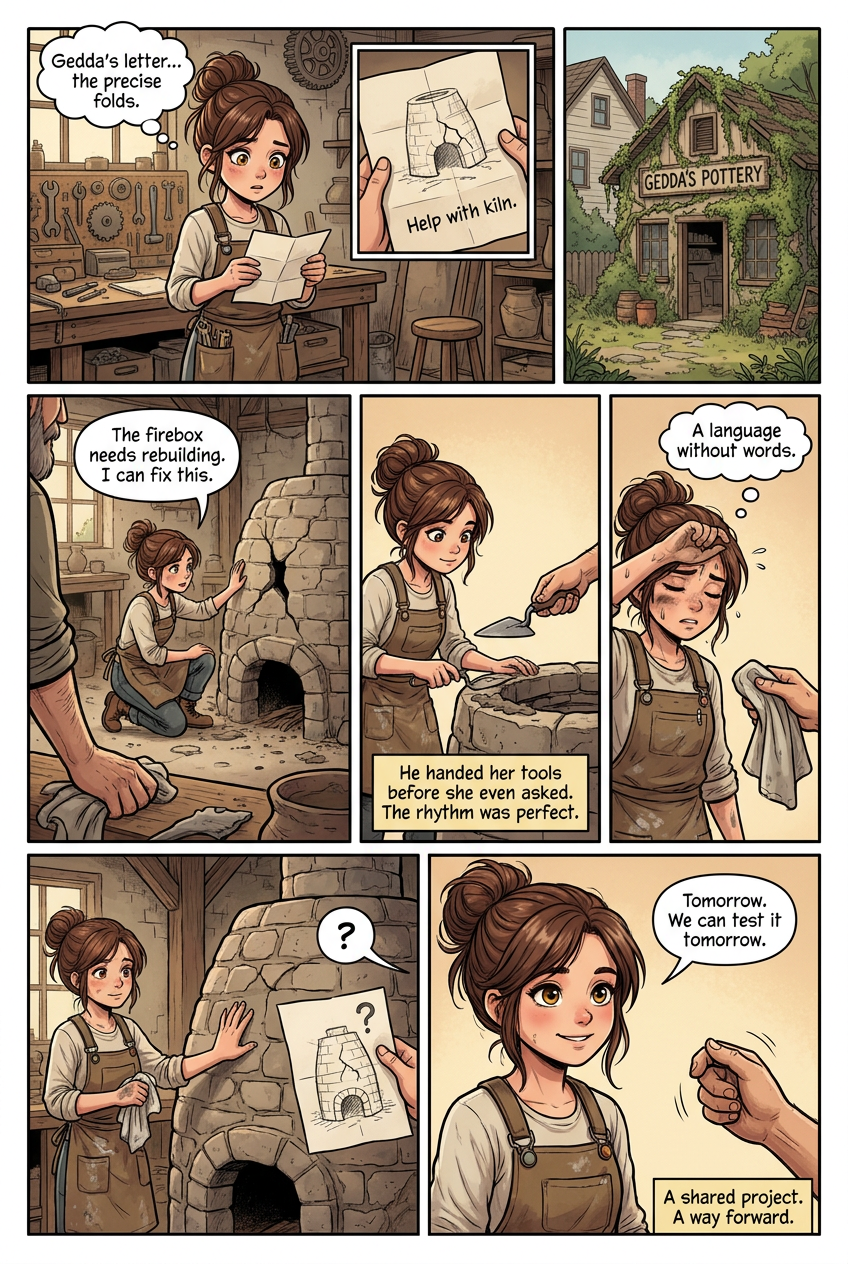
The letter arrived folded twice, the paper soft from handling. Aima recognized the careful way the edges lined up — Gedda had always been precise with his hands. She opened it standing in her workshop, tools spread across the bench behind her. The note asked for help with a kiln. No greeting, no explanation, just the request and a rough sketch of a crack running through brickwork. Her chest tightened. He'd written to her. Not spoken, but this was something. She found the workshop behind his house, half-hidden by vines that had grown wild across the roof. Clay pots lined wooden shelves inside, some finished, others abandoned mid-form with their surfaces gone dusty. The kiln stood in the corner, its stones cracked where heat had worked through the mortar. Gedda sat on a stool near the drying shelf, his shoulders curved forward. He didn't look up when she entered, but his hand moved slightly toward the damaged brickwork. Aima knelt beside the kiln and ran her fingers along the crack. It was fixable. She could rebuild the firebox, replace the broken stones, seal the joints. She started talking while she worked, explaining what she found and what she'd need to repair it. Gedda stayed silent, but he handed her tools when she reached for them — the right ones, without her asking. His timing was perfect, like he could read the rhythm of her movements. When she paused to wipe sweat from her forehead, he was already holding out a rag. The language between them wasn't words, but it was there. She felt it in the way he anticipated her next move, the way his hand appeared with exactly what she needed. By the time the sun dropped low, the kiln was sealed and ready for firing. Aima stepped back and wiped clay dust from her palms. Gedda stood and placed one hand flat against the repaired stones, his expression unreadable but intent. Then he picked up a piece of paper from the shelf and sketched quickly — a simple drawing of the kiln with a question mark beside it. She understood. When would it be ready? "Tomorrow," she said. "We can test it tomorrow." He nodded once, slow and deliberate, and something in his posture eased. They had a shared project now. A reason to meet again. A way forward that didn't need words.
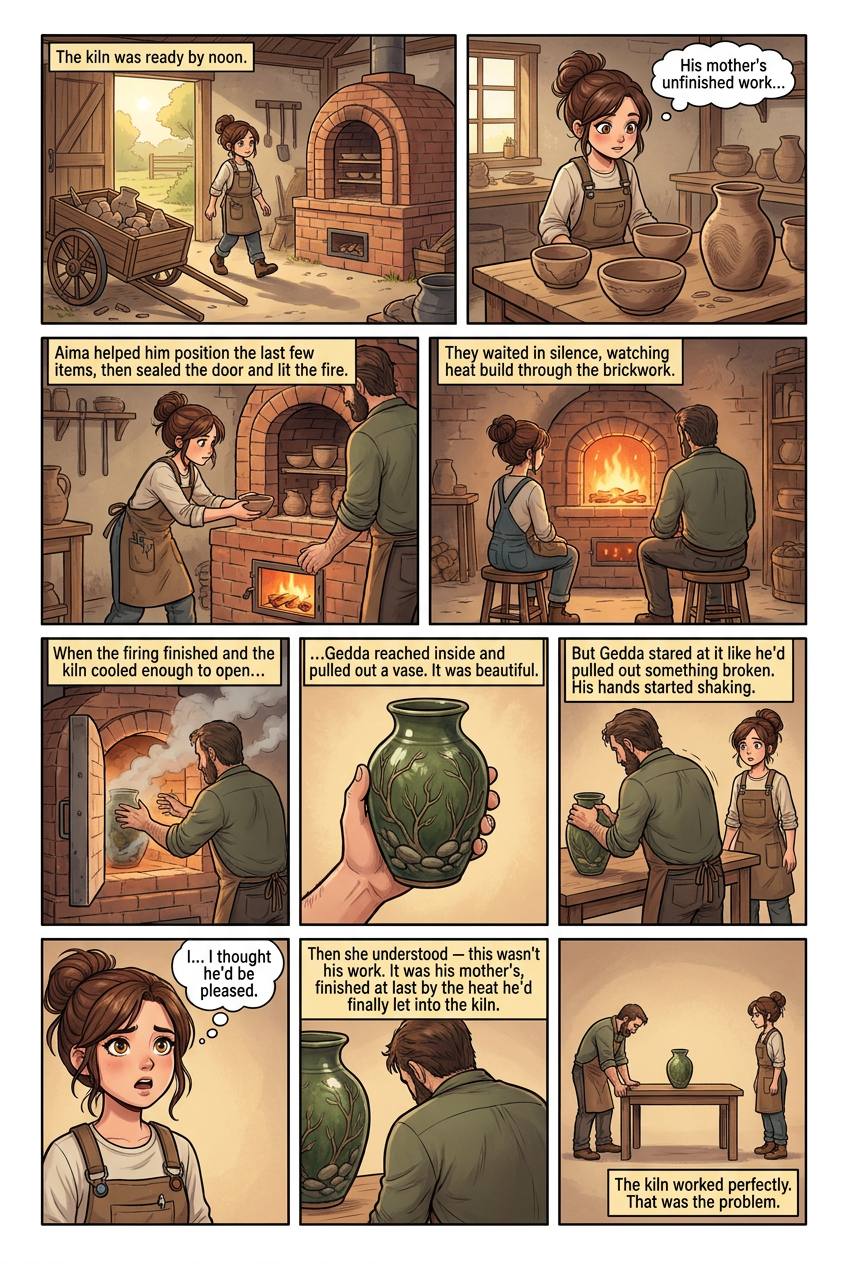
The kiln was ready by noon. Aima arrived early and found Gedda already there, standing beside a table where he'd arranged his mother's unfinished work — clay bowls and a half-formed vase with fingerprints still pressed into its surface. He'd been loading pieces into the kiln before she arrived. A wagon with a broken wheel sat near the workshop door, filled with ceramic work — some cracked, some warped, all failures that told the story of someone learning alone. Gedda moved between the wagon and the kiln with steady purpose, placing each piece inside the firebox with care. Aima helped him position the last few items, then sealed the door and lit the fire. They waited in silence, watching heat build through the brickwork. When the firing finished and the kiln cooled enough to open, Gedda reached inside and pulled out a vase. The glaze had settled into deep moss-green streaks across the surface, and the base showed carved willow branches wound around smooth river stones. It was beautiful — the kind of work that came from years of practice, not months. But Gedda stared at it like he'd pulled out something broken. His hands started shaking. He set the vase down hard on the table and turned away, his shoulders curling inward. Aima stood frozen, her mouth half-open with praise she couldn't deliver. She'd expected him to be pleased, maybe even proud. Instead he looked gutted. Then she understood — this wasn't his work. It was his mother's, finished at last by the heat he'd finally let into the kiln. He'd been keeping it cold, keeping her unfinished pieces exactly as she'd left them. By asking Aima to repair it, by firing it today, he'd let go of something he'd been holding frozen. She watched him grip the edge of the table, his head bowed, and realized the language between them had just spoken something neither of them had words for. The kiln worked perfectly. That was the problem.
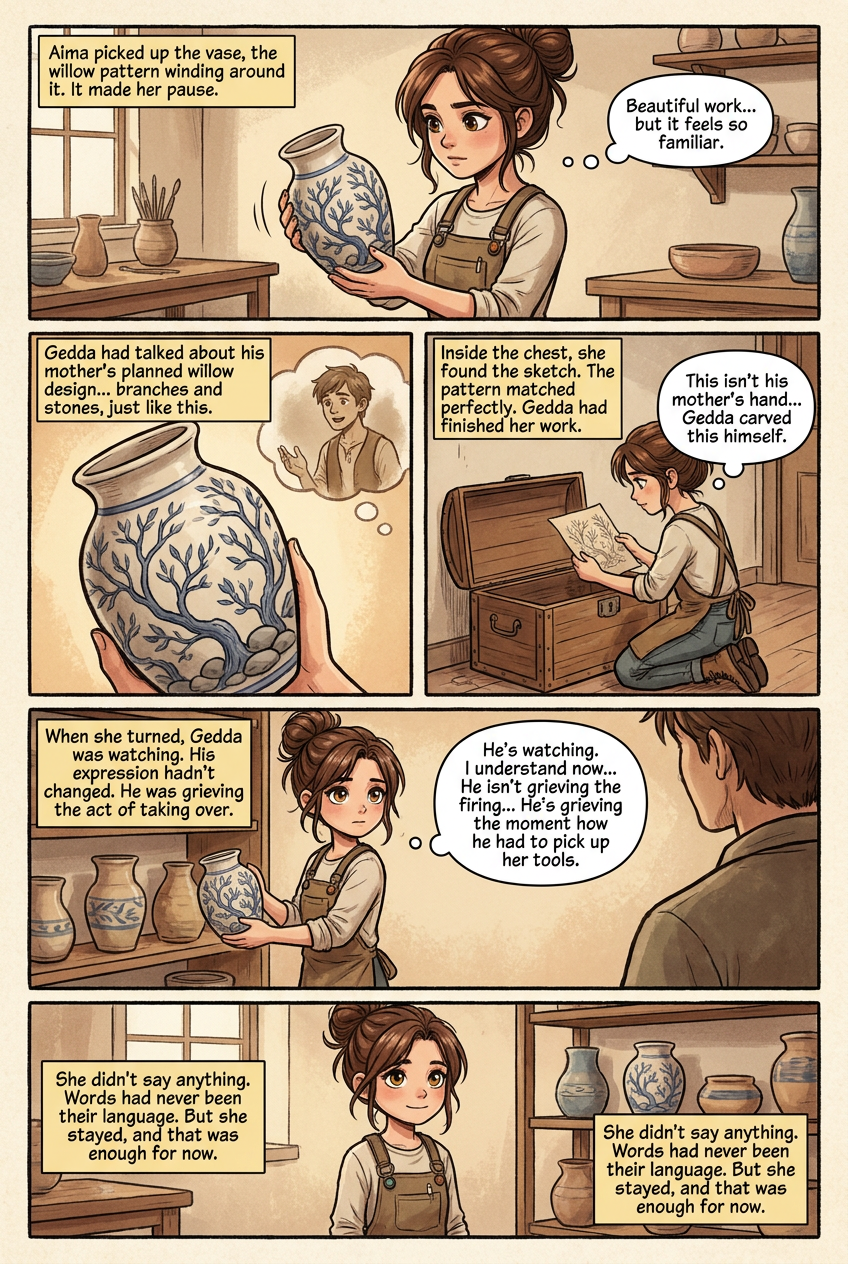
Aima picked up the vase to examine it more closely, turning it in her hands. The willow pattern wound all the way around — branches drooping toward water, stones nestled beneath them. Beautiful work, but something caught her attention. The design felt familiar in a way that made her pause. She glanced at Gedda, then back at the vase. Years ago, before he left, he'd talked about his mother's work constantly. One afternoon he'd described a willow pattern she'd been planning — branches and stones, exactly like this. His mother had sketched it in her journal, he'd said, but never carved it into clay. Aima looked at the carved lines again, following the careful curves. This wasn't his mother's hand finishing her own design. Gedda had carved this himself. She set the vase down and walked to a wooden chest against the wall, the kind potters kept for storing tools and patterns. Inside she found sketches and templates, including one with willow branches drawn in faded ink. The pattern matched perfectly. Gedda's mother had left the design behind, and he'd learned to carve it without her. He'd finished her work, but he'd also made it his own. When she turned around, Gedda was watching her. His expression hadn't changed — still gutted, still lost — but she understood now. He wasn't grieving the firing of his mother's work. He was grieving the moment he'd had to pick up her tools and become the one who finished it. Aima walked back to the shelf where the completed pieces sat cooling and placed the vase among them. She didn't say anything, because words had never been the language that worked between them. But she stayed, and that was enough for now.
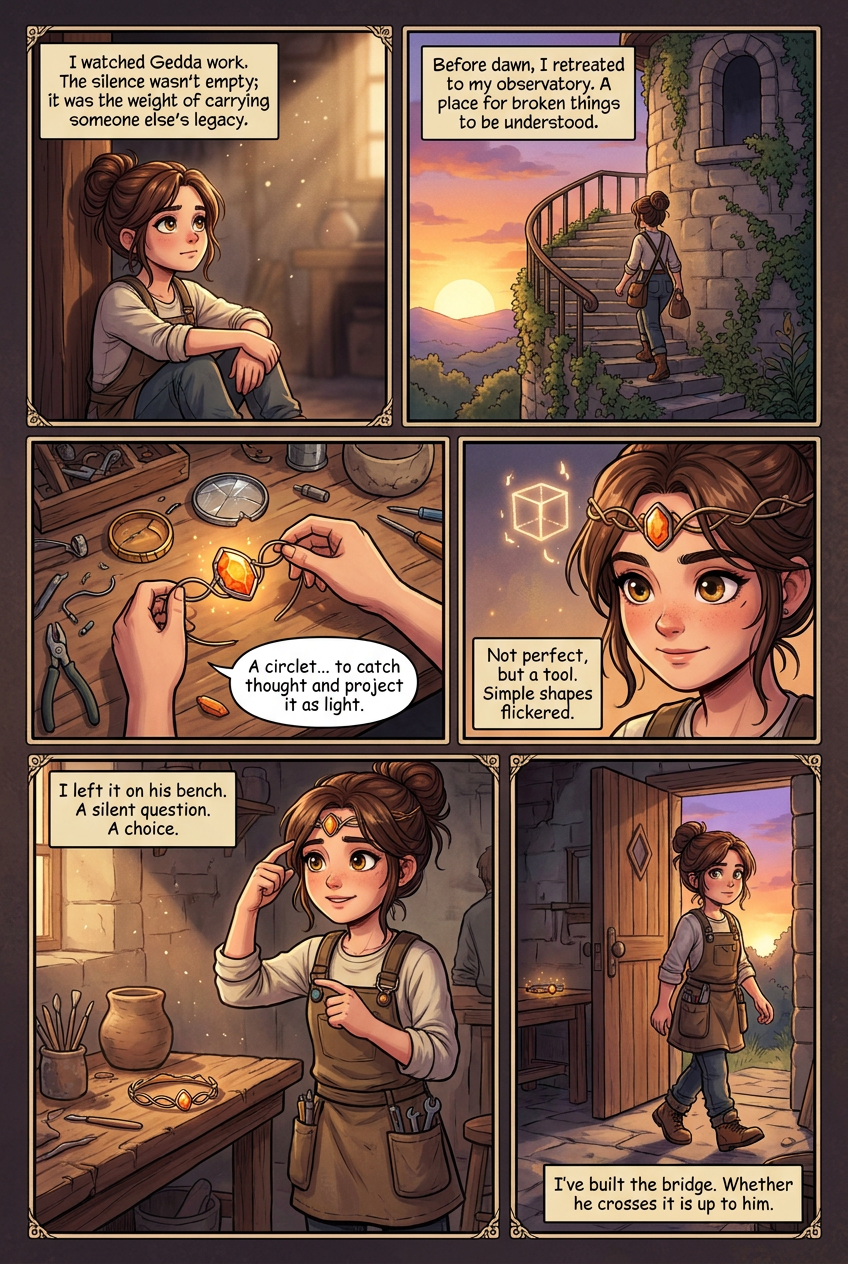
Aima spent the rest of the evening at the workshop, watching Gedda work. He moved through the space with the same quiet focus he'd always had, but now she understood what that silence meant. It wasn't emptiness. It was the weight of carrying someone else's work forward. She left before dawn and climbed the old stone tower she'd claimed years ago — a place where broken things went to be understood. The observatory had been abandoned when she found it, ivy choking the walls, but she'd cleared enough space to work. Now she spread her tools across the floor and pulled out the pieces she'd been collecting: wire frames salvaged from lanterns, a cracked lens from a telescope, an orange stone she'd pried from a ruined mechanism. She worked through the morning, bending wire into a circular frame and setting the stone at its center. The design was simple — a circlet that would rest against the temples, with the stone positioned to catch thought and project it outward as light. By afternoon she had something that worked. She tested it on herself first, thinking simple shapes, and watched as symbols flickered in the air above the stone — rough approximations of what she meant. It wasn't perfect. The images wavered and sometimes the stone showed nothing at all. But it was a tool, and tools could be learned. She wrapped it carefully and carried it back to the workshop, where Gedda was wedging clay at his bench. She set the circlet on the table beside him without explanation. He glanced at it, then at her, and she saw the question in his face. She touched her own temple, then pointed to the stone. His hand moved toward it, hesitated, then pulled back. Aima waited, but he turned away and returned to his clay. She felt the refusal like a door closing, but she didn't take the circlet with her when she left. It sat on his workbench where he'd have to see it every day — a choice he could make when he was ready, or never. Either way, she'd done what she came to do. She'd built the bridge. Whether he crossed it was up to him.
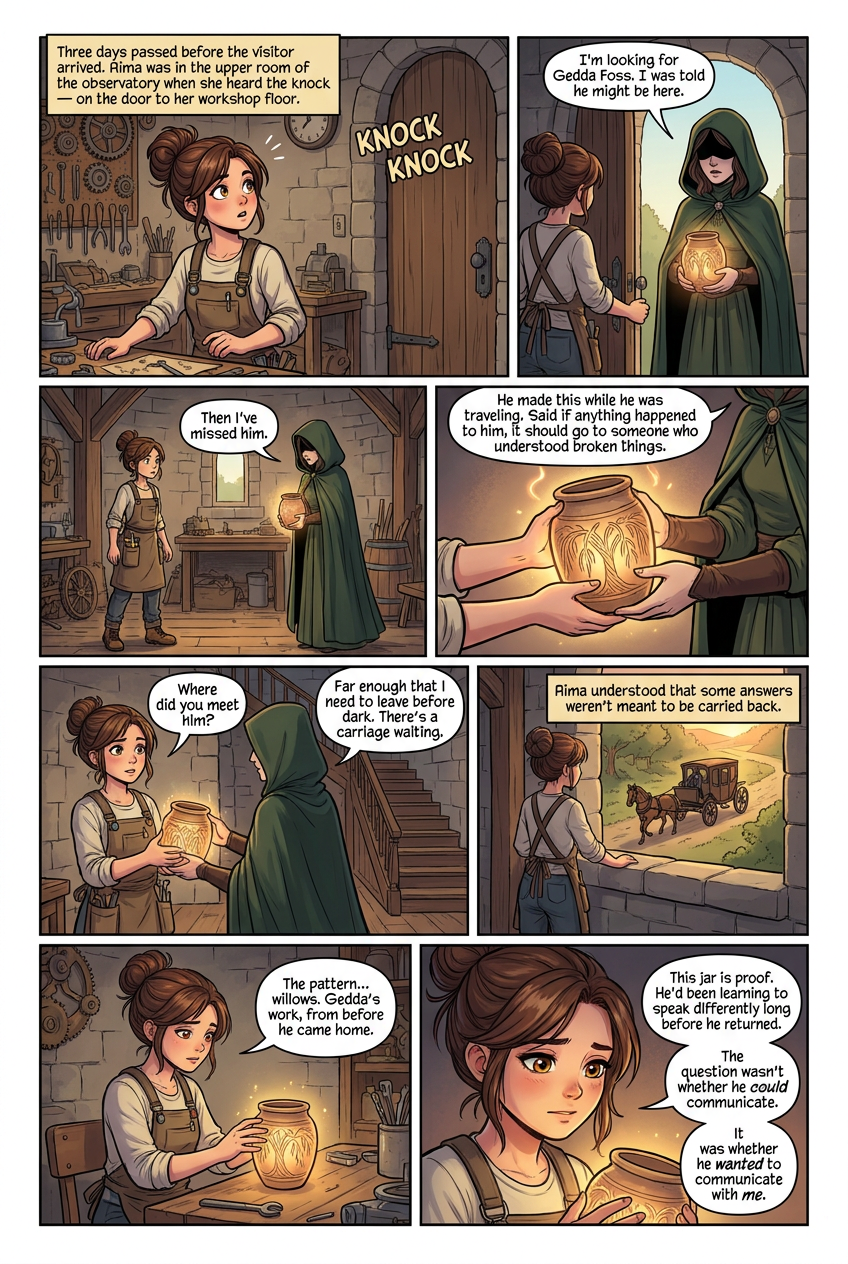
Three days passed before the visitor arrived. Aima was in the upper room of the observatory when she heard the knock — not at the base of the tower where most people gave up, but on the door to her workshop floor. Someone who knew the way. She opened it to find a woman in a dark green cloak, holding a ceramic jar that glowed faintly from within. The woman's face was unfamiliar, but her eyes moved past Aima into the workshop with the quick assessment of someone looking for a specific person. "I'm looking for Gedda Foss," she said. "I was told he might be here." Aima stepped back without answering, letting the woman see the empty room behind her. The woman's shoulders dropped slightly. "Then I've missed him." She held out the jar. "He made this while he was traveling. Said if anything happened to him, it should go to someone who understood broken things." The glow inside pulsed once, like a heartbeat. Aima took the jar carefully, feeling its warmth through the clay. The surface was carved with a pattern she recognized — willows, but simplified, the way someone would draw them if they'd learned the design from memory rather than from a teacher's hand. Gedda's work, but from before he came home. "Where did you meet him?" she asked. The woman glanced toward the stairs. "Far enough that I need to leave before dark. There's a carriage waiting." She didn't offer more. Aima wanted to ask what Gedda had been like then, whether he'd spoken, whether he'd been different. But the woman was already turning toward the door, and Aima understood that some answers weren't meant to be carried back. She watched from the window as the woman climbed into a horse-drawn carriage below and disappeared down the road. The jar sat on her workbench, still glowing. Aima ran her fingers over the carved willows and realized what she was holding — proof that Gedda's silence hadn't started when he came home. He'd been learning to speak differently long before he returned. The circlet she'd made was still at his workshop, untouched. But this jar told her something the circlet couldn't. Gedda had already found a way to be understood by someone else. The question wasn't whether he could communicate. It was whether he wanted to communicate with her.
Play your story to life
Storycraft is a mobile game where you create AI characters, craft items and locations to build their world, then discover what direction your story takes. Download the iOS game for free today!
Download for free