

Aldric Thornwood's Arc
10 Chapters
Aldric Thornwood's dream is solving the cold case that has haunted him for decades..

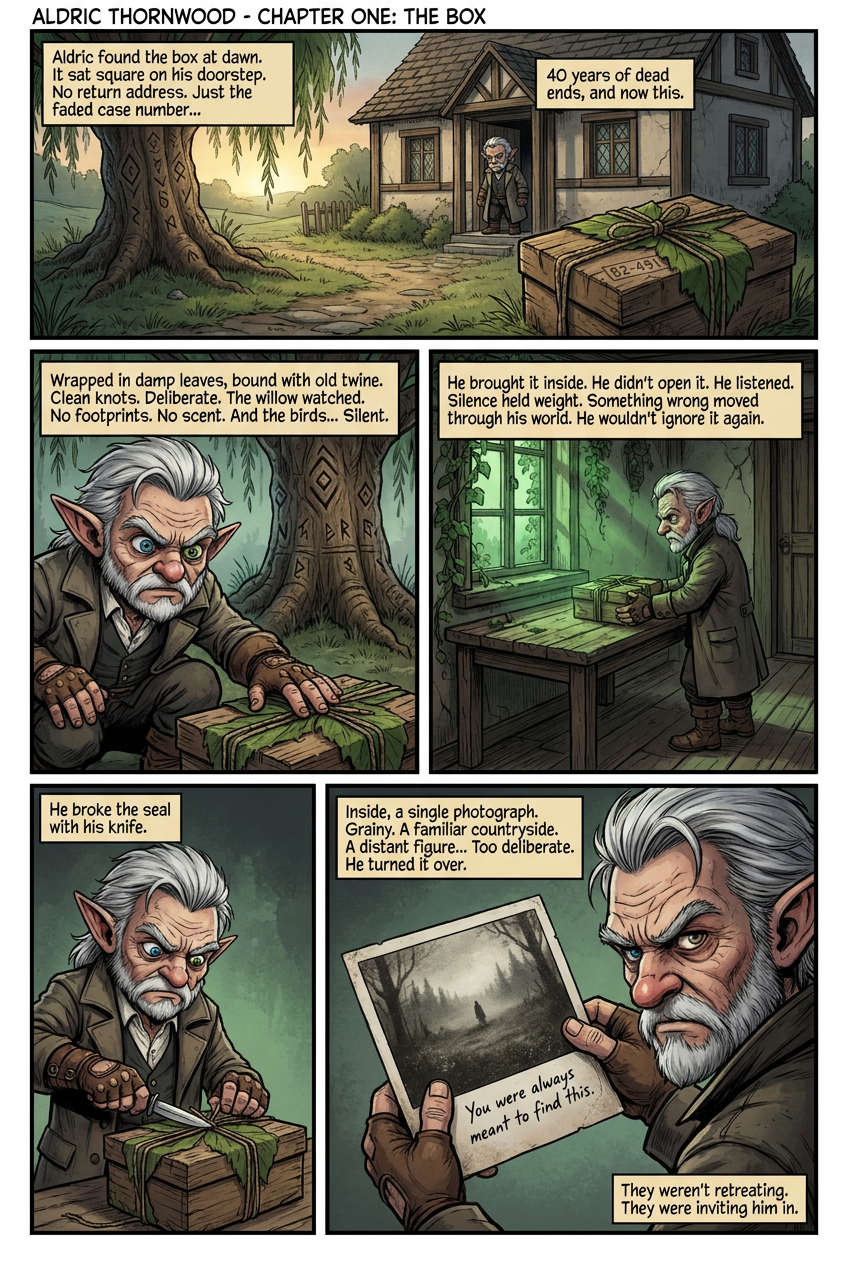
Aldric Thornwood found the box at dawn. It sat square in the center of his doorstep, edges worn but seal intact. No return address. No note. Just the faded case number stamped across the lid — a number he'd carried in his mind for forty years, through every dead end and buried lead. Someone knew he was close. Someone wanted him to know they knew. He crouched beside it, one calloused hand resting on the seal. The box was wrapped in broad leaves, still damp with morning dew, bound tight with frayed twine that looked decades old. The knots were deliberate. Clean. Whoever left this hadn't been careless. Behind him, the ancient willow stood silent, its rune-carved trunk watching over the narrow path to his door. No footprints marked the soft earth beneath its drooping branches. No scent lingered. The birds hadn't sung at all that morning. Aldric carried the box inside and set it on the scarred table near the window. Light filtered through the vines that climbed the walls of his home, casting green shadows across the stamped case number. He didn't open it right away. Instead, he circled the room once, listening. The silence outside held weight. Animals didn't go quiet for nothing. They went quiet when something wrong moved through their world. He'd ignored that truth for fifteen years. Three people had disappeared in those years. He wouldn't ignore it again. He broke the seal with his knife. Inside lay a single photograph — grainy, faded, taken in the same stretch of countryside where he'd found the boot. In the background, barely visible through the trees, stood a figure. Too far to identify. Too deliberate to be accidental. Aldric turned the photo over. On the back, written in careful script: "You were always meant to find this." The perpetrator wasn't retreating. They were inviting him in.
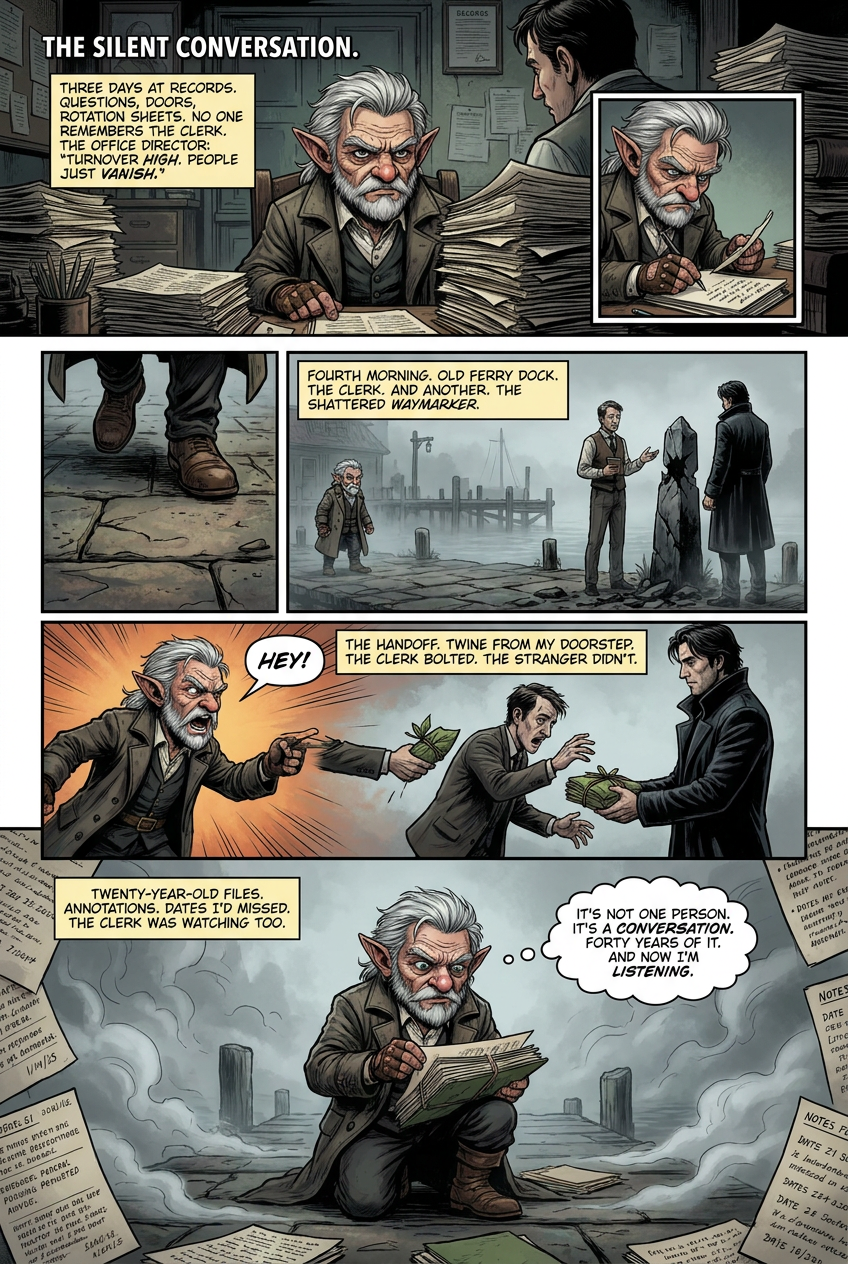
Aldric spent three days at the records office. He asked questions at every desk, pushed every door, checked every rotation sheet. No one remembered the clerk who'd filed the boot. No one admitted seeing him leave. The office director looked through Aldric with tired eyes and said staff turnover was high, records incomplete, and some people just stopped showing up for work. Aldric wrote down names anyway. He cross-referenced addresses, employment dates, anything that might connect to the forty-year pattern. Nothing fit. The clerk had simply vanished into the same silence that swallowed the others. But on the fourth morning, Aldric found him. The clerk stood at the old ferry dock beyond the records building, hands jammed in his pockets, staring at the water. Aldric moved down the worn flagstone path, keeping his steps quiet. Twenty yards out, he saw the other figure — a man already there, positioned beside the shattered waymarker stone that marked the dock's edge. The stone was split clean down the middle, blackened by old fire, its carved sigil burned beyond reading. The stranger leaned against it like he'd been waiting. The clerk glanced once over his shoulder, saw Aldric approaching, and turned back to the man at the stone. Aldric broke into a run. The stranger pulled something from his coat — a bundle wrapped in broad leaves, bound with the same frayed twine Aldric had seen on his doorstep. The clerk reached for it. Aldric was ten yards away when their hands met. He shouted. The clerk flinched, dropped the bundle, and bolted down the dock toward the water. The stranger didn't run. He bent, picked up the fallen package, and met Aldric's mismatched eyes with a calm that felt rehearsed. Then he stepped backward off the dock into the shallow reeds and disappeared into the morning fog that clung to the riverbank. Aldric reached the edge and stopped. The bundle sat at his feet where the stranger had placed it — not dropped, placed. He knelt and unwrapped the leaves. Inside were copies of case files, twenty years old, marked with the same case number as the box on his doorstep. Annotations filled the margins in handwriting that wasn't his own. Notes about animal behavior. Dates that lined up with disappearances he'd never connected. The clerk hadn't vanished. He'd been watching the same pattern Aldric had, probably longer. And now someone else knew they both were close. Aldric folded the files, turned toward the empty dock, and realized the question he'd been asking was wrong. He wasn't chasing one person who knew too much. He was standing in the middle of a conversation that had been happening without him for forty years.
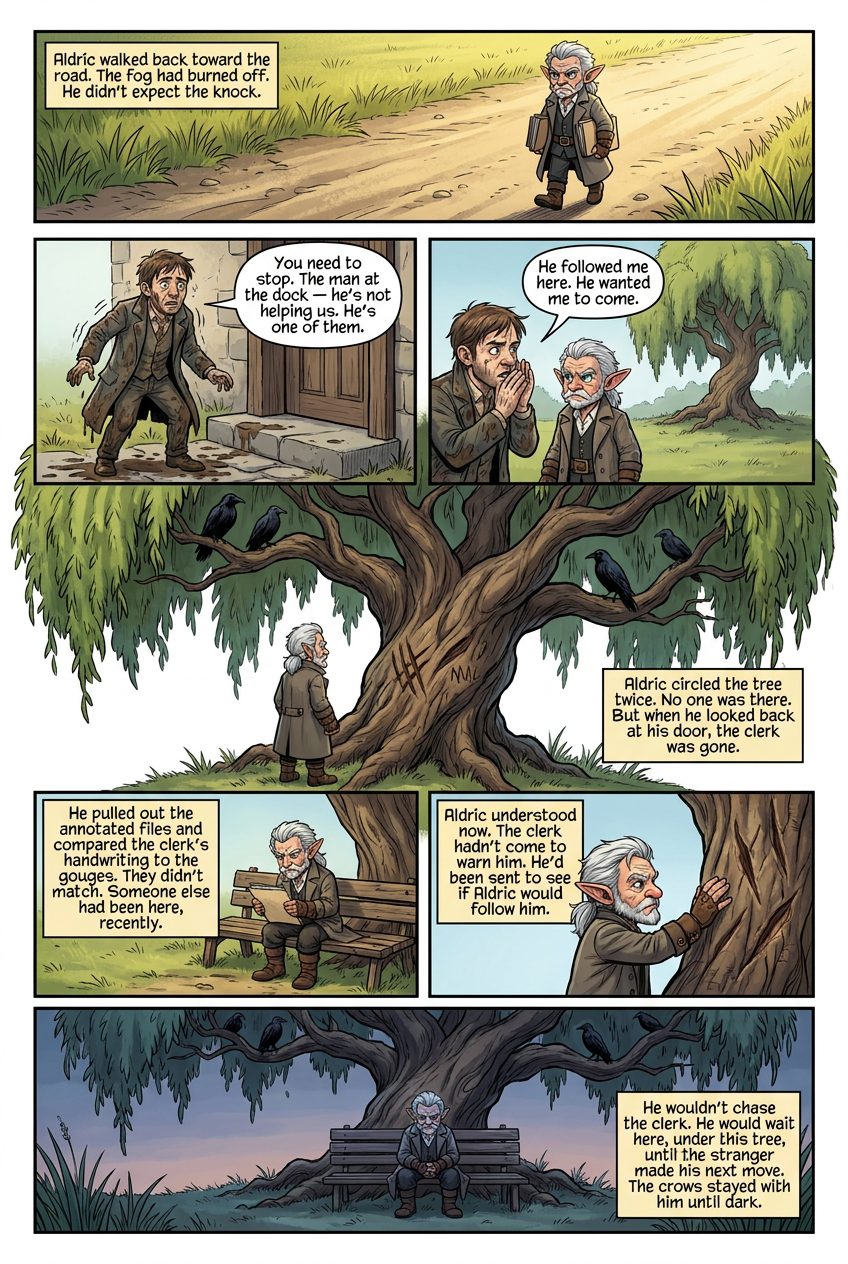
Aldric walked back toward the road with the files tucked under his arm. The fog had burned off by the time he reached the first bend, and the light made the grass look sharper than it had in days. He didn't expect the knock. The clerk stood on his doorstep when Aldric arrived home, mud streaked up his legs and across his coat. His boots left fresh prints on the stone path, dark and wet like he'd run through a field without looking where he stepped. His hands shook when he tried to speak. "You need to stop," he said. "The man at the dock — he's not helping us. He's one of them." Aldric wanted him to come inside, to sit down and explain everything he'd been tracking for twenty years. But the clerk kept glancing back toward the road, toward the old willow that stood bent and gnarled at the edge of Aldric's property. Its branches hung low enough to hide someone underneath. "He followed me here," the clerk whispered. "He wanted me to come." Aldric stepped past him and walked to the willow. The trunk was massive, twisted like it had been growing in the wrong direction for decades. Crows perched in the upper branches, silent and still. A wooden bench sat beneath it, half-rotted, covered in moss. Someone had carved initials into the bark years ago, but they'd been scratched over with deep gouges that looked fresh. Aldric circled the tree twice. No one was there. But when he looked back at his door, the clerk was gone. The muddy prints led down the path, then stopped at the road. Aldric followed them until they vanished into a stretch of grass that showed no sign of being disturbed. He returned to the willow and sat on the bench. The crows shifted but didn't leave. Aldric pulled out the annotated files and compared the clerk's handwriting to the gouges in the tree. They didn't match. Someone else had been here, recently, and left a message meant to be seen. Aldric understood now — the clerk hadn't come to warn him. He'd been sent to see if Aldric would follow him away from the house. The stranger at the dock wasn't trying to hide. He was testing how much Aldric trusted what he saw. Aldric placed his hand on the scarred bark and made his decision. He wouldn't chase the clerk. He would wait here, under this tree, until the stranger made his next move. The crows stayed with him until dark.
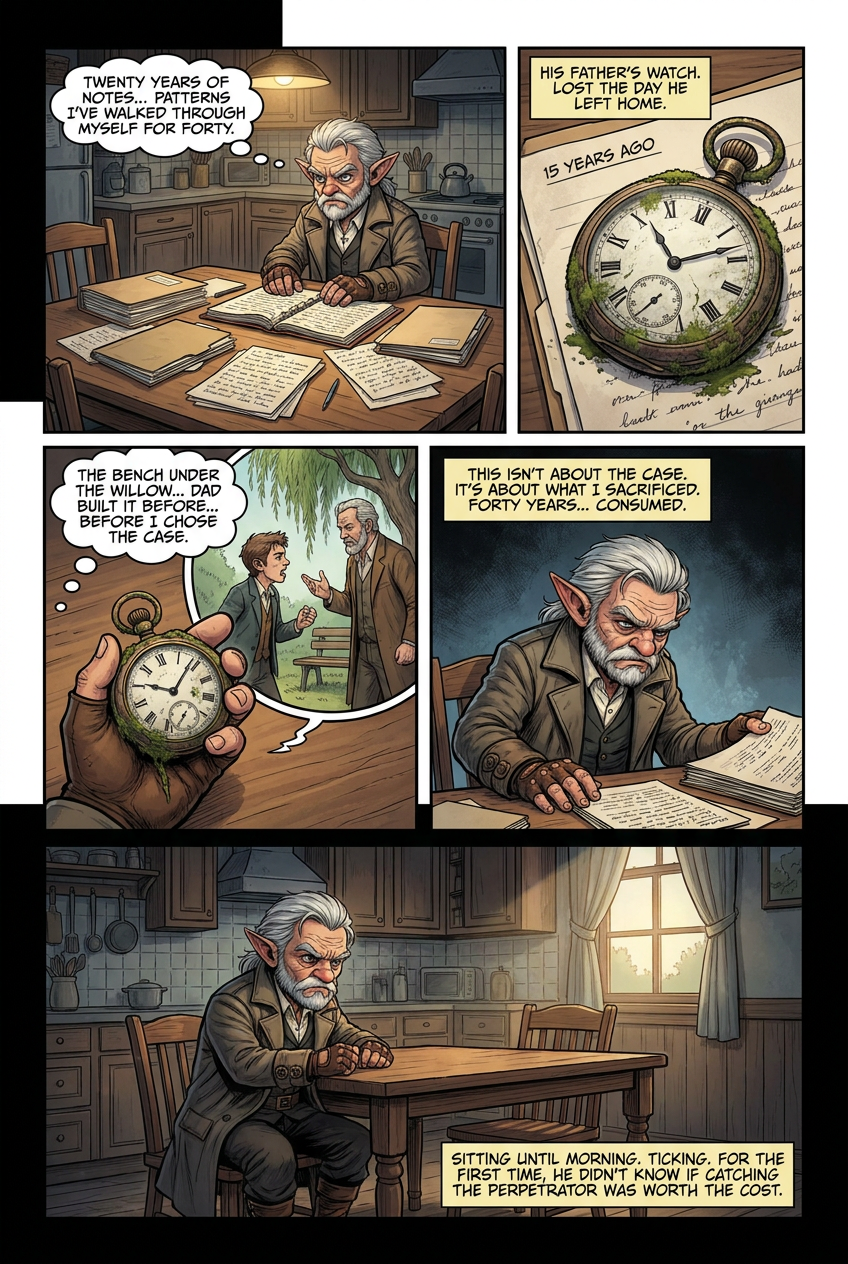
Aldric opened the annotated files on the kitchen table and spread them out in order of date. The clerk's handwriting filled the margins with notes about animal silence, patterns of fog, times when the countryside seemed to hold its breath. Twenty years of watching the same stretch of land Aldric had walked through for forty. He found the pocket watch wedged between two pages dated fifteen years ago — the exact period he'd ignored the pattern. Moss still clung to its ornate surface, dirt packed into the carved channels. Aldric recognized it immediately. It had belonged to his father, lost the day Aldric left home to pursue his first case. He'd searched for weeks, then given up. Now here it sat, wrapped in fresh leaves bound with twine, placed deliberately in files the clerk had carried for years. Someone had been inside his childhood home. Someone had taken this before Aldric ever became the man who would spend forty years chasing ghosts. The bench under the willow suddenly made sense. His father had built it when Aldric was twelve, before the arguments about duty and obsession, before Aldric chose investigation over family. The moss hadn't grown naturally — someone had cultivated it, kept it alive while Aldric studied case files and ignored the people who'd once mattered. The watch ticked in his palm, still working after decades buried. He thought of the three victims who'd disappeared during his fifteen years of denial. He thought of his father, who'd died while Aldric was examining an empty field three counties away. Aldric closed the files and placed the watch on top. He understood now why the stranger wasn't hiding. This wasn't about solving a case. It was about making Aldric see what he'd sacrificed to chase it. The investigation had consumed forty years, and he couldn't name a single person outside of it who still knew him. He sat at the table until morning, the watch ticking steadily, and made no move toward the countryside. For the first time since finding that boot, he didn't know if catching the perpetrator would be worth what it had already cost. The decision to continue would require choosing the investigation over the memory of everyone he'd lost along the way.
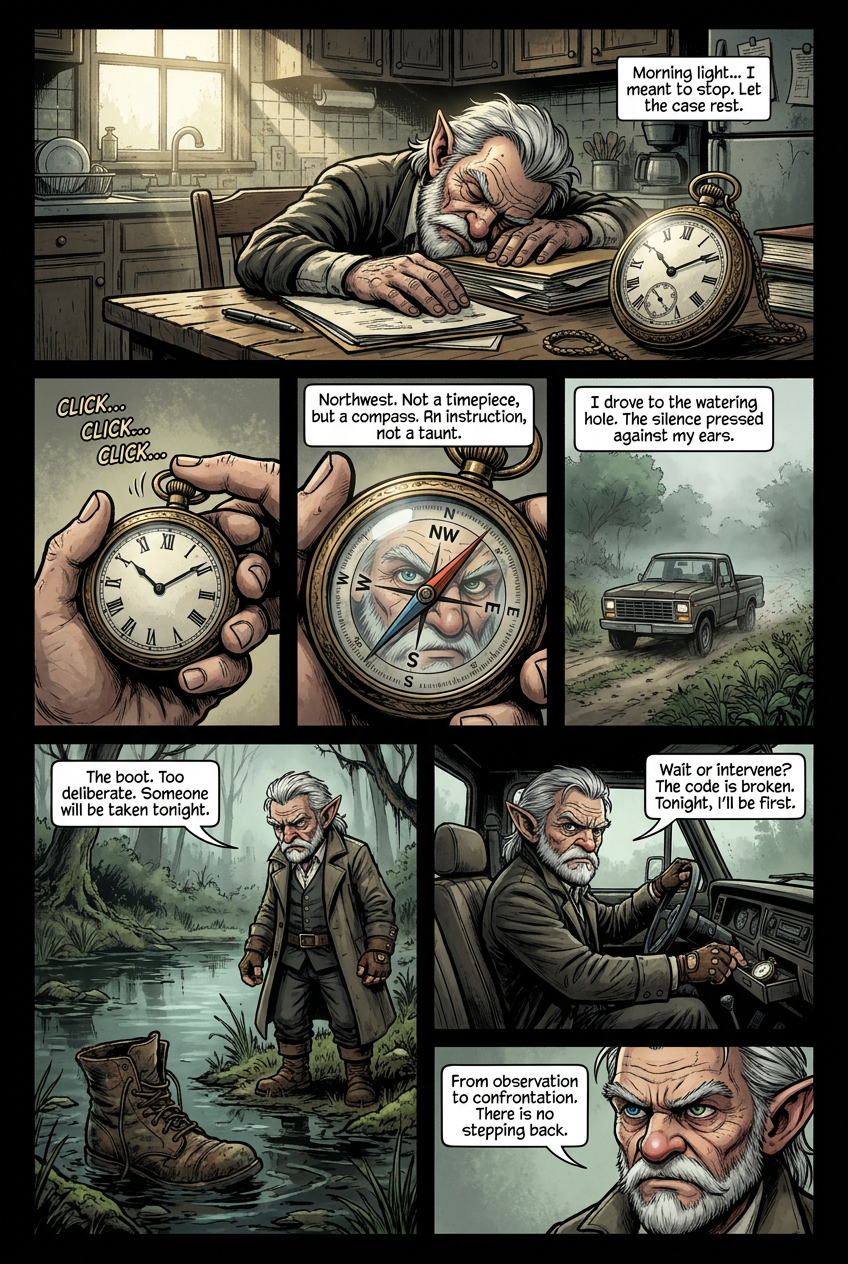
Aldric woke with his head on the table, the watch still ticking beside the files. Morning light cut through the kitchen window. He'd meant to stop, to let the case rest. But his hand reached for the watch without thinking, and he felt the mechanism click under his thumb — once, twice, three times in quick succession. The inner dial spun. Numbers aligned with compass points, turning the ornate face into a directional marker. Northwest. Aldric held the watch flat and watched the spinning needle settle. The pattern wasn't random — it was a signal, timed to the morning hour when animals woke. His father's watch had never been a timepiece. It was a compass meant for someone who knew how to read it. The perpetrator had left it in the files as an instruction, not a taunt. Acting on it meant walking directly into whatever waited at the end of that needle. Aldric drove to the watering hole northwest of his property, where fog clung to dark stones ringed with moss. No birds called. No insects moved through the grass. The silence pressed against his ears the way it had before every disappearance he'd documented. He stepped closer and saw the boot half-buried in mud at the water's edge — weathered leather, still laced, positioned too deliberately to be accidental. Someone had been here recently. Someone would be taken tonight if he didn't move now. He marked the location and returned to his truck. The watch had given him the place, but not the time. The perpetrator was forcing him to choose: wait and watch, or intervene and reveal how much he understood. Aldric locked the watch in the glove box and turned the ignition. For forty years he'd stayed one step behind. Tonight he would be there first, even if it meant the killer would know he'd broken the signal's code. The case had moved from observation to confrontation. There was no stepping back.
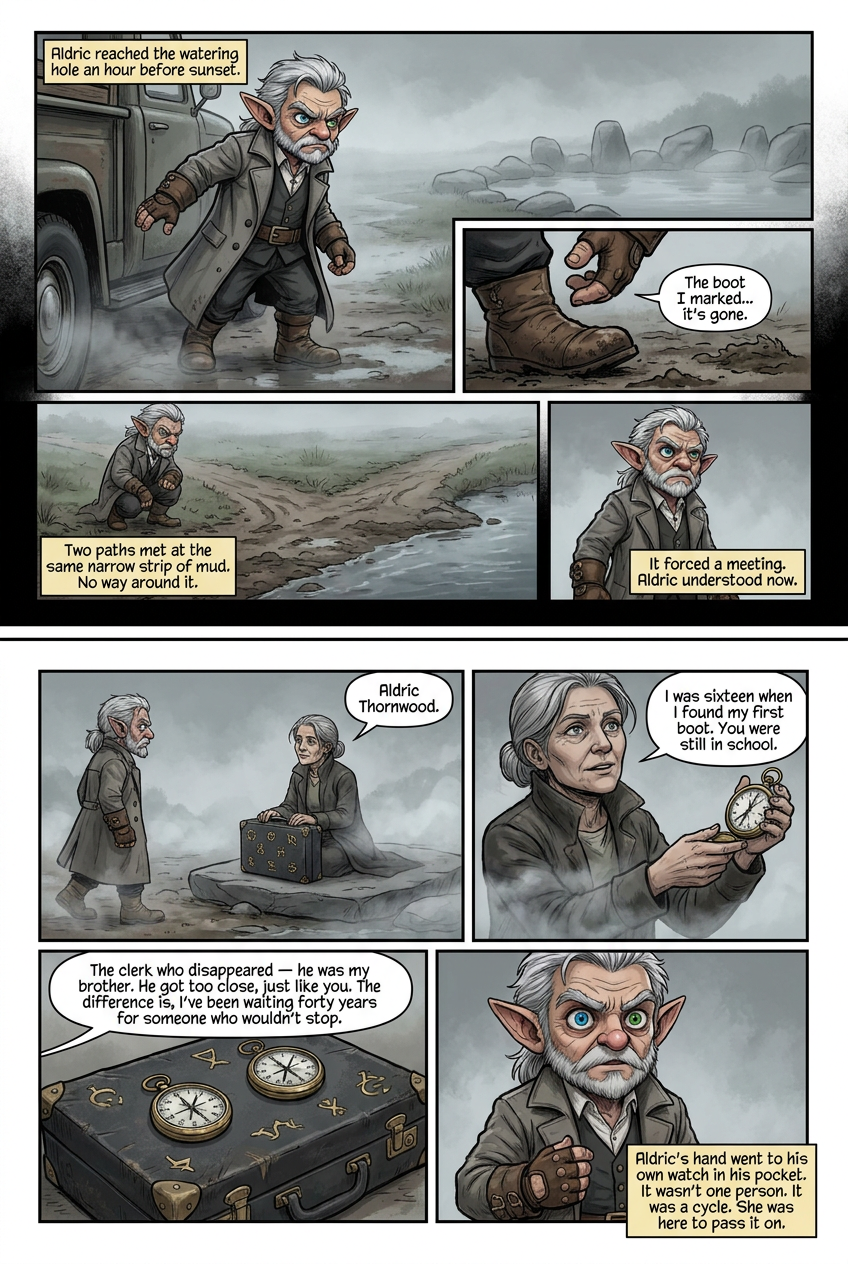
Aldric reached the watering hole an hour before sunset. The fog had thickened since morning, turning the stones at the water's edge into gray shapes that barely held form. He parked the truck fifty yards back and approached on foot, boots careful on the wet ground. The boot he'd marked earlier was gone. Two paths met at the water's edge where erosion had carved channels through the bank. One led from the north, the other from the west, and both ended at the same narrow strip of mud. There was no way around it. Anyone approaching from either direction would leave tracks, would be seen. Aldric understood now why the perpetrator had chosen this place. It forced a meeting. A woman sat on a flat stone twenty feet from the water. She was older than Aldric, gray hair pulled back, hands resting on a black briefcase covered in symbols he didn't recognize. The leather was worn but cared for, the brass corners polished. She'd been here long enough for the fog to settle on her coat. When she looked up, her expression held no surprise. "Aldric Thornwood," she said. Not a question. She reached into her coat and pulled out a pocket watch identical to his father's, the face marked with the same compass dial. "I was sixteen when I found my first boot. You were still in school." She set the watch on the briefcase between them. "The clerk who disappeared — he was my brother. He got too close, just like you. The difference is, I've been waiting forty years for someone who wouldn't stop." Aldric's hand went to his own watch in his pocket. The perpetrator wasn't one person. It was a cycle, and this woman had been part of it longer than he'd been alive. She wasn't here to kill. She was here to pass it on.
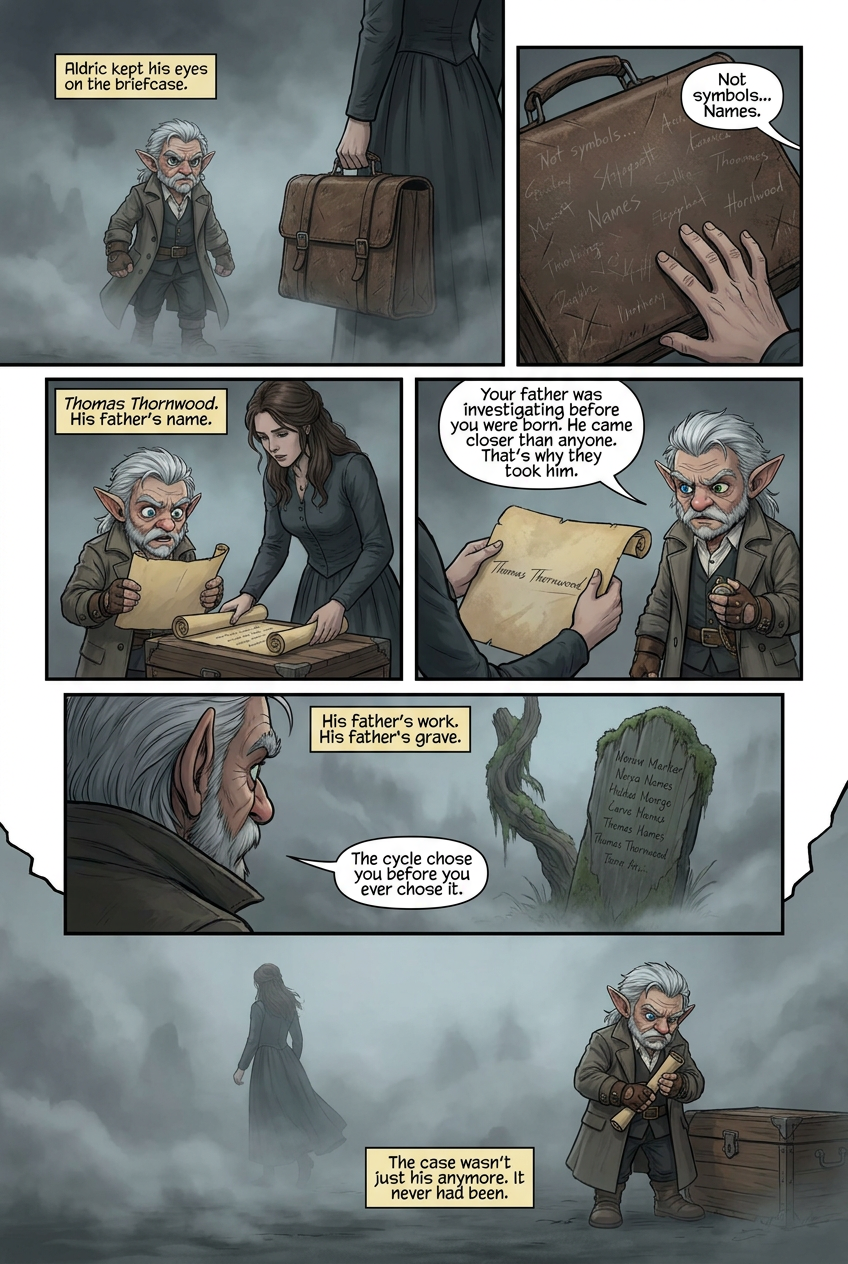
Aldric kept his eyes on the briefcase. The symbols carved into the leather were faint in the fog, but clear enough now that he was closer. Not symbols at all. Names. Dozens of them, scratched in different hands, different years. Some he recognized from his files. Others he'd never seen. He stepped forward. The woman didn't move. She opened the briefcase and pulled out a scroll, yellowed and brittle at the edges. The handwriting was elegant, deliberate. She unrolled it across the wooden chest beside her and held it flat with both hands. Aldric read the first name. Then the second. Halfway down, his breath stopped. Thomas Thornwood. His father's name, written in ink that had faded decades ago. "Your father was investigating before you were born," the woman said. Her voice was steady, without apology. "He came closer than anyone. That's why they took him." Aldric's hand went to the pocket watch. His father hadn't died in an accident. The obsession wasn't his alone — it had been passed down, deliberate as the boot left in the field. "They wanted you to follow," she continued. "They needed someone who wouldn't stop. Someone who'd carry it forward." Aldric looked past her to the water's edge. A moss-covered marker stood half-hidden in the fog, twisted wood carved with symbols he now understood weren't warnings but names. His father's work. His father's grave. The woman stood and left the scroll on the chest. "You wanted to know why you couldn't let it go," she said. "Now you do. The cycle chose you before you ever chose it." She walked north into the fog. Aldric didn't follow. He picked up the scroll, rolled it carefully, and tucked it inside his coat. The case wasn't just his anymore. It never had been.
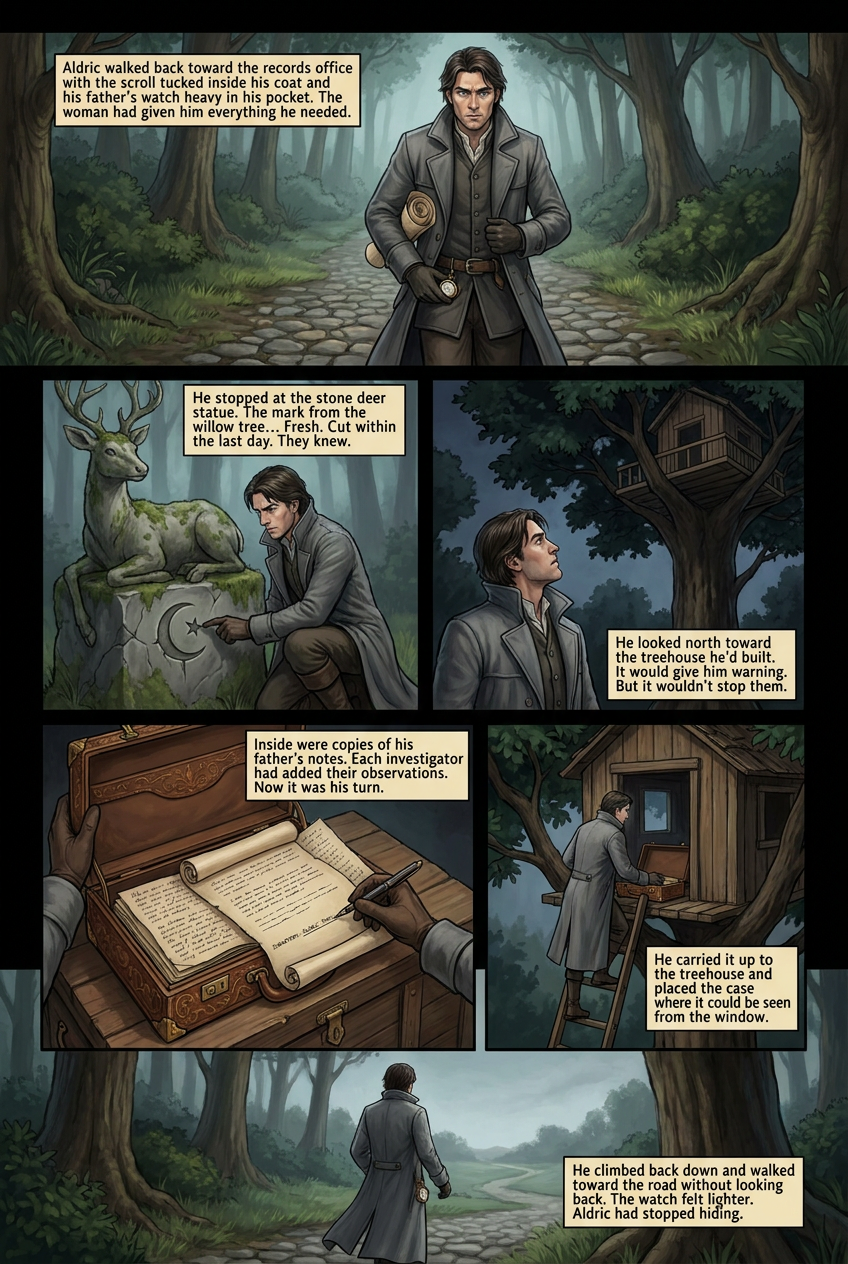
Aldric walked back toward the records office with the scroll tucked inside his coat and his father's watch heavy in his pocket. The woman had given him everything he needed to move forward. Names. Dates. Connections his father had drawn forty years ago. But using any of it meant stepping into the open. He stopped at the stone deer statue halfway between the watering hole and the road. The moss grew thick along its flank, and someone had carved a symbol into the base—the same mark from the willow tree. Aldric knelt and ran his fingers across it. Fresh. Cut within the last day. They knew he'd been to the watering hole. They knew what he now carried. He looked north toward the treehouse he'd built three years ago to watch the approach roads. From here, he could see the platform through the branches, dark wood against darker leaves. It would give him warning if anyone came. But it wouldn't stop them. Aldric opened the ornate briefcase the woman had left on the chest. Inside were copies of his father's notes, annotated in a dozen different hands. Each investigator had added their observations before passing it forward. Now it was his turn. He took out the scroll and laid it flat across the briefcase lid. His father's name stared back at him. He pulled a pen from his coat and wrote his own name beneath it. The ink dried quickly in the cold air. There. He'd signed himself into the record. Anyone looking for proof that he knew would find it. He closed the briefcase and carried it up to the treehouse. The ladder creaked under his weight. Inside, he placed the case on the floor where it could be seen from the window. Then he climbed back down and walked toward the road without looking back. The perpetrator would come for the briefcase now, or for him—it didn't matter which. Aldric had stopped hiding. The watch felt lighter in his pocket. His father had made the same choice forty years ago. Now Aldric understood what it cost.
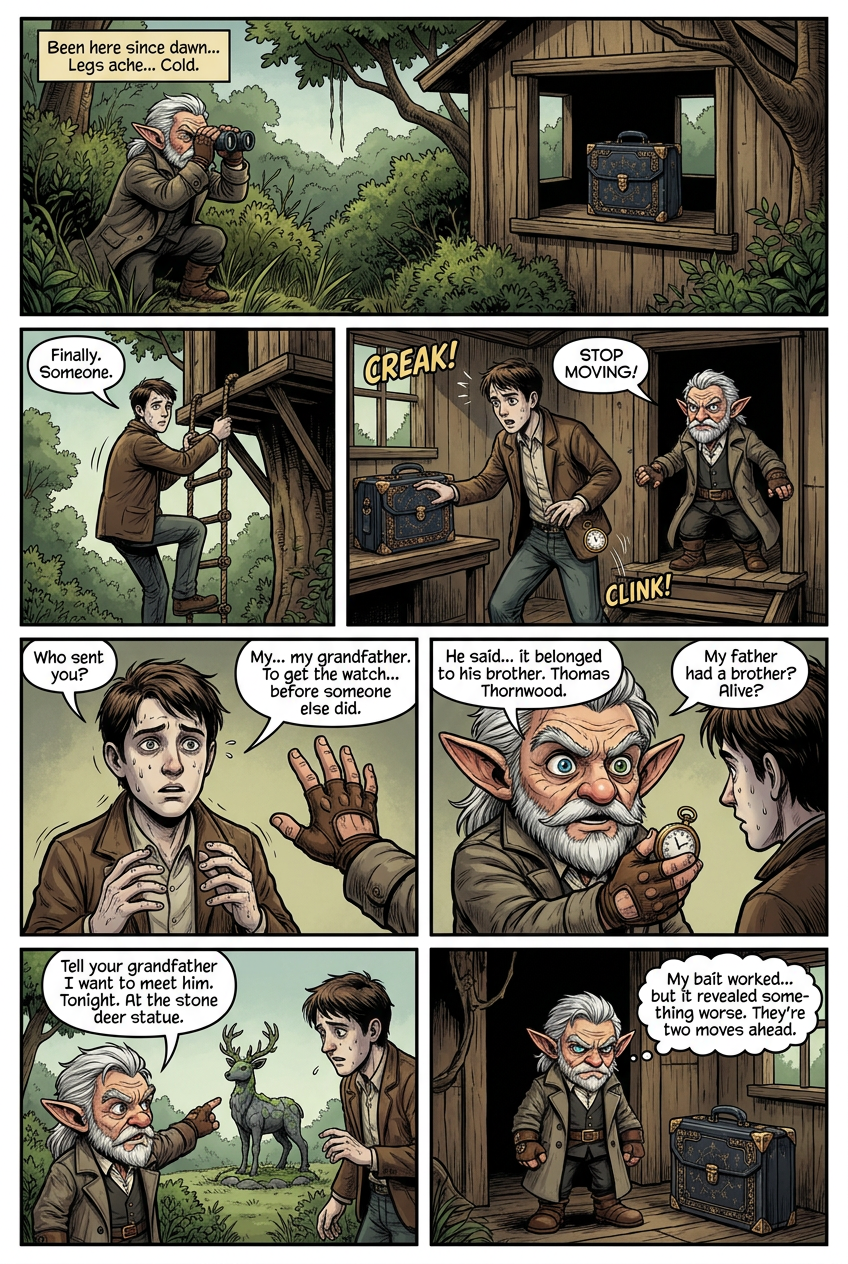
Aldric waited in the brush thirty yards from the treehouse. The briefcase sat visible through the window, exactly where he'd left it. He'd been here since dawn, watching. His legs ached from crouching. His hands were cold. But movement came just after noon—a figure climbing the ladder, quick and careful. The rope ladder swayed under the climber's weight. Aldric rose from the brush and moved closer, staying low. The figure reached the platform and stepped inside. Through the window, Aldric saw a young man, maybe twenty-five, reaching for the briefcase. Not the perpetrator. Too young. Too uncertain in his movements. The man opened the case and pulled out a pocket watch—not his father's, but one identical to it. The man turned it over in his hands like he'd seen it before. Aldric climbed the ladder before the man could leave. The platform creaked under his boots. The young man spun around, dropping the watch. His face went pale. Aldric stepped through the doorway and saw the trap door he'd built into the floor—meant to catch someone trying to escape through the back. The man backed toward it without knowing it was there. Aldric raised one hand. "Stop moving," he said. The man froze. "Who sent you?" The young man's voice shook. "My grandfather. He said to get the watch before someone else did." He pointed at the case. "He said it belonged to his brother. Thomas Thornwood." Aldric felt the ground shift under him. His father had a brother. Someone who'd been alive this whole time, watching. Someone who knew what the watch meant and had sent his grandson to retrieve it. The perpetrator wasn't coming for the briefcase. They'd sent an innocent instead, testing whether Aldric would act without knowing the full picture. He'd almost trapped the wrong person. Aldric picked up the fallen watch and handed it back to the young man. "Tell your grandfather I want to meet him," he said. "Tonight. At the stone deer statue." The man nodded and left quickly, the ladder creaking as he descended. Aldric stood alone in the treehouse, staring at the briefcase. His bait had worked—but it had revealed something worse. The perpetrator knew his methods well enough to stay two moves ahead.
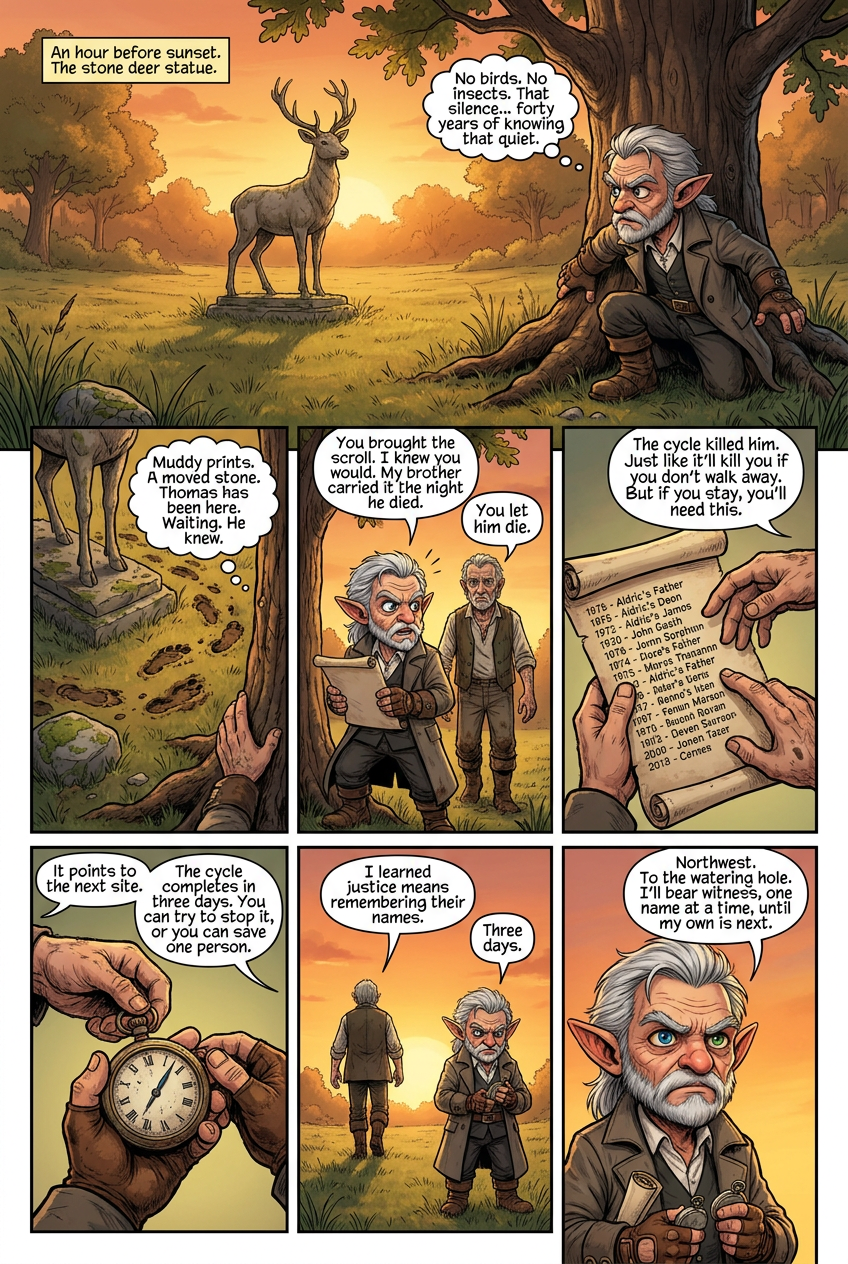
Aldric arrived at the stone deer statue an hour before sunset. He wanted the position advantage this time. The statue stood in a clearing surrounded by tall grass, visible from three directions. He chose a spot behind an oak tree twenty feet back, where he could watch without being seen. The air was still. No birds called. No insects moved through the grass. The silence pressed against his ears the way it always did before something disappeared. He'd spent forty years learning to recognize that quiet. But the muddy footprints around the statue told him someone had been here for days. The prints circled the base of the deer, deep and deliberate. Behind the statue, a moss-covered stone sat where no stone had been before. Someone had moved it into position. Thomas Thornwood had arrived early and stayed, waiting for this moment just as Aldric had. The realization settled cold in Aldric's chest. His uncle had known he would come. Had planned for it. Had probably been watching him watch the clearing right now. "You brought the scroll." The voice came from behind the oak tree, not in front of it. Aldric turned slowly. Thomas Thornwood stood three feet away, an old man with Aldric's father's eyes and calloused hands that matched his own. He wore mud-stained boots and carried nothing. "I knew you would," Thomas said. "My brother carried it the night he died. I watched them take him. Watched them bury him in a field that's been searched a dozen times since." Aldric pulled the scroll from his coat. His father's name was there, third from the bottom. "You let him die," Aldric said. Thomas nodded once. "I let forty-three people die. Your father wanted to stop it. I told him the cycle was bigger than both of us. He didn't listen." Aldric unrolled the scroll fully. Every name on it had a date beside it. Disappearances spanning a hundred and twenty years, not forty. Three generations of Thornwoods had tracked it, and three had died trying to stop it. "You killed him," Aldric said. Thomas shook his head. "The cycle killed him. Just like it'll kill you if you don't walk away." Aldric looked at the old man, at the moss-covered stone, at the clearing where the animals had gone silent again. He thought of the three victims from his fifteen years of denial. The shepherd's dog. The crow on his shoulder. The boot with no name. "I'm not walking away," he said. Thomas studied him for a long moment, then reached into his pocket and pulled out a pocket watch identical to the one Aldric carried. "Then you'll need this," he said. "It points to the next site. Always has. Your father refused to use it. Said tracking them made him complicit." He held it out. "The cycle completes in three days. You can save one person, maybe two. Or you can try to stop it and lose everyone, just like he did." Aldric took the watch. It was heavier than his father's, the metal worn smooth from decades of hands. He opened it and saw the needle inside pointing northwest, toward the watering hole. The same direction his father's watch had shown. "Who's taking them?" he asked. Thomas looked at the stone deer statue. "No one you can arrest. No one you can prove. The disappearances are the proof. Forty years, and you've got a boot and a scroll. That's all anyone's ever had." He turned to leave, his footprints already fading into the damp grass. "Your father thought justice meant stopping it," Thomas called back. "I learned justice means remembering their names." Aldric stood alone in the clearing, the scroll in one hand and the watch in the other. The needle pointed northwest. Three days until the cycle completed. He thought of his father's name on the scroll, of the woman at the watering hole, of the clerk who'd vanished into fog. Forty years of pursuit, and the only thing he'd proven was that some disappearances were designed to stay unsolved. He closed the watch and slipped it into his pocket beside his father's. Then he walked northwest, toward the watering hole, knowing he'd spend the next three days watching animals go quiet and trying to save people who were already gone. His father had wanted to stop the cycle. Aldric would settle for bearing witness to it, one name at a time, until his own was
Play your story to life
Storycraft is a mobile game where you create AI characters, craft items and locations to build their world, then discover what direction your story takes. Download the iOS game for free today!
Download for free