

Alex Steven's Arc
6 Chapters
Alex Steven's dream is building the world's most profitable and spectacular prehistoric zoo.

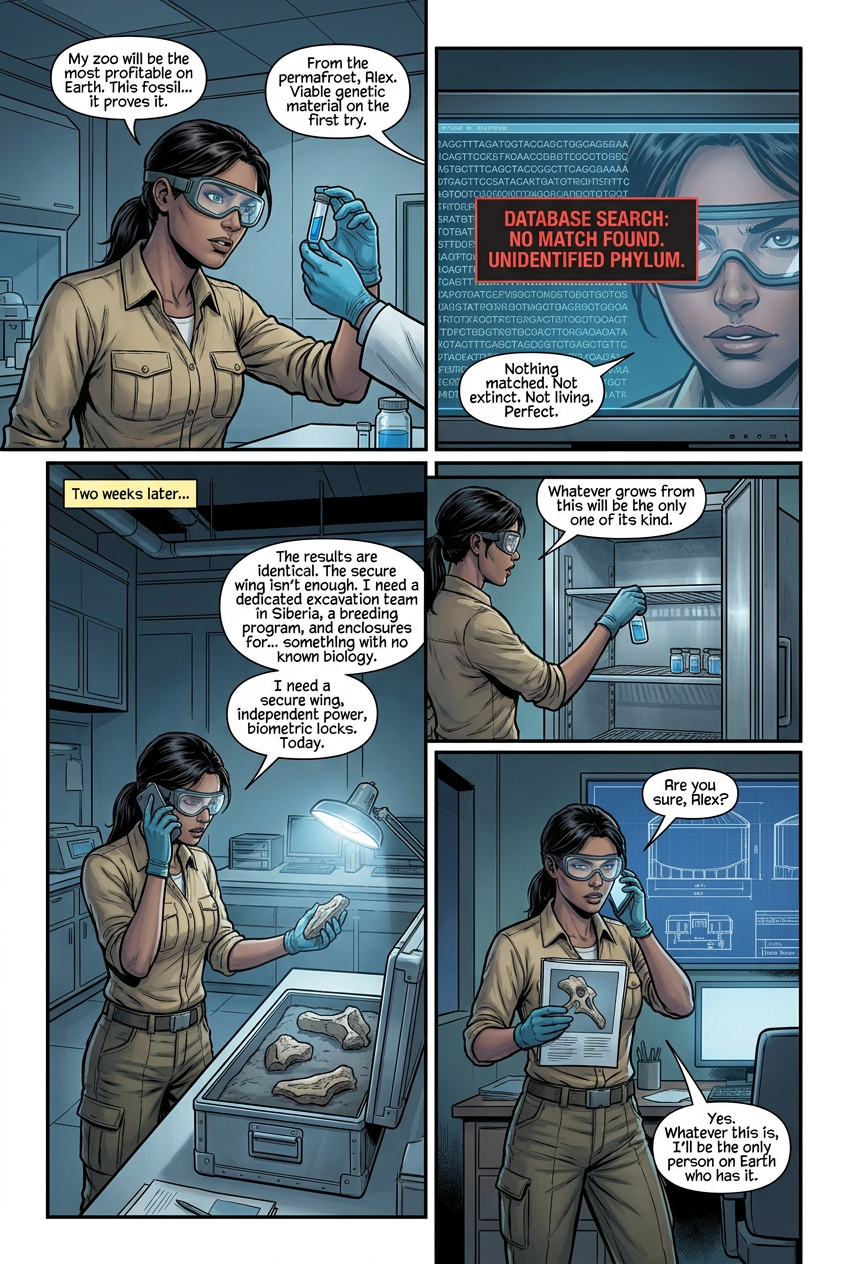
Alex stood in the sterile air of the new research facility, watching her lead scientist hold up a vial of extracted DNA. The sample came from permafrost in Siberia, preserved so well they'd pulled viable genetic material on the first try. She'd built this zoo to be the most profitable attraction on Earth, something no competitor could match, and this fossil was about to prove she'd succeeded. The scientist ran the sequence through every database they had access to. Nothing matched. Not extinct species. Not living ones. Not even close relatives in any phylum they recognized. Alex authorized construction of a secure wing that same afternoon. The new lab would need independent power, biometric locks, and equipment sensitive enough to map DNA that evolution had apparently never produced before. Her team didn't know what they'd found, but she did know this: whatever grew from that sample would be the only one of its kind in existence. She signed the construction order and placed the vial in a steel-lined freezer. In six months, when the lab came online, she'd begin the real work. But three other samples from the same dig site arrived two weeks later. Alex opened the transport case herself, examining each fossil fragment under the lab's bright lights. The bone structure looked wrong for anything in the fossil record. Too dense. Too strange. She photographed them, logged them, and sent tissue samples for extraction. If one impossible creature could change her zoo's future, four would make it untouchable. Her competitors were still cloning mammoths and saber-tooths. She would have something that had never been catalogued, never been named, never been seen. The results came back identical. All four samples carried the same unidentifiable DNA. Alex stood at the examination table, looking at the small vial that held the future of her entire operation. She picked up the phone and called her construction lead. The secure wing wasn't enough anymore. She needed a dedicated excavation team on permanent rotation in Siberia, a breeding program designed for species with no known biology, and enclosures built for animals whose behavior she couldn't predict. The scientist asked if she was sure. Alex looked at the vial again and said yes. Whatever this was, she would be the only person on Earth who had it.
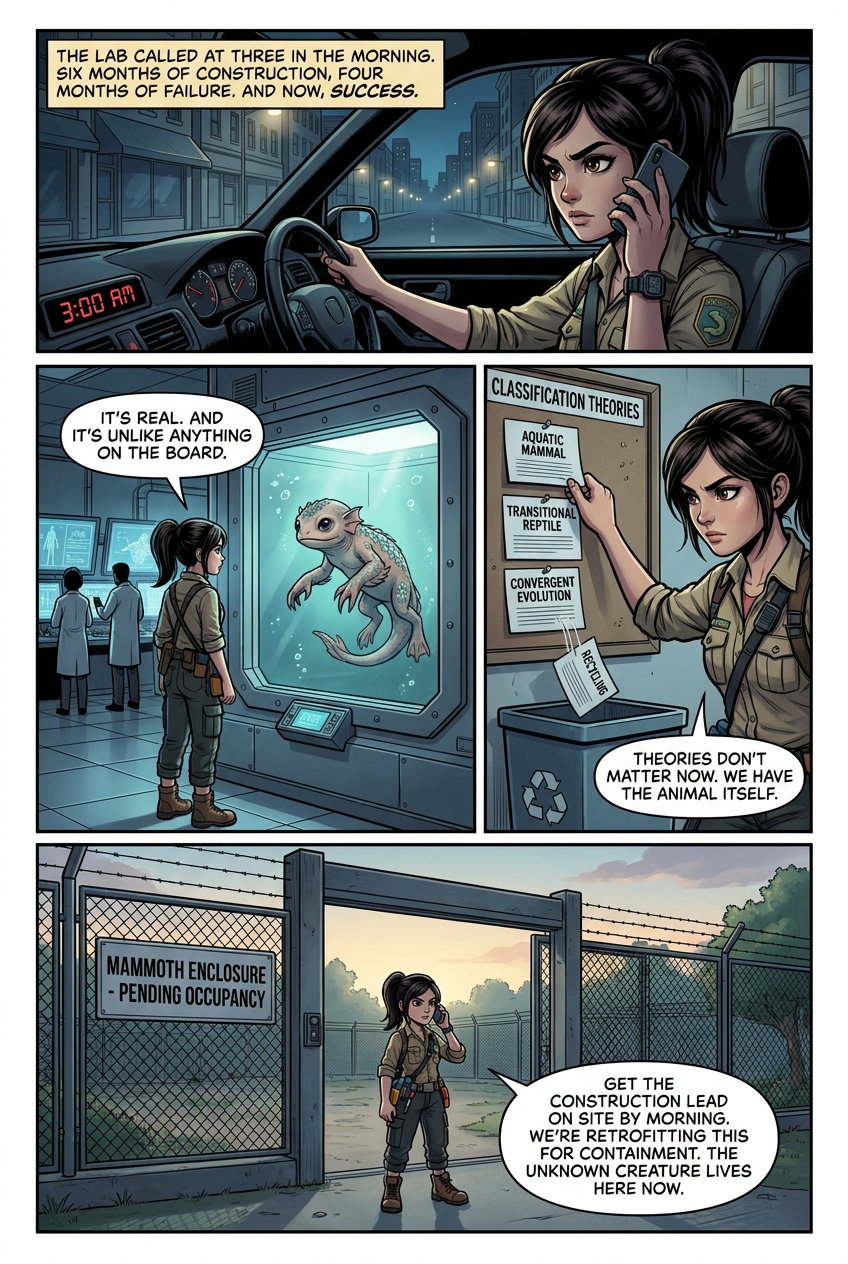
The lab called at three in the morning. Alex drove through empty streets with her phone still warm against her leg. Six months of construction, four months of failed attempts, and now the scientist on duty said one of the embryos had made it through gestation. She parked outside the secure wing and scanned her badge at the entrance. The creature lay in a temperature-controlled tank behind reinforced glass. It was small, maybe twenty pounds, but its body already showed features that shouldn't exist together. Four limbs with webbed feet and retractable claws. A skeletal structure that looked mammalian in the chest but reptilian in the spine. Smooth skin with patches of fine scales along the flanks. Alex stood at the observation window while two scientists ran diagnostics on the monitors. Behind them, mounted on the wall, was the classification board they'd been updating for months. Three theories, each with supporting evidence pinned beneath colored strings. Aquatic mammal. Transitional reptile. Convergent evolution from an unknown branch. The creature in the tank matched none of them completely. Alex walked to the board and pulled down all three theory cards. The scientists stopped talking. She folded the cards once and dropped them in the recycling bin beside the door. One of them started to protest, but Alex shook her head. They didn't need theories anymore. They had the animal itself. What mattered now was building an enclosure that could hold something they still didn't understand. She turned back to the tank and watched the creature's chest rise and fall in steady rhythm. It was alive, and it was hers, and that was enough. She left the observation room and walked across the grounds to the mammoth enclosure. The structure was solid, built for animals that weighed tons and could push through barriers if they wanted to. But mammoths were known. Their behavior was documented in living elephants. This new creature had no living relatives and no fossil record to predict what it might do as it grew. Alex stood at the enclosure's entrance and made the call. She wanted the construction lead on site by morning. They would retrofit this building with aquatic features, reinforced barriers, and monitoring systems sensitive enough to track every movement. The unknown creature would live here until they learned what it actually was. She ended the call and locked the door behind her. The chapter of speculation was over. Now came the work of containment.
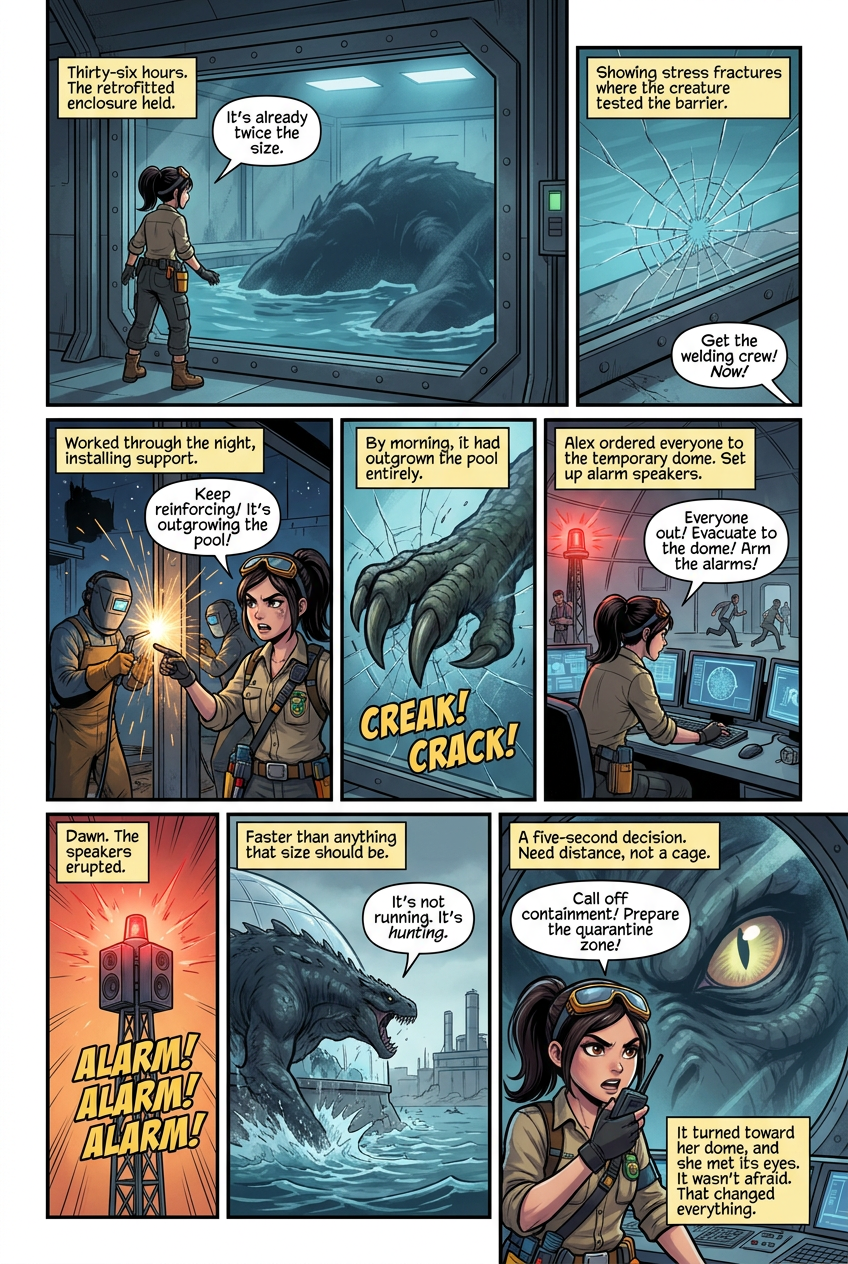
The retrofitted enclosure held for thirty-six hours. Alex stood at the observation window and watched the creature move through the shallow pool they'd installed along the eastern wall. It was already twice the size it had been two days ago. She called the construction lead and told him to bring the welding crew. The reinforced glass was showing stress fractures along the bottom edge where the creature had been testing the barrier with its claws. They worked through the night installing additional support beams and a secondary containment wall, but by morning the creature had outgrown the pool entirely. Its body pressed against the observation window hard enough to make the glass flex. Alex ordered everyone out of the main building and set up operations in the temporary dome they'd erected fifty yards from the enclosure. She positioned alarm speakers at each corner of the structure, calibrated to trigger if the glass gave way. The creature broke through at dawn. Alex was reviewing growth projections when the speakers erupted with sound. She ran to the dome's observation deck and saw the shattered window, water streaming through the gap, and the creature's massive form already halfway out of the building. It moved faster than anything that size should move. She reached for the radio to call the containment team, but stopped. The creature wasn't running. It was standing in the flooded courtyard, turning its head toward the larger enclosures where the mammoths and the bear were kept. It was hunting for something it recognized. Alex made the decision in five seconds. She called off the containment team and ordered them to prepare the quarantine zone at the facility's edge instead. This building was done. The creature had proven it would outgrow anything they built around it. What she needed now wasn't a stronger cage. She needed distance, open space, and time to understand what it was becoming before it reached full size. The creature turned toward her dome, and she met its eyes through the reinforced window. It wasn't afraid of her. That changed everything about what came next.
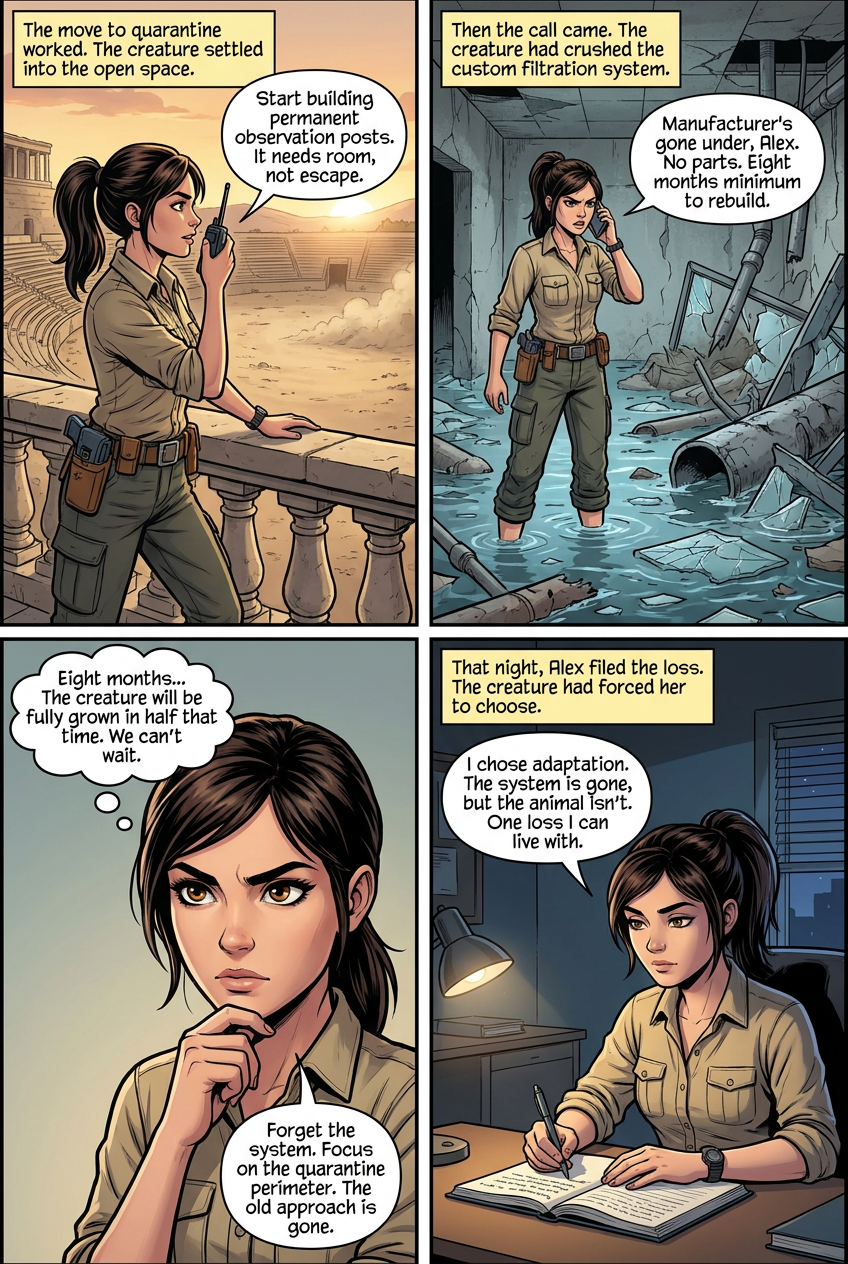
The move to quarantine worked. The creature settled into the open space within an hour, pacing the perimeter of the old amphitheater that had been cleared for emergency containment. Alex stood at the edge of the site and watched it test the boundaries without aggression. It wanted room, not escape. She radioed the construction team to start building permanent observation posts around the structure. Then the engineering lead called with the damage report from the breached building. Alex walked back through the flooded courtyard and saw the wreckage herself. The creature had crushed the custom filtration system during the breakout. Water pooled across cracked concrete where the pipes had ruptured. The lead explained that the manufacturer had gone under six months ago. No replacement parts existed. No other company made anything close to the specifications they needed. Alex stared at the twisted metal and shattered glass panels scattered across the floor. That system had taken fourteen months to design and install. It was the only reason they'd been able to maintain both aquatic and terrestrial environments in one enclosure. She asked how long it would take to build a new system from scratch. The lead said eight months minimum, maybe longer if they couldn't source the right materials. Alex did the math in her head. The creature would be fully grown in less than half that time. They couldn't wait. She told him to forget the filtration system and focus on the quarantine perimeter instead. The old approach was gone. Whatever this animal needed, they'd have to provide it in open air. Alex filed the loss in her project log that night and marked the breached building as unsalvageable for specialized containment. The creature had forced her to choose between rebuilding what worked before and adapting to what it was becoming. She chose adaptation. The filtration system was irreplaceable, but so was the animal. One of those losses she could live with.
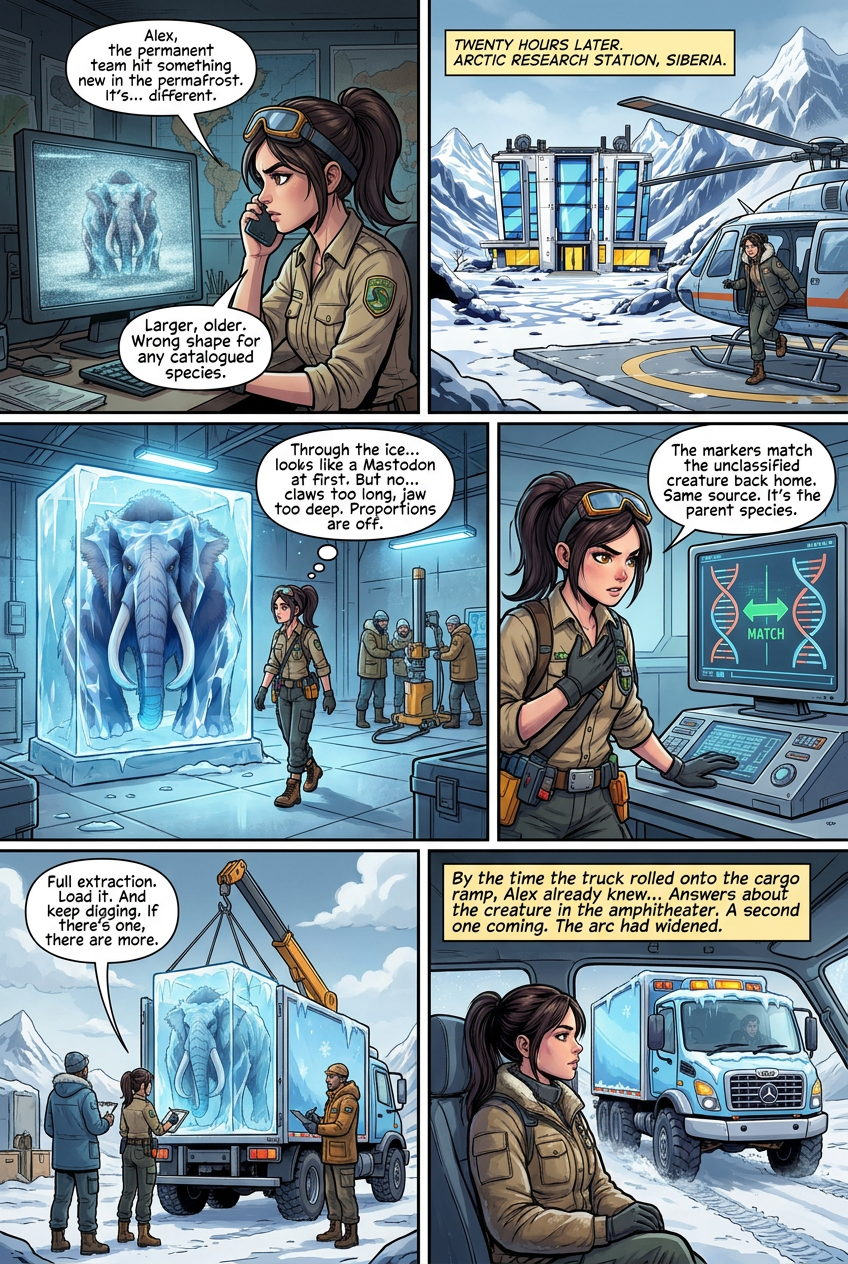
The call came in from Siberia two days after Alex finished the quarantine perimeter. The permanent excavation team had hit something new in the permafrost. Alex took the satellite feed in her office and watched the grainy footage scroll across her screen. A second specimen lay half-exposed in the ice. It was larger than the first by a wide margin, and the team lead said the layer above it dated older than anything they'd pulled before. The shape was wrong for any catalogued species. Heavy limbs. A long skull. Still locked in clear blue ice, intact enough that the tissue underneath looked fresh. Alex flew out within twenty hours. The field station sat low against the white slope, metal and glass braced against the wind. Inside, the team had already cut a rough block around the specimen and moved it into the cold storage bay. Alex circled the block slowly. Through the ice she could see a curled trunk, tusks, and a thick coat of dark fur. It looked like a mastodon at first glance. It wasn't. The proportions were off, the claws on the forelimbs too long, the jaw too deep. She gave the order to extract. The team drilled core samples from three points and sealed them in nitrogen tubes. The DNA pulled clean on the first try. Alex watched the sequencer run and felt her chest tighten. The markers matched the unclassified creature back home. Same source. Same line. This was its parent species, or close to it. They loaded the full ice block into a refrigerated transport unit, a heavy blue hauler rigged for long-haul cold chain. Alex signed the manifest herself and rode with it to the airstrip. She told the team to keep digging. If there were two, there were more. By the time the truck rolled onto the cargo ramp, Alex already knew what she'd bought herself. Answers about the creature in the amphitheater. And a second one coming, larger and older, with DNA already in her lab. The arc had widened. She didn't slow down.
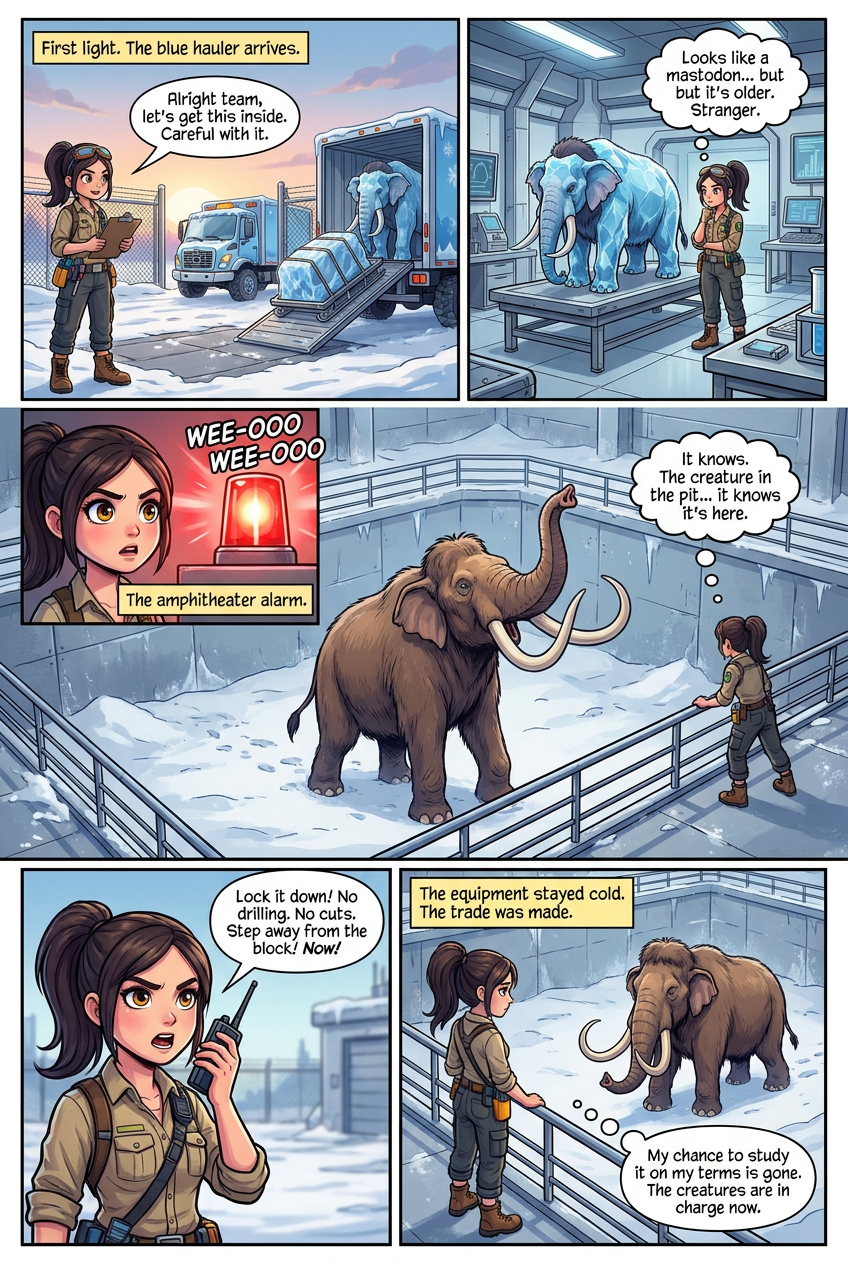
The blue hauler rolled through the gates at first light. Alex met it on the loading pad, clipboard in hand, her team already waiting in cold gear. The ice block came off the truck on a reinforced sled. Inside the clear blue, the curled trunk and long tusks caught the morning sun. It looked like a mastodon dressed in winter, but Alex knew better. The shape under the ice was older and stranger than that. They rolled it into the staging bay. Alex had a full workup planned. Core drills, tissue scans, sequencing rigs lined up on the steel benches. Flasks and burners stood ready beside the centrifuge. Her lead tech reached for the first probe. Then the amphitheater alarm went off. Alex ran. She crossed the yard and climbed the observation rail above the quarantine pit. Below, the creature was standing tall against the far wall, head lifted, nostrils wide. It was facing the staging bay. It had not moved like this before. It let out a low sound that traveled through her chest. The ice block was still sealed. No one had touched it. And the creature already knew it was there. Alex called the bay on her radio. Lock it down. No drilling. No cuts. Step away from the block. Her tech argued for one quick sample. Alex said no. Whatever was in that ice was talking to the one in the pit, and she would not be the one who opened the door without knowing what came through it. The equipment stayed cold on the benches. The ice block stayed sealed. In the pit, the creature paced a slow circle and would not settle. Alex gripped the rail and understood the trade. She had her answer about lineage. She had lost her chance to study the second specimen on her terms. Whatever came next would be set by the creatures, not by her.
Play your story to life
Storycraft is a mobile game where you create AI characters, craft items and locations to build their world, then discover what direction your story takes. Download the iOS game for free today!
Download for free