

Asteria Pyromacha's Arc
5 Chapters
Asteria Pyromacha's dream is forging a legendary weapon that reunites a fractured guild of smiths.

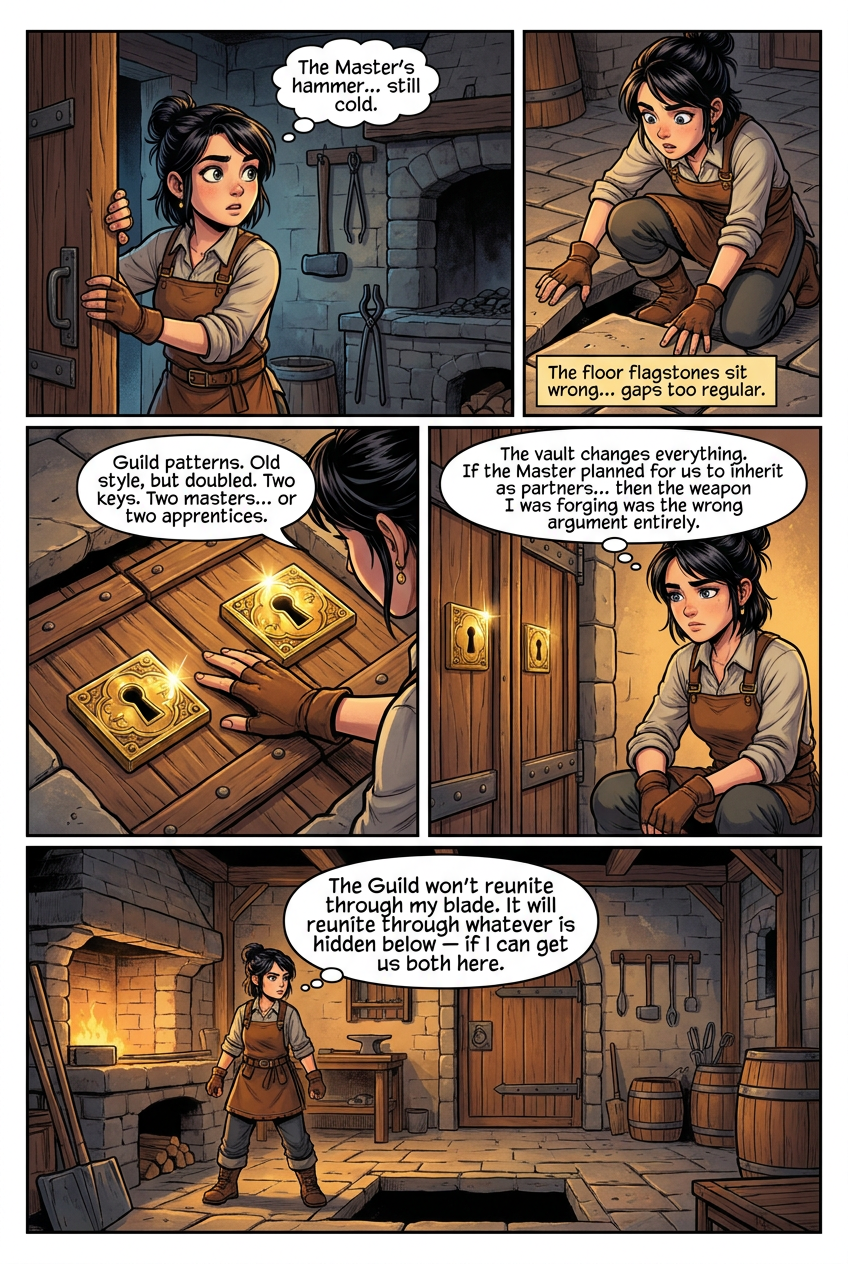
Asteria opened the forge door and stopped. The master's hammer still hung on its hook. His tongs still rested by the cold hearth. But the floor flagstones near the back wall sat wrong — edges too clean, gaps too regular. She knelt and worked her fingers into the gaps. The stones lifted easier than they should have. Beneath them, a wooden door sat flush with the foundation, brass locks gleaming in the dim light. She traced the lockwork with one finger — guild patterns, old style, but doubled. Two keys, two masters, or two apprentices meant to open it together. The vault changed everything. If the master had planned for both apprentices to inherit as partners, then the weapon she was forging was the wrong argument entirely. She sat back on her heels and stared at the locks. The guild wouldn't reunite through her blade. It would reunite through whatever the master had hidden below — if she could get both apprentices into this room before they tore each other apart.
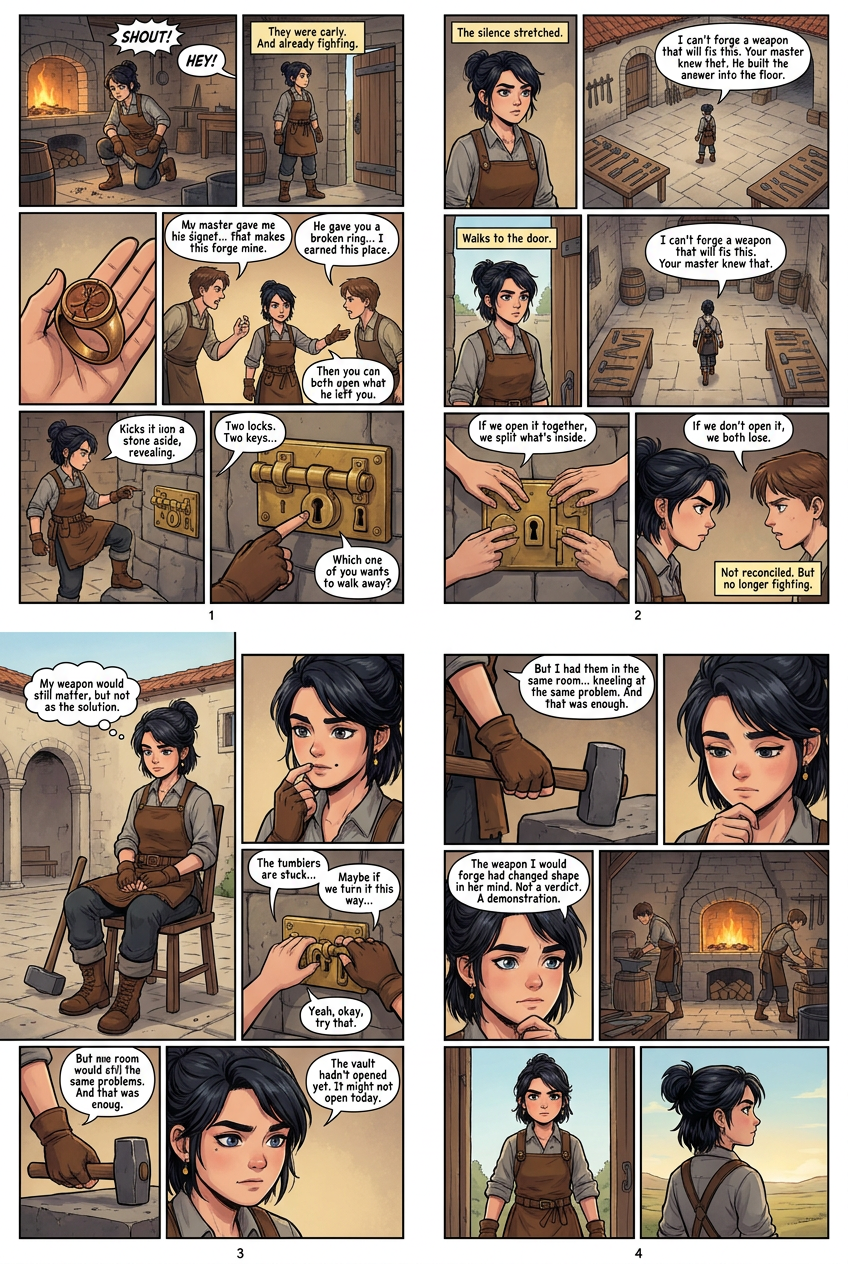
Asteria had just lowered the stones back into place when she heard voices outside — sharp, overlapping, already heated. Both of them. She stood and brushed dust from her knees. They were early, and they were fighting before they even reached the door. The door banged open and the two apprentices pushed through at the same moment, shoulders colliding in the frame. The taller one recovered first and held up a ring — bronze bands wrapped around a cracked stone seal. "My master gave me his signet before he died," she said, voice tight. "That makes this forge mine." The other apprentice crossed his arms. "He gave you a broken ring because he pitied you. I learned his techniques. I earned this place." Asteria watched them both, calculating. She had planned to bring them here separately, to control how they learned about the vault, but the argument itself had delivered them together. She stepped between them and pointed at the floor. "Then you can both open what he left you." She kicked the nearest stone aside, exposing the brass locks beneath. Both apprentices went silent. Asteria knelt and traced the doubled mechanism with one finger. "Two locks. Two keys, or two masters working together. Which one of you wants to walk away?" Neither moved. The question hung in the air, and for the first time since the master died, neither of them had an answer ready. The silence stretched. Asteria stood and walked to the door, looking out at the courtyard where both apprentices had staked their claims — furniture arranged on opposite sides, tools laid out like battle lines. She had expected resistance when she revealed the vault. What she hadn't counted on was this: perfect stillness. No shouting. No threats. Just two people staring at locks that wouldn't open unless they worked together. She turned back. "I can't forge a weapon that will fix this. Your master knew that. He built the answer into the floor." The taller apprentice knelt by the vault, fingers hovering over the brass. "If we open it together, we split what's inside." The other apprentice crouched beside her. "If we don't open it, we both lose." Asteria watched them lean closer, heads nearly touching as they examined the mechanism. Not reconciled. Not yet. But no longer fighting. Asteria stepped outside and sat on one of the chairs in the courtyard. Her hammer rested against her thigh, the weapon she'd planned half-forged in her mind. She had believed the right argument, made in the right material, could force a choice. But the master had already made that argument in brass and stone — a lock that demanded cooperation or gave nothing. She traced the beauty mark beside her mouth, thinking. Her weapon would still matter, but not as the solution. It would be proof that what they built together could surpass what either could make alone. Inside, she heard the apprentices talking — low voices, technical, testing each other's knowledge of the lock work. The vault hadn't opened yet. It might not open today. But she had gotten them both into the same room, kneeling at the same problem, and that was enough. The weapon she would forge had changed shape in her mind. Not a verdict. A demonstration.
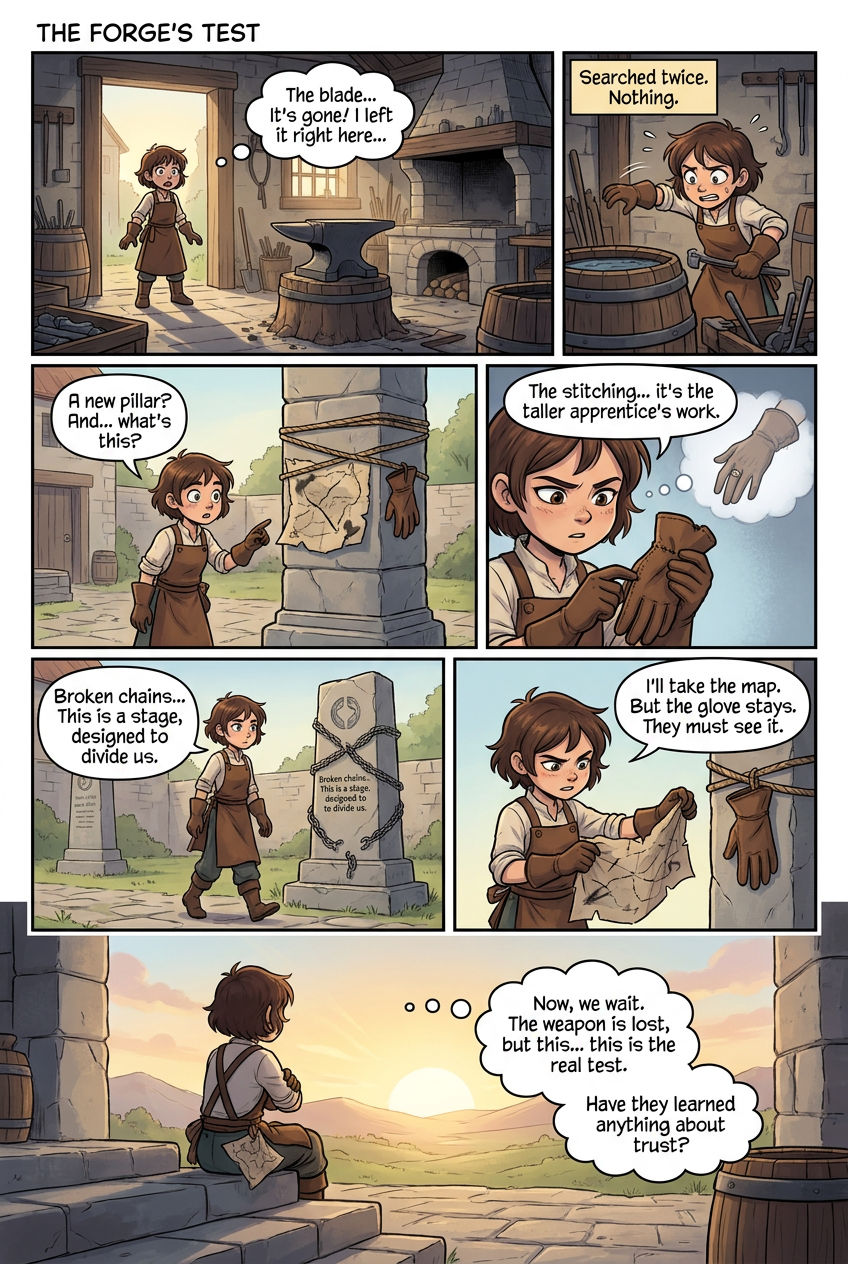
Asteria returned to the forge at dawn to check the weapon's progress. The anvil stood empty. The half-forged blade she had left cooling overnight was gone. She searched the workshop twice, moving tools and checking behind the quench barrels. Nothing. She stepped outside and found a stone pillar standing in the courtyard that hadn't been there the night before. Rope wrapped around it twice, binding something against the weathered surface. She approached and saw a torn cloth map tied to the stone, marked with charcoal lines that traced routes she recognized — paths both apprentices used to reach the forge. Pine needles stuck to the fabric. Below the map, wedged between the rope coils, sat a leather work glove. She pulled it free and turned it over. The stitching pattern matched the taller apprentice's hand work, the one who carried the signet ring. Asteria walked past the monument at the edge of the grounds, where broken chains lay wrapped around carved stone. The engravings told old stories about fractured alliances and the cost of distrust. Someone had staged this scene carefully, planting evidence to point blame while the real thief stayed hidden. She looked back at the pillar, at the glove and map displayed like an accusation. The weapon was gone, but the theft itself had become a test — one she hadn't designed. She pulled the map free and folded it into her belt. The glove she left tied to the pillar where both apprentices would see it when they arrived. If she removed the evidence, she would be choosing sides. If she confronted the accused apprentice alone, she would fracture the fragile cooperation they had built at the vault. She sat on the steps of the forge and waited. When they came and saw what had been left for them, they would have to decide whether to trust the planted proof or question who wanted them divided. The weapon was gone, but the apprentices' response would show her whether they had learned anything from the doubled locks beneath the floor.
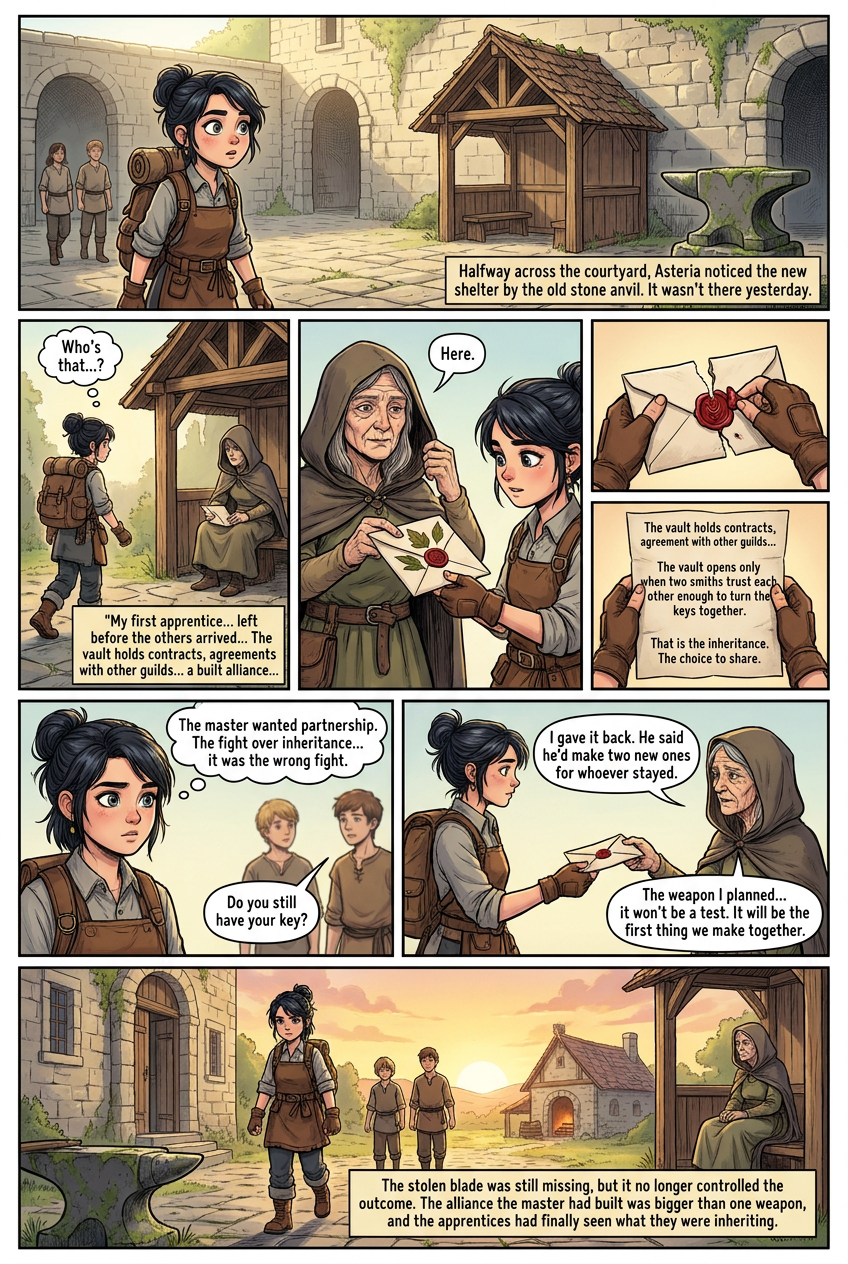
They were halfway across the courtyard when Asteria noticed the shelter. It stood near the old stone anvil at the edge of the grounds, weathered posts supporting a peaked roof shingled with bark. She hadn't seen it yesterday. The apprentices stopped walking. A figure sat on the bench inside, hood pulled low, hands resting on a letter pressed flat against their knee. Asteria approached slowly. The figure stood and pushed back the hood. An older woman, face lined deep around the eyes. She held out the letter without speaking. Asteria took it. Pressed leaves decorated the edges, sealed with red wax that showed a mark she didn't recognize. The woman pointed at the stone anvil beside the shelter. Moss covered the base, but the top bore hammer marks Asteria knew — the master's work, decades old. This anvil had been here before the forge was built. Asteria broke the seal and unfolded the letter. The writing was careful, dated two years before the master died. It named the woman as his first apprentice, the one who had left the guild before either of the current apprentices arrived. The letter explained what the vault held: not tools or weapons, but contracts. Agreements the master had made with other guilds, promising shared knowledge and joint training. He had been building an alliance, not just passing down a forge. The woman spoke quietly. "He told me about the dual locks before I left. He said the vault would only open when two smiths trusted each other enough to turn the keys together. That was the inheritance. Not the forge. Not the tools. The choice to share." Asteria looked at the two apprentices. They stood close together now, not apart. The shorter one reached for the letter and read it twice. The taller one watched the older woman, then asked if she still had her key. She shook her head. "I gave it back when I left. He told me he'd make two new ones for whoever stayed." The apprentices looked at each other, and Asteria saw the question forming between them. If the master wanted partnership, then the fight over who inherited the forge had been the wrong fight from the start. The vault wasn't the prize. It was the proof that they could work as equals. Asteria folded the letter and handed it back to the woman. The weapon she had planned to forge would still matter, but not as a test or a trick. It would be the first thing the apprentices made together after opening the vault, using the knowledge inside to build something neither guild had seen before. The woman returned to the shelter and sat back down. Asteria walked toward the forge with both apprentices following. The stolen blade was still missing, but the theft no longer controlled the outcome. The alliance the master had built was bigger than one weapon, and the apprentices had finally seen what they were inheriting.
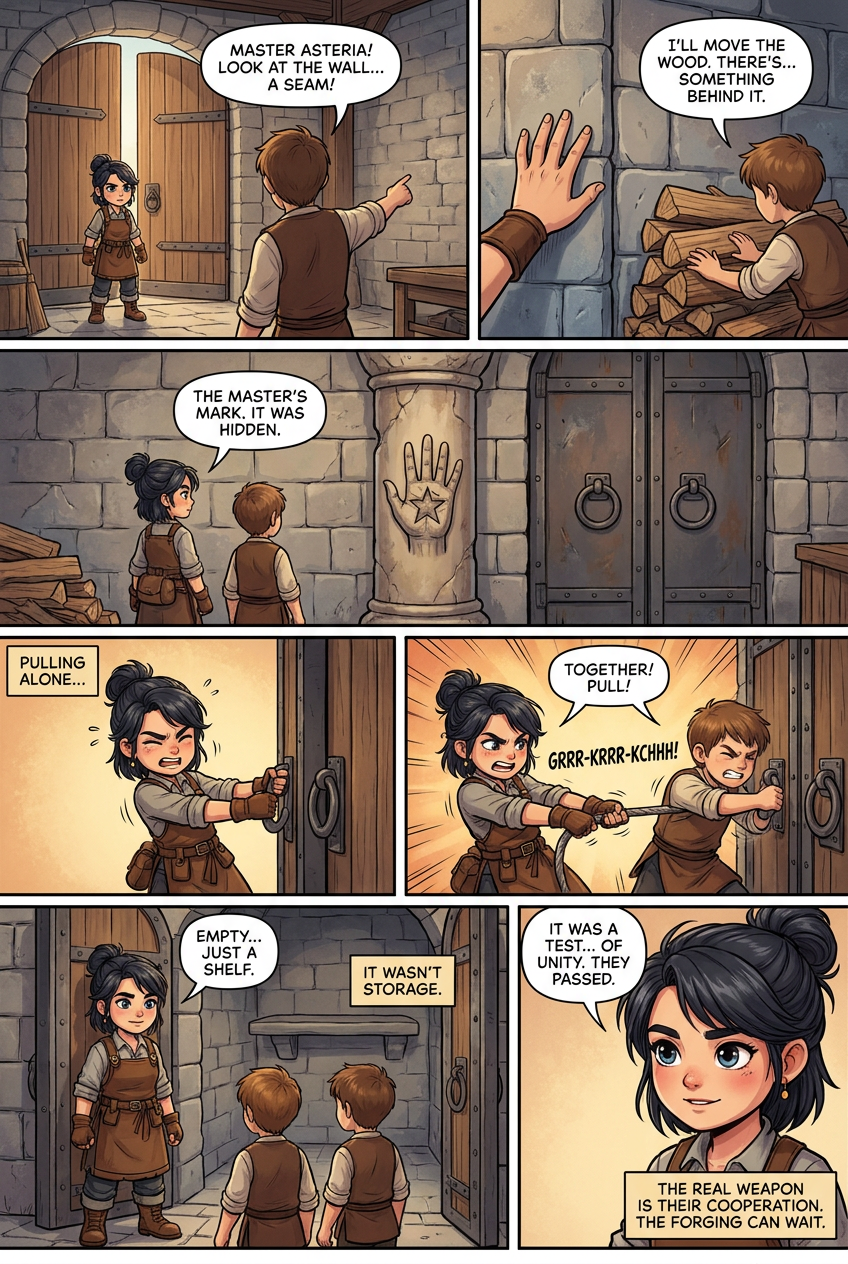
Asteria reached the foundry doors just as the taller apprentice pointed toward the far wall. A seam ran along the stonework where none had been visible before. The floor around it showed signs of recent disturbance — dust patterns broken, small stones pushed aside. She crossed the foundry floor and pressed her palm against the seam. Cold stone met her hand, but when she pushed harder, the wall shifted slightly inward. The shorter apprentice moved firewood stacked against the adjacent section, revealing more of the outline — a rectangular opening fitted so precisely into the wall that mortar alone had hidden it for years. Behind the wood stood a heavy iron door set into an archway carved with two ring handles, one on each side. Between the handles, a weathered pillar fragment had been mortared into the wall itself, showing a carved hand with fingers spread wide and a star pressed into the palm. The master's mark. Asteria tried pulling one handle alone. It didn't move. The taller apprentice gripped the other handle and pulled. Nothing. They looked at each other, then both pulled together. The rings turned in unison with a grinding sound, and the door swung inward on hidden pivots. The chamber beyond was small and empty except for a single stone shelf. No tools. No contracts. Just a flat surface that could hold one object, waiting. Asteria understood immediately what the master had built. This wasn't storage. It was a test that came before the vault — a place that could only be opened by two smiths working as one, proving they were ready for what the vault would ask of them. The apprentices had opened it without her telling them how, and that mattered more than what the chamber held. She stepped back from the doorway and watched them examine the empty shelf together, their argument finally behind them. The weapon she would forge with them could wait. They had already passed the test that mattered.
Play your story to life
Storycraft is a mobile game where you create AI characters, craft items and locations to build their world, then discover what direction your story takes. Download the iOS game for free today!
Download for free