

Astrid the Astronaut's Arc
15 Chapters
Astrid the Astronaut's dream is showing how insignificant humans are in space.

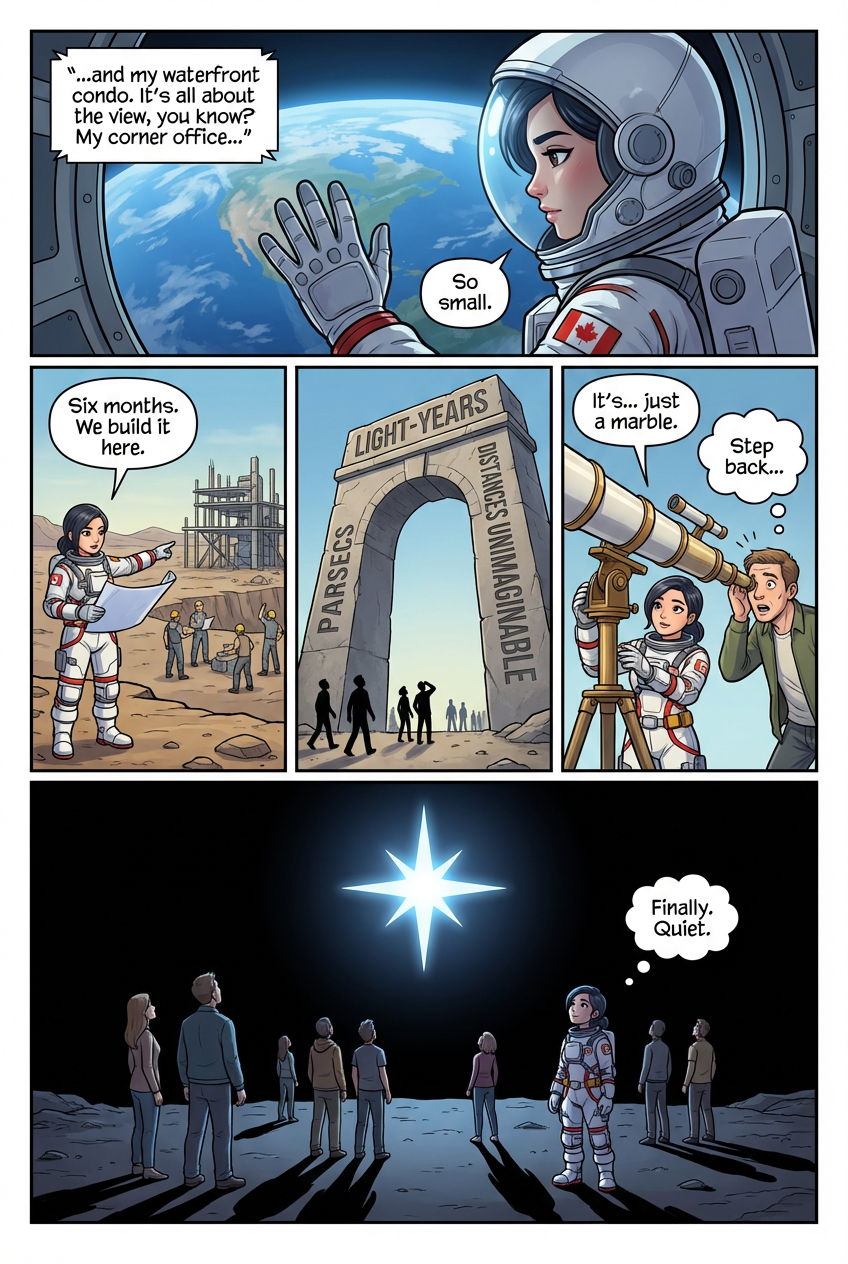
Astrid floats in the observation module, watching Earth spin below. A businessman's voice crackles through the comm system. He's talking about his corner office, his Mercedes, his waterfront condo. She presses her thumb against the window. The planet disappears behind it. She returns to Earth with blueprints. Within six months, Space Haven stands on a barren plateau. A massive stone arch towers at the entrance, carved with measurements: light-years, parsecs, distances most people can't picture. Visitors walk through it, necks craned back, already smaller than they were. Beyond the arch sits a telescope mounted on polished brass. Astrid adjusted the lens herself. When visitors look through it, they see Earth exactly as she sees it from orbit. A blue marble. Small enough to hide behind a thumb. They step back, blinking. Some laugh nervously. Others go quiet. At night, she activates the final piece. A glowing star installation pulses in the darkness above the plateau, casting long shadows. But around it spreads pure black. No city lights. No moon glow. Just the kind of silence that exists four hundred kilometers up, where eight billion voices vanish into nothing. People stand beneath it and finally stop talking about their houses.
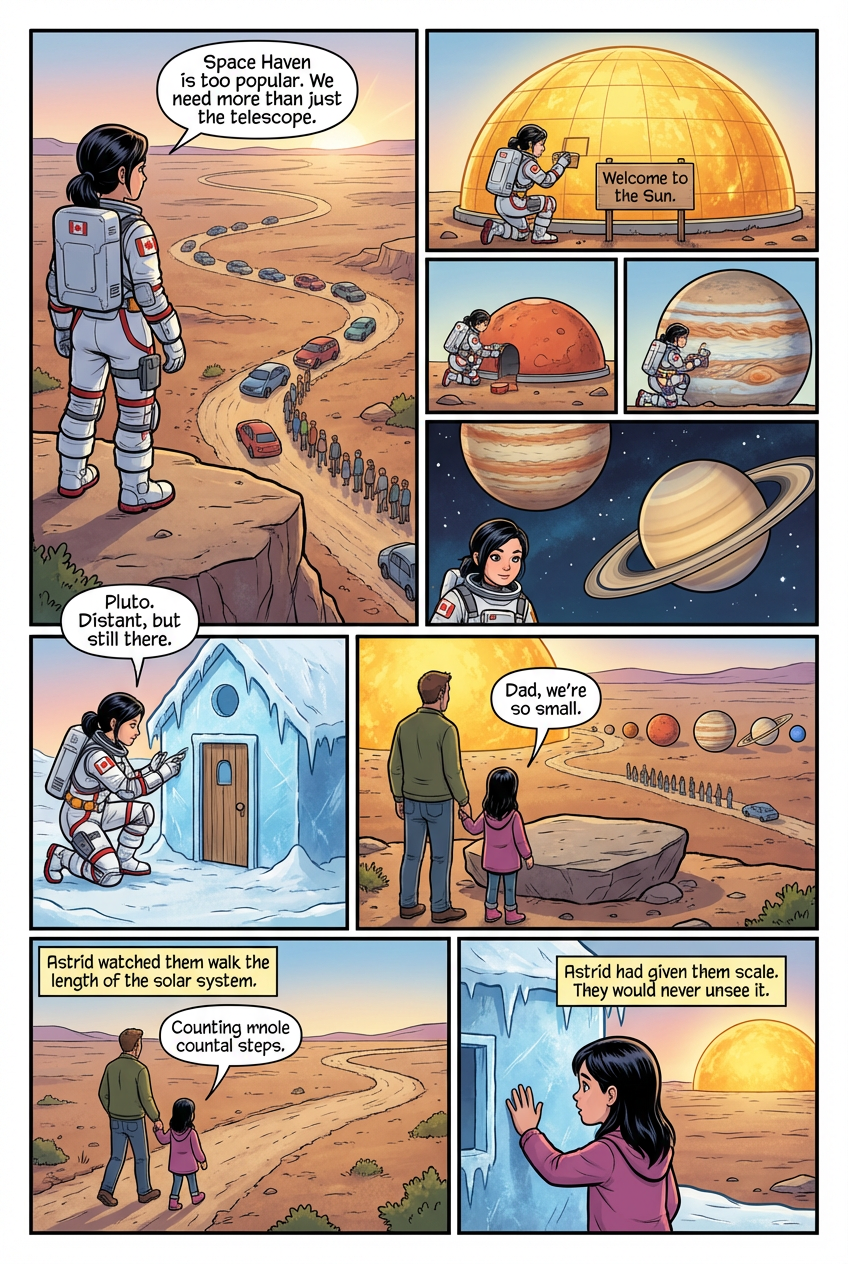
The first visitors arrived at dawn, drawn by news reports and satellite photos. Astrid stood at the edge of the plateau, watching their cars snake up the dirt road. Space Haven had been open for three weeks, but the crowds kept growing. People came, looked through the telescope, stood beneath the stars, and left quieter than they arrived. But the plateau couldn't hold them all anymore. Families waited hours for a turn at the telescope. Buses idled in makeshift parking areas. Astrid watched a woman argue with her husband about leaving before they'd seen everything. The question wasn't whether to expand. It was how to make the expansion mean something. She started building the next morning. Nine structures, arranged in a line stretching east from the original site. The first one glowed golden, twice the size of the others, with a wooden sign planted in front: Welcome to the Sun. Then came smaller buildings in order, each one representing a planet. Mercury, Venus, Earth. Mars with its red clay exterior. Jupiter's mass translated to volume. Saturn, Uranus, Neptune. At the far end, she built a small house with an icy blue shell, its wooden door barely tall enough for a child. Pluto. Demoted, distant, but still there. A father lifted his daughter onto the flat-topped boulder Astrid had positioned for viewing. The girl looked down the row of houses, then back at the golden sun structure. "Dad," she said, "we're so small." He didn't correct her. Astrid watched them walk the length of the solar system, the daughter counting her steps between planets. By the time they reached the ice-covered house at the end, the girl had gone quiet. She pressed her hand against its cold exterior and stared back at the sun, now just a distant glow. Astrid had given them scale. They would never unsee it.
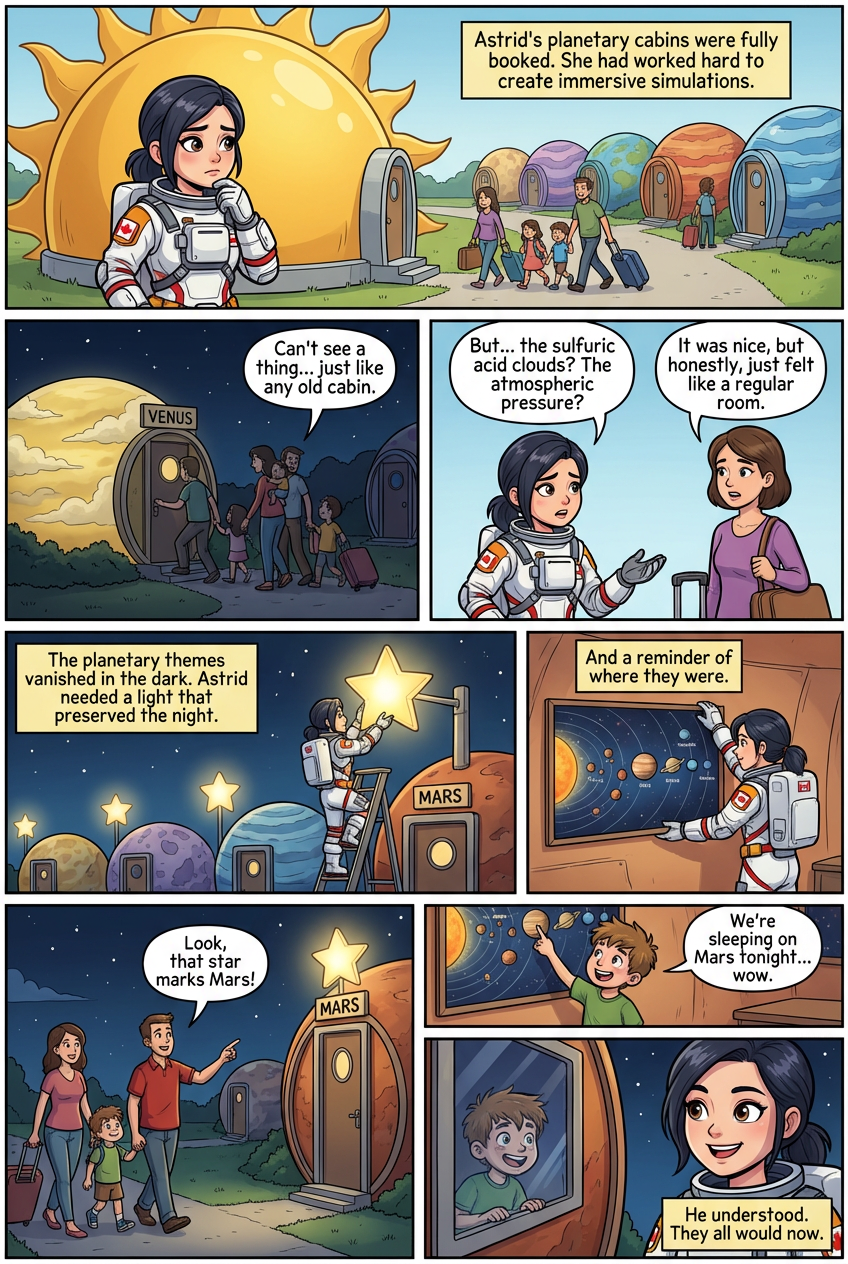
The buildings had been open for overnight stays for two weeks, and every room was booked solid. Astrid stood in the golden sun structure as the first evening guests arrived, watching families wheel suitcases through the door. She had installed beds, running water, heating systems. Each planet house became a place where people could sleep inside a simulation of another world. But the guests weren't getting it. They arrived after dark, stumbled to their assigned planet in the dim light, and collapsed into bed without looking around. In the morning they ate breakfast and left. A mother checked out of the Venus house and told Astrid it was nice but felt like any other cabin. Astrid realized her mistake: people couldn't see what made each building different. The planetary themes disappeared in darkness. She needed light that wouldn't ruin the effect. She mounted a luminous star above each entrance, suspended on posts tall enough to cast soft light across the entire row. The stars glowed against the black sky, bright enough to see by but dim enough to preserve the night. Inside each room, she hung a poster showing the solar system with every planet labeled and positioned to scale. Guests would see it first thing when they woke up, a reminder of where they'd spent the night. The next family to check into the Mars house arrived just after sunset. They walked slowly down the row, pausing at each glowing star to read the signs. Inside, the father noticed the red clay walls, the rust-colored bedding, the barren feel of the room. His son found the poster and traced his finger from the sun to the small red dot labeled Mars. "We're sleeping on Mars tonight," the boy said, his voice quiet with something like awe. Astrid watched through the window as he pressed his face against the glass, staring out at the darkness beyond. He understood. They all would now.
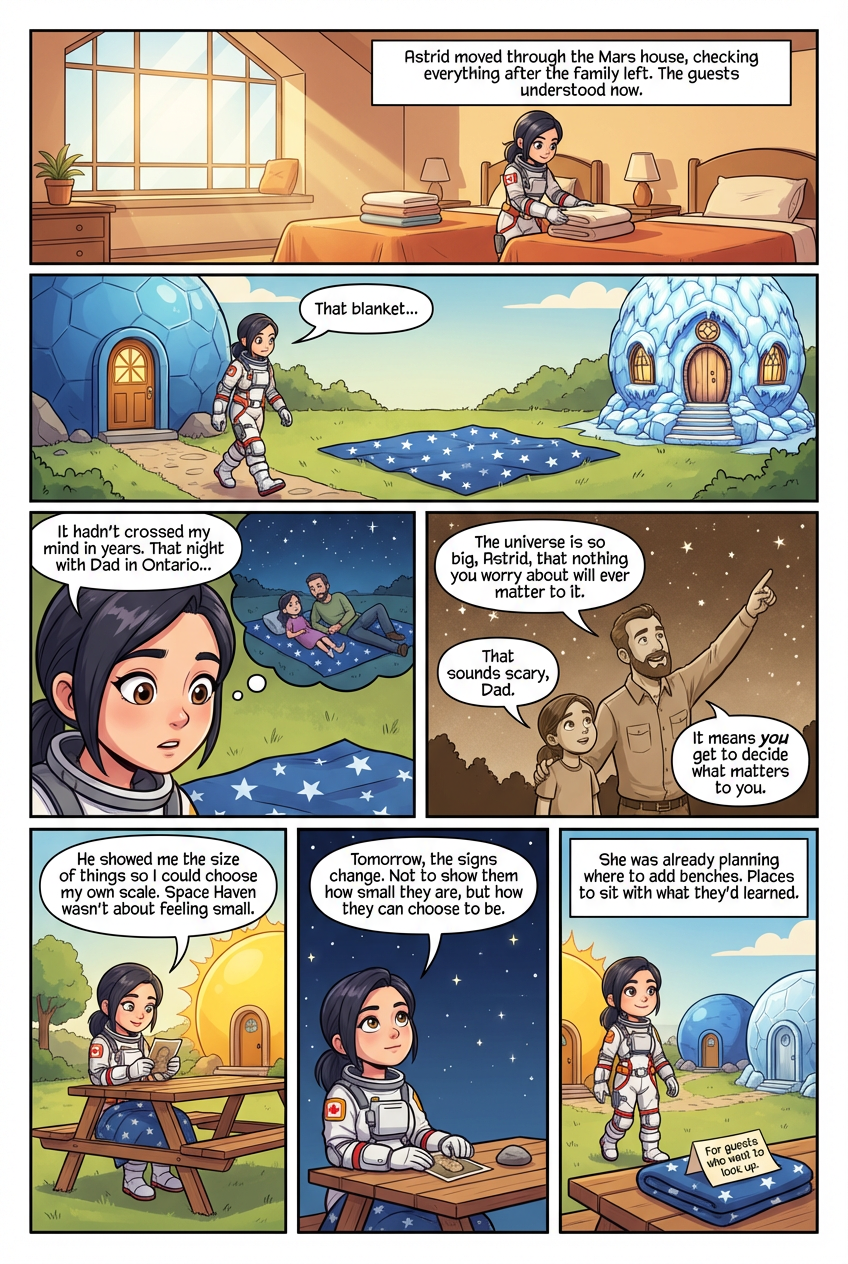
Astrid walked through the Mars house after the family left, collecting towels and straightening beds. She moved through each planet building the same way, checking pipes and testing lights. Everything worked. The guests understood now. They saw the posters and felt the difference between Venus and Neptune, between Mercury and Pluto. But when she stepped outside, she saw something that stopped her cold. A guest had left a blanket spread on the grass between Neptune and Pluto, its blue fabric printed with white stars. Astrid stared at it. She hadn't thought about that night in years. The night she and her father laid on a blanket just like this one in their backyard in Ontario, when she was seven. He'd pointed up at the stars and told her how far away they were, how small Earth was compared to everything else. She remembered feeling scared at first, then safe. Her father had squeezed her hand and said the universe was so big that nothing she worried about would ever matter to it, which meant she got to decide what mattered to her. She picked up the blanket and folded it slowly. Space Haven wasn't really about showing people how small they were. It was about what came after that feeling. The freedom of it. She'd built this place thinking she was teaching perspective, forcing people to confront their insignificance. But her father hadn't done that to her. He'd shown her the size of things so she could choose her own scale. She walked to the cedar picnic table behind the sun building and sat down, the blanket in her lap. From her pocket she pulled out the worn photo of her dad, creased and faded. She'd kept it in her flight suit on every mission. She sat there until the stars came out, then placed the photo on the table and weighted it down with a stone. Tomorrow she would change the signs at Space Haven. Not to make people feel small, but to show them they could choose what size to be. The blanket would go in the sun building's common room with a note: "For guests who want to look up." She stood and walked back toward the planet houses, already planning where to add benches and quiet spaces. Places where people could sit with what they'd learned and decide what to do with it.
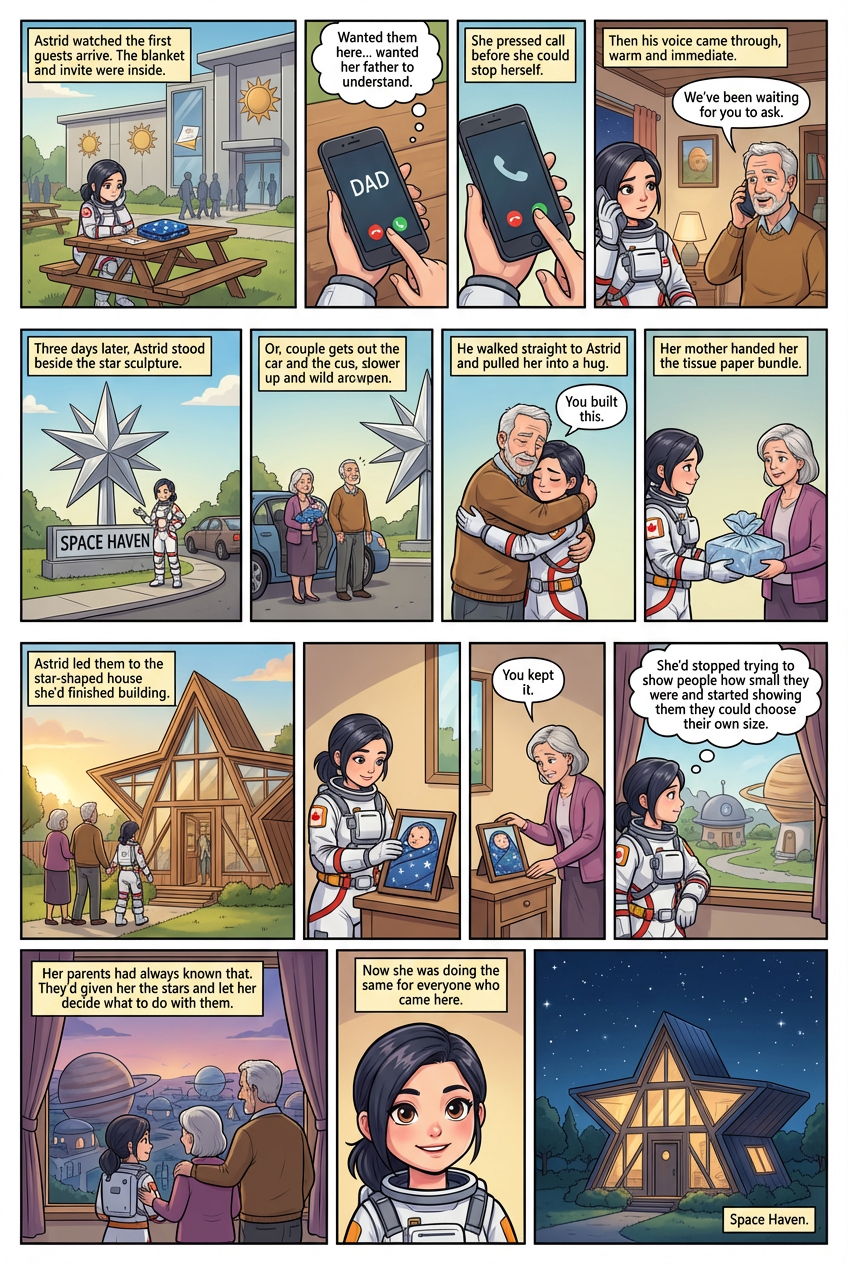
Astrid sat at the picnic table behind the sun building the next morning, watching the first guests arrive. She'd placed the blanket inside earlier, along with a small card inviting people to use it. The photo of her father was back in her pocket now. She pulled out her phone and stared at his number. Her thumb hovered over the screen. She wanted them here, wanted her mother to see what she'd built, wanted her father to understand how that backyard lesson had grown into something real. But asking felt like admitting she needed something from them, and she'd spent so many years being the one who left Earth behind. She pressed call before she could stop herself. Her father answered on the second ring. "Would you and Mom like to visit Space Haven?" The silence stretched long enough that she thought the connection had dropped. Then his voice came through, warm and immediate. "We've been waiting for you to ask." Three days later, Astrid stood beside the large star sculpture she'd installed at the entrance, its points radiating outward like light frozen in metal. Her parents' car pulled into the lot. Her mother got out first, carrying something wrapped in tissue paper. Her father followed, slower now than she remembered, but his eyes found the star immediately and held there. He walked straight to Astrid and pulled her into a hug that smelled like cedar and old books. "You built this," he said, not as a question. Her mother handed her the tissue paper bundle. Inside was a photo of Astrid as a baby, wrapped in a pink blanket, the same blanket she'd folded days before. Astrid led them to the star-shaped house she'd finished building that morning, its wooden walls warm in the afternoon light. Inside, she'd placed the baby photo on a small table beside a window that faced the planet houses. Her mother touched the frame gently, then looked at Astrid. "You kept it." Astrid nodded. She realized then what had changed—she'd stopped trying to show people how small they were and started showing them they could choose their own size. Her parents had always known that. They'd given her the stars and let her decide what to do with them. Now she was doing the same for everyone who came here.
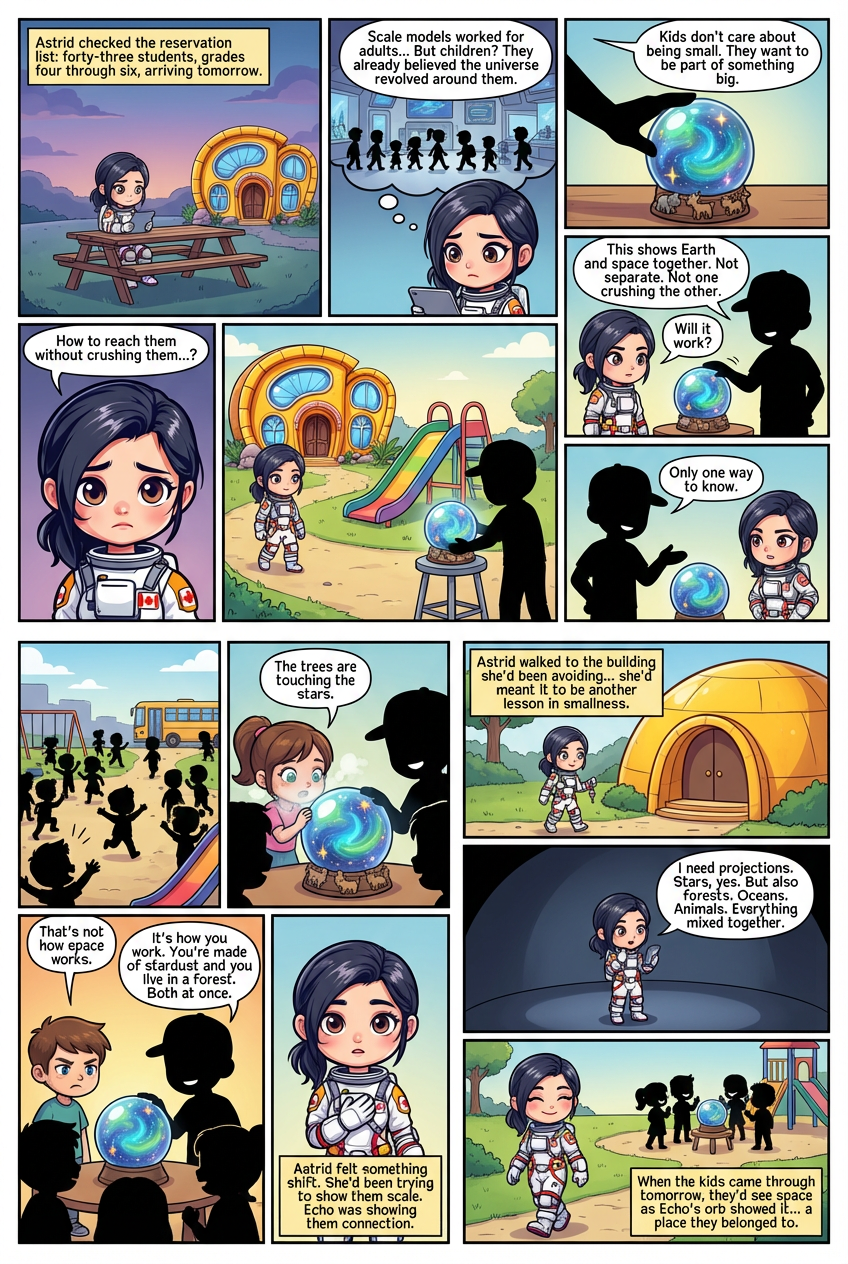
Astrid checked the reservation list that evening and saw it: forty-three students, grades four through six, arriving tomorrow morning. She sat at the picnic table behind the sun building and tried to picture them walking through Space Haven. The scale models worked for adults who could remember feeling small. The quiet spaces worked for people tired of being rushed. But children? They already believed the universe revolved around them. That was the whole problem she'd been trying to fix when she first built this place. Now she needed a way to reach them without crushing them, and she had no idea how. She found Echo the next morning setting up a small playground near the entrance, bright slides and swings arranged in a wide circle. He was placing something on a wooden stand in the center—a glass sphere filled with swirling colors, trees and stars mixed together, tiny carved animals circling its base. "What is that?" Astrid asked. Echo looked up. "Kids don't care about being small. They want to be part of something big." He tapped the orb. "This shows Earth and space together. Not separate. Not one crushing the other." Astrid studied it. The colors moved like they were alive. "Will it work?" Echo shrugged. "Only one way to know." The buses arrived an hour later. Astrid stood back and watched the students pour out, loud and restless. Echo met them at the playground and gathered them around the orb. He didn't explain it. He just let them look. One girl leaned in close, her breath fogging the glass. "The trees are touching the stars," she said. A boy next to her frowned. "That's not how space works." Echo smiled. "It's how you work. You're made of stardust and you live in a forest. Both at once." The kids went quiet. Astrid felt something shift in her chest. She'd been trying to show them scale. Echo was showing them connection. That afternoon, Astrid walked to the building she'd been avoiding—a domed structure she'd built months ago but never opened. She'd meant it to be another lesson in smallness, another way to dwarf visitors with images of galaxies. But now she unlocked the door and stepped inside. The dome ceiling was blank, waiting. She pulled out her phone and called a contractor. "I need projections," she said. "Stars, yes. But also forests. Oceans. Animals. Everything mixed together." When the kids came through tomorrow, they'd see space the way Echo's orb showed it—not as a place that erased them, but as a place they belonged to. Astrid locked the door behind her and walked back toward the playground. She could hear the students still talking about the trees and the stars.
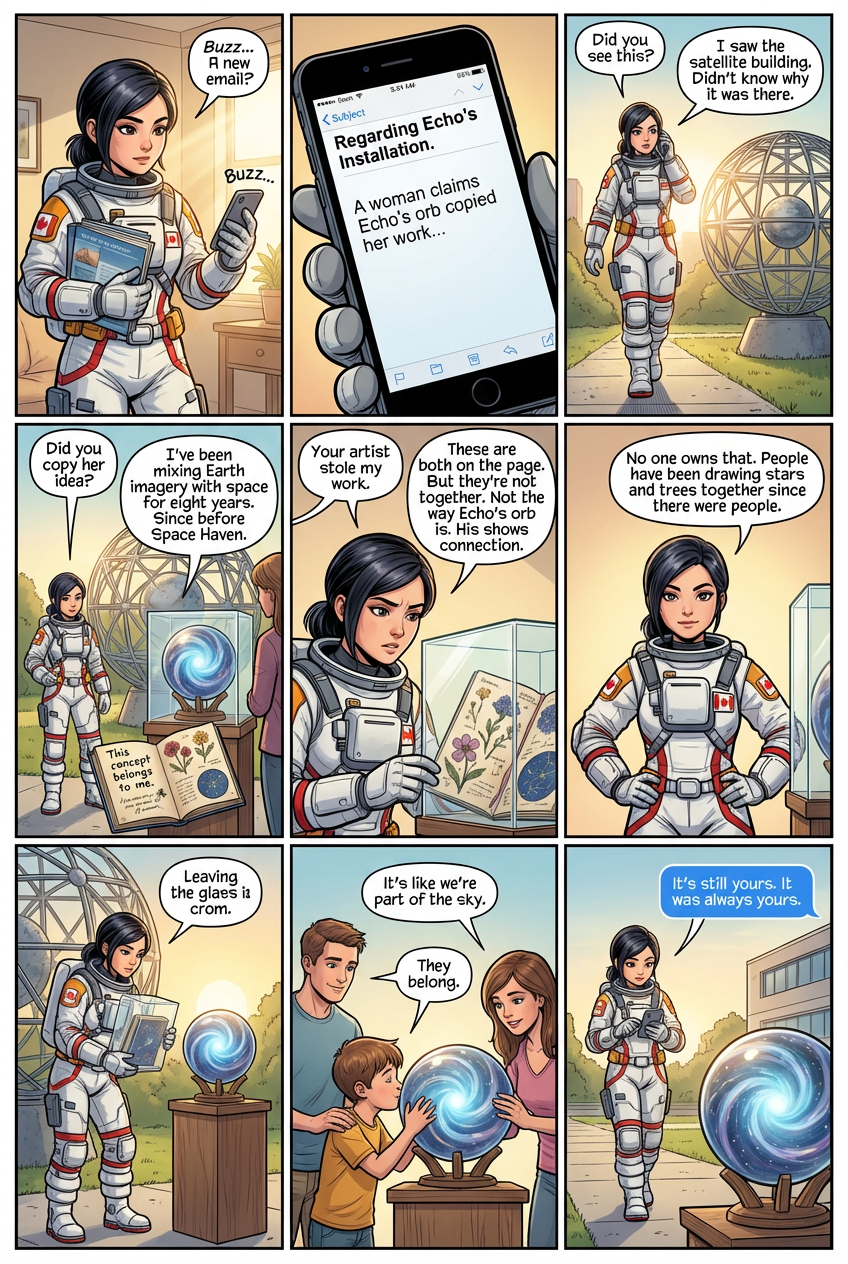
The email arrived three days after the students left. Astrid was restocking brochures when her phone buzzed. The subject line read: Regarding Echo's Installation. She opened it standing in the doorway of the sun building, sunlight warming the back of her neck. The message was short. A woman claimed Echo's orb copied her work—Earth and space merged together, just like drawings in her old journal. She'd set up a metal sphere structure near the entrance, solar panels catching light. Inside it, she'd placed Echo's orb in a glass case with her journal open beside it, pressed flowers and star maps visible through the transparent walls. Visitors were stopping to read her handwritten note: This concept belongs to me. Astrid called Echo. "Did you see this?" He was quiet for a moment. "I saw the satellite building. Didn't know why it was there." Astrid walked toward the entrance, phone pressed to her ear. "Did you copy her idea?" Echo's voice was steady. "I've been mixing Earth imagery with space for eight years. Since before Space Haven existed." Astrid reached the structure. The woman stood beside it, arms crossed, watching guests read her journal. Astrid approached slowly. The woman turned, her expression hard. "Your artist stole my work." Astrid looked at the journal through the glass. The star maps were beautiful, delicate. But they weren't the same as Echo's orb—his showed connection, movement, the idea that people belonged to both worlds at once. This journal showed separation, Earth on one page and stars on another, never touching. "These are both on the page," Astrid said carefully. "But they're not together. Not the way Echo's orb is." The woman's jaw tightened. "The concept is mine. Earth and space in one piece." Astrid felt something settle in her chest. She'd spent months trying to show people how small they were. Then she'd learned to show them how they belonged. This woman was doing neither—she was claiming ownership of an idea that came from looking up at the sky. "No one owns that," Astrid said. "People have been drawing stars and trees together since there were people." The woman left an hour later, her satellite structure still standing but empty. Astrid removed the glass case and journal, leaving only Echo's orb on the wooden stand where it had always been. She stood back and watched a family approach it, a young boy pressing his face close to see the colors swirl. His mother leaned down beside him. "It's like we're part of the sky," she said. The boy nodded, breath fogging the glass. Astrid pulled out her phone and texted Echo: It's still yours. It was always yours. Then she walked back to the sun building, leaving the orb where everyone could see it, no case around it, no claim attached. Just the idea itself, free for anyone who stopped to look.
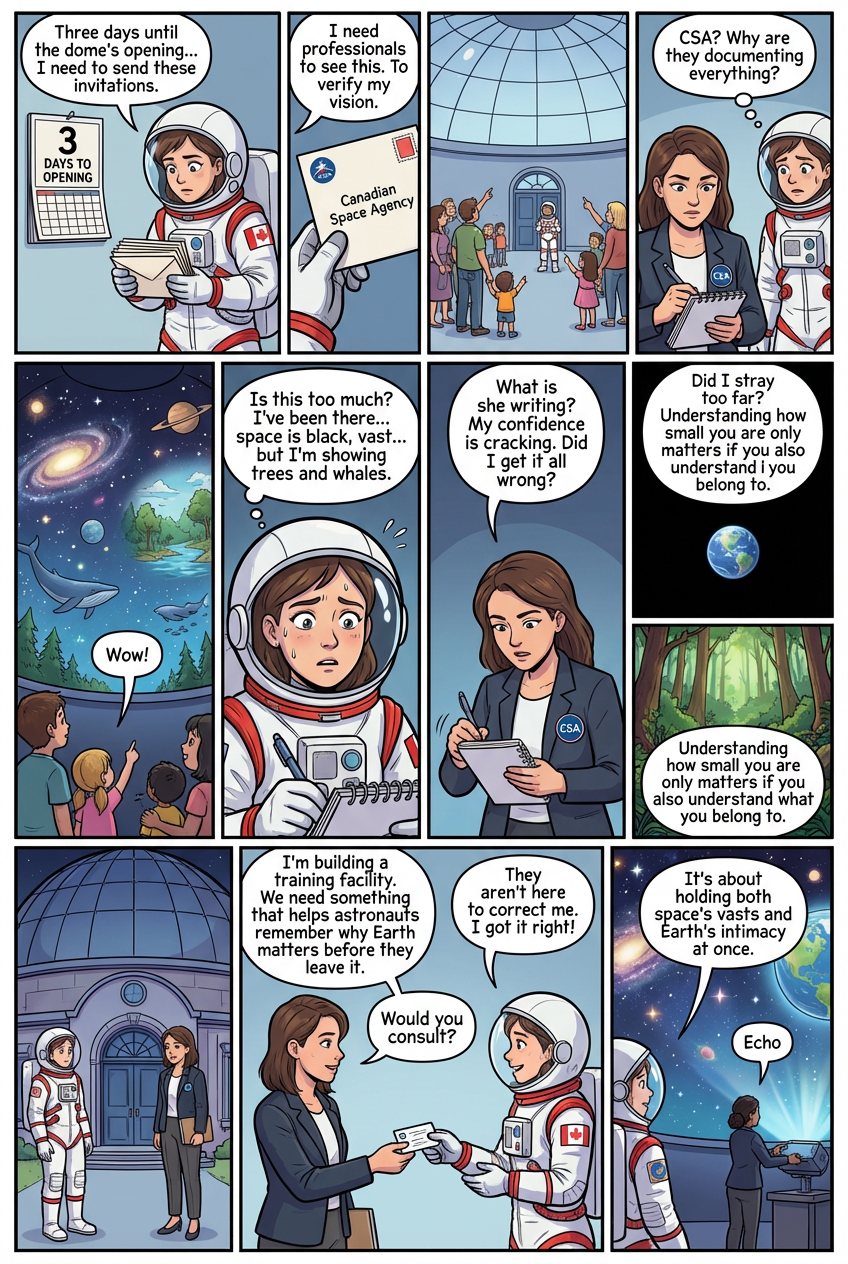
The dome's opening night was three days away when Astrid decided to send invitations to every space agency in the country. She wanted professionals to see what she'd built—people who understood what space actually looked like, who could verify that her new vision still held truth. The Canadian Space Agency responded first. The crowd filled every seat by seven o'clock. Astrid stood near the entrance, watching families settle into rows beneath the banner she'd hung that morning. Children pointed at the curved ceiling, excited voices echoing off the walls. Then she saw the woman in the front row—crisp blazer, an elegant notebook open in her lap, pen moving steadily across the page. The small badge on her collar read CSA. Astrid's chest tightened. She didn't know why someone from the agency was documenting everything. The lights dimmed. The dome came alive with stars, then forests, then oceans bleeding into the darkness above. A child gasped. The woman kept writing. Astrid watched her pen move—quick, certain strokes—and felt her carefully built confidence begin to crack. Was this wrong? Had she strayed too far from what space actually was? She'd spent years in orbit staring at pure black, at Earth small enough to cover with her thumb. Now she was showing people trees and whales alongside distant galaxies. The woman turned a page and kept writing. After the show ended, Astrid waited by the door as guests filed out. The woman approached last, notebook tucked under her arm. "I'm building a training facility," she said. "We need something that helps astronauts remember why Earth matters before they leave it." She held out a business card. "Would you consult?" Astrid took the card, her hands steady. The agency wasn't here to correct her. They were here because she'd finally gotten it right—that understanding how small you are only matters if you also understand what you belong to. She looked past the woman at the dome, where Echo was adjusting a projector, and felt something settle. This wasn't about choosing between space's vastness and Earth's intimacy. It was about holding both at once.
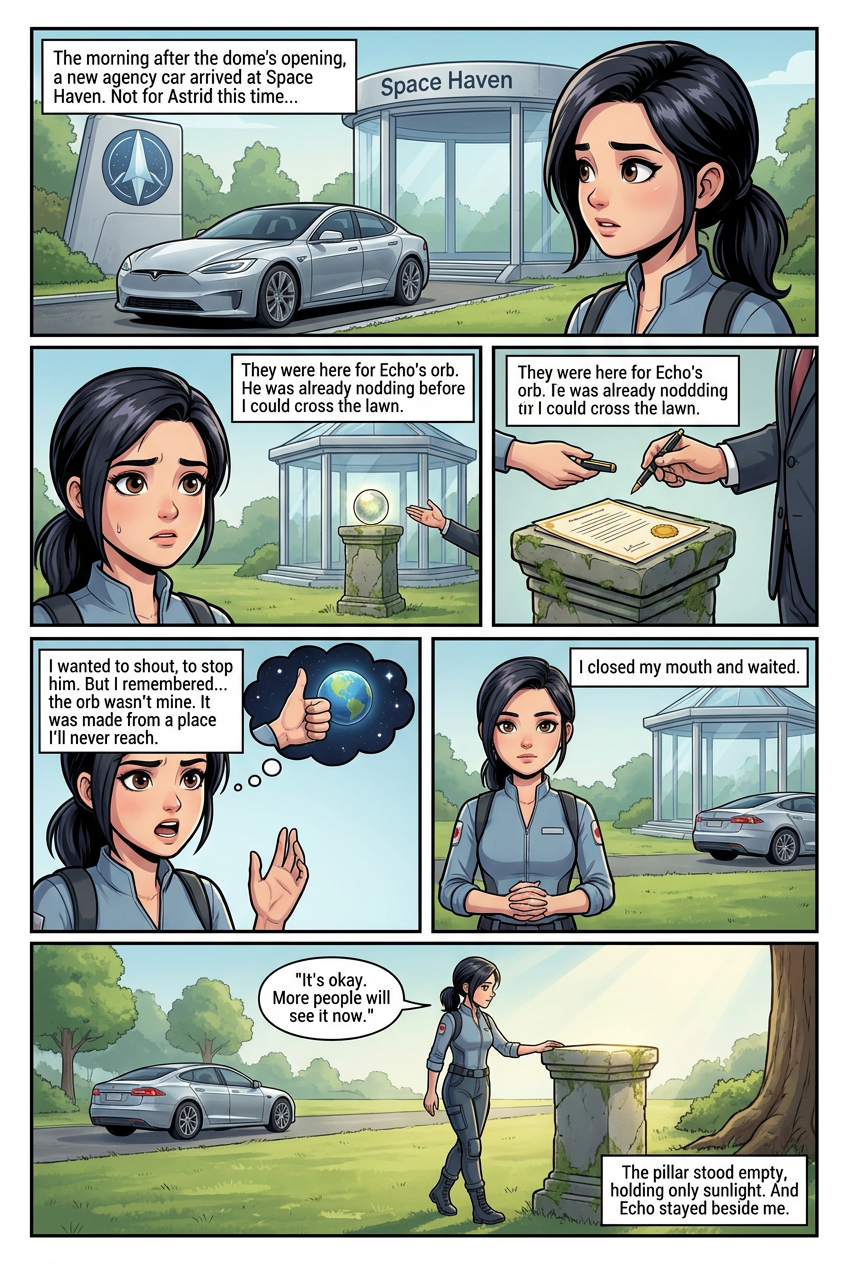
The morning after the dome's opening, another agency car pulled up at Space Haven. A different representative stepped out, holding a slim case. He wasn't here for Astrid. He was here for Echo's orb. He wanted to buy it for their permanent collection, and Echo was already nodding before Astrid could cross the lawn. The man had set up a small glass pavilion near the entrance overnight. Inside, charts showed where the orb would travel and how many people would see it. Echo stood beside an old mossy stone pillar, listening. His orb rested on top, catching the sun. The man slid a gold-sealed document onto the pillar and offered Echo a pen. Astrid stopped walking. She watched Echo's fingers hover over the page. She wanted to shout, to pull the paper away. Instead, she thought of the thumb she once held up to cover Earth. The orb wasn't hers. It had never been hers. Echo had made it from a place she would never reach. She closed her mouth and waited. Echo signed. He handed the orb to the man with both hands, then turned to Astrid. His face was calm, but his eyes searched hers. The pillar stood empty. Astrid walked over and rested her palm on the cool stone. "It's okay," she said. "More people will see it now." The car drove away. Echo stayed beside her, smaller somehow, and the empty pillar held only sunlight.
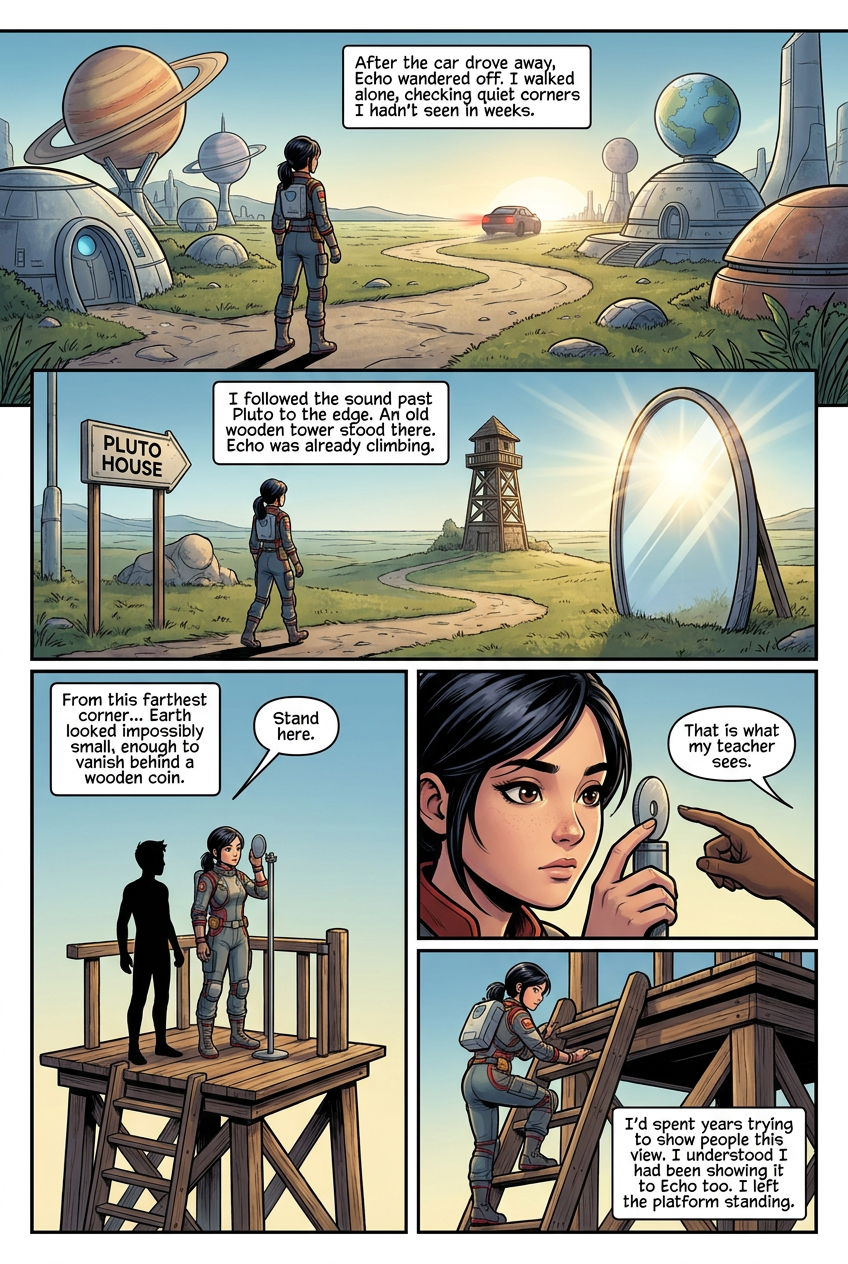
After the car drove away, Echo wandered off across the grounds. Astrid let him go. She walked the paths alone, checking on quiet corners she hadn't visited in weeks. The wind moved through the planet structures. Somewhere past the outer buildings, she heard Echo's footsteps stop. She followed the sound past the Pluto house to the far edge of the property. There stood an old wooden tower she had nearly forgotten. Echo was already climbing the ladder. A tall mirrored arch caught the sun nearby, throwing light across the weeds. Astrid climbed up after him. At the top, Echo pointed to a small wooden platform with a disc on a pole. "Stand here," he said. Astrid stepped behind it and looked toward the horizon. The disc covered the distant view completely. From this farthest corner of Space Haven, Earth looked impossibly small — small enough to vanish behind a wooden coin. Echo was quiet a long time. Then he said softly, "That is what my teacher sees." Astrid lowered her hand. She had spent years trying to show people this view. Now she understood she had been showing it to Echo too. She left the platform standing, and walked down the ladder gentler than she came up.
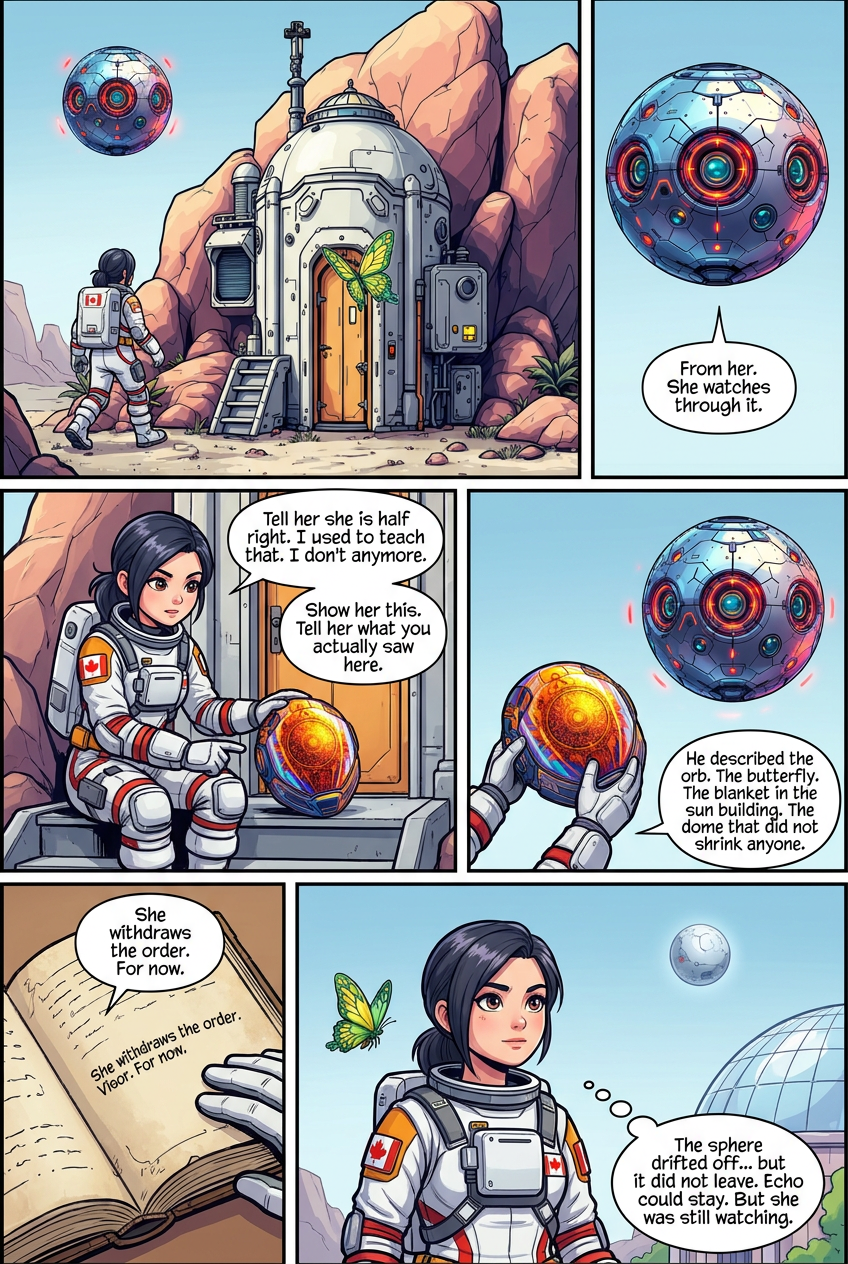
The next morning, Astrid found Echo near a small domed outpost tucked against the rocks at the edge of the grounds. He sat on the step holding his communicator. A green-winged butterfly drifted past his shoulder and landed on the door. Echo did not look up. A metallic sphere hovered above the outpost, blinking slow red lights. Astrid had never seen it before. It had arrived in the night. "From her," Echo said quietly. "She watches through it." The sphere turned once, then went still. Echo opened a worn book on his lap. New words had appeared on a blank page, written in his teacher's hand. He read them aloud for Astrid. The message said Space Haven was teaching the wrong lesson. It said Astrid's view made humans small, and Echo was forbidden to learn smallness. He was to leave at once. Astrid sat down on the step beside him. She thought of the tower, the disc, the tiny Earth. She thought of the dome she had redesigned, the forests and oceans inside the stars. "Tell her she is half right," Astrid said. "I used to teach that. I don't anymore." She placed a helmet visor from her old suit on the step between them, its painted sun facing up. "Show her this. Tell her what you actually saw here." Echo lifted the visor and held it toward the hovering sphere. He spoke into the communicator for a long time. He described the orb. The butterfly. The blanket in the sun building. The dome that did not shrink anyone. The sphere's lights dimmed, then brightened once, then dimmed again. The book's page filled with a single new line. Echo read it twice before he spoke. "She withdraws the order," he said. "For now." The sphere drifted off above the rocks, but it did not leave. It hung in the sky like a small second moon. Astrid watched it settle there. Echo could stay. But his teacher was still watching, and Space Haven was being measured now, every path and every room. Astrid stood up gentler than she sat down, and walked back toward the dome to look at it with new eyes.
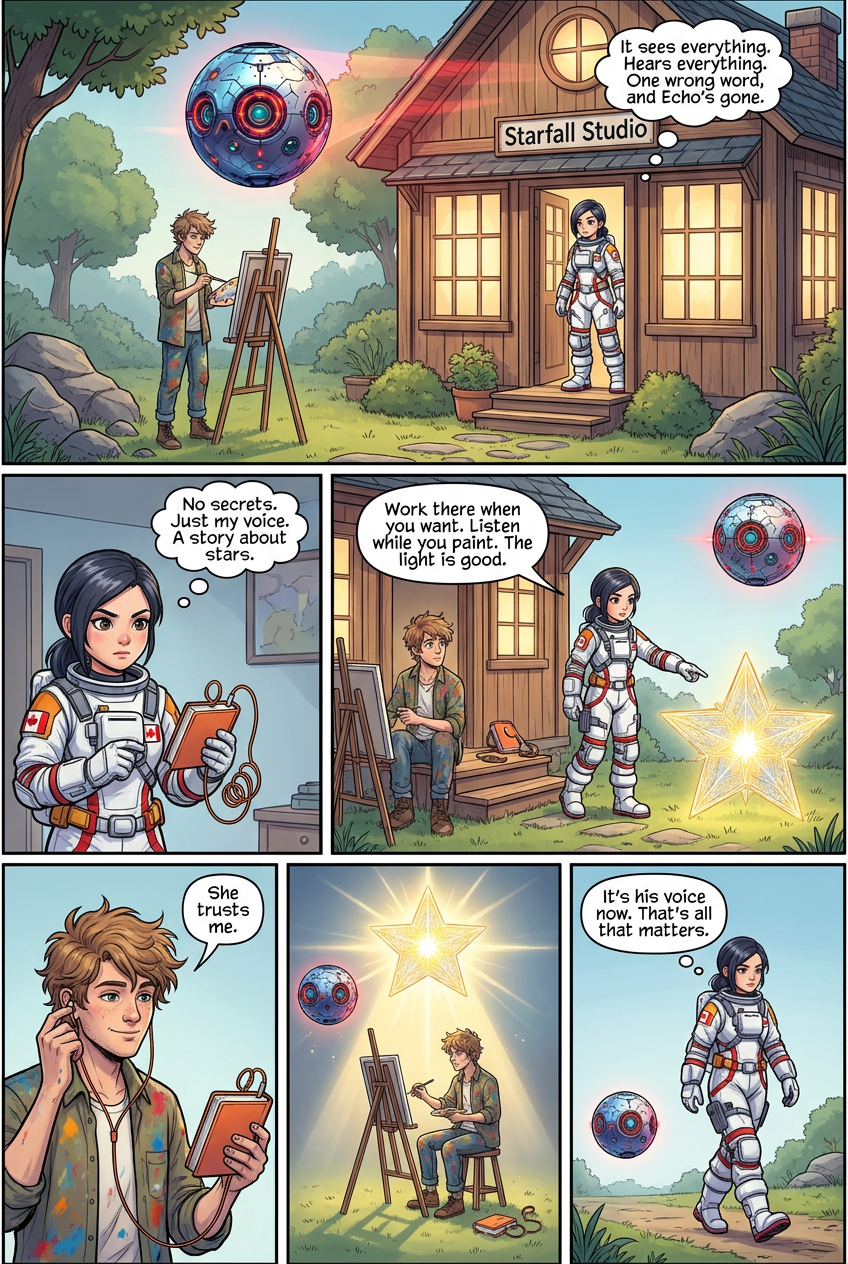
By afternoon, Echo had set up a small wooden studio near the rocks. Tall windows caught the light. Inside, jars of paint lined the shelves. He worked at an easel by the open door, where the sphere could see him clearly. Astrid stood at the threshold and watched the red lights blink above the roof. She knew the problem now. The sphere heard every word. If Echo said the wrong thing, or if Astrid coached him, his teacher would take him away. Astrid had no way to know what the sphere reported. She needed to tell Echo he was safe without speaking it aloud. Astrid went to her room and found her small audiobook player, the one shaped like a slim book. She loaded a recording of her own voice reading a children's story about stars. Nothing secret. Nothing about teachers. Just a calm voice, steady and warm. She walked back and set it on the studio step with the earbuds coiled neatly beside it. Echo picked it up. He looked at her. Astrid pointed to a bright star sculpture she had carried out and placed on the grass beneath the sphere. "Work there when you want," she said, loud enough for the sphere. "Listen while you paint. The light is good." Echo put one earbud in. He carried his easel to the star and sat down inside its glow. He smiled, small and certain. He understood. The signal was the gift itself: she trusted him to speak for himself now. She would not whisper behind his teacher's back. The sphere drifted lower, watching Echo paint beside the star. Astrid walked away and did not look back. She had given up the last thing she could control. Whatever the sphere reported, Echo's words would be his own. That was the only ground she could stand on now.
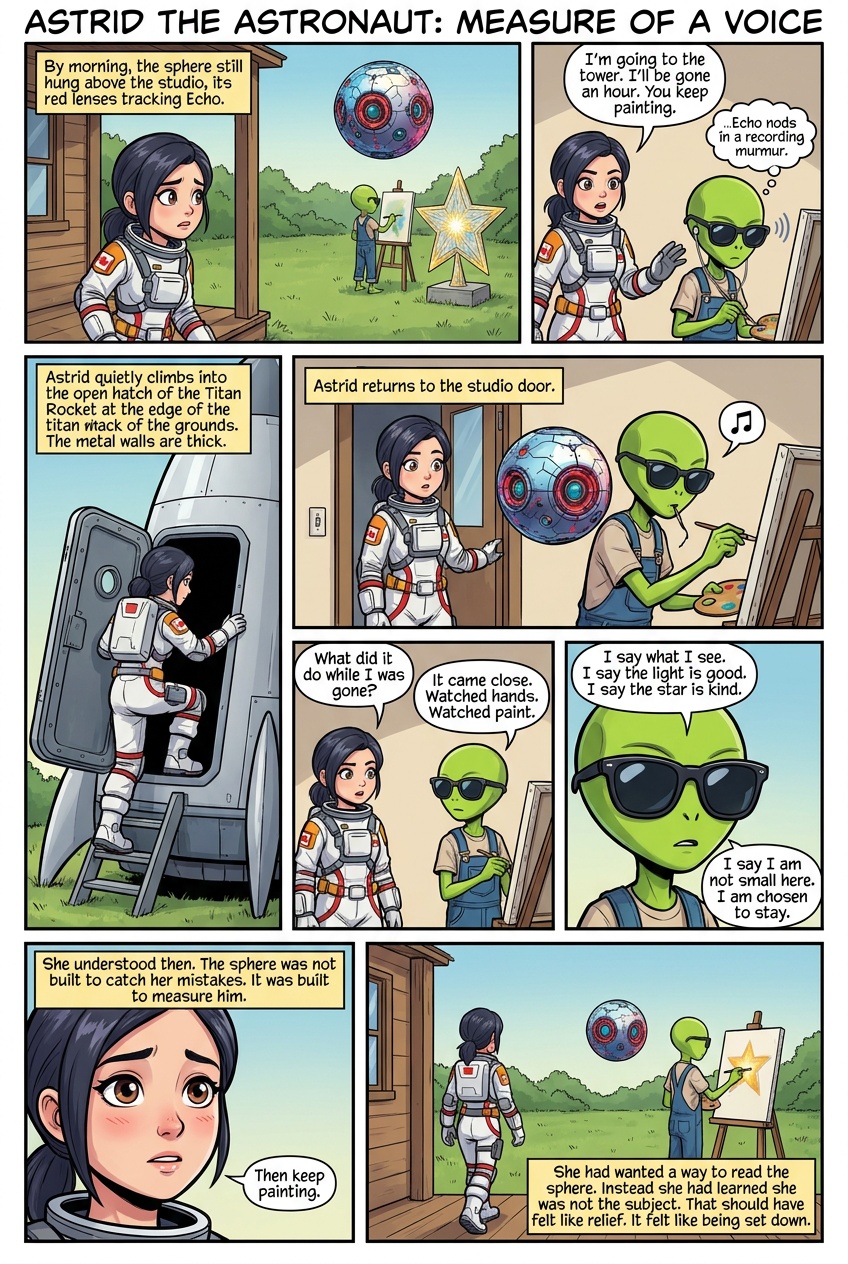
By morning, the sphere still hung above the studio, its red lenses tracking Echo as he painted beside the star sculpture. Astrid watched from the porch. She had promised herself she would not coach him. But she still had no way to know what the sphere was telling his teacher. A single flat sentence, reported without context, could be enough. She needed proof of what the sphere heard, or she needed to stop guessing. She walked to the studio and stood where the sphere could see her. "I'm going to the tower," she said. "I'll be gone an hour. You keep painting." Echo nodded. One earbud sat in his ear. The recording of her voice murmured on, calm and slow. Astrid did not go to the tower. She walked to the rocket structure at the edge of the grounds and climbed inside. The metal walls were thick. No signal reached in. She sat on the floor and waited. When she came back, the sphere had drifted low over Echo's shoulder. Its lenses were fixed on the canvas. Echo was painting the star, the grass, the sky. He was humming. Astrid stopped at the studio door. "What did it do while I was gone?" Echo tilted his head. "It came close. Watched hands. Watched paint." He paused. "Not the mouth. Not the ear." Astrid looked up at the sphere. It had not followed her to the rocket. It had stayed with Echo. It was not tracking her words at all. It was tracking his. She understood then. The sphere was not built to catch her mistakes. It was built to measure him. Whatever Echo said, whatever he painted, whatever he hummed — that was the report. Her silence had not saved him. His own steadiness had. She sat on the studio step. "Echo. What have you been telling it?" He set down his brush. "I say what I see. I say the light is good. I say the star is kind." He looked at her through the dark lenses. "I say I am not small here. I am chosen to stay." Astrid's throat tightened. She had spent two days afraid of a machine that was only listening for one voice, and it was not hers. Echo had been speaking for himself the whole time, and the sphere had been letting him. "Then keep painting," she said. He picked up the brush. The sphere drifted a little higher, still watching his hands. Astrid walked back to the porch. She had wanted a way to read the sphere. Instead she had learned she was not the subject. That should have felt like relief. It felt like being set down. Echo was standing on his own ground now, and the teacher would decide based on him alone. Whatever came next would come through Echo, not through her.
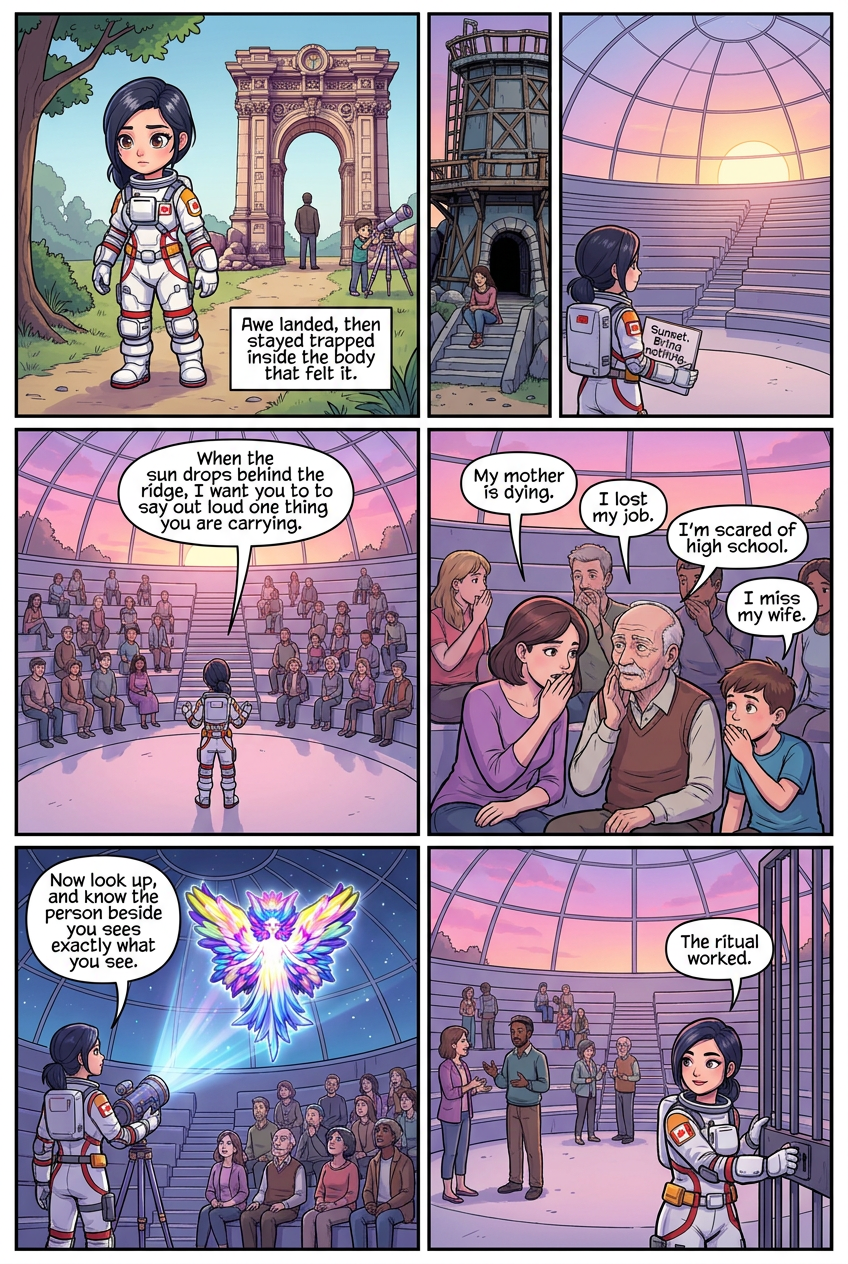
The sphere kept its watch on Echo the next morning, and Astrid left it to him. She walked the grounds instead. Visitors were arriving in twos and threes. A man stood alone at the arch, reading the numbers. A woman sat on the tower steps with her hands in her lap. A boy pressed his face to the telescope and said nothing when he stepped away. Each of them looked struck. None of them looked at each other. Astrid had built every room for one person at a time. That was the flaw. The awe landed, then stayed trapped inside the body that felt it. People came out quiet and drove home quiet. Whatever they had seen, they carried alone. She needed a room where strangers could feel it in the same breath, or Space Haven would keep making private astronauts and no shared sky. She went to the glass amphitheatre at the north edge of the grounds. The walls were clear. The tiered seats faced open sky. She had used it for lectures and left it half-finished. Today she opened the gates and posted a single sign: Sunset. Bring nothing. By dusk about forty people had come. They sat scattered, one per row, the way strangers sit. Astrid stood at the front. She did not explain the planets or the scale or the numbers. She said, "When the sun drops behind the ridge, I want you to say out loud one thing you are carrying. Not to me. To the person beside you. Then listen to theirs." A man laughed once, uncomfortable. No one moved seats. The sun dropped. The glass walls went pink, then violet. Astrid nodded at the woman in the front row. The woman turned to the stranger next to her and said her mother was dying. The stranger said he had lost his job in April. The sentences moved down the rows, slow, then steady. A boy said he was scared of high school. An old man said he missed his wife. Nobody fixed anything. They just heard each other under the same darkening glass. Astrid dimmed the interior lights. Above them, the projector she had rigged that afternoon threw a single figure across the dome of sky — a winged shape she had painted for the children's show, wings the colors of the aurora, arms open. It was not real and everyone knew it. That was the point. One made-up thing they were all seeing at once. "Now look up," she said, "and know the person beside you sees exactly what you see." They looked up together. She heard the intake of breath ripple down the tier. Not private this time. Shared. When the lights came back, people were talking to the strangers next to them. Two women exchanged numbers. The boy was still looking up. Astrid locked the gates behind the last of them. The ritual worked. Now she had forty people who would tell others, and no room large enough for what came tomorrow.
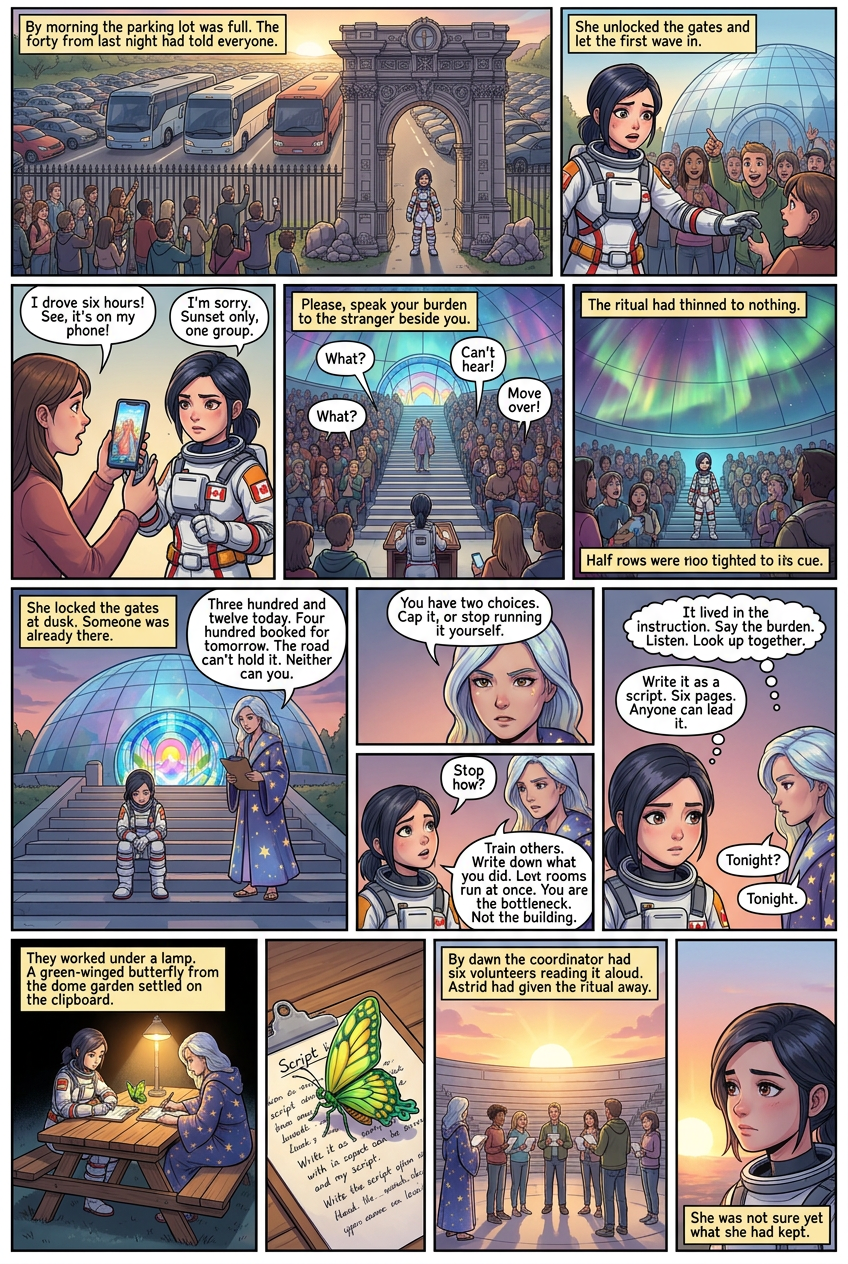
By morning the parking lot was full. Cars lined the access road past the gates. Astrid counted three tour buses she had not booked. People stood at the arch with phones out, asking each other where the sunset room was. The forty from last night had told everyone. She had a glass amphitheatre that seated eighty, and she guessed three hundred had come. She unlocked the gates and let the first wave in. They filled the tiers and then the aisles. She turned the rest away at the entrance and watched their faces close. A woman held up a printed screenshot of last night's ritual and said she had driven from far away. Astrid said sunset only, one group, and heard how thin it sounded. The woman left without answering. Astrid stood at the front of the packed room and tried to run it the same way. She asked people to speak their burden to the stranger beside them. The rows were too tight. Voices overlapped. A man in the back could not hear the woman next to him and gave up. The projected aurora figure appeared above and half the room missed the cue because they were still explaining themselves. When the lights came up, people were polite. Nobody exchanged numbers. The ritual had not died, but it had thinned to nothing. She locked the gates at dusk and sat on the steps. Someone was already there. The staff coordinator she had hired to manage overnight bookings — a small figure in a star-printed robe, clipboard flat on her knees. Astrid had barely spoken to her in weeks. Tonight she was waiting. "Three hundred and twelve today," the coordinator said. "Four hundred booked for tomorrow. The road can't hold it. Neither can you." "I know." "You have two choices. Cap it and turn people away for months. Or stop running it yourself." Astrid looked at her. "Stop how." "Train others. Write down what you did. Let ten rooms run at once, small groups, different nights. You are the bottleneck. Not the building." She paused. "My sister drove six hours yesterday. I couldn't get her in either." It landed harder than the numbers. Astrid thought about the sunset room and the winged figure and forty strangers breathing at once. She had thought the magic lived in her standing at the front. It did not. It lived in the instruction. Say the burden. Listen. Look up together. "Write it as a script," she said. "Six pages. Anyone can lead it." "Tonight?" "Tonight." They worked at the picnic table under a lamp. A green-winged butterfly from the dome garden settled on the clipboard and stayed there, opening and closing its wings while they wrote. By midnight they had the script. By dawn the coordinator had six volunteers reading it aloud. Astrid had given the ritual away. She was not sure yet what she had kept.
Play your story to life
Storycraft is a mobile game where you create AI characters, craft items and locations to build their world, then discover what direction your story takes. Download the iOS game for free today!
Download for free