

Jacob Carter's Arc
3 Chapters
Jacob Carter's dream is locating Vault 116 and securing the G.E.C.K. device inside.

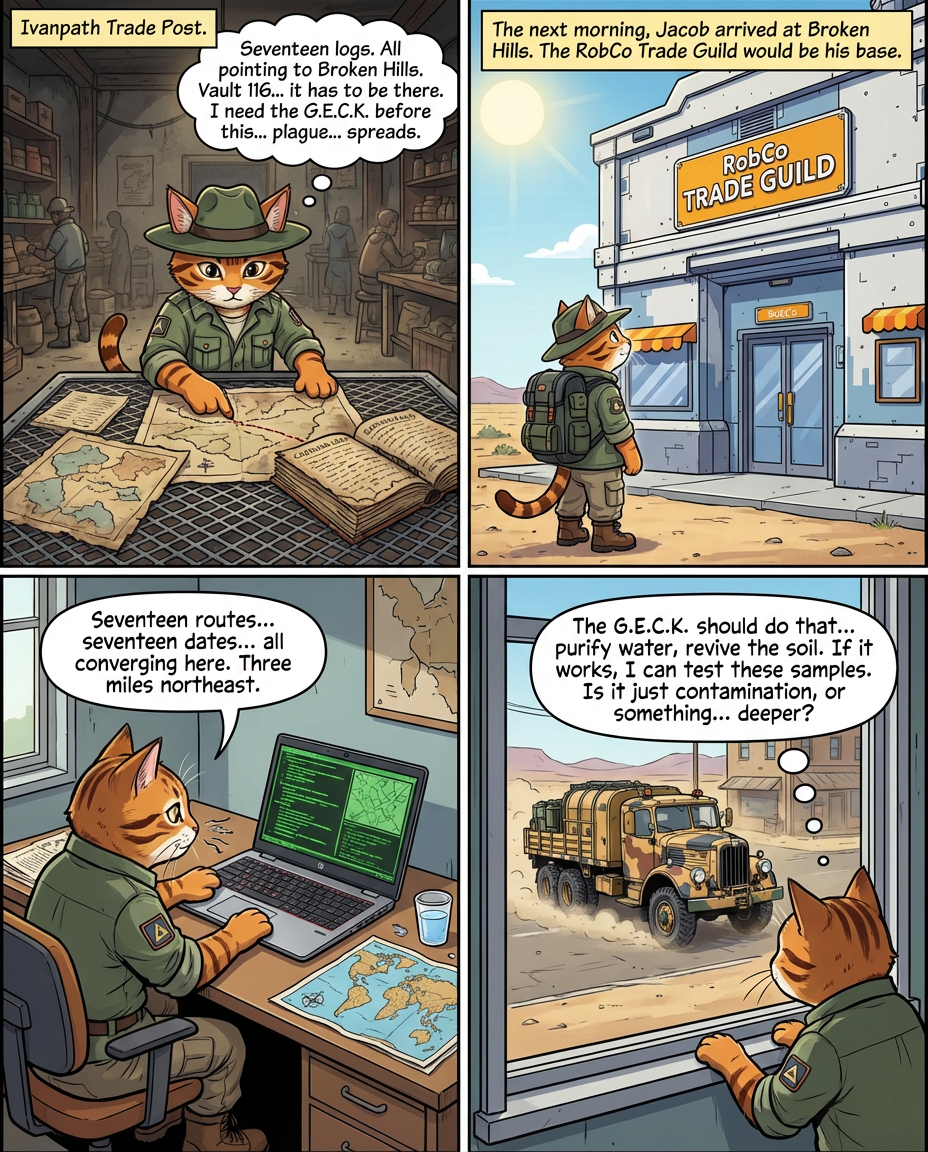
Jacob Carter spread the seventeen caravan logs across the metal table at the Ivanpath Trade Post. His paw traced the same route on each map—they all pointed to Broken Hills. Vault 116 had to be there, buried somewhere in that desert wasteland. Inside that vault was a G.E.C.K., and he needed to find it before whatever killed those people in the other vaults spread further. He packed his gear the next morning and headed to Broken Hills. The RobCo Trade Guild Office stood near the edge of the settlement, its light blue and grey walls marked with gold lettering. Jacob set up inside, claiming a corner desk. The building had power, security, and access to old trade records. It would work as his base while he searched. The HP ZBook Power G11 sat on the desk, its silver and black casing reflecting the overhead lights. Jacob powered it on and pulled up pre-war government files. Vault locations, construction records, geological surveys—everything was there. He cross-referenced the caravan logs with the vault registry. Seventeen different routes, seventeen different dates, all converging on coordinates three miles northeast. His whiskers twitched as he marked the location on his map. Outside, a 1944 Bedford OY truck rumbled past with tan and brown camouflage paint. A water treatment processor sat mounted on its flatbed, pipes and filters visible through the metal frame. Jacob watched it through the window. The G.E.C.K. was supposed to do that kind of work—turn poisoned water clean, make dead soil grow crops again. If the device in Vault 116 still functioned, he could test it against the yellowish water samples he'd collected. He could prove whether the contamination was something the G.E.C.K. could fix, or if the dimensional breach went deeper than any machine could reach.
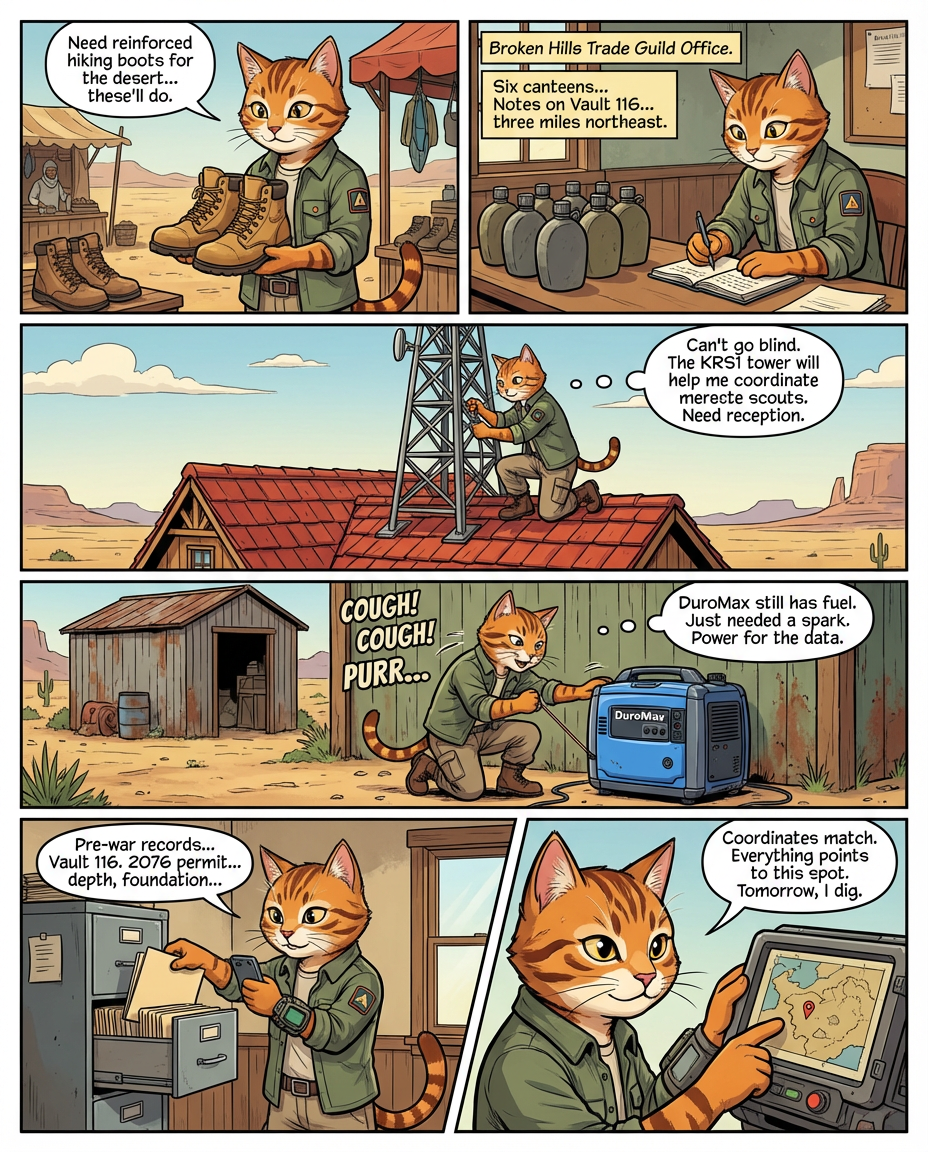
Jacob needed boots first—the kind that wouldn't fall apart in desert heat. He walked through Broken Hills until he found a trader with a pair of reinforced hiking boots, tan leather with thick rubber soles. He tested the ankle support, checked the tread pattern, and counted out caps. Next came water—six canteens, enough for three days if he rationed. He filled each one and lined them up on his desk at the Trade Guild Office. Then he pulled out his notebook and wrote down everything he knew about Vault 116's location: coordinates, depth estimates, possible entry points. Seventeen caravan logs had led him here. Now he had to walk three miles northeast and start looking for a door buried in sand. But walking blind into the wasteland was stupid. Jacob needed scouts—people who could search grid patterns while he tracked their reports. He climbed onto the Trade Guild Office roof and installed a radio transmission tower, bolting the metal framework to the concrete. The KRS1 Radio Broadcast Station would let him receive signals from anyone he sent out to search distant regions. He tested the frequency range twice, then wrote down the coordinates where reception dropped off. If someone found a vault entrance, they could call it in before nightfall. Power failures would kill everything. Jacob walked outside and found a generator rusting behind a storage shed. The DuroMax XP11000iH still had fuel in its tank. He cleaned the spark plugs, replaced a cracked fuel line, and pulled the starter cord. The engine coughed, then caught. He ran a cable through the wall to his computer setup inside. If the main grid failed, his vault-tracking data wouldn't disappear with it. He needed one more thing—official records. Jacob found the South Western Regional Land Management Office at the edge of the settlement, a one-story building with wood, brick, and concrete walls that looked like they'd survived the bombs. Inside, metal filing cabinets lined the walls. He pulled drawers open until he found pre-war government documents: land surveys, construction permits, geological reports. Vault 116 appeared on a permit dated 2076, with depth specifications and foundation blueprints. Jacob photographed every page with his Pip-Boy, cross-referenced the coordinates with his caravan logs, and marked the exact search zone on his map. Everything pointed to the same spot. Tomorrow, he'd start digging.
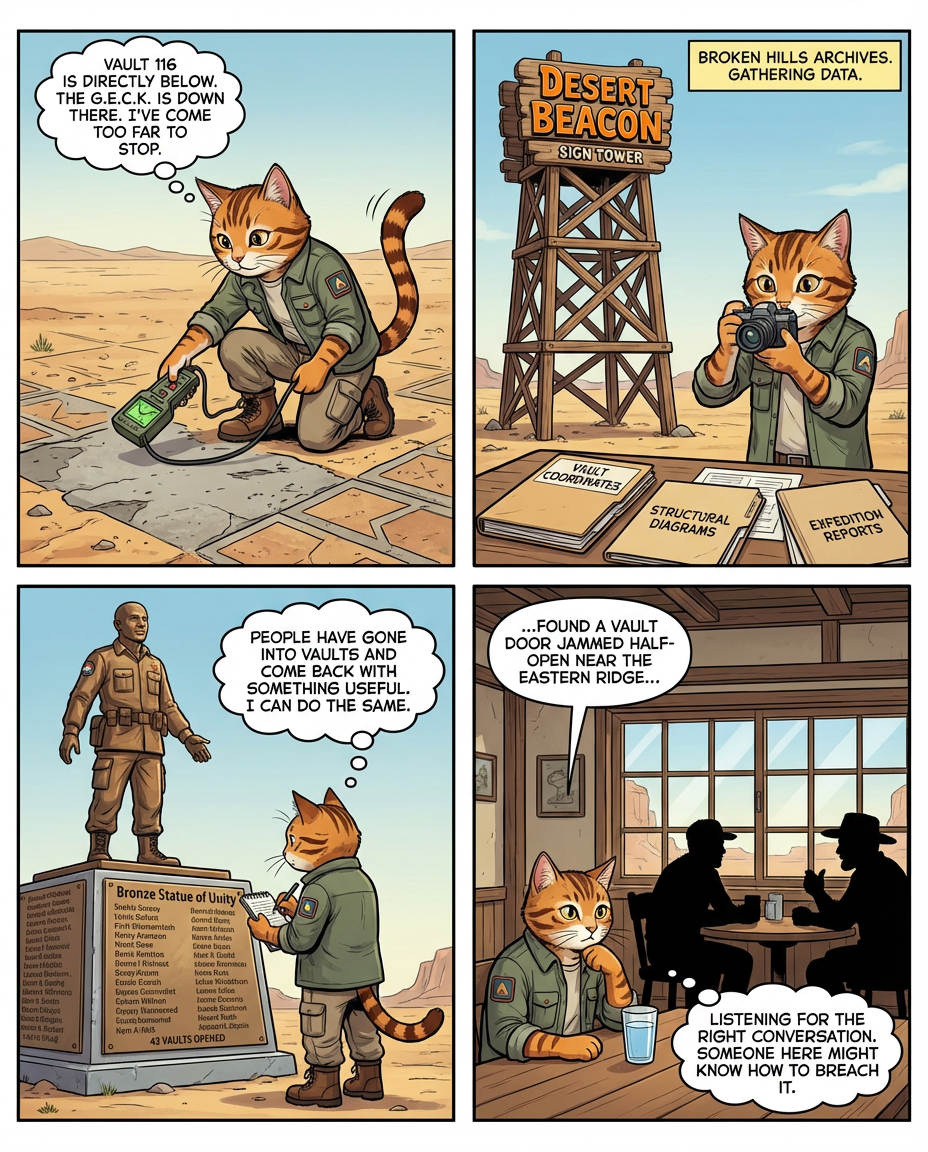
Jacob stood at the edge of his search zone, three miles northeast of the Trade Guild Office. The ground here looked wrong—too flat, too uniform. He dropped to one knee and brushed sand away from a section of concrete. His claws scraped against pre-war construction material, the kind used for vault entrances. He pulled out his radiation meter and swept it across the surface. The readings spiked in a geometric pattern, just like the fractals he'd found in the other vaults. This was it. Vault 116 was directly below him, and whatever had arranged those bodies in groups of seven was probably still inside. But the G.E.C.K. was down there too, and he'd come too far to stop now. He needed help—specialists who tracked vaults for a living. Back in Broken Hills, a wooden tower stood against the desert sky, stacked planks rising high with bold text painted across the top. The sign advertised vault location archives and expedition planning. Jacob walked inside and found filing cabinets full of vault coordinates, structural diagrams, and expedition reports. He pulled three folders on nearby vaults and spread them across a table. Each one listed entry methods, structural weak points, and radiation levels. Vault 116 would have the same basic layout. He photographed the pages and added the data to his notes. Outside, a bronze statue caught his eye—an NCR soldier and an Arizona Ranger shaking hands on a blue and red marble base. Names of successful vault expeditions covered the sides. Jacob counted them: forty-three vaults opened, thirty-one cleared of threats, twelve with working technology recovered. The G.E.C.K. wasn't listed, but pre-war water purifiers and medical equipment were. People had gone into vaults before and come back with something useful. He could do the same. Jacob walked to a weathered brick building with a wood and tile roof. The 37th Aero Squadron Bunker served food and drinks to travelers passing through. Inside, three different groups sat at tables—caravan guards, scavengers, a trader counting caps. He listened to their conversations. One scavenger mentioned finding a vault door jammed half-open near the eastern ridge. Another talked about hearing mechanical sounds underground. Jacob pulled out his map and marked both locations. Someone here might know about Vault 116's entrance mechanism, or what kind of tools could breach a sealed door. He ordered water and sat down to wait for the right conversation.
Play your story to life
Storycraft is a mobile game where you create AI characters, craft items and locations to build their world, then discover what direction your story takes. Download the iOS game for free today!
Download for free