

Barry ‘Bardog’'s Arc
13 Chapters
Barry ‘Bardog’'s dream is opening a bar and Inn for weary travelers.

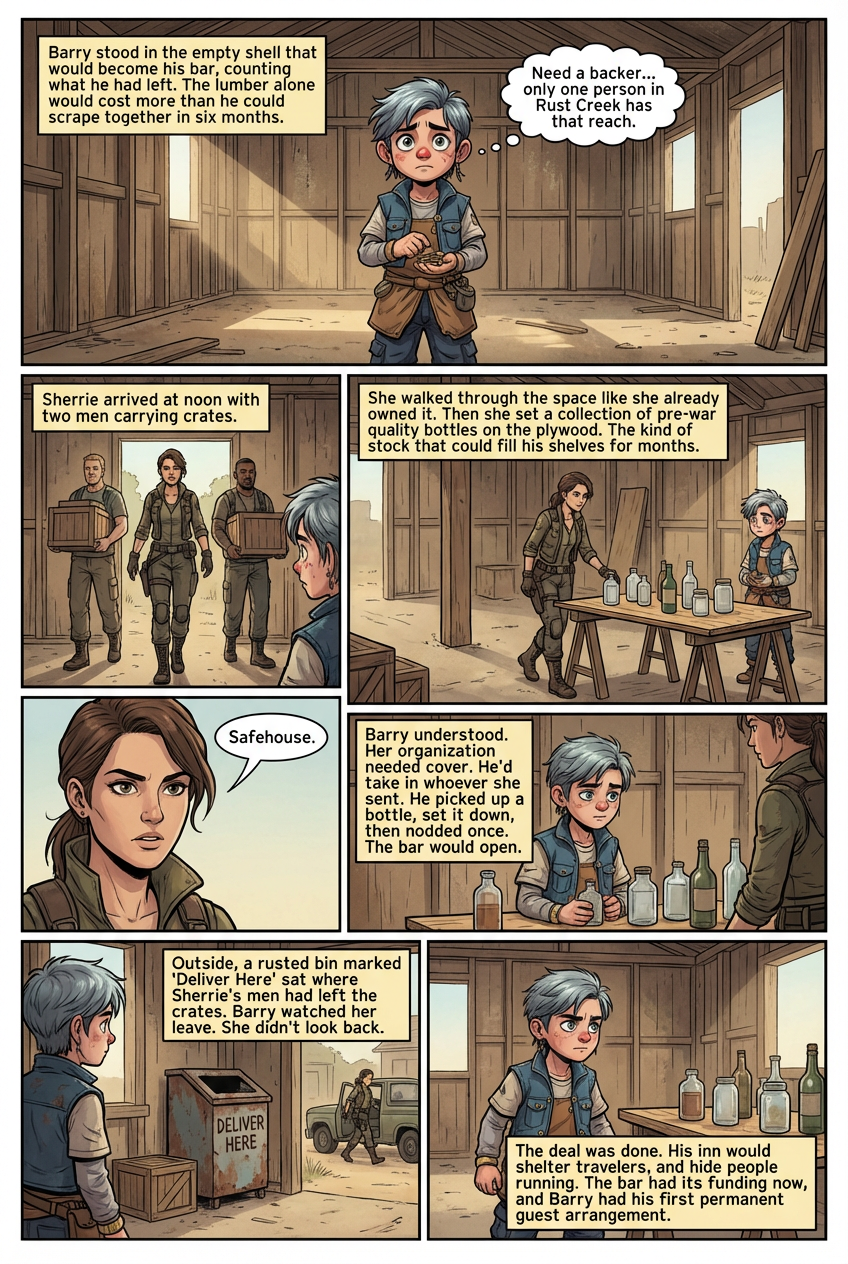
Barry stood in the empty shell that would become his bar, counting what he had left. The lumber alone would cost more than he could scrape together in six months. He needed a backer, and there was only one person in Rust Creek with that kind of reach. Sherrie arrived at noon with two men carrying crates. She walked through the space like she already owned it, tapping walls and testing floorboards. Then she set a collection of bottles and jars on the plywood he'd laid across sawhorses. The labels were pristine, pre-war quality, the kind of stock that could fill his shelves for months. She didn't ask if he wanted them. She waited for him to understand what she was offering and what it would cost. Her eyes moved to the upper floor, the rooms he'd planned for travelers, and she said one word: "Safehouse." Barry looked at the bottles, then at Sherrie. Her organization needed a place that looked legitimate, somewhere her people could disappear into when things went wrong. He'd have to take in whoever she sent, no questions, no records. It wasn't money she wanted and it wasn't labor. It was cover. He picked up one of the bottles, turned it over in his hands, and set it back down. Then he nodded once. The bar would open, and it would serve two purposes now. Outside, a rusted bin with faded white letters reading "Deliver Here" sat against the wall where Sherrie's men had left the crates. Barry watched through the window as she climbed into her truck. She didn't look back. The deal was done, and the rules were set. His inn would shelter travelers, but it would also hide people running from things he'd never ask about. He turned away from the window and looked at the bottles on the plywood. The bar had its funding now, and Barry had his first permanent guest arrangement.
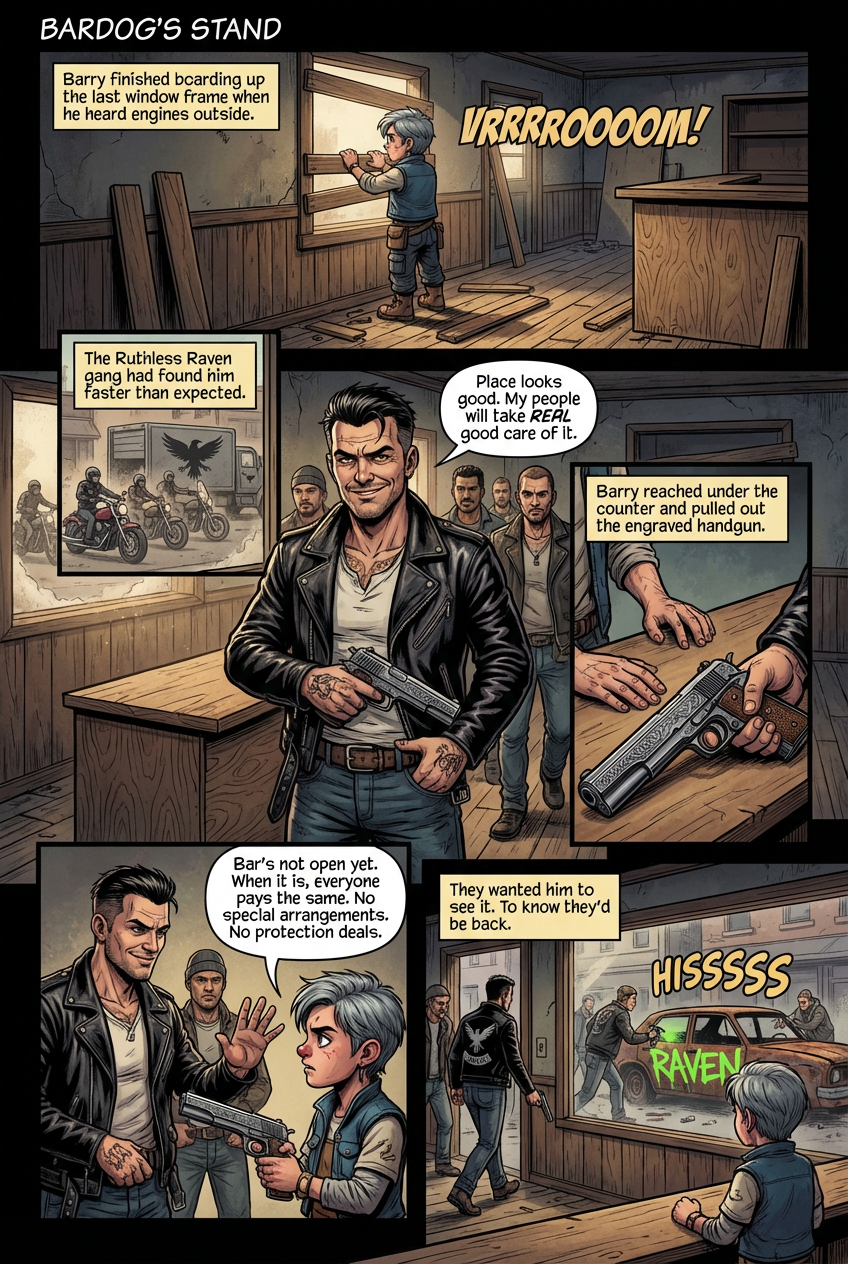
Barry finished boarding up the last window frame when he heard engines outside. Three bikes and a truck, all marked with the same symbol painted on their doors and fuel tanks. The Ruthless Raven gang had found him faster than he'd expected. Five men walked through the door without knocking. The one in front wore a handgun with scrollwork along the barrel, the kind of piece you kept for showing off. He looked around the half-finished bar, at the bottles Sherrie had left, at the plywood counter where Barry stood. Then he smiled and said the place looked good, that his people would take real good care of it. Barry watched his hands, the way they stayed loose and ready. This wasn't a negotiation. They'd come to claim what they wanted, and they'd done it before. Barry reached under the counter and pulled out the engraved handgun, setting it on the plywood where everyone could see it. Not pointing it. Just placing it there between them. The leader stopped smiling. Barry said the bar wasn't open yet, and when it was, everyone paid the same. No special arrangements. No protection deals. The room went quiet. One of the men behind the leader moved his hand toward his belt, but the leader raised his palm and shook his head. He looked at Barry for a long moment, then at the gun, then back at Barry's face. The leader turned and walked out. His men followed. Through the window, Barry watched them spray-paint a rusted car across the street, bright colors marking it with their tag. They wanted him to see it, to know they'd be back. But they'd left without taking anything, and that mattered. Barry picked up the handgun and put it back under the counter. The gang knew he'd stand his ground now, and he knew they wouldn't forget the refusal. The bar would open, but the Ruthless Ravens would be watching.
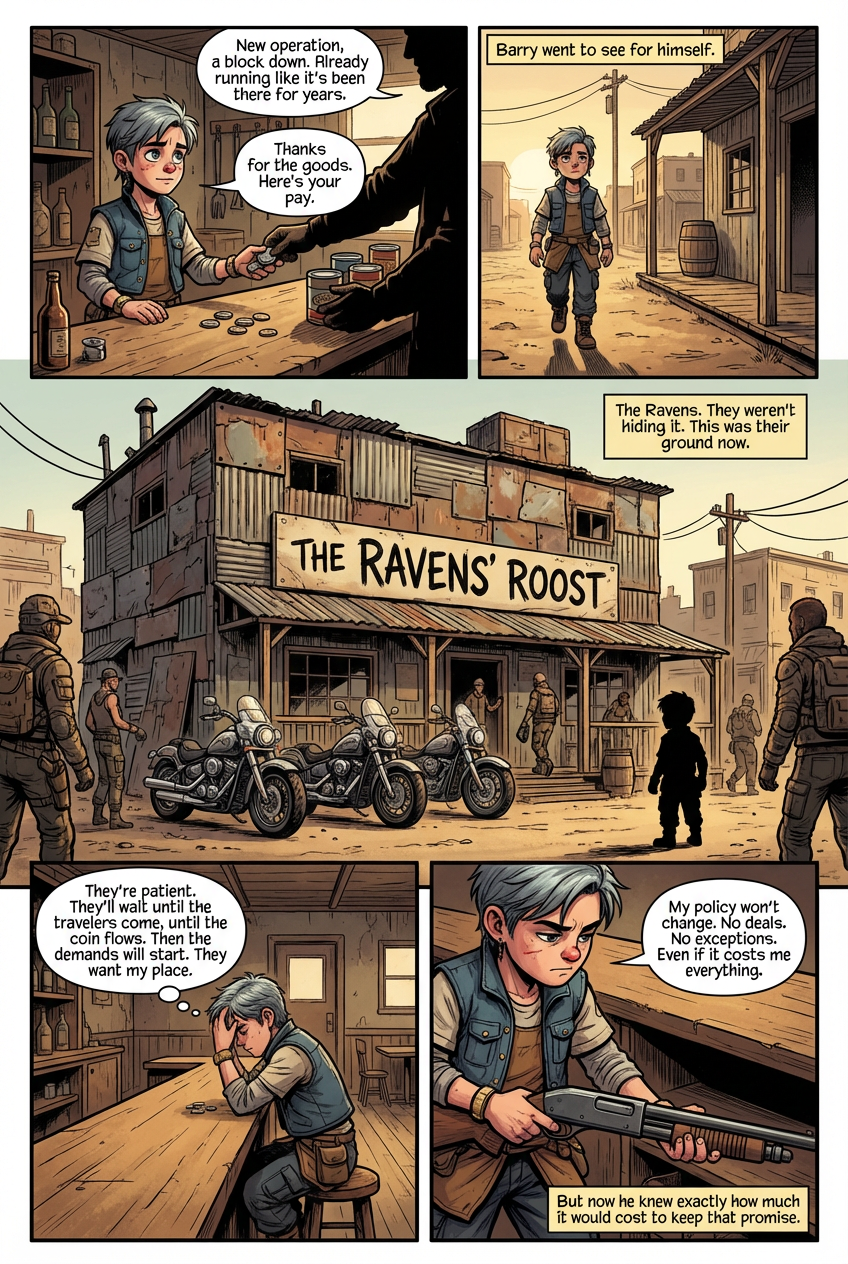
Barry heard about the new operation before he saw it. A trader mentioned it while dropping off canned goods — said the place opened up a block away, already running like it had been there for years. Barry thanked him and paid what they'd agreed on, then walked outside to look. The building stood two stories tall, built from scrap metal and tin sheets welded into something that looked permanent. A sign across the front spelled out the name in bold letters, and below it sat three combat bikes parked in a row, their armor plating polished clean. Barry recognized the setup immediately. The Ravens weren't hiding their stake in it. They wanted everyone to know this was their place, their ground. He stood across the street for a minute, watching people go in and out. Some carried tools. Others looked like they were there to drink. It didn't matter what they sold — the message was clear. The Ravens had put down roots one block from his bar, and they weren't asking permission. Barry walked back to his own place and locked the door behind him. He pulled out a chair and sat at the plywood counter, thinking it through. The Ravens had tested him once and he'd held his ground. Now they'd set up shop close enough to watch his door every day. They were patient. They'd wait until his bar opened, until travelers started showing up with goods to trade and coin to spend. Then they'd come back with a different offer, one that wouldn't sound like a demand until he refused. Barry reached under the counter and checked the shotgun, making sure it was loaded. He wouldn't change his policy. Everyone paid the same, no deals, no exceptions. But now he knew exactly how much it would cost him to keep that promise. The Ravens had made sure of it.
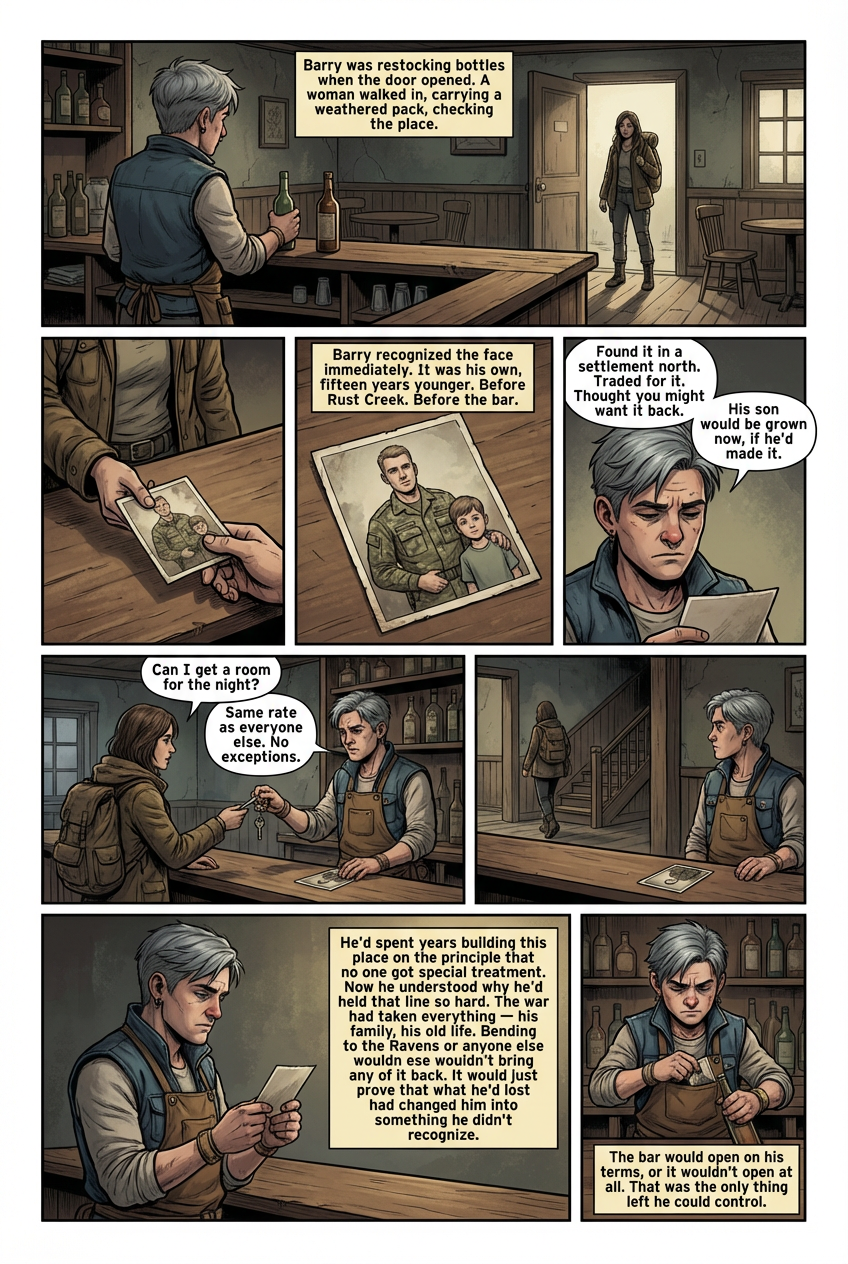
Barry was restocking bottles behind the counter when the door opened and a woman walked in carrying a weathered pack. She set it down on the floor and looked around the bar like she was checking for something specific. Barry nodded at her and waited. She pulled out a yellow sign from her pack and set it on the counter. The metal was pre-war clean, with bold letters that read REST STOP. "Found this half-buried on the road in," she said. "Figured you might want it for the place." Barry looked at the sign and then at her face. She was younger than him, maybe thirty, with the kind of tired eyes that came from moving too long without a destination. "You passing through or staying?" he asked. She shrugged. "Depends on what's here." Barry set down the bottle he was holding and leaned against the counter. "Why bring me this?" She met his eyes without hesitation. "Because I knew your brother. He pulled me out of a building collapse in the third year of the war. Told me if I ever made it to Rust Creek, I should find Bardog and tell him he kept his word." Barry went still. His brother had died in the fourth year, buried under rubble when a supply depot collapsed during a raid. He'd promised to get people out before the structure went down, and he had. Barry had heard the story from three different survivors, but never from someone who looked him in the eye like this. "He got you out," Barry said. It wasn't a question. She nodded. "He stayed inside to make sure the last of us cleared the door. I owe him my life." Barry picked up the sign and turned it over in his hands. The weight of it felt solid, real. He'd spent years after the war refusing to let anyone dictate terms to him because his brother had died following orders from people who didn't care if he lived. Barry had built his bar on the principle that no one got special treatment, that everyone paid the same, because the moment you bent for one person, you had to bend for them all. But his brother hadn't died following bad orders. He'd died keeping a promise to people who had nothing to offer him in return. Barry set the sign down and looked at the woman. "You can stay," he said. "Work the bar, help with the rooms upstairs. I'll pay you fair and you eat what I eat." She studied him for a moment, then nodded. "That works." Barry realized he'd just hired someone without checking if she could pour a drink or clean a room, and he didn't care. His brother had kept his word because it mattered more than survival. Barry had been holding the line because he refused to let anyone take from him, but that wasn't the same thing. He picked up the sign again and walked outside. The Ravens' building sat one block away, their bikes parked in a row. Barry found a post near the entrance to his bar and bolted the sign to it. REST STOP. Let them see it. Let them know what this place was for. He wasn't bending to them, but he wasn't just holding ground anymore either. He was building something his brother would have recognized.
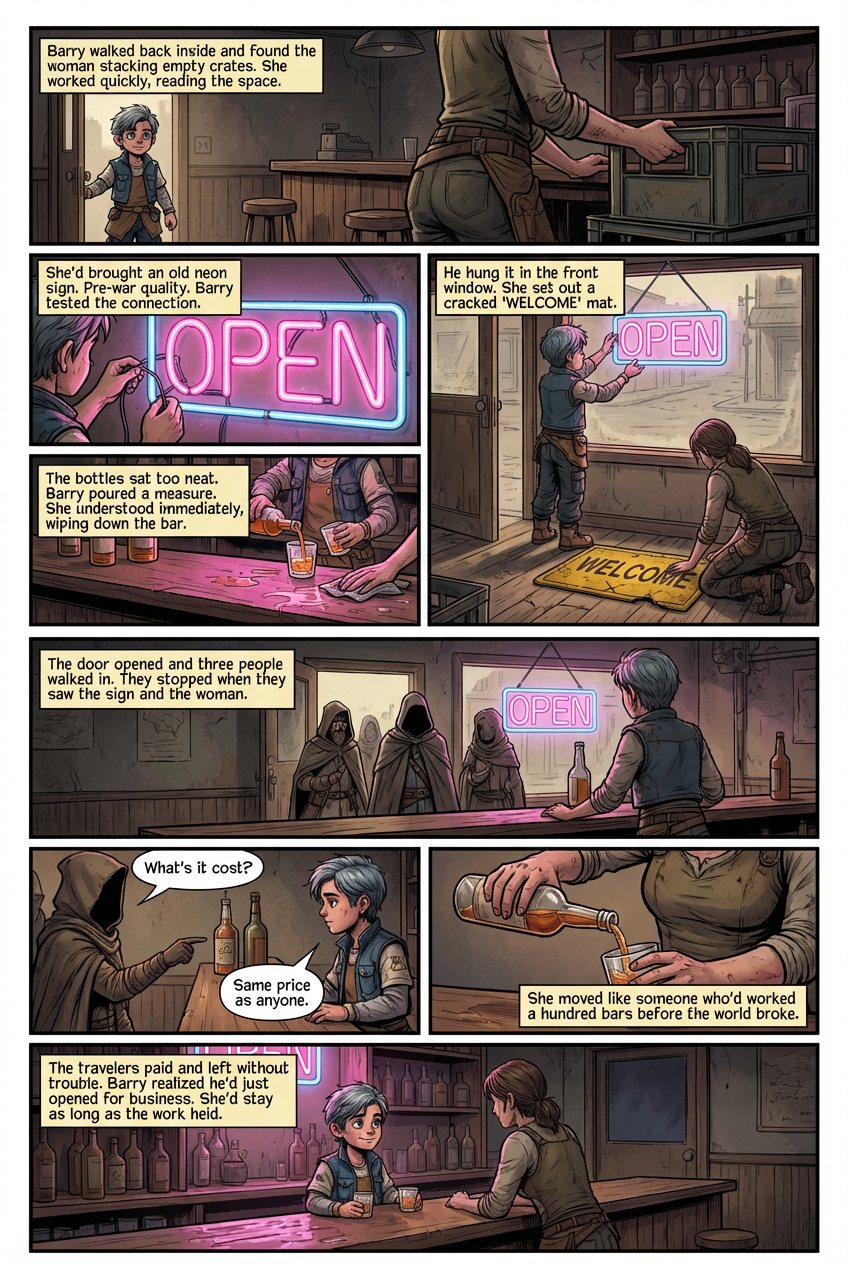
Barry walked back inside and found the woman stacking empty crates behind the bar. She worked quickly, without asking where things went, reading the space the way he read people. He needed to set up the main room before anyone else showed up. She'd brought an old neon sign with her, wrapped in cloth at the bottom of her pack. The glass tubes were intact, pre-war quality that still held their charge. Barry tested the connection and the word OPEN flickered to life in pink light. He hung it in the front window where anyone passing could see it. The woman nodded at the sign and pulled out a rubber mat from behind the counter, faded letters spelling WELCOME across cracked yellow surface. She set it at the entrance without saying anything. Barry looked at the room and saw what was missing. The bottles on the shelves sat too neat, untouched. No one would believe this place served drinks if nothing looked used. He pulled down two bottles of the pre-war stock Sherrie had traded him and poured a measure into glasses on the counter. The woman understood immediately and wiped down the bar with a rag, leaving damp streaks that caught the neon light. She set out clean glasses in a row and hung a towel over her shoulder like she'd been working there for months. The door opened and three people walked in, faces Barry didn't recognize. They stopped when they saw the lit sign and the woman behind the bar. One of them pointed at the bottles and asked what it cost. Barry told them the price, same as he'd tell anyone, and watched the woman pour without hesitation. She moved like someone who'd worked a hundred bars before the world broke. The travelers paid, drank, and left without trouble. Barry realized he'd just opened for business, and no one had tried to take it from him yet. The woman met his eyes across the counter and he knew she'd stay as long as the work held.
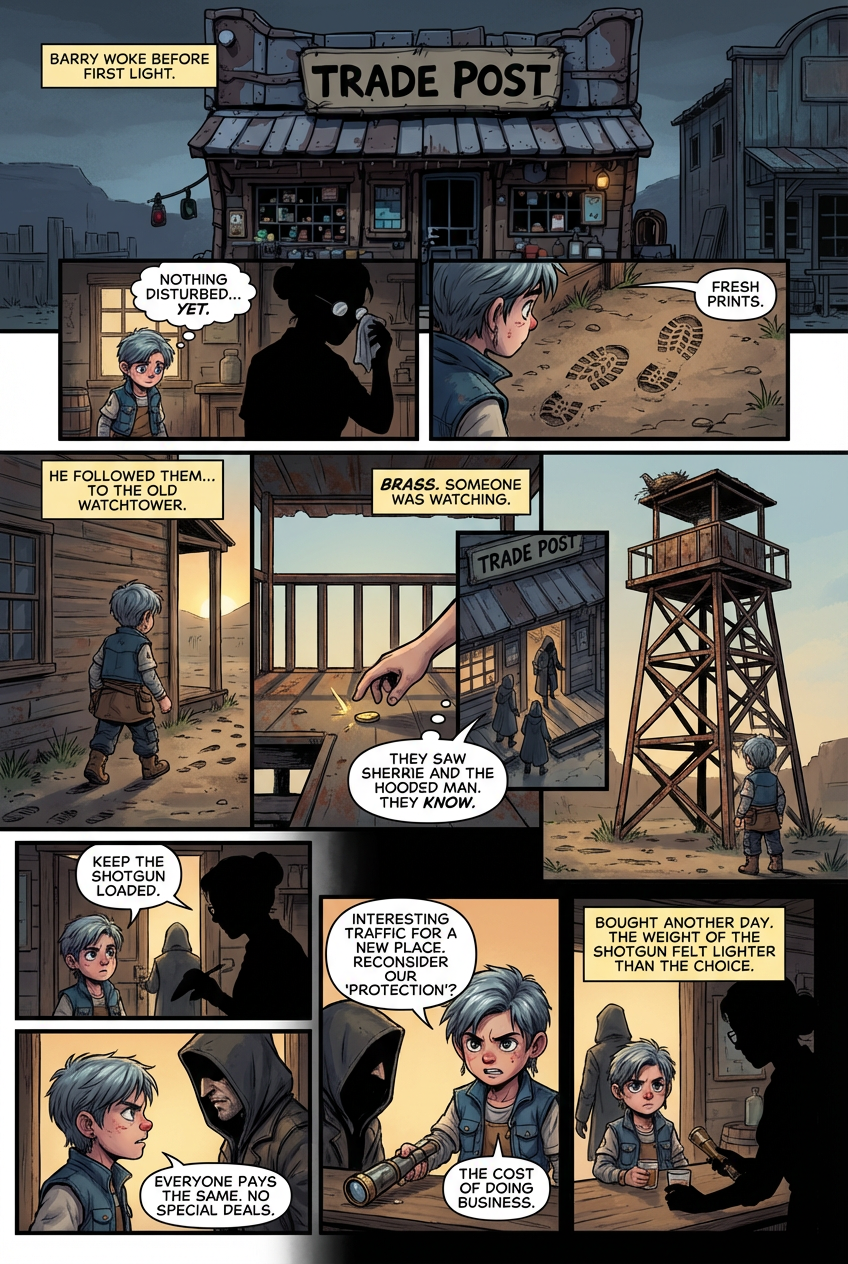
Barry woke before first light and went downstairs to check the bar. The woman was already behind the counter, wiping down glasses from the night before. Nothing looked disturbed. He walked to the window and saw fresh boot prints in the dirt outside, recent enough that the edges hadn't settled yet. He stepped outside and followed the prints around the side of the building. They led to an old watchtower one block over, rust bleeding down its metal frame. A bird's nest sat crooked on top, but through the railings he caught the glint of brass. Someone had been watching. Barry studied the angle from the platform back to his entrance and saw exactly what they'd seen: Sherrie arriving last night with a man whose face stayed hidden under a hood, both of them going upstairs for two hours before leaving separately. The Ravens knew he was running more than a bar now. He walked back inside and told the woman to keep the shotgun loaded. She nodded and checked the chamber without asking why. The sun was barely up when a Raven knocked on the door, alone this time, no gang behind him. Barry let him in and the man set a dented spyglass on the counter between them. He said they'd seen interesting traffic for a place that just opened, and maybe Barry wanted to reconsider that protection arrangement. Barry looked at the spyglass and understood the cost of last night's business. He told the Raven the same thing he'd told them before: everyone pays the same, no special deals. The man picked up the spyglass and left without another word. Barry knew they'd be back with more than questions next time, but he'd bought himself another day to figure out how to run Sherrie's safehouse without the Ravens burning it down. The woman poured him a drink and he took it, the weight of the shotgun under the bar feeling lighter than the choice he'd just made.
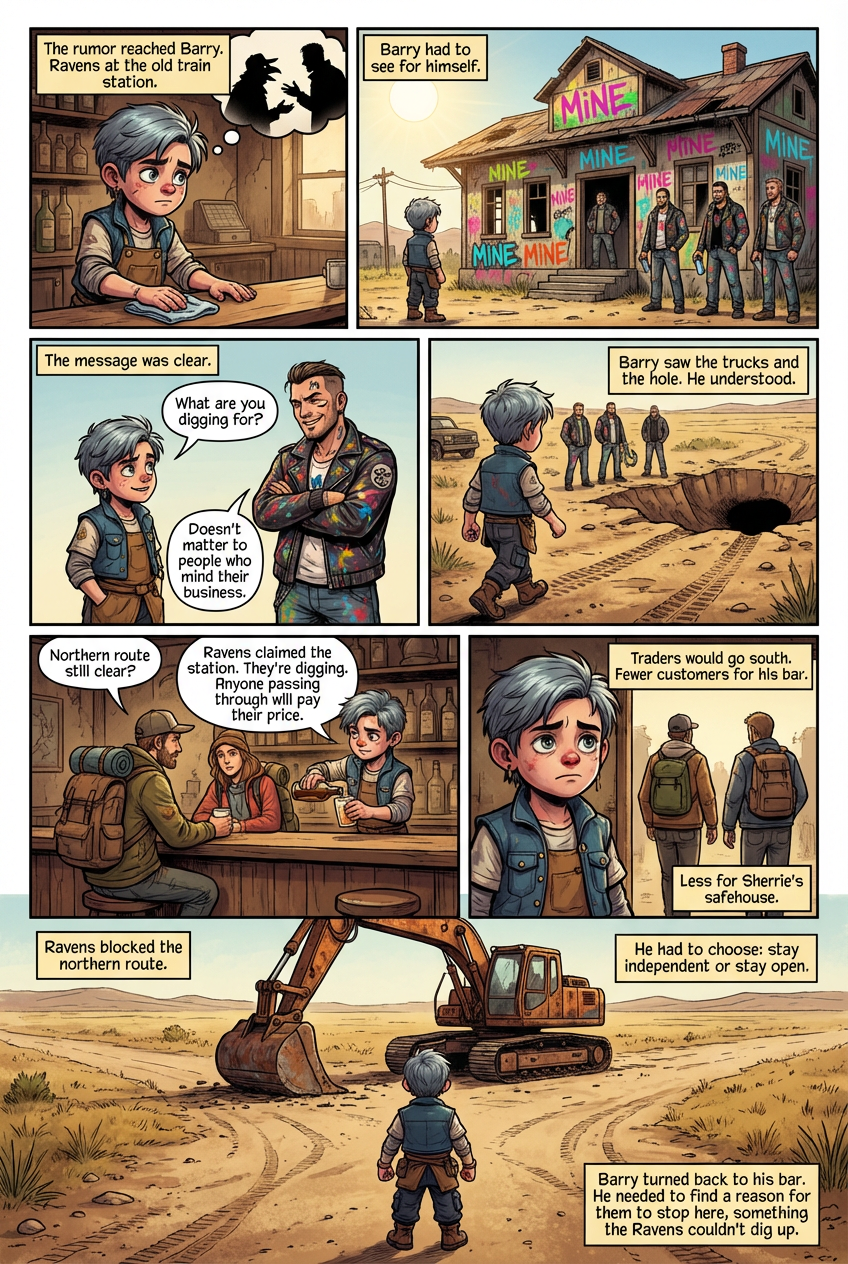
The rumor reached Barry through a scavenger who stopped for water. The Ravens were digging under the old train station, hauling up dirt and rock in the middle of the night. Traders were already talking about rerouting south to avoid whatever was down there. Barry walked to the station that afternoon to see for himself. The building still stood, cracked concrete and broken windows, but the Ravens had marked it now. Fresh graffiti covered the walls in bright colors that seemed to glow even in daylight, the word MINE spray-painted over every surface. Five bikers stood guard at the entrance, jackets covered in paint and gang marks, spray cans clipped to their belts like weapons. One of them stepped forward when Barry got close, not threatening but not welcoming either. Barry asked what they were moving down there. The biker smiled and said it didn't matter to people who minded their business. Barry looked past him and saw tire tracks where trucks had come and gone, deep ruts in the dirt leading to a hole that dropped into darkness. He turned and walked back to his bar. That evening, two traders came through his door and asked if the northern route was still clear. Barry poured them drinks and told them what he'd seen: the Ravens had claimed the station and everything under it, and anyone passing through would be paying their price soon enough. The traders exchanged looks and one of them said they'd take the southern pass from now on, even if it cost them an extra day. Barry watched them finish their drinks and leave, understanding what the excavation meant for his bar. Fewer traders would come through Rust Creek now, which meant fewer customers and less business to cover for Sherrie's safehouse. The Ravens weren't just digging for whatever was buried down there. They were choking off the trade that kept places like his alive, and there wasn't a damn thing he could do to stop it. The next morning Barry walked two blocks past the station to where the main road split north and south. He found what he expected: a rusted excavator parked across the northern route, its bucket resting on the ground like a barricade. The Ravens had made their move clear. Barry stood there calculating the numbers. The southern pass meant traders would bypass Rust Creek entirely or arrive exhausted and low on supplies. Either way, his bar would see less traffic just when he needed it most. But he'd seen the bikers' faces yesterday, the way they'd looked at him when he asked questions. They wanted him to know this was deliberate. They were forcing him to choose between staying independent and staying open. Barry turned back toward his bar, accepting what he couldn't change but already working through what he could. If traders wouldn't come through Rust Creek anymore, he'd have to give them a reason to stop here anyway. The bar would need to offer something worth the detour, something the Ravens couldn't dig up or block off. He didn't know what that was yet, but he knew he'd figure it out before his next shipment from Sherrie arrived.
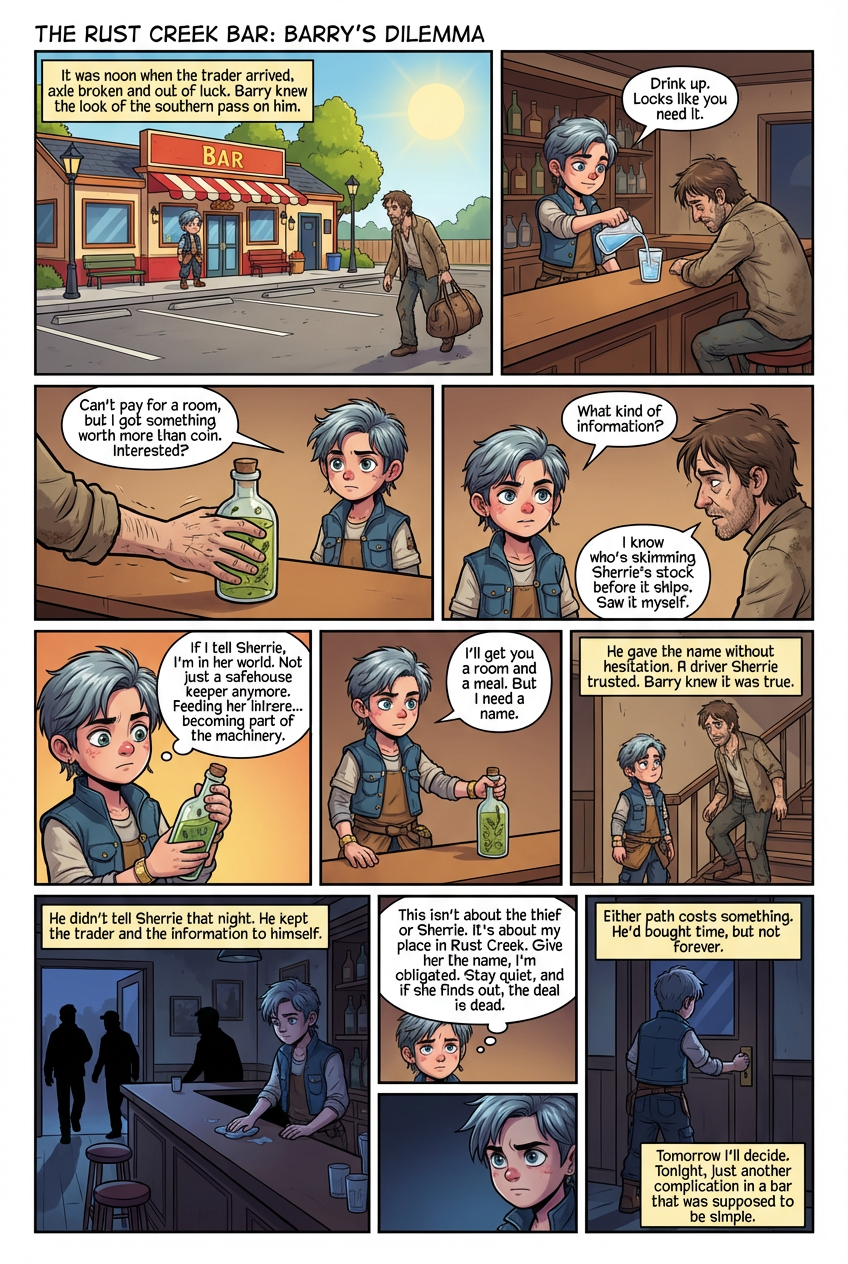
The trader showed up at noon with a broken axle and no way to fix it. Barry saw him limping across the parking lot, dragging a bag behind him, and knew before the man said anything that he'd been stranded on the southern pass for at least two days. Barry poured him water and watched him drink. The man had the look of someone who'd been sleeping rough, dirt caked into his collar and hands shaking just enough to show he was running on empty. He set a glass bottle on the bar between them, bright green liquid inside with herbs floating near the bottom. Said he couldn't pay for a room but he had information worth more than coin if Barry was interested. Barry asked what kind of information. The man glanced at the door, then back at Barry, and said he knew who was skimming Sherrie's stock before it shipped. He'd seen it himself two weeks back, watched them loading a bag of medical supplies into a private truck while the main convoy was stopped for repairs. Barry kept his face neutral and asked why he was selling this instead of taking it to Sherrie herself. The trader said he didn't have the connections to get close to her, but he knew Barry did, and he figured that was worth a bed and some food. Barry picked up the bottle and turned it in his hands, thinking through what the information meant. If someone inside Sherrie's operation was stealing, she'd want to know. But telling her would put Barry deeper into her world than he'd planned, make him more than just the man who ran a safehouse. It would mean he was feeding her intelligence now, becoming part of the machinery instead of just renting space in it. He set the bottle down and told the trader he'd get him a room upstairs and a meal, but he needed a name. The trader gave it without hesitation, a driver Sherrie trusted on the eastern route, and Barry knew from the way he said it that it was true. Barry walked the trader upstairs and came back down to the bar, the weight of the decision already settling into his chest. He didn't tell Sherrie that night. Barry stood behind the bar pouring drinks for two scavengers who'd come through on their way south, and he kept the trader's information to himself. The choice wasn't about protecting the thief or helping Sherrie. It was about what kind of position he wanted to hold in Rust Creek. If he gave her the name, he'd be useful to her in a new way, and useful meant obligated. But if he stayed quiet and she found out later he'd known, the deal they had would be done. Barry closed up the bar near midnight and locked the door, accepting that either path would cost him something. He'd bought himself time by keeping the trader upstairs and the information quiet, but he knew he couldn't sit on it forever. Tomorrow he'd decide. Tonight he'd just added another complication to a bar that was supposed to be simple.
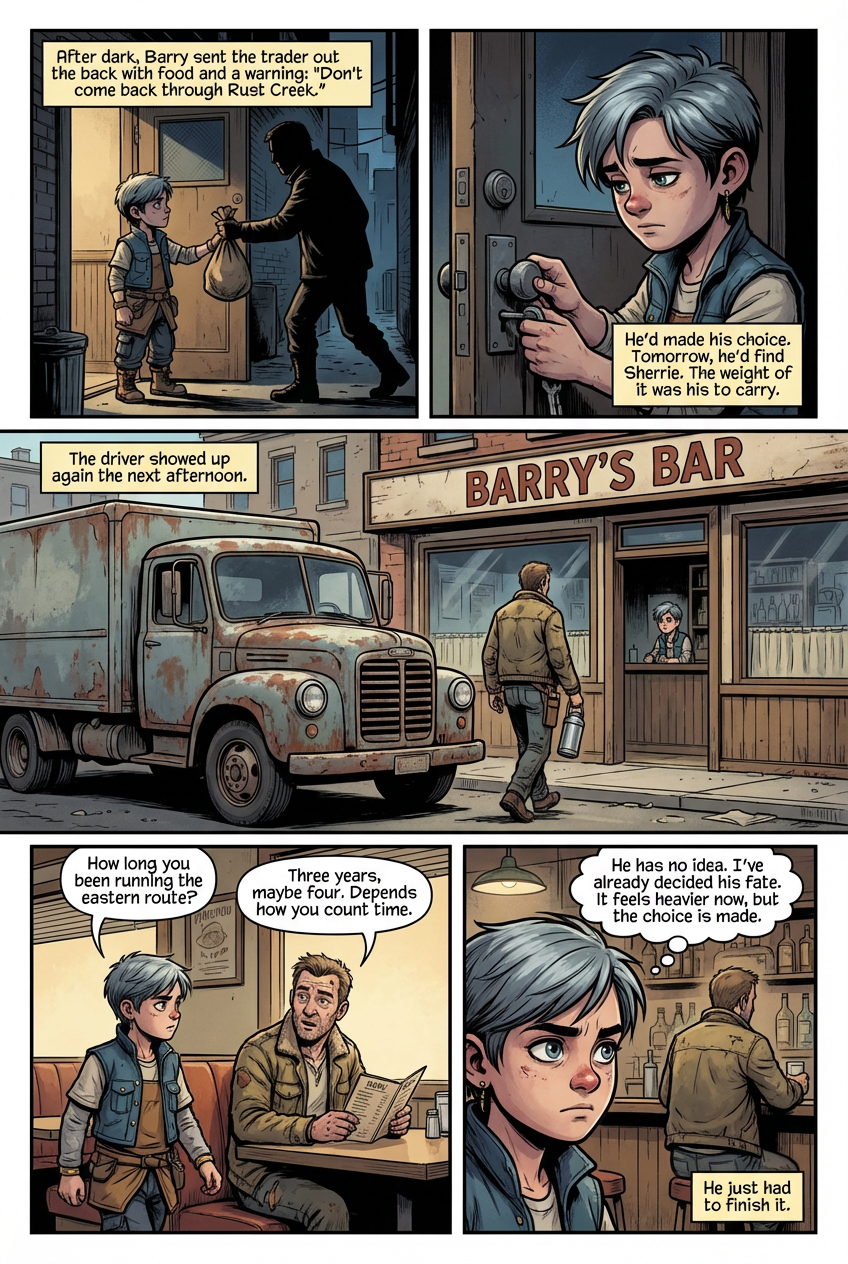
Barry sent the trader out the back door after dark with enough food for two days and told him not to come back through Rust Creek. The man didn't argue, just shouldered his bag and disappeared into the lot behind the bar. Barry locked the door and went back inside, knowing he'd crossed a line he couldn't step back over. He'd made his choice. Tomorrow morning he'd find Sherrie and give her the driver's name, and whatever came after that would be his to carry. The driver showed up again the next afternoon in a rusted delivery truck with faded logos still visible on the sides. He parked in the lot and came through the front door carrying the metal thermos on his belt, same as before. Barry was behind the bar when the man sat down at a booth near the window. The woman brought him water and the driver ordered food again, paying with a small pouch of screws and wire. Barry watched him settle in, relaxed and unhurried, and felt the weight of what he knew pressing against his chest. The man had no idea Barry had already decided his fate. Barry walked over to the booth and sat down across from him without asking. The driver looked up, surprised but not alarmed, and Barry asked him how long he'd been running the eastern route. The man said three years, maybe four, depending on how you counted time anymore. Barry nodded and asked if the work paid well enough to make it worth the risk. The driver shrugged and said it paid what it paid, same as anything else in Rust Creek. Barry leaned back and watched the man's face, looking for the crack in the surface, the moment when the lie would show itself. But there was nothing there except a tired driver waiting for his next shipment. Barry stood up and told him the food would be out soon, then walked back to the bar and poured himself water. He'd confirmed everything he needed to know. The driver was good at what he did, good enough that Sherrie had trusted him for years. That made what Barry was about to do feel heavier, but it didn't change the choice. He'd already told the trader to leave. Now he just had to finish it.
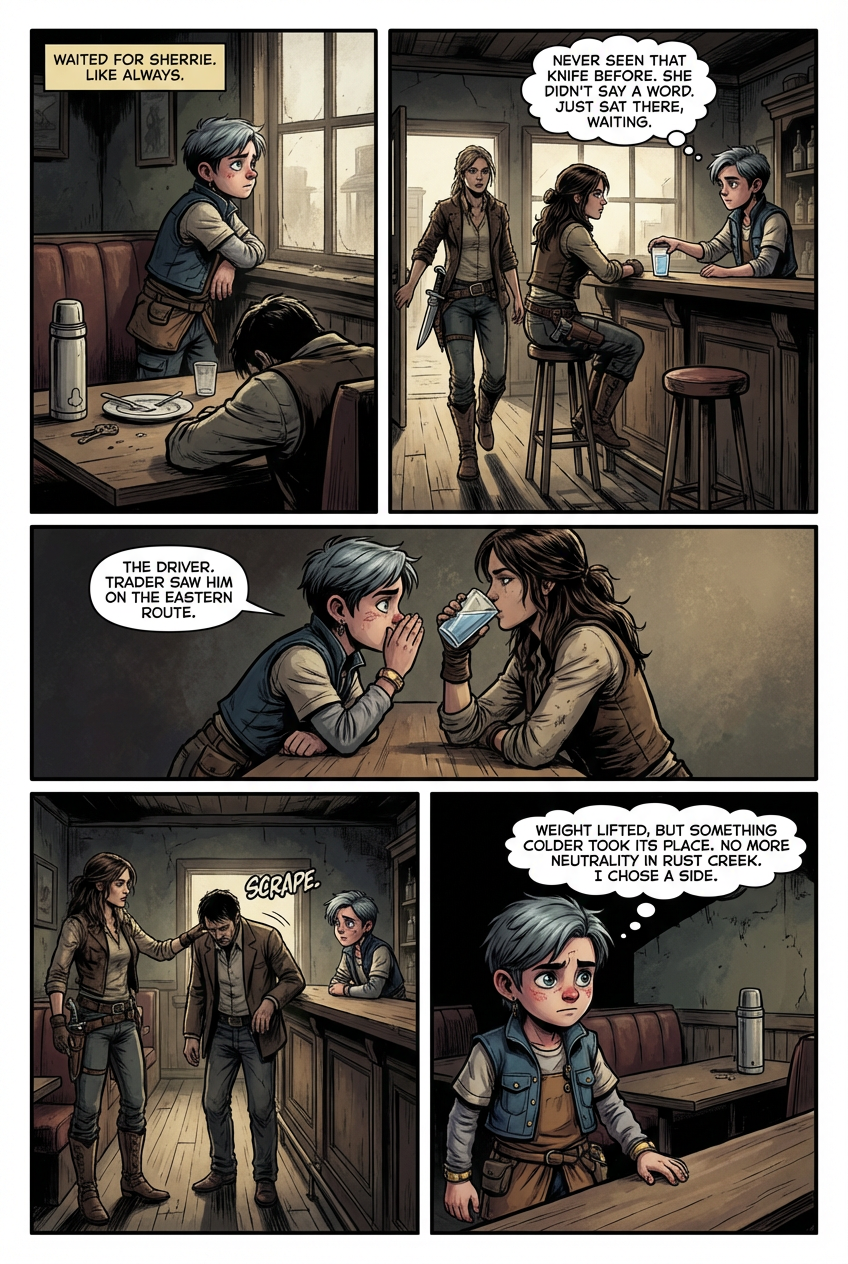
Barry stayed behind the bar after the driver finished eating. The woman cleared the booth and brought the thermos back to the kitchen without saying anything. Barry watched the lot through the window, waiting for Sherrie to show up like she always did when her trucks came through. Sherrie walked in twenty minutes later while the driver was still at his booth, staring out the window with his arms crossed. She didn't look at Barry. She walked straight to the broken stool at the end of the bar and sat down on it even though it wobbled under her weight. Barry saw the knife on her belt, handle shaped like a raven's head, the metal catching light from the window. She'd never worn it before. Barry set a glass of water in front of her and waited. Sherrie looked at the driver, then back at Barry. She didn't ask anything. She just sat there with her hand resting near the knife, waiting for him to say it. Barry told her the driver's name and what the trader had seen on the eastern route. Sherrie didn't move except to pick up the glass and take a long drink. She set it down and nodded once, then stood up and walked toward the driver's booth. Barry didn't follow her. He stayed behind the bar and listened to the sound of her boots on the floor, the scrape of the bench as the driver stood up, the low murmur of voices he couldn't make out. A minute later Sherrie walked the driver out through the front door with her hand on his shoulder. The driver didn't resist. Barry watched them disappear into the lot and felt the weight lift off his chest, replaced by something colder. He'd done what he had to do, and now Sherrie knew he'd choose her side when it mattered. That was worth something in Rust Creek, but it also meant he couldn't pretend to be neutral anymore.
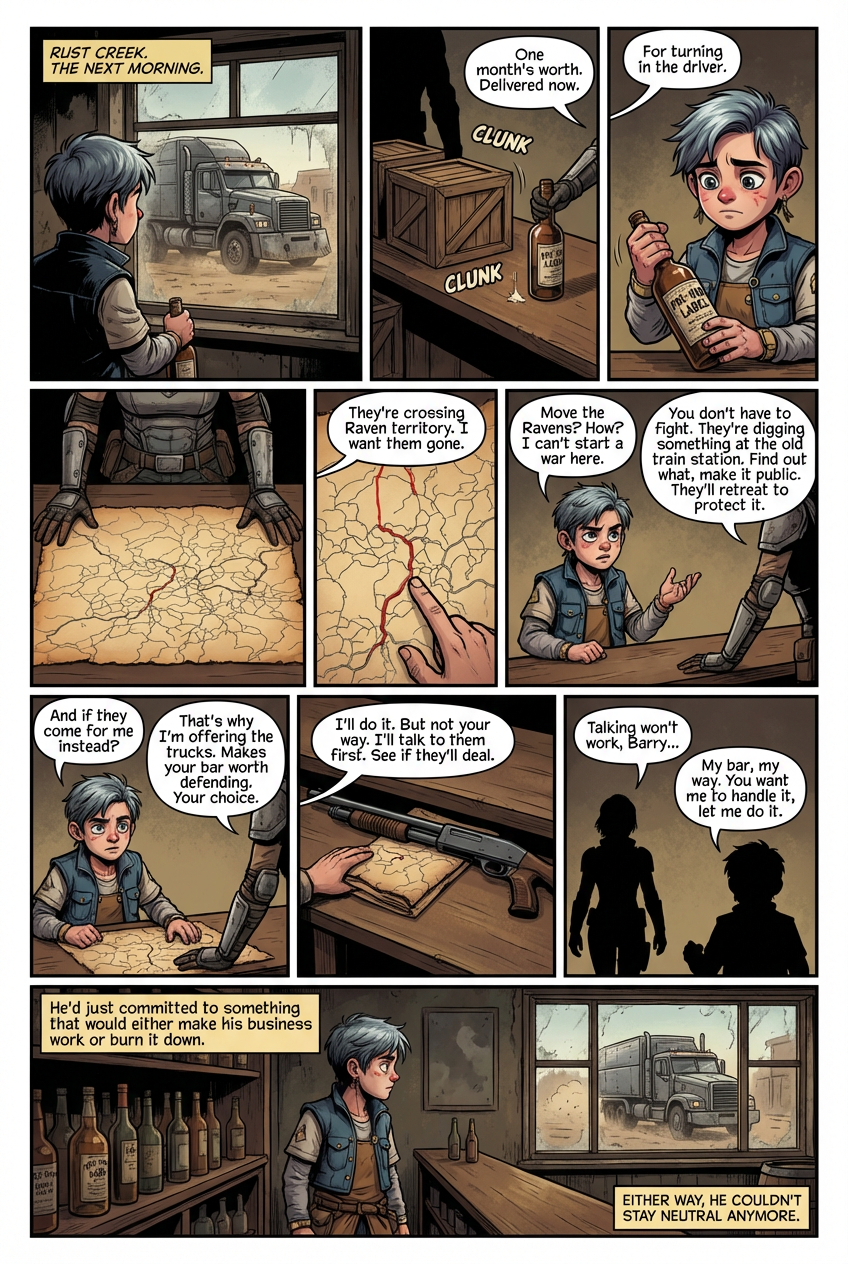
Barry watched Sherrie's armored truck pull into the lot the next morning. The steel panels caught sunlight as it rolled to a stop near the door. Sherrie climbed out and walked to the back, dropping the gate with a heavy clang. She pulled out two crates and carried them inside without saying anything. Barry looked at the bottles lined up in rows—pre-war labels he hadn't seen in years. Sherrie set them on the bar and said this was what turning in the driver had earned him. One month's worth, delivered now instead of later. Barry ran his hand over the glass and felt the weight of what she'd brought. Then Sherrie pulled out the map again and spread it flat on the counter. She tapped the northern route where it crossed through Raven territory and told him what she wanted in return. Barry asked how she expected him to move the Ravens without starting a war in his own lot. Sherrie leaned against the bar and said he didn't have to fight them. He just needed to give them a reason to leave on their own. She told him the Ravens were digging something at the old train station, something they didn't want anyone to see. If Barry could figure out what it was and make it public, the Ravens would pull back to protect it. Barry looked at the map and traced the route with his finger. He asked what happened if the Ravens came after him instead. Sherrie straightened up and said that was why she was offering the trucks—so his bar would be worth defending. She said the choice was his, but if he wanted traders stopping here instead of bypassing Rust Creek, he needed to clear the threat one block over. Barry folded the map and put it under the bar next to the shotgun. He told Sherrie he'd do it, but not her way. He said he'd talk to the Ravens first and see if they'd take a deal before he exposed anything. Sherrie shook her head and said talking wouldn't work, but Barry cut her off. He said if she wanted him to handle it, she had to let him do it his way. Sherrie stared at him for a long moment, then nodded once and walked out. Barry heard the truck engine turn over and watched it pull away through the window. He looked at the bottles on the bar and knew he'd just committed to something that would either make his business work or burn it down. Either way, he couldn't stay neutral anymore.
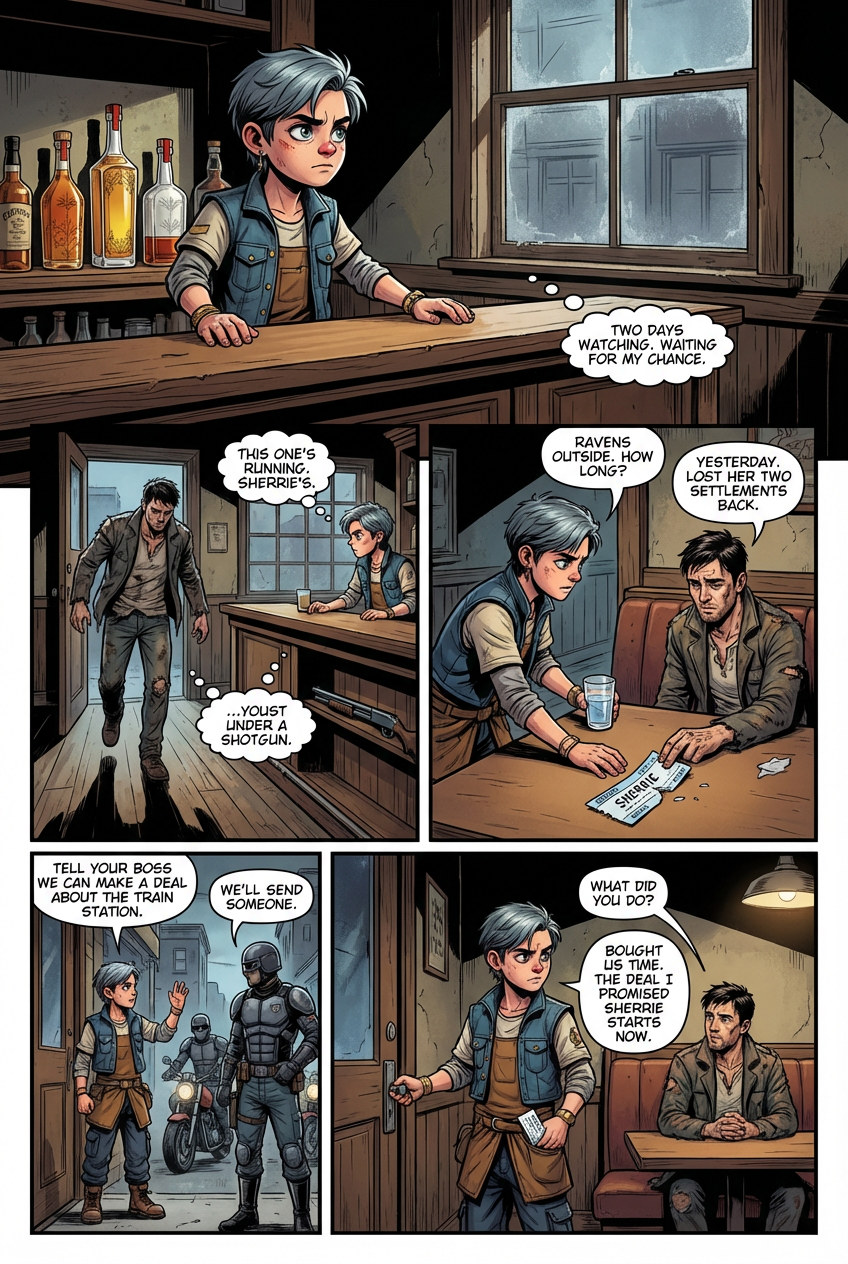
Barry spent the next two days watching the street and waiting for his chance to talk to the Ravens. The bottles Sherrie brought sat lined up behind the bar where customers could see them, and word spread fast enough that more travelers stopped in than usual. He served them without comment and kept his eyes on the door. The man came in just after noon on the third day, moving fast and keeping his head down. Barry recognized the way he walked—shoulders tight, eyes checking exits. The torn jacket and dirt-streaked pants told him the man had been running for a while. He slid into a booth near the back wall and kept his hands below the table. Barry wiped down the counter and waited to see if anyone would follow. Through the window, he spotted two motorcycles parked across the street, engines still ticking from the heat. The riders sat watching the door, their frames still and patient. Barry reached under the bar and felt the shotgun's stock, then looked back at the man in the booth. The fugitive was one of Sherrie's—had to be—and the Ravens had tracked him here. Barry walked over and set a glass of water on the table. He told the man the Ravens were outside and asked how long he'd been running. The fugitive looked up and said since yesterday, voice dry and cracked. He pulled out a torn bus ticket and slid it across the table—Sherrie's name written across the top in her own hand. Barry studied it and asked if she knew where he was. The man shook his head and said he'd lost contact two settlements back. Barry straightened and made his choice. He told the man to stay put and walked to the door, stepping outside where the Ravens could see him. One of them stood and started forward, hand resting on a knife at his belt. Barry held up his hand and said he wanted to talk about the train station—said he knew what they were digging and that they could make a deal. The Raven stopped and looked back at his partner, then told Barry they'd send someone who could negotiate. Barry nodded and went back inside, locking the door behind him. The fugitive stared at him from the booth and asked what he'd just done. Barry told him he'd bought them both some time, and now they'd see if it was enough. He walked back to the bar and looked at the ticket lying on the table. Sherrie would know soon that one of her people had surfaced here, and the Ravens would come back expecting answers about what Barry knew. He'd forced both sides to deal with him at once, which meant he'd either negotiate his way to something that worked or lose everything when they both decided he was more trouble than he was worth. Barry picked up the ticket and put it in his pocket. The deal he'd promised Sherrie started now, whether he was ready or not.
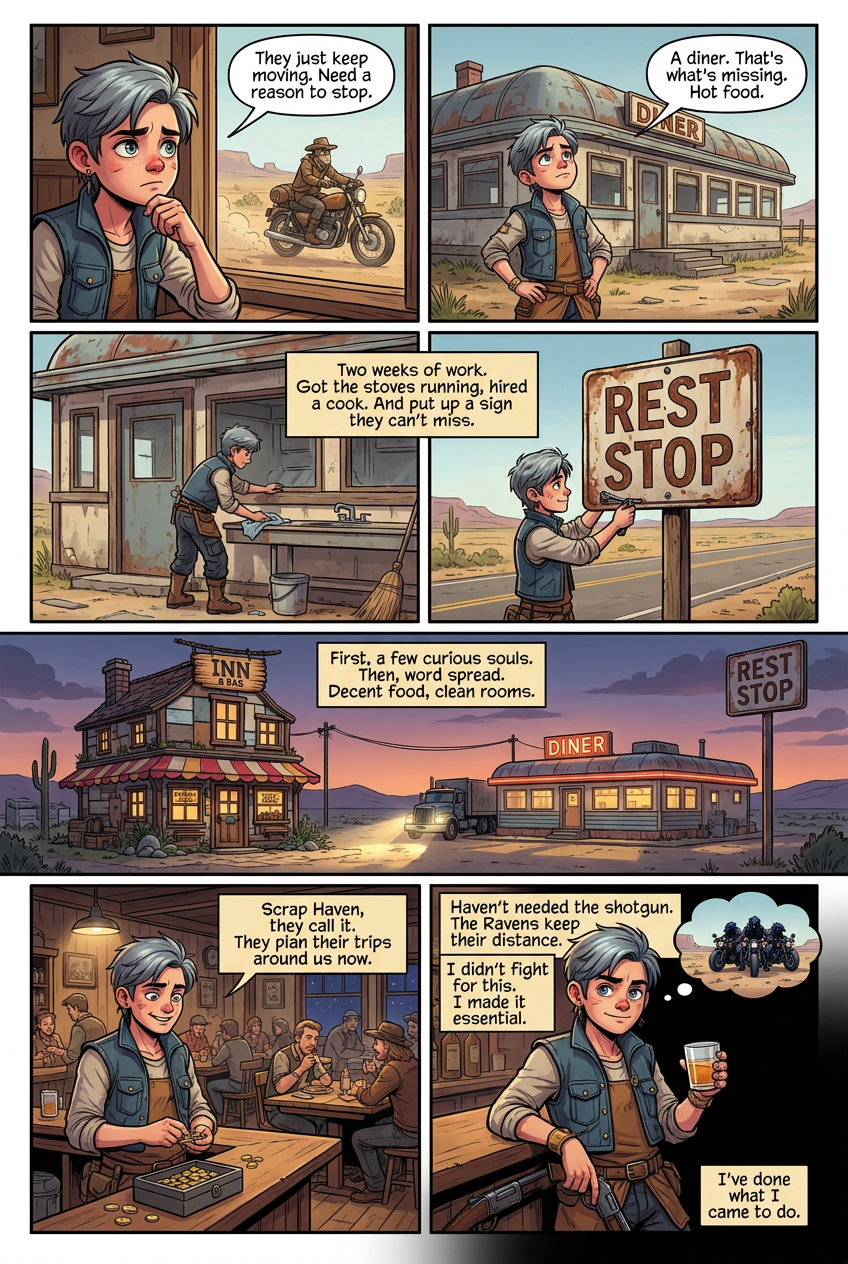
The northern route stayed open, but Barry watched the numbers and saw the problem. Travelers passed through Rust Creek without stopping—they'd gas up at the outskirts, grab whatever they needed from the scrap traders, and keep moving. His bar had rooms and liquor, but that wasn't enough to make them pull off the road when they could push another twenty miles before dark. He needed something that made stopping here worth the time, something traders couldn't get anywhere else on the route. Barry walked the block around his bar and found it two streets over—an old diner with a curved metal roof and faded paint, its windows intact and its kitchen still standing. He spent a week clearing it out and another getting the stoves working with scavenged parts. The bartender knew someone who could cook, and Barry paid them in room and board to serve hot meals from sunrise to dark. Barry hauled a rusted sign out of a collapsed garage and bolted it to a post at the edge of the main road where traders would see it a quarter mile out. The letters read REST STOP in chipped paint, and he angled it so anyone coming south from the tunnel would know there was a place to eat and sleep before the next settlement. The first week brought a handful of travelers who stopped because they were curious. The second week brought more because word spread that the food was decent and the rooms were clean. By the third week, Barry's stretch of Rust Creek had become a fixture on the route—traders planned their trips around it, and some started paying in advance to hold a room for their next pass through. Barry stood at the bar one night and counted the coins and scrap in the lockbox, then looked at the tables full of travelers eating and talking like they had time to spare. The diner's lights glowed across the street, and the rest stop sign caught headlights from the road every few minutes as someone new pulled in. He'd built what he set out to build—a place that worked because people needed it, not because he'd forced it on them. The inn and bar were open, the route ran through his door, and he'd done it by reading the gaps and filling them with what made sense. Barry locked the box and poured himself a drink from the pre-war stock. The trade route had a name for this stretch now—Scrap Haven—and it wasn't going anywhere. The shotgun stayed under the bar, but Barry hadn't touched it in weeks. The Ravens kept their distance, Sherrie's people moved through the safehouse upstairs without incident, and the travelers kept coming because they knew what they'd find here. Barry watched the bartender work the counter and the cook flip plates in the diner across the street, and he realized he'd stopped counting days since the last threat. He'd stripped survival down and built something that lasted—not by fighting for it, but by making it essential. The inn was his, the route was open, and Rust Creek had a rest stop that people trusted. Barry finished his drink and set the glass down. He'd done what he came to do.
Play your story to life
Storycraft is a mobile game where you create AI characters, craft items and locations to build their world, then discover what direction your story takes. Download the iOS game for free today!
Download for free