

Suzuki Pittmore's Arc
6 Chapters
Suzuki Pittmore's dream is mastering tech repair to become the region's essential equipment specialist.

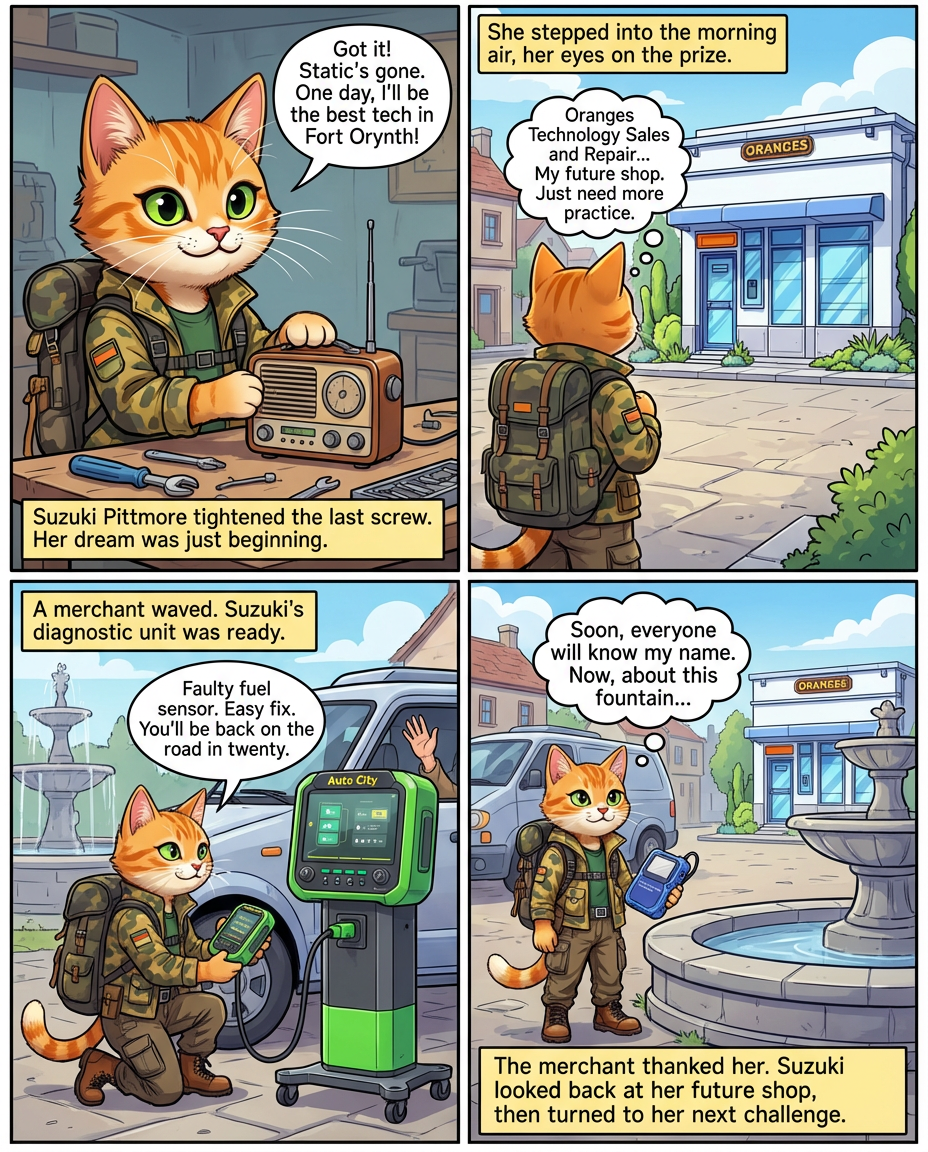
Suzuki Pittmore tightened the last screw on the radio and flipped the power switch. Static crackled, then a clear voice broke through. Her whiskers twitched with pride. One day, she'd be the best tech repair specialist in all of Fort Orynth and Ivanpath Village. She packed her tools and stepped outside into the morning air. The white building with blue trim stood across the square—Oranges Technology Sales and Repair. It would be her shop, her base, her workshop. The place where customers would bring broken equipment and leave with working gear. She just needed more practice first. A merchant waved from his stalled vehicle near the fountain. Suzuki jogged over, backpack bouncing against her shoulders. The green and black diagnostic unit from Auto City sat in her pack, ready for this exact problem. She plugged it into the vehicle's panel and watched the screen light up. Faulty fuel sensor. Easy fix. Twenty minutes later, the engine rumbled to life. The merchant thanked her and drove off. Suzuki looked back at the white building. Her building. Soon everyone in both towns would know her name when their machines broke down. She pulled out her circuit analyzer and walked toward the fountain's control box. The water had stopped flowing yesterday. Time to practice some more.
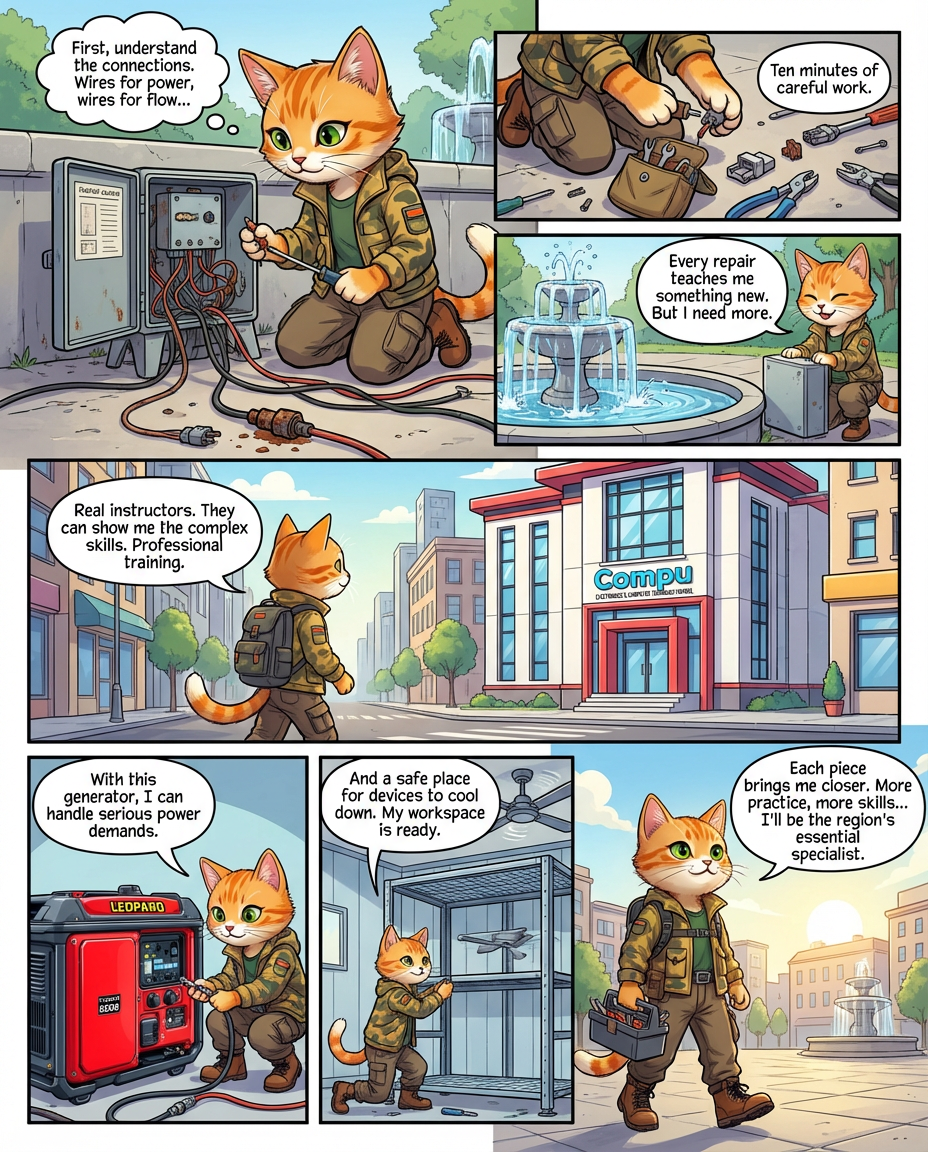
Suzuki studied the fountain's control box, running her paw along the metal casing. Water repair wasn't her strongest skill yet. She needed to start with the basics—understanding how each system connected. Her claws clicked against the panel as she removed the screws. Inside, wires tangled around a rusted pump motor. She traced each connection with her finger, noting which ones carried power and which controlled flow. The rust had eaten through a connector clip. She pulled out her toolkit and selected a replacement from her spare parts pouch. Ten minutes of careful work, and the fountain gurgled back to life. Water splashed into the basin. She smiled and closed the panel. Every repair taught her something new about how machines worked. But she couldn't learn everything from field repairs alone. The modern building with red, white, and black trim stood three blocks away. Light blue letters spelled out Compu Electronics & Computer Technology School across the front. Real instructors taught there. They could show her the complex skills she needed for harder jobs. She walked toward it, her boots clicking on the pavement. Professional training would make her faster, better, more reliable. Back at her workspace, she installed the red and black generator outside. The Leopard 8500 Watt model could handle serious power demands. When electrical outages hit, her tools would keep running. She connected the fuel line and tested the switch. The engine roared to life, then settled into a steady hum. Next, she assembled the storage rack with the shade roof and cooling fans. Devices that overheated during repairs needed a safe place to cool down. The fans whirred softly as she tested them. She stepped back and looked at her setup. Generator for power. Rack for cooling. Training starting next week. Each piece brought her closer to becoming the region's essential equipment specialist. People would trust her with their most important machines. She picked up her toolkit and headed toward the square. More practice meant more skills, and more skills meant more customers.
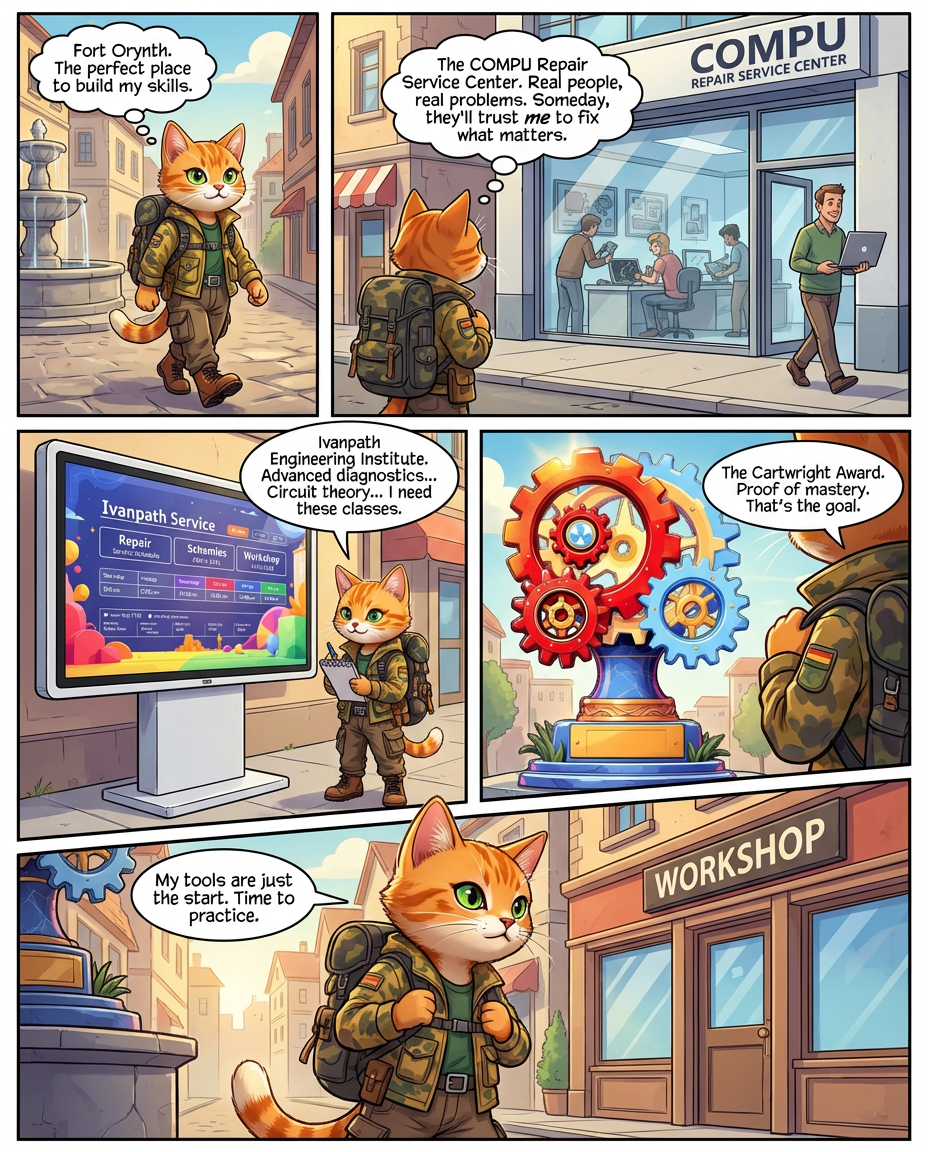
Suzuki walked past the fountain toward the edge of town. Fort Orynth had everything she needed to build her skills. The tech school would teach her advanced circuits. Her workshop would give her space to practice. And all around her, machines waited to break down. The COMPU Repair Service Center sat on the corner with its white walls and blue and red letters. Through the windows, she spotted customers waiting with broken tablets and damaged phones. A sign on the door listed repair hours and walk-in times. This was where ordinary people brought their everyday problems. She watched a customer leave with a working laptop, relief clear on his face. One day, her own shop would serve people just like this. They'd trust her to fix what mattered to them. Suzuki turned down the next street and stopped at the digital sign mounted outside the Ivanpath Engineering Institute. Workshop schedules scrolled across the screen in bright letters. Advanced diagnostics on Tuesdays. Circuit theory on Thursdays. The classes would fill in the gaps her field work couldn't teach. She pulled out her notepad and copied down the times. In the town square, sunlight caught the metal gears of the Cartwright Award. The trophy stood on its blue marble base, honoring the region's top engineering mind. Red and gold metal gleamed against the light blue accents. Suzuki's chest tightened as she stared at it. That award meant something real—proof that someone had mastered their craft so completely that everyone recognized their name. She touched the strap of her backpack. The tools inside were just the start. This world had training, customers, and recognition waiting for those skilled enough to earn it. She turned back toward her workshop, ready to practice.
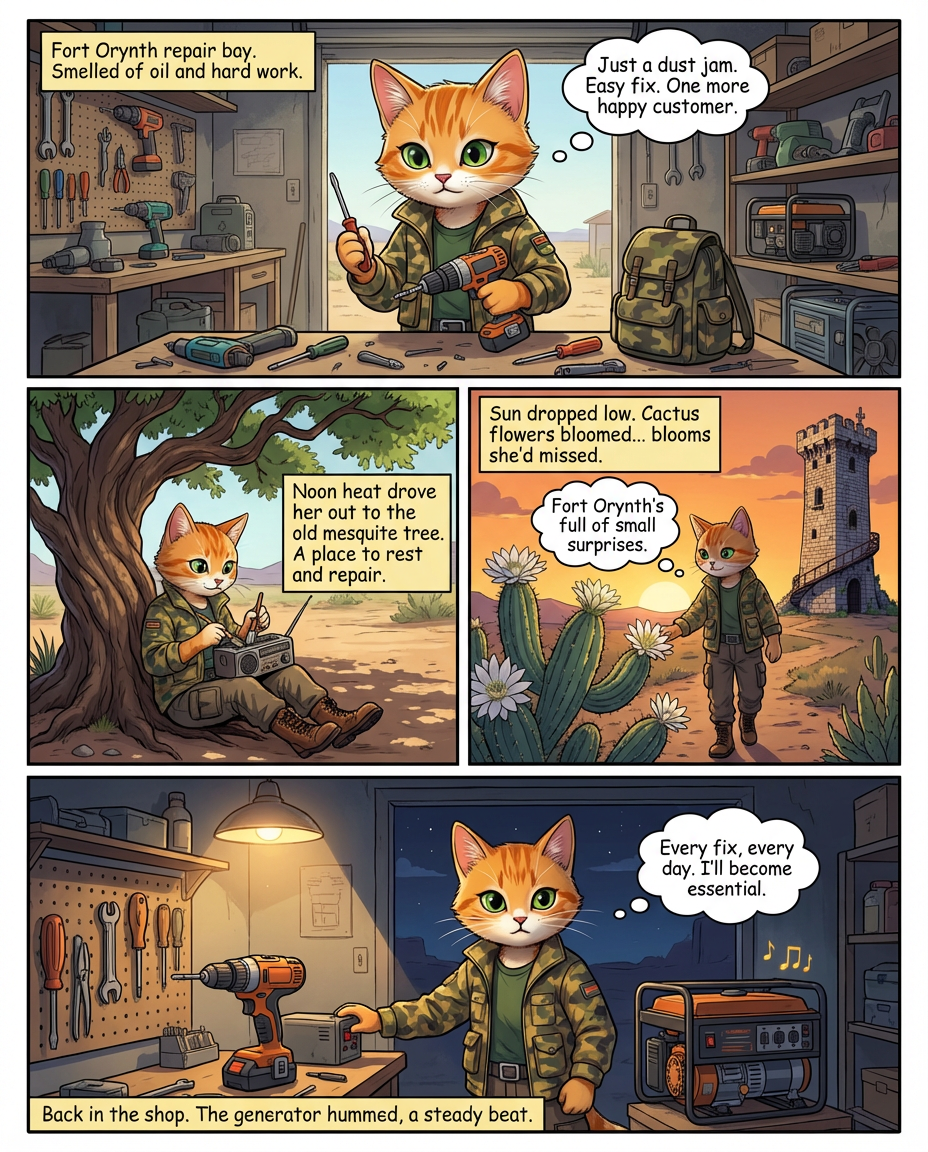
Suzuki stepped into the repair bay at the edge of town, her toolkit clinking against her hip. The space smelled like motor oil and hot metal. Rows of broken equipment lined the walls—power tools with burned-out motors, generators with cracked casings, control panels with fried circuits. Each machine represented a problem someone couldn't solve on their own. She picked up a damaged drill and turned it over in her paws. The trigger mechanism had jammed from dust buildup. She worked the screwdriver into the casing and popped it open. Five minutes later, the trigger clicked smoothly. She set it on the finished rack and grabbed the next item. This was how she'd build her reputation—one working machine at a time. By noon, the heat forced her outside. She grabbed a broken radio and walked to the gnarled mesquite tree behind the bay. Its twisted branches cast thick shade across the packed dirt. She sat against the trunk and opened the radio's back panel. The thorny limbs above her creaked in the hot breeze. This tree had probably stood here longer than the town itself. People must have worked under it for years, fixing things, talking, resting between jobs. She pulled a corroded battery terminal free and cleaned it with a wire brush. After the radio worked again, she walked through Fort Orynth's streets as the sun dropped low. A pale desert cactus grew near a shop wall, its sandy stem catching the orange light. White flowers had opened along its ridges—blooms she'd never noticed during the day. She stopped and touched one of the petals. The desert hid small surprises if you paid attention. She kept walking until the old watchtower came into view. Gray stone rose against the darkening sky, its weathered brick exterior marked by decades of wind and sun. A narrow spiral staircase wound up inside. Before modern equipment arrived, this tower had connected the town to the outside world through radio signals. Now it just stood there, a reminder of earlier technology. Suzuki headed back to her workshop as the last light faded. The tower, the cactus, the mesquite tree—they all belonged to Fort Orynth's story. Her shop would become part of that story too. Every repaired machine added to her skills. Every satisfied customer spread her name. She flipped on the generator and listened to its steady hum. The path to becoming essential was clear: keep learning, keep fixing, keep building trust. She pulled the next broken tool from the shelf and got back to work.
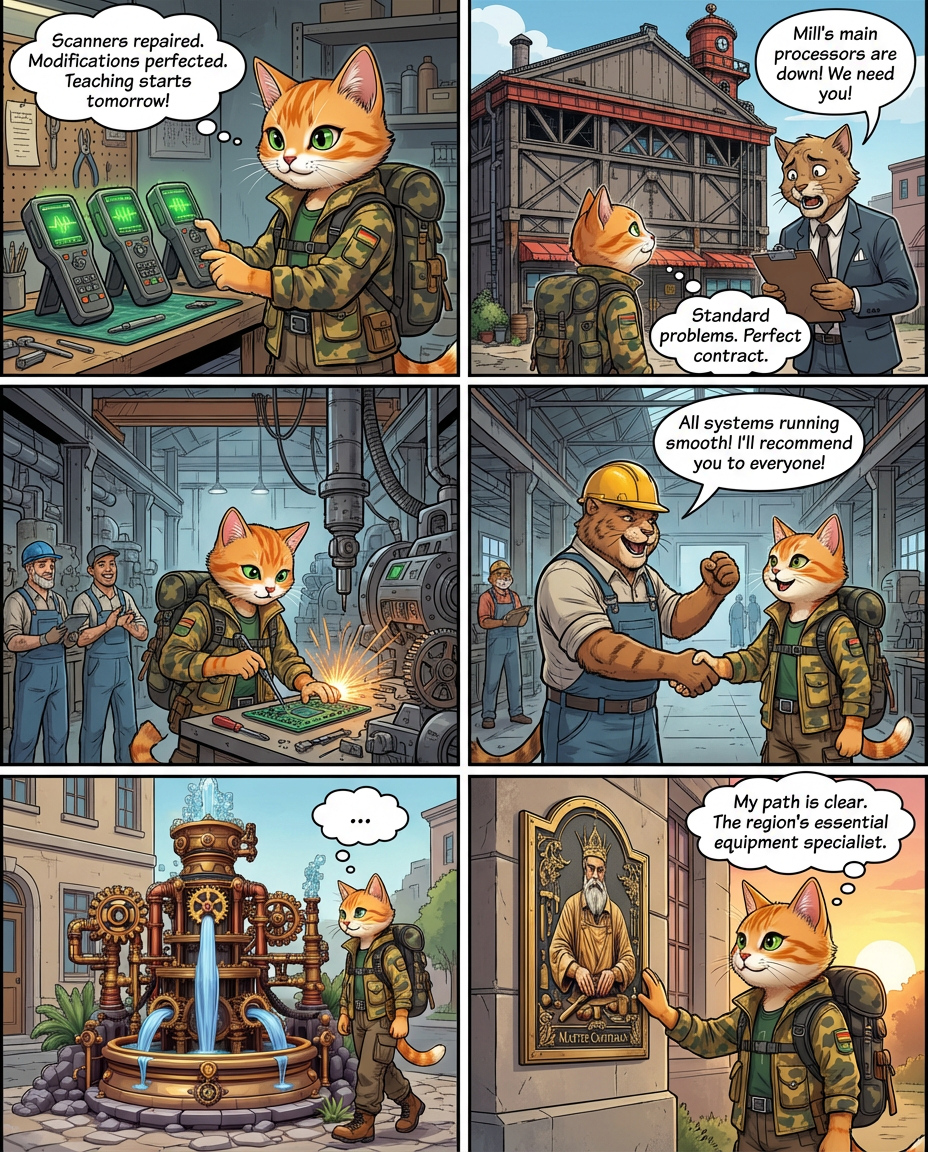
Suzuki set three repaired scanners on her workbench and checked each display. All three power meters held steady in the green. The modifications she'd made to their energy detection circuits worked exactly as planned. She'd spent two weeks testing the design, and now traders could spot unusual readings from twice the normal distance. Her first student would arrive tomorrow to learn the technique. Teaching someone else would prove she'd mastered it herself. The morning brought something better than a single student. A representative from the Ivanpath Textile Mill showed up at her workshop door with a equipment list and a desperate look. The mill's main fabric processors had stopped working overnight. Their backup units were failing one by one. Without repairs, production would halt completely within days. Suzuki scanned the list—bearing assemblies, control boards, motor housings. Standard industrial problems, but enough of them to keep her busy for weeks. She quoted her rate and timeline. The representative agreed immediately. This was exactly the kind of contract that would make her name essential. She worked through the week at the mill, surrounded by steel beams and rust-colored awnings. The building mixed industrial metal with older wood and brick sections where the mechanic's workshop sat. Each day she pulled apart another machine, identified the problem, and put it back together stronger. Workers stopped to watch her modify a control board to handle voltage spikes better than the original design. By Friday, all primary systems ran smoothly again. The mill supervisor shook her paw and promised to recommend her to every factory owner he knew. On her way back through town, she passed the mechanical fountain outside the tech school. Brass gears turned while copper pipes channeled water through interlocking wheels. The design showed what happened when engineering served both function and form. Further down, a brass plaque caught her eye near a municipal building. The relief showed a craftsman's hands holding precision tools, captured in metal with perfect detail. That level of recognition wasn't hers yet, but the mill contract had moved her closer. She adjusted her backpack and headed home. Her scanner modifications worked. Her industrial repairs satisfied paying customers. Each success built the foundation for the next one. The path to becoming the region's essential equipment specialist wasn't just clear anymore—she was walking it.
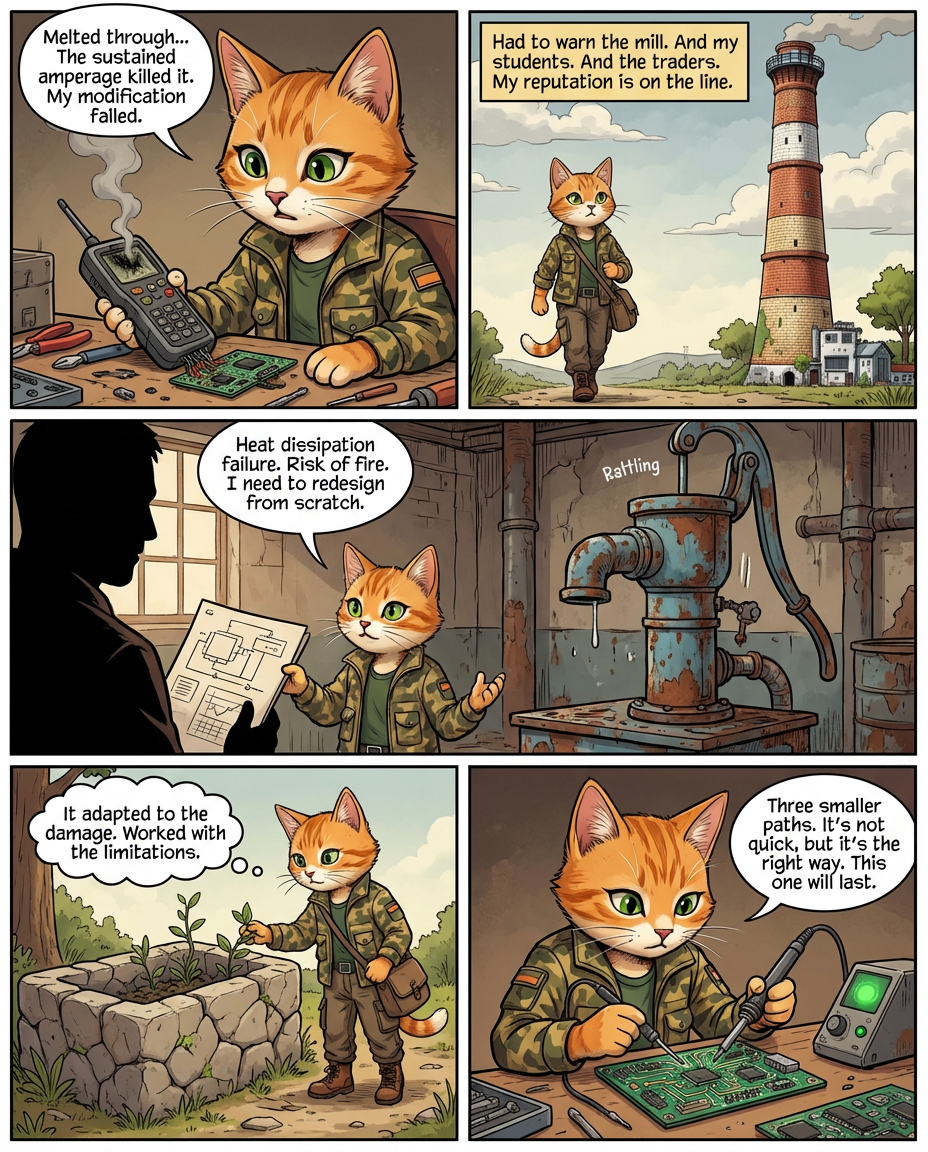
Suzuki stared at the smoking scanner on her bench. The modified circuit board had melted straight through the casing. Her student had been due an hour ago to learn this exact modification—the one that was supposed to detect energy signatures at twice the normal range. She grabbed her tools and pried open the housing. The connections she'd designed had overheated under sustained use. The fix that worked perfectly in short tests had failed when pushed to real-world conditions. She set down her screwdriver and looked at the two other modified scanners on the shelf. Were they time bombs too? Her reputation as a teacher had depended on this technique being solid. Now she'd have to tell her student the modification wasn't ready. Worse, she'd have to contact the three traders who'd already paid for the upgrade and admit the design had a fatal flaw. She packed the failed scanners into her bag and headed toward the Ivanpath Textile Mill. The mill supervisor needed to know before anyone got hurt. The textile patterned steel smokestack stood at the entrance, its sun-bleached brick bands faded by years of weather. The carved patterns honored machinery that had worked for decades without failing. Her modification couldn't even last a week under real conditions. Inside, she found the supervisor near a rustic prewar water pump that supplied the mill's cooling system. He was adjusting the rusted valves while sand-caked pipes rattled. She explained the scanner problem in exact technical terms—sustained amperage, heat dissipation failure, risk of fire. He listened without interrupting, then asked if she could fix it. She said yes, but it would take time to redesign from scratch. The walk back felt longer than usual. She passed a weathered stone trough outside an abandoned building. Deep cracks ran through the basin, and edges had worn smooth over years of use. Small plants grew from the splits anyway, their roots finding water in places that shouldn't hold any. The stone container was broken but still served a purpose. Her modification was just broken. She stopped and touched one of the plants. It had adapted to damage. Maybe her design needed the same approach—work with the limitations instead of trying to force more power through failing connections. Back at her workshop, she cleared the bench and started over. The original modification had pushed components past their safe operating temperature. The new design would use three smaller circuit paths instead of one large connection. Heat would spread across multiple points instead of concentrating in one spot. It meant more complex work and longer installation time, but it would hold up under sustained use. She soldered the first connection and tested it with a heat sensor. The temperature stayed well below the danger point. This wasn't the quick solution she'd promised, but it was the right one. Being essential meant building things that lasted, even when it took longer than expected. She reached for the next component and kept working.
Play your story to life
Storycraft is a mobile game where you create AI characters, craft items and locations to build their world, then discover what direction your story takes. Download the iOS game for free today!
Download for free