

Betsy Beekeeper's Arc
10 Chapters
Betsy Beekeeper's dream is making the best honey in the world.

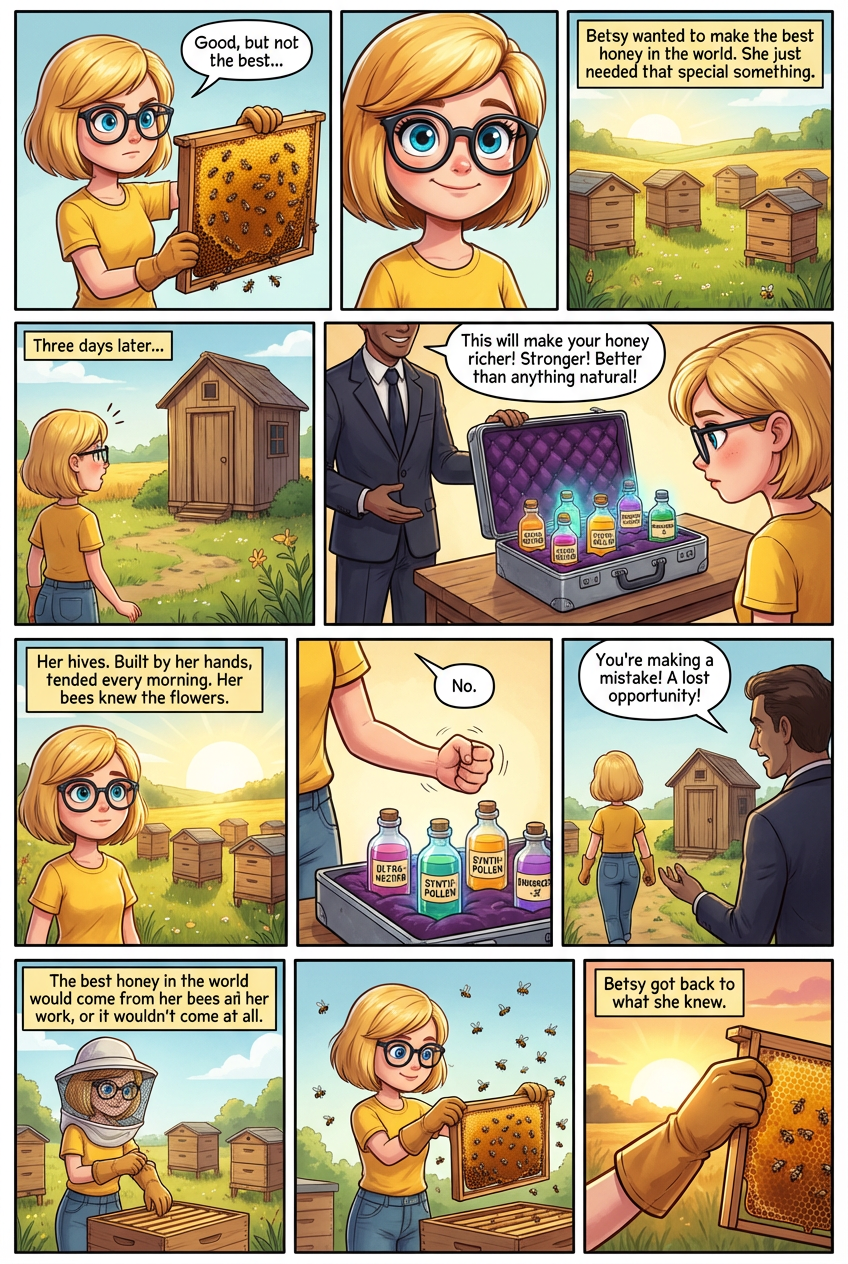
Betsy checked the last frame and knew she was close. The bees moved in steady patterns across the comb, and the honey they made was good — darker than most, with notes of clover and wildflower. But good wasn't enough. She wanted to make the best honey in the world, and that meant finding something more. The wooden shed appeared on the edge of the field three days later. Betsy noticed it on her way to the hives, standing where nothing had been before. A man waited outside with a metal case open on a folding table. Bright bottles lined the velvet interior, each one labeled with technical terms she didn't recognize. He smiled when she stopped walking. The substance would make her honey richer, he said. Stronger. Better than anything she could produce on her own. Betsy looked at the bottles, then at her own hives in the distance. The carved boxes sat honest in the sun, built by her hands, tended every morning. The bees inside knew the flowers within five miles. They worked the way bees had always worked. She turned back to the stranger and his chemical promise. Her hands wanted to shake, but she kept them still. She walked past the shed without a word and headed to her hives. The man called after her about lost opportunity, about being left behind. Betsy pulled on her gloves and lowered her veil. The best honey in the world would come from her bees and her work, or it wouldn't come at all. She lifted the first frame and got back to what she knew.
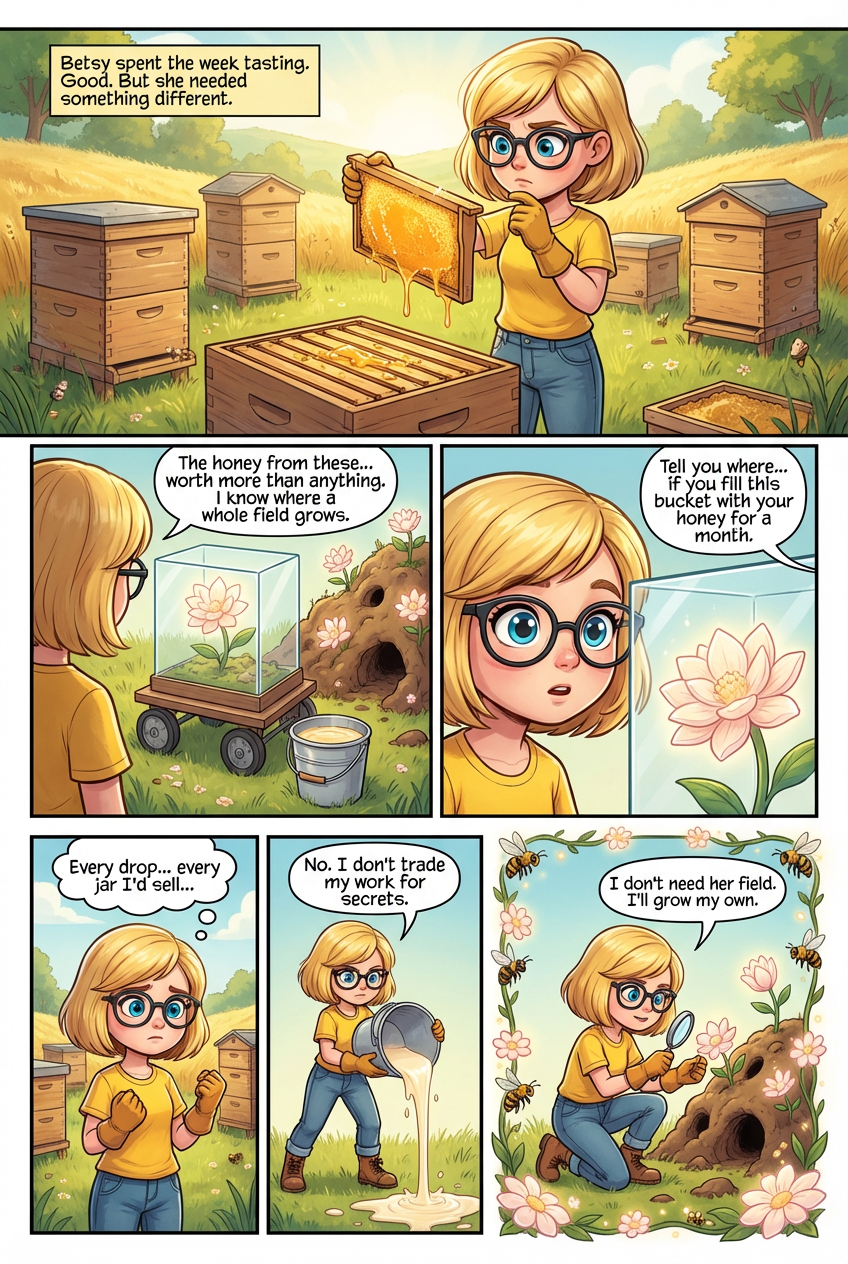
Betsy spent the next week at her hives, working through every frame, tasting the honey with a critical tongue. It was good. Always good. But she could feel the ceiling pressing down on what her bees could achieve with the flowers they knew. She needed something different. The woman arrived on a Tuesday morning with a glass case balanced on a wooden cart. Inside the case sat a single flower — pale pink with layered petals that seemed to glow from within. Behind the cart stood something stranger: a massive mound of earth shaped like a dome, its surface dotted with tunnel openings and covered in the same pink flowers. The woman set the case down near Betsy's hives and waited. A bucket sat beside her, filled with honey so pale it looked almost white. The smell carried across the field — sweet but sharp, like nothing Betsy had encountered before. Betsy walked closer and looked at the flower behind the glass. The woman explained she knew where these grew wild, an entire field of them, and the honey they produced was worth more than anything else in the world. But she wouldn't say where the field was. Not unless Betsy agreed to fill that bucket with her own honey first — every drop from her hives for the next month. Payment for the location. Betsy looked at the pale honey, then at the flower, then back at her own wooden boxes. A month of production meant every jar she'd planned to sell, every bit of income she relied on. Her hands wanted to reach for her gloves, to go back to what she knew. But she kept them still. Betsy picked up the bucket and turned it over. The honey spilled across the grass in a slow, wasting stream. The woman's face went hard. Betsy told her she didn't trade her work for secrets, and she didn't make the best honey in the world by emptying her hives for someone else. The woman packed her case without a word and left, pulling the cart behind her. The earthen mound stayed where it was, flowers trembling in the breeze. Betsy walked to it and knelt down, studying the blooms up close. She didn't need the woman's field. She needed one flower, one seed, one cutting she could grow herself. The answer was right here if she was willing to work for it.
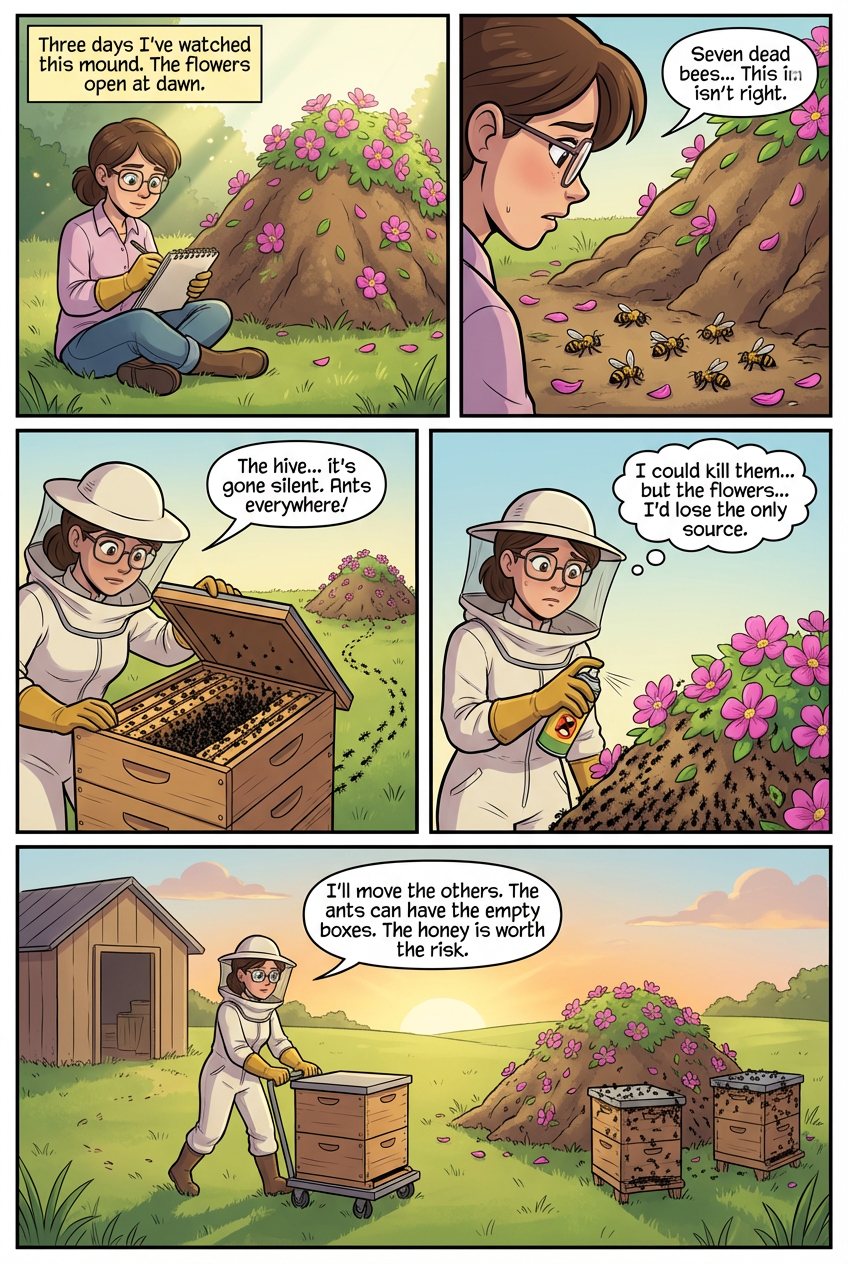
Betsy spent three days studying the earthen mound the woman had left behind. She sketched the pink flowers, collected fallen petals, and watched how the blooms opened at dawn. On the fourth morning, she found seven dead bees at the base of the mound. By the end of the week, two of her hives had gone silent. She lifted the first box with steady hands and pulled a frame. Ants covered every surface — black bodies thick as carpet, flowing over the honeycomb in streams. The bees were gone. She checked the second hive and found the same. The ants were coming from the mound, following trails across the grass to her wooden boxes. She could see the cracks in the earthen surface now, wider than before, with dark tunnels branching underneath. Something about the pink flowers was drawing them out, and the ants were taking her hives one by one. Betsy went to her shed and came back with the spray can. She stood at the mound with her finger on the trigger, watching ants pour from the tunnels. If she killed them here, she might save the rest of her hives. But the pink flowers grew from this earth, roots tangled in whatever network the ants had built. Poison the mound and she'd lose the only source of the flower she needed. Her hands didn't shake. She lowered the can and walked back to the shed, leaving the mound untouched. She spent the rest of the day moving her remaining hives to the far end of the field, as far from the mound as her property allowed. The ants could have the two silent boxes. She'd lost hives before and kept working. But now she knew the price of the pink flowers — and she knew she'd pay it. The best honey in the world didn't come from playing it safe. It came from keeping your bees alive long enough to find out if the risk was worth it.
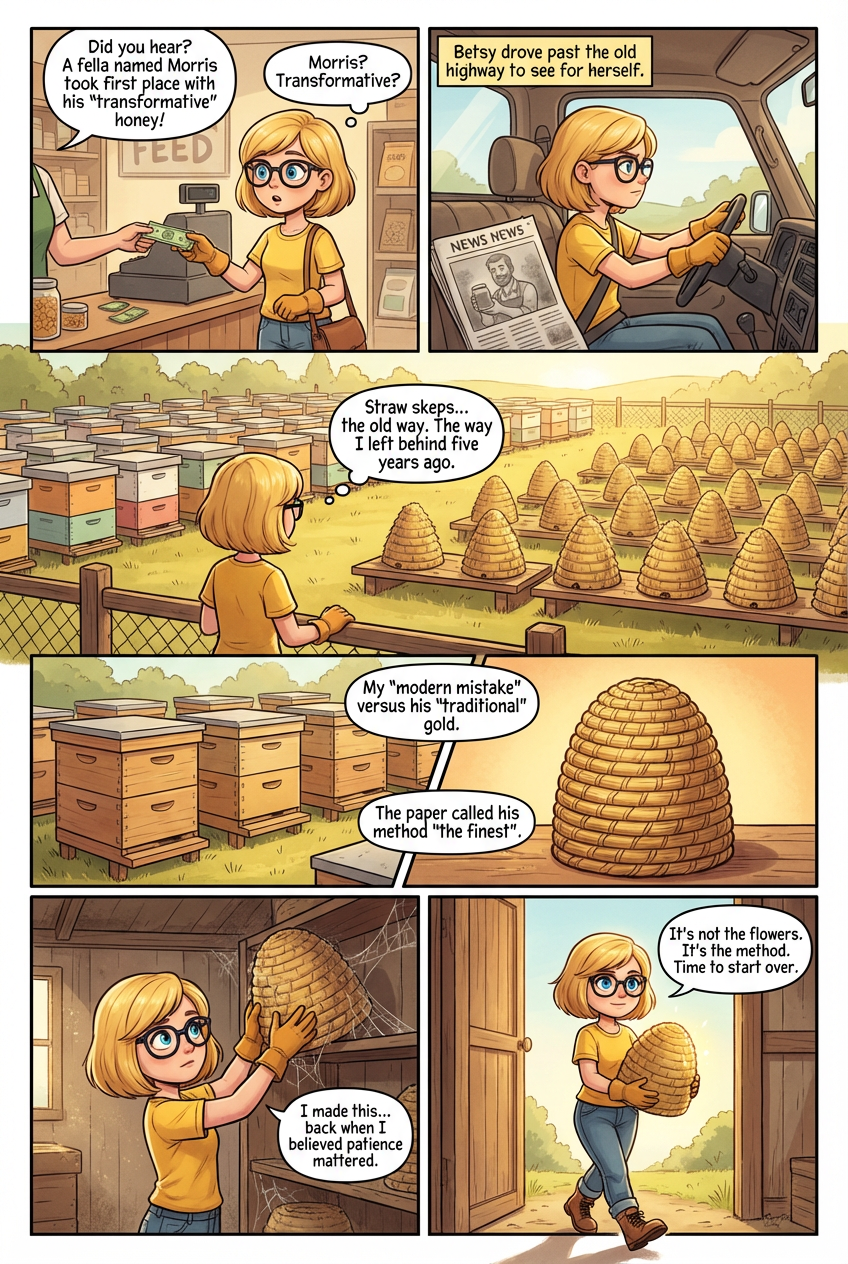
Betsy heard the news at the feed store. The cashier mentioned it while counting her change — someone named Morris had taken first place at the regional fair with honey so good the judges called it transformative. The secret, people said, was wild pink flowers he'd found somewhere out past the old highway. Betsy drove out to see Morris's operation herself. She found it spread across three acres, rows of hives lined up in perfect order. Painted boxes, new equipment, a covered work area twice the size of her shed. But it was the straw skeps that stopped her. Dozens of them, woven tight and set on platforms in the sun. Morris was keeping bees the old way — the way she'd abandoned five years ago when she switched to wooden boxes for easier inspection and disease control. The way that produced less honey per hive but somehow tasted better. She stood at the fence line long enough to see Morris walk out with a frame dripping gold. He didn't notice her. The newspaper clipping was still in her truck from when someone had left it on her windshield last week. She'd read the article three times, studying the photo of Morris holding up a jar while the judges smiled. The paper called his method traditional beekeeping at its finest. It called her approach, without naming her, the modern mistake that prioritized quantity over quality. Betsy drove home and pulled the old skep from the back of her shed. Dust covered the woven straw, but the shape was still perfect. She'd made it herself years ago, back when she believed patience mattered more than efficiency. She set it on her workbench and ran her hand over the weave. The best honey in the world wasn't waiting at the pink flowers. It was waiting in the method she'd thrown away to save time. She could build new skeps, move her bees back to the old way, and start over. Or she could keep chasing the flowers and hope Morris was wrong. Her hands were steady. She picked up the skep and carried it outside.
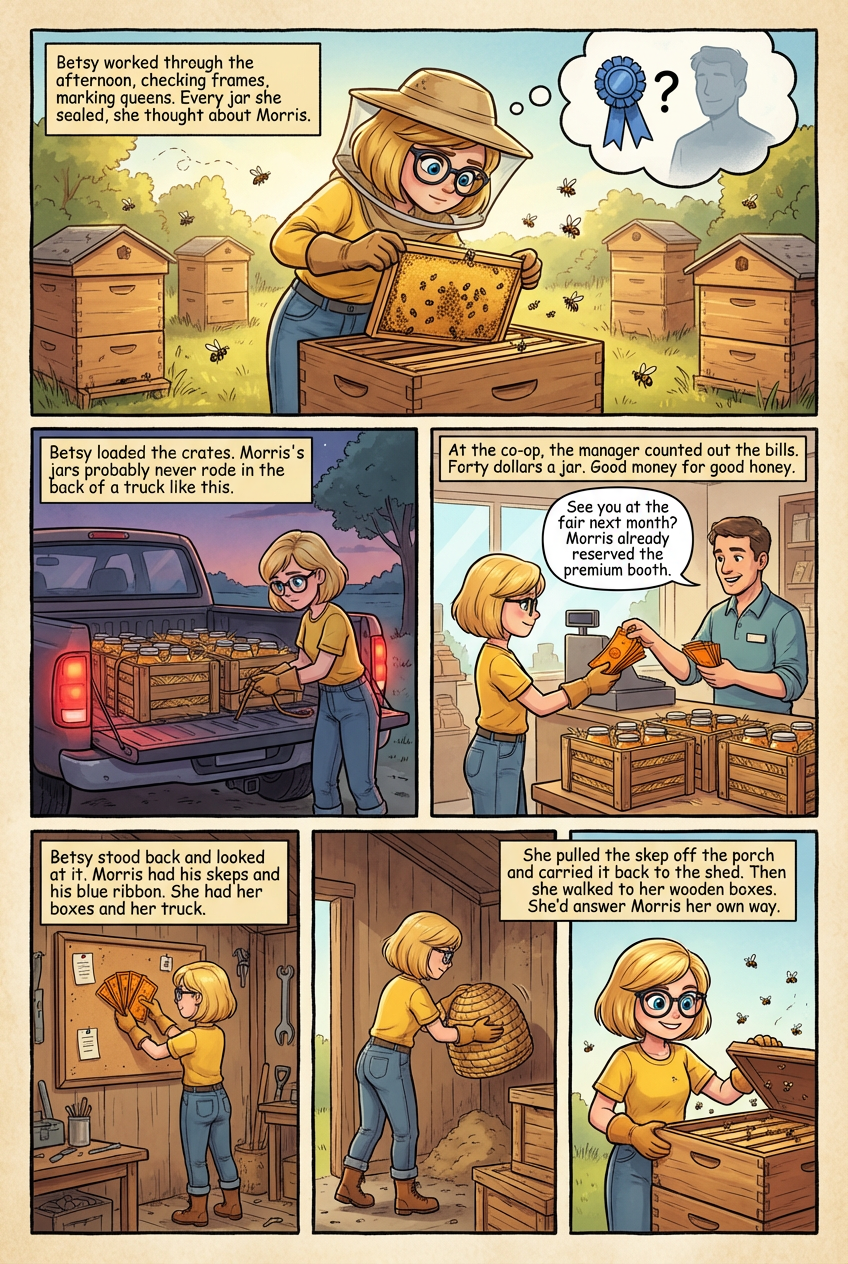
Betsy left the skep on the porch and went back to her wooden boxes. She worked through the afternoon checking frames, marking queens, filling jars with honey that tasted good enough but not great. Every jar she sealed, she thought about Morris. She loaded three crates into the truck bed that evening — eighteen jars packed tight in straw. The buyer at the co-op had asked for a delivery by Friday. Betsy stacked the crates and tied them down, then stood looking at them in the fading light. Morris's jars probably never rode in the back of a truck like this. His probably went straight to specialty shops with hand-written cards explaining the traditional method. Hers went where honey always went — bulk orders, fair prices, nothing special. Betsy drove to the co-op and carried the crates inside. The manager counted the jars and counted out bills until the stack sat between them on the counter. Forty dollars a jar. Seven hundred and twenty dollars total. Good money for good honey. The manager asked if she'd be at the fair next month. Betsy said she would. He mentioned Morris had already reserved the premium booth. Then he pushed the bills across the counter and thanked her for the delivery. Betsy took the money home and pinned it to the board above her workbench with a single thumbtack. She stood back and looked at it — orange bills fanned out like something won instead of earned. Morris had his skeps and his blue ribbon. She had her boxes and her truck and her steady orders. The pink flowers were still growing at the far end of the field. Her relocated hives were still producing. She pulled the skep off the porch and carried it back to the shed, setting it in the same corner where dust had covered it for five years. Then she walked to her wooden boxes and opened the nearest one. The bees hummed inside. She'd answer Morris her own way.
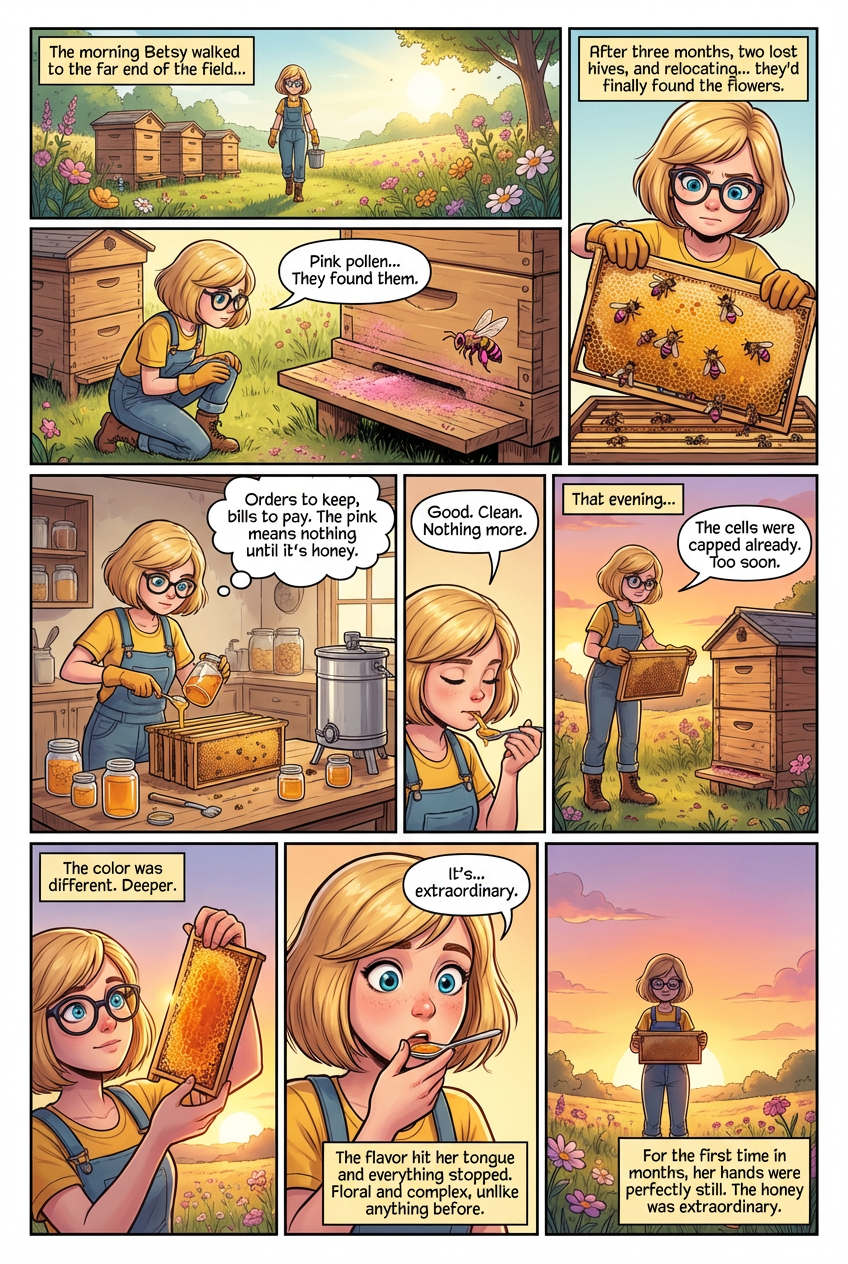
The morning Betsy walked to the far end of the field and found pink pollen dusting the landing boards, something in her chest went tight. She knelt in front of the nearest hive and watched a bee return heavy with it, the color unmistakable against the weathered wood. She opened the box and pulled a frame. The bees clustered thick across the comb, their legs coated bright pink. They'd found the flowers. After three months of waiting, after losing two hives to ants, after relocating everything to this corner of the field — they'd finally found them. Betsy replaced the frame and checked the next hive. More pink. The next one too. Every hive showed the same dusting of color, the same heavy traffic of workers bringing it home. But the honey wouldn't be ready for weeks yet. Betsy closed the last box and walked back to her workbench. She had jars to fill from the older frames, orders to keep, bills to pay. The pink pollen meant nothing until it became honey, and honey meant nothing until someone tasted it. She spent the afternoon extracting frames from the boxes she'd been working before the relocation, filling jar after jar with honey that looked the same as it always had. When she finished, she set one aside and opened it. The taste was good. Clean. Nothing more. That evening she walked back to the relocated hives and pulled a frame heavy with fresh comb. The cells were capped already, sealed tight by the workers. Too soon — the bees shouldn't have capped honey this fast. Betsy cut a piece free and held it up to the fading light. The color was different. Deeper. She broke the wax seal and tasted it. The flavor hit her tongue and everything stopped. It wasn't just good. It was something else entirely — floral and complex and unlike anything she'd produced before. She stood there holding the frame as the sun dropped behind the trees, and for the first time in months her hands were perfectly still. The pink flowers had done exactly what she'd paid for with two dead hives and three months of waiting. The honey was extraordinary.
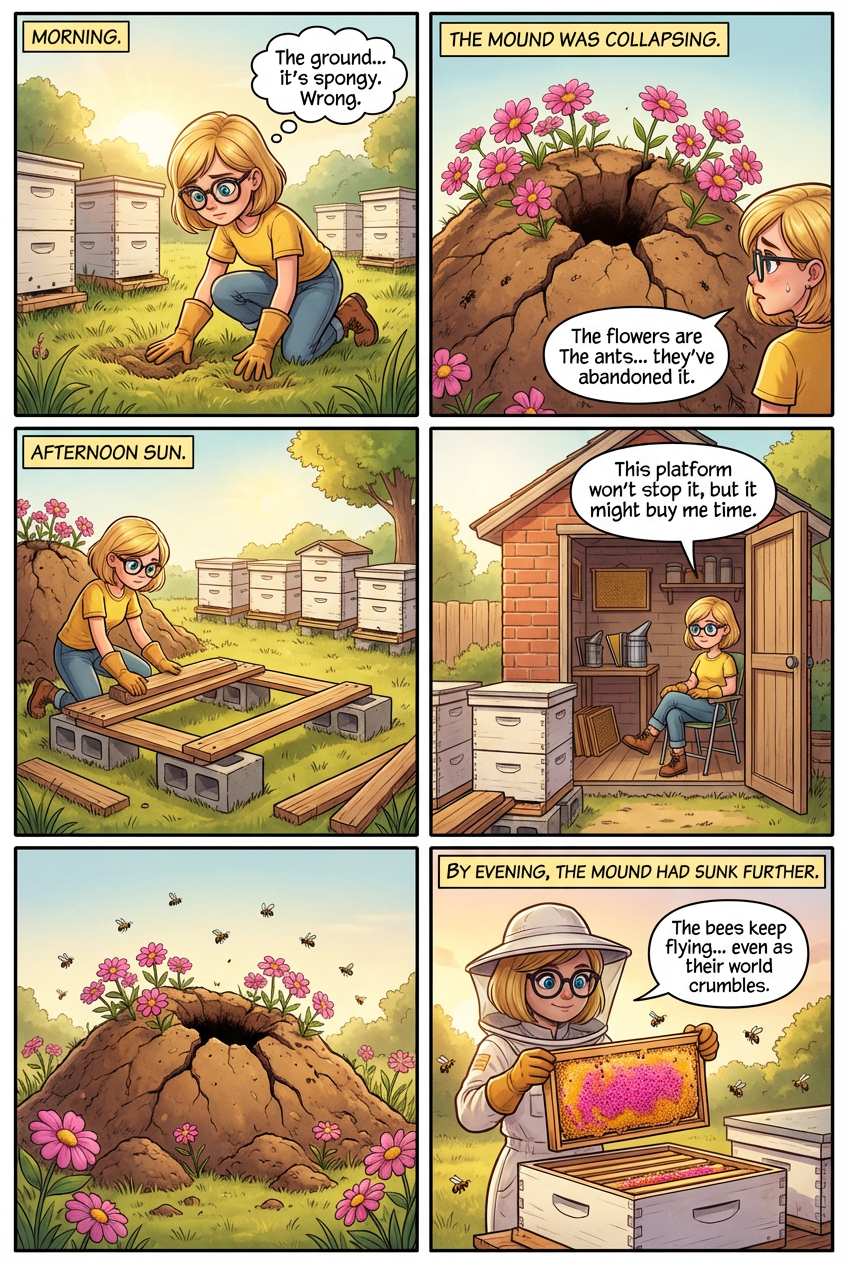
The next morning Betsy returned to the hives with empty jars and found the ground soft beneath her boots. The grass around the relocated boxes sagged lower than it had the day before. She knelt and pressed her palm to the earth. It gave under her hand, spongy and wrong. She walked back across the field to where the mound sat crowned with pink flowers. The structure had changed overnight. What had been a solid dome now showed cracks running down its sides, the opening at its center wider and deeper than before. The pink flowers tilted inward, their stems leaning toward the dark hollow. Betsy circled the mound and saw the pattern — earth pulling down and in, tunnels collapsing, the whole structure beginning to fold into itself. The ants had abandoned it or died trying to hold it together. Either way, the flowers were sinking with it. She spent the afternoon building a platform from scrap lumber and concrete blocks, positioning it between the mound and the hives. The brick shed that stored her smokers and spare frames became her watching post. She dragged a chair inside and propped the door open so she could see both the mound and the wooden boxes pressed together at the field's edge. If the ground gave way beneath the hives, she'd have minutes at most to move them. She counted the boxes — eight hives producing extraordinary honey from flowers that were vanishing into the earth. There was nothing to stabilize the mound with, no way to stop dirt from being dirt. She could only watch it fail and be ready. By evening the mound had sunk another two inches. The pink flowers bent at sharper angles, some already touching the ground. Betsy pulled a frame from the nearest hive and found the cells still heavy with pink pollen, the bees still working. The honey inside would be extraordinary for as long as the flowers lasted. She sealed the hive and walked back to the shed. The platform wouldn't save the mound, but it might buy her enough time to move the boxes before the ground took them. She sat in the chair and watched the flowers tilt further toward the dark. The bees kept flying.
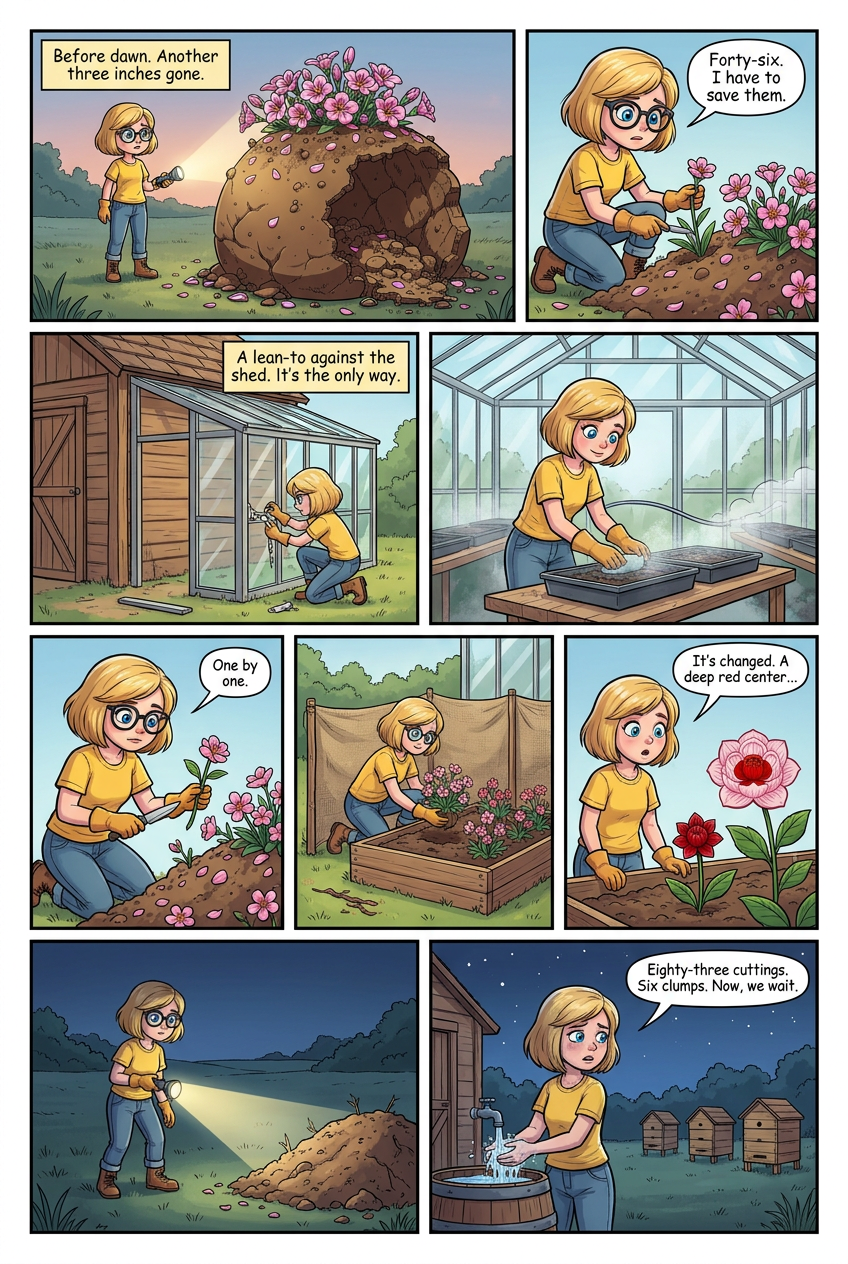
Betsy woke before dawn and walked the field with a flashlight. The mound had dropped another three inches in the night. Only one edge still held its shape — a soft hump of earth crowned with pink blooms, the slope beneath it crumbling in slow flakes. Petals lay scattered on the dirt like spilled paint. She knelt and counted the flowers still standing. Forty-six. Two days ago there had been over a hundred. The bees would lose them within the week, and she would lose the only honey that had ever tasted like the one she wanted to make. Watching the mound fail was no longer enough. She had to take the flowers off it before it swallowed them. She drove to town and came back with bags of rooting compound, plastic trays, a roll of misting line, and four panels of secondhand glass. She set the glass up against the south wall of the shed and framed it into a small lean-to greenhouse, sealing the seams with caulk. Inside she laid the trays on a board across two sawhorses and ran the misting line from a barrel. By noon the little house smelled of wet peat. She pulled on her gloves, took a clean knife, and crossed the field to the dying mound. She worked through the afternoon. She cut stems above the leaf nodes, dipped each one in rooting powder, and pressed it into a tray cell. She lifted whole clumps where the soil was loose enough to hold the roots, and carried them back in a flat box. Outside the lean-to she set up a second bed in open ground — a raised frame of boards filled with the same compost, a windbreak of burlap on the north side. She transplanted six of the strongest clumps there to test whether the flowers would take to open soil. By evening one of them had already opened a fresh bloom, its pink petals folded around a deep red center she had never seen on the mound. The flower had changed in the new soil. She stood over it a long minute, then went back for more cuttings. She worked until her flashlight beam was the only light in the field. When she finally stopped, the mound was a sunken bowl with a few bent stems still clinging to its rim. Eighty-three cuttings stood in the trays. Six clumps stood in the outside bed. She washed her hands at the barrel and felt them shake under the cold water. The flowers were off the mound. Whether any of them would root, she would not know for a week. But the bees would have something to fly to past Friday, and that was the question she had come out here to answer. She closed the lean-to door and walked back to the shed to watch the hives through the night.
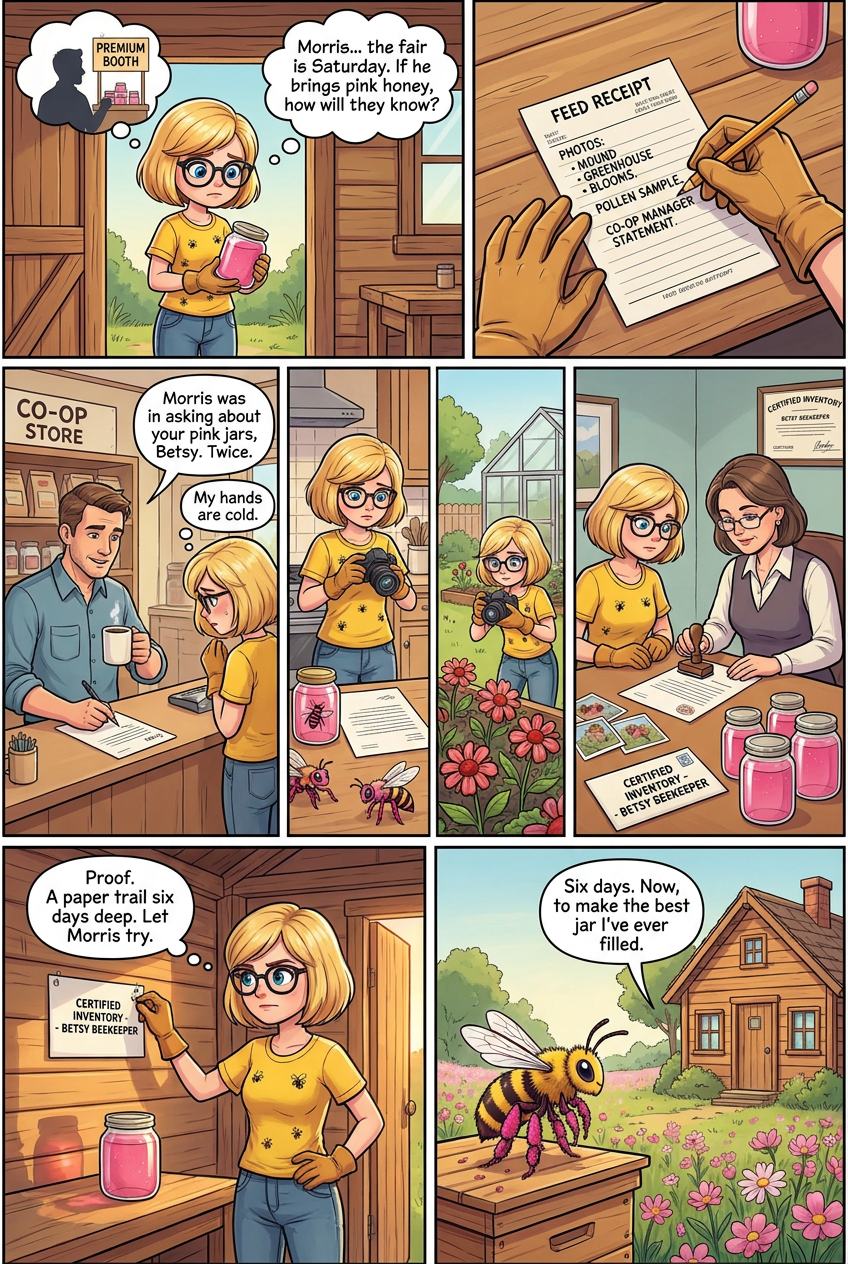
Betsy slept four hours on the shed floor and woke to a cold sun. The cuttings in the lean-to were still standing. The outside bed showed two new blooms with the same deep red centers as the first. She should have felt relief. Instead she stood in the doorway holding a jar of pink honey from last week's pull, and thought about Morris. The fair was Saturday. Six days. Morris had the premium booth and a reputation for winning. If she brought pink honey and he brought pink honey, the judges would have no way to tell whose bees had found the flower first. He could say he'd cultivated it for years. She had no paperwork. No witnesses. She had done this alone. She set the jar on the shed table and made a list on the back of a feed receipt. Photographs of the mound, dated. Photographs of the greenhouse and the outside bed. A sample of pink pollen scraped from a returning bee. A signed and dated statement from the co-op manager, who had tasted the honey in June when she brought her bulk jars in. She drove to town before the co-op opened. The manager arrived at seven with his coffee. She showed him the jar and asked him to write down what he remembered — the date she'd first brought a small taster in, the color, the flavor. He wrote it out on co-op letterhead and signed it. He said Morris had been in twice asking about her pink jars. Her hands went cold on the counter. She drove home faster than she should have. In the kitchen she laid the letter flat and photographed it. She photographed the greenhouse from four angles, the outside bed with its new red-centered blooms, the sunken bowl where the mound had been. She caught a forager at the hive entrance and shook her gently into a jar. The bee's back legs were packed thick with pink. She sealed the jar and labeled it with the date. Then she drove to the notary above the hardware store. She brought the photographs, the co-op letter, the pollen sample, and three sealed jars of the pink honey. The notary stamped and dated an inventory of everything on the desk. She paid twenty-two dollars and walked out with a certified envelope in her hand. At home she pinned the envelope to the shed wall above her workbench. The pink honey jar sat below it, catching the late light. The proof existed now. Morris could bring whatever he wanted to the fair. She could show a paper trail six days deep and a co-op manager who would swear to June. She went out to check the hives. A forager landed on the platform with her legs bright pink. Betsy watched her walk into the box. Six days. She still had to make the entry honey itself, and it had to be the best jar she had ever filled.
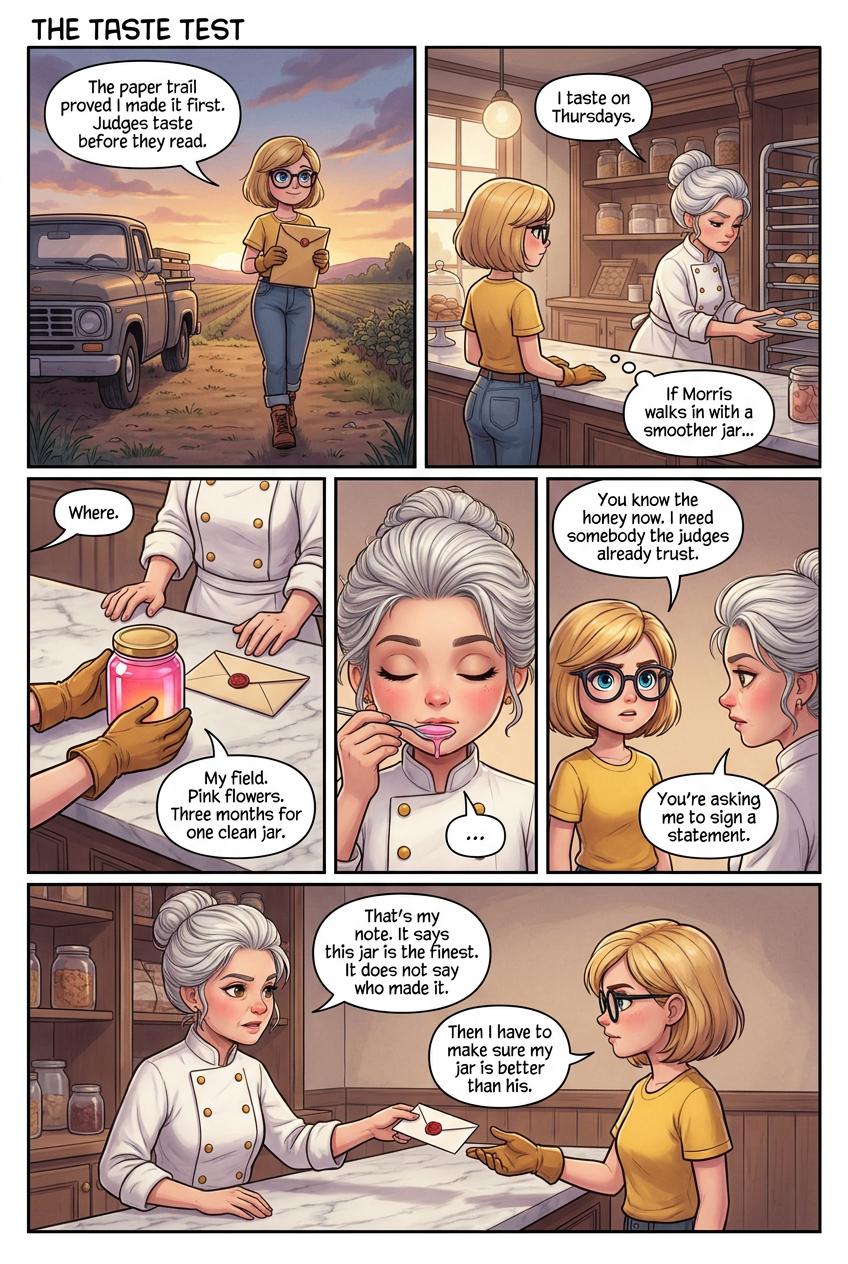
Betsy carried the sealed envelope out to her truck at dawn. The paper trail proved she'd made pink honey first. It proved nothing about whether the honey was good. Judges tasted before they read. If Morris walked in with a smoother jar, her documents would sit on the table unopened. She needed a name the judges already respected to say, on record, that her honey was extraordinary. She drove into town with a jar of the pink honey wrapped in a dish towel on the passenger seat. The confectioner kept a shop three blocks from the fairgrounds. Betsy had never spoken to her. She had only seen her once, judging pastry at last year's fair, tasting each entry with a small silver spoon and writing a single line in a notebook. The judges had leaned in to read what she wrote. The shop smelled of burnt sugar. Marguerite Dulcet stood behind the counter in a white coat with gold buttons, pulling a tray of candied violets from a rack. Her hair was pinned high and silver. She did not look up. "I keep a list," Marguerite said. "You can leave a sample. I taste on Thursdays." "It's Wednesday," Betsy said. "Then leave it and come back." Betsy set the jar on the counter and unwrapped it. The honey caught the shop light and threw a rose color onto the marble. Marguerite's hands stopped moving. She set the tray down. "Where." "My field. Pink flowers. I've been working three months for one clean jar." Marguerite took a fresh spoon from a drawer. She dipped, held it to the light, then to her mouth. She closed her eyes. She dipped a second time and did the same. She did not speak for a long moment. "Saturday," Betsy said. "The fair. Morris will bring a jar that looks like this. I have papers that prove I made it first. I need somebody the judges already trust to say it tastes like what I say it tastes like." Marguerite opened her eyes. "You're asking me to sign a statement." "Yes." "I don't sign for people I don't know." "You know the honey now." Marguerite looked at her for a long time. Then she took a card from beside the register, wrote three lines on the back, and pressed her thumb into a red wax stamp beside her signature. She slid it across the marble. "That's my note to the head judge. It says this jar is the finest honey I have tasted in twenty years of judging. It does not say who made it. If Morris brings the same flavor, the note helps him as much as you." Betsy took the card. Her hand was steady for the first time in a week. "Then I have to make sure my jar is better than his." "Yes," Marguerite said. "You do."
Play your story to life
Storycraft is a mobile game where you create AI characters, craft items and locations to build their world, then discover what direction your story takes. Download the iOS game for free today!
Download for free