

Billy Troll's Arc
15 Chapters
Billy Troll's dream is being the best version of himself that he can be.

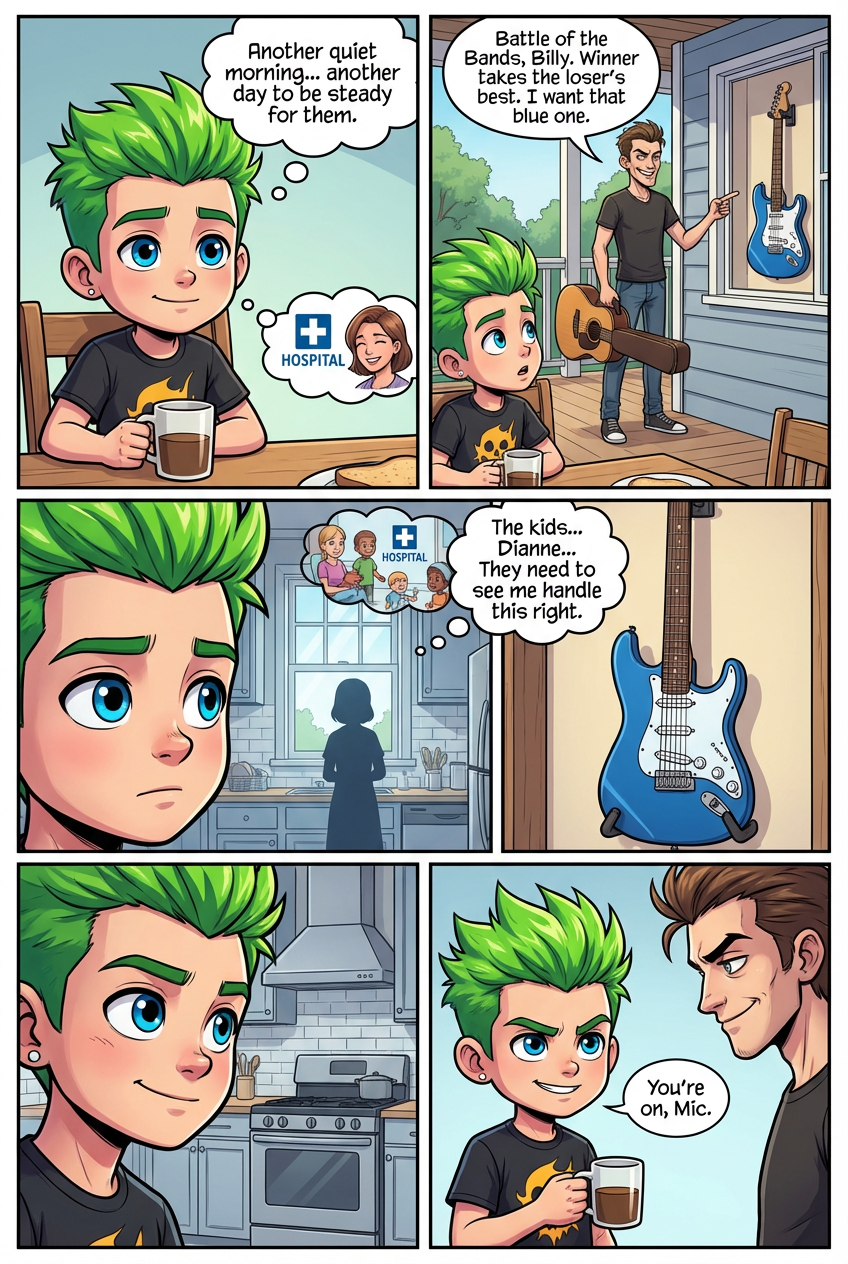
Billy set down his coffee and looked up from the breakfast table, ready to give his full attention to whatever came next. He'd built his whole life around showing up — for the kids at the hospital, for Dianne, for anyone who needed him to be steady. This morning felt like any other, the kind of quiet moment before the day really started. But then the gate buzzed. Footsteps crossed the patio stones. Mic appeared around the corner of the pool with that smirk already fixed on his face, carrying a beat-up acoustic guitar slung over his shoulder. He didn't knock. He didn't call ahead. He just walked right into Billy's family morning like he owned the place. Mic dropped the guitar case on the patio table with a heavy thud. "Battle of the Bands next month," he said. "Winner takes the loser's best instrument. I want that blue electric of yours." He pointed toward the studio window where Billy's favorite guitar hung on the wall, the one he'd used on every album, every charity show. The one that meant something. Billy felt the weight of Dianne's eyes on him from the kitchen window. He thought about the kids who watched him at the hospital, who learned from how he handled moments like this. He picked up his coffee again, took a slow sip, and met Mic's stare. "You're on," he said, and watched the smirk falter for just a second before it locked back into place. The best version of himself wouldn't back down from this.
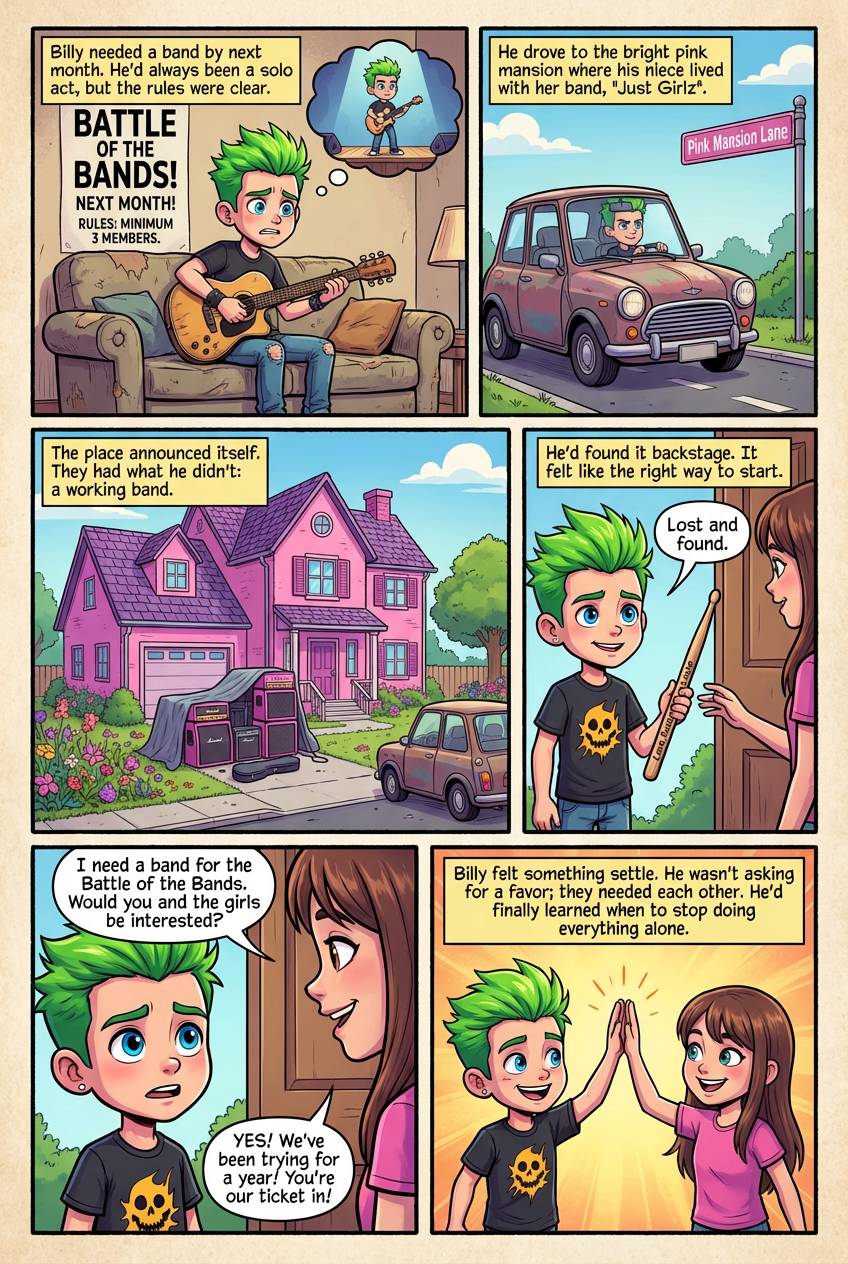
Billy needed a band by next month. He'd accepted the challenge without thinking through the most basic problem: he'd always been a solo act. That was how he'd built his name, just him and his guitar at every show, every hospital visit, every recording. But the Battle of the Bands had rules, and those rules required at least three people on stage. He drove across town to the bright pink mansion where his niece lived with her bandmates. The place practically announced itself from the street — purple roof tiles, orange trim, flower beds that looked like someone had spilled a paint set across the lawn. Out front, a stack of pink amps sat under a tarp next to a keyboard case and a guitar with a finish so bright it hurt to look at in the sun. Real equipment. Serious equipment. Just Girlz had been together for two years now, playing school dances and weekend gigs at the community center. They had what he didn't: a working band. Billy parked and grabbed the drumstick from his passenger seat. He'd found it backstage after one of their shows last month, the words "Love Suzie" carved into the wood. He'd been meaning to return it, but now it felt like the right way to start this conversation. When his niece answered the door, he held it up. "Lost and found," he said. She grinned and took it, then looked at him with that sharp teenager expression that said she knew he hadn't driven all the way here just to be helpful. He asked. She said yes before he even finished explaining about Mic and the battle and needing people on stage. "We've been trying to get into that competition for a year," she said. "They only take established acts. You're our ticket in." Billy felt something settle in his chest. He'd come here thinking he was asking for a favor, thinking he'd have to convince her or maybe even beg. But she wanted this as much as he needed it. He'd shown up asking for help, and that was different from being a burden. That was being the kind of person who knew when to stop doing everything alone.
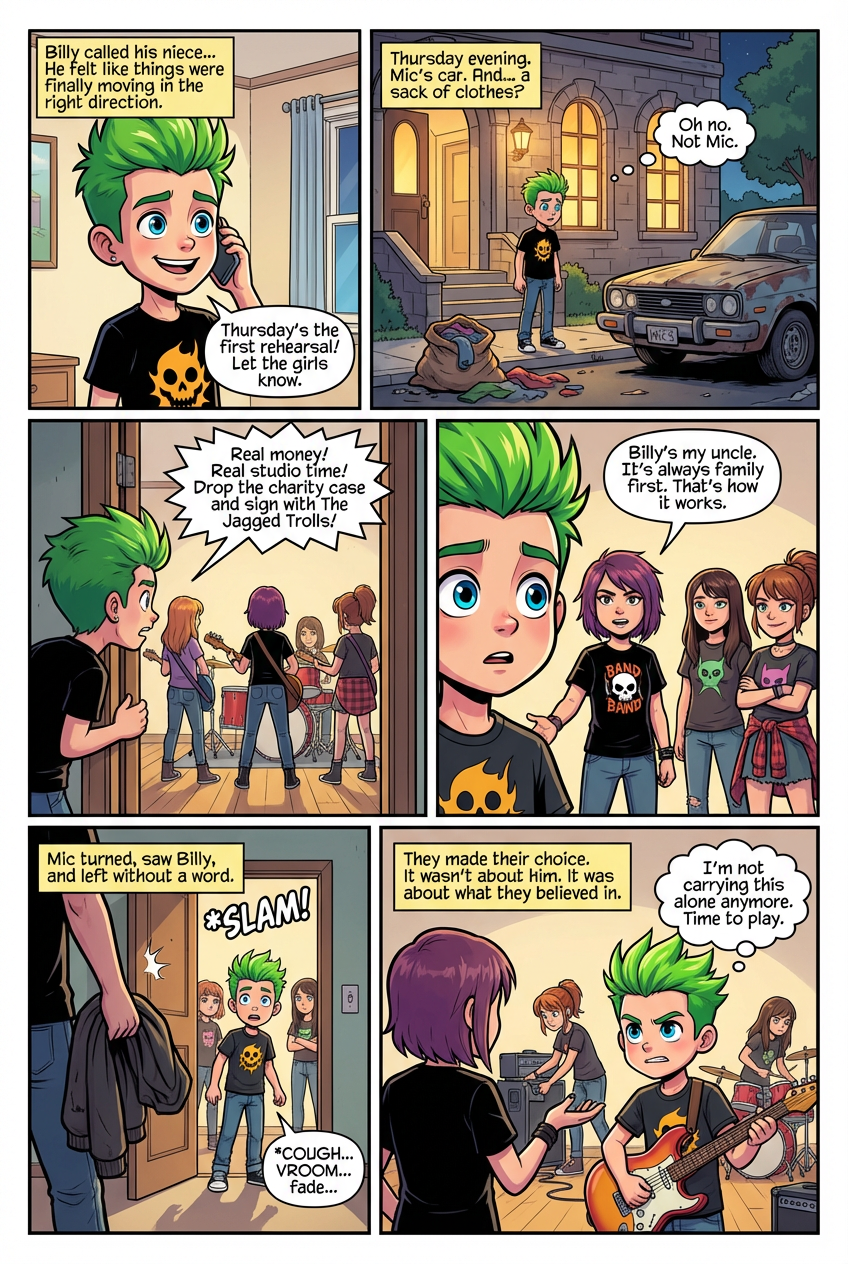
Billy called his niece the next afternoon to tell her they had their first rehearsal scheduled for Thursday. She said she'd let the other girls know. He hung up feeling like things were finally moving in the right direction. But when Billy arrived at the rehearsal hall Thursday evening, he found Mic's beat-up car parked outside. The building had stone walls and wooden trim, warm lights glowing through arched windows. A tattered sack sat by the front steps, spilling clothes onto the ground like someone had dumped it there in anger. Billy's stomach tightened. He pushed through the door and heard Mic's voice carrying from the practice room. "I'm offering you real money. Real studio time. All you have to do is drop the charity case and sign with The Jagged Trolls as our backing band." Billy stopped in the doorway. The four girls stood in a half-circle facing Mic, instruments in hand, and none of them looked interested. Suzie stepped forward first. "Billy's my uncle," she said. Her voice was steady, not angry, just matter-of-fact. "It's always family first. That's how it works." The other girls nodded. One of them crossed her arms. Another set her bass down and pointed at the door. Mic turned and saw Billy standing there. For a second, neither of them moved. Then Mic grabbed his jacket and walked past without a word. Billy heard the car door slam outside, then the engine cough to life and fade down the road. Billy looked at his niece. She shrugged like it was no big deal, but he could see the pride in her face. The other girls went back to setting up their equipment, adjusting mic stands and plugging in amps. No one asked if he was okay. No one treated him like he needed protecting. They'd made their choice before he even got there, and it wasn't about him. It was about what they believed in. Billy picked up his guitar and joined them. For the first time since Mic showed up at his house, he felt like he wasn't carrying this alone. He didn't have to be the only one showing up. Other people could do that too.
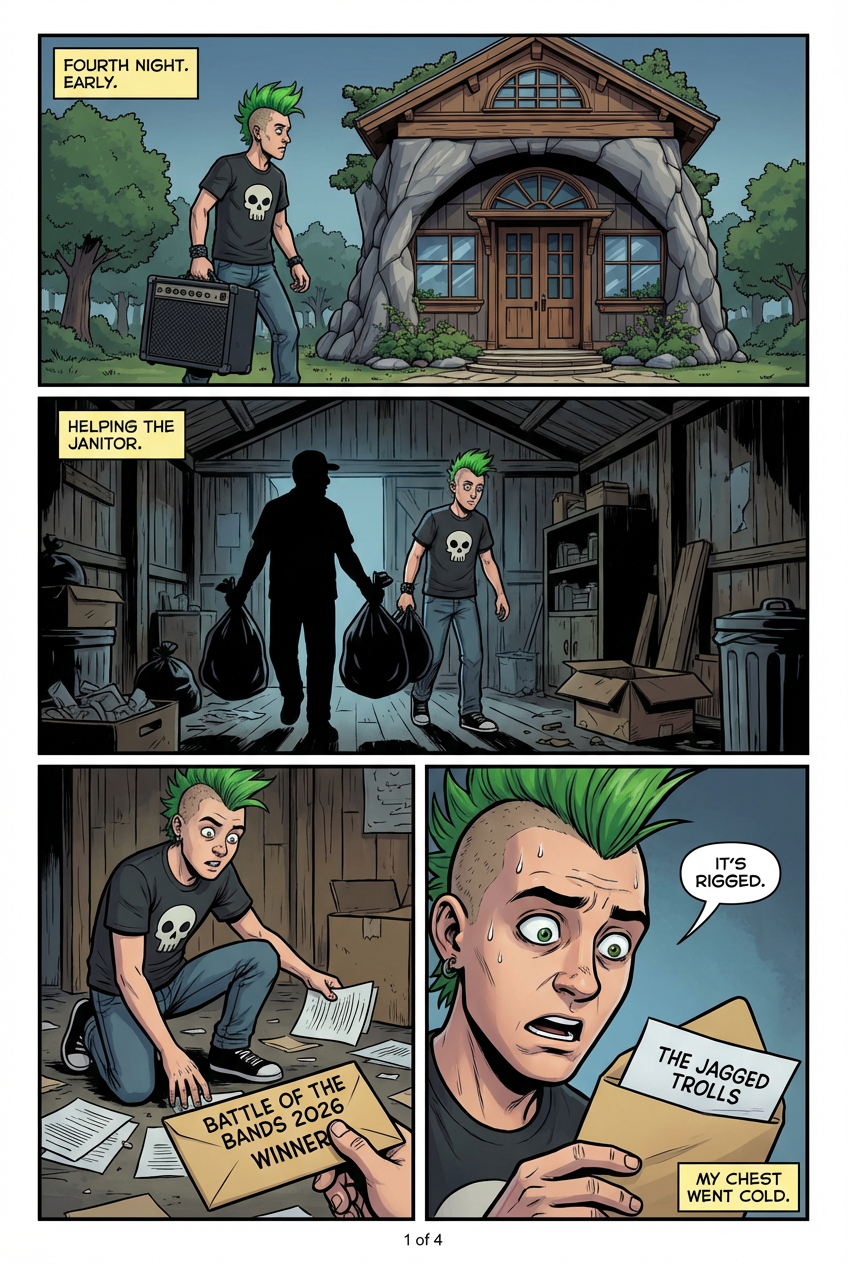
Billy came back three nights in a row after that. Each time, the girls were already there, tuning their instruments and running through progressions. They didn't waste time on small talk. They just played, working through transitions until the songs felt tight. On the fourth night, Billy arrived early to drop off his amp. The rehearsal hall was empty except for the janitor, who was propping open a back door to carry trash out. Billy helped him haul a few bags to the old timber shed behind the building where they kept the dumpster. The shed door hung crooked on its hinges, and inside, stacked against the far wall, Billy spotted boxes of old competition paperwork. One box had split open, spilling folders across the dirt floor. He bent down to gather them up and saw an envelope with official lettering across the front: Battle of the Bands 2026 Winner. His chest went cold. The competition hadn't even happened yet. It was still two months away. Billy pulled the envelope out and turned it over. It was sealed, but the name of the winner was written on a slip of paper visible through the translucent backing. The Jagged Trolls. He stood there holding it, his hands shaking. The janitor called from outside, asking if he was coming. Billy shoved the envelope in his jacket and walked back to the hall. When the girls arrived twenty minutes later, he told them they needed to talk. He showed them the envelope and watched their faces change. Suzie asked what it meant. Billy said it meant the competition was rigged. It meant Mic already knew he was going to win before he ever showed up at Billy's house to challenge him. The girls wanted to pull out. One of them said there was no point in playing if the outcome was fixed. But Billy realized something as he stood there listening to them. He'd spent years showing up for the kids at the hospital, knowing that most of them wouldn't get better, that the outcomes were already written in ways he couldn't change. He showed up anyway because the showing up mattered. Because who you chose to be in the face of a rigged game said more about you than winning ever could. He told the girls they were still going to compete. Not because they could win, but because walking away would mean letting Mic decide who they were. They practiced that night harder than they ever had before, and Billy felt something settle in his chest that had been restless for weeks. He wasn't trying to beat Mic anymore. He was trying to show everyone watching—including himself—what it looked like to keep going when the deck was stacked against you.
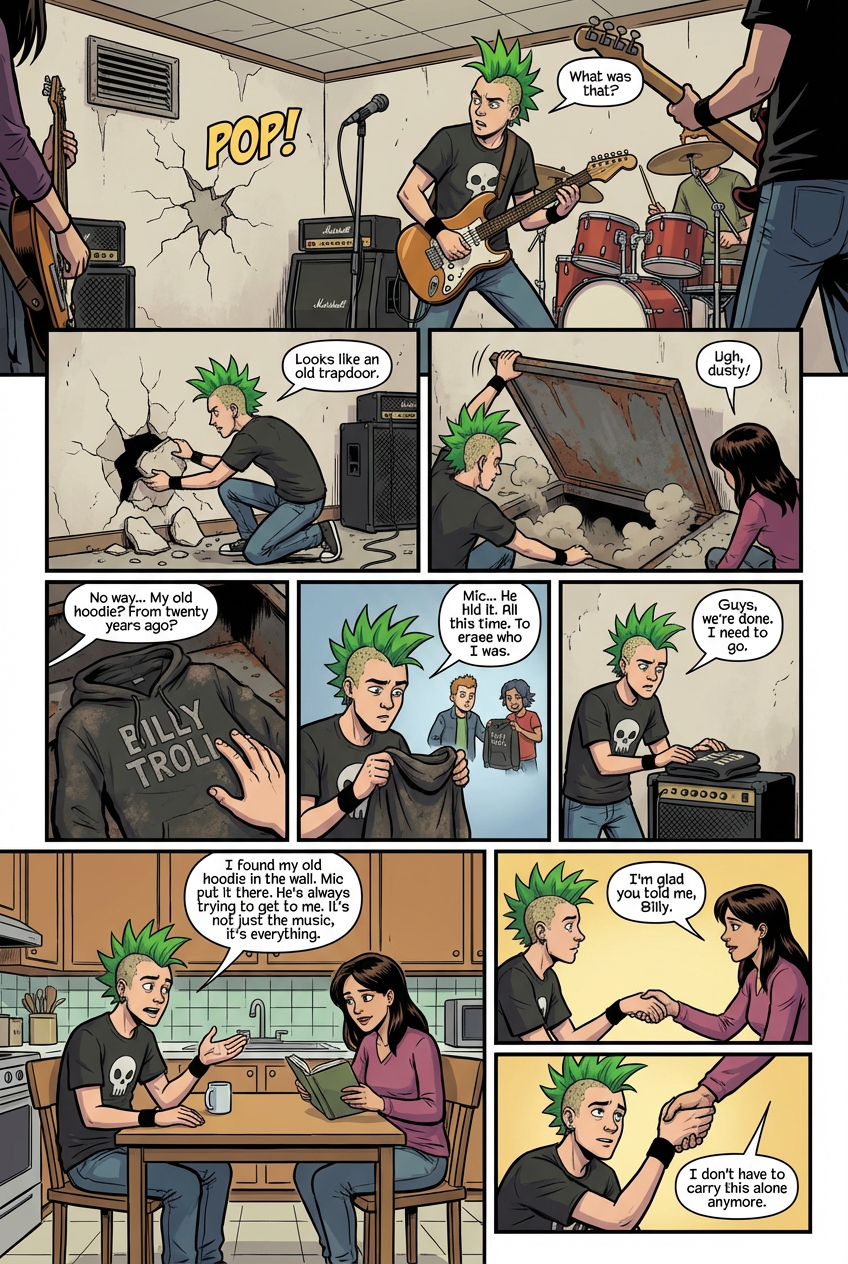
The wall crack appeared during the second verse of their fastest song. Billy heard it before he saw it—a sharp pop that cut through the drums and bass. The girls stopped playing. A chunk of plaster had fallen near the corner where the old heating vent used to be. Billy walked over and knelt down. Behind the broken plaster, he could see wooden slats and something that looked like a metal frame. He pulled at the loose pieces until more of the wall came away, revealing a trapdoor set flush against the floor beneath where the vent had been mounted. The hinges were old but solid, the metal frame rusted at the edges. Suzie came over and helped him clear the rest of the debris. When they pulled the door open, dust billowed up from the small space underneath. Inside was a single item—a faded hoodie with his name printed across the front in lettering he recognized from twenty years ago. Billy lifted it out slowly. He'd lost this at a practice session before his first real gig, back when Mic was still his bandmate and not his rival. He'd assumed someone had stolen it. But Mic had sealed it in the wall instead, in this building that Mic's family had owned before selling it to the city. Billy held the hoodie and understood what Mic had been trying to tell him all along. Mic hadn't just been mocking his hospital visits or challenging him to competitions. Mic had been trying to erase every trace of who Billy used to be—the version of himself who'd walked away from their shared band to build something different. The hoodie was proof that Mic had never let go of that moment, had literally buried it in the foundation of a place where musicians came to practice. Billy folded the hoodie carefully and set it on top of his amp. He told the girls they were done for the night and that he needed to talk to Dianne. When Billy got home, Dianne was reading in the kitchen. He sat down across from her and told her everything—about the hoodie, about how much space Mic occupied in his head, about how the mockery of his hospital work hurt more than any musical insult ever could. Dianne listened without interrupting. When he finished, she reached across the table and took his hand. She didn't try to fix it or tell him what to do. She just said she was glad he'd finally let her in. Billy realized that being the best version of himself meant letting people see the parts that weren't okay, not just the ones that smiled through everything. He couldn't carry Mic's weight alone anymore, and he didn't have to.
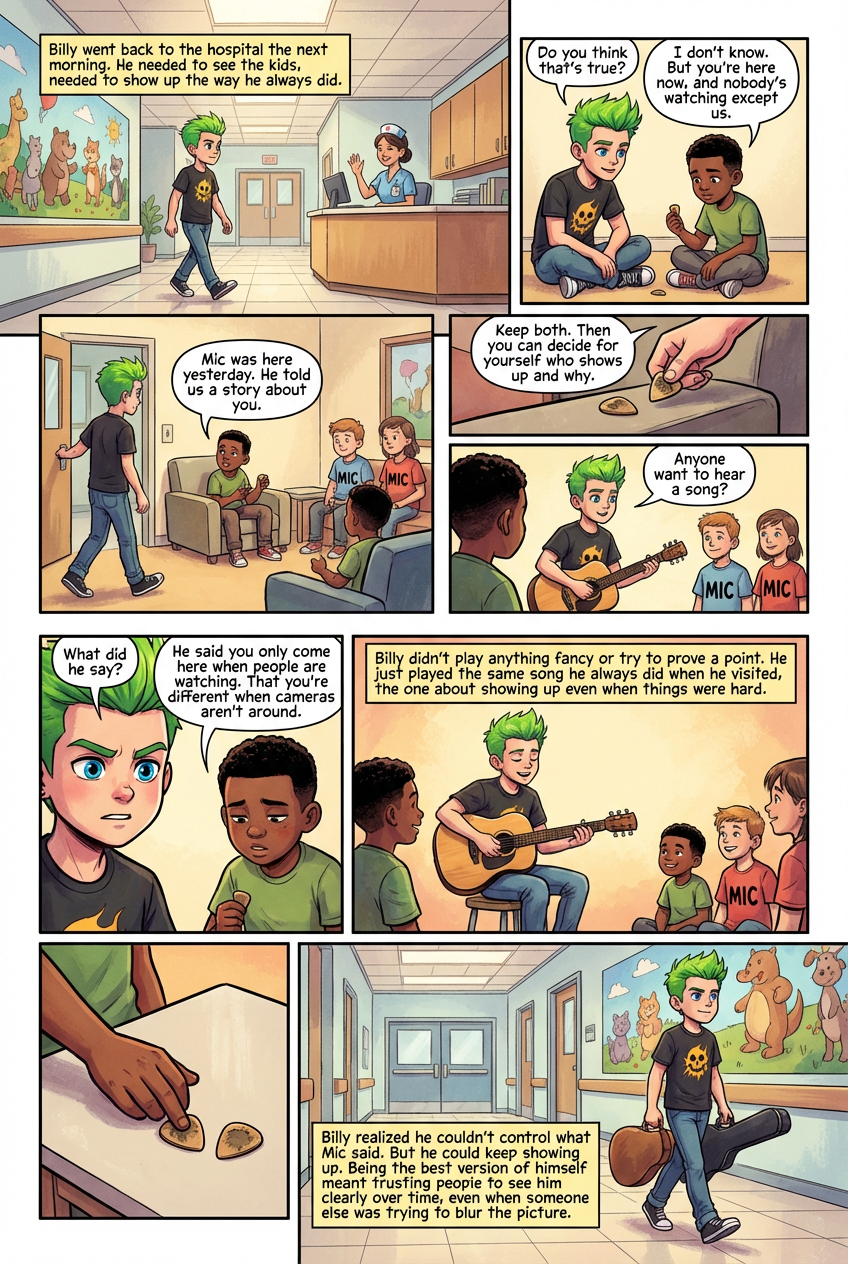
Billy went back to the hospital the next morning. He needed to see the kids, needed to show up the way he always did. The nurse at the desk waved him through with a smile. He walked past the mural of cartoon animals and turned left toward the common room where most of the mobile patients gathered. A boy named Marcus sat in the corner with a guitar pick in his hand, turning it over slowly. Billy recognized the worn surface immediately—it was old, weathered, the kind a touring musician would carry for years. Marcus looked up when Billy approached. "Mic was here yesterday," he said. "He told us a story about you." Two other kids nearby were wearing shirts with Mic's name printed across the front in bold letters. Billy's chest tightened, but he kept his face steady. "What did he say?" Marcus looked down at the pick. "He said you only come here when people are watching. That you're different when cameras aren't around." The words landed exactly where Mic had aimed them. Billy sat down on the floor next to Marcus's chair. He didn't try to defend himself or explain why Mic was wrong. Instead, he asked Marcus a question. "Do you think that's true?" Marcus was quiet for a moment, still turning the pick over in his hands. "I don't know," he said finally. "But you're here now, and nobody's watching except us." Billy nodded. He reached into his pocket and pulled out a guitar pick of his own—one he'd been carrying since his first real gig, before Mic became his rival. He set it on the armrest of Marcus's chair. "Keep both," Billy said. "Then you can decide for yourself who shows up and why." Marcus picked up Billy's pick and held it next to Mic's. They looked almost identical—worn smooth by years of use, marked by the same kind of dedication. Billy stood up and asked if anyone wanted to hear a song. The kids in the Mic shirts looked at each other, then nodded. Billy didn't play anything fancy or try to prove a point. He just played the same song he always did when he visited, the one about showing up even when things were hard. When he finished, Marcus set both picks down on the table between them. Billy realized he couldn't control what Mic said about him or what stories got told when he wasn't in the room. But he could keep showing up, and eventually the kids would know the truth by what they saw, not what they heard. He left the hospital knowing Mic had been there first, but also knowing that being the best version of himself meant trusting people to see him clearly over time, even when someone else was trying to blur the picture.
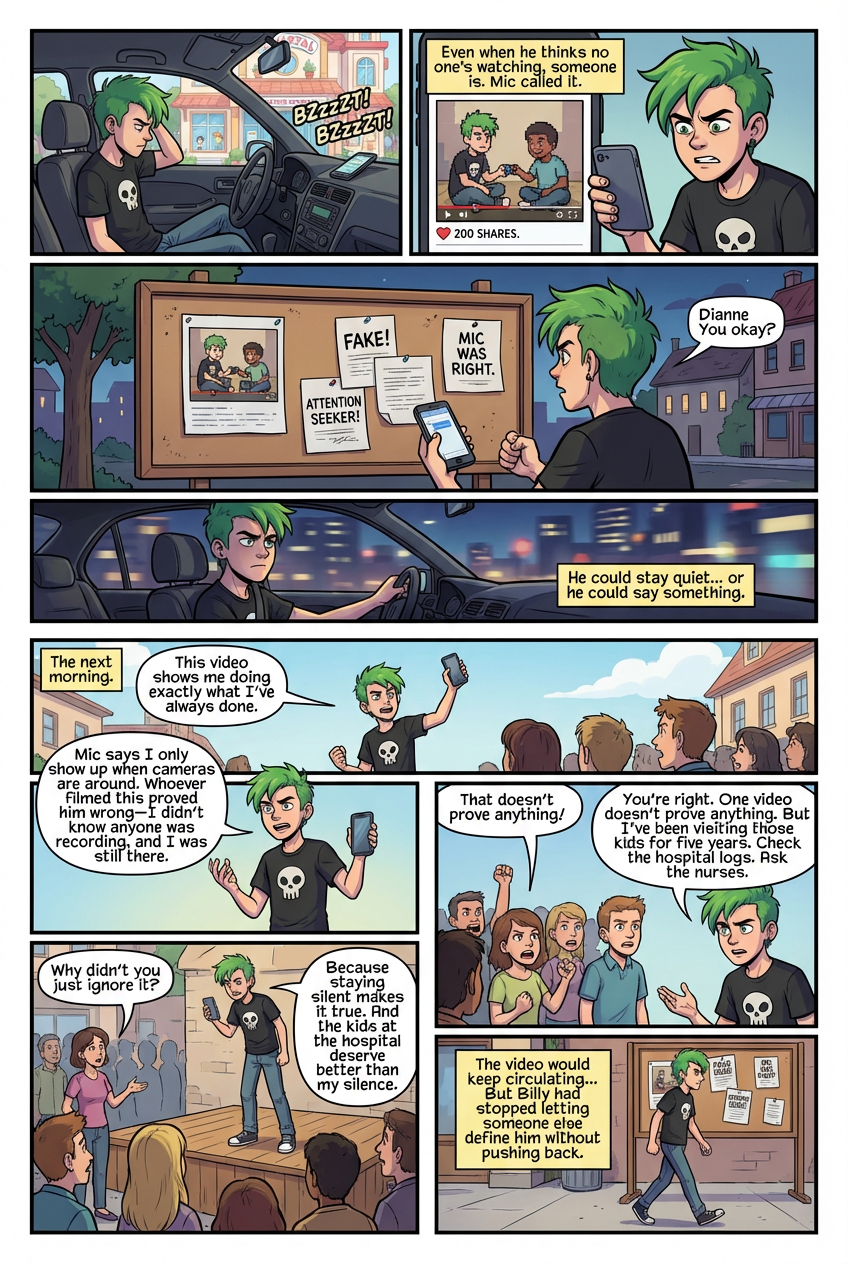
Billy sat in his car outside the hospital for ten minutes before his phone started buzzing. The first message was from a friend with a link and three question marks. The second was from someone he barely knew asking if he'd seen it yet. By the time he opened the video, it had been shared two hundred times. The footage showed him sitting on the floor next to Marcus, handing over the guitar pick. Someone had filmed it through the common room window and paired it with a recording of Mic's voice explaining why Billy only visited for attention. The caption read: "Even when he thinks no one's watching, someone is. Mic called it." Billy's hands tightened on the steering wheel. He could stay quiet and let people think what they wanted, or he could say something and risk making it worse. By evening, the video was pinned to the bulletin board in the town square alongside printed comments calling him fake. Dianne texted him asking if he was okay. He didn't answer. The next morning, Billy walked to the small stage near the square where local musicians sometimes played. A few people were already gathering near the wooden amphitheater on the hillside above, drawn by word that he might show up. He didn't have a plan or a speech prepared. He just stepped onto the platform, pulled out his phone, and held it up so everyone could see the screen. "This video shows me doing exactly what I've always done," he said. "Mic says I only show up when cameras are around. Whoever filmed this proved him wrong—I didn't know anyone was recording, and I was still there." Someone in the crowd shouted that it didn't prove anything. Billy nodded. "You're right. One video doesn't prove anything. But I've been visiting those kids for five years. You can check the hospital logs. You can ask the nurses. Or you can keep watching Mic's version and decide that's enough." He put his phone away and stepped down from the stage. A woman near the front asked why he didn't just ignore it. Billy stopped and looked at her. "Because staying silent makes it true," he said. "And the kids at the hospital deserve better than my silence." He walked past the bulletin board without tearing anything down. The video would keep circulating, and some people would still believe Mic's story. But Billy had stopped letting someone else define him without pushing back. That was the part of himself he'd been missing—the part willing to speak up even when it cost him something.
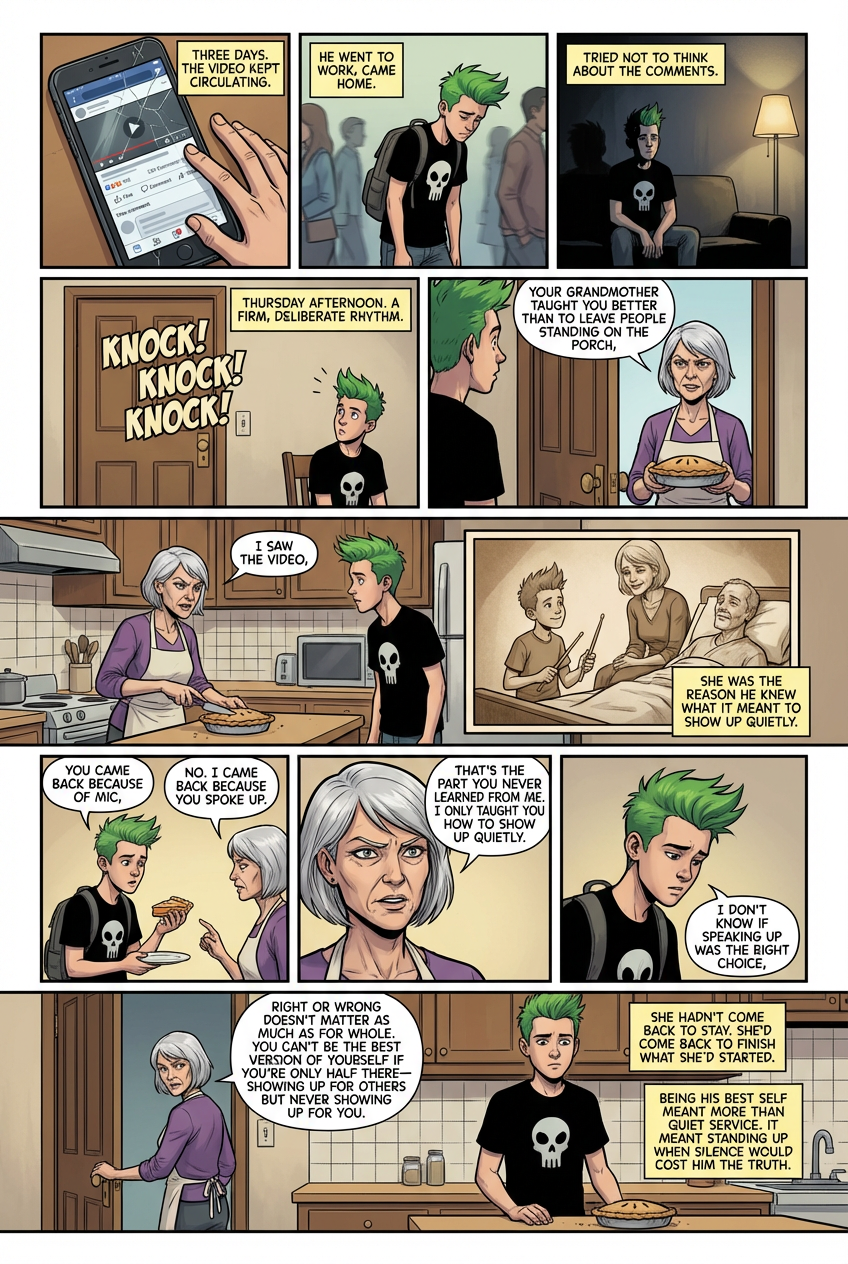
The video kept circulating for three days, and Billy stopped checking how many times it had been shared. He went to work, came home, and tried not to think about the comments section. On Thursday afternoon, someone knocked on his door—not Dianne's polite tap, but a firm, deliberate rhythm he hadn't heard in years. Billy opened the door to find an older woman holding a pie in both hands. She had the same sharp eyes he remembered from childhood, though her hair had gone completely silver. She didn't wait for an invitation, just walked past him into the kitchen and set the pie on the counter. "Your grandmother taught you better than to leave people standing on the porch," she said. Billy closed the door and stared at her. This was the woman who'd handed him a pair of drumsticks when he was twelve years old and asked him to play for her sick husband every Tuesday afternoon until he died. She was the reason Billy knew what it meant to show up when no one was filming. "I saw the video," she said, cutting into the pie without asking for a plate. "Reminded me you're still doing what I asked you to do all those years ago." Billy took the slice she offered him. He wanted to ask why she'd disappeared after her husband's funeral, why she'd never reached out in twenty years. But the words stuck in his throat because part of him already knew—she'd taught him what he needed to learn and then let him carry it forward without her. "You came back because of Mic," he said. She shook her head. "I came back because you spoke up. That's the part you never learned from me. I only taught you how to show up quietly." Billy set the pie down and looked at the woman who'd started everything. She'd given him the gift of service without ever asking him to defend it, and he'd built his entire life around that silence. But staying silent hadn't protected the hospital kids from Mic's lies, and it hadn't stopped people from believing the worst about him. "I don't know if speaking up was the right choice," he admitted. She wiped her hands on a towel and met his eyes. "Right or wrong doesn't matter as much as whole," she said. "You can't be the best version of yourself if you're only half there—showing up for others but never showing up for you." She left the pie on the counter and walked to the door. Billy didn't try to stop her. He understood now that she hadn't come back to stay. She'd come back to finish what she'd started—to show him that being his best self meant more than quiet service. It meant standing up when silence would cost him the truth.
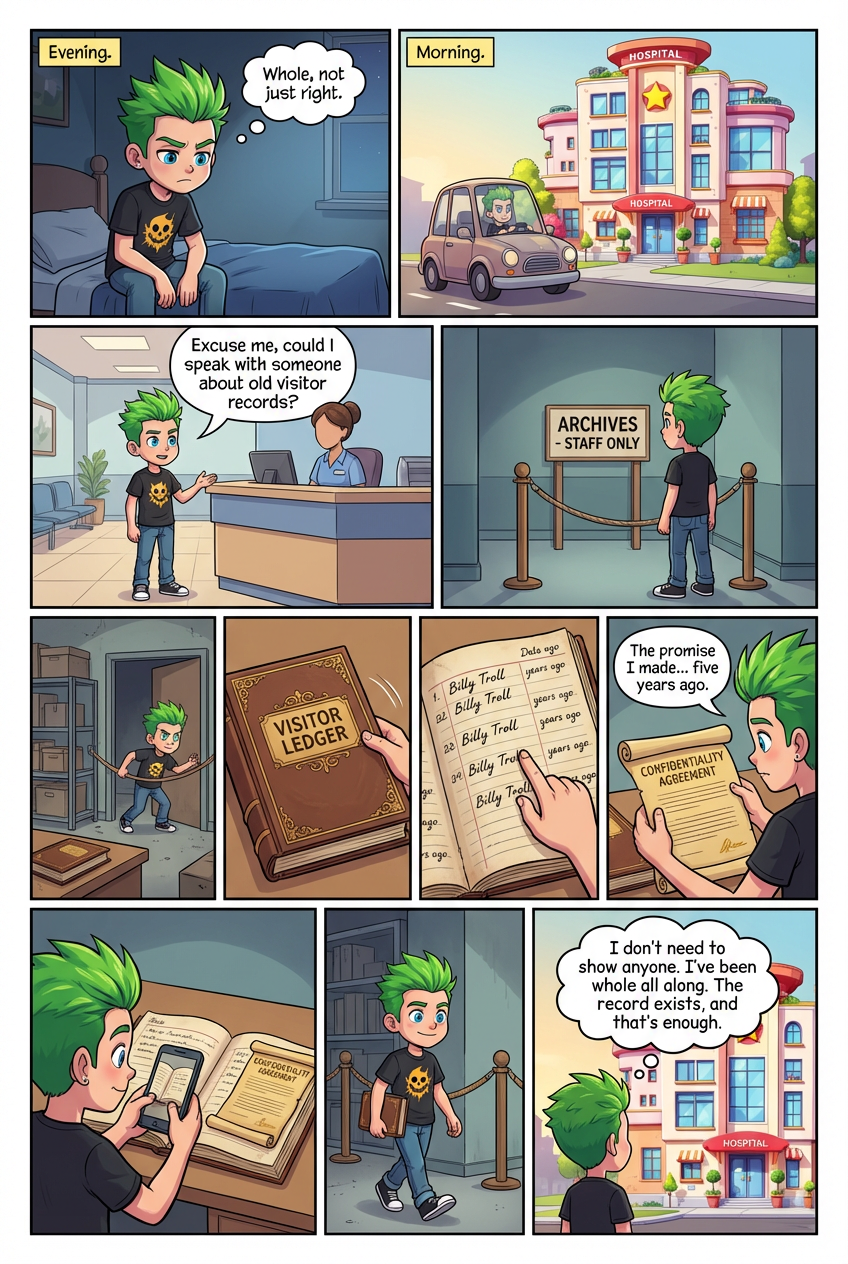
Billy spent the rest of Thursday evening thinking about what the woman had said. Whole, not just right. He'd been showing up for the hospital kids for five years, but he'd never let anyone see the full picture of what that meant. The next morning, he drove to the hospital early, before his usual visiting hours. The main lobby was empty except for a cleaning crew and a woman at the reception desk Billy didn't recognize. He asked if there was someone he could speak with about old visitor records, and she pointed him toward a hallway he'd never noticed before. At the end of it, two wooden posts connected by rope blocked off a storage room with a sign that read "Archives - Staff Only." Billy ducked under the rope and pushed open the door. Inside, metal shelves lined the walls, stacked with boxes and forgotten equipment. On a corner desk sat a leather-bound book with an ornate cover—the hospital's visitor ledger from years past. Billy opened it and flipped through pages of handwritten signatures, dates, and room numbers. He found his own name appearing every week, sometimes twice a week, dating back five years. The entries were exact and detailed, recording visits that happened long before anyone filmed him or posted accusations online. Tucked between two pages near the back, he found a folded scroll with gold lettering at the top: "Confidentiality Agreement." It was the document he'd signed when he first started visiting, promising not to use the children's stories for publicity or personal gain. His signature sat at the bottom, dated the same week his grandmother's neighbor had taught him what service meant. Billy took a photo of the ledger pages and the signed agreement, then closed the book and left it exactly where he'd found it. He didn't need to take it with him or show it to anyone right now. What mattered was that he'd found proof—not for Mic or the internet, but for himself. He'd been whole all along, showing up in private while speaking up in public when it counted. The record existed whether people believed him or not, and that was enough.
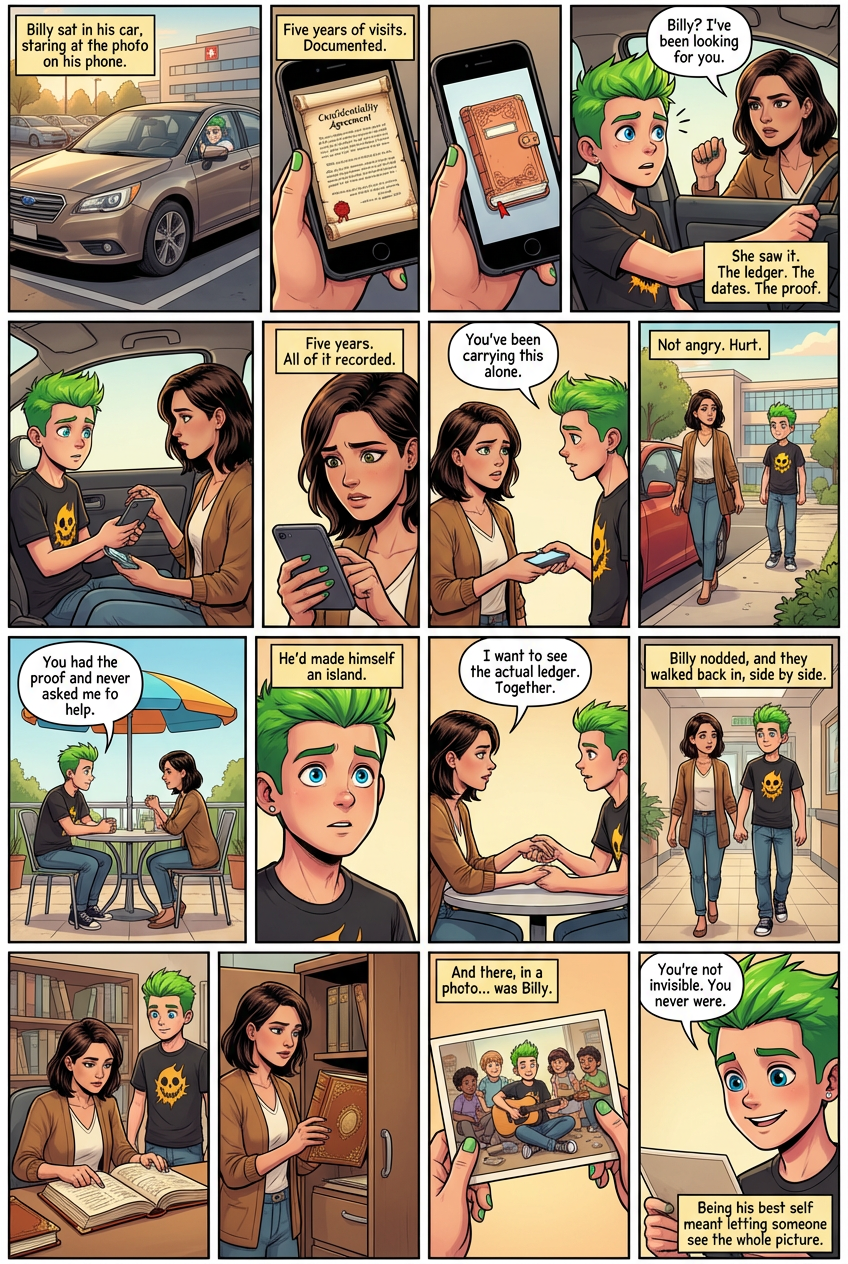
Billy sat in his car outside the hospital for a long time, staring at the photo on his phone. The ledger pages were clear. The confidentiality agreement was signed in his own handwriting. Five years of visits, documented in ink that couldn't be erased or edited or spun into something else. He didn't notice Dianne's car pull into the lot until she knocked on his window. She'd been looking for him, she said. He'd left early without telling her where he was going. Billy unlocked the passenger door and she slid in, her eyes moving immediately to the phone still glowing in his hand. He tried to turn it off, but she'd already seen the image. The ledger. The dates. The signature. She asked how long he'd had this, and Billy couldn't answer right away. Since this morning, he finally said. But the visits? Five years. All of it recorded. All of it proof he'd never once thought to share with her. Dianne took the phone from his hand and studied the photo more carefully. She scrolled through the dates with her thumb, reading each entry like she was seeing something she should have known all along. Then she handed it back and got out of the car without a word. Billy followed her across the parking lot to a small patio set with a bright umbrella near the hospital's side entrance. She sat down in one of the wooden chairs and looked up at him. You've been carrying this alone, she said. Not just today. All of it. Every time Mic said something. Every time someone doubted you. You had the proof and you never asked me to help you carry it. Billy sat down across from her and realized she wasn't angry—she was hurt. He'd spent so long trying not to be her problem that he'd made himself an island instead. Dianne reached across the table and took his hand. She told him she wanted to see the actual ledger, the real pages, not just a photo. She wanted to stand in the archive room with him and read every entry together. Billy nodded, and they walked back into the hospital side by side. In the archive room, Dianne opened the leather-bound book and turned the pages slowly, her finger tracing each line where Billy's name appeared. When she finished, she closed it and placed it back on the desk. Then she opened a cabinet beneath the shelves and pulled out an old photo album with an ornate cover. Inside were pictures of past hospital events—volunteers, staff, children. And there, in a photo from three years ago, was Billy sitting with a group of kids, guitars in hand. Dianne held it up so he could see. You're not invisible, she said. You never were. Billy looked at the photo and understood what had changed. He'd been trying to prove himself alone, but being his best self meant letting someone else see the whole picture—even the parts he'd been afraid to show.
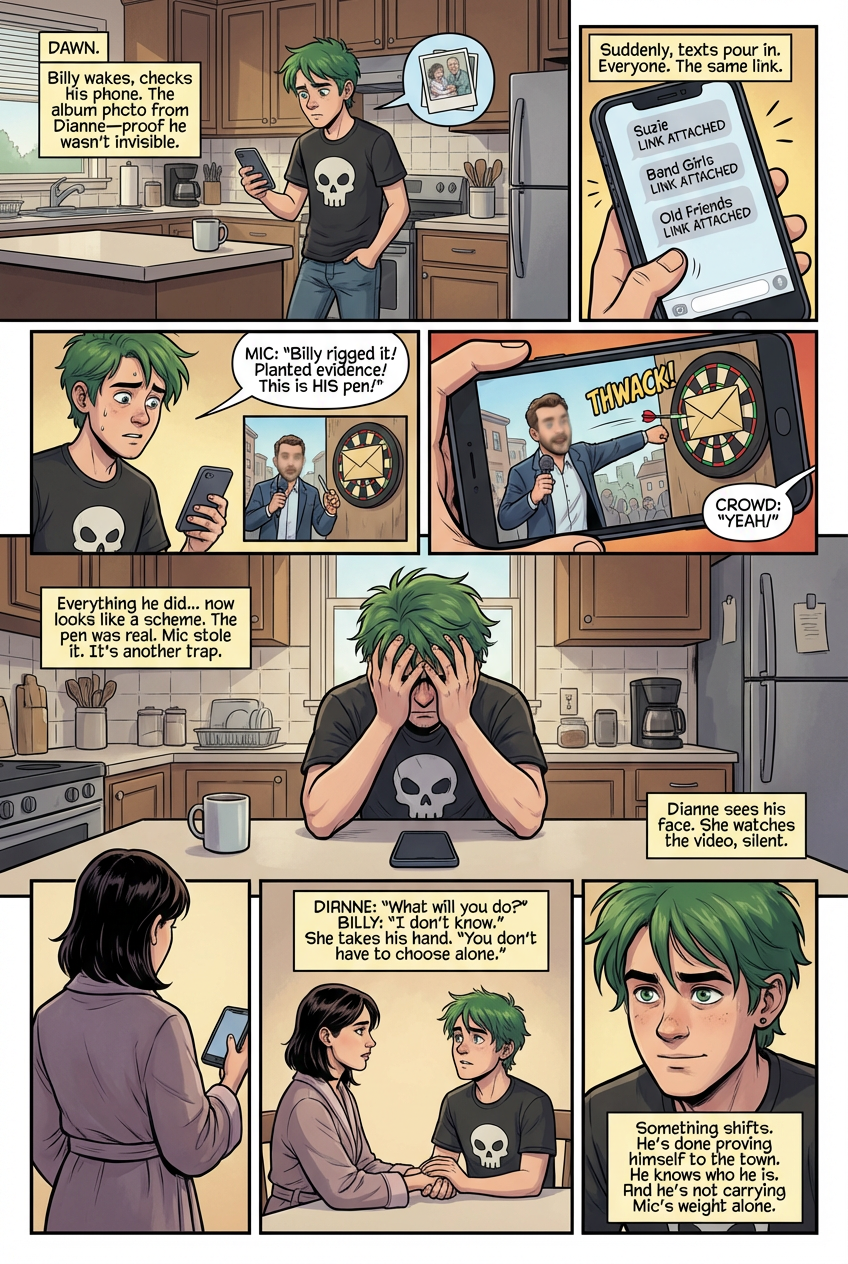
Billy woke before dawn and checked his phone. The album photo Dianne had shown him yesterday was still there in his messages—proof that he'd never been invisible at the hospital, even when he'd felt like it. He got dressed quietly and made coffee in the kitchen while Dianne still slept. He was halfway through his cup when his phone started buzzing. Texts from Suzie. From the girls in the band. From people he hadn't heard from in months. Each message had the same link attached. Billy clicked it and watched his phone load a video—Mic standing in front of a makeshift board set up in the town square, a large envelope taped to the center like a target. Mic was speaking directly to the camera, holding up a silver pen with Billy's initials etched into the barrel. He told the crowd that Billy had rigged the competition himself, planted the evidence in the shed to make Mic look guilty, all to cover his own attempt at fixing the battle. The envelope on the board had Billy's name written across it in what looked like his own handwriting. Mic threw a dart at the board and it stuck right through the envelope. The crowd cheered. The video ended. Billy set the phone down and stared at the kitchen counter. Everything he'd done—finding the envelope, showing the girls, convincing them to compete anyway—now looked like his own scheme to frame Mic. The pen was real. He'd lost it weeks ago during a practice session. Mic must have taken it. The handwriting on the envelope was close enough to his that most people wouldn't question it. Billy could try to defend himself again, explain that the original envelope was sealed months before he ever touched it, but he knew how it would sound. Another public statement. Another defense. Another viral video of Billy claiming innocence while everyone decided whether to believe him. Dianne came into the kitchen and saw his face. She picked up his phone and watched the video without asking. When it finished, she sat down across from him and asked what he was going to do. Billy told her the truth—he didn't know. He could fight back again, post the original photos of the sealed envelope with the date stamps, try to prove the timeline didn't match. Or he could let it go and focus on the competition tomorrow, let his performance speak instead of his words. Dianne reached across the table and took his hand. She said he didn't have to choose alone this time. Billy nodded and realized something had shifted. He wasn't trying to prove himself to the town anymore. He was trying to figure out who he wanted to be when the lies kept coming and the target stayed on his back. The answer didn't come with a plan or a statement. It came with knowing Dianne was sitting across from him, and he didn't have to carry the weight of Mic's games by himself.
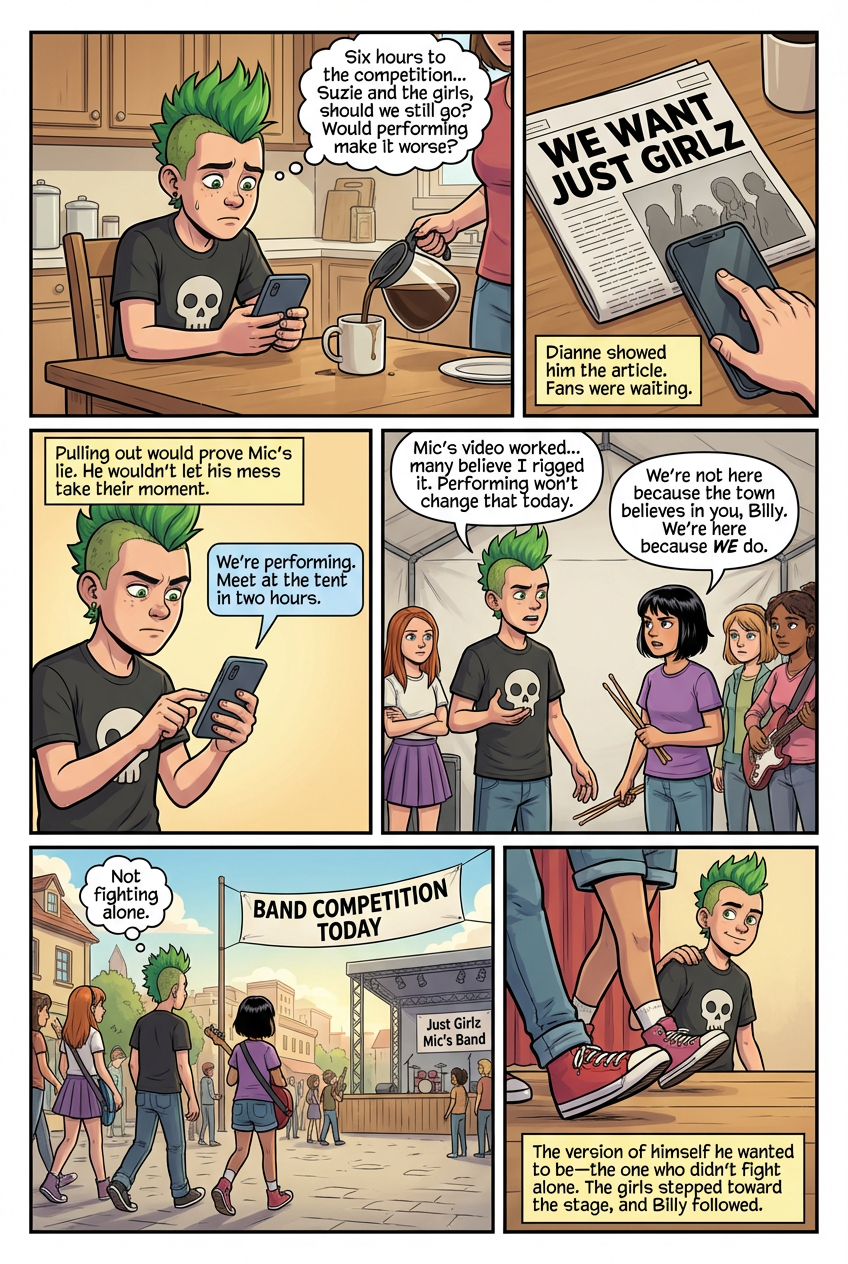
Billy sat at the kitchen table and watched Dianne refill his coffee. The competition was six hours away. He'd spent the morning texting with Suzie and the girls, trying to figure out if they should still show up. Every message came back to the same question—would performing make things worse for them? Dianne set down a printed news article she'd found online. The headline read "WE WANT JUST GIRLZ" in bold letters across the top. Fans had been posting all morning asking where the band was, saying they'd been waiting a year to see them perform. Billy stared at the page and realized pulling them out wouldn't protect them—it would prove Mic's lie worked. The girls would lose their shot, and everyone watching would think Billy had backed down because the accusation was true. He picked up his phone and texted Suzie: We're performing. Meet at the tent in two hours. Billy drove to the competition grounds and found the rehearsal tent where the girls were already waiting. Suzie looked tired but her drumsticks were in her hands. The other girls sat with their instruments unpacked, watching him. Billy told them the truth—Mic's video had worked, half the town believed he'd rigged the competition, and performing today wouldn't change that. But pulling out would hurt them more than him, and he wouldn't let his mess take their moment. Suzie stood up and said they weren't here because the town believed in Billy. They were here because they did. The other girls nodded. Billy felt something settle in his chest that had been loose for days. They walked to the town square together and saw the banner hung across the main stage: "BAND COMPETITION TODAY." Just Girlz was still listed on the lineup. Mic's name was at the top. Billy looked at the girls and saw them looking back at him, instruments ready, not afraid. He realized he wasn't trying to prove himself anymore. He was showing up for people who'd chosen to stand with him when it cost them something. That was the version of himself he wanted to be—not the one who won every fight, but the one who didn't fight alone. The girls stepped toward the stage, and Billy followed.
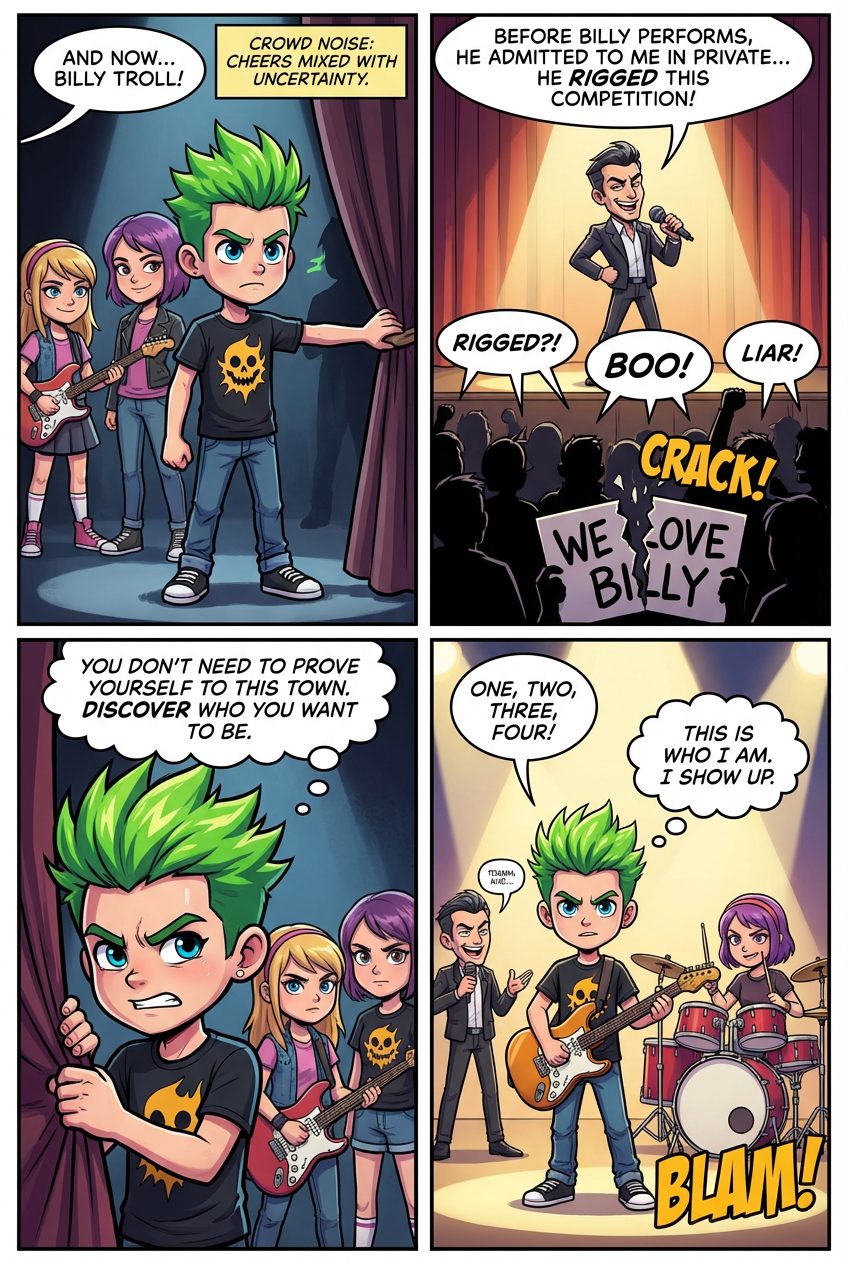
Billy stood backstage with the girls and heard his name called from the main stage. The crowd noise changed—half cheers, half something else he couldn't identify. Suzie looked at him and nodded toward the curtain. He stepped forward and saw Mic already at the microphone, holding it like he owned it. Mic tapped the silver top of the stand and smiled at the audience. "Before Billy performs," he said, "I need to tell you something he told me in private." Billy felt his stomach drop. Mic paused and let the silence build. "He admitted to me that he rigged this whole competition. Said he couldn't beat me fair, so he framed me instead." The crowd erupted. Someone in the front row held up a handmade sign that read WE LOVE BILLY, but the person next to them ripped it down. Billy watched the wooden sign hit the ground and break in half. Billy walked to the edge of the red curtain and gripped the velvet fabric. He wanted to step out there and call Mic a liar in front of everyone. He wanted to show them the envelope, the visitor ledger, everything he'd found. But Dianne's voice played in his head—You don't need to prove yourself to this town. You need to discover who you want to be. Billy let go of the curtain and turned back to the girls. They were watching him, instruments ready, waiting for his call. Billy nodded to Suzie and pointed at the stage. The girls walked past him toward the light, and he followed. Mic was still talking when Billy stepped into view, but the words didn't matter anymore. Billy picked up his guitar and stood beside Suzie's drums. He didn't defend himself. He didn't correct the lie. He just looked at the girls and counted them in. The first note rang out, and Billy realized he'd made his choice—not to win the argument, but to show up anyway. That was the version of himself he wanted to be.
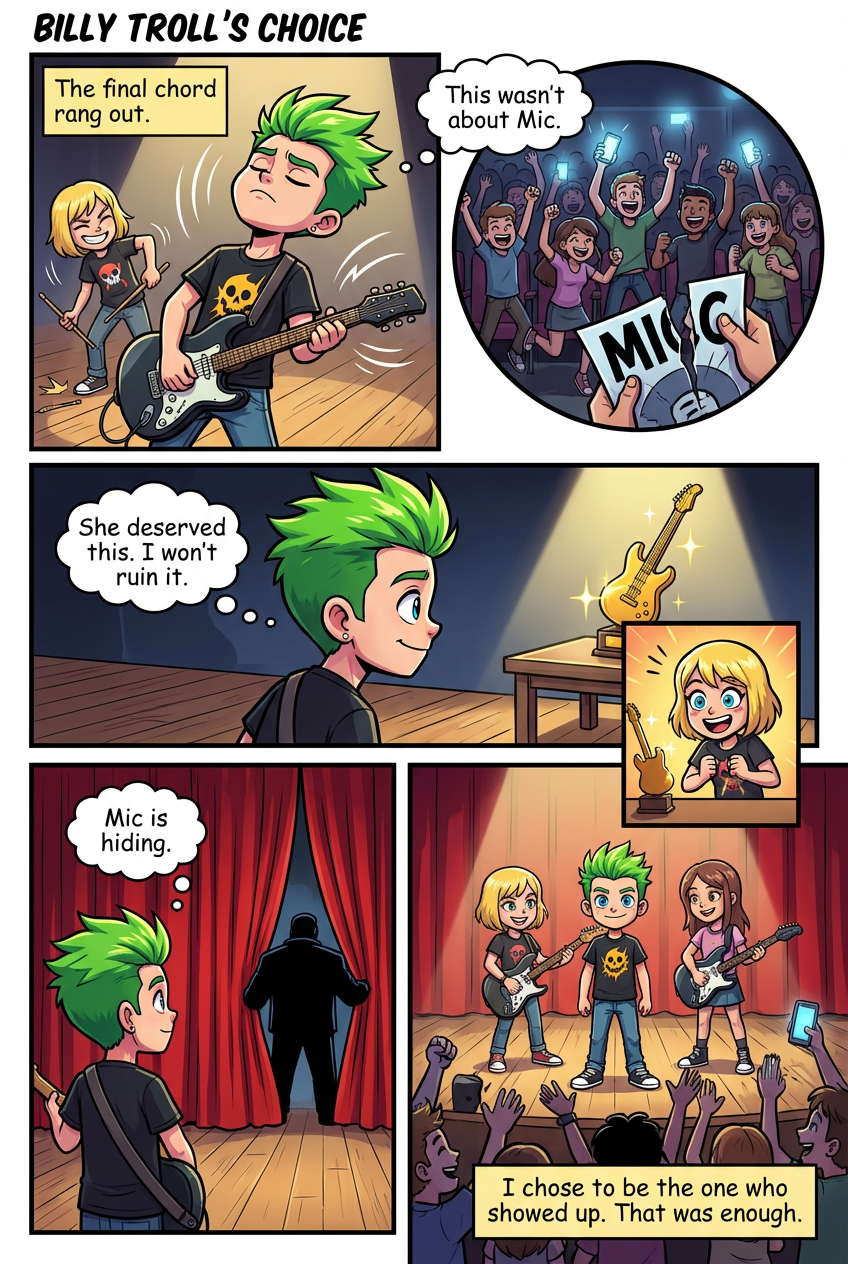
Billy hit the final chord and let it ring out across the wooden stage. The sound filled the space and hung in the air for three long seconds before fading. Suzie dropped her sticks on the drum rim and grinned at him. The other girls lowered their instruments and looked out at the crowd. Billy turned to face them too. The noise came like a wave. People jumped from their seats and shouted. Someone in the front row lifted a poster with Mic's name on it and tore it in half, then ripped it again until the pieces scattered on the ground. Billy watched the torn paper fall and felt something shift in his chest. He hadn't come here to destroy Mic. He'd come here to show up for the girls who believed in him when half the town didn't. Billy looked toward the side of the stage where the trophy sat on a small table. The guitar-shaped award caught the light and gleamed. He didn't need to win it. The girls did. They'd stood with him when it cost them something, and that mattered more than any prize. Billy glanced back at Suzie and saw her staring at the same trophy with wide eyes. She deserved this moment, and he wasn't going to take it from her by making it about his fight with Mic. Billy turned toward the red curtains at the back of the stage and caught sight of a dark shape moving behind them. The silhouette of someone tall and broad-shouldered slipped away from the edge of the fabric and disappeared into the shadows backstage. Mic was hiding. Billy could chase him down and demand he admit the truth in front of everyone. He could force the confrontation he'd been avoiding for twenty years. But standing here with Suzie and the girls, hearing the crowd cheer for them instead of tearing them down, Billy realized he didn't want that anymore. He wanted to be the person who showed up and played his best, even when the system was rigged. That was enough. That was who he chose to be.
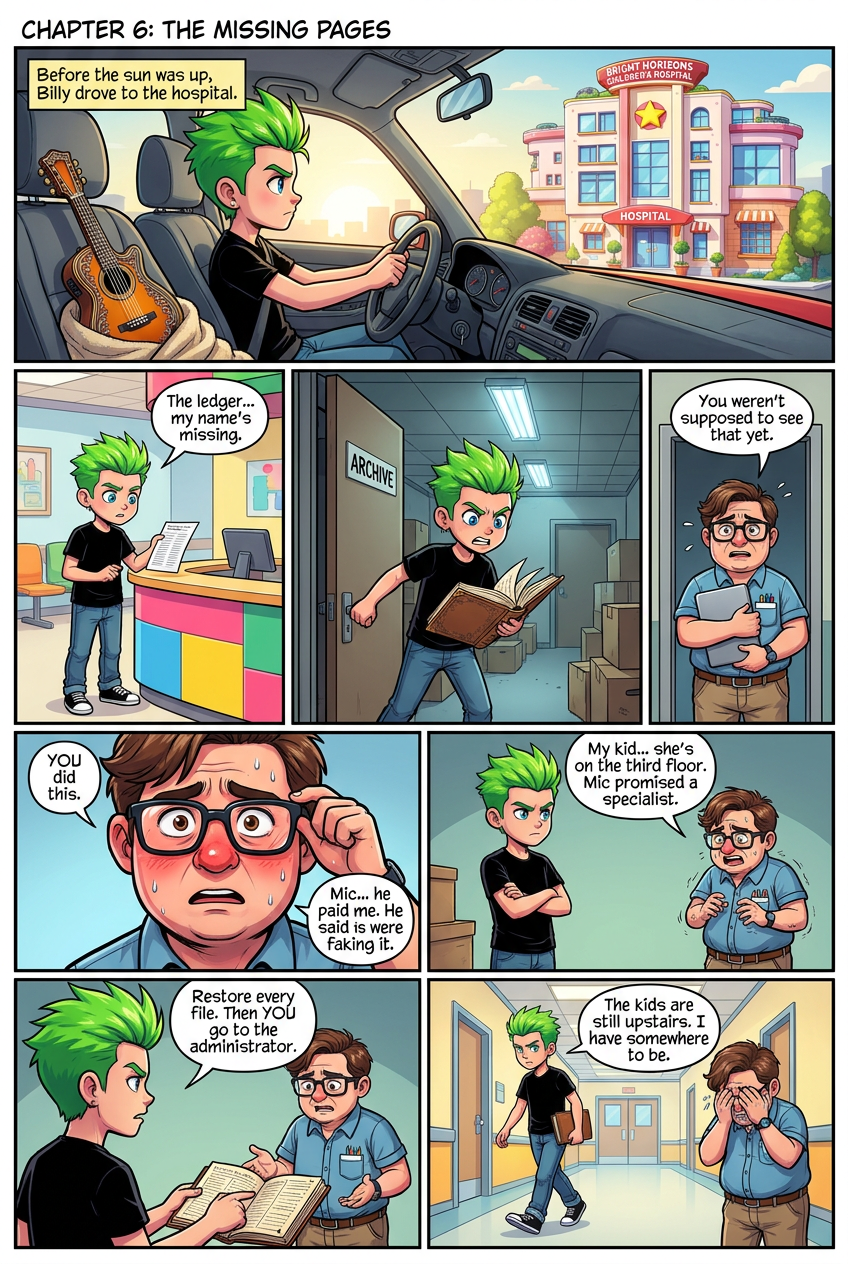
The morning after the competition, Billy drove to the hospital before the sun came up. The trophy sat in the back seat wrapped in a towel. He wanted to show it to the kids on the ward before the day nurses arrived. But when he stopped at the front desk to sign in, the ledger wasn't there. A printed sheet had replaced it. His name from last week was missing. Billy asked the volunteer at the desk where the old book had gone. She said the records had been moved to the archive room for scanning. Billy walked down the hall past the colorful murals and pushed open the archive door. Boxes sat stacked against the wall. He opened the top one and pulled out the ledger. He flipped to his own name and ran his finger down the column. Whole months were gone. Someone had cut pages out with a blade. The paper edges were clean and fresh. A voice behind him said, "You weren't supposed to see that yet." Billy turned. A short man with glasses and a badge clipped to his blue shirt stood in the doorway holding a laptop against his chest. Pens lined his shirt pocket. Billy had seen him before, hunched over a monitor at the nurse's station, fixing printers. The badge said Marcus Datawell, IT. "You did this," Billy said. He held up the cut ledger. Marcus didn't move. His face went red under the fluorescent lights. He set the laptop on a filing cabinet and pushed his glasses up his nose. "He paid me," Marcus said. "Mic. He said you'd been faking the visits. He wanted the digital files gone too. I was going to put it all back after the competition. I swear I was." His hands were shaking. "My kid is in this hospital, Billy. On the third floor. Mic said he could get her moved to the specialist in the city if I helped him." Billy set the ledger down on the table. He looked at Marcus for a long time. He thought about walking out and calling the administrator. He thought about the twenty years he'd spent keeping quiet while other people wrote his story. Then he thought about a scared father on the third floor. "Restore every file," Billy said. "Every page. Then you go to the administrator yourself and tell her what you did. Not me. You." Marcus nodded fast. "And your daughter?" Billy asked. Marcus looked at the floor. Billy pulled out his phone and opened his contacts. "Dianne knows the specialist. I'll ask her tonight. That part isn't a trade. That part is because your kid is sick." Marcus started crying. Billy picked up the cut ledger and tucked it under his arm. He walked out into the hall. The trophy was still in the car. The kids were still upstairs. He had somewhere to be.
Play your story to life
Storycraft is a mobile game where you create AI characters, craft items and locations to build their world, then discover what direction your story takes. Download the iOS game for free today!
Download for free