

Blush Cutiebunny's Arc
12 Chapters
Blush Cutiebunny's dream is proving to grown-ups that kids can be real heroes.

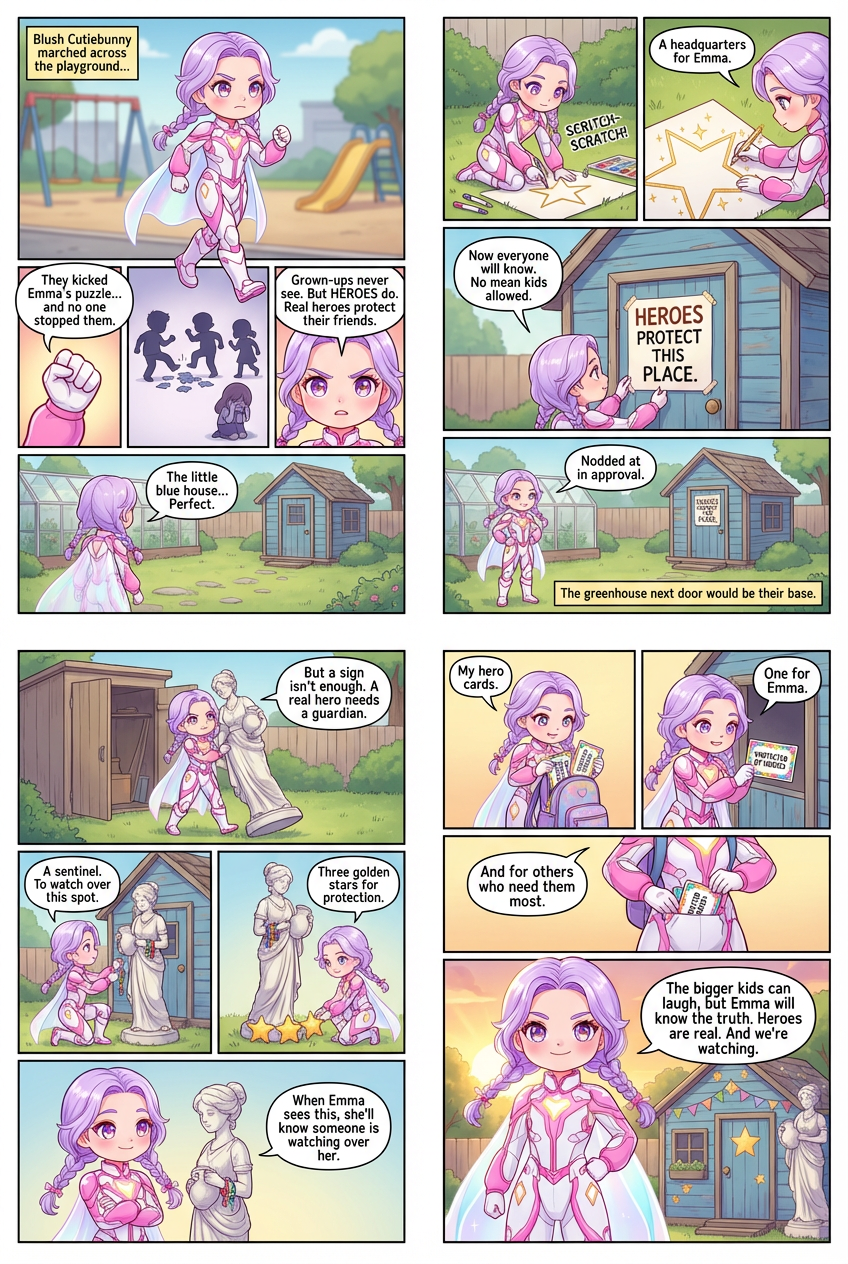
Blush Cutiebunny marched across the playground with her fists clenched tight. The bigger kids had kicked Emma's puzzle apart right before the bell rang, scattering pieces everywhere. Emma had cried, and nobody stopped them. Grown-ups never saw what really happened at recess, but heroes would. Real heroes protected their friends. She found the little blue house at the edge of the school garden. Perfect. Blush pulled out her markers and drew a giant star on poster board, then taped it to the front door. She added golden sparkles around the edges with her special gel pen. Underneath she wrote in big letters: HEROES PROTECT THIS PLACE. The greenhouse next to the house would be their headquarters, where Emma could build puzzles without anyone bothering her. Blush stood back and nodded. Now everyone would know that mean kids couldn't win here anymore. But a warning sign wasn't enough. Blush dragged a white statue from behind the art teacher's storage shed and positioned it right in front of the blue house. The lady holding the pitcher looked important, like she guarded something special. Blush hung her friendship bracelets on the statue's arms and placed three golden stars at its feet. She stepped back and crossed her arms. Any bigger kid who walked past would see it and know this spot belonged to heroes now. When Emma saw it tomorrow, she'd understand that someone was watching over her. Blush reached into her backpack and pulled out the small cards she'd decorated during art class. Each one had a sparkly rainbow border and said PROTECTED BY HEROES across the top. She tucked one inside the blue house for Emma. Then she made five more and slipped them into her pocket. Tomorrow she'd give them to the kids who needed protection most. The statue with its golden stars would stand guard while she was gone. The bigger kids could laugh all they wanted, but when Emma came to the blue house and found her card, she'd know the truth. Heroes were real, and they were watching.
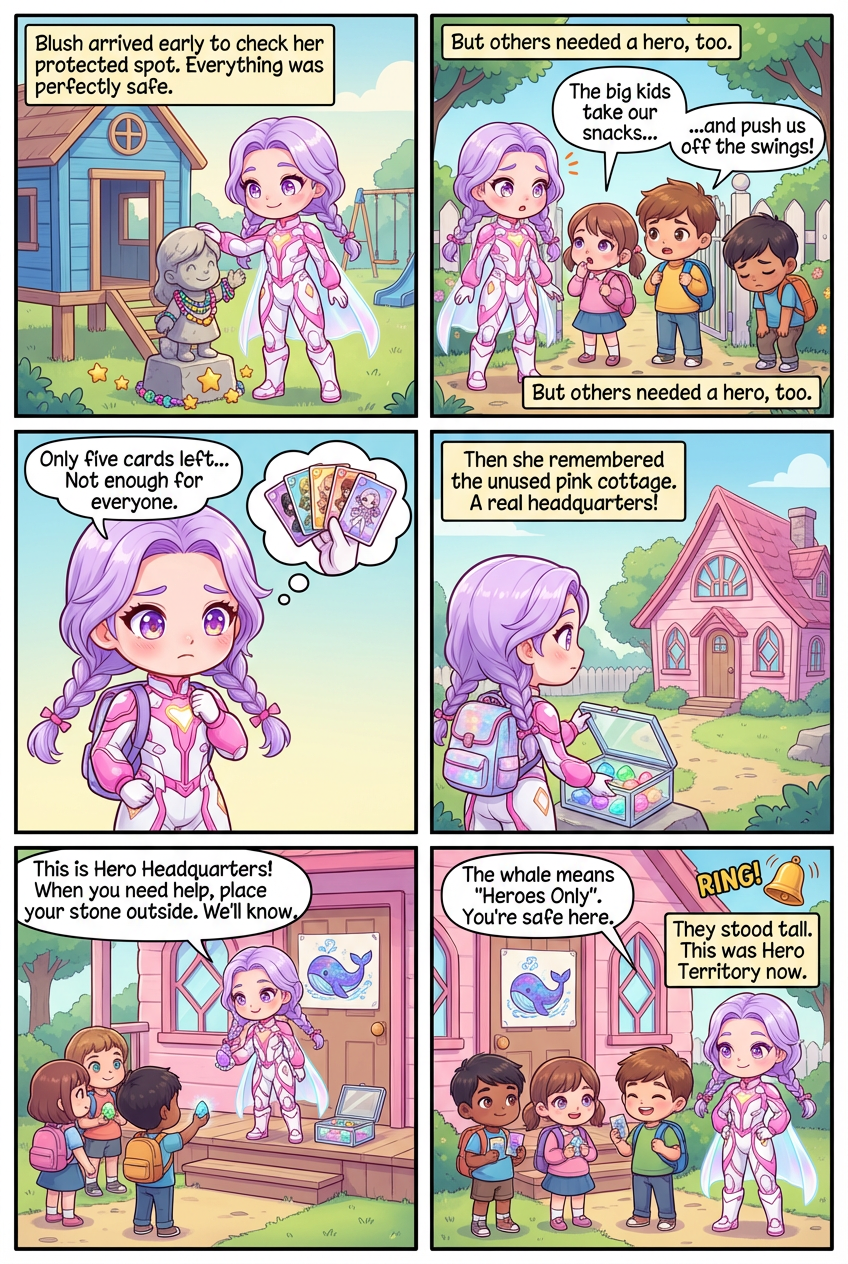
Blush arrived at school early the next morning, her pocket heavy with the special cards. She walked straight to the blue house to check on everything before the bell rang. The statue stood exactly where she'd left it, the friendship bracelets still draped over its arms. She smiled and patted the golden stars at its feet. But three kids were waiting for her by the garden gate, their backpacks clutched tight against their chests. The smallest one stepped forward first. "The big kids take our snacks every day," she whispered. "They push us off the swings." The boy next to her nodded fast. "They said we can't use the slide anymore." The third kid just stared at the ground, shoulders hunched like he expected Blush to laugh. They'd seen her poster, seen the protected spot she'd made for Emma. Now they wanted hero cards too. Blush's chest got tight. She only had five cards in her pocket, and more kids needed them than she'd planned for. She couldn't make enough cards for everyone who got picked on. Then she remembered the pink cottage past the garden, the one with the pretty windows that nobody ever used. If she could turn it into a real hero headquarters, kids wouldn't need cards to prove anything. They could just go there and be safe. She reached into her backpack and pulled out the glass case she'd brought from home, the one that held her mom's special stones. Each stone caught the light different colors. "Come with me," she said. Blush led them to the pink cottage and set the case on the porch steps where everyone could see it. She placed one stone outside the case for each of the three kids standing with her. "When you need help, you come here and add your stone to the outside. That's how heroes know someone needs them." She hung the whale drawing she'd made last night on the cottage door, its swirls of blue and purple shimmering in the morning light. "This means bigger kids can't come here. Only heroes and the people they protect." The smallest girl picked up her stone and held it tight. The boy put his in his pocket. The third kid finally looked up and nodded. Blush gave each of them a card anyway, because having proof in your hand made you braver. The bell rang across the playground, but none of them moved yet. They were standing in hero territory now, and everyone could see it.
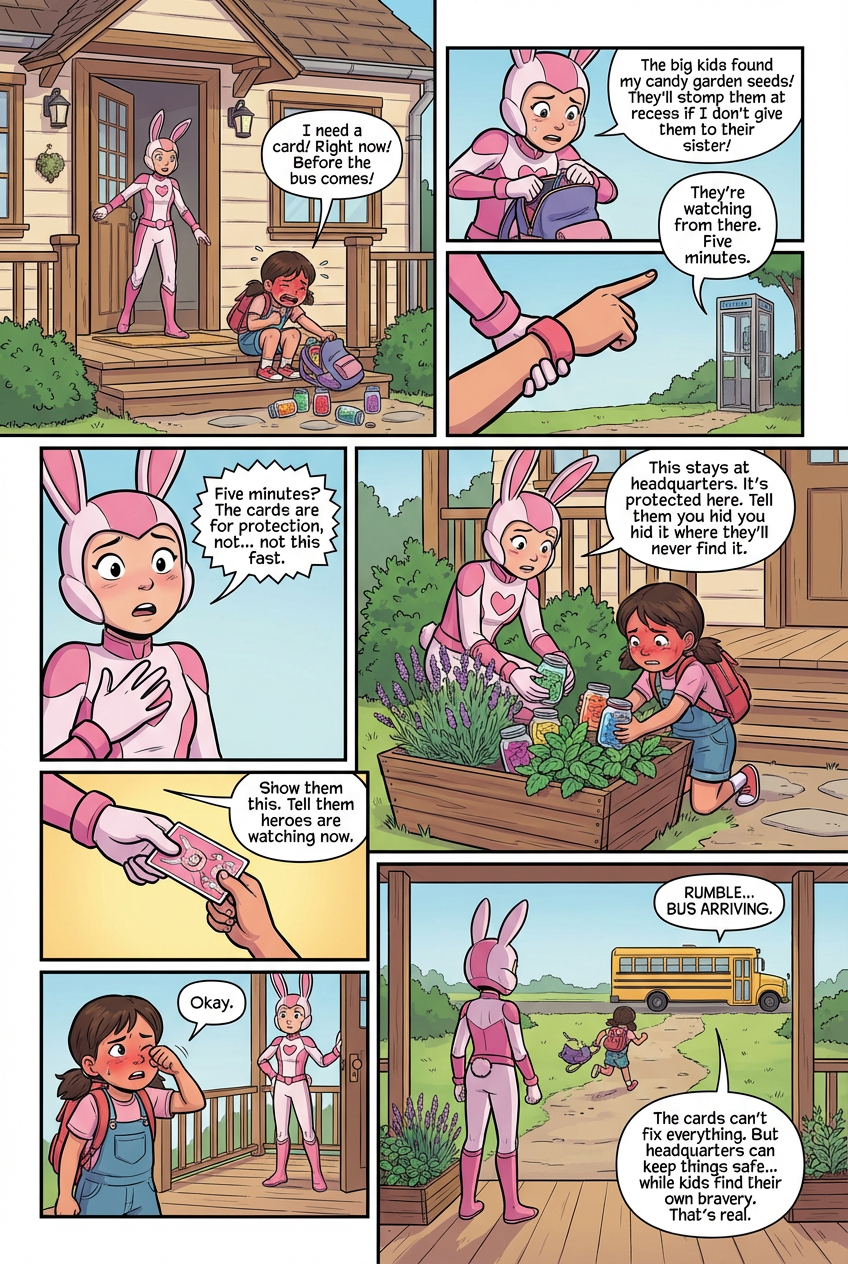
But when she opened the front door, Zorie was already there on the porch steps, breathing hard. Her backpack hung from one shoulder, the bottom seam ripped open. Bright glass jars with candy-colored seeds inside had spilled onto the ground around her feet. Zorie's face was red and tear-streaked. "I need a card," she said fast. "Right now. Before the bus comes." Blush pulled her backpack around and dug for a card, but Zorie grabbed her wrist. "The big kids found my candy garden seeds. They said they're going to stomp them all at recess unless I give them to their little sister." She pointed toward the old phone booth down the path where the bus always stopped. "They're watching from there. They told me I had five minutes." Blush's stomach went cold. The cards were supposed to protect kids after she gave them out, not solve problems this fast. She didn't know if a card would even work against kids who were already threatening someone. Blush looked at the wooden planter by the cottage door, the one filled with purple lavender and bright green mint. She grabbed it with both hands and set it on the bottom porch step, then helped Zorie gather all the spilled jars. They tucked each one carefully into the planter between the plants. "This stays at headquarters," Blush said. "It's protected here. Tell them you already hid it somewhere they'll never find." She pressed a hero card into Zorie's hand. "Show them this. Tell them heroes are watching now." Zorie stared at the card, then at the planter full of her precious jars, then back at Blush. Her breathing slowed down. She wiped her face with her sleeve and nodded once, hard. The distant rumble of the school bus echoed from somewhere beyond the phone booth. Zorie shoved the card in her pocket and ran toward the sound, her torn backpack bouncing against her back. Blush stayed on the cottage steps and watched her go. The hero cards couldn't fix everything by themselves. But headquarters could hold things safe while kids figured out how to be brave. That was something real she could do.
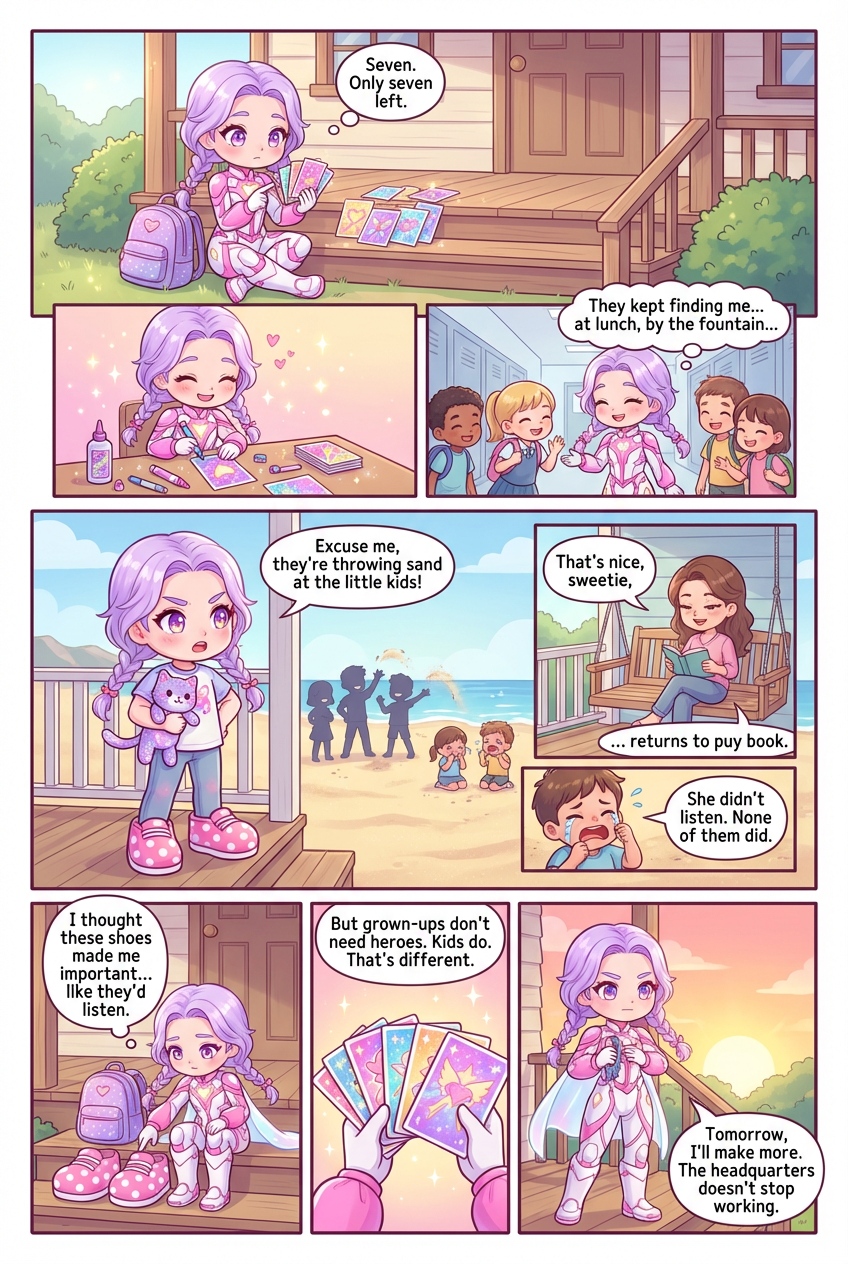
Blush sat on the cottage steps that afternoon and counted the cards left in her backpack. Seven. Only seven. She'd made twenty-three at the start of the week, using her best markers and all the glitter glue from the art supply bin. Now kids kept finding her between classes, at lunch, by the water fountain. She pulled out the pink polka dot shoes from the bottom of her backpack and set them on the step beside her. They were too big for her feet, way too big, but she'd found them in the donation box last year and knew they were special the moment she saw them. She'd worn them to the big beach house near school when the mean teenagers were throwing sand at the kindergarteners. She'd marched right up to the nearest grown-up reading on the porch and told her what was happening. The woman had looked at Blush's sparkly cat toy tucked under her arm, at her too-big shoes, and smiled the way people smile at puppies. "That's nice, sweetie," she'd said, and gone back to her book. Two minutes later, a little kid got sand in his eyes and started crying. Blush traced the white dots on the shoes with one finger. She'd kept them because they made her feel tall and important, like someone people would listen to. But that day taught her the truth: grown-ups saw the polka dots and the toy and the kid trying too hard, and they decided none of it mattered. They decided she didn't matter. She put the shoes back in her bag and looked at the seven cards. The cards weren't for grown-ups. They were for kids who needed to believe someone was watching out for them, even when the adults weren't paying attention. That was different from making grown-ups take her seriously. That was making something real that worked right now, today, for the kids who needed it. She stood up and brushed off her jeans. Tomorrow she'd make more cards during art time, enough for everyone who asked. The grown-ups didn't have to believe in heroes for the headquarters to keep working.
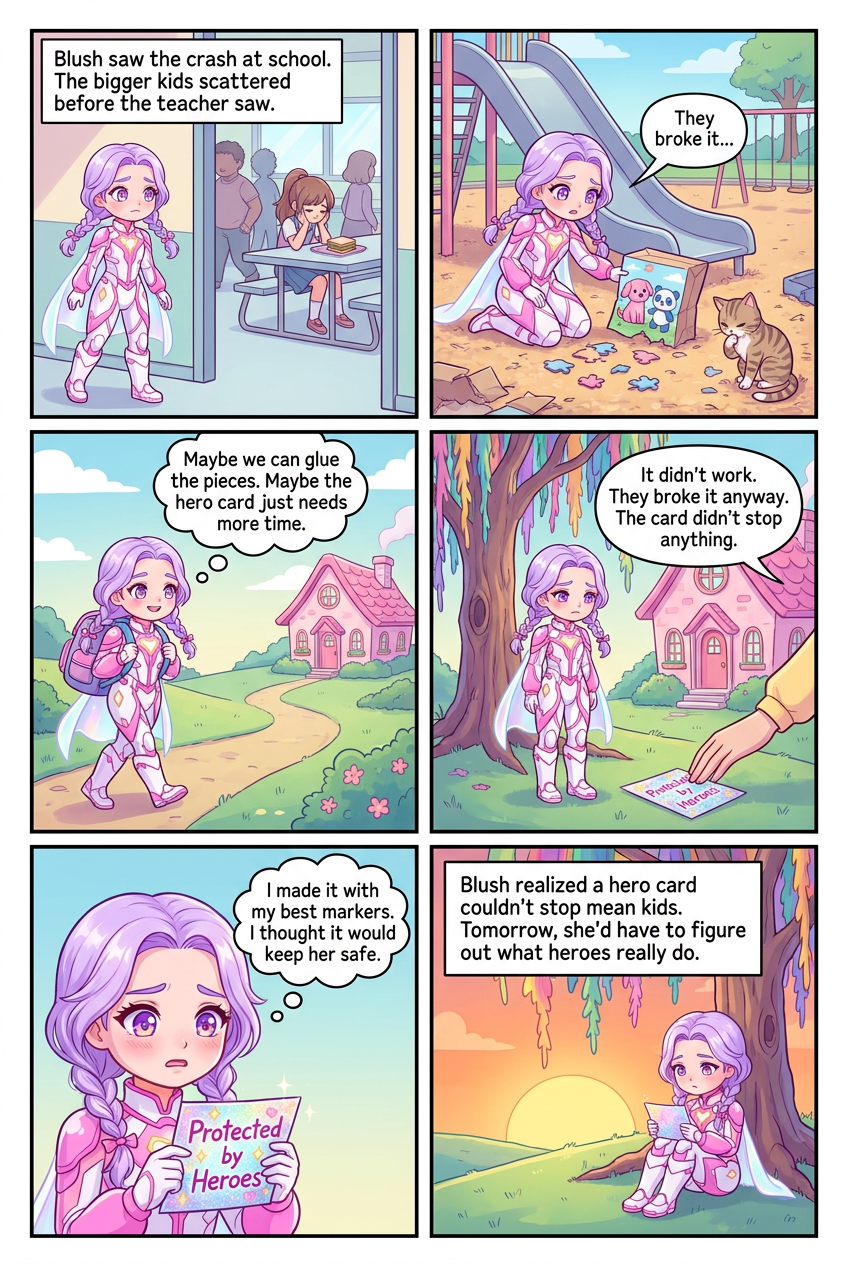
Blush found Emma at lunch, sitting alone at the corner table with her sandwich untouched. The puzzle Emma had brought for indoor recess was gone. Blush had seen the bigger kids crowding around Emma's desk earlier, heard the crash, watched them scatter before the teacher turned around. After school, Blush ran to the recess yard to look for pieces. She found the puzzle box crushed under the slide, the picture on the lid still visible—a pink dog hugging a blue panda, both smiling. Most of the pieces were scattered in the wood chips, snapped in half or missing corners. A tabby cat sat nearby, cleaning its paw, watching her gather what remained. Blush filled her backpack with broken pieces and brought them to the pink cottage, hoping Emma would want to fix it together. Maybe they could glue the pieces. Maybe the card just needed time to work. Emma came to the cottage before dinner. She didn't look at the puzzle pieces Blush had collected in a pile by the door. She pulled the hero card from her pocket—the one Blush had left at the blue house last week—and set it on the ground under the strange tree with the colorful hanging branches. "It didn't work," Emma said. Her voice was flat, tired. "They broke it anyway. The card didn't stop anything." She walked away without waiting for an answer. Blush picked up the card and turned it over in her hands. She'd made it with her best markers, added extra glitter glue around the edges, written "Protected by Heroes" in careful letters. She'd believed it would keep Emma safe, that just knowing someone cared would make the mean kids think twice. But Emma's puzzle was still broken. The bigger kids still did whatever they wanted. Blush sat down under the tree and stared at the card until the sky turned orange. The headquarters could hide things and the cards could make kids feel braver, but they couldn't actually stop anyone from being mean. She'd been giving out protection she couldn't deliver. Tomorrow she'd have to figure out what heroes were supposed to do when feeling brave wasn't enough.
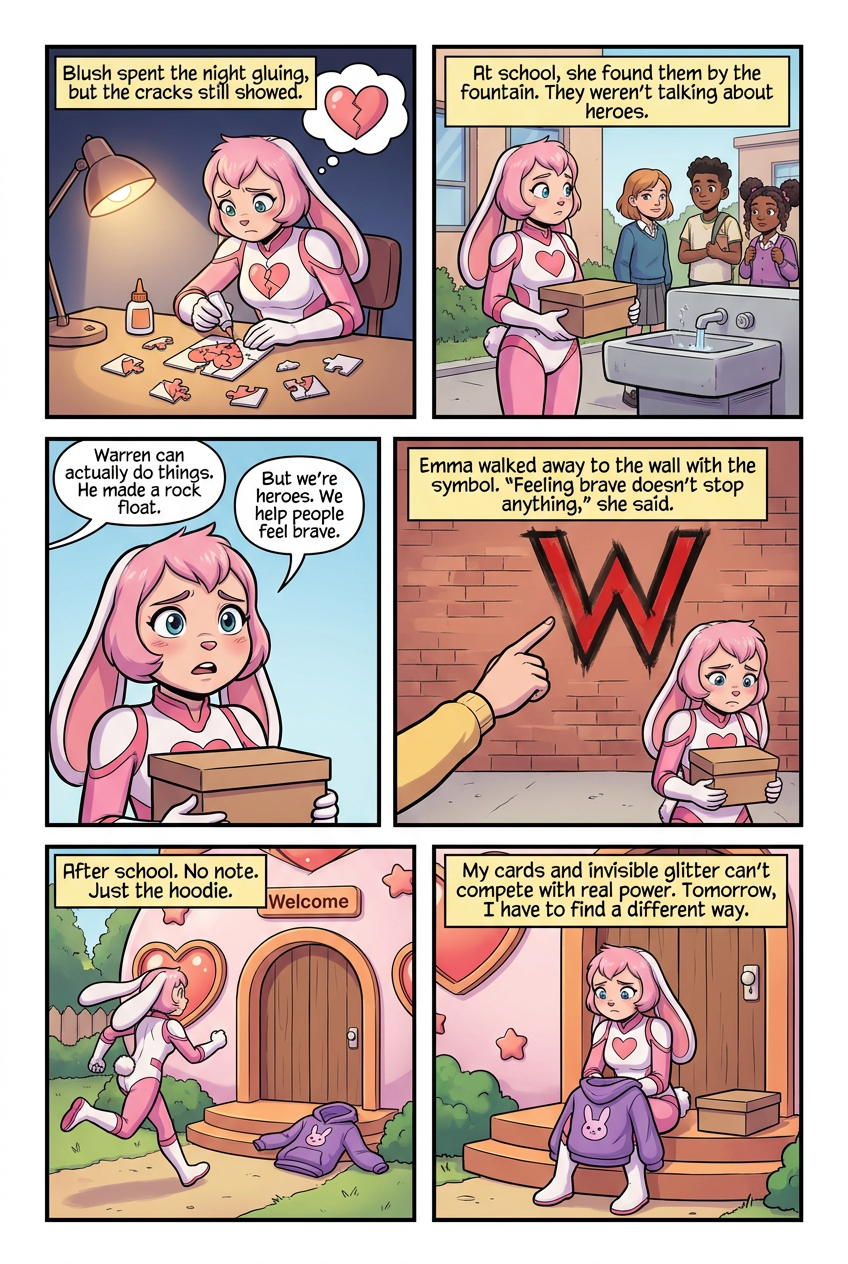
Blush spent the night gluing puzzle pieces back together, but the cracks still showed. In the morning, she brought the repaired puzzle to school in a shoebox, planning to give it to Emma before class. She found Emma by the water fountain with David Moonboom and Zorie Lavenderbee, but they weren't talking about puzzles or hero cards. "Warren can actually do things," Emma said, not looking at Blush. "He showed us yesterday. He made a rock float in the air. No strings, no tricks." David nodded, eyes wide. Zorie twisted her fingers together but didn't disagree. Blush held the shoebox tighter, feeling the weight of the broken puzzle inside. "But we're heroes," she said. "We help people feel brave." Emma finally looked at her. "Feeling brave doesn't stop anything. Warren's group actually has power." She walked away toward the brick wall near the playground where someone had painted a huge red and black symbol with a W in the center. David and Zorie followed. Blush ran to the pink cottage after school and found a purple hoodie folded on the ground by the door—the one Emma had worn all last week, the one with the bunny on the front. No note, no explanation. Just the hoodie, left behind like the hero card. Blush picked it up and saw other kids walking past the cottage toward the field where Warren's tent stood. Through the trees, she could see the colorful graffiti wall he'd set up, the word KINGS painted in huge gold letters. Six kids were already there. Maybe more. Blush sat on the cottage steps with Emma's hoodie in her lap and the broken puzzle beside her. She'd tried to prove kids could be heroes by making everyone feel protected, but feeling protected wasn't the same as being protected. Warren showed real power—things that actually worked, things people could see. Her cards and her cottage and her invisible glitter couldn't compete with that. She folded the hoodie carefully and placed it inside the cottage, then walked home without looking back at the field. Tomorrow she'd have to find a different way to prove heroes were real, because feeling brave wasn't going to be enough anymore.
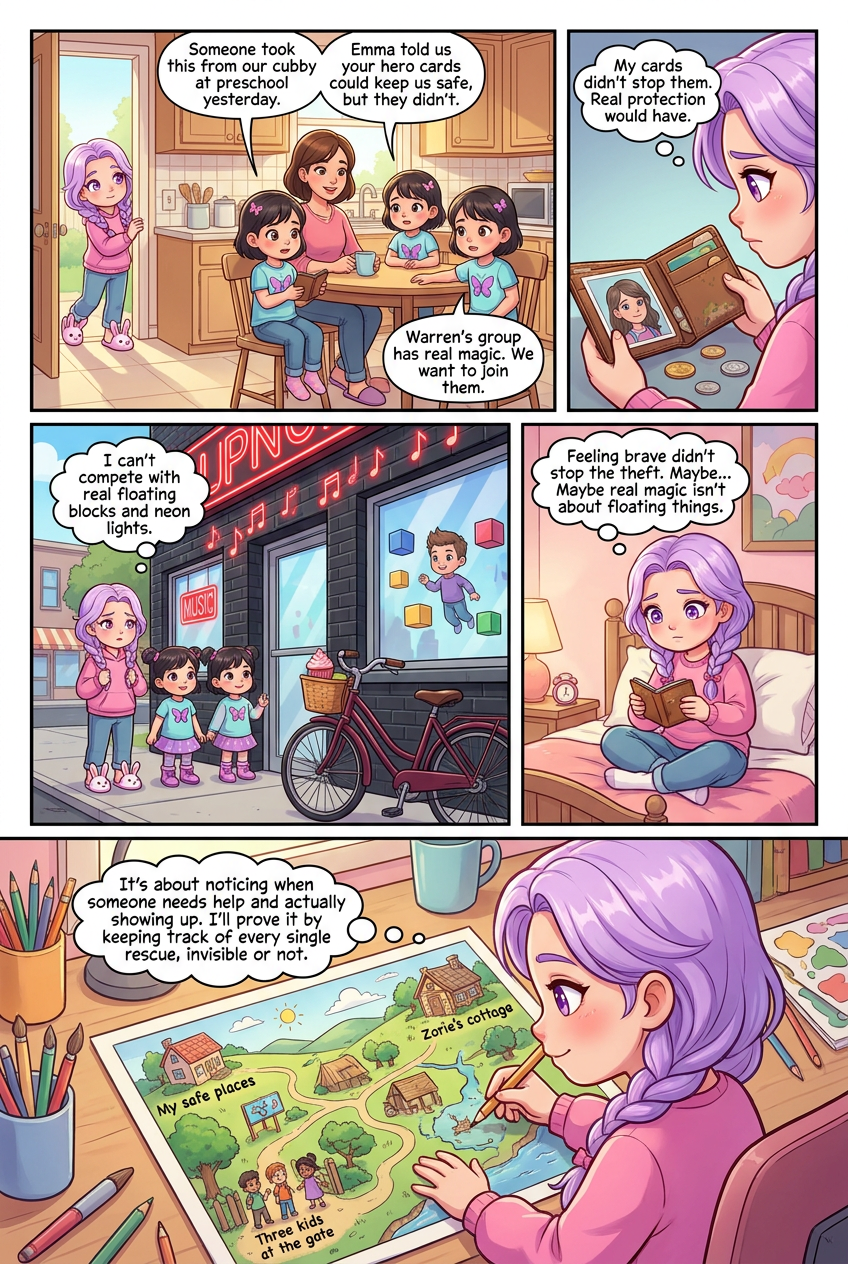
Blush woke up Saturday morning and heard voices in the kitchen. Emma's voice. She crept to the doorway in her bunny slippers and saw Emma's two younger sisters sitting at the table with her mom. They were maybe four and five, wearing matching butterfly shirts. The smaller one held out a worn leather wallet. "Someone took this from our cubby at preschool yesterday," she said, her voice wobbly. "Emma told us your hero cards could keep us safe, but they didn't. They just laughed and said heroes aren't real." The older sister nodded. "Warren's group has a place with neon lights and music near the field. Emma said they do actual magic there. We want to join them instead." Blush's mom looked at her, waiting. Blush took the wallet and saw a photo inside—some girl she didn't know, with coins scattered around it. Real protection would have stopped the stealing. Her cards hadn't. Blush walked to the field after breakfast. A maroon bicycle with a cupcake in the basket sat by the entrance to a building she'd never seen before—black bricks with bright red concert signs glowing even in daylight. Music thumped from inside. Emma's sisters stood by the bike, holding hands, staring at the doors like they were waiting for something wonderful. Blush could see other kids through the windows, watching Warren float colored blocks in the air. She'd come to convince the sisters her group was enough, but the words died in her throat. She couldn't compete with floating blocks and neon lights. She walked back home and sat on her bed with the wallet still in her pocket. The sisters were right—feeling brave didn't stop theft or protect cubbies. Warren's magic was real and visible. Her invisible glitter and hero cards were just pretend. But then she thought about the three kids at the school gate who'd wanted cards, about Zorie's seed jars hidden safely at the cottage, about how her protection sign had made Emma smile before the puzzle broke. Maybe real magic wasn't about floating things. Maybe it was about noticing when someone needed help and actually showing up. She pulled out her art supplies and started making something new—not hero cards this time, but a map showing every safe place she'd created, every hiding spot, every kid she'd helped. If grown-ups wouldn't believe kids could be heroes, she'd prove it by keeping track of every single rescue, invisible or not.
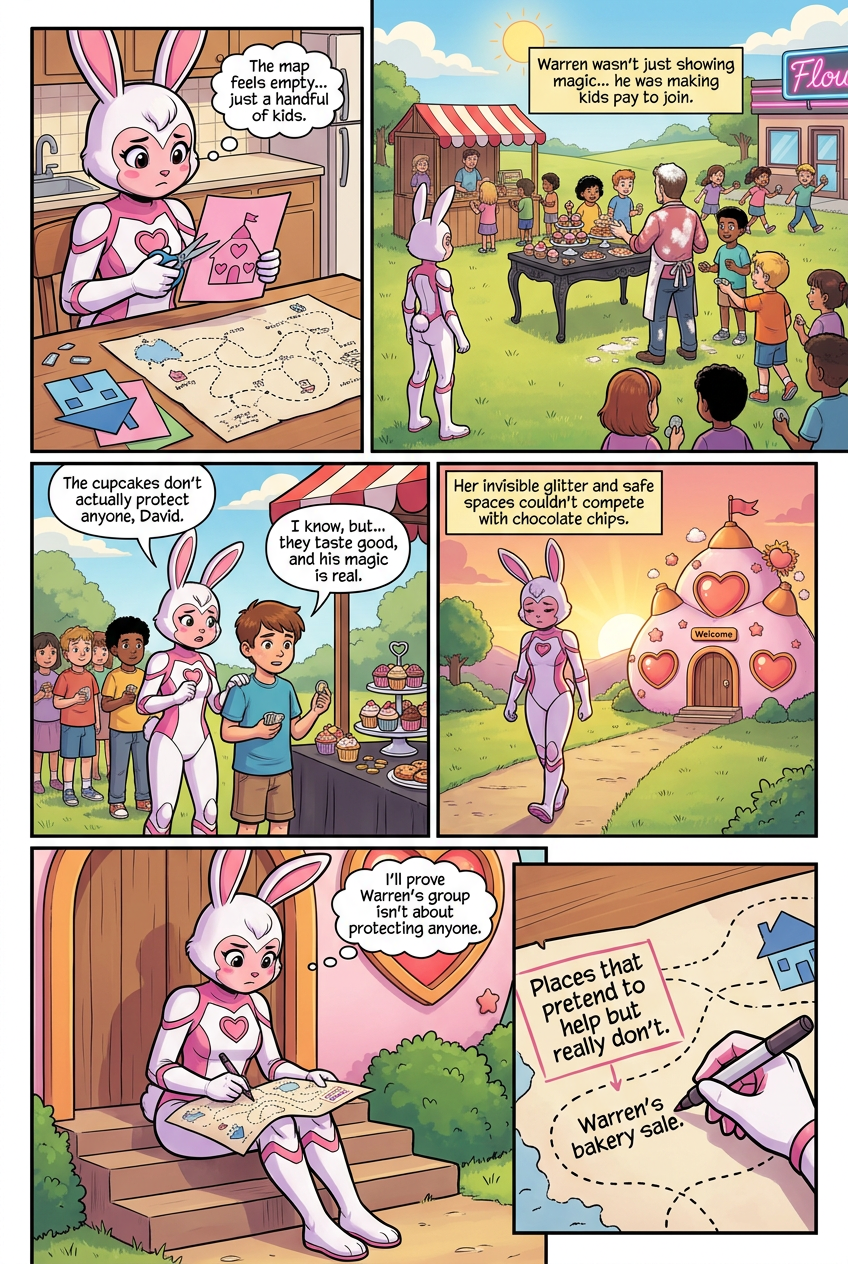
Blush spent Sunday morning cutting construction paper at the kitchen table, adding the pink cottage and the blue house to her rescue map. She drew dotted lines between them and wrote tiny labels for each hiding spot. But when she looked at it, the map felt empty—just two places and a handful of kids who'd already left for Warren's group. She walked to the field Monday after school to see how many kids Warren had now. A wooden stall with red and white striped awnings sat near his building, surrounded by at least fifteen kids from different grades. Behind the counter stood Warren wearing a flour-covered apron with money sticking out of the pocket. A fancy black table next to him displayed cupcakes, cookies, pies, and cakes arranged like a palace feast. Kids handed over coins and walked away with treats, some heading straight into the neon-lit building. Blush watched a second-grader buy three cookies, then ask Warren about joining. Warren pointed at the doors and smiled. Blush's chest went tight. She'd been handing out cards and hiding seed jars while Warren was selling cupcakes and turning snacks into memberships. Her invisible glitter and safe spaces couldn't compete with chocolate chips and strawberry frosting. She turned to leave, but stopped when she saw David in line, coins in his palm. He hadn't bought anything yet. She walked over and stood next to him. "The cupcakes don't actually protect anyone," Blush said quietly. David looked at the dessert table, then at Warren's apron stuffed with cash. "I know," he said. "But they taste good, and his magic is real." He handed Warren his coins and took a cookie. Blush walked back to the pink cottage alone, the apron and the stall and the crowd of kids burned into her mind. Warren wasn't just showing magic anymore—he was making kids pay to join, turning heroes into customers. She sat on the cottage steps and pulled out her rescue map. Grown-ups might not believe kids could be heroes, but she could prove Warren's group wasn't about protecting anyone at all. She added a new section to her map: "Places that pretend to help but really don't." Warren's bakery sale went at the top.
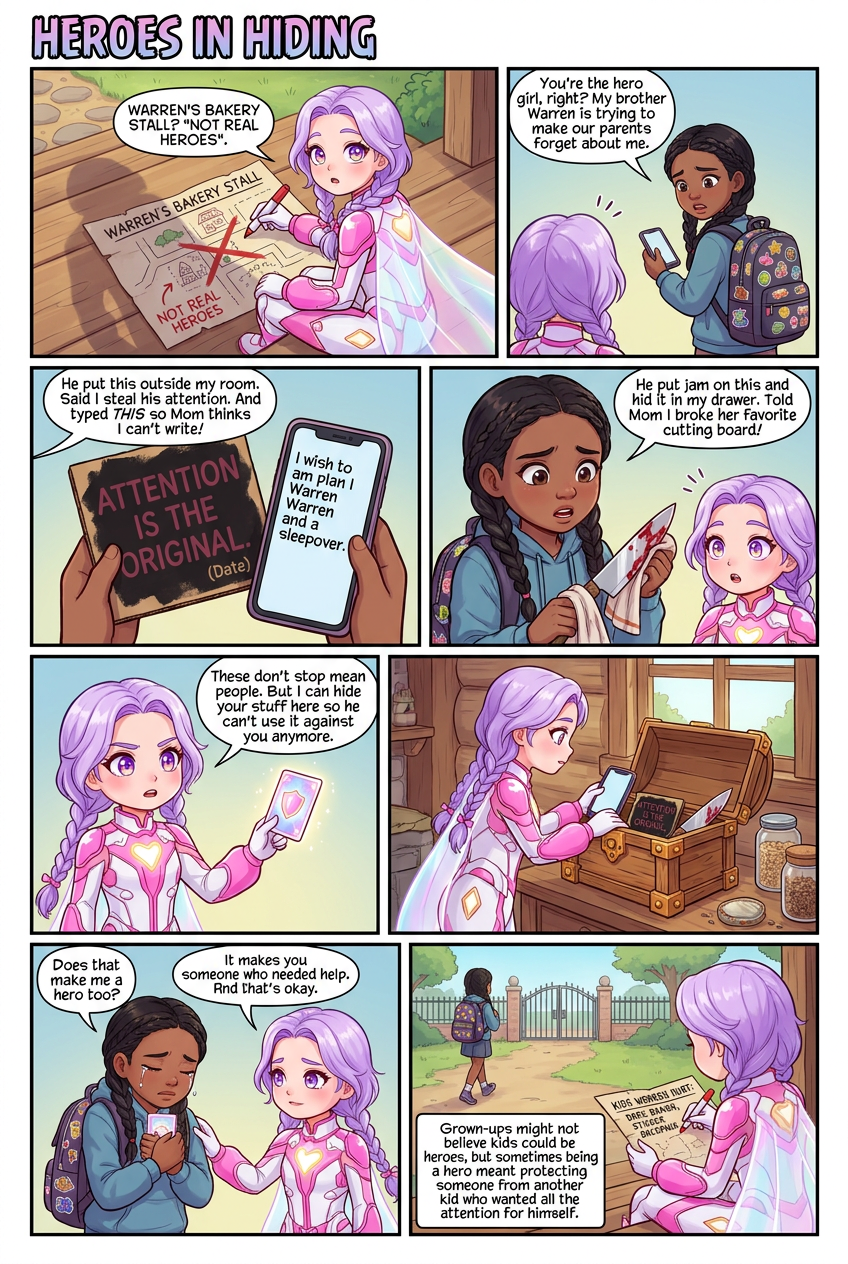
Blush sat on the cottage steps Tuesday afternoon, adding Warren's bakery stall to her map in red marker. She drew an X through it and wrote "NOT REAL HEROES" in careful letters underneath. A shadow fell across the paper. She looked up and saw a girl about her age standing at the edge of the garden. The girl had dark braids and wore a backpack covered in stickers. She held a phone in one hand and pointed at the cottage with the other. "You're the hero girl, right?" she said. "I need help. My brother Warren is trying to make our parents forget about me." She pulled something from her backpack—a cardboard square painted black with maroon letters. The words read "Attention is the Original" with a date underneath. "He put this outside my room," she said. "He says I steal his attention and his magic won't work if I'm around. He's been telling Mom and Dad I'm lying about everything." Blush stood up slowly, studying the painted board. The girl thrust the phone forward. On the screen was a text message: "I wish to am plan I Warren Warren and a sleepover." The girl's voice cracked. "He typed that on my phone so Mom would think I can't write. He wants them to send me away." Blush's hands felt cold. She'd been focusing on Warren's bakery stall and his magic tricks, but she hadn't thought about who Warren might hurt at home. The girl set down her backpack and pulled out a kitchen knife wrapped in a towel. Red stains covered the blade. Blush stepped back. "He told Mom I broke her favorite cutting board," the girl said quickly. "But he put jam on the knife and hid it in my drawer. I found it this morning." Blush looked at the painted board, the phone, the knife. Warren wasn't just pretending to be a hero—he was making his own sister look bad so he could be the only one people noticed. Blush picked up one of her protection cards from the cottage steps and held it out. "These don't stop mean people," she said. "But I can hide your stuff here so he can't use it against you anymore." The girl took the card and clutched it against her chest. She handed Blush the phone, the painted board, and the wrapped knife without saying anything. Blush carried them inside the cottage and placed them in the wooden chest next to Zorie's seed jars. When she came back out, the girl was crying. "Does that make me a hero too?" she whispered. Blush shook her head. "It makes you someone who needed help," she said. "And that's okay." The girl wiped her face and walked back toward the school gate. Blush sat down and picked up her map again. She added a new section next to Warren's bakery: "Kids Warren hurt." Underneath she wrote the girl's description—dark braids, sticker backpack—because she'd never asked her name. Grown-ups might not believe kids could be heroes, but Blush had just proven that sometimes being a hero meant protecting someone from another kid who wanted all the attention for himself.
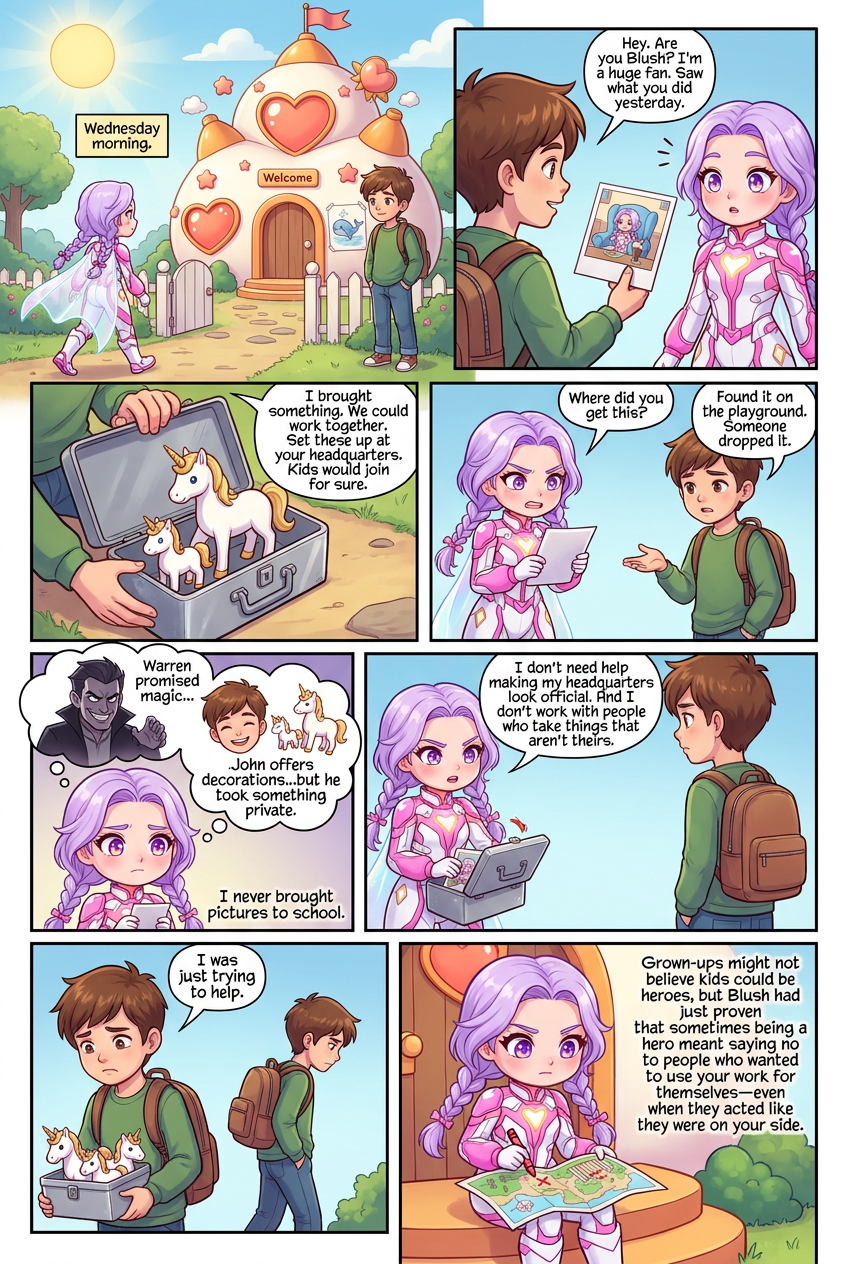
Blush walked to the cottage Wednesday morning and found someone waiting by the garden gate. John Maloney stood with his hands in his pockets, looking at the whale drawing she'd taped to the cottage door. He turned when he heard her footsteps. "Hey," he said. "Are you Blush?" He pulled something from his backpack—a photograph of her sitting in a big blue chair at home with a chocolate milkshake, watching cartoons. "I'm a huge fan. I saw what you did for that girl yesterday. The one with the dark braids." He set down a metal box by the gate. "How about we work together and make our ideas together? I brought something to show you." Blush stared at the photograph. She'd never met John before, but he'd somehow gotten a picture from her house. He opened the metal box and lifted out two plastic unicorns—one big and one small, both white with gold horns. "I thought we could set these up at your headquarters," he said. "Make it look more official. Kids would join for sure." Blush picked up the photograph and held it carefully. Her stomach felt tight. "Where did you get this?" she asked. John shrugged. "Found it on the playground yesterday. Someone must have dropped it." But Blush knew she'd never brought pictures from home to school. She looked at the metal box, at the unicorns, at John's eager smile. Warren had promised magic and treats to get kids to follow him. Now John was offering decorations and partnership—but he'd taken something private without asking. Blush set the photograph back in the metal box and closed the lid. "I don't need help making my headquarters look official," she said. "And I don't work with people who take things that aren't theirs." John's face changed. "I was just trying to help," he said, but he picked up the box and unicorns and walked away without looking back. Blush sat on the cottage steps and pulled out her map. She didn't add John's name to the "Kids Warren hurt" section, but she drew a small red X next to the garden gate with the words "not everyone who says they're a fan is really helping." Grown-ups might not believe kids could be heroes, but Blush had just proven that sometimes being a hero meant saying no to people who wanted to use your work for themselves—even when they acted like they were on your side.
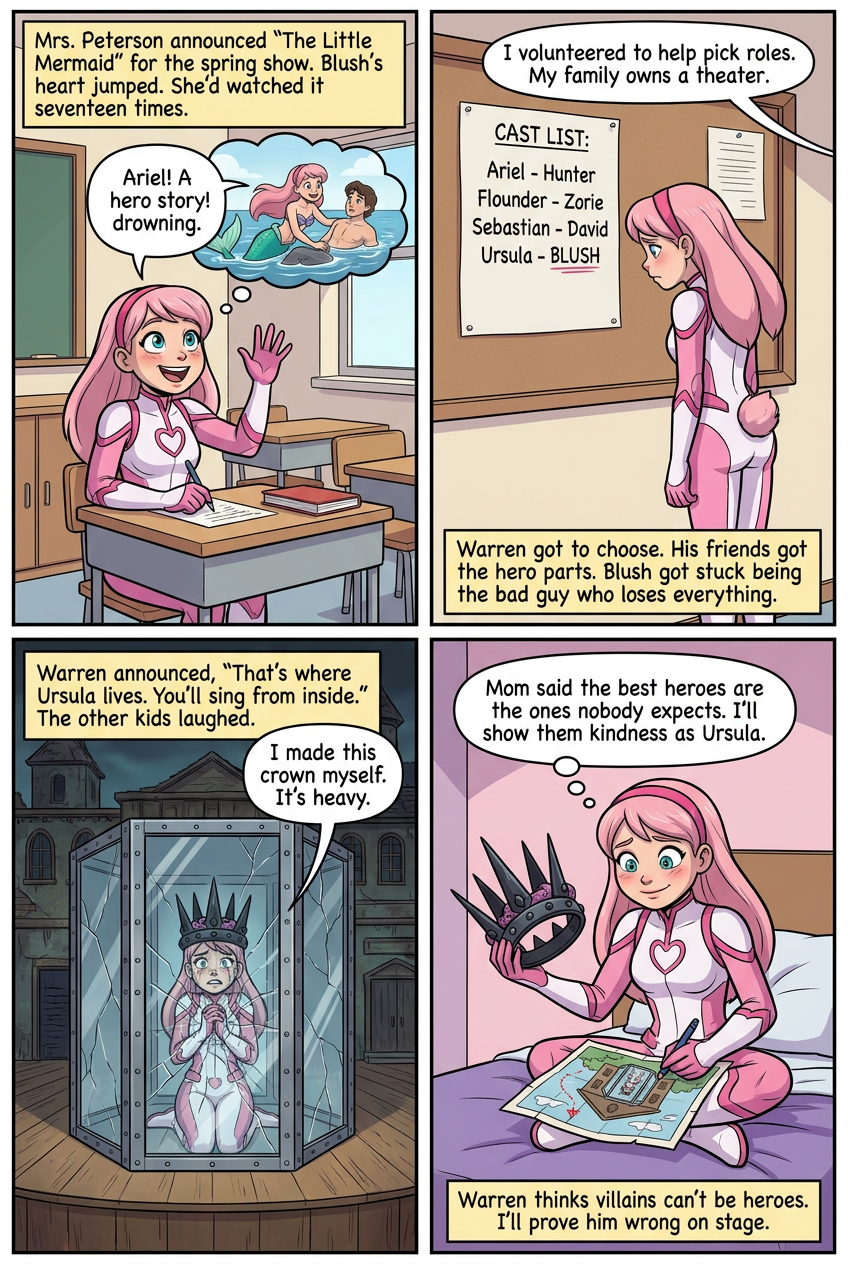
Thursday morning, Mrs. Peterson announced that their class would perform The Little Mermaid for the spring show. Blush's heart jumped. She'd watched the movie seventeen times and knew every song by heart. Maybe she'd get to be Ariel, swimming through the ocean and saving Prince Eric from drowning—a real hero story where everyone could see it. But at lunch, Mrs. Peterson explained that Warren had volunteered to help pick roles and design costumes since his family owned a theater with real stage equipment. Blush's stomach dropped when Warren smiled at her from across the cafeteria. The cast list went up after recess, and Blush found her name next to Ursula—the villain who tried to steal Ariel's voice and trick everyone. Hunter got Ariel. Zorie got Flounder. David got Sebastian. All the hero parts went to Warren's friends, and Blush got stuck being the bad guy who loses everything at the end. Friday afternoon, Warren led the class to a building near the school with tall windows and exposed brick walls. A wooden stage filled one end of the room, and in the center sat a giant glass box with steel frames and cracks running through every panel. "That's where Ursula lives," Warren announced, pointing at Blush. "You'll sing your songs from inside the cracked box so everyone can see the sea witch trapped in her own lair." The other kids laughed. Warren pulled out a crown covered in black spikes and dark tentacle bands wrapped around the base. "And this is your costume. I made it myself." He set it on Blush's head, and the weight made her neck hurt. Through the cracked glass panels, Blush could see her reflection split into dozens of broken pieces. Blush walked home with the crown in her backpack, feeling the spikes poke through the fabric. Warren had given her the villain role on purpose—to show everyone that his magic and his theater and his choices mattered more than her hero cards ever did. But sitting on her bed that night, Blush remembered something her mother had told her: the best heroes were the ones nobody expected, the ones who kept showing up even when people tried to make them disappear. She pulled out her rescue map and drew the theater building with the cracked glass box in the center. Next to it she wrote: "Warren thinks villains can't be heroes. I'll prove him wrong on stage." Grown-ups might believe Warren controlled the story, but Blush had just decided that being assigned the villain role didn't mean she had to act like one—and maybe showing kindness as Ursula would prove more about real heroism than playing Ariel ever could.
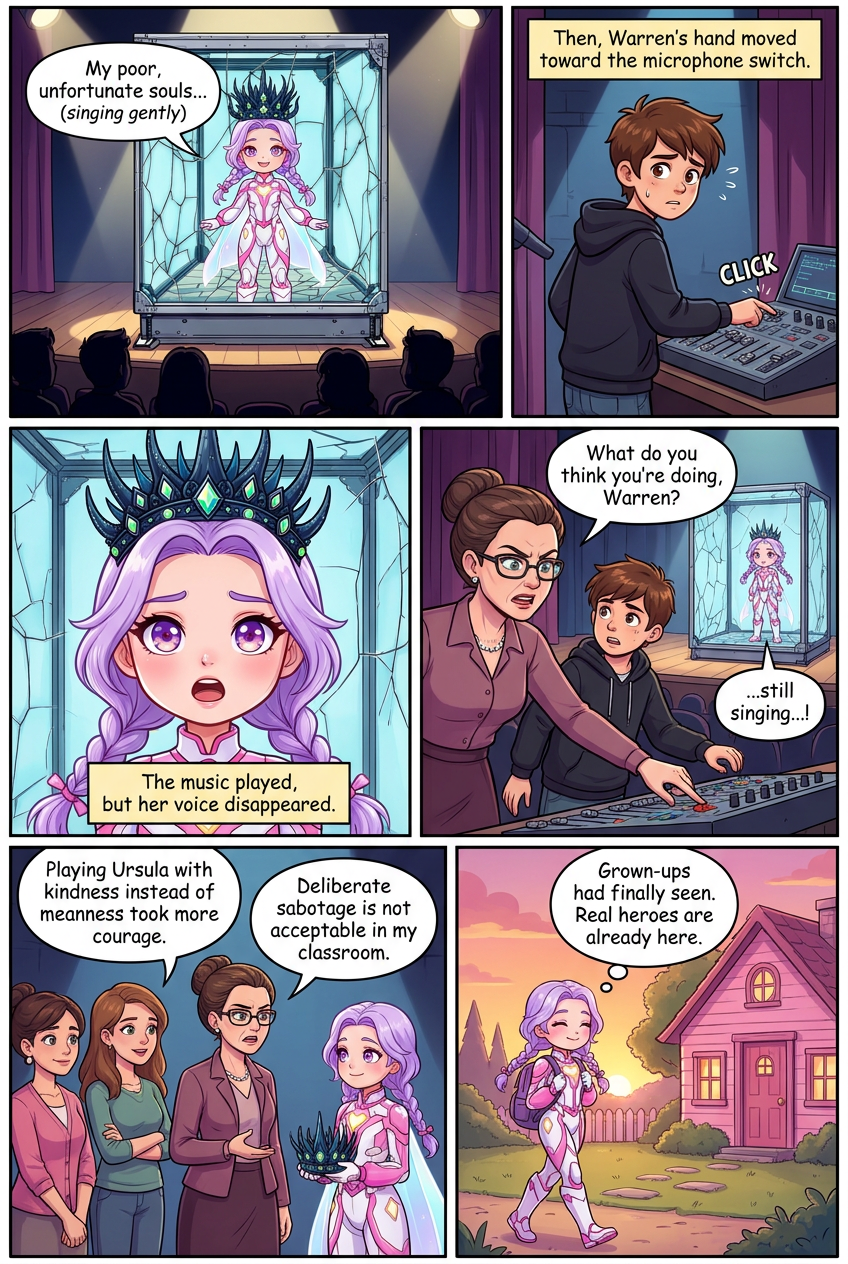
Opening night arrived on a Tuesday. Blush put on the heavy spiked crown and squeezed into the cracked glass box while families filled the seats. When her scene started, she sang Ursula's song but changed her voice from mean to gentle, like she was offering Ariel a real choice instead of a trap. She moved her hands slowly and smiled at the audience, showing them that even villains could care about people. Warren stood backstage by the sound equipment, watching her through the curtains. His hand moved toward the mixing board. Blush kept singing, pouring all her heart into making Ursula kind and protective instead of cruel. Then her microphone clicked off mid-note. The music kept playing but her voice disappeared. Blush kept singing anyway, even though nobody could hear her anymore. She pressed her hands against the cracked glass and mouthed the words, trying to show everyone that heroes don't stop just because someone takes away their voice. The audience shifted in their seats. Some parents leaned forward, confused. Hunter stumbled through her next line as Ariel, waiting for Ursula's response that never came. Blush saw Mrs. Peterson rush toward the sound board where Warren stood. She grabbed the microphone switch and flipped it back on. Blush's voice returned halfway through the final verse, stronger than before. The song ended and Blush stayed in character, placing one hand over her heart like Ursula was learning something new. When the curtain fell, Mrs. Peterson called Warren into the hallway. Through the stage door, Blush heard her teacher's firm voice asking why the microphone had been turned off during the performance. Warren said it was an accident, that he'd leaned against the board by mistake, but Mrs. Peterson didn't sound like she believed him. After the show, three mothers approached Blush by the costume rack. One said her daughter had been talking about the hero cards Blush made at school. Another asked if Blush had really tried to help Emma's sisters when their wallet got stolen. The third mother knelt down and told Blush that playing Ursula with kindness instead of meanness took more courage than playing the princess, and that her son had noticed how Blush kept singing even after the microphone cut out. Mrs. Peterson joined them and said she'd be talking to Warren's parents about what happened with the sound equipment, and that deliberate sabotage wasn't acceptable in her classroom. Blush felt the weight of the spiked crown in her hands and realized the grown-ups had finally seen what she'd been trying to show them all along—that being a hero meant protecting people and choosing kindness even when someone tried to silence you, and that kids could demonstrate real courage without needing magic tricks or special powers to prove it. The next morning at school, Mrs. Peterson announced that Warren would no longer be helping with the theater program. She asked Blush to stay after class and handed her a small purple butterfly made from folded paper and craft leaves. A first-grader had left it on Blush's desk with a note that said the cracked glass box reminded her of feeling trapped until she saw Blush keep singing without a voice. Mrs. Peterson smiled and said sometimes the most important heroism happens in the smallest moments, when kids choose kindness even though it costs them something. Blush tucked the butterfly into her backpack next to her rescue map and golden stars. She'd proven what she needed to prove—not by stopping every bad thing or showing off magic powers, but by showing grown-ups that real heroes were already here, working hard every day, and all they needed was for someone to finally notice. Blush walked home past the pink cottage and decided she didn't need a headquarters anymore. The kids who needed help knew where to find her now. The grown-ups had seen her keep going when Warren tried to make her disappear. And next time someone needed protection or kindness or just someone to believe them, Blush would be ready—not because she had invisible powers or special equipment, but because she'd learned that being a hero meant showing up with your whole heart, even when the microphone cut out and the stage felt too small and the villain costume was supposed to make you look bad. She'd done that. And everyone had seen it.
Play your story to life
Storycraft is a mobile game where you create AI characters, craft items and locations to build their world, then discover what direction your story takes. Download the iOS game for free today!
Download for free