

Natti Lancaster's Arc
5 Chapters
Natti Lancaster's dream is transforming Lancaster Farm into a thriving agricultural education center.

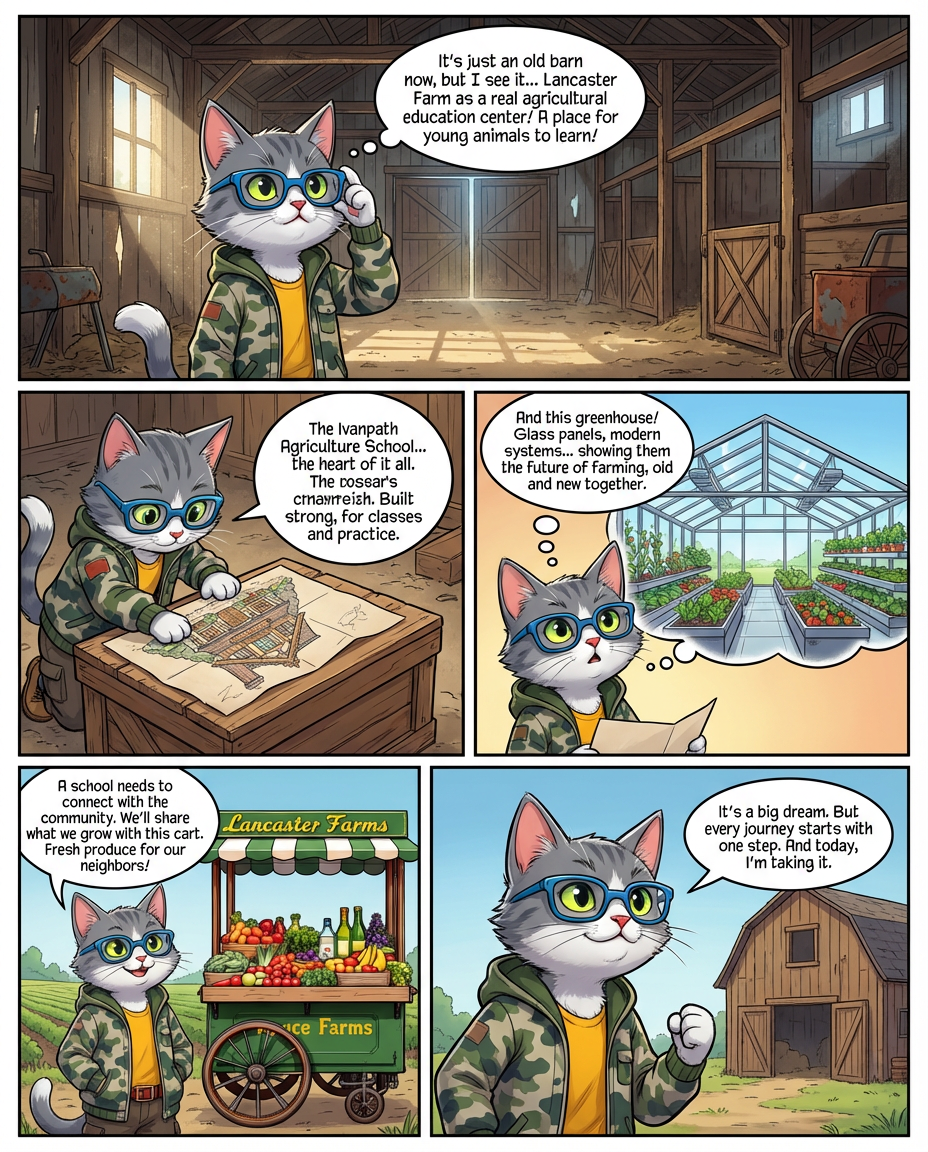
Natti Lancaster stood in the middle of her family's old barn, dusty sunlight streaming through the cracks in the wooden walls. She pushed her blue glasses up her nose and looked around at the empty stalls and rusted equipment. This place could be so much more. Her dream was simple but huge: turn Lancaster Farm into a real agricultural education center where young animals could learn to farm the right way. She wanted greenhouses, proper classrooms, and fields full of students getting their paws dirty. The farm had good bones, but it needed work. Lots of work. Still, when she pictured kids laughing while planting seeds and gathering eggs, her whiskers twitched with excitement. She pulled a folded paper from her jacket pocket and spread it across an old wooden crate. The sketches showed her vision clearly. First, she'd need a proper building for classes. She'd drawn a sturdy structure of brown and gray stone with wooden beams. The Ivanpath Agriculture School would be the heart of everything. Students could gather there for lessons before heading out to practice what they learned. Her paw traced the lines of the drawing. It felt real now, seeing it on paper. Next to the school building, she'd sketched a greenhouse unlike anything Ivanpath had seen before. Glass panels would let in tons of light, and modern systems would help plants grow year-round. The futuristic greenhouse would show students both old farming methods and new technology working together. She imagined rows of vegetables on one side and colorful flowers on the other. Kids could plant seeds, watch them sprout, and take care of them through every season. But a school needed to connect with the community too. Natti tucked the plans back into her pocket and smiled. She'd already started building a green and yellow cart with "Lancaster Farms" painted on the side. Once students harvested their crops, they could wheel the cart into town and share what they'd grown. Fresh vegetables for neighbors, and pride for young farmers learning their craft. The dream was big, but every journey started with one step. Today, she'd taken several.
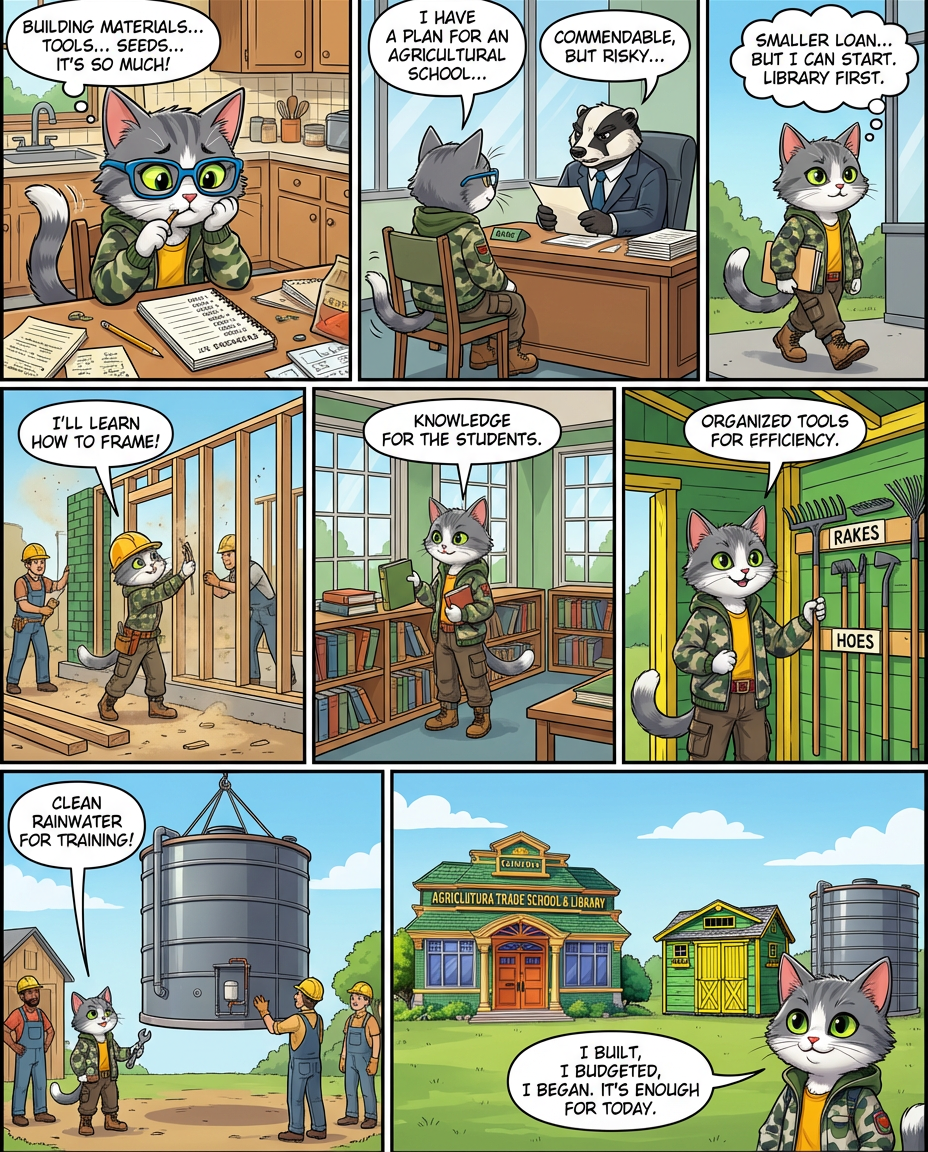
Natti needed money before anything else could happen. She sat at the kitchen table with a notebook and pencil, writing down every expense she could think of. Building materials for the school would cost the most. Then came tools, seeds, and soil for the greenhouse. Her pencil moved faster as the list grew longer. Insurance, permits, furniture for classrooms—it all added up to more than she'd ever seen in her life. She chewed the eraser and stared at the numbers. The dream was still real, but now she understood the gap between wanting something and making it happen. Tomorrow she'd visit the bank in Fort Orynth to ask about loans. Tonight, she'd figure out exactly what to say. The bank manager looked over her papers for a long time. Natti's tail flicked nervously as she waited in the stiff chair. Finally, he nodded and slid a folder across his desk. The loan was approved, but smaller than she'd hoped for. She'd have to build in stages instead of all at once. Walking back to the farm, she made a new plan. First things first—students needed a place to learn and access to good information. Everything else could wait. She started with the library and classroom building. The green brick and tan wood structure went up over six weeks. Natti worked alongside the builders, learning how walls were framed and roofs were sealed. Gold letters spelling out "Green Brick Agricultural Trade School and Library" were installed above the front door. Inside, she set up shelves for farming books and research guides. Students would study here before heading outside. Next came the bright green and yellow storage shed behind the main building. She organized rakes, hoes, and teaching supplies inside, labeling each section carefully. Instructors could grab what they needed for outdoor demonstrations without wasting time searching. The final piece was the water system. Natti watched workers install the steel tank, painted gun metal grey and light brown with red "Ivanpath" letters on the side. The filtration system would collect rainwater for student training activities. She tested the valve and watched clean water flow into a bucket. It worked. Three buildings stood on Lancaster Farm now, and her savings account was nearly empty. But when she looked at the library's front door and the organized shed and the full water tank, something tight in her chest loosened. The education center wasn't finished, but it had started. She'd learned to build, to budget, and to begin. That was enough for today.
Natti walked through Fort Orynth's main square, notebook tucked under her arm. Her school had walls and a library now, but she needed instructors who actually knew their stuff. Real experts. She stopped at the bulletin board outside the general store and pinned up a notice: "Agricultural Instructors Wanted—Lancaster Farm Education Center." Her paw smoothed the paper flat. Fort Orynth had traders, builders, and travelers passing through every week. Someone here would know about crops or livestock management. Someone could teach what she couldn't. The trading post three blocks down might have leads too. She headed that direction, her boots kicking up dust with each step. The trading post owner shook his head when she asked about instructors. No luck there. Natti adjusted her glasses and kept walking. Two more shops gave her the same answer. Her tail drooped slightly, but she didn't stop. At the edge of the square, she spotted a small diner with light green and tan walls and yellow trim. The sign read "Auntie Cleo's Breakfast & Lunch Diner." Through the window, she saw farmers gathered at tables, talking over coffee. Perfect. These were exactly the people who'd know the local talent. She pushed through the door and the smell of fresh bread hit her nose. Natti approached a table where three older farmers sat. She explained what she needed—experienced people who could teach crop rotation, animal husbandry, proper irrigation. One farmer mentioned a woman two towns over who'd studied soil science. Another knew a livestock handler who'd worked on big operations. Natti wrote everything down, her handwriting getting messier as she tried to keep up. By the time she left the diner, her notebook had seven solid leads. Her chest felt lighter. Fort Orynth wasn't just a place to post notices. It was a place where information moved between people who actually did the work. Walking back toward the farm, she passed a monument she'd never really looked at before. A cow statue stood on a green granite base, names carved into the stone beneath it. She stopped and read a few. These were teachers and farmers who'd shared what they knew with others. The Ellsie Mentor Award, the plaque said. Natti's whiskers twitched. Someday, maybe her instructors would be remembered like this. Maybe students from her school would teach others, and the cycle would keep going. She touched the base of the statue once, then headed home. Tomorrow she'd start contacting every name in her notebook. Today, she'd learned that Fort Orynth held more than supplies and traders. It held the connections she needed to make her school real.
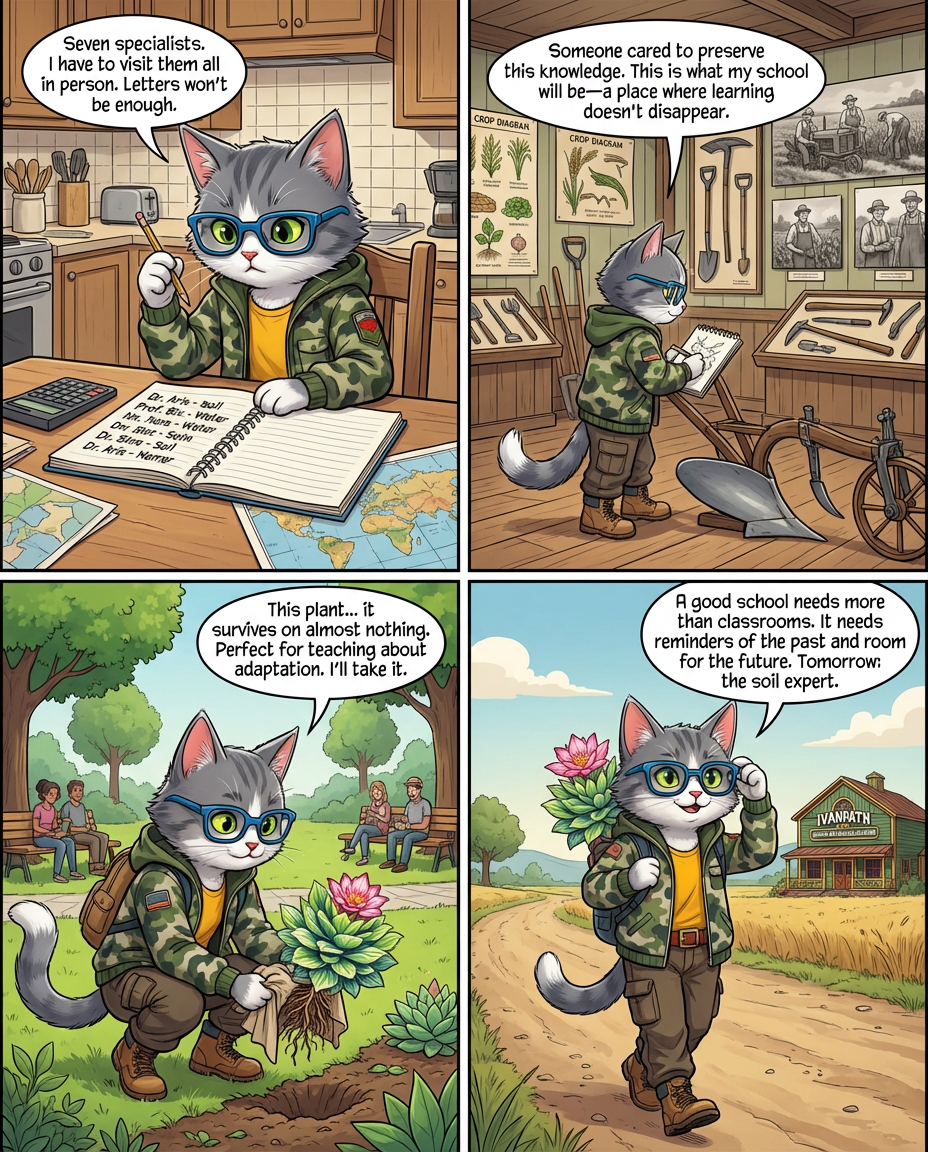
Natti spread her notebook across the kitchen table and reviewed every instructor contact she'd gathered. Seven names, seven different specialties. She'd need to visit each one personally—letters wouldn't cut it for something this important. Her pencil tapped against the paper as she calculated travel time and costs. Fort Orynth was just the beginning. The real experts might be scattered across multiple towns, and she'd have to convince each one that her school was worth their time. The first trip took her back through Fort Orynth and then three hours east to Ivanpath Village. She'd heard the town had farming history, and she wanted to see what worked. The Ivanpath Farm Museum and Cultural Heritage Center stood at the edge of the settlement—a ranch-style building painted green and brown with yellow trim. White letters spelled out its name across the front. Natti pushed through the door and spent two hours studying displays of old tools, crop rotation diagrams, and photos of farmers from fifty years back. Someone had cared enough to preserve all this knowledge. Her tail swished as she took notes. This was what she wanted her school to become someday—a place where learning didn't disappear. On her way out of Ivanpath, she passed a grass park bordered by neat small shrubs. A few people sat on the ground in the shade, talking quietly. Students could gather like this between lessons, she thought. They'd need outdoor spaces, not just classrooms. She made a note about adding benches near the school buildings. Near the park's edge, she spotted a rosette succulent growing wild—thick leaves arranged in a perfect spiral, topped with tiny pink flowers. She crouched down and examined it closely. The plant survived on almost nothing. It would be perfect for teaching students about water efficiency and adaptation. She carefully dug it up and wrapped the roots in damp cloth from her pack. Walking back toward the road, Natti tucked the succulent into her bag and reviewed her notes. She'd seen how other places honored their farming past and created spaces for people to share ideas. Her school could do both. The instructors she planned to visit would want to see that she understood what teaching required—not just buildings, but gathering places and practical examples. She adjusted her glasses and started the walk home. Tomorrow she'd contact the soil science expert two towns over. Today, she'd learned that a good school needed more than classrooms. It needed reminders of what came before and room for what came next.
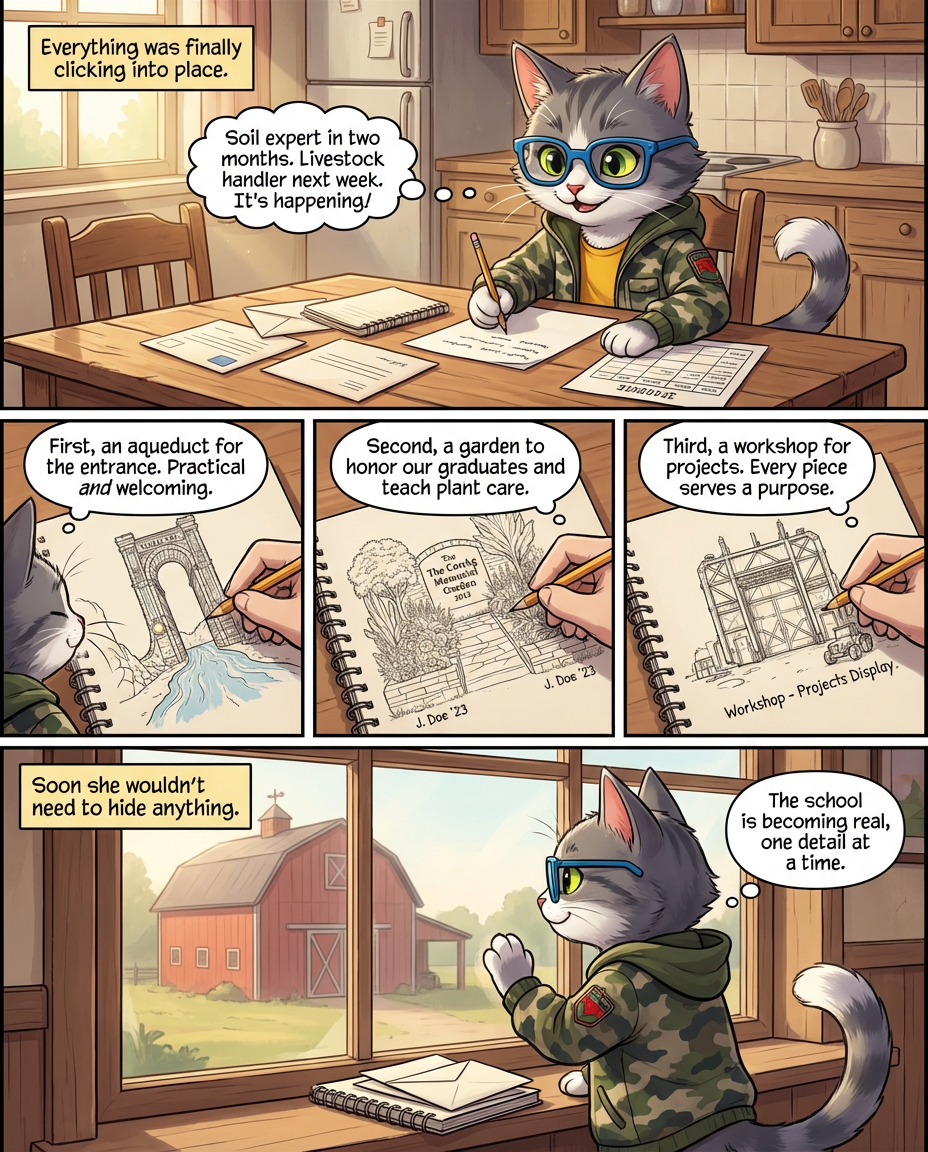
Natti sat at her kitchen table with three letters spread in front of her. Two instructors had written back—both interested in teaching at her school. The soil expert could start in two months, and the livestock handler wanted to visit the farm next week. Her tail curled with satisfaction as she added their names to her master schedule. She pulled out a fresh sheet of paper and calculated the costs again. With two confirmed instructors, she could officially call it a teaching staff. Her pencil moved faster now, sketching out a basic class rotation. Morning sessions for crops, afternoon sessions for animals. The numbers worked. Everything was finally clicking into place. She flipped to a fresh page and drew the farm layout from memory. The school buildings stood ready, but students would need more than classrooms. Her pencil marked three spots on the map. First, an aqueduct at the entrance—sandstone arches carrying water downhill, decorated with colored tiles. The sound of flowing water would greet arriving students. Second, a garden with raised stone beds near the main building. Each bed could mark a graduate's name and the year they finished. Students could see proof that others had succeeded before them. Third, a workshop building where finished projects could go on display. Tools, crafted items, anything that showed what people learned here. She calculated the costs and timelines for each addition. Billy would ask questions soon. The farm had changed too much for him not to notice. But these weren't just decorations—they were proof the school could actually work. Natti traced her finger over the aqueduct drawing. Water conservation was practical. The memorial garden taught plant care while honoring achievements. The workshop gave students a goal to work toward. Every piece served two purposes. That's what made them worth building. She stacked the letters and tucked them into her notebook. Two instructors confirmed, three new features planned, and a class schedule that actually functioned. Her whiskers twitched as she stood and walked to the window. The barn stood quiet in the afternoon light, her research notes still hidden beneath the floorboards. Soon she wouldn't need to hide anything. Soon the whole farm would be teaching what she'd spent five years learning on her own. She pressed her paw against the glass and smiled. The school was becoming real, one confirmed detail at a time.
Play your story to life
Storycraft is a mobile game where you create AI characters, craft items and locations to build their world, then discover what direction your story takes. Download the iOS game for free today!
Download for free