

Caleb Nomad's Arc
5 Chapters
Caleb Nomad's dream is uncovering why his father abandoned the family forge years ago.

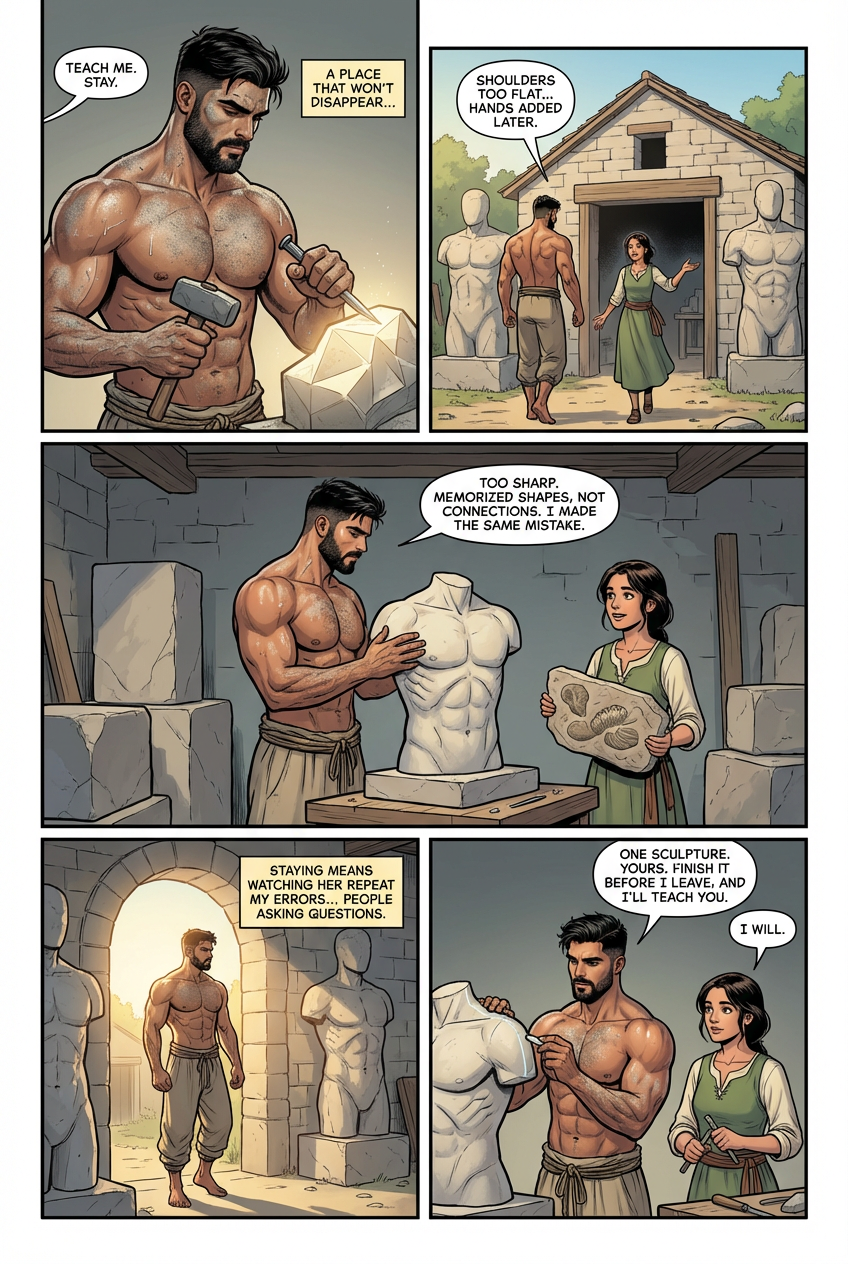
Caleb finished the last cut on the tower sculpture as the young woman approached with her proposition. She wanted lessons. She wanted him to stay. She offered workspace, materials, a place that wouldn't disappear when the wind shifted. He set down his chisel and looked at the stone — another piece designed to catch light and let it go. She led him to the workshop she'd already started building. Two massive stone figures flanked the entrance, shirtless torsos carved into the archway. The proportions were good. The muscle definition showed promise. But the shoulders sat wrong, too flat across the top, and the hands looked like they'd been added as an afterthought. Inside, uncarved blocks waited in neat rows. She pulled out a limestone slab covered in fossils and ancient markings, proof she could find quality material. Then she showed him her practice piece — a torso carved from pale stone. The work was clean enough that he could see exactly where she'd lost confidence in the curves. Caleb ran his thumb along the ribcage of her carved torso. The transitions between muscles were too sharp, like she'd memorized shapes instead of understanding how they connected. He knew this mistake. He'd made it himself when he first switched from metal to stone, trying to force the material instead of following what it wanted to become. Teaching her would mean staying long enough to watch her repeat his errors until she found her own answers. It would mean people asking questions he didn't plan to answer. He set the torso back on the workbench and walked to the entrance. The sun hit the archway figures at an angle that would shift by a hand's width every week. In six months, the light would fall completely different. He turned back to the young woman and told her he'd stay through one sculpture — hers, not his. If she could finish it before he needed to leave, he'd teach her what he knew. She nodded once, already reaching for her tools. Caleb picked up a piece of chalk and marked the shoulder line on her practice torso, showing her where to start cutting away what didn't belong.
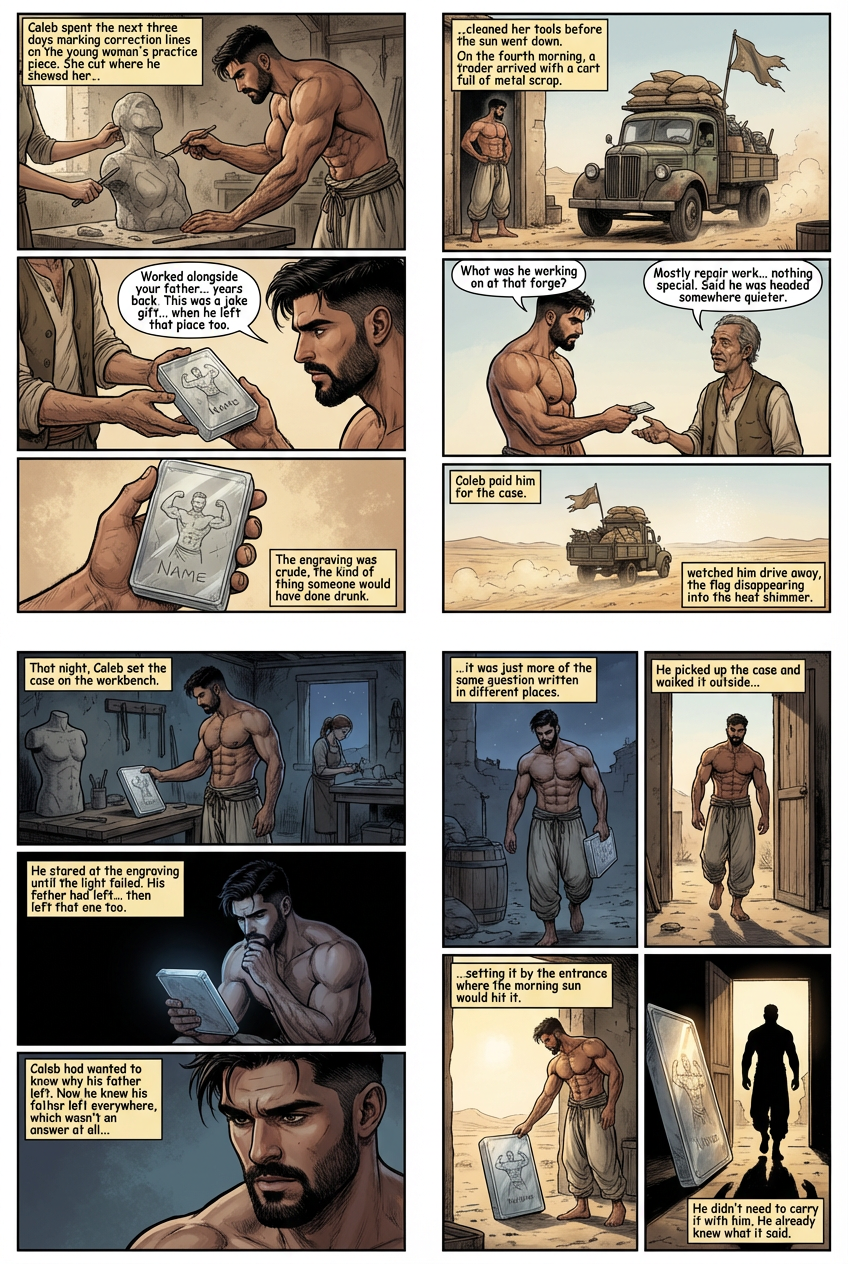
Caleb spent the next three days marking correction lines on the young woman's practice piece. She cut where he showed her, asked no questions about anything except the stone, and cleaned her tools before the sun went down. On the fourth morning, a trader arrived with a cart full of metal scrap. The trader's truck sat outside the workshop with burlap sacks tied to the roof and a faded flag snapping in the wind. He unloaded bent rebar and twisted sheet metal, sorting pieces by size. Caleb watched from the doorway while the young woman worked inside. The trader looked up, wiped his hands on his vest, and walked over carrying a clear case with an engraving on the front — a flexing figure and a name Caleb recognized immediately. The trader said he'd worked alongside Caleb's father at a forge out past the eastern dunes, years back. Said the case had been a joke gift from the crew when his father left that place too. Caleb asked where exactly. The trader described a blacksmith shop with glass walls and slag heaps that caught the light like oil on water. He said Caleb's father never talked much, kept to himself, but the work he did was clean. Then the trader asked if Caleb wanted to buy the case, said it had been sitting in his truck for two years and he figured maybe it meant something to someone. Caleb took the case and turned it over in his hands. The engraving was crude, the kind of thing someone would have done drunk after a long shift. His father's name sat under the flexed arms in script that tried too hard. He asked the trader what his father had been working on at that forge. The trader shrugged and said mostly repair work, farm tools, gate hinges, nothing special. Caleb set the case down and asked if his father ever mentioned where he was going next. The trader said no, just that he was headed somewhere quieter. Caleb paid him for the case and watched him drive away, the flag disappearing into the heat shimmer. That night, Caleb set the case on the workbench next to the young woman's practice torso. She glanced at it, then back at her work, and said nothing. He stared at the engraving until the light failed. His father had left the family forge and gone to another forge, then left that one too. The pattern was there, clean and factual. Caleb had wanted to know why his father left. Now he knew his father left everywhere, which wasn't an answer at all — it was just more of the same question written in different places. He picked up the case and walked it outside, setting it by the entrance where the morning sun would hit it. He didn't need to carry it with him. He already knew what it said.
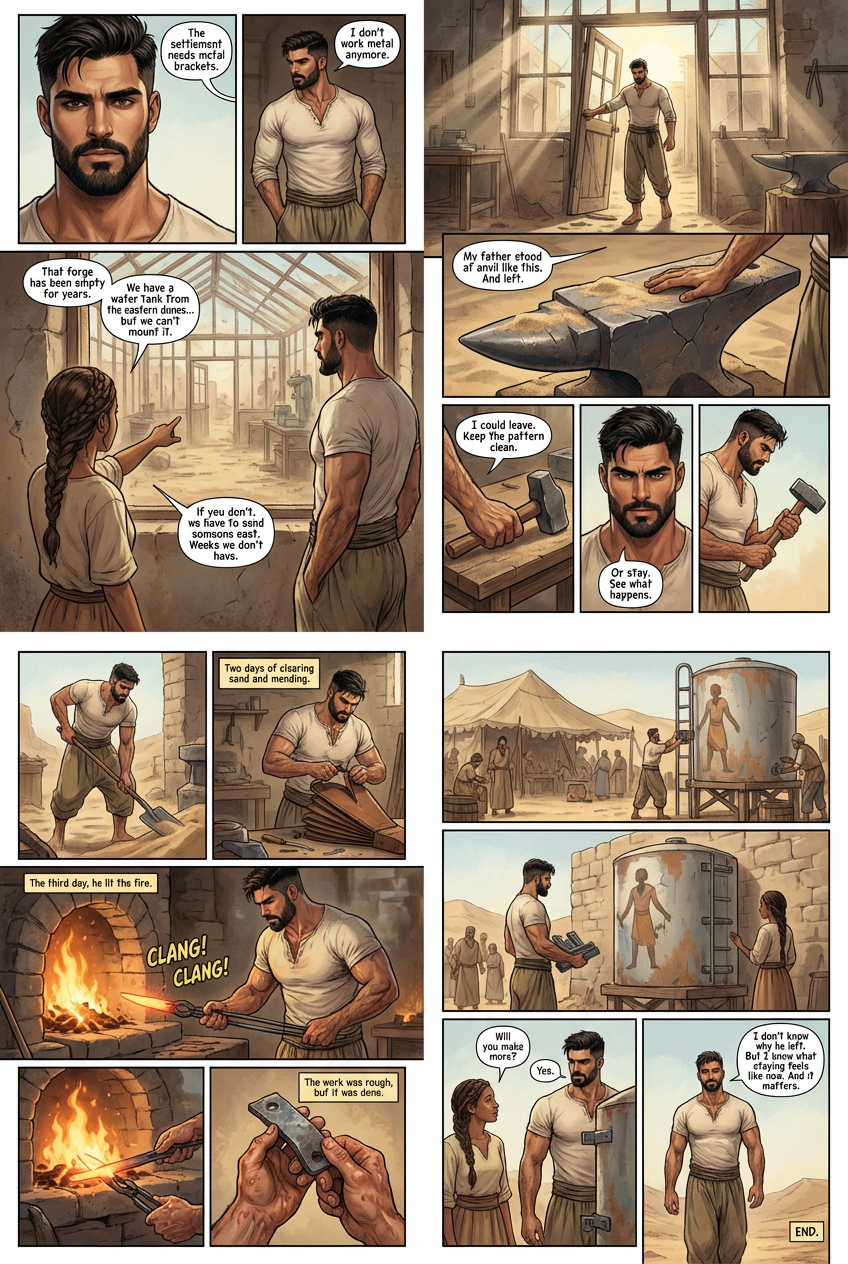
The young woman walked into the workshop the next morning and told Caleb that the settlement needed metal brackets for the new gathering hall roof. She said they'd asked around, but no one here worked metal. She looked at him and waited. Caleb told her he didn't work metal anymore. She pointed out the window at the abandoned workshop with the glass walls, the one the trader had described. She said it had been sitting empty since before she arrived, full of tools no one knew how to use. The settlement had hauled a water tank from the eastern dunes last month, she said, but they couldn't mount it properly without someone who could forge the connection brackets. The tank sat behind the gathering hall with a painted figure on its side, waiting. Caleb asked why it mattered to her. She said because if he didn't do it, they'd have to send someone east to find another smith, and that would take weeks they didn't have. Caleb walked to the glass workshop alone that afternoon. The door hung crooked on its hinges. Inside, the anvil sat under a layer of sand, its surface cracked and dented like something that had taken more weight than it was built for. He touched the edge and felt the crack run under his palm. The sound of his hand on the metal was wrong, hollow. He thought about his father standing at a different anvil, in a different place, making the same choice to walk away. Caleb could leave again, keep the pattern clean. Or he could stay and see what happened when he broke it. He picked up a hammer from the workbench and tested its weight. The handle felt like it remembered being used. He spent two days clearing sand from the forge and repairing the bellows with leather scraps from the young woman's tools. On the third day, he lit the fire and worked the first bracket, shaping the metal slowly until it fit the tank's mounting holes. The work was rough, louder than he remembered, and his hands blistered in places stone had never touched. When he finished, he carried the brackets to the gathering hall and watched while others bolted the tank into place. The young woman stood nearby and asked if he'd make more. Caleb said yes. He didn't know why his father left, and working metal wouldn't answer that. But now he knew what staying felt like, and it felt different enough to matter.
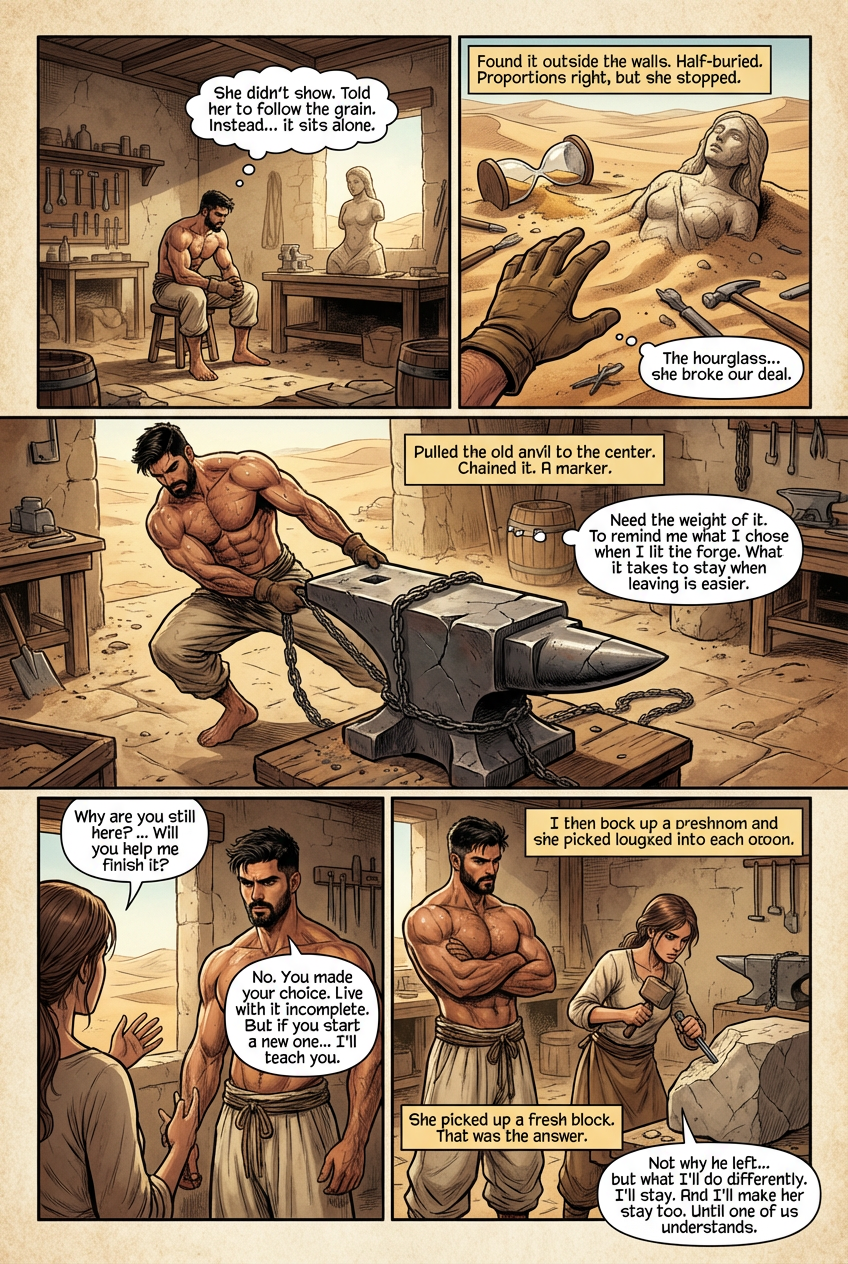
The young woman didn't show up for the next lesson. Caleb waited in the workshop with the stone she'd been carving, the figure half-formed, tool marks still visible where she hadn't smoothed them yet. He'd told her to work the shoulders next, to follow the grain. Instead the stone sat alone on the bench. He found her sculpture outside the settlement walls the next morning. The piece stood half-buried in sand, a figure emerging from desert stone with its face just starting to break free. Her tools lay scattered around the base. She'd gotten the proportions right this time, carved the flow of fabric across the chest exactly as he'd shown her. Then she'd stopped. The hourglass he'd given her to mark her work sessions sat in pieces nearby, glass shattered, sand spilled across the ground. She'd broken their agreement. One sculpture, completed. That was the deal. She'd walked away mid-work, left it unfinished, and now Caleb had to choose whether to leave like he always did or stay and force himself to see what that cost. He went back to the glass workshop and pulled the old anvil into the center of the room where he could see it while he worked stone. The metal was cracked and ugly, but he wrapped chains around it and bolted it to the floor so it couldn't be moved. It sat there like a marker, like something that said this is what it takes to stay when leaving is easier. He didn't need the anvil for his sculpture work. He needed to see it every day, needed the weight of it to remind him what he'd chosen when he lit that forge again. The young woman came back three days later and asked why he was still here. Caleb told her he didn't know yet. She looked at the chained anvil, then at him, and asked if he'd help her finish the desert piece. He said no. She'd made her choice, and now she had to live with it sitting out there incomplete, the same way he had to live with staying in a place that hurt to be. But he'd keep teaching her if she started a new sculpture and saw it through. She nodded once and picked up a fresh block of stone. That was the answer, then. Not why his father left, but what Caleb would do differently. He'd stay, and he'd make her stay too, until one of them understood what finishing something actually meant.
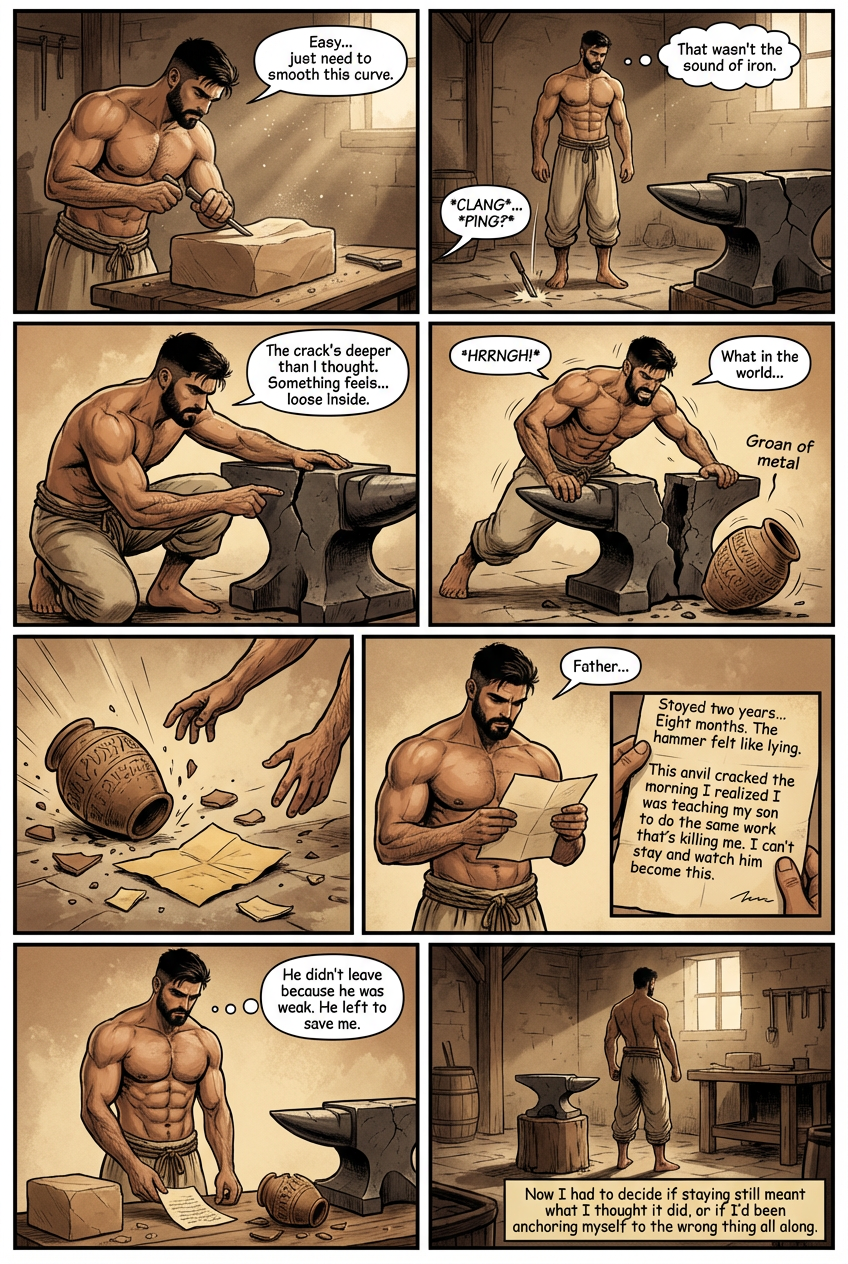
The anvil had been in the workshop for six days when Caleb noticed the sound. He was smoothing a curve in sandstone when his chisel slipped and rang against the floor near the anvil's base. The crack in the metal answered back with a different note, something that didn't match the empty ring of broken iron. He set down his tools and crouched beside it. The crack ran deeper than he'd thought. He traced it with his fingertips and felt the gap widen near the center where the metal had split years ago. Something shifted inside when he pressed against it. He worked his fingers into the gap and pulled. The anvil resisted, then gave way with a groan that sounded like tearing. The two halves separated and an old clay jar rolled free, its surface covered in carved patterns he didn't recognize. The jar was already cracked through, fragments held together only by being contained. When it hit the floor, it broke apart completely. Inside the shattered pieces lay a folded square of paper, edges yellowed but still intact. Caleb picked it up and opened it. His father's handwriting covered the page in tight, careful lines. The letter wasn't addressed to anyone. It was a list of forge locations, dates, and single-sentence notes beside each one. "Stayed two years. Left when the work stopped making sense." "Eight months. The hammer felt like lying." The last entry read: "This anvil cracked the morning I realized I was teaching my son to do the same work that's killing me. I can't stay and watch him become this." Caleb read it twice, then set it on the workbench beside his student's unfinished stone. The answer wasn't clean or factual. His father had left because he saw Caleb turning into him, and staying meant watching that happen. Caleb had bolted the anvil to the floor to prove he could stay when his father couldn't. But his father had sealed this letter inside it, had cracked the anvil trying to contain what he couldn't say out loud, then walked away from both. Caleb looked at the broken jar, the scattered clay, the letter that had been waiting inside the thing he'd built his resolve around. He'd found what his father left behind. Now he had to decide if staying still meant what he thought it did, or if he'd been anchoring himself to the wrong thing all along.
Play your story to life
Storycraft is a mobile game where you create AI characters, craft items and locations to build their world, then discover what direction your story takes. Download the iOS game for free today!
Download for free