

Canada Moose's Arc
7 Chapters
Canada Moose's dream is being the greatest animal in the Canadian forest besides the grizzly bear.

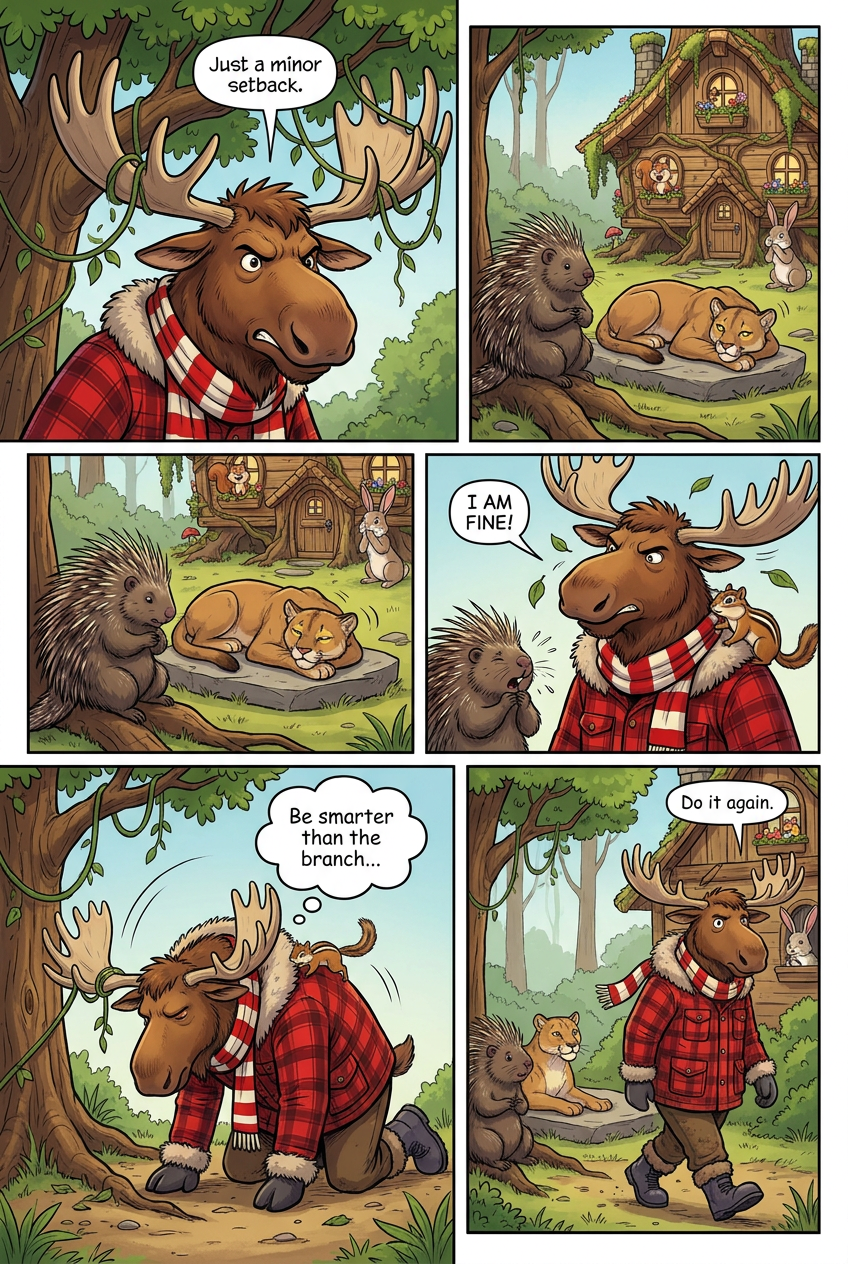
Canada Moose wanted to be the greatest animal in the forest, second only to the grizzly bear. That was hard to remember with his head stuck in an oak tree. His left antler had hooked a low branch of the broad oak that marked the thickest stretch of brush. His right antler was tangled in a vine. He wore his red and white scarf and the Canadian-made jacket that had carried him through three winters, including the January blizzard that almost killed him. The jacket was fine. The antlers were the problem. He pulled. The branch bent. The branch did not break. A porcupine sat on a root four feet away and watched. Behind the porcupine, a cougar lay on a flat stone, tail twitching, eyes half closed. Past the cougar stood a small wooden house grown into the trunks of three trees, its windows full of mushrooms and flowers. Smaller animals leaned from the windows. A squirrel laughed. A rabbit covered its mouth. Canada Moose felt his ears burn under the scarf. "I am fine," he announced. He yanked his head sideways. Leaves fell on his nose. The porcupine sneezed. The cougar opened one yellow eye, looked at him for a long second, and closed it again. That was worse than the laughing. Canada Moose tried backing up. The vine tightened. He tried lowering his head. The branch scraped down his skull and caught harder. He stood there breathing, antlers pinned, while a chipmunk climbed onto his shoulder to get a better view. He stopped fighting. He thought about the grizzly, who would simply walk through this brush and crush it. He could not be the grizzly. He could be smarter than a branch. He folded his front legs, knelt in the dirt, and let his head drop low. The antlers slid free of the vine. He shuffled forward on his knees until the oak branch lifted clear. Then he stood. The chipmunk fell off. The porcupine blinked. The cougar did not open her eye, but her tail stopped twitching. Canada Moose walked out of the brush on his own four hooves, scarf crooked, jacket dusted with bark. He had escaped. He had also knelt in front of every animal in the clearing, and they had all seen it. Somewhere behind him, a small voice in the tree house said, "Do it again." He kept walking. He needed a plan that did not involve kneeling.
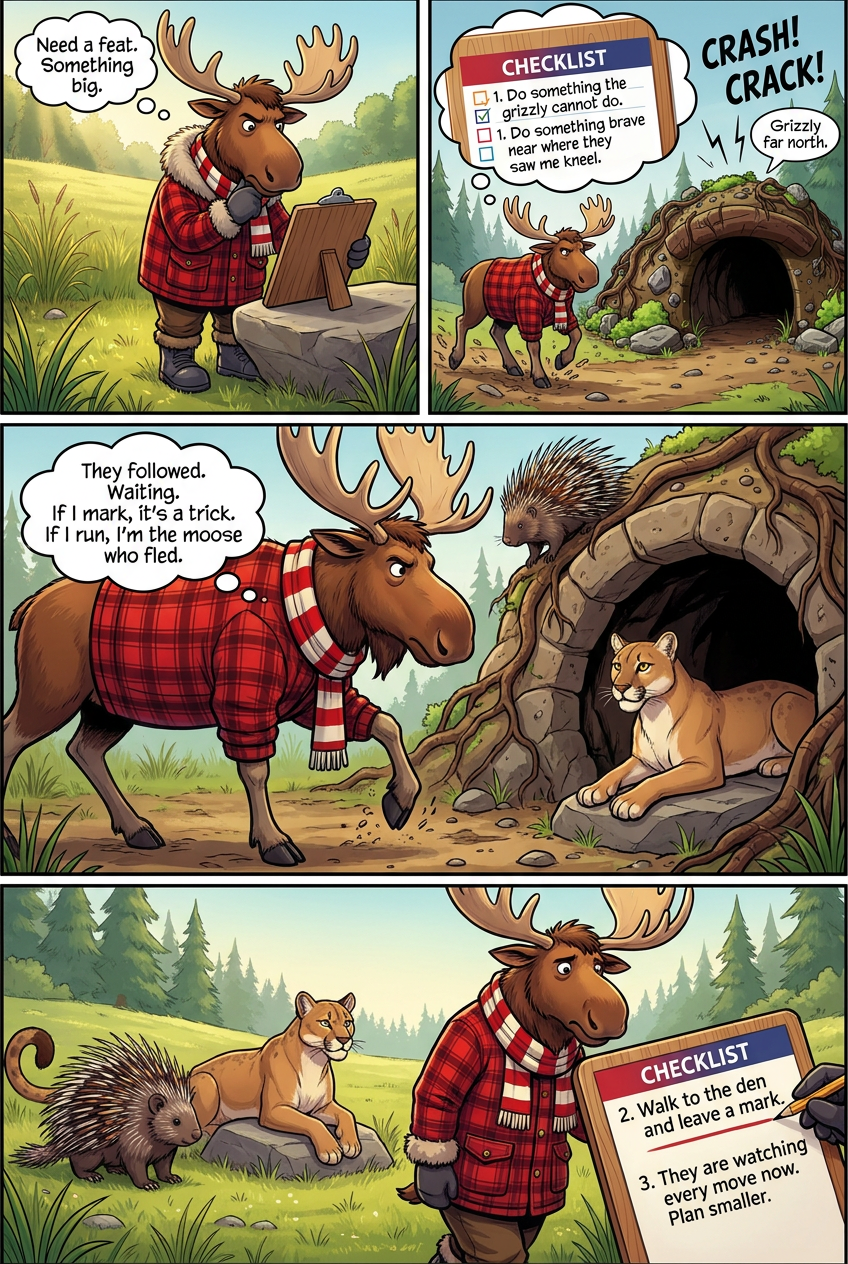
Canada Moose walked until the laughing was behind him. He stopped at the edge of a small meadow and pulled a folded board from inside his jacket. It was a checklist he kept tucked against his ribs for moments like this. He set it on a flat stone and stared at the empty lines. He needed a feat. Something big enough to wipe out the picture of him on his knees. He wrote: 1. Do something the grizzly cannot do. He stared at that line for a long time. Then he crossed it out. He wrote: 1. Do something brave near where they saw me kneel. The spot where the animals had gathered was easy to find. A thick cluster of tall grass grew at the edge of the brush, bent and trampled where the porcupine and cougar had sat. Canada Moose stood in the flattened grass and tried to think like a hero. Across the trees, up a low rise, he could see the dark mouth of the grizzly's den. Roots hung over the opening. Stones held the mound in place. The grizzly was not home. Canada Moose knew this because he could hear the grizzly crashing through a creek far to the north, breaking branches without trying. That sound was the whole problem. The grizzly did not need a plan. Canada Moose did. He looked at the checklist again and wrote: 2. Walk to the den and leave a mark. Touch it. Come back. Tell the animals you did. He folded the board, tucked it away, and started up the rise. His hooves slid on loose dirt. He reached the front of the den and stopped. The opening smelled of old meat and wet fur. He lifted one hoof to scratch a line in the earthen mound. Then he heard a branch snap behind him. He turned. The porcupine sat on a root ten feet away, watching. The cougar lay on a stone below, tail still. They had followed him. They were waiting to see what he would do at the den that did not belong to him. Canada Moose lowered his hoof. He could not scratch the mound now. If he did, it would look like a trick performed for an audience, not a feat. If he ran, he would be the moose who knelt and then fled. He stood straight, turned his antlers toward the den opening, and waited. He counted to sixty. Nothing came out. He walked back down the rise past the porcupine and the cougar without hurrying. Neither animal laughed. Neither animal looked impressed. He reached the meadow, pulled out the checklist, and crossed off task two. Under it he wrote: 3. They are watching every move now. Plan smaller. He had wanted one big feat. He had earned an audience instead.
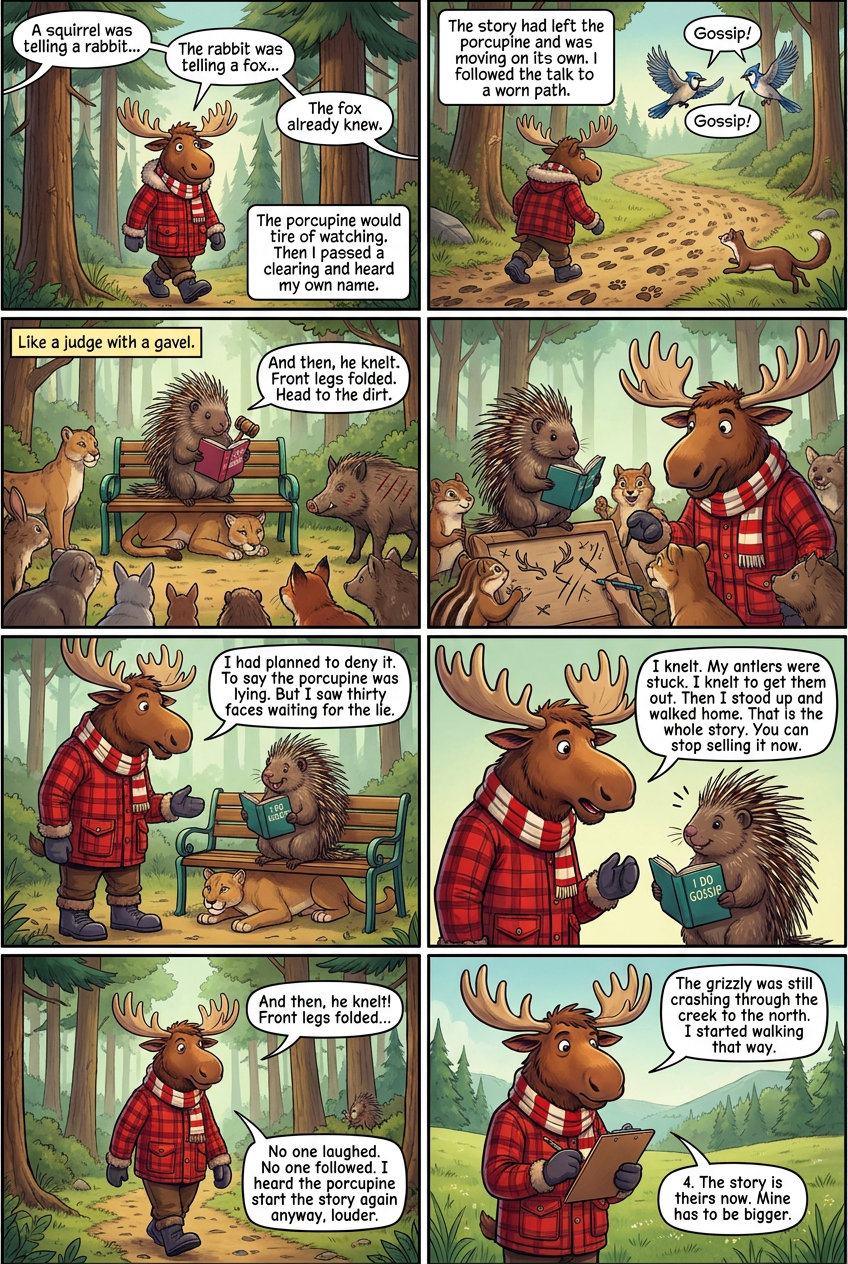
Canada Moose came down from the rise and tried to walk off the morning. He took the long way back through the pines. He told himself the porcupine would tire of watching and find something else to do. Then he passed a clearing and heard his own name. A squirrel was telling a rabbit about the kneeling. The rabbit was telling a fox. The fox already knew. The story had left the porcupine and was moving on its own. He followed the talk to a worn path he did not remember being so busy. Hoofprints and pawprints crossed each other in the dirt. A weasel ran past him with its ears up. A pair of jays cut overhead, calling the same word twice. The path led to a wooden bench at the edge of a small clearing, the kind hikers leave behind. Animals were crowded around it three deep. On the back of the bench sat the porcupine, quills high, holding a slim white book in his front paws. The cover read I DO GOSSIP in fat black letters. He tapped it when he spoke, like a judge with a gavel. "And then," the porcupine said, "he knelt. Front legs folded. Head to the dirt." The animals leaned in. A chipmunk wrote something on a weathered message board nailed to a nearby trunk. The board was already covered with scratched signs and paw marks. A fresh symbol sat near the top: two antlers, bent down. Canada Moose pushed through the crowd. His size made a path whether he wanted one or not. He stopped in front of the bench. The porcupine did not flinch. He held the book up like a shield and smiled. The cougar lay under the bench, tail flicking once. Canada Moose had planned, on the walk over, to deny it. To say the porcupine was lying. He opened his mouth and saw thirty faces waiting for the lie. He saw the chipmunk's pencil ready at the board. "I knelt," Canada Moose said. "My antlers were stuck. I knelt to get them out. Then I stood up and walked home." He looked at the porcupine. "That is the whole story. You can stop selling it now." The porcupine blinked. The crowd waited for more. Canada Moose did not give them more. He turned and walked back down the path the way he had come. No one laughed. No one followed. Behind him, he heard the porcupine start the story again anyway, louder, as if volume could buy back the room. He reached his meadow and pulled out the checklist. He crossed off task three. Under it he wrote: 4. The story is theirs now. Mine has to be bigger. He folded the board and tucked it against his ribs. The grizzly was still crashing through the creek to the north. Canada Moose started walking that way.
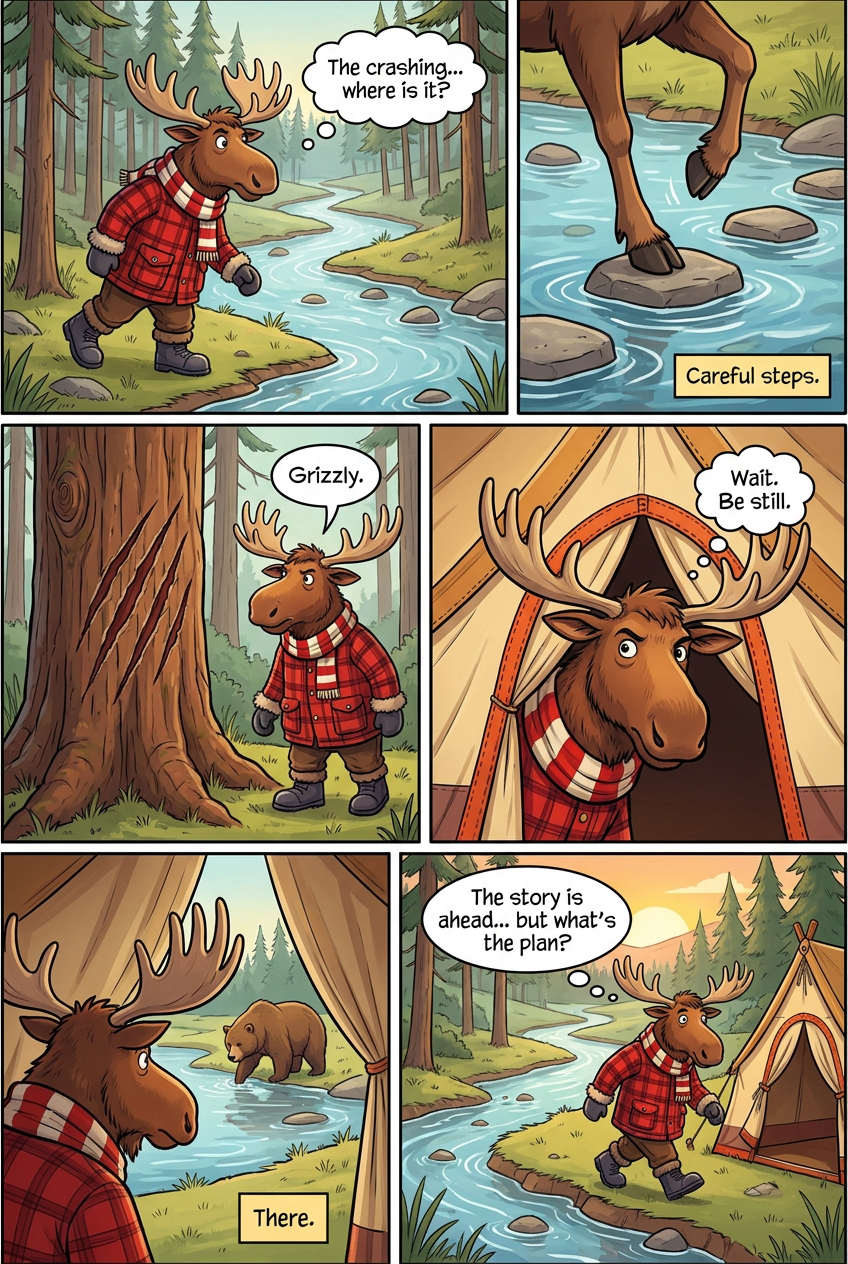
Canada Moose walked north until the pines thinned and the ground started to slope. He could hear water before he saw it. The creek ran clear over a bed of stones, winding between low banks. He stopped at the edge and listened for the crashing he had heard from his meadow. Nothing now. Just water. The grizzly could be a mile upstream or around the next bend. He did not know which, and walking the bank blind would put him nose to nose with claws. He followed the creek downstream until he found a place to cross. Three flat stones broke the surface, spaced for a smaller animal but steady enough for his hooves. He went over slow, one leg at a time, the jacket bunching at his shoulders. On the far bank he found what he was hoping for. A trunk stood beside the trail with four deep gouges cut into the bark, each one longer than his face. The cuts were fresh. Sap still beaded along the lower mark. The bear had come through here, and not long ago. Canada Moose backed away from the trunk and looked for high ground. He found it twenty paces up the slope: a small canvas tent left behind by hikers, the flap tied open, the poles still sound. From inside he could see a long stretch of the creek through the gap in the trees. He folded his legs and pushed his head and shoulders through the opening. His antlers caught the top seam and held. He stayed still. He could see the water. He could see the clawed trunk. He could see the bend upstream where the bank dropped away. He waited. The sun moved a hand's width across the sky. Then the willows up at the bend shook, and the grizzly walked out into the shallows. It stopped to drink. Canada Moose counted: one bear, upstream, on the far bank, drinking. He marked the spot in his head against the bent pine behind it. The bear finished, climbed the bank, and disappeared into the brush going north. Canada Moose let his breath out. He knew where the grizzly was now, and where the grizzly was not. He backed out of the tent, careful with the seam, and started walking upstream along the near bank. The story he wanted was waiting at that bend. He still had no plan for what to do once he got there.
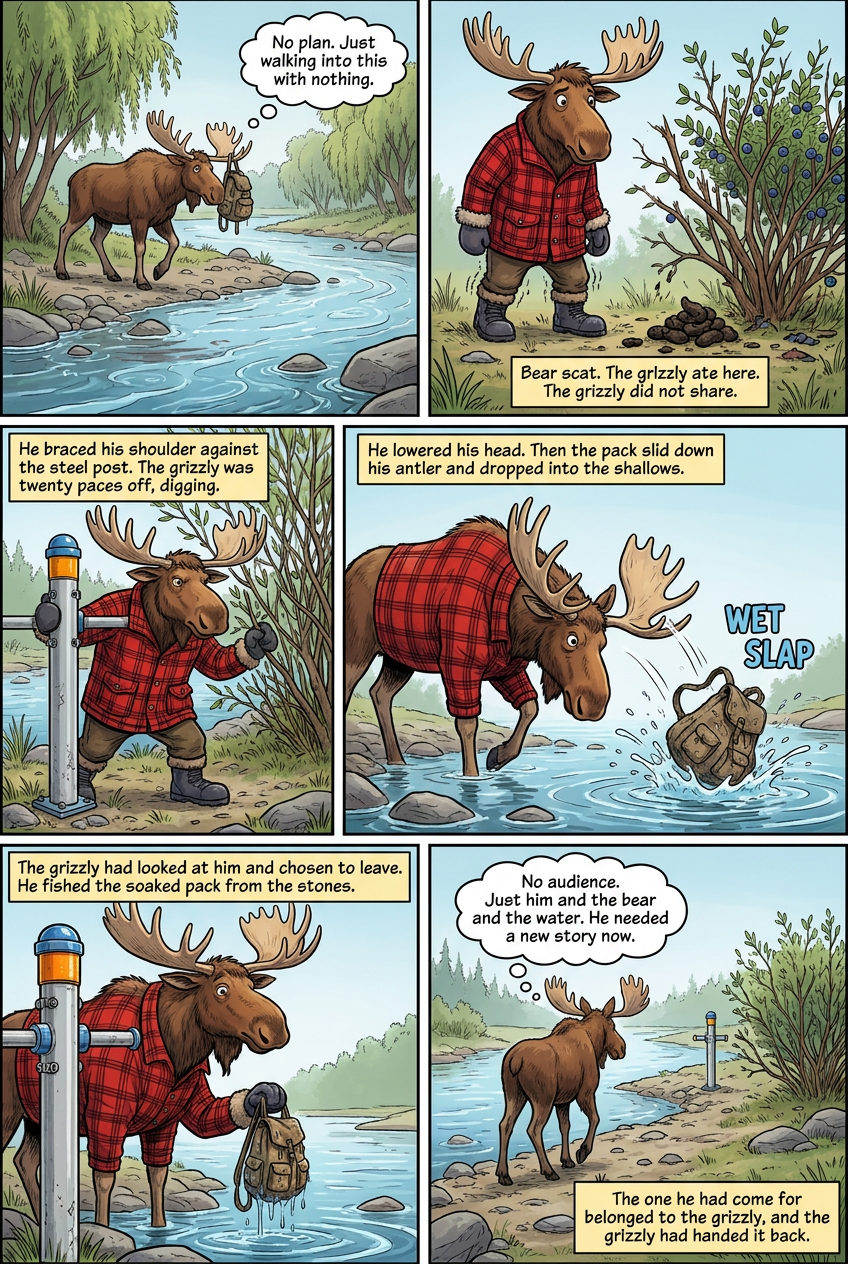
Canada Moose moved upstream along the near bank, hooves slow on the wet stones. The river ran clear and shallow here, bending where the willows thickened. He had no plan. He had a jacket, a scarf, and antlers. He also had a torn pack he had picked up by the abandoned tent, dragging from one antler tine by a frayed strap. He did not know why he had grabbed it. It bumped his shoulder with every step and rattled with grit and old trash. It was not a weapon. It was not a tool. It was proof, if he stopped to look, that he had walked into this with nothing. Halfway to the bend he passed a blueberry bush taller than his chest, stripped bare. Branches were snapped low. Bear scat sat at the base, dark with skins and seeds. The grizzly ate here often. The grizzly did not share. Canada Moose stepped past the bush and felt his legs shake under the jacket. He kept walking because stopping felt worse. At the bend he found a steel post driven into the bank, left over from some old hiker's rail. It stood waist-high, solid, bolted to a plate in the dirt. He braced his shoulder against it and looked through the willows. The grizzly was twenty paces off, back turned, digging at a rotted log. Canada Moose could see the muscle move under the fur. He could see one paw turn the log like it weighed nothing. He had come to do something. He still did not know what. He lowered his head. He thought about charging. He thought about bellowing. He thought about the antlers stuck in the oak, and the porcupine, and every animal who had watched him kneel. Then the torn pack slid down his antler and dropped into the shallows with a wet slap. The grizzly's head came up. It turned. It looked straight at him across the water. Canada Moose did not move. The grizzly did not move. They stood like that for a long count. Then the grizzly snorted, picked the log back up in its jaws, and walked north into the brush without hurry. It had seen him. It had decided he was not worth the trip across the river. Canada Moose stayed against the post until his legs would hold him again. He had not been mauled. He had not been brave. The grizzly had looked at him and chosen to leave, the way you leave a stone in the path. He waded out, fished the soaked pack from the stones, and shook it dry. No one had seen this. No porcupine, no cougar, no audience. Just him and the bear and the water. He turned downstream. He needed a new story now, because the one he had come for belonged to the grizzly, and the grizzly had handed it back.
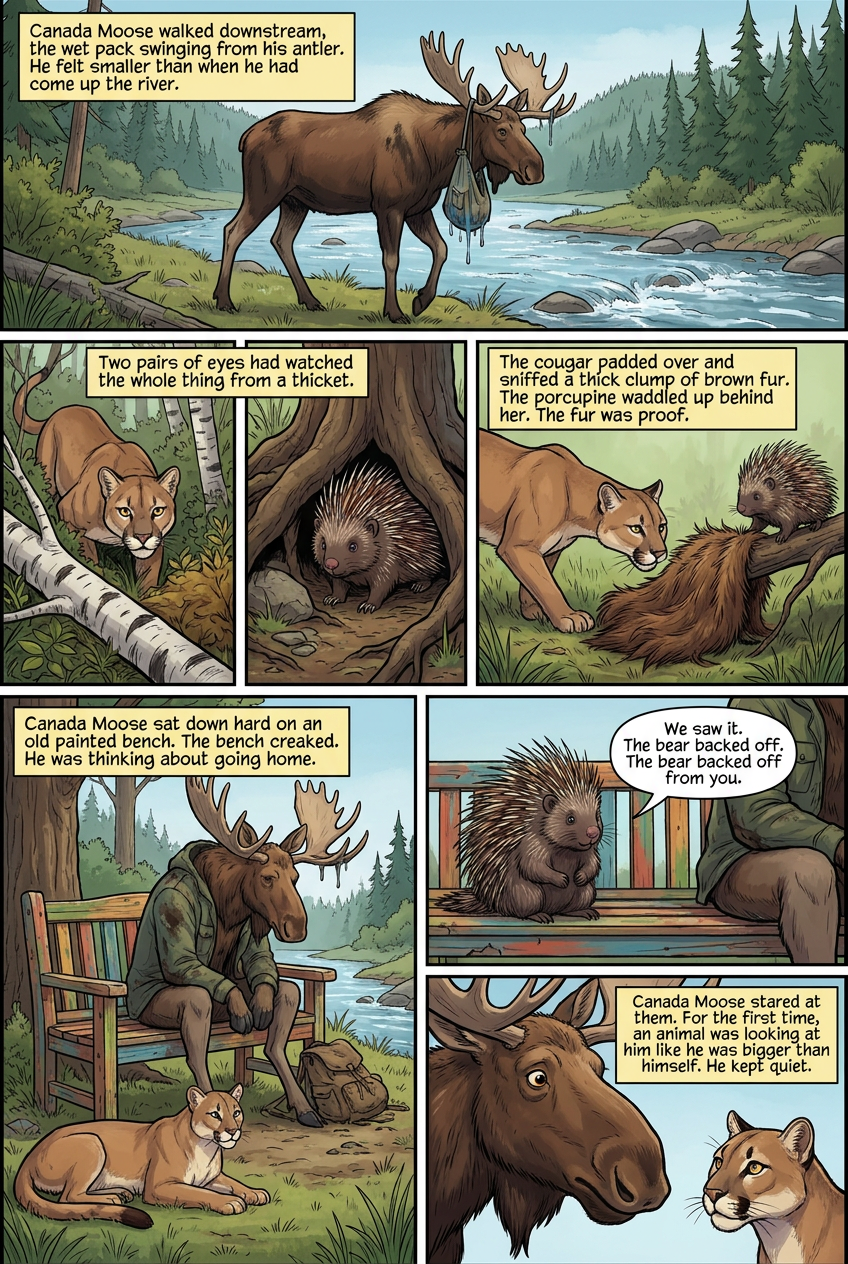
Canada Moose walked downstream with the wet pack swinging from his antler. He kept to the bank where the stones were flat. He felt smaller than when he had come up the river. He had pictured a fight and gotten a snort and a turned back. He did not know yet that two pairs of eyes had watched the whole thing from a thicket on the near side of the creek. The cougar had been crouched low behind a fallen birch. The porcupine had been wedged under a root three feet to her left. They had followed him since the blueberry bush, certain he was about to die. Instead they had seen the grizzly lift its head, look at the moose across the water, and walk away. To them it did not look like a snort. It looked like a bear that had measured a moose and decided not to risk it. The porcupine's quills had clattered when he tried to whisper. The cougar had hissed him quiet. Where the grizzly had stood, a thick clump of brown fur had caught on a low branch, torn loose when the bear pushed through the brush. The cougar padded over after Canada Moose was gone and sniffed it. The porcupine waddled up behind her. The fur was proof. A bear did not leave fur behind unless it was moving fast, and the bear had not been moving fast until it saw the moose. Canada Moose came up out of the river trail and onto the worn path that cut past an old painted bench at the edge of the clearing. He sat down hard. The bench creaked. He let the pack slide off his antler into the dirt. Mud from the river had dried in two long streaks down his shoulder, and the strap had pressed a print into the wet fabric of his jacket — two shapes, side by side, dark and clear, where the buckle and the torn flap had stamped him. He did not notice. He was thinking about going home. The porcupine reached the bench first, coming from the other side of the clearing. He climbed up onto the seat without asking and sat beside Canada Moose. The cougar came after, slower, and lay down in the grass at the moose's hooves. Neither of them spoke for a moment. Then the porcupine said, "We saw it. The bear backed off. The bear backed off from you." The cougar lifted her chin once in agreement. Canada Moose stared at them. He opened his mouth to correct them and closed it. They had seen something. They believed what they had seen. He looked down at the dark twin print on his jacket and did not understand it yet, but he understood the porcupine's face, and the cougar's steady eyes. For the first time since the oak tree, an animal was looking at him like he was bigger than himself. He kept quiet. He let them keep what they thought they knew.
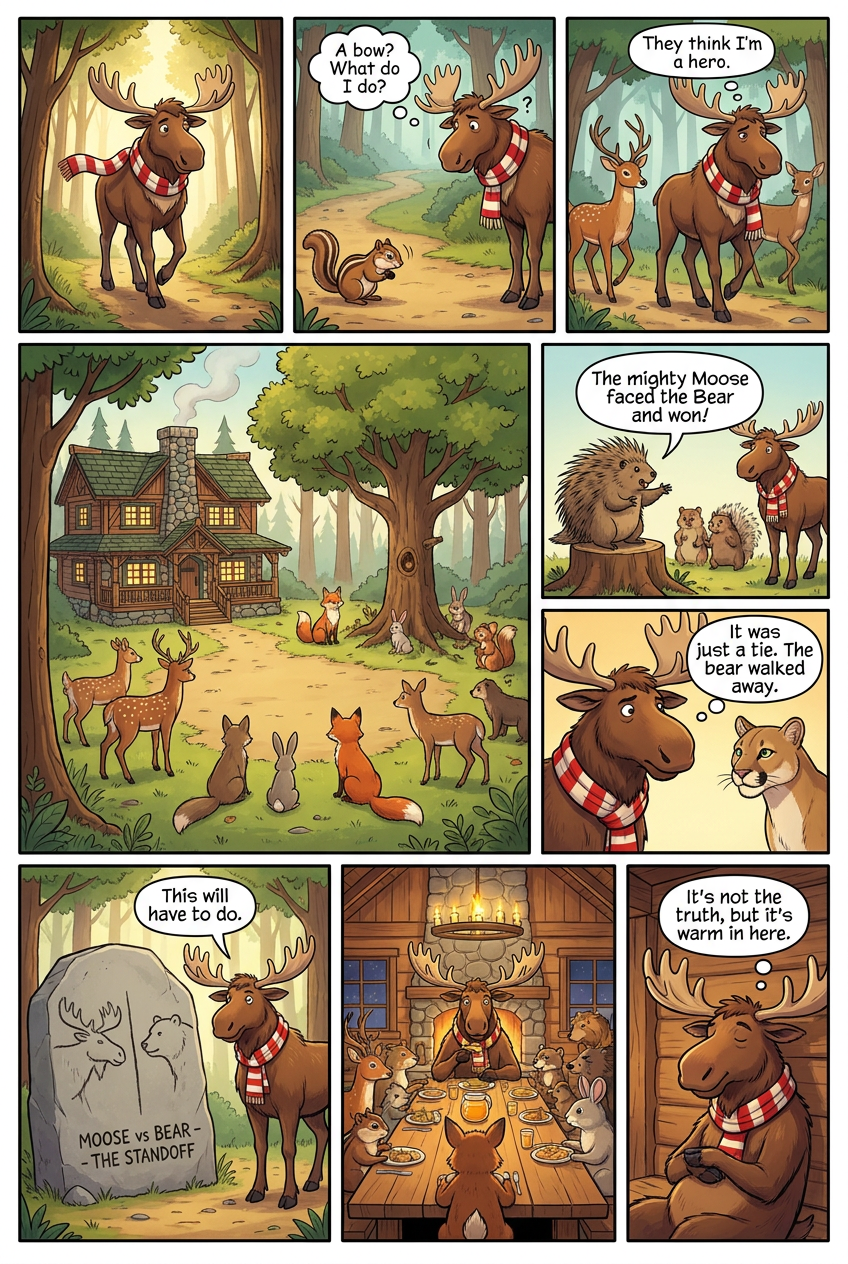
By morning, the story had run ahead of Canada Moose. The porcupine had told the rabbits. The cougar had told no one, but her silence was its own kind of proof. The rabbits had told the squirrels, and the squirrels told everyone. When Canada Moose came down the path from his bedding ground, a chipmunk was already waiting at the bend. The chipmunk bowed. Canada Moose did not know what to do with a bow, so he nodded back and kept walking. Two deer stepped aside to let him pass. He felt the mud print on his jacket like a badge he had not earned. They took him to the clearing where he had once knelt to free his antlers. The animals had been busy. A low lodge of stacked logs stood at the far edge, roofed with cedar boughs and a chimney of river stones. Smoke curled from the top. Inside, a long table ran the length of the room, piled with berries, cattail roots, and a comb of honey the bees had donated under protest. Outside, animals filled the grass in a loose ring around a young oak. An owl perched on a branch. A fox sat with a squirrel. Rabbits pressed close to the trunk. They had built him a hall and a crowd, and both were waiting. The porcupine climbed onto a stump and told the story again. He told it louder this time, with the bear growing bigger and the moose growing braver. Canada Moose stood at the edge and listened. He could feel the correction sitting behind his teeth. The bear had walked away because it did not care. He had dropped a pack and startled it. He had not stared it down. He opened his mouth. He looked at the rabbits, and at the chipmunk who had bowed, and at the cougar, who was watching him and not the porcupine. She already knew what he would do. He closed his mouth. He let the story finish. At the edge of the clearing, near the path where the grizzly's trail cut north, the beavers had dragged up a flat slab of grey stone and set it upright in the dirt. A squirrel had scratched two shapes into the face of it with a sharp flint — a moose head with wide antlers, and a bear on its hind legs, facing each other. Below the shapes, a shallow line marked the ground between them. The animals called it the standoff stone. Canada Moose walked over to it after the speeches. He put one hoof against the base. He thought about the real clearing, months ago, when he and the grizzly had stood without moving and he had counted it as a tie. That, at least, had been true. He decided the stone could stand for that day instead. No one else needed to know which standoff it marked. He went into the lodge and took the seat they had built for him at the head of the table. The animals came in after him and filled the benches. The porcupine sat close. The cougar lay by the fire and watched the flames. Canada Moose ate a little honey and listened to them talk about him as if he were not there. He was the second greatest animal in the forest now. The grizzly was still first, and the grizzly did not care, and that was the shape of things. He had not beaten the bear. He had outlived the story of kneeling. For a moose who had spent twenty minutes climbing out of a snowbank and two hours walking in circles, that was enough. He pulled his red and white scarf straight, leaned back against the log wall, and let the room be warm around him.
Play your story to life
Storycraft is a mobile game where you create AI characters, craft items and locations to build their world, then discover what direction your story takes. Download the iOS game for free today!
Download for free