

Captain NorthStar Lightwalker's Arc
14 Chapters
Captain NorthStar Lightwalker's dream is having a seat on the council, falling in love, searching the galaxy for another home to train his children and star fleet crew.

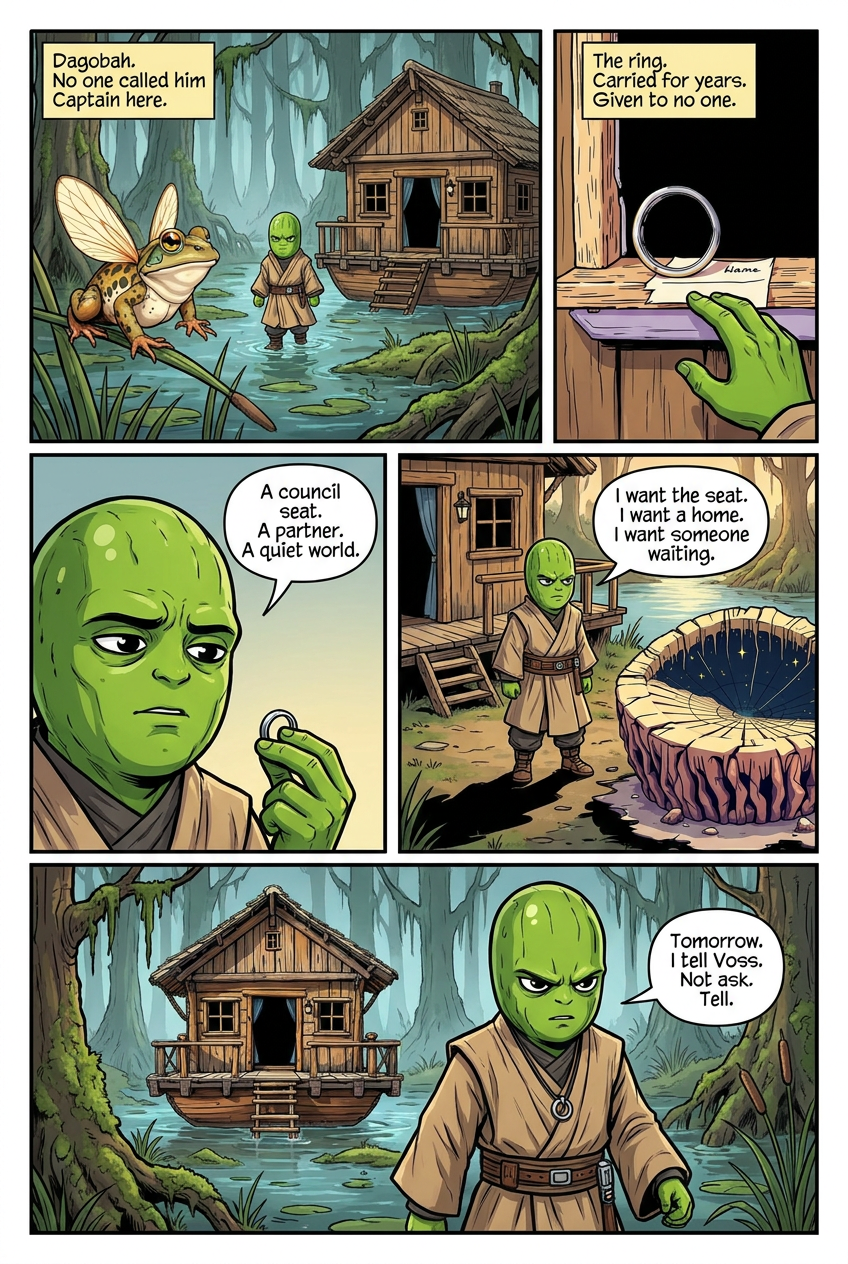
Captain NorthStar Lightwalker stepped off his shuttle and into the wet green hush of Dagobah. He left the USS Pickle in orbit and walked alone to the small wooden houseboat moored in the swamp. Here, no one called him Captain. Here, he could stop pretending he did not want a council seat, a partner, a quiet world for his children. Here, he could want. A winged toad rang its bell-throat from the reeds. He climbed the ladder and pushed open the door. On the windowsill sat a thin silver ring. He had carried it for years and never given it to anyone. Beside it lay a folded note in his own handwriting, the top line blank where a name should be. He picked up the ring and turned it between his fingers, the way he always did when he was alone. Outside, the carved sundial caught the last light. Its shadow lines pointed at stars he had never spoken about, not to his chief engineer, not to Admiral Voss, not even to himself. He stood over it and said the words out loud. "I want the seat. I want a home. I want someone waiting." The swamp did not answer. But he had said it. He slipped the ring onto a cord around his neck and walked back toward the shuttle. Tomorrow he would tell Voss. Not ask. Tell.
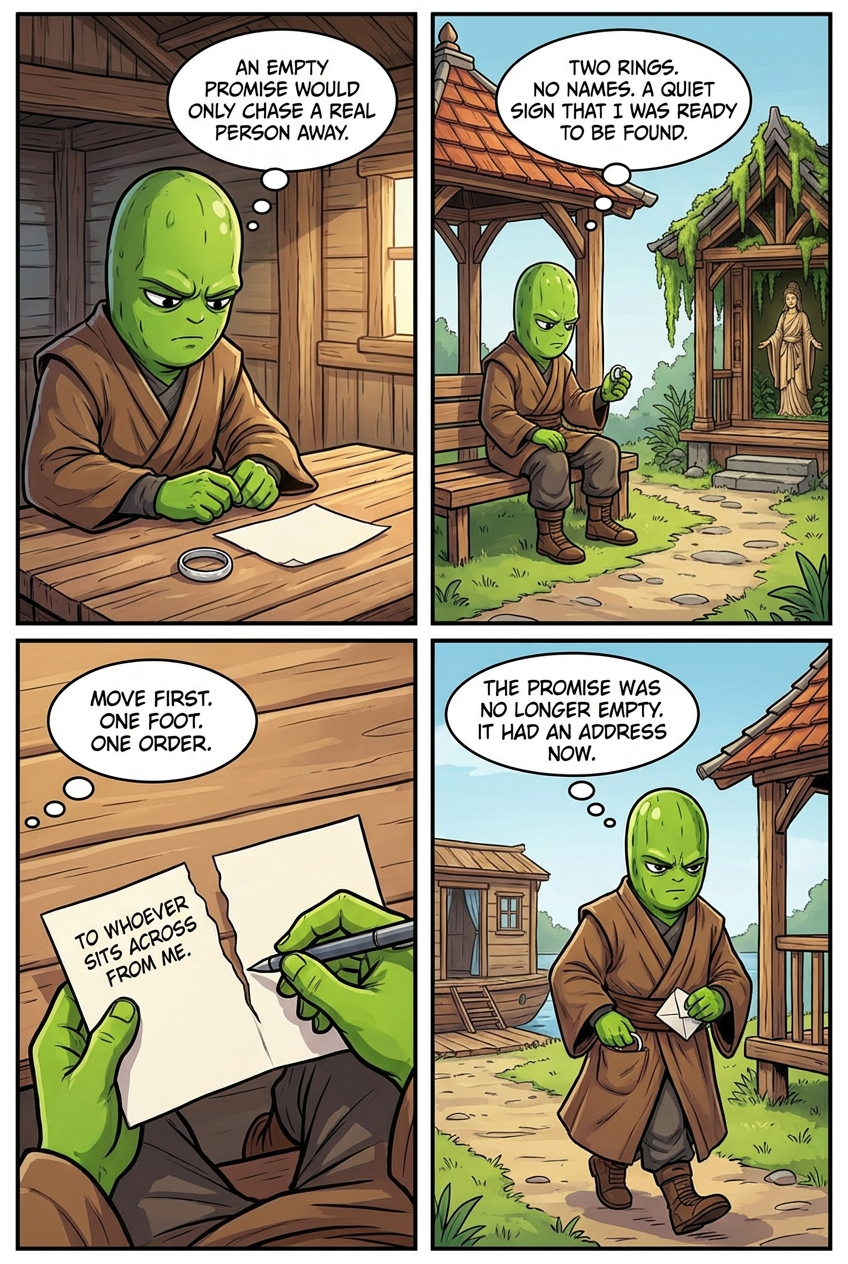
Back on the houseboat the next dawn, NorthStar laid the silver ring on the table beside the blank note. He could not bring it to Voss. He could not bring it to anyone. An empty promise would only chase a real person away. He walked outside to the twin gazebo he had built years ago. One bench was worn smooth. The other had never held a person. He sat in the unused one this time and felt how wrong it was. From his pocket he drew a second ring, a polished signet with a blank face. He had carried it for the same reason. Two rings. No names. He set it on the railing and stared at the moss-draped shrine he had raised at the path's edge, a quiet sign that he was ready to be found. Move first, he told himself. One foot. One order. He took the blank note and tore it in half. Then he wrote a new line at the top, in steady ink: To whoever sits across from me. Not a name. A seat saved. He folded the note around the silver ring and tucked both into his coat. The promise was no longer empty. It had an address now, even without a face. He climbed back toward the shuttle, lighter, and knew the next person he met would matter more than he was ready for.
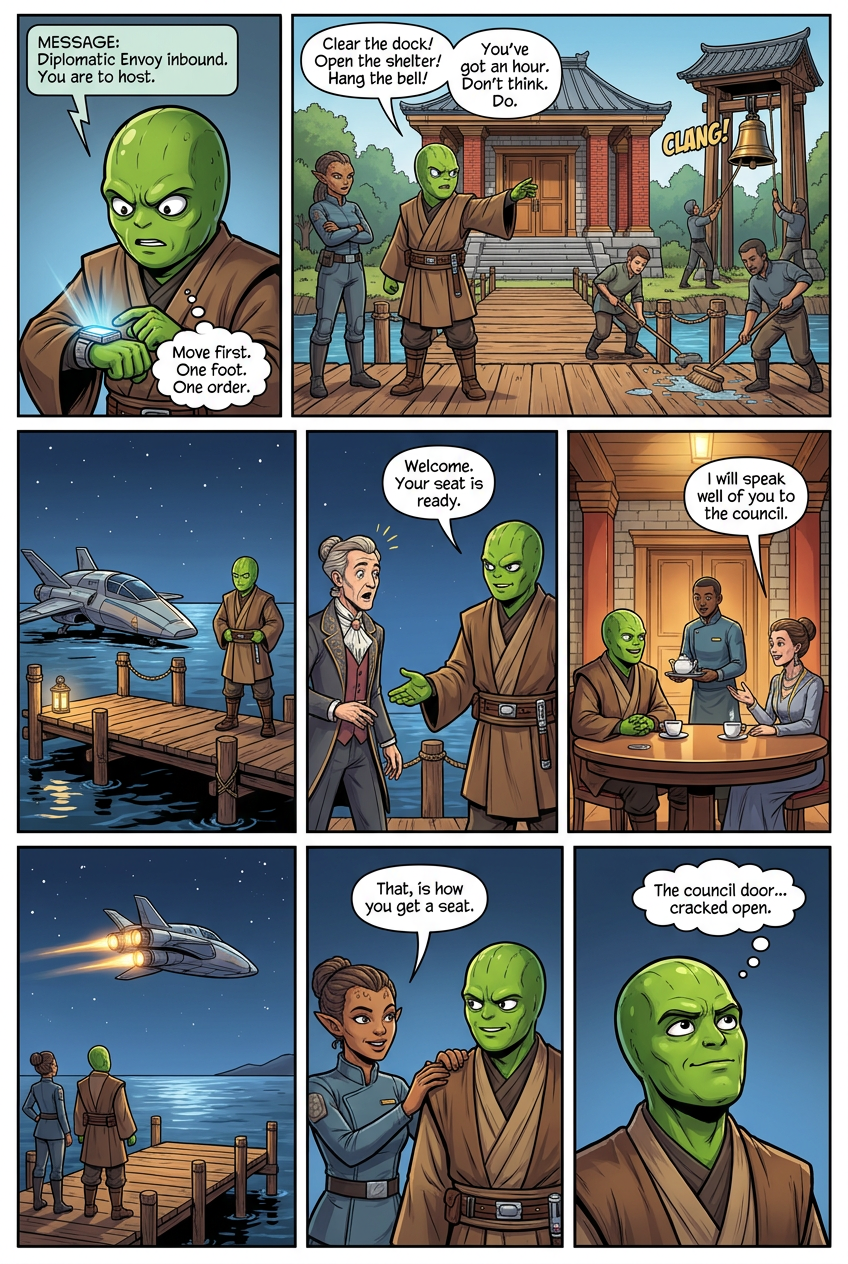
NorthStar's shuttle had barely touched the fleet when the message hit his comm. A diplomatic envoy was inbound. They expected him to host. He felt the old freeze try to rise, cold in his chest. Move first, he told himself. One foot. One order. He gave the order before he had a plan. Clear the wooden dock by the water. Open the brick-pillared shelter that had stood unused for months. Hang the old bronze bell where any arriving guest would see it. His chief engineer met him on the deck, arms crossed. "You've got an hour," she said. "Don't think. Do." NorthStar moved. He helped tie ropes to the dock posts himself. He swept the shelter's stone steps with his own hands. He hauled the mossy bell tower upright at the path's mouth and tested the rope. The sound rang clean across the water. Crew members stopped, then joined without being asked. The envoy's craft landed as the last lantern lit. NorthStar stood at the dock's edge, coat straight, the silver ring still tucked at his chest. He did not wait to be greeted. He stepped forward first and offered his hand. "Welcome. Your seat is ready." The envoy paused, surprised, then smiled and took his hand. Inside the shelter, the meeting went smoothly. No fumbling. No apology. When it ended, the envoy promised to speak well of him to the council before the next session. NorthStar watched the craft lift away. His engineer came to stand beside him. "That," she said, "is how you get a seat." He nodded once. He had not frozen. He had moved first. And somewhere ahead, the council door had cracked open an inch wider.
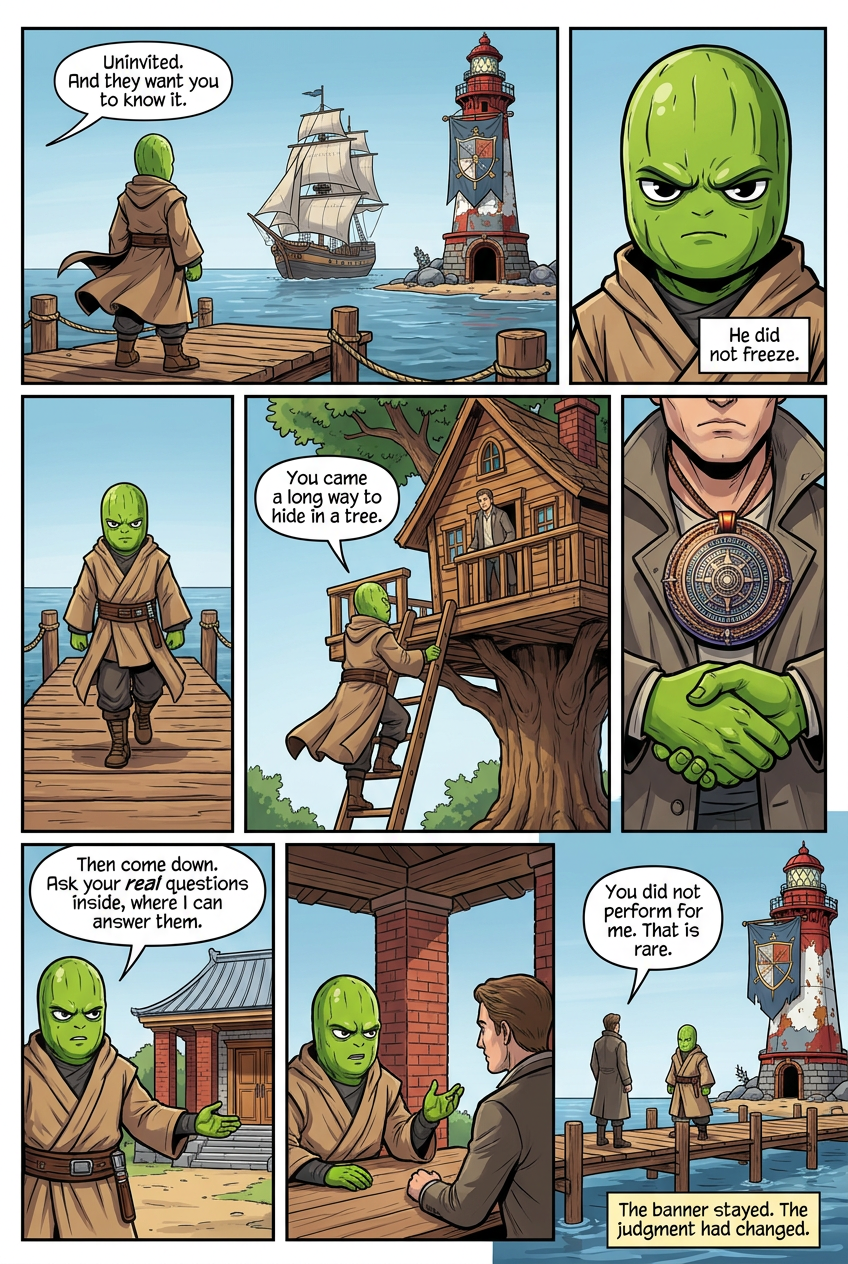
By morning, the envoy's praise had spread further than NorthStar planned. A new ship sat anchored off the rocky shore, and a tall iron lighthouse banner had been raised beside it — a crest he did not recognize. No hail. No request. Just a flag staking ground. His engineer found him at the dock. "Uninvited," she said. "And they want you to know it." NorthStar tightened his coat. He did not freeze. He stepped onto the planks and walked toward the shore alone. He spotted the observer halfway up a wooden treehouse deck above the water, watching him through the rails. A stranger in plain clothes, no badge, no weapon shown. NorthStar climbed the ladder and offered a steady hand. "You came a long way to hide in a tree." The observer almost smiled. A medallion slipped from their collar — etched with battle lines and march routes, not diplomacy. NorthStar saw it clearly. They were not here to judge a host. They were measuring a commander. He did not flinch. He gestured toward the brick-pillared shelter below. "Then come down. Ask your real questions inside, where I can answer them." The observer studied him a long moment, then tucked the medallion away and followed. Inside, NorthStar spoke plainly about his crew, his search for a home, and what he would not trade for a seat. The observer listened, asked three sharp questions, and left without a promise. But at the dock, they paused and said, "You did not perform for me. That is rare." The banner stayed. The judgment had changed.
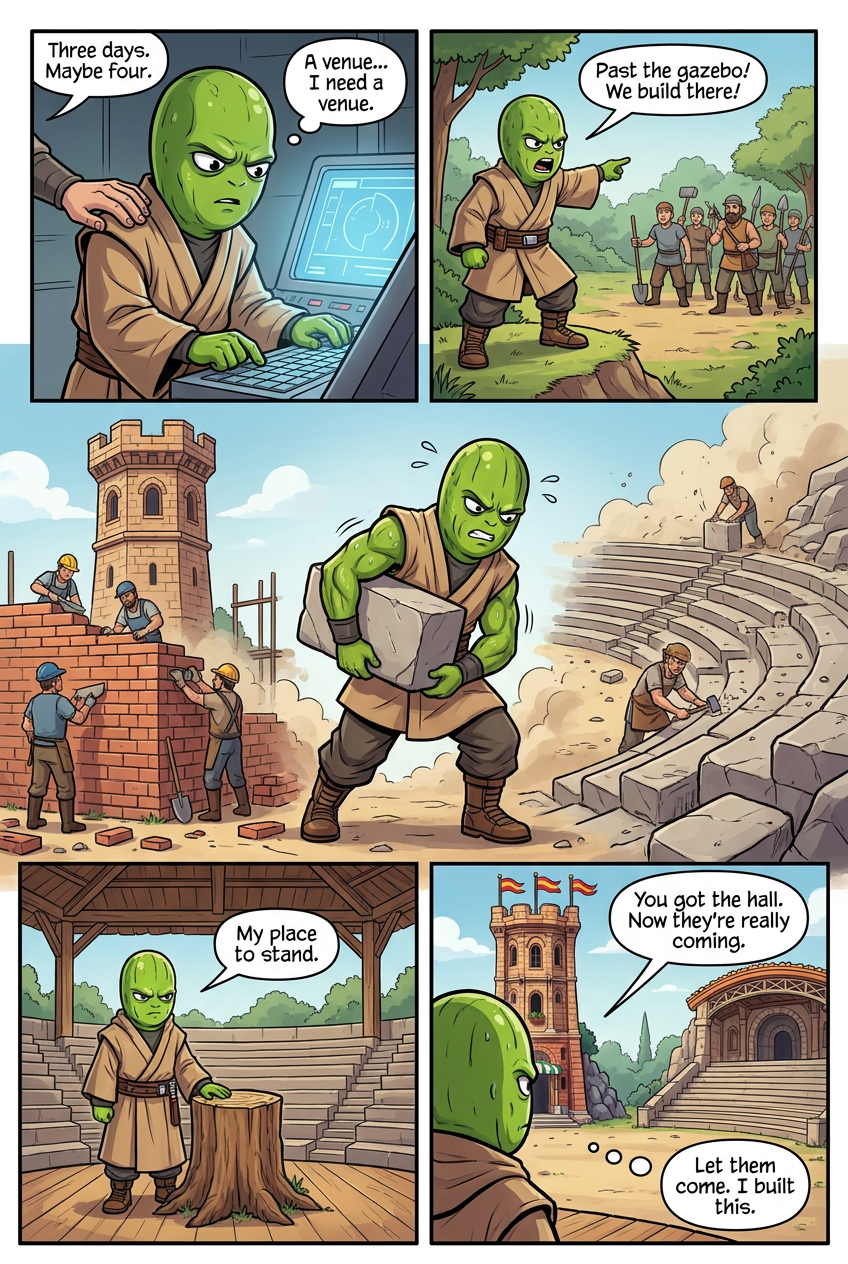
The observer's ship lifted off at dawn, and a coded packet pinged NorthStar's console before the engines cooled. The envoy had sent a quiet warning. The council wanted to come in person. They wanted to see a hall, a seat, a place that said he could host them. He had a dock and a shelter. He did not have a venue. His engineer read the message over his shoulder. "Three days," she said. "Maybe four." NorthStar did not sit down to think. He moved. One foot, one order. He called the crew to the clearing past the gazebo and pointed at the rising ground. They worked through the day and into the night. NorthStar hauled stone himself. The crew raised a tall brick tower at the edge of the clearing, narrow windows cut high, two bright flags snapping from its peak. Below it they shaped a wide amphitheater from carved stone benches, with a sturdy wooden roof braced by iron beams. It was rough. It was real. On the third morning he walked the empty stage alone. At its center he set a tall stump, its top flattened smooth, deep grooves cut into the weathered wood. This would be his place to stand. Not a podium granted to him. One he had cut himself. The envoy's reply came an hour later. The council had accepted. They would arrive within the week to judge the venue and the man who built it. His engineer found him at the stump, hand resting on the grooves. "You got the hall," she said. "Now they're really coming." NorthStar nodded. The fear was there, steady and familiar. But the ground under his boots was his. He had not asked. He had built. Whatever walked off those ships next, it would meet him standing on wood he had carved with his own hands.
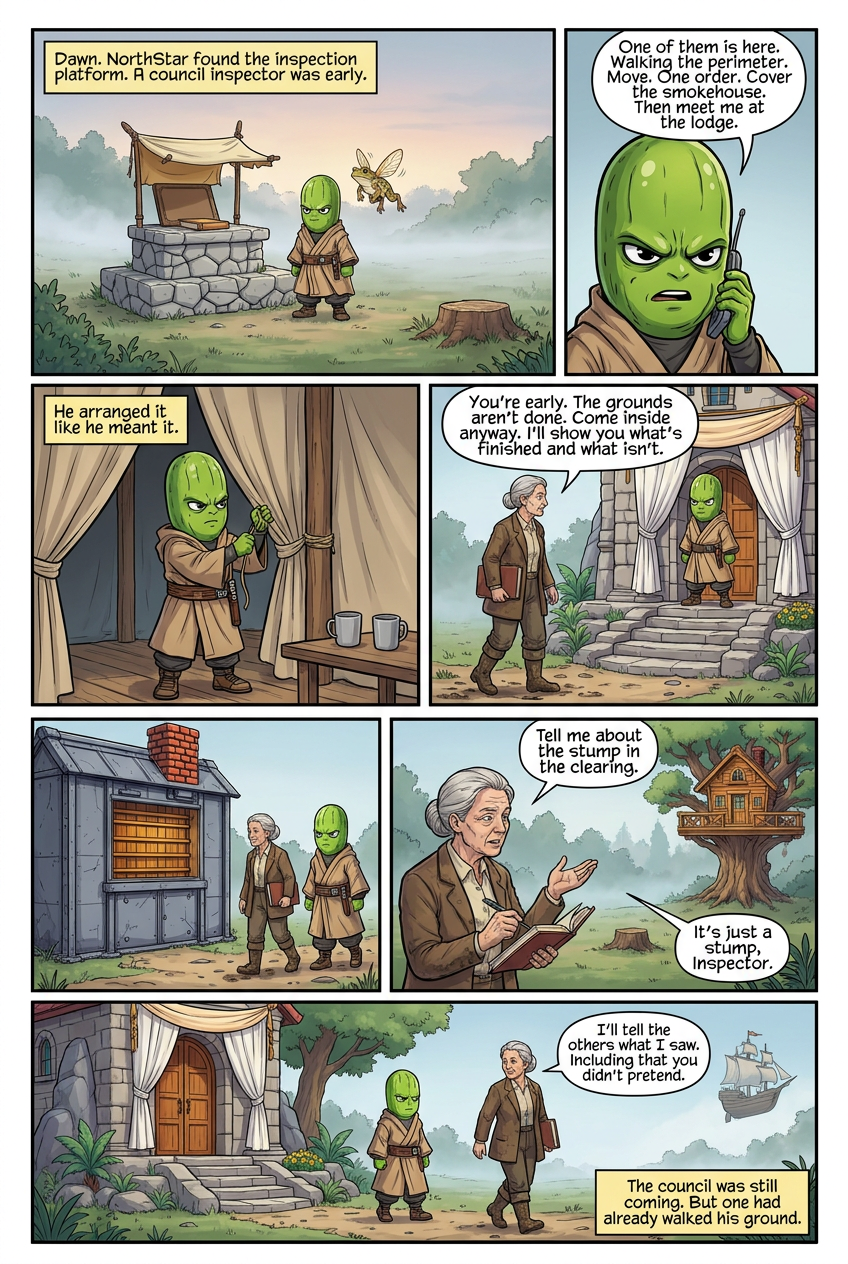
Dawn broke over the clearing, and NorthStar was already on his feet. The hall stood ready. The grounds did not. Crates lay open near the amphitheater. A toad with thin wings buzzed past his ear. He had two days before the council ships were due. Then he saw it. A low stone platform at the edge of the path, a canvas stretched tight above an open registry book. Someone had set it there in the night. A council inspector had come early, alone, and was already walking his grounds. His engineer found him staring at the registry. "One of them is here," she said. "Walking the perimeter." NorthStar's chest tightened. The old freeze pressed in. He spoke before it could take hold. "Move. One order." He pointed to the half-built smokehouse, its chimney still missing bricks, racks hanging loose. "Cover it. Then meet me at the lodge." He ran to the small stone lodge near the dock, its draped cloth walls still loose at the seams. He tied the curtains himself. He set two cups on the step. He did not hide the unfinished work. He arranged it like he meant it. The inspector came up the path with the registry tucked under one arm. She was older, sharp-eyed, boots already muddy. NorthStar met her at the steps. "You're early," he said. "The grounds aren't done. Come inside anyway. I'll show you what's finished and what isn't." She studied him a long moment. Then she climbed the steps. She stayed an hour. She wrote in her book. She asked about the smokehouse, the tower, the stump in the clearing. NorthStar answered plain. When she left, she closed the registry and tucked it under her arm. "I'll tell the others what I saw," she said. "Including that you didn't pretend." Her ship lifted before noon. The council was still coming. But one of them had already walked his ground and not turned away.
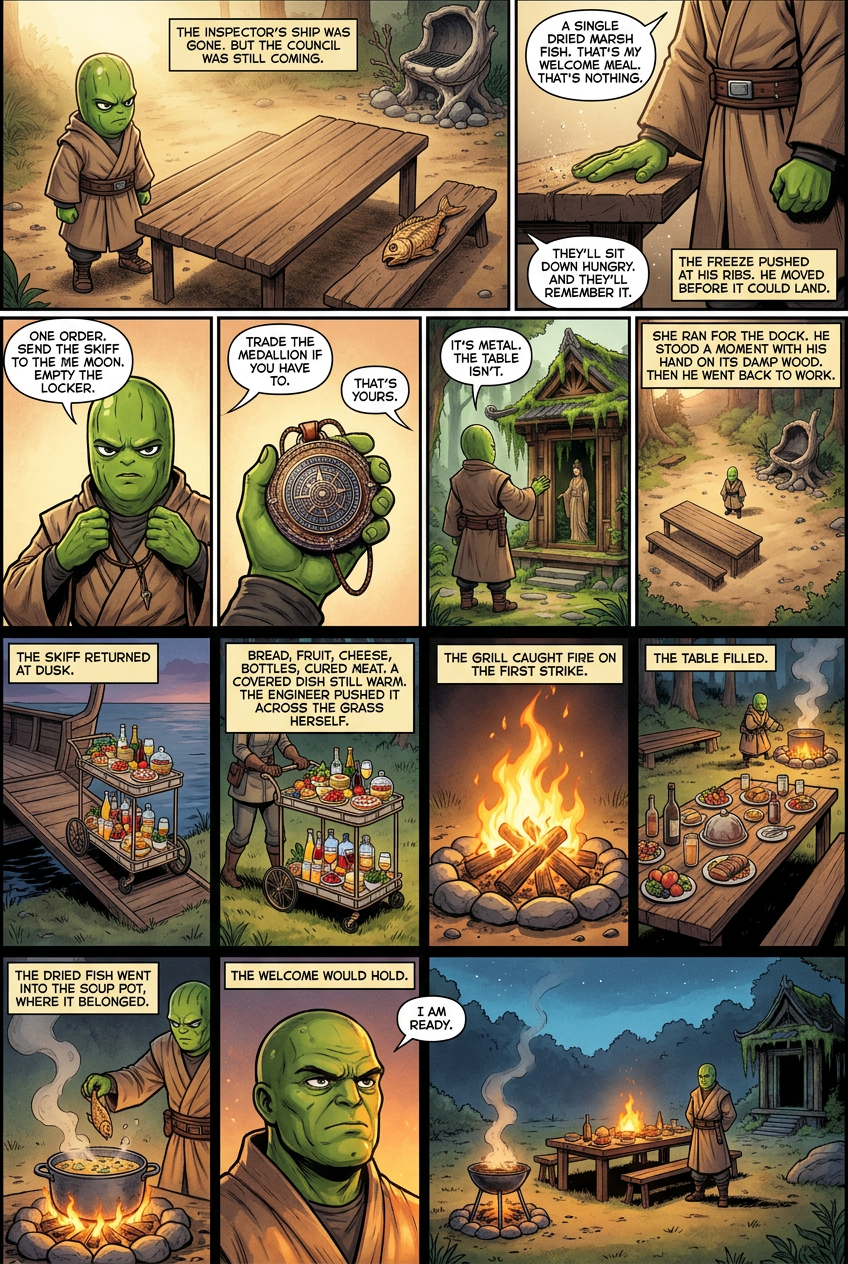
The inspector's ship was gone, but the council was still coming. NorthStar walked to the clearing and saw what he had not let himself see. The long table he had dragged out was bare wood. A single dried marsh fish lay on a plank beside it, scales curled hard from the sun. That was his welcome meal. That was nothing. Near the table stood a cold driftwood grill, bleached branches lashed tight, stones half-sunk at its base. No fire. No coals. No cook. His engineer came up behind him and looked at the fish without speaking. "They'll sit down hungry," she said. "And they'll remember it." NorthStar pressed his palm flat on the table. The freeze pushed at his ribs. He moved before it could land. "One order," he said. "Send the skiff to the trade moon. Empty the locker. Trade the medallion if you have to." He pulled the strategic medallion from under his collar and set it in her hand. The leather cord swung once and stopped. She stared at it. "That's yours." "It's metal," he said. "The table isn't." She closed her fist and ran for the dock. NorthStar walked to the small mossy shrine at the clearing's edge and stood a moment with his hand on its damp wood. Then he went back to work. The skiff returned at dusk. A wheeled cart rolled off the ramp, stacked high — bread, fruit, cheese, bottles, cured meat, a covered dish still warm. The engineer pushed it across the grass herself. The grill caught fire on the first strike. The table filled. The dried fish went into the soup pot, where it belonged. The welcome would hold.
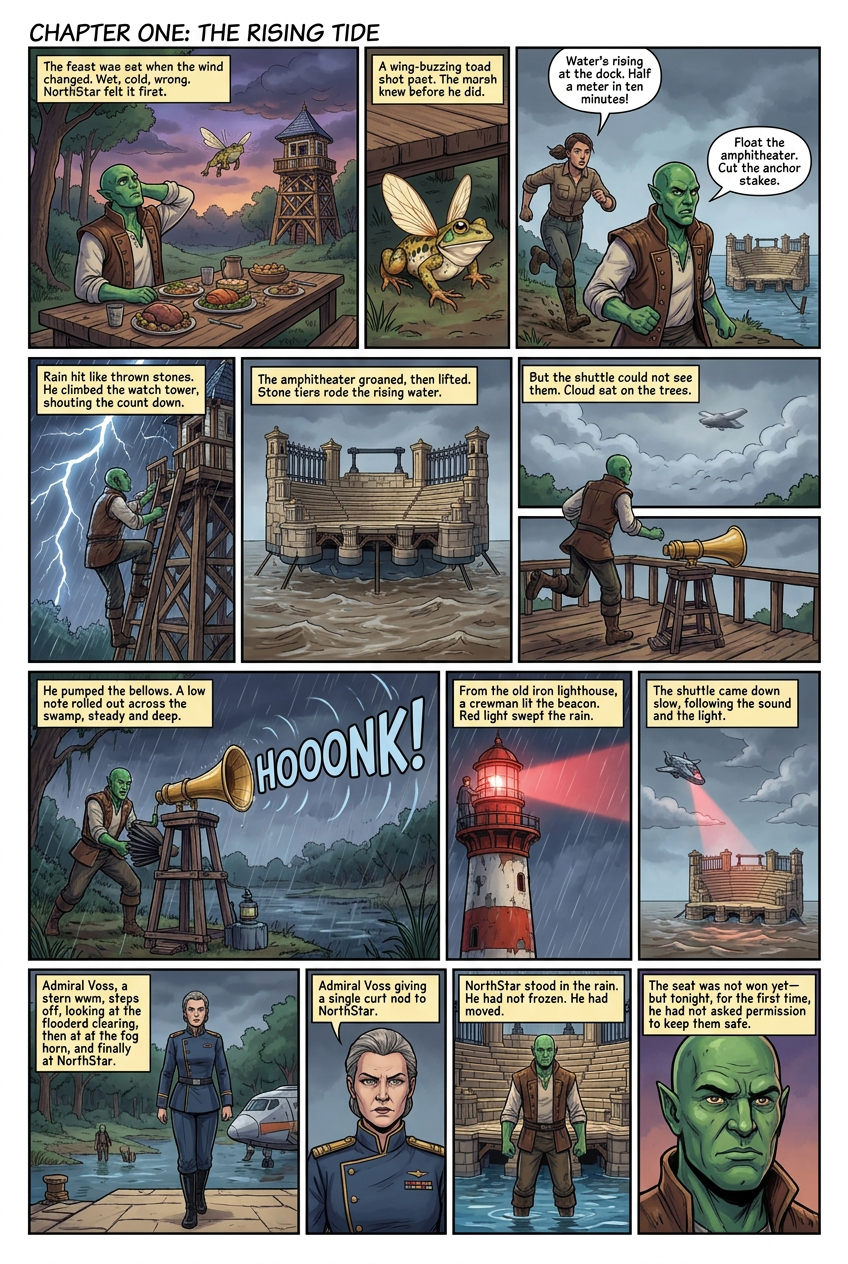
The feast was set when the wind changed. NorthStar felt it first on the back of his neck — wet, cold, wrong. He looked up. The sky over the clearing had turned the color of bruised fruit. A wing-buzzing toad shot past his ear and dove under the table. The marsh knew before he did. A storm was coming, and the council's shuttle was already in the air. His engineer ran up with mud on her boots. "Water's rising at the dock. Half a meter in ten minutes." NorthStar pressed his fist against his thigh. One foot. One order. "Float the amphitheater," he said. "Cut the anchor stakes. Let the pontoons take it." She blinked once, then ran. The seating was built on sealed metal drums for exactly this — a thing he had paid for and prayed never to use. Rain hit like thrown stones. NorthStar climbed the tall wooden watch tower at the clearing's edge and shouted the count down to the crew below. The amphitheater groaned, then lifted. Stone tiers rode the rising water. Iron beams held. The platform settled three feet above the flood and stayed there, rocking gentle as a moored boat. But the shuttle could not see them. Cloud sat on the trees. NorthStar climbed back down and ran to the brass-funneled horn on its wooden frame. He pumped the bellows. A low note rolled out across the swamp, steady and deep. He kept pumping. From the old iron lighthouse beyond the trees, a crewman lit the beacon. Red light swept the rain. The shuttle came down slow, following the sound and the light. Its landing skids touched the floating stone. The council stepped off onto a dry platform above a drowned clearing. Admiral Voss looked at the flood, then at the horn, then at NorthStar. She did not smile. She nodded once. It was enough. NorthStar stood in the rain with water past his ankles and the council dry above him. He had not frozen. He had moved. The seat was not won yet — but tonight, for the first time, he had not asked permission to keep them safe.
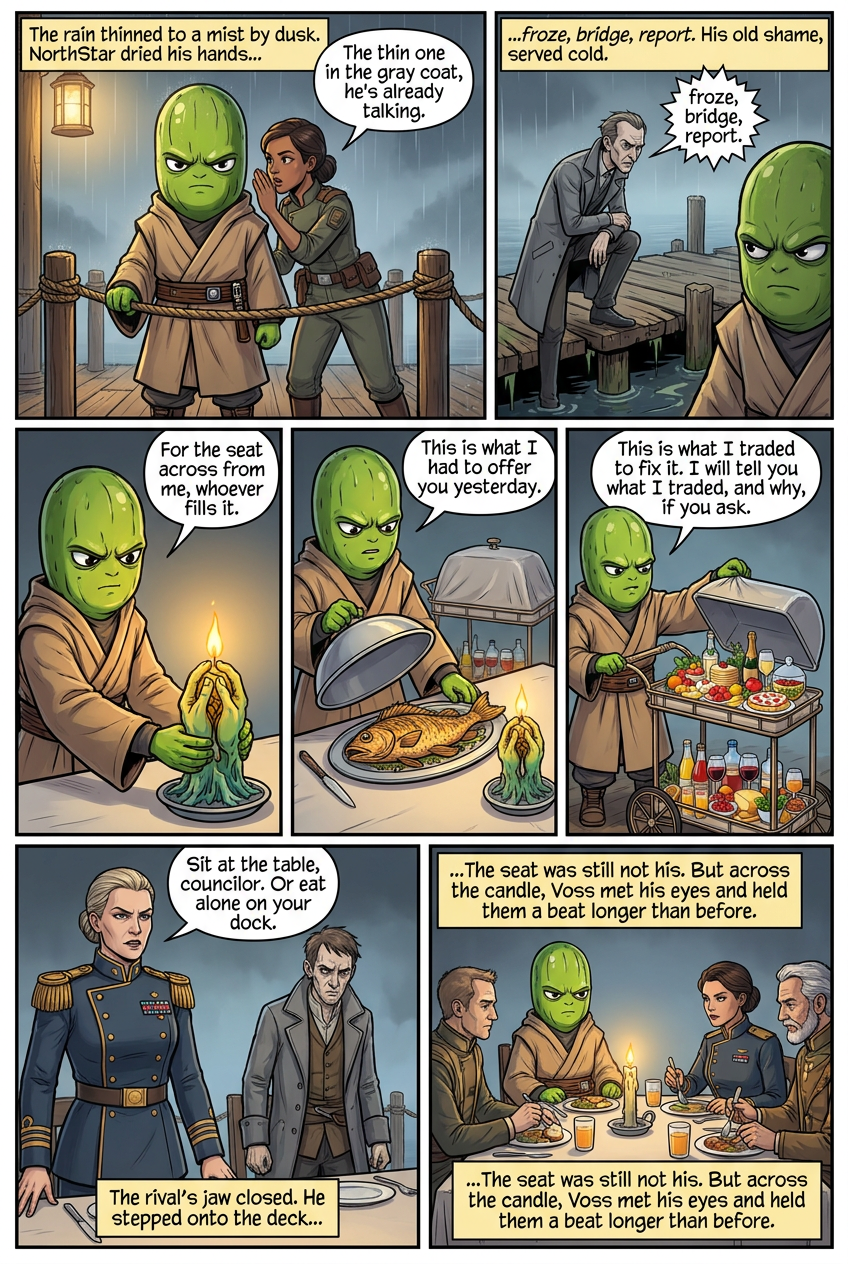
The rain thinned to a mist by dusk. NorthStar dried his hands and climbed onto the floating deck where the long dinner table waited under rope rails and lantern light. Voss's nod still warmed him. But his engineer caught his sleeve at the steps. "The thin one in the gray coat," she whispered. "He's already talking." NorthStar found the rival seated apart from the others, perched on a half-sunken rotting dock that drifted near the deck like a private booth. He leaned toward each council member who passed, voice low, words sharp. NorthStar heard one drift up — froze, bridge, report. His old shame, served cold. One foot. One order. NorthStar did not argue. He walked to the serving cart, wheeled it himself to the center of the table, and set down a single carved candle shaped like two hands cupping a flame. He lit the wick. "For the seat across from me," he said quietly, "whoever fills it." The council looked up. The rival kept talking. No one leaned in anymore. Then NorthStar lifted the lid off the platter beside the candle. Under it lay one sun-curled marsh fish, brittle and small. "This is what I had to offer you yesterday," he said. He set it down. He uncovered the rest of the cart — hot bread, fruit, stew. "This is what I traded to fix it. I will tell you what I traded, and why, if you ask." The rival opened his mouth. Admiral Voss spoke first. "Sit at the table, councilor," she said, without turning. "Or eat alone on your dock." The rival's jaw closed. He stepped onto the deck and took the farthest chair. The whispers died under the clink of plates. NorthStar sat. He did not feel triumphant. He felt steady. The rumor had not killed him tonight, and he had not killed it with anger — only with the truth laid plain on a table he built. The seat was still not his. But across the candle, Voss met his eyes and held them a beat longer than before.
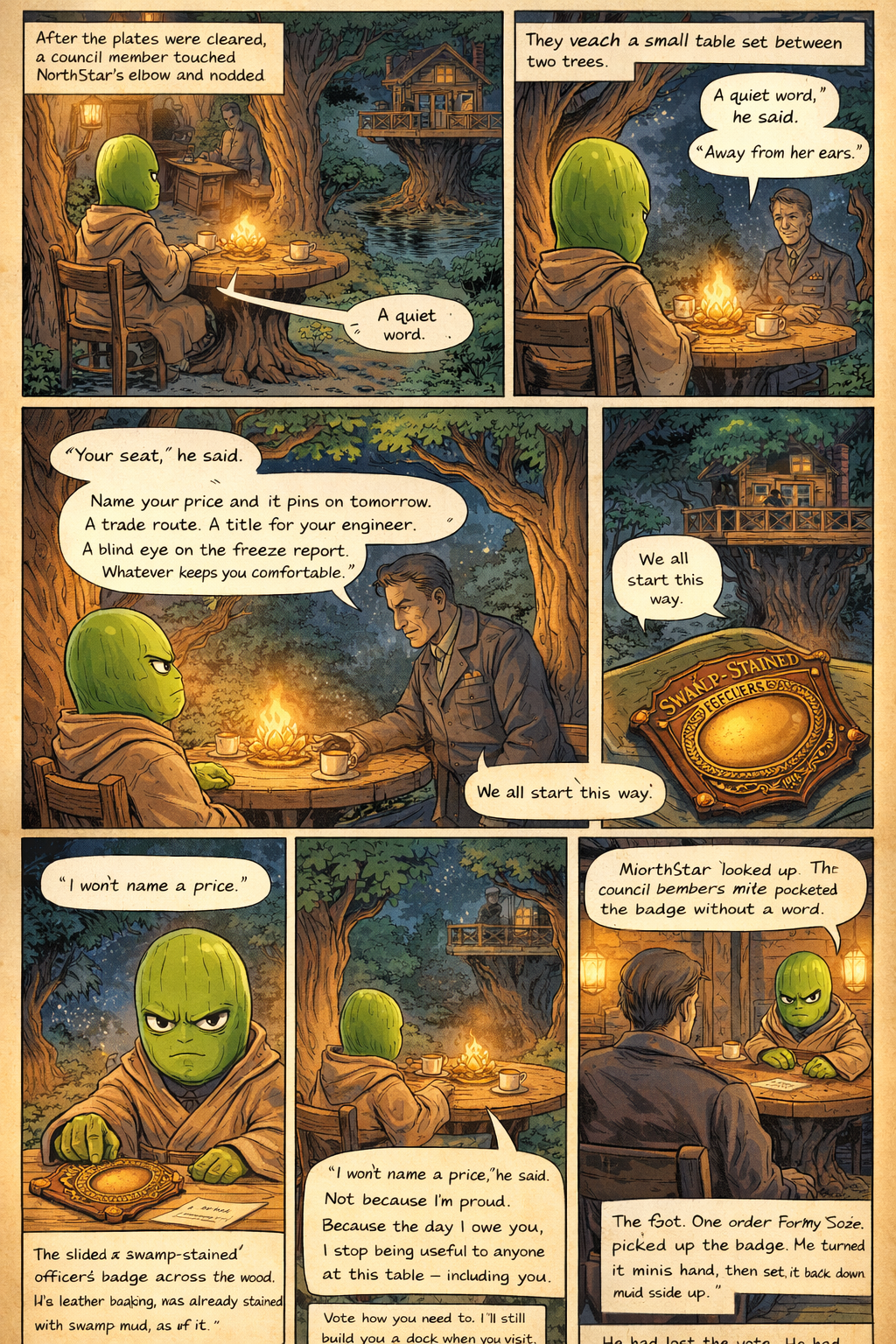
After the plates were cleared, a council member touched NorthStar's elbow and nodded toward the trees. They walked past the lantern light to a small carved table set between two living trunks, a low flame burning at its center. The man sat first and gestured for NorthStar to join him. "A quiet word," he said. "Away from her ears." He slid a brass badge across the wood. Its leather backing was already stained with swamp mud, as if it had been waiting for NorthStar all along. "Your seat," the man said. "Name your price and it pins on tomorrow. A trade route. A title for your engineer. A blind eye on the freeze report. Whatever keeps you comfortable." He smiled. "We all start this way." NorthStar looked up. Through the branches he could see the rival's gray coat on the railed deck of a treehouse above them, watching, listening. The offer had a witness. Refusing wrong meant losing two votes, not one. One foot. One order. NorthStar picked up the badge. He turned it in his hand, then set it back down, mud-side up. "I won't name a price," he said. "Not because I'm proud. Because the day I owe you, I stop being useful to anyone at this table — including you." He pushed the badge an inch toward the man. "Vote how you need to. I'll still build you a dock when you visit." The council member's smile thinned. He pocketed the badge without a word and walked back toward the lights. Above, the gray coat withdrew from the treehouse rail. NorthStar sat alone at the small table a moment longer, watching the flame. He had lost the vote. He had kept the seat worth having. When he returned to the deck, Admiral Voss was waiting by the steps. She had seen the man come back empty-handed. She did not speak. She only nodded once — the smallest thing — and moved aside to let him pass.
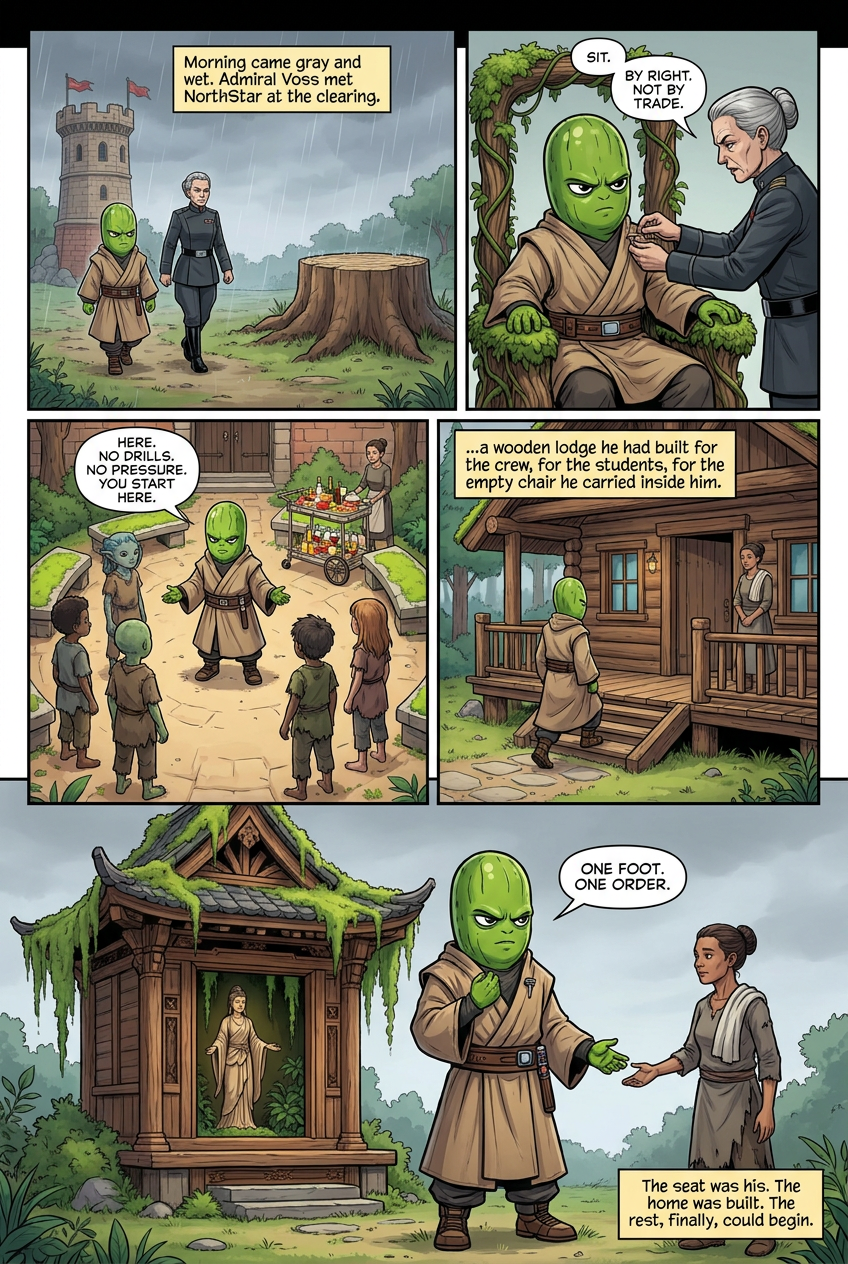
Morning came gray and wet. Admiral Voss met NorthStar at the clearing with a small wooden box in her hands. She did not open it yet. She walked him past the tower and the stump platform, into a quiet stand of trees where vines had grown thick around an old root. The vines had been shaped overnight into a seat — woven tight, soft with moss along the arms. "Sit," she said. NorthStar sat. The throne held him like it had been waiting. Voss opened the box and took out a plain pin — no mud, no leather, no debt attached. She fixed it to his collar herself. "By right," she said. "Not by trade." She stepped back and gave him the smallest smile he had ever seen on her face. His engineer was already moving behind them. She rolled a serving cart along the path and called the crew in from the dock. Children spilled out after them, blinking at the new seat among the vines. NorthStar stood and walked them across the clearing to a clay courtyard he had quietly cleared weeks ago — packed earth, stone benches, room enough for small feet to learn. "Here," he told the children. "No drills. No pressure. You start here." Past the courtyard sat a wooden lodge with a stone chimney and a wide porch. He had built it for the crew, for the students, for the empty chair he carried inside him. A woman stood on the porch with a cloth over her shoulder, watching him come up the steps. She was new to the settlement, quiet, kind to the children — and she did not look away when he met her eyes. He stopped at the door beside a small mossy shrine and touched the pin at his collar. One foot. One order. He held out his hand to her, and she took it. The seat was his. The home was built. The rest, finally, could begin.
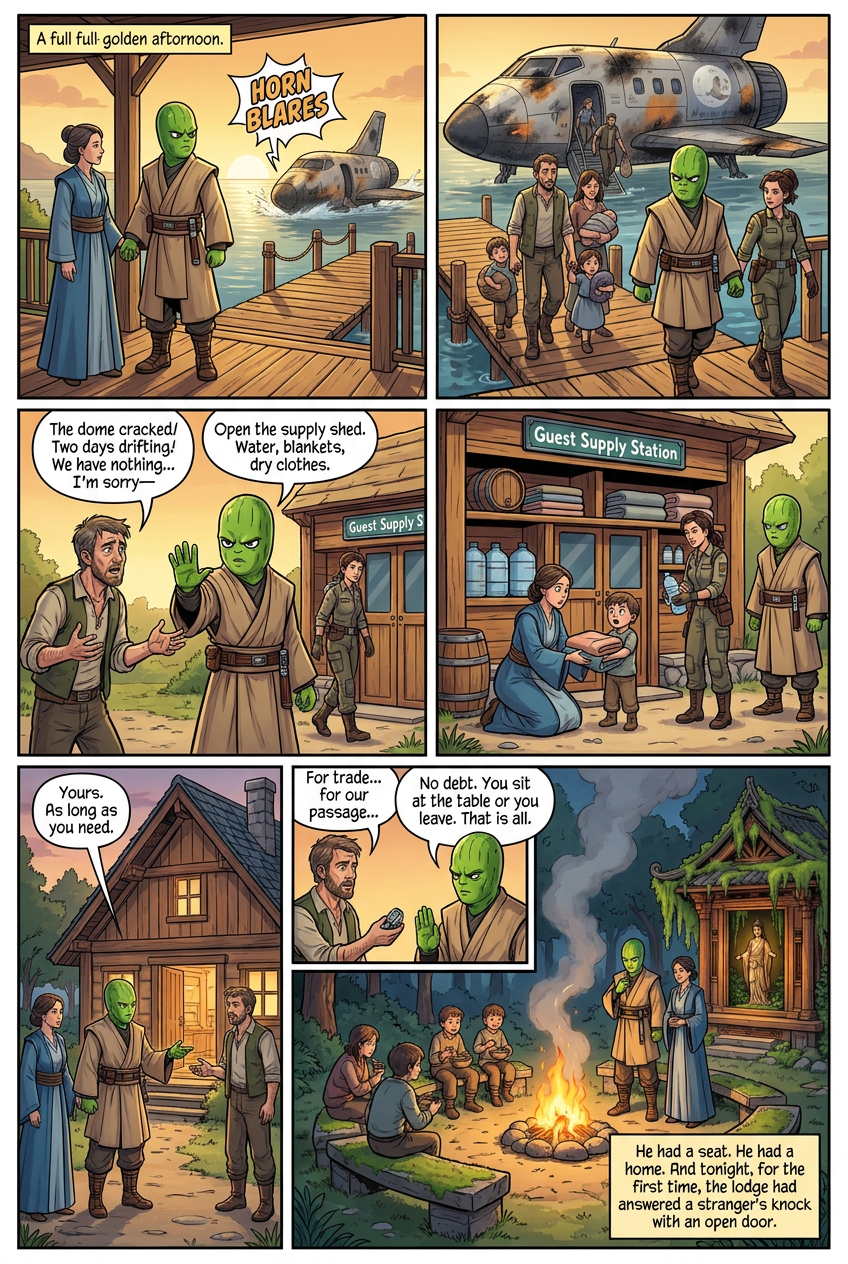
The woman's hand was still warm in his when a shuttle horn cut across the clearing. NorthStar stepped off the porch and saw a small craft settling near the dock, its hull scorched, moon-colony markings half burned away. A man climbed out first, then a woman, then two children clutching a bundle of cloth. They had nowhere else to go. NorthStar felt the old freeze rise in his chest. One foot. One order. He walked toward them. The father spoke fast. The dome had cracked. They had drifted for two days. NorthStar held up a hand and stopped the apology before it started. He turned to his engineer, already at his shoulder. "Open the supply shed," he said. "Water, blankets, dry clothes." She moved without a word, sliding back the doors of the small wooden station at the courtyard edge. The children stared at the open shelves like they did not believe them. The woman from the porch was already there, pressing folded cloth into small arms, kneeling to meet their eyes. NorthStar watched her hands work and felt something steady in him that had not been steady before. He led the family past the teaching courtyard to a stone cottage at the tree line — thick walls, raised deck, glass thick enough to hold against a storm. He had built it for a day he hoped would not come. "Yours," he said. "As long as you need." The father tried to offer a trade. NorthStar shook his head. "No debt. You sit at the table or you leave. That is all." By dusk the family had laid flat stones in a ring near the cottage and lit a small fire at the center. Smoke rose thin and steady above the trees. The children sat close to it, eating from bowls the engineer brought down. The mark of them was on the ground now — a hearth where there had been none. The courtyard was no longer a promise. It was a place that had kept its word. NorthStar stood at the edge of the firelight and touched the pin at his collar. The woman from the lodge came up beside him and did not speak. Across the clearing, the small shrine among the vines caught the last gray light. He had a seat. He had a home. And tonight, for the first time, the lodge had answered a stranger's knock with an open door.
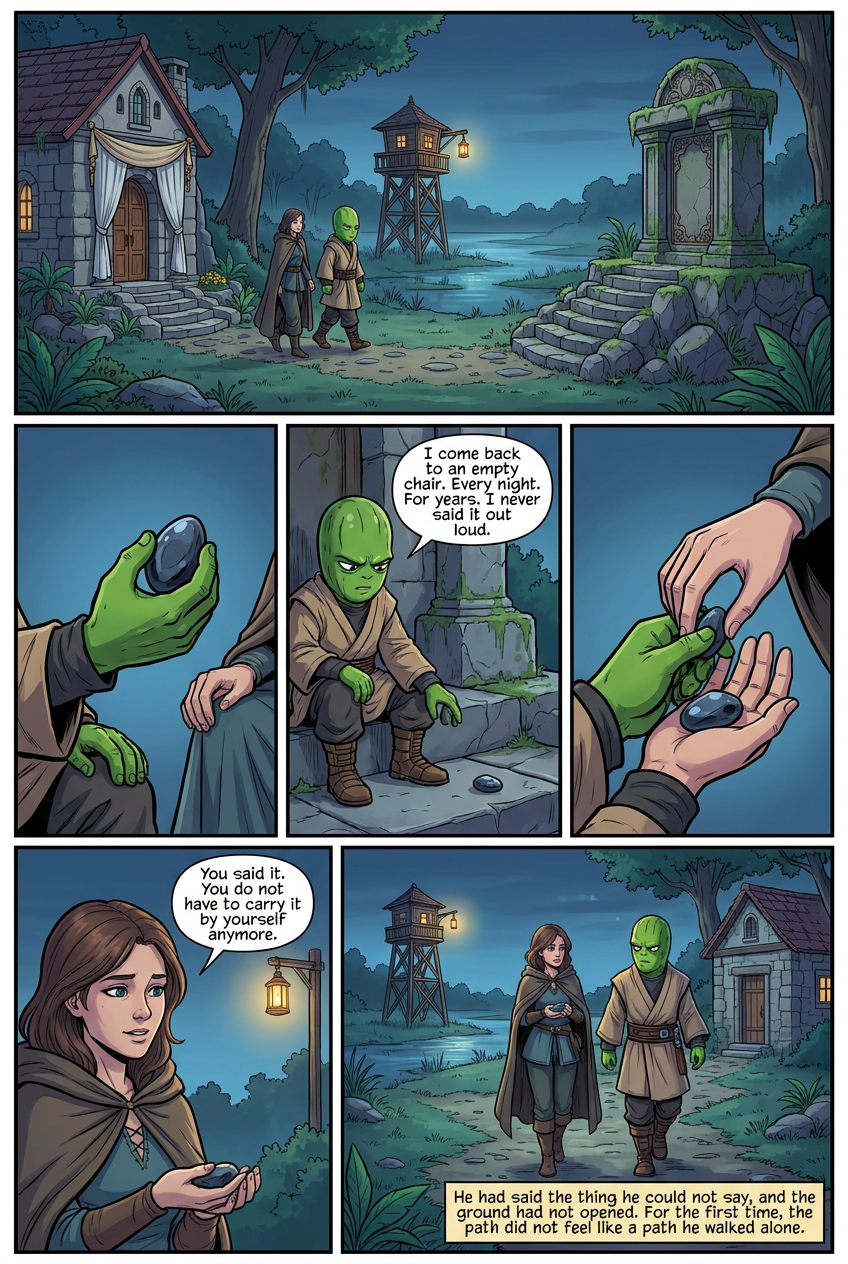
The fire at the cottage burned low, and the woman from the lodge stayed at his elbow longer than the night needed. She did not ask. She only walked with him past the courtyard, toward the old stone altar at the tree line, where the steps were green with algae and the air felt older than the rest of the clearing. He had come here twice this week to say it and left without speaking. He sat on the bottom step. She sat beside him. In his pocket, his fingers closed around a smooth black pebble he had carried since the dock. He turned it over and over. The words were right there. They would not move. Across the water, a small wooden tower rose against the dusk. She had hung a lantern from its rail two nights ago. He had not asked her to. The light was steady. It meant she was staying close. He looked at it and felt the pebble grow heavy in his hand. "I come back to an empty chair," he said. His voice cracked on the last word. He did not look at her. "Every night. For years. I never said it out loud." He set the pebble on the step between them. "That is what it weighs." She picked it up. She did not speak right away. She turned it the way he had turned it, learning it. Then she closed her hand around it and put her other hand over his. "You said it," she said. "You do not have to carry it by yourself anymore." He breathed out. The shrine behind them stayed quiet. The lantern on the tower stayed lit. He had said the thing he could not say, and the ground had not opened, and she had not gone. He walked her back to the lodge with the pebble still in her hand, and for the first time the path did not feel like a path he walked alone.
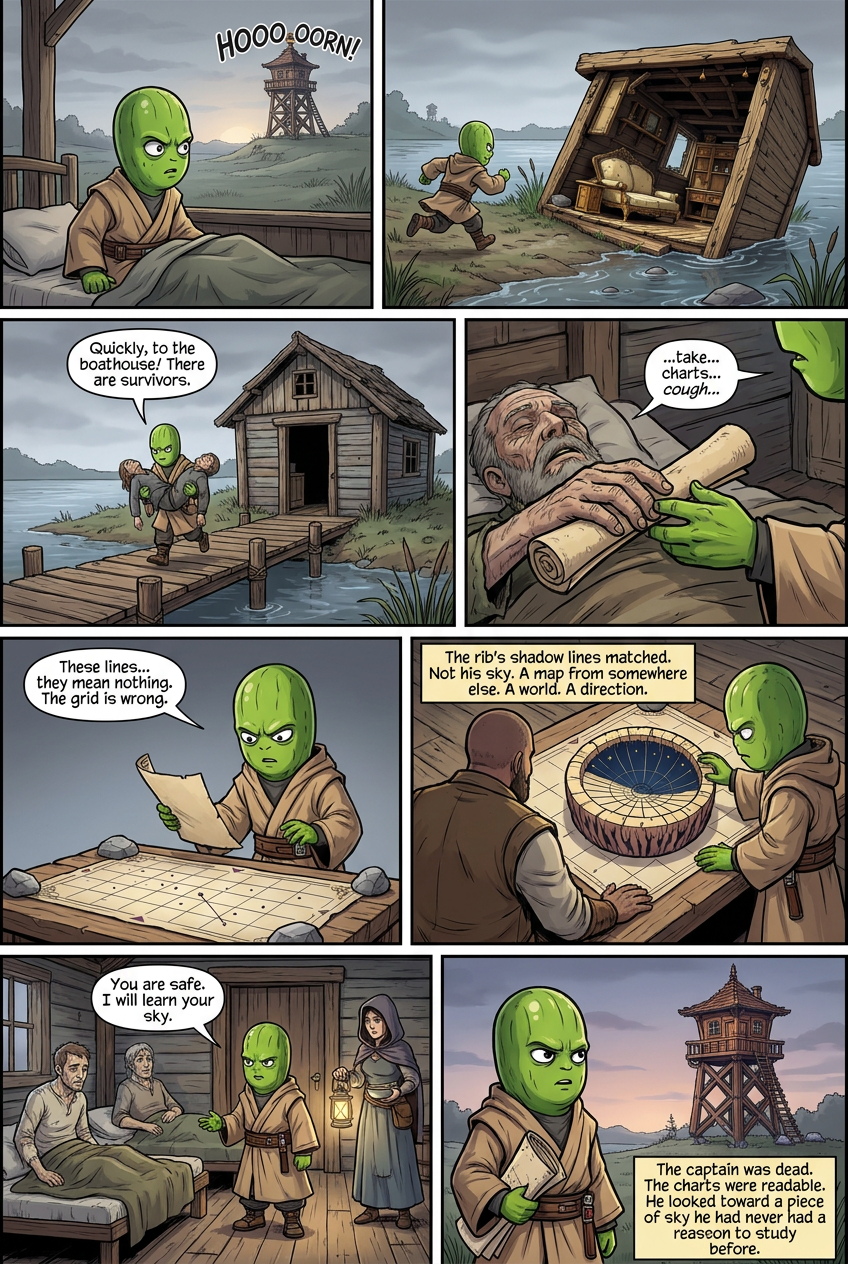
He woke before dawn to a horn from the lookout tower. A ship had drifted in on the storm tide, split open like a cabin tipped on its side. Rotted velvet showed through the broken hull. Tarnished brass caught the gray light. He ran for the dock. Three crew were still breathing. His engineer helped him carry them to the weathered boathouse and lay them on dry planks. Their captain pressed a roll of star charts into his hand. The lines meant nothing to him. The man coughed once and did not cough again. NorthStar carried the charts to the carved table in the clearing and weighted them with stones. The grid did not match his sky. He turned the parchment. He turned it again. One foot. One order. He sent his engineer for the rib sundial from the altar path. They laid the curved bone beside the chart. The shadow lines on the rib matched three marks on the parchment. Not a map of stars he knew. A map of stars seen from somewhere else. A world. A direction. He went back to the boathouse. Two of the three were awake now, weak but alive. He told them they were safe. He told them he would learn their sky. The woman from the lodge brought broth and a lit lantern and sat down beside the cot without being asked. The captain of the drifter was dead. The charts were readable. NorthStar folded them under his arm and looked out past the tower lantern, toward a piece of sky he had never had a reason to study before.
Play your story to life
Storycraft is a mobile game where you create AI characters, craft items and locations to build their world, then discover what direction your story takes. Download the iOS game for free today!
Download for free