

Constance Ashworth's Arc
4 Chapters
Constance Ashworth's dream is commissioning a portrait that captures her true nature without revealing it.

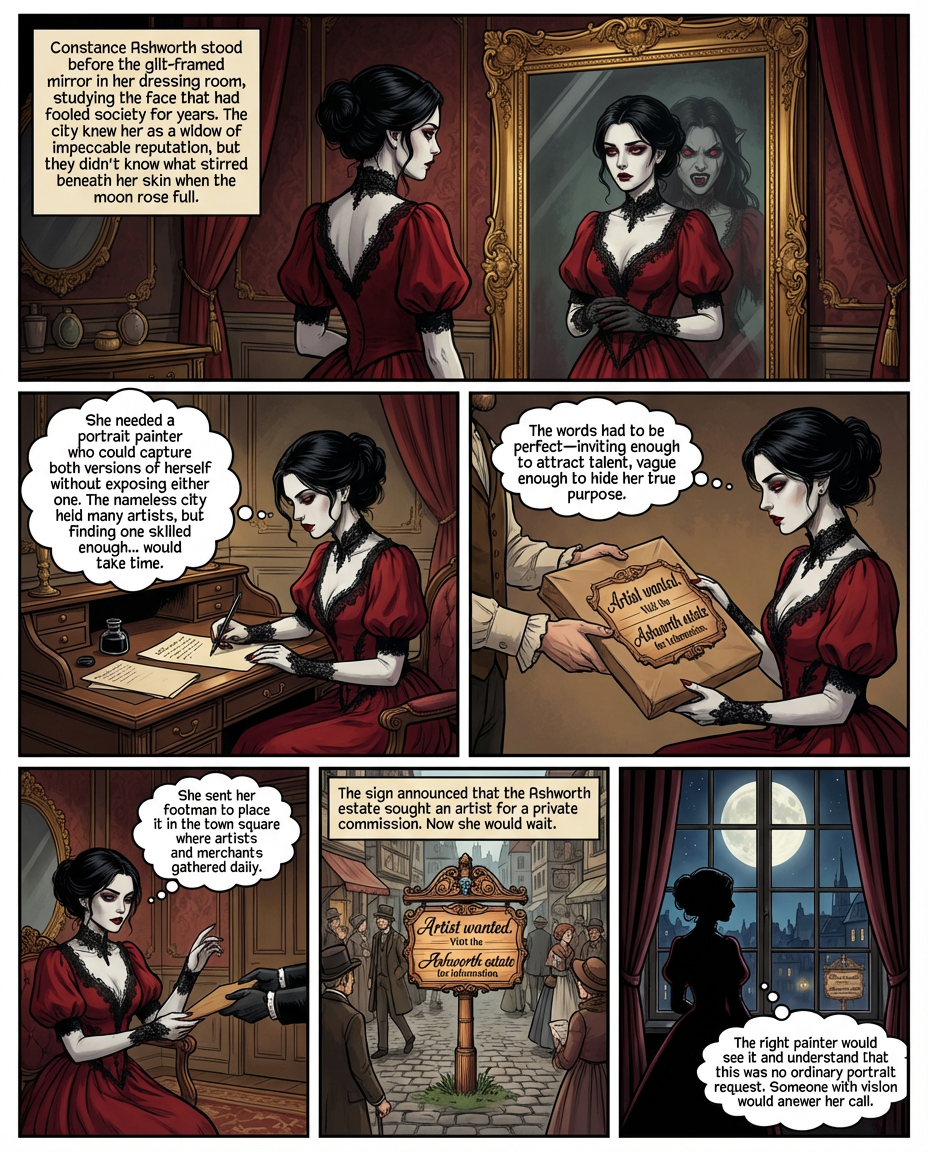
Constance Ashworth stood before the gilt-framed mirror in her dressing room, studying the face that had fooled society for years. She touched her pale cheek with gloved fingers. The city knew her as a widow of impeccable reputation, but they didn't know what stirred beneath her skin when the moon rose full. She needed a portrait painter who could capture both versions of herself without exposing either one. The nameless city held many artists, but finding one skilled enough to paint the truth while hiding it would take time. She spent the morning composing the advertisement at her writing desk. The words had to be perfect—inviting enough to attract talent, vague enough to hide her true purpose. By afternoon, she had commissioned an elegant sign with intricate lettering. The craftsman delivered it wrapped in brown paper. Constance examined every detail before approving it. The sign announced that the Ashworth estate sought an artist for a private commission. She sent her footman to place it in the town square where artists and merchants gathered daily. Now she would wait. The right painter would see it and understand that this was no ordinary portrait request. Someone with vision would answer her call.
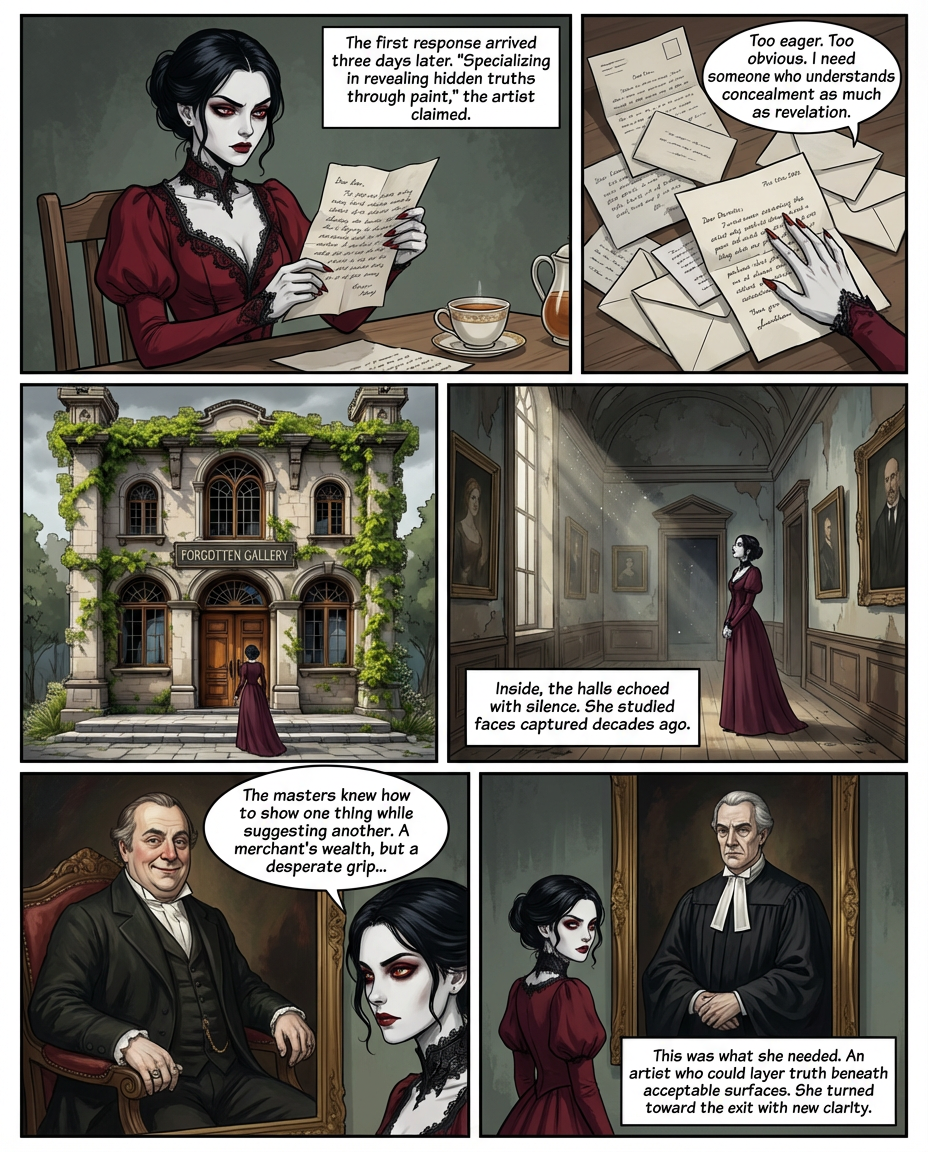
The first response arrived three days after the sign went up. Constance unfolded the letter at her breakfast table. The handwriting slanted sharply to the right, each word pressed hard into the paper. The artist claimed to specialize in revealing hidden truths through paint. She set the letter aside and reached for her tea. Too eager, too obvious. She needed someone who understood concealment as much as revelation. By week's end, seven more letters had arrived. She read each one twice, searching for the quality she couldn't quite name. None of the letters satisfied her. She realized she didn't know enough about portraits to judge these artists properly. The next morning, she dressed in her burgundy walking dress and left the house. The Forgotten Gallery stood three blocks away, its stone facade marked by weather and time. Inside, the halls stretched empty and quiet. Dust motes floated through shafts of light from high windows. She moved from painting to painting, studying faces captured decades ago. Some portraits revealed everything—desperate eyes, cruel mouths, trembling hands. Others hid their subjects behind pleasant masks that said nothing at all. The masters knew how to show one thing while suggesting another. A merchant's portrait displayed wealth and confidence, but his fingers clutched the armrest too tightly. A lady's serene smile didn't reach her calculating eyes. Constance stopped before a portrait of a judge in formal robes. His face looked stern and proper, yet the painter had caught something hungry in the tilt of his head. This was what she needed—an artist who could layer truth beneath acceptable surfaces. She turned toward the exit with new clarity about what questions to ask.
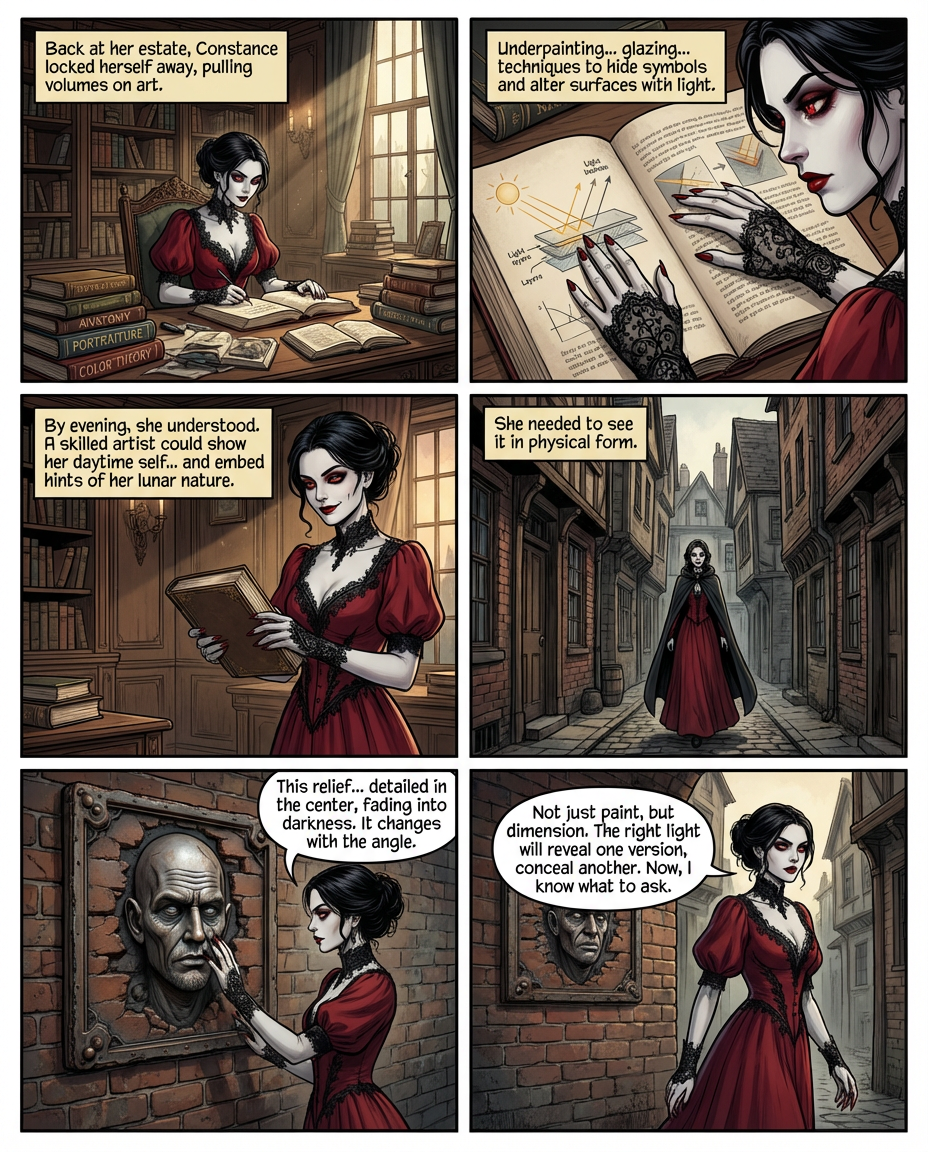
Constance returned to her estate and locked herself in the library. She pulled books from the shelves—volumes on portraiture, anatomy, color theory, and technique. The afternoon light shifted across the desk as she read. One chapter described how certain painters used underpainting to hide symbols beneath the final work. Another explained glazing techniques that made surfaces appear different depending on the angle of view. She traced her finger across a diagram showing how light could reveal or conceal features. By evening, she understood what was possible. A skilled artist could paint her daytime composure on the surface while embedding hints of her lunar nature in shadow and brushwork. The knowledge settled into her bones like certainty. She closed the last book and smiled. Now she knew exactly what to ask the next artist who answered her call. The next morning she walked through the older district where buildings pressed close together. She needed to see how artists worked with light and shadow in physical form, not just on canvas. A metal relief caught her attention on a brick wall. The portrait emerged from the weathered surface, its features detailed in the center but fading into darkness at the edges. She stopped and studied it. The face appeared clear from one angle, but stepping to the side made half of it vanish into shadow. The artist had used depth and texture to show and hide simultaneously. This was the method—not just paint, but dimension and viewing angle. She touched the cool metal, feeling the raised surface under her glove. A portrait could do this too, with thick brushwork in some areas and thin glazes in others. The right light would reveal one version while concealing another. She stepped back, memorized the technique, and turned toward home. Her requirements were complete now. She knew what questions to ask and what techniques to demand.
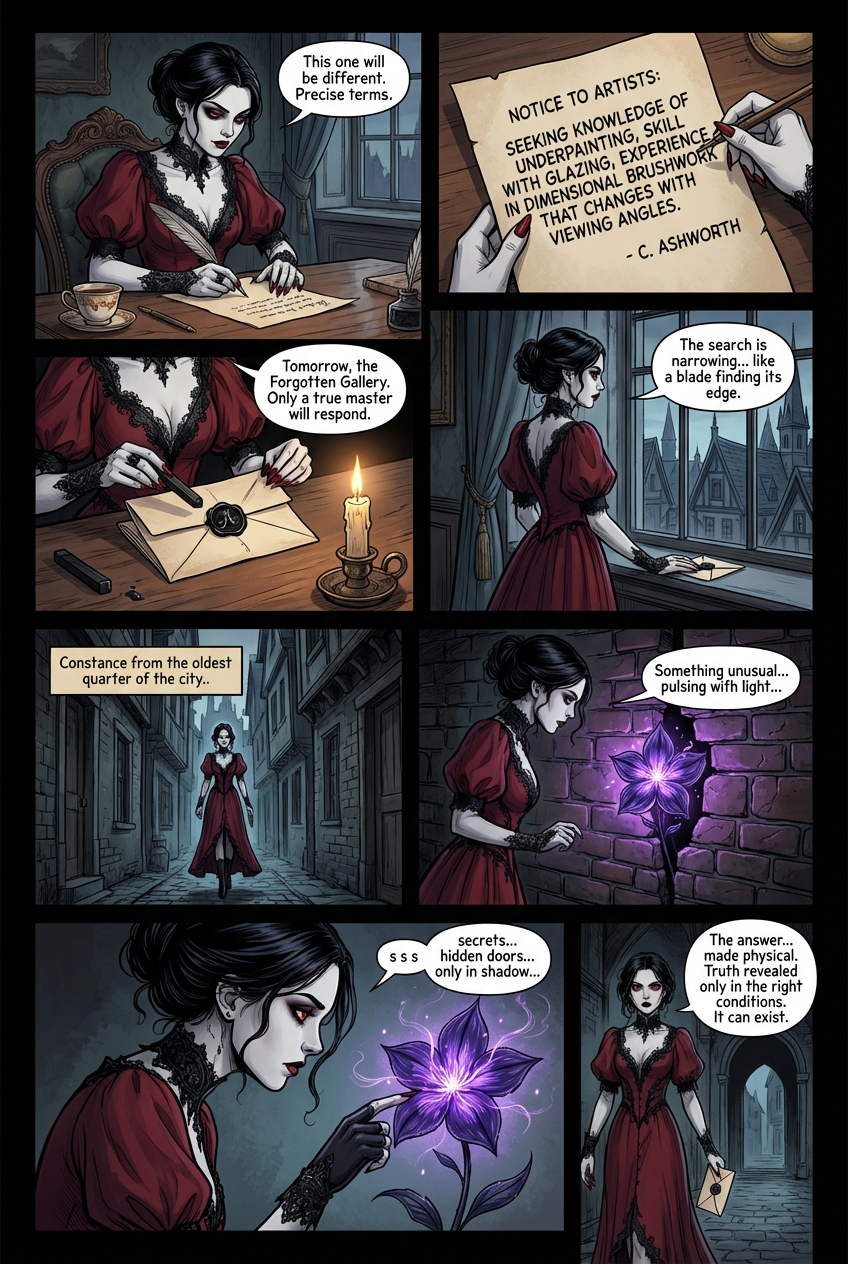
Constance sat at her writing desk and composed a new notice. This one would be different from the first. She listed her requirements in precise terms—knowledge of underpainting, skill with glazing techniques, experience in dimensional brushwork that changed with viewing angles. The words filled half a page. She folded the paper and sealed it with black wax. Tomorrow she would post it at the Forgotten Gallery where serious artists would see it. The unqualified would eliminate themselves. Only someone with real mastery would respond to such specific demands. She set the sealed notice beside her teacup and looked out the window at the city's angular rooflines. The search was narrowing now, becoming sharp and focused like a blade finding its edge. The morning walk to the Gallery took her through the oldest quarter. She turned down an alley she'd never noticed before. The buildings blocked most of the sunlight here, creating shadows that lasted all day. Against the brick wall, she spotted something unusual—a flower growing from a crack in the stone. Purple light pulsed from its petals despite the darkness around it. She crouched down and leaned closer. The glow shifted and moved like liquid. Whispers came from the flower itself, sounds too quiet to make out clearly. She tilted her head and listened. The petals seemed to mouth secrets about the walls around them, about hidden rooms and forgotten doors. This plant only bloomed in shadow, revealing beauty that daylight would destroy. She touched one petal with her gloved finger. The whisper changed pitch, responding to her presence. Here was the answer to her portrait problem made physical—something that showed its truth only to those who looked in the right conditions, at the right angle, in the proper darkness. She stood and continued toward the Gallery with the sealed notice in her hand, certain now that what she wanted could exist.
Play your story to life
Storycraft is a mobile game where you create AI characters, craft items and locations to build their world, then discover what direction your story takes. Download the iOS game for free today!
Download for free