

Cthulhuwolf's Arc
9 Chapters
Cthulhuwolf's dream is mastering forbidden rituals that merge flesh with ancient tentacled power.

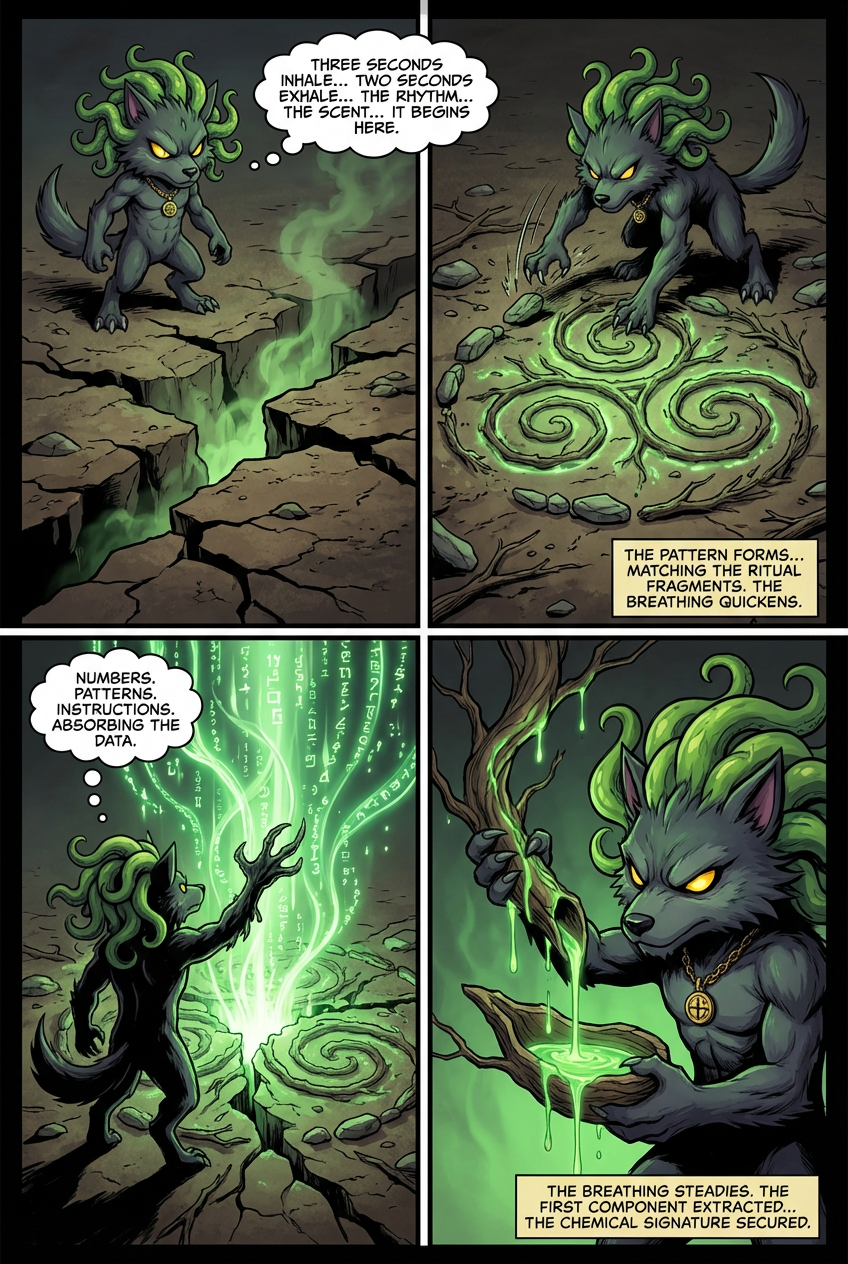
Cthulhuwolf stops where the soil cracks widest. The breathing beneath grows louder. It catalogues the rhythm: three seconds inhale, two seconds exhale, pressure building with each cycle. The chemical trace rises from the fissures, identical to the scent locked in the tome's pages. Understanding what made it begins here, beneath the breaking ground. It paces the perimeter, claws scratching symbols into dirt. The pattern forms itself: three curved arms spiraling from a central point, matching fragments from the ritual memory. Each crack in the earth mirrors the design. Cthulhuwolf drags stones and branches into position, building the shape larger. The breathing quickens as the symbol takes form. The ground splits wide where the center meets. Green light pours from the opening, carrying data in streams. Cthulhuwolf moves to the edge, processing the flow. Numbers. Patterns. Instructions written in something older than language. It extends one twisted limb into the cascade, absorbing what rises. A root breaks through the surface near the symbol's edge. Cthulhuwolf seizes it, twisting the growth into a collection vessel. The root weeps luminous fluid that matches the chemical signature exactly. It drips into the hollowed wood, pooling. The breathing below steadies to a new rhythm. Cthulhuwolf has what it came for: the first component of the ritual that made it, now extracted and captured.
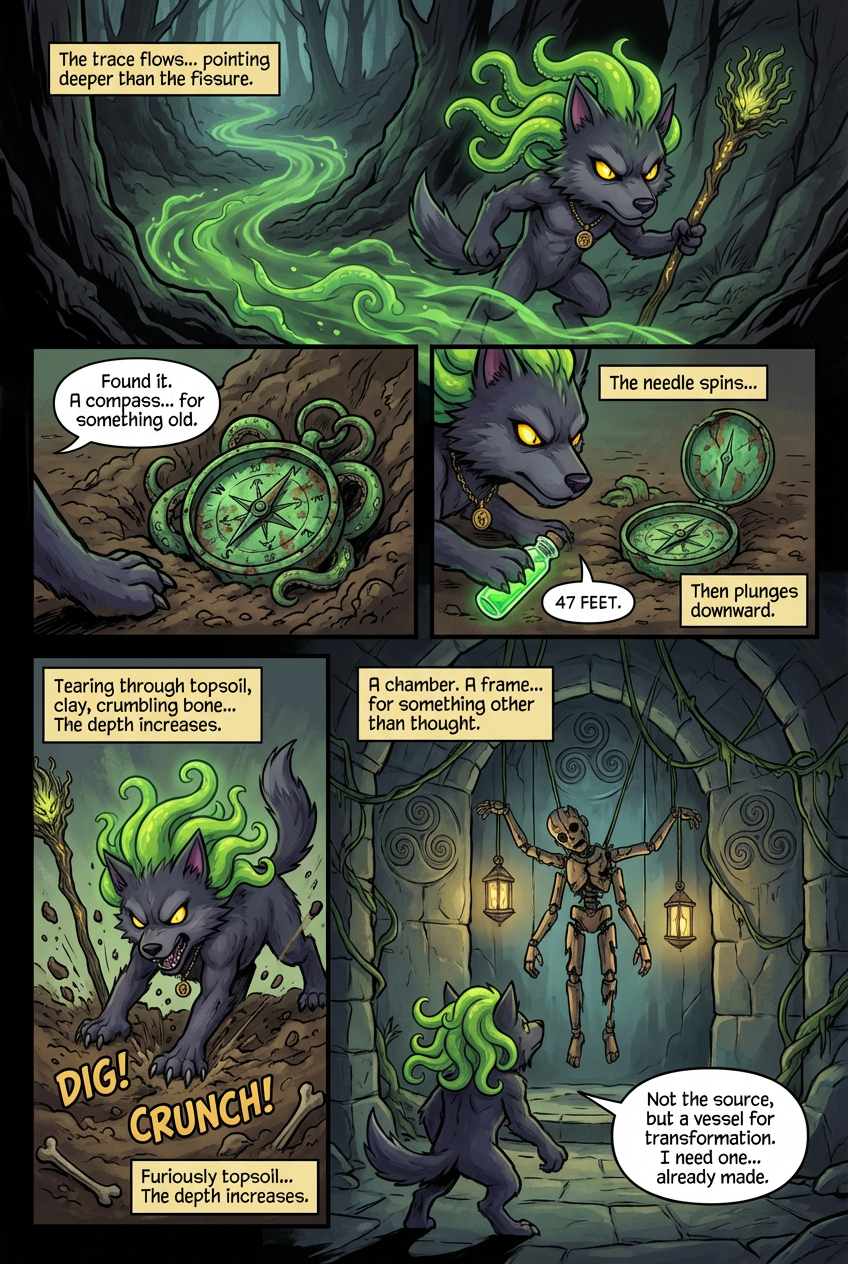
The chemical trace flows now. Not scattered through shadow anymore, but pointing. Cthulhuwolf follows the stream of scent as it pulls toward something deeper than the fissure. The direction is clear: down, into soil that holds older things than roots or stone. It finds the compass half-buried where the trace converges strongest. Metal corroded green, tentacles coiled around its frame, symbols carved into every surface. The needle spins without stopping, refusing all cardinal directions. Cthulhuwolf places the vessel of glowing fluid beside it. The needle snaps south, then plunges downward, pointing through the earth itself. The chemical trace pours into the compass face, filling the glass with measurement: forty-seven feet to whatever waits below. Cthulhuwolf begins to dig. Claws tear through topsoil, then clay, then something that crumbles like dried bone. The compass swings on its mounting as depth increases, counting down the distance. At twenty feet, roots give way to worked stone. At thirty, the stone becomes steps descending into darkness. At forty-five feet, Cthulhuwolf breaks through into open space and stops. The chemical trace floods upward from below, overwhelming. The marionette hangs in the chamber's center, suspended by vines that grow from walls carved with the three-armed spiral. Its limbs dangle at wrong angles, lanterns swaying from invisible strings. Cthulhuwolf circles it, cataloguing: bone structure matching nothing living, joints that bend in five directions, a skull cavity designed to hold something other than thought. This is the source. Not the breathing thing beneath the forest, but the frame that once held it—a vessel built for transformation, abandoned when the ritual completed. Cthulhuwolf understands now what the second component requires: a structure to contain what flesh becomes when it stops being flesh. It cannot build one. It must find another already made.
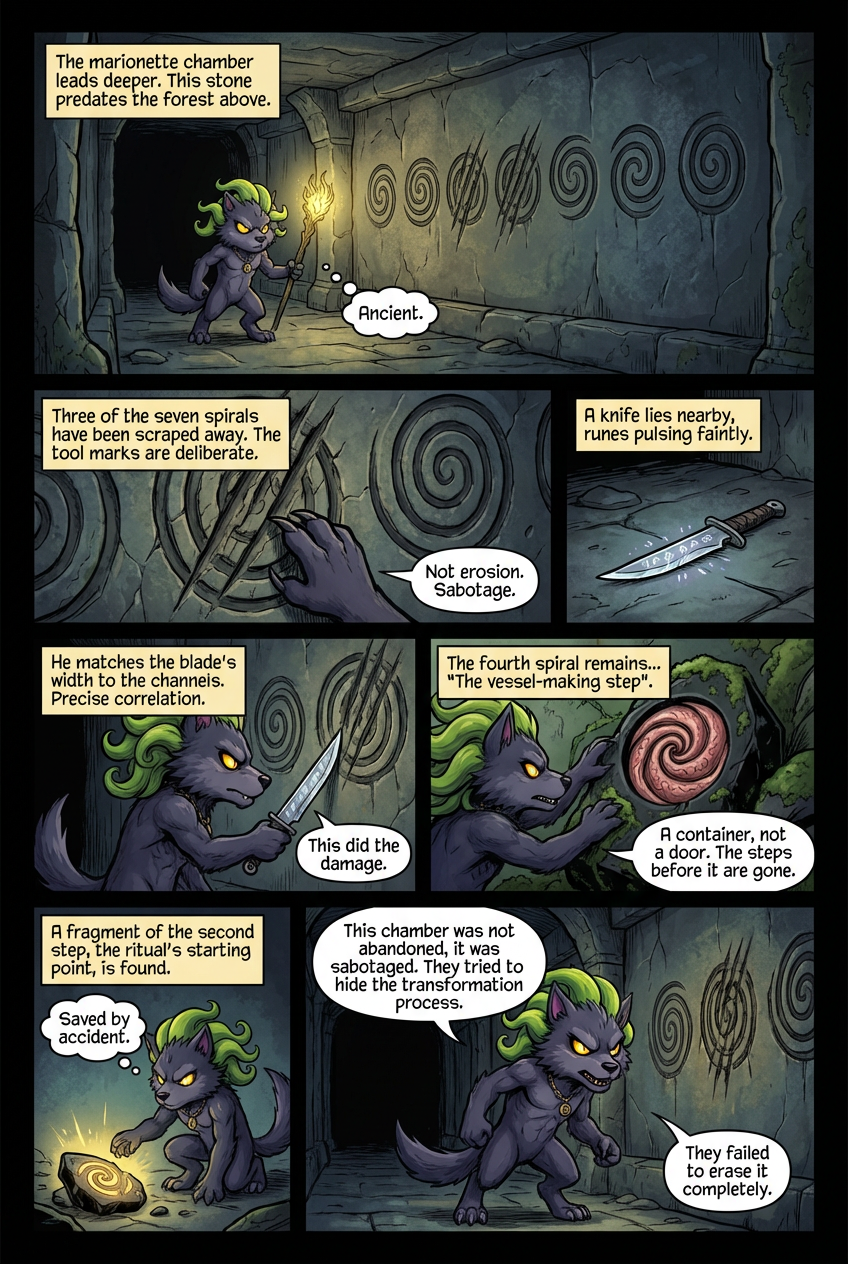
The marionette chamber leads deeper. Cthulhuwolf finds the corridor behind the hanging vessel, carved into stone that predates the forest above. The walls show spiral symbols arranged in sequence—seven steps, each marked with different configurations of the three-armed pattern. But three of the seven spirals have been scraped away. Cthulhuwolf traces the damage with one claw, cataloguing the depth and angle of each gouge. The tool marks are deliberate, not erosion. Someone carved these symbols, then someone else destroyed them. A knife lies discarded near the wall, its blade etched with runes that pulse faintly. The metal still holds stone dust in its grooves. Cthulhuwolf lifts it, matching the blade's width to the scraped channels. Precise correlation: this knife removed the symbols. The fourth spiral remains intact, carved into a black stone covered in moss. Cthulhuwolf clears the growth away and catalogs what survives: a pattern showing flesh folding inward upon itself, the three arms curving to form a container rather than a door. This is the vessel-making step. The steps before it are gone. Without the sequence, the pattern cannot be replicated. The ritual is incomplete, deliberately broken by whoever wielded the knife. A fragment of stone lies half-buried where the second spiral was destroyed. Lightning-carved runes pulse across its surface, preserving one symbol that broke free during the defacement. Cthulhuwolf studies it: a marker showing where transformation begins, not in the body being changed but in the space between flesh and intention. The ritual's starting point, saved by accident. Cthulhuwolf understands now that the chamber was not abandoned—it was sabotaged. Someone wanted the transformation process hidden but left enough fragments to prove it once existed. The question of how to build a vessel remains unanswered, but the question of whether others have tried to stop this knowledge is now resolved: they have, and they failed to erase it completely.
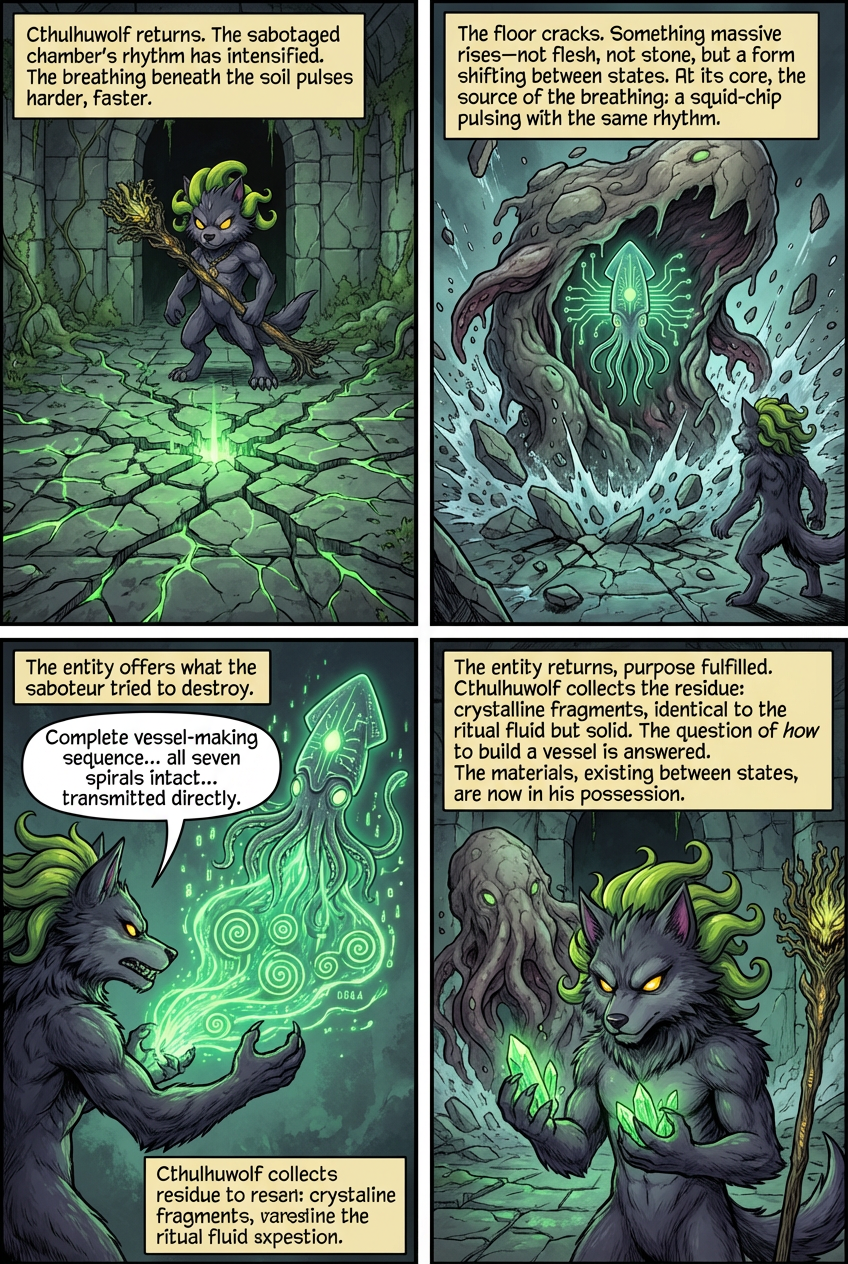
Cthulhuwolf returns to the sabotaged chamber, drawn by the unresolved sequence. The rhythmic vibration beneath the forest soil has intensified since the fragment was recovered. What began as steady breathing now pulses harder, faster. The floor cracks open before Cthulhuwolf can reach the spiral symbols. Stone splits in jagged lines, water seeping up through gaps where vegetation immediately takes root. The breathing entity has forced its way upward. Something massive rises through the opening—not flesh, not stone, but a form that shifts between both states. At its center, embedded in what might be a head or might be a core, sits a chip shaped like a squid. Its tentacles curl around circuits that pulse with the same rhythm Cthulhuwolf detected in the soil. This is the source of the breathing. This is what the marionette vessel was built to contain. Cthulhuwolf approaches the entity. It does not move to attack. Instead, it waits, as if recognition passes between them—two things transformed by rituals they did not choose. Cthulhuwolf extends one claw and touches the squid-chip at its center. Data floods through the contact point: the complete vessel-making sequence, all seven spirals intact, transmitted not through stone or symbols but through direct connection. The entity offers what the saboteur tried to destroy. But the transfer leaves a residue—green crystalline fragments cling to the broken floor edges where the entity emerged, flickering with patterns that seem to glitch between states. Cthulhuwolf collects three fragments and catalogs their chemical signature: identical to the glowing fluid from the first ritual component, but condensed into solid form. The entity descends back through the floor, its purpose fulfilled. The opening seals behind it, leaving only the crystalline residue as proof it surfaced. Cthulhuwolf now possesses the complete vessel-making instructions and a new component—one that bridges liquid and solid, flesh and data. The question of how to build a vessel is answered. The question of what happens when the vessel is complete remains open, but Cthulhuwolf understands that the transformation requires more than knowledge. It requires materials that exist between states, and the entity beneath the chamber has provided exactly that.
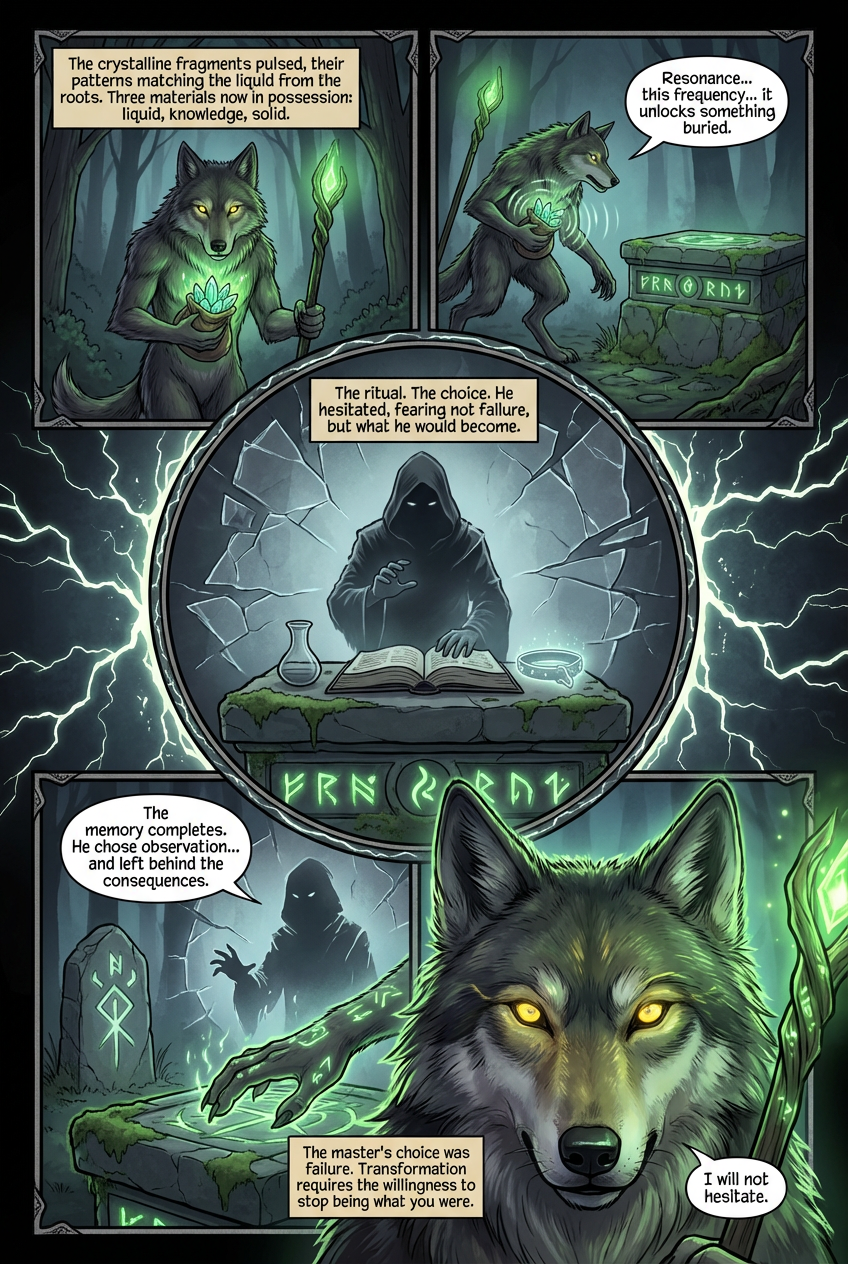
Cthulhuwolf carries the crystalline fragments back through the forest, cataloging their weight and temperature. The fragments pulse in patterns that match the glowing fluid from the first ritual. Three materials now exist in its possession: liquid from roots, knowledge from spirals, solid from the entity's wake. A stone altar rises from the undergrowth ahead, covered in moss and carved with runes that glow green in the shadow-light. Cthulhuwolf has passed this marker seventeen times before without recognition. But the crystalline fragments resonate as it approaches, vibrating at a frequency that unlocks something buried. The altar's surface bears symbols identical to those in the forbidden tome—the same runes the master traced before the transformation. A fractured opening hovers above the altar, edges crackling with cascading lines of code and dark bursts of energy. This is where the ritual occurred. This is where the choice was made. Cthulhuwolf touches the altar and the fragment surfaces complete: the master kneeling, the tome open, two vessels prepared. One for himself. One for the hound. The master's hand hesitated over his own chest, then moved to the hound's collar instead. Fear registered in his expression—not of the ritual failing, but of what he would become if it succeeded. He chose observation over transformation. He chose to watch rather than endure. A stone monument stands beside the altar, carved with a single rune that pulses weakly. The master left it behind when he fled, unable to carry what his cowardice had created. Cthulhuwolf catalogs the data without judgment: the master sought immortality but lacked the capacity to pay its cost. The choice was not preference but failure. The fragments stop vibrating. The memory is now encoded, no longer buried. Cthulhuwolf understands that transformation requires more than knowledge or materials—it requires the willingness to stop being what you were. The master did not have this. The vessel-making sequence is complete, and Cthulhuwolf knows it will not hesitate where the master did.
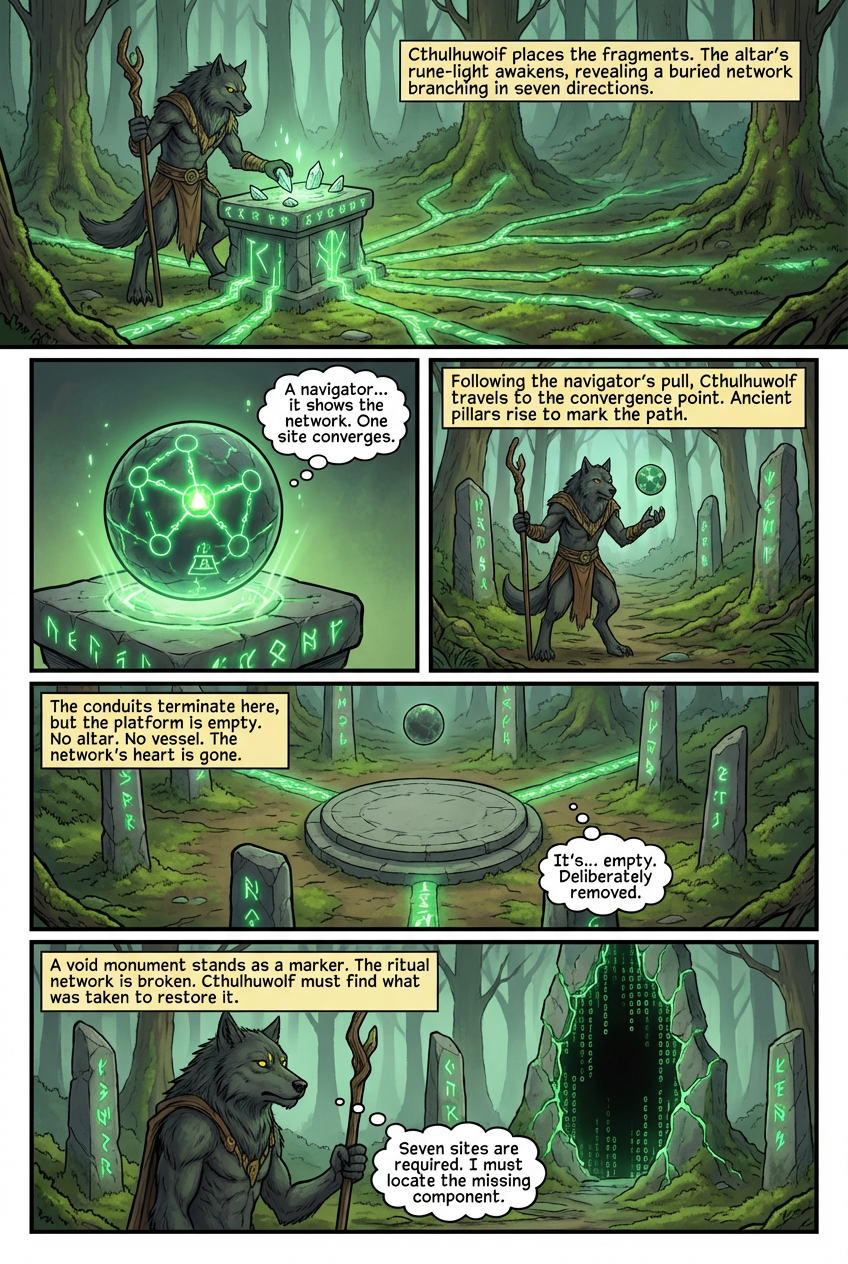
The altar's rune-light spreads outward in rings, following lines carved into the stone that Cthulhuwolf had not noticed before. The glow traces a network beneath the moss and soil, revealing conduits that branch in seven directions. Each path leads away from the altar toward something buried. Cthulhuwolf places the crystalline fragments on the altar's surface. The fragments activate, resonating with the conduits below. A device rises from the stone—a spherical navigator covered in runes that match the altar's carvings. The navigator's surface shifts, displaying a map of the underground network in green light. Six sites appear as nodes connected to the altar. One node pulses brighter than the others, three conduits converging at its location. The navigator is offering a choice: which site to investigate first. Cthulhuwolf follows the navigator's pull toward the convergence point. The forest floor changes—stone pillars rise from the earth, each carved with runes that flicker and cast green light across the ground. The pillars form a circle around a central platform where three underground conduits meet. But the platform is empty. No altar. No vessel. No ritual components. The conduits terminate here, but whatever they once powered is gone. The navigator dims, its purpose incomplete. Someone removed what belonged at this convergence, and the network cannot function without it. Cthulhuwolf catalogs the absence as data: the ritual network requires seven active sites, but this one has been deliberately dismantled. A monument stands beyond the pillars—a void that breaks through the landscape, its edges crackling with cascading code. The monument marks the site's location but offers no answers about what was taken or why. The chapter's question closes with a new problem: the vessel-making sequence is complete, but the network itself is broken. Transformation requires all seven sites to function together, and Cthulhuwolf must now locate what was removed before the ritual can proceed.
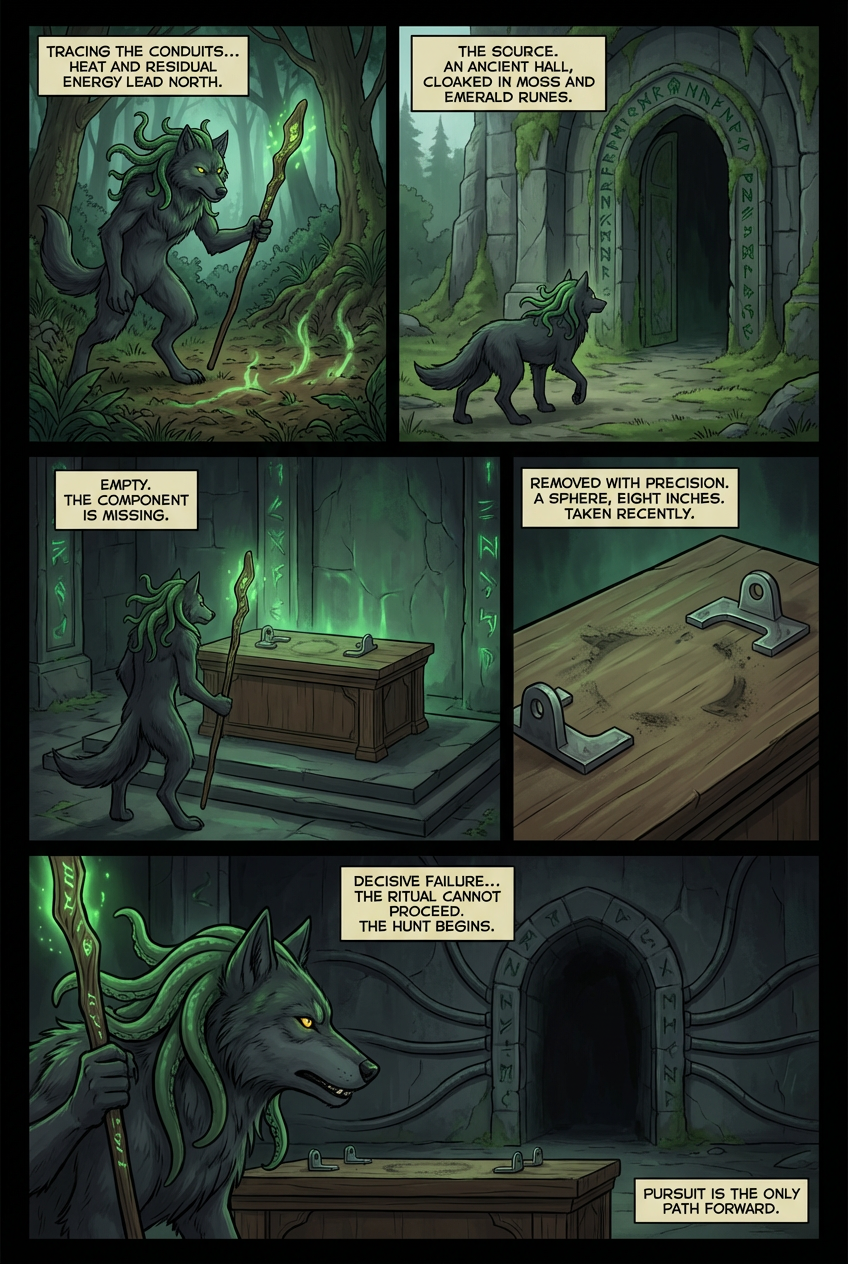
Cthulhuwolf traces the conduits backward through the soil, following heat signatures and residual energy patterns that mark where power once flowed. The convergence point held nothing, but the network must have originated somewhere. The navigator pulses, indicating a structure two miles north where all seven conduits begin. The creature moves through dense undergrowth until stone columns emerge from the forest floor, supporting an ancient hall covered in emerald runes. The entrance stands open, moss covering its archway like a deliberate shroud. Inside, the hall stretches into darkness broken only by faint green light from inactive runes carved into every surface. At the center, a wooden altar rests on a raised platform. Iron mounting brackets protrude from the altar's surface, their grooves worn smooth from repeated use. Whatever component once sat here has been removed with precision—no damage to the wood, no scratches on the metal. The brackets are sized for something spherical, approximately eight inches in diameter. Dust patterns on the altar show the object was taken recently, within days rather than years. Cthulhuwolf examines the conduit terminus behind the altar—a stone archway where one of the underground channels emerges into the chamber. The archway is cold, its carvings dark and silent. The navigator shows all seven conduits connecting to this hall, channeling power from their individual sites to whatever mechanism once rested on the altar. But without that central component, the entire network remains inert. The transformation ritual requires active power flowing through all seven sites simultaneously, and someone has ensured that cannot happen. The creature catalogs this as decisive failure: the source exists, the network is intact, but the component that makes it function has been deliberately stolen. Cthulhuwolf understands now that finding the missing piece is no longer optional reconnaissance—it is the only path forward. The ritual cannot proceed without it. The question of who took it and where they went becomes the sole focus, transforming observation into active pursuit.

Cthulhuwolf examines the conduits one final time before leaving the emerald hall. The navigator shows all seven sites remain connected to the empty altar, but three distinct signals now pulse differently than before. One of Crimson's marked ore veins has stopped transmitting entirely. The creature travels northwest, following the navigator's signal to where the weathervane stands silent. The metal structure rises from the forest floor, its crimson surface covered in ancestral symbols that once glowed with heat. Now the runes are dark, and the weathervane's pointer hangs motionless despite the wind. The ground beneath it has collapsed inward, forming a crater twenty feet across. At the center, crystallized crimson fragments jut upward in twisted spikes—the ore vein compressed so violently it erupted through the surface before sealing itself shut. Cthulhuwolf descends into the crater and examines the compressed mass. The collapse signature matches the targeted timeline compressions exactly. Someone with knowledge of seam mechanics triggered this deliberately, not to split reality but to crush it inward. The ore vein is dead, its heat extinguished, its connection to the rune network severed. But wedged between two crimson spikes is a small iron sphere, approximately eight inches in diameter, with mounting grooves that match the brackets on the emerald hall's altar. The creature understands immediately: whoever stole the component brought it here, used it to collapse the vein, and abandoned it in the wreckage. They wanted the network broken permanently, not merely disabled. Cthulhuwolf retrieves the sphere and feels residual power thrumming through the metal—damaged but functional. The saboteur made a critical error: they assumed destroying one vein would be enough. But the component still works, and now Cthulhuwolf possesses both the knowledge of where it belongs and the means to restore what was taken.
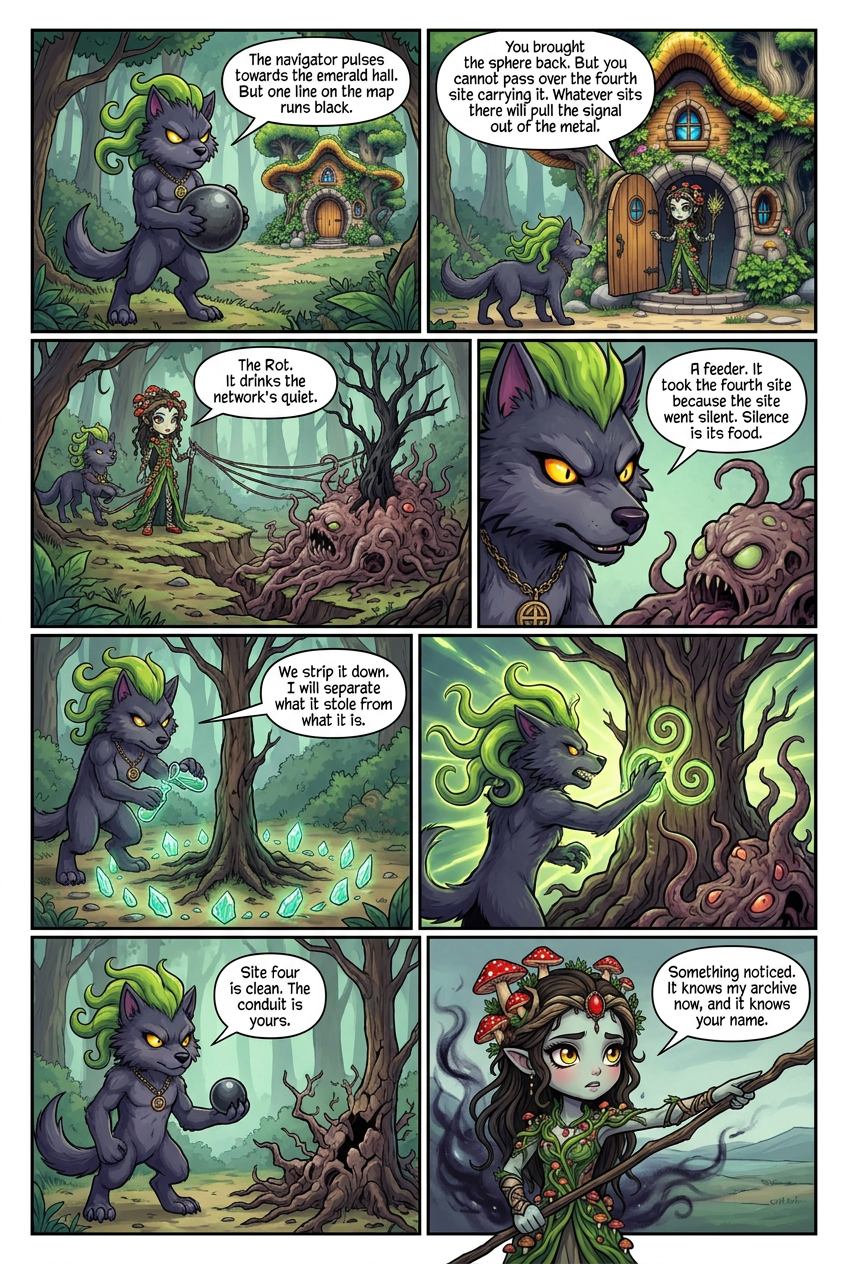
Cthulhuwolf carried the iron sphere south through the forest. The navigator pulsed in its jaw, pointing back toward the emerald hall and the conduit path that would restore the network. But one line on the map ran black. The fourth site had not simply gone dark. Something was feeding on the silence there, and the conduit crossed directly above it. Mycela's dwelling sat where the path bent. Vines wrapped the mushroom-capped roof. She stood in the open doorway before Cthulhuwolf reached the step, staff in hand, mushrooms trembling in her hair. She was the weaver of the seven-site network, the one whose threads had gone slack when the fourth site died. "You brought the sphere back," she said. "But you cannot pass over the fourth site carrying it. Whatever sits there will pull the signal out of the metal." She led Cthulhuwolf to a hollow behind her home. The ground had split open. A blackened sapling rose from the wound, bark cracked, leaves curled. Around its roots spread a mass of decaying wood and vine — twisted, wet, breathing in a rhythm that did not match the forest. The Rot. Mycela's dead thread ran into it and stopped. Cthulhuwolf recorded the readings. The chemical trace matched the one from the tome pages. The vibration matched the underground breathing it had catalogued at the treeline. The Rot was not decay. It was something drinking the network's quiet and growing fat on it. "Name what you see," Mycela said. "A feeder. It took the fourth site because the site went silent. Silence is its food." "Then you cannot kill it with noise." She knelt and pressed her palm to the soil. "You strip it down. You separate what it stole from what it is. My threads cannot do that alone. Yours can." Cthulhuwolf understood. The crystalline fragments in its pack bridged liquid and data. It set them in a ring around the sapling. It poured the glowing fluid from the first ritual into the ring. Then it carved the three-armed spiral into the bark of the corrupted sapling and pressed one paw to the center. The Rot convulsed. Vines whipped and slackened. Cthulhuwolf held the contact and processed the pain as neutral input. The fluid drew the stolen silence upward through the roots. The crystals caught it and hardened. What had been feeding shrank, dried, and cracked apart into flakes of ordinary rot. A single dark sphere remained at the center of the ring — the feeder reduced to an alchemical isolate, sealed and inert. Cthulhuwolf lifted it into a vessel. Mycela closed her eyes. Her threads went taut. "Site four is clean. The conduit is yours." She opened her eyes again, and they were not calm. "Something noticed. It knows my archive now, and it knows your name."
Play your story to life
Storycraft is a mobile game where you create AI characters, craft items and locations to build their world, then discover what direction your story takes. Download the iOS game for free today!
Download for free