

Daddy Parker's Arc
10 Chapters
Daddy Parker's dream is making sure his three children have everything they need and/or want.

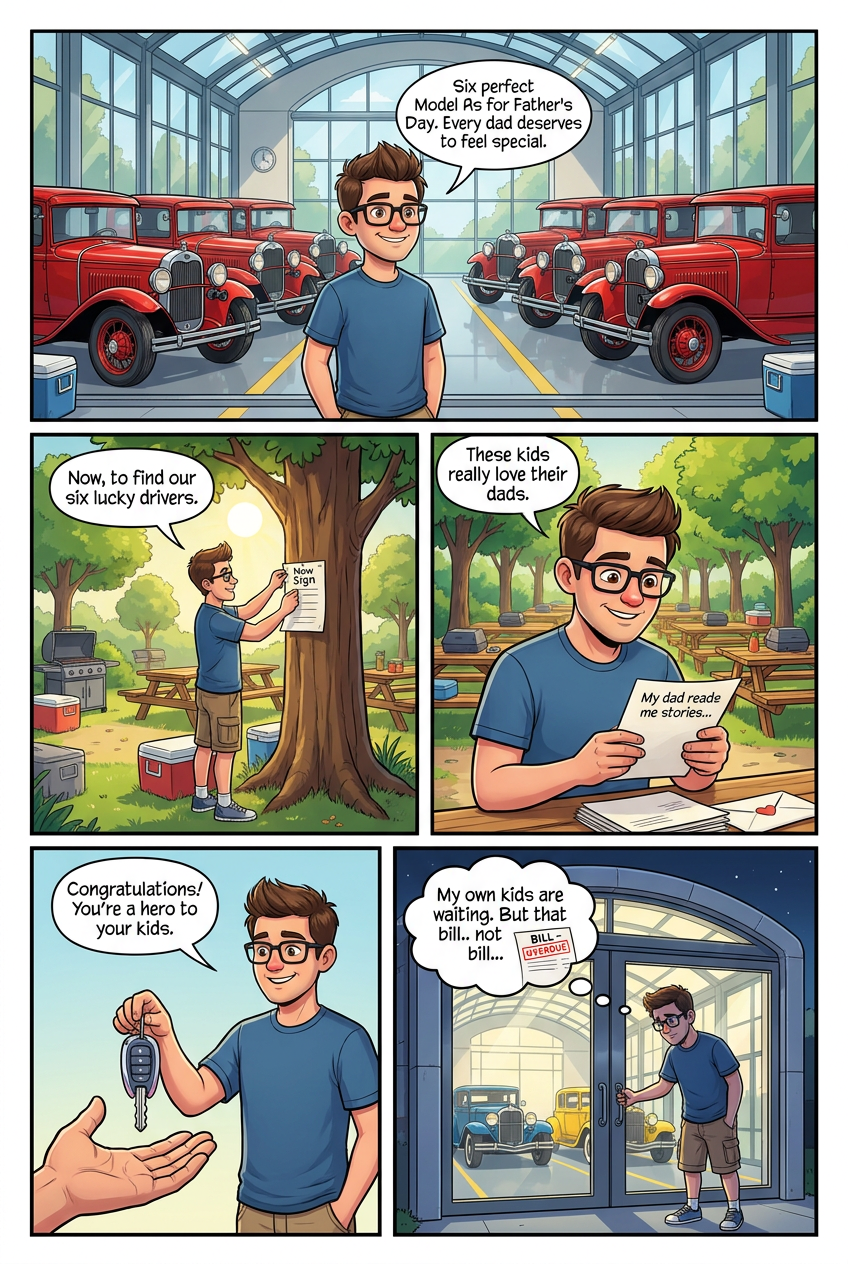
Daddy Parker unlocked the glass doors of the showcase garage and stepped inside. Six shiny 1931 Model A Fords sat in a perfect row, ready for Father's Day. He wanted every dad to feel special, the way he tried to make his own three children feel every day. He walked outside to check the gathering spot. Wooden picnic tables lined the path, with barbecues and bright coolers waiting for hungry families. Fathers would relax here while they waited for their turn behind the wheel. Daddy Parker pinned a sign to the largest tree. It explained the rules. Six lucky dads would be chosen over the next few weeks. They had to be heroes in their children's eyes. Big deeds or small ones counted the same. Letters from kids started arriving by the next morning. Some praised dads who fixed bikes. Others thanked dads who read bedtime stories every night. Daddy Parker read each one twice, smiling. By week's end, he had chosen six fathers. He placed a set of sleek car keys into each father's open hand. Father's Day Corner was officially ready. But as he locked up that night, Daddy Parker thought of his own kids waiting at home — and the bill he still hadn't paid.
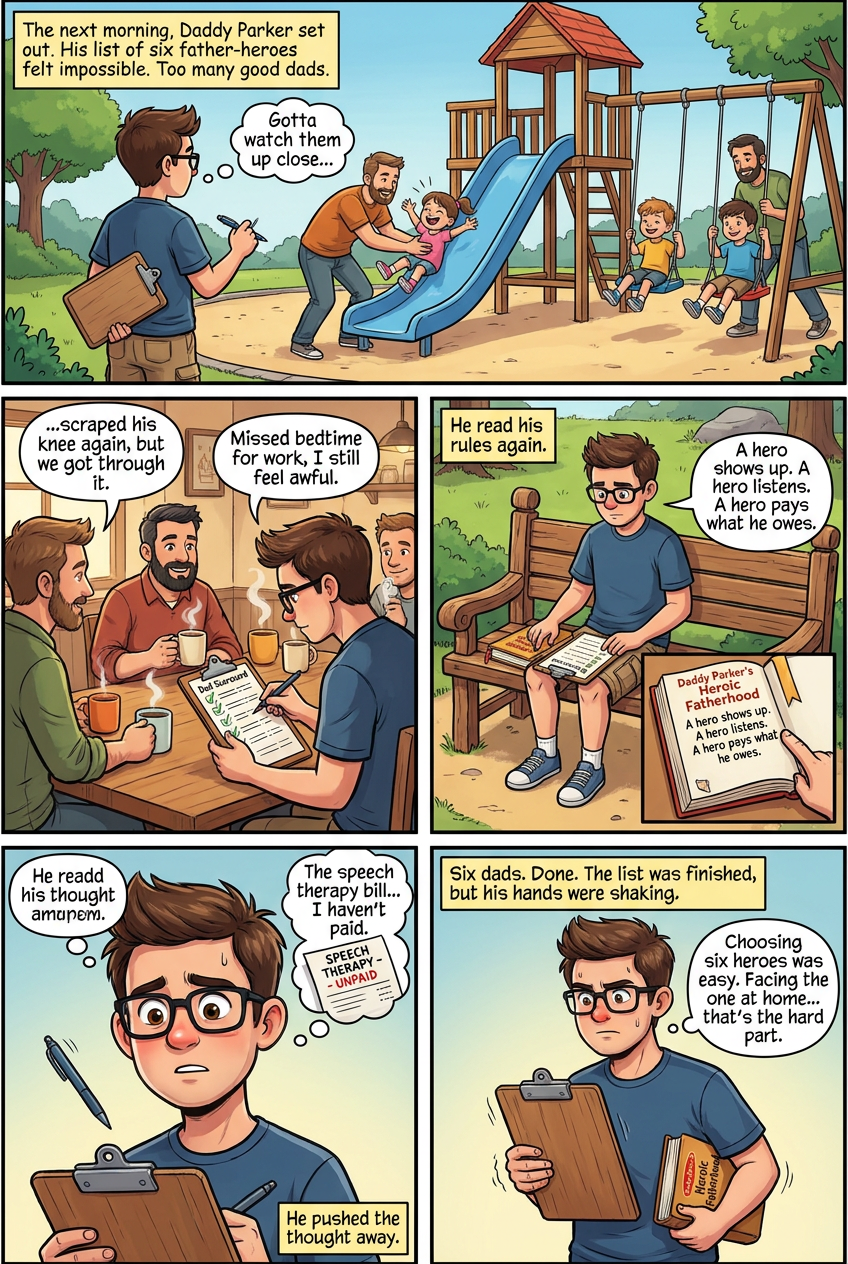
The next morning, Daddy Parker tucked a clipboard under his arm and set out across Storyland Canada. His list of six father-heroes felt impossible. Too many good dads. He needed to watch them up close before deciding. He started at the playground. Colorful slides curved down the rocky hill. One dad caught his daughter at the bottom of the blue slide every single time. Another pushed twin boys on the swings, never tiring. Daddy Parker scribbled notes. His pen moved faster than his thoughts. By lunchtime, the clipboard was crowded with checkmarks. He slipped into the coffee shop where the local dads gathered. Steam curled from warm mugs. Fathers traded stories about scraped knees and missed bedtimes. Daddy Parker listened, head down, adding more names to his list. He took his notes to a wooden bench outside. He spread the pages across his lap. His own book on heroic fatherhood sat beside him, dog-eared and worn. He read his rules again. A hero shows up. A hero listens. A hero pays what he owes. His pen froze. He thought of the speech therapy bill he hadn't paid. He pushed the thought away and circled six names. Six dads. Done. Daddy Parker closed the clipboard. The list was finished, but his hands were shaking. Choosing six heroes had been easier than facing the one waiting at home.
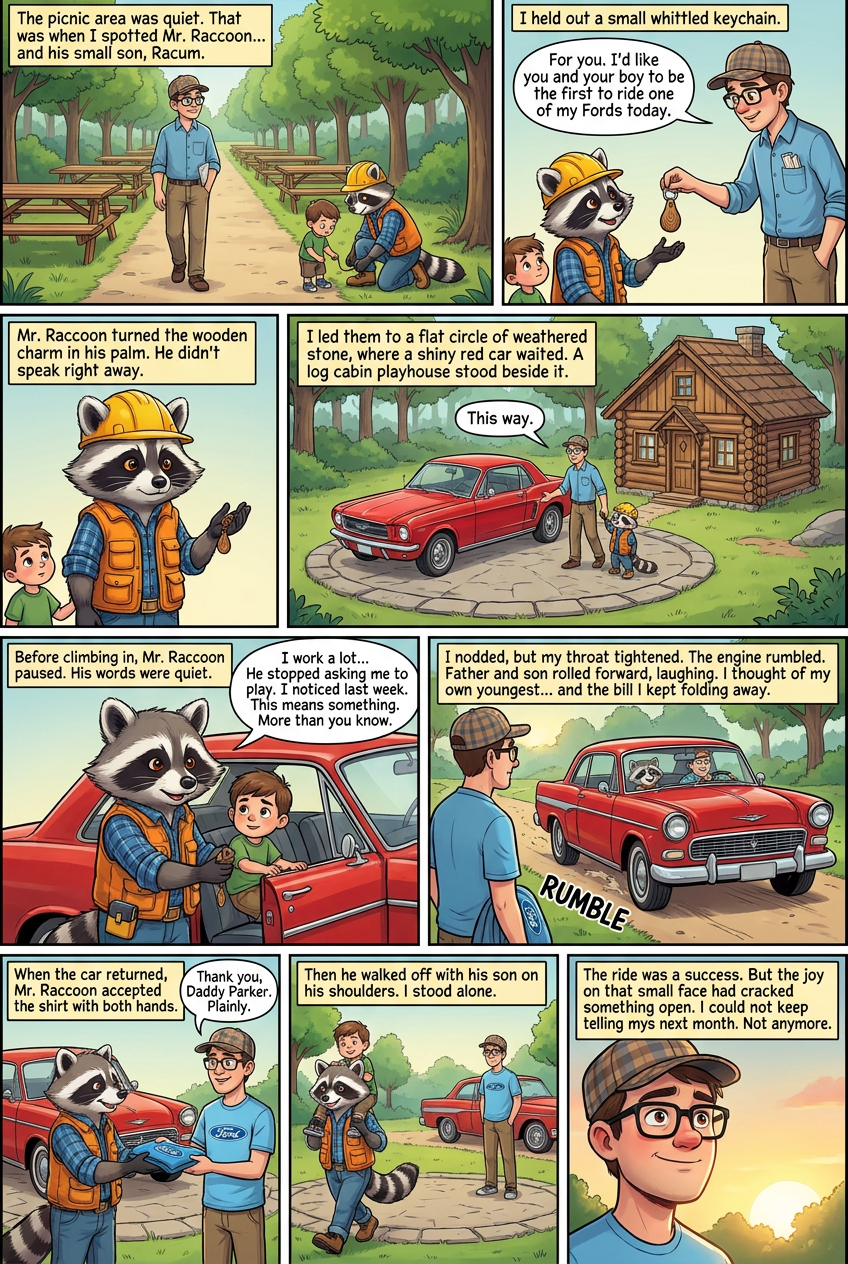
The next morning, Daddy Parker walked his showcase grounds with the finished list folded in his pocket. The picnic area was quiet. That was when he spotted Mr. Raccoon near the trees, kneeling beside his small son, Racum, tying a loose bootlace. The boy watched his father's hands like they held the world. Daddy Parker stopped walking. Something about it pulled at him. He stepped closer and cleared his throat. He held out a small whittled keychain he kept for moments like this. "For you," he said. "I'd like you and your boy to be the first to ride one of my Fords today." Mr. Raccoon turned the wooden charm in his palm. He didn't speak right away. Daddy Parker led them to a flat circle of weathered stone set into the grass, where a shiny red car waited. A small log cabin playhouse stood beside it, built for children to climb. Racum's eyes went wide. He gripped his father's pant leg. Mr. Raccoon lifted him gently into the passenger seat. Before climbing in, Mr. Raccoon paused. He looked at Daddy Parker. "I work a lot," he said quietly. "He stopped asking me to play. I noticed last week." He pressed the keychain into his pocket. "This means something. More than you know." Daddy Parker nodded, but his throat tightened. The engine rumbled. Father and son rolled forward, laughing, Racum's small hand on the wheel. Daddy Parker watched them go. He thought of his own youngest at home, the words that wouldn't come, the bill he kept folding away. A blue shirt with a Ford emblem hung over his arm — a gift he'd planned to give after the ride. When the car returned, Mr. Raccoon lifted Racum down and accepted the shirt with both hands. He thanked Daddy Parker plainly. Then he walked off with his son on his shoulders. Daddy Parker stood alone on the stone circle. The ride was a success. But the joy on that small face had cracked something open. He could not keep telling himself next month. Not anymore.
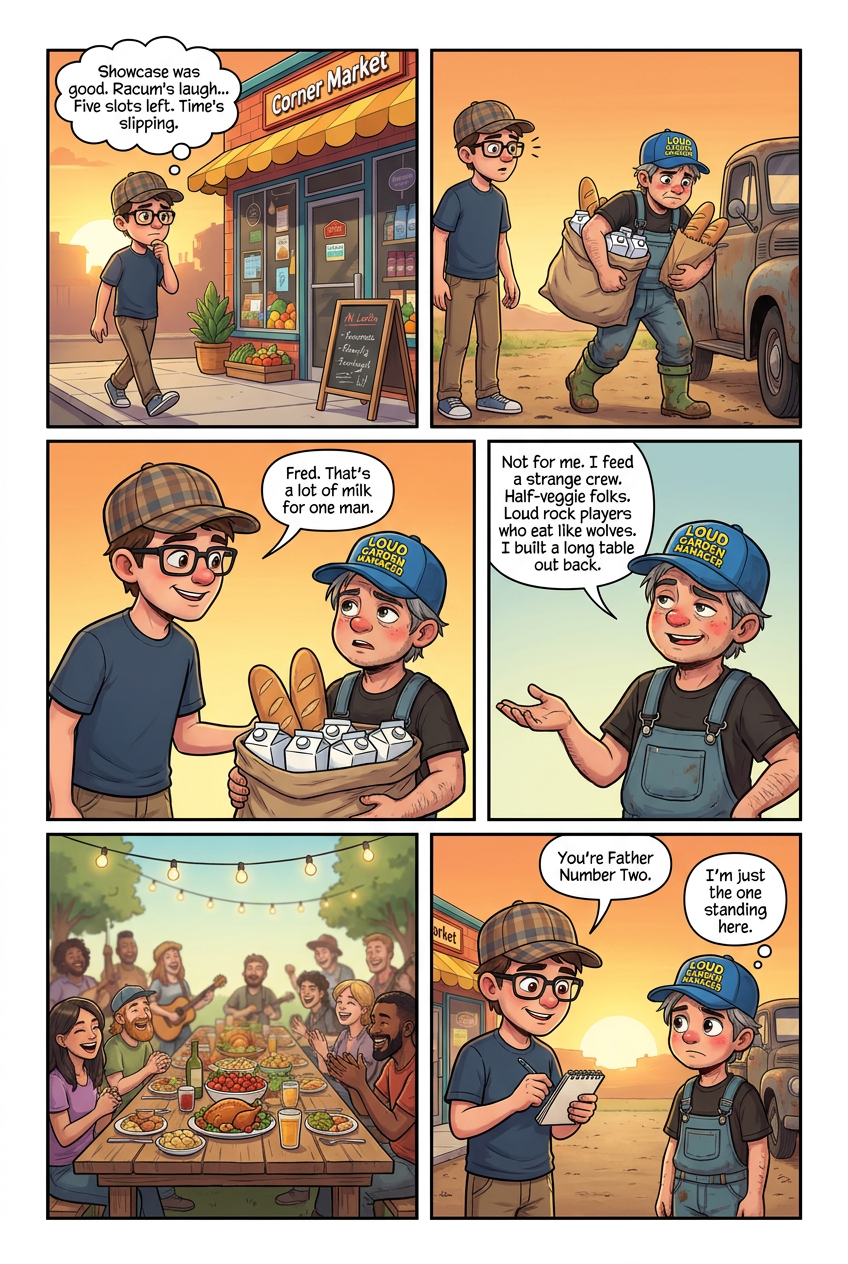
Daddy Parker left the showcase grounds with the ride still warm in his mind. Racum's laugh stayed with him. He had five slots left to fill, and the day was slipping. He drove into town and parked near the bright awning of the small grocery store. A chalkboard sign leaned by the door, listing the daily specials. That was when he saw Farmer Fred step out, hauling a sack stuffed with milk cartons. Six, maybe more, poked from the top. Bags of bread hung from his other arm. Daddy Parker watched him load it all into a dusty truck. No kids tugged at his sleeves. No wife waited in the cab. "Fred," Daddy Parker called, walking over. "That's a lot of milk for one man." Farmer Fred set the sack down. "Not for me. I feed a strange crew. Half-veggie folks. Loud rock players who eat like wolves. I built a long table out back. They show up. I cook." He shrugged. "I'm not the right man for it. I'm just the one standing there." Daddy Parker felt something settle. He pulled his list from his pocket and uncapped his pen. "You're Father Number Two," he said. Farmer Fred blinked, then gave a small nod, like he'd been chosen for something he didn't quite believe but wouldn't refuse. Four slots left. The day pressed on, and the bill at home pressed harder.
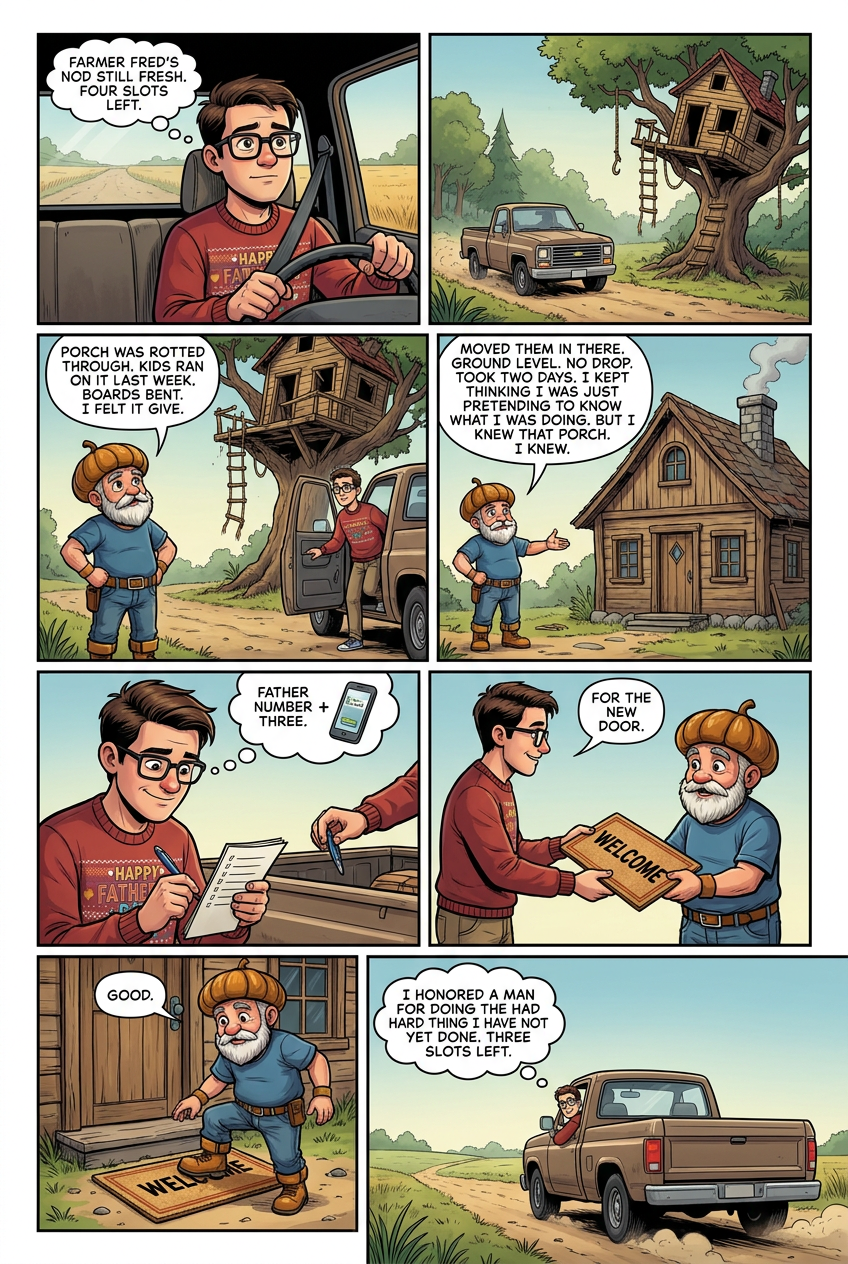
Daddy Parker drove on with Farmer Fred's nod still fresh. Four slots left. He followed a back road and slowed where a busted treehouse leaned in the trees. Broken railings hung loose. Fallen branches covered the porch boards. A rope ladder dangled, frayed at the ends. A man in work boots stood at the base, hands on his hips. Papa Acorn. He looked up at the wreck, then down at the ground. "Porch was rotted through," he said when Daddy Parker stepped out. "Kids ran on it last week. Boards bent. I felt it give." "So you came down," Daddy Parker said. Papa Acorn nodded toward a small wood cottage past the trees, stone chimney puffing soft smoke. "Moved them in there. Ground level. No drop. Took two days. I kept thinking I was just pretending to know what I was doing. But I knew that porch. I knew." Daddy Parker pulled out his list. He thought about the bill he kept hiding, the call he kept not making. A man who saw the danger and acted, even scared. He uncapped his pen. "Father Number Three," he said. He walked to his truck and lifted out a fresh welcome mat, the word bright across it. "For the new door." Papa Acorn took it with both hands. He set it down on the cottage step and pressed it flat with his boot. "Good," he said quietly. Three slots left. Daddy Parker drove off knowing he had honored a man for doing the hard thing he himself had not yet done.
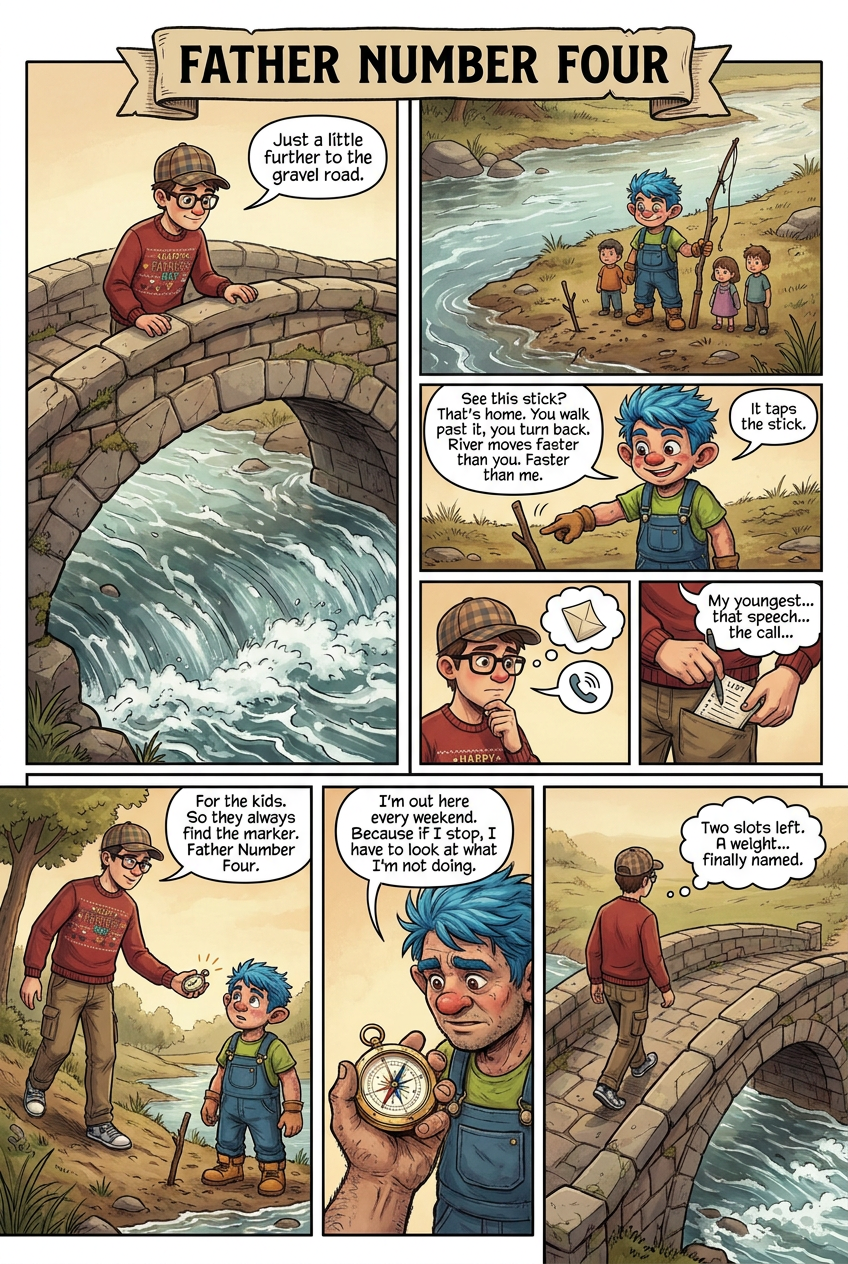
Daddy Parker left Papa Acorn's cottage and drove until the road thinned to gravel. He parked near an old stone footbridge and walked out onto its worn arch. From there he could see the river below, fast and white at the edges. He kept his hands on the rail and watched. A man with bright blue hair stood on the bank with three small children. Troll Daddy. He held a fishing rod cut from a twisted reed, line tied at the tip. He showed the kids how to grip it. He pointed to a stick jammed in the mud as a marker. "See this stick? That's home," Troll Daddy said. "You walk past it, you turn back. River moves faster than you. Faster than me." He tapped the stick twice. "Faster than me." Daddy Parker watched him kneel and show the youngest how to step back from the wet rocks. No flourish. Just hands and words. Daddy Parker thought of his own youngest at home, the speech bill folded in a drawer, the call he kept not making. He pulled out his list anyway. He uncapped the pen. He walked down the slope. Troll Daddy looked up, surprised. Daddy Parker held out a small pocket compass, polished brass, the needle steady. "For the kids," he said. "So they always find the marker." He paused. "Father Number Four." Troll Daddy took the compass in his rough hand. He turned it once. "I'm out here every weekend," he said quietly. "Every weekend. Because if I stop, I have to look at what I'm not doing." Daddy Parker nodded. He didn't trust his voice. He climbed back to the bridge with two slots left, and a weight in his chest that finally had a name.
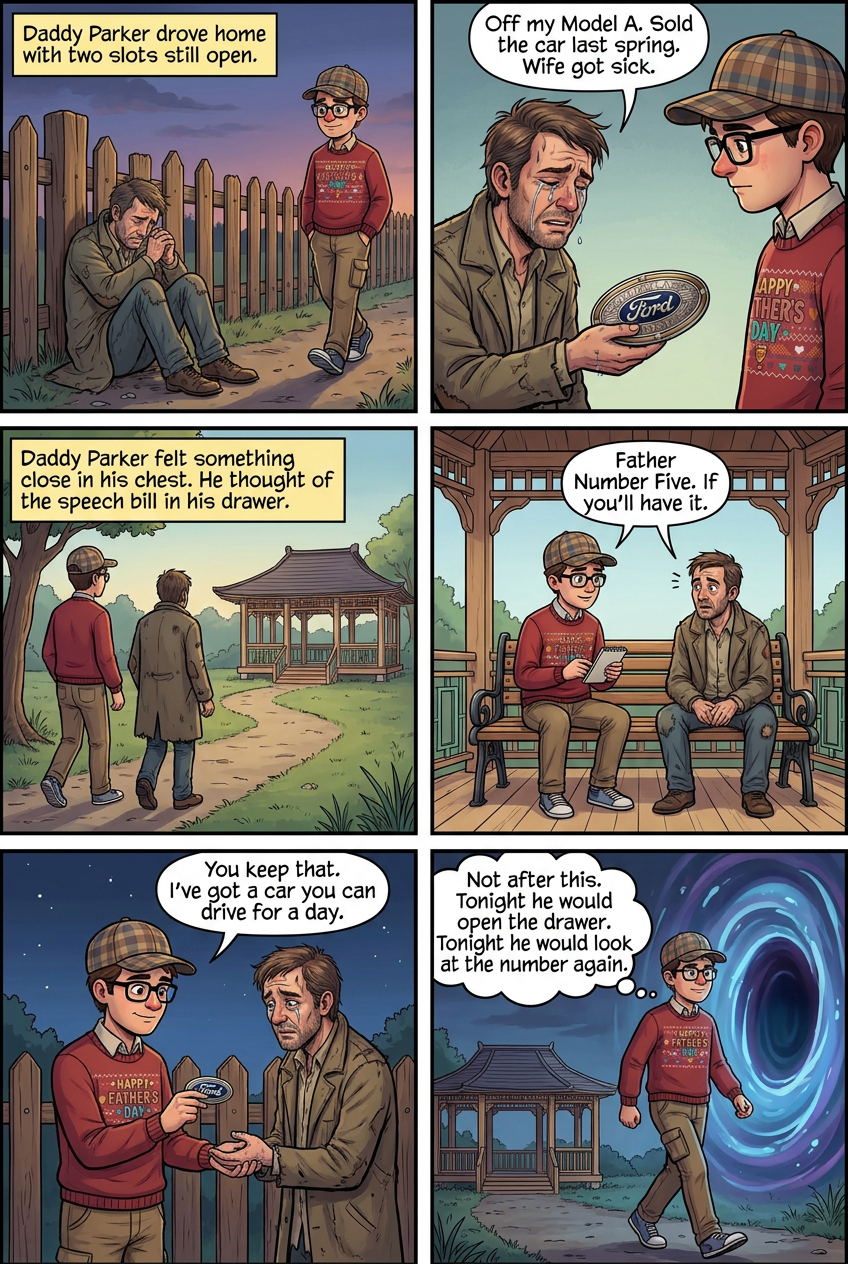
Daddy Parker drove home with two slots still open. He parked near his property line and walked along the wood fence to clear his head. That's when he saw the man. A grown man, hands braced on a fence post, shoulders shaking. Daddy Parker slowed. He didn't speak. He just stood beside him at the rough planks until the worst of it passed. The man wiped his face. He pulled something from his coat pocket. A small oval badge, polished smooth from years of thumb-rubbing. A Ford emblem. "Off my Model A," he said. "Sold the car last spring. Wife got sick. Two girls at home who need more than I can give." He turned the emblem in his palm like it weighed more than it did. Daddy Parker felt something close in his chest. He thought of the speech bill in his drawer. The call he hadn't made. The quiet math he did every night and lost. "Come sit," he said. He walked the man to a small pavilion on the edge of the property, an open roof and clean wood floor. They sat together on an iron-and-wood bench under the eaves. Daddy Parker didn't fill the silence. He let it hold them both. After a long while, Daddy Parker took out his list. He uncapped the pen. "Father Number Five," he said. "If you'll have it." The man's mouth worked. He nodded once. Daddy Parker closed the man's fingers back around the emblem. "You keep that. I've got a car you can drive for a day." They walked back toward the road. One slot left now. Daddy Parker felt the weight of the man's grief settle next to his own, and he knew, walking, that he could not keep telling himself next month. Not after this. Tonight he would open the drawer. Tonight he would look at the number again.
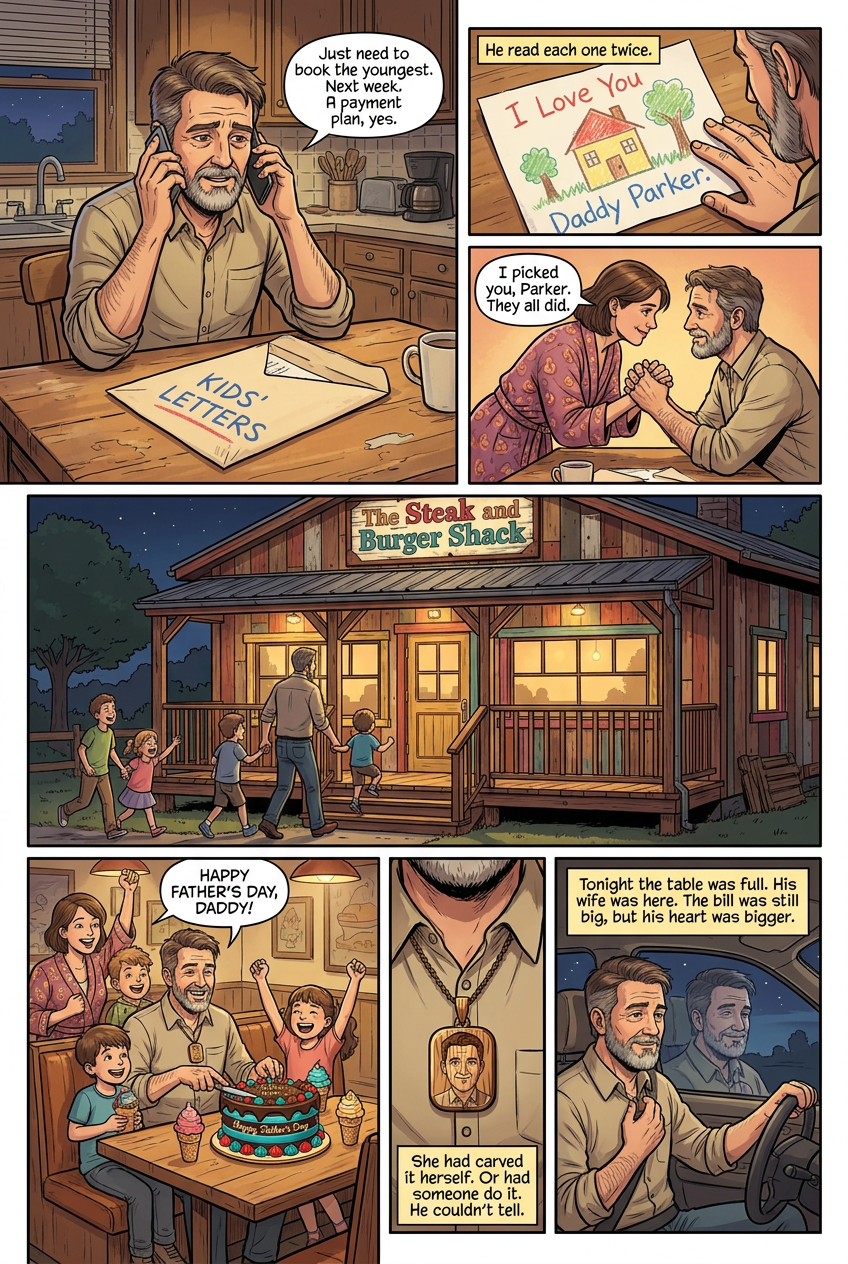
Daddy Parker made the call that night. He opened the drawer, pulled out the bill, and dialed the clinic before he could talk himself out of it. The woman on the line booked the youngest for next week and set up a payment plan he could handle. He hung up and sat in the kitchen with his hand flat on the table. Delores came in then, in her robe, and told him she had picked her sixth father. She had picked him. She slid an envelope across the table with the kids' crayon letters inside. He read each one twice. The next evening he drove the family out to a roadside place with a hand-painted sign and a wood porch. The kids ran ahead up the steps. Delores held his arm. Inside, they took a booth by the window and ordered too much. Steaks for him and Delores. Burgers for the kids. The youngest pointed at the menu and said the word for fries clear enough that Daddy Parker caught Delores's eye across the table. She squeezed his hand under the booth. He didn't say anything. He didn't need to. A waitress wheeled out a cart for dessert. On it sat a two-tier cake with blue frosting and four ice cream cones standing around it like candles. "Happy Father's Day" ran along the bottom in piped gold. The kids cheered. Jeffy got chocolate on his chin. Jeremy traded his cone twice before settling. Daddy Parker cut the cake himself and gave the corner piece to Delores. He watched her laugh at something the oldest said and felt the tight knot in his chest loosen a notch. The bill at home was still big. The plan was still thin. But tonight the table was full and the kids were loud and his wife was here. When the plates were cleared, Delores reached into her purse and pulled out a small wooden pendant on a chain. She had carved his likeness into the oak herself, or had someone do it. He couldn't tell which and didn't ask. She stood, walked around the booth, and slipped the chain over his head. The kids lined up beside her. "Happy Father's Day, Daddy," they said together. Jeffy said it twice to get it right. Daddy Parker touched the pendant against his shirt. He thanked them. He meant it. On the drive home he kept one hand on the wheel and one on the wood at his collar, and he thought about the appointment on the calendar, and the five other fathers, and the one slot he still had not filled.
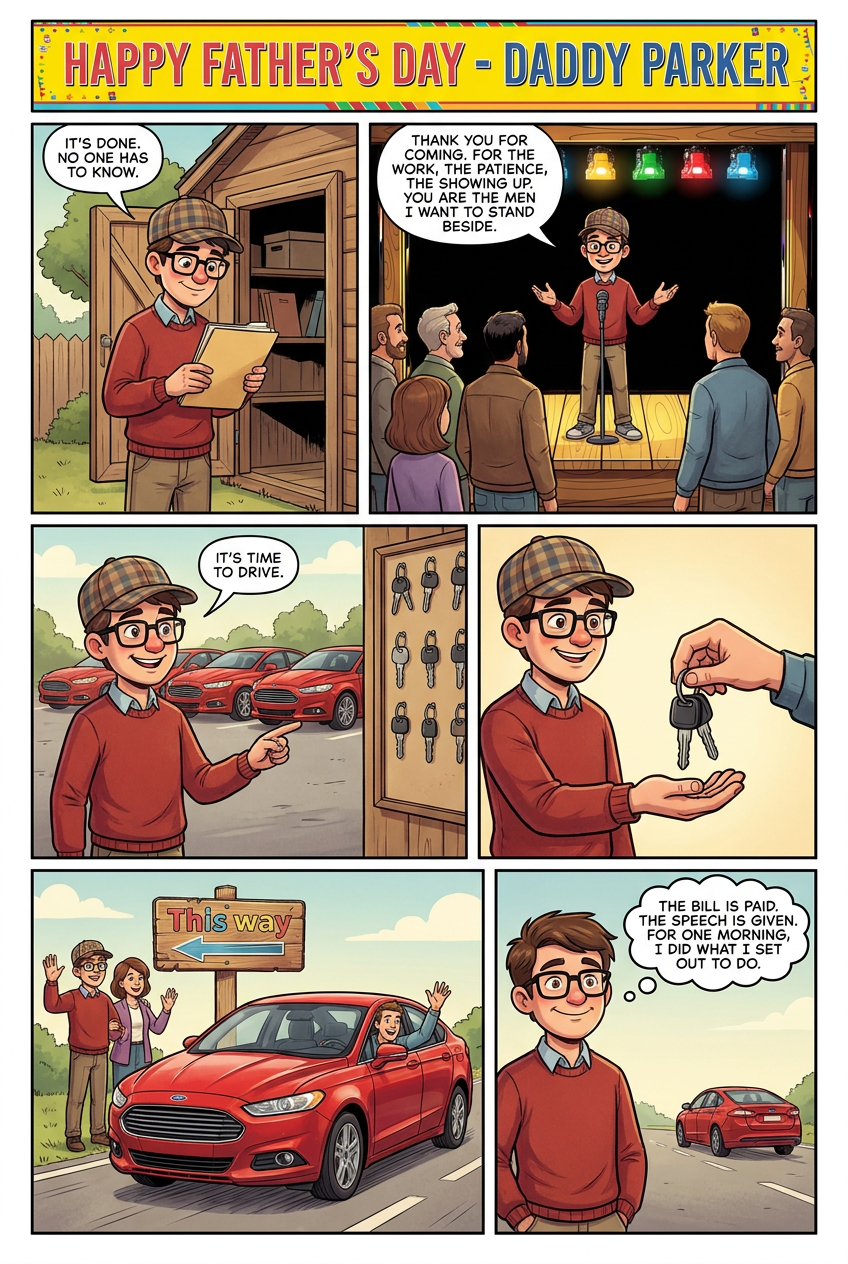
The morning after the dinner, Daddy Parker walked the property with a folder under his arm. Inside was the paid stamp from the clinic, fresh from the mail. He had wired the balance before sunrise, clearing the bill in full. He stood a moment by the small shed at the back of his lot, the one lined with old plates and shop tools, and let the weight of it settle. The thing he had carried alone for months was done. No one had to know how late it was. He tucked the folder onto a shelf inside the shed and closed the door. By ten the fathers had arrived. Daddy Parker had set up a wooden platform near the showcase garage, with lights strung above and a microphone at the center. He climbed the steps and gripped the stand. His mouth went dry. He looked out at the five men he had chosen, and at his wife near the picnic table, and he started anyway. He thanked each father for coming. He named what he had seen in each one: the work, the patience, the showing up. He said they were the kind of men he wanted to stand beside. The words came easier the longer he spoke. When he finished, he pointed past the platform to the row of red Fords, keys lined up on a board. "It's time to drive," he said. The fathers came forward one at a time and took their keys. Daddy Parker shook each hand. At the head of the driveway he had planted a painted sign, an arrow pointing the way out toward the road. He had built it himself the night before, after he sent the wire. The first engine turned over. Then the second. Delores stood beside him as the cars rolled past the sign, one after another, the men waving through open windows. Daddy Parker raised his hand. He kept it up until the last Ford cleared the drive. Then he lowered it and breathed out for what felt like the first time all week. The bill was paid. The speech was given. The fathers were on the road. For one morning, he had done what he set out to do, and nothing was hiding in the drawer at home.
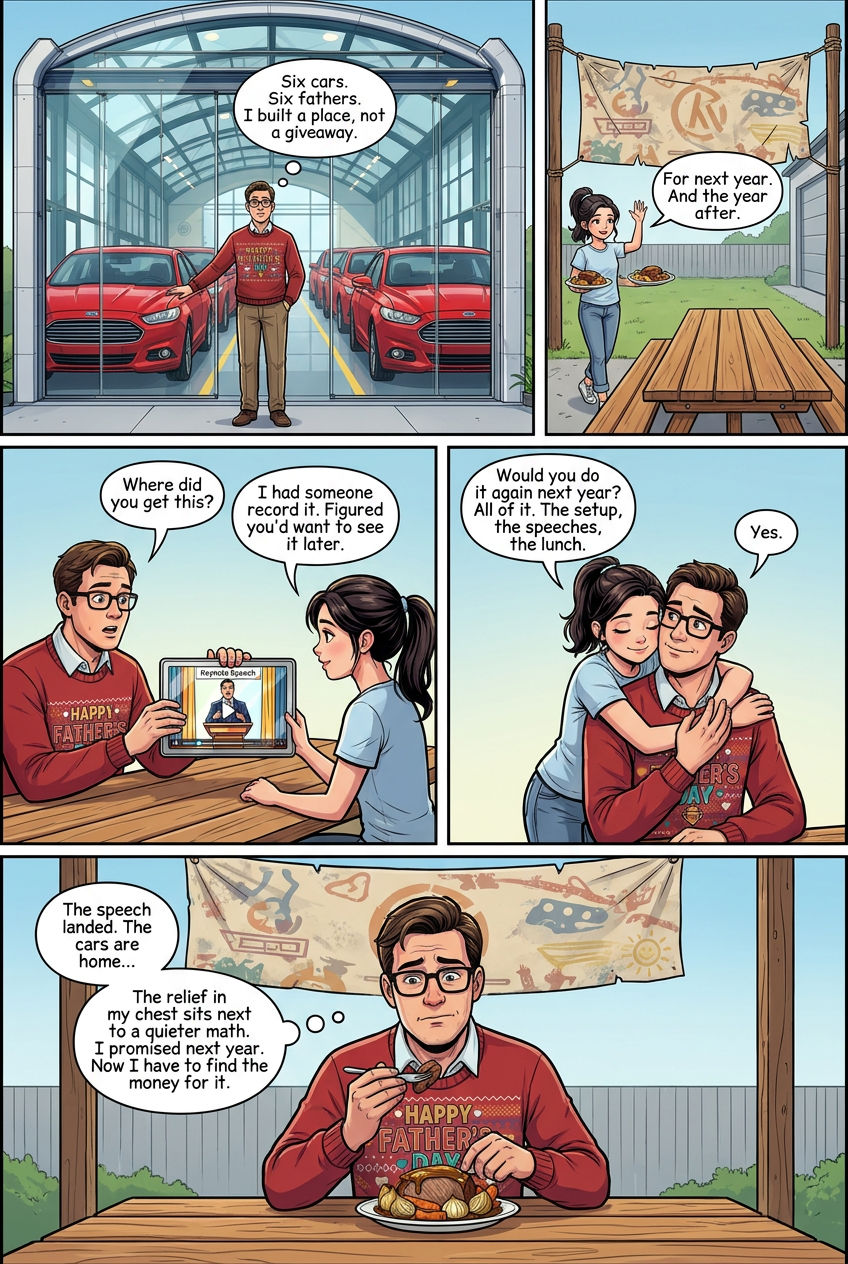
After the fathers drove off, Daddy Parker stood at the head of the drive a while longer. Then he turned back toward the garage. The six red Fords were still inside, lined up in their bays, hoods cool in the shade. He had only handed out keys, not titles. The cars stayed. The men went home in their own trucks and on foot, the way they had come. Daddy Parker walked the row and rested a hand on each fender. Six cars. Six fathers. He had built a place, not a giveaway. Delores came out from the picnic area carrying two plates of pot roast. She set them on the long wooden table near the garage doors and waved him over. Above the table, a weathered banner hung between two tall posts. She had strung it that morning while he was on the platform. Faded shapes ran across the cloth — small cars, small hands, a sun. "For next year," she said. "And the year after." He sat across from her. The children were inside the cottage with a sitter. For a few minutes it was only the two of them and the smell of the roast. She pushed a flat package across the planks. He opened it. Inside was a framed screen, a still image of him at the microphone, lips parted mid-word. She pressed a small button on the side. The screen lit up and played his speech back to him, all four minutes and forty seconds. He watched himself thank each father by name. He watched himself look at her. He did not stumble once. He had not known how he looked from the outside. He looked like a man who meant it. He set the frame down carefully on the table. "Where did you get this?" "I had someone record it," she said. "Figured you'd want to see it later." He nodded. He pictured the banner still hanging next June, and the cars still in their bays, and another pot roast on this table. He cleared his throat. "Would you do it again next year? All of it. The setup, the speeches, the lunch." Delores chewed, swallowed, looked at him plainly. "Yes." She did not pause. She stood, walked around the table, and hugged him hard around the shoulders. He held on a moment longer than he meant to. When she sat back down, he ate. The speech had landed. The cars were home. The bill at the clinic was paid and the youngest had said a clean word at dinner two nights back. For the first time in months, nothing was hidden in a drawer. But he looked at the banner and counted forward — twelve months of school shoes, winter coats, more therapy sessions, three birthdays. The relief in his chest sat next to a quieter math. He had promised her next year. Now he had to find the money for it.
Play your story to life
Storycraft is a mobile game where you create AI characters, craft items and locations to build their world, then discover what direction your story takes. Download the iOS game for free today!
Download for free