

Delores Parker's Arc
10 Chapters
Delores Parker's dream is supporting her husband no matter what he gets himself into ie, keeping six 1931 Model A Fords that she thought he was going to sell.

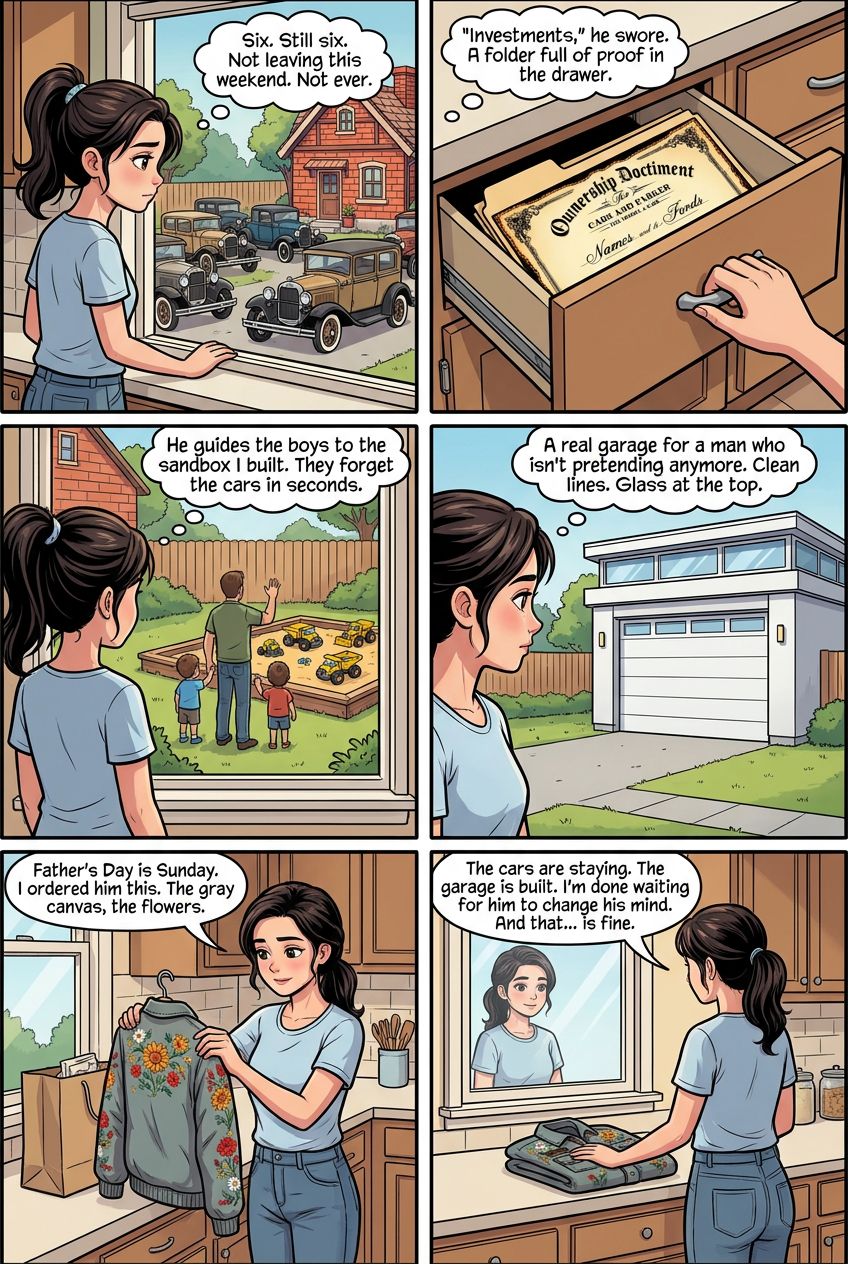
Delores stands at the kitchen window and counts them again. Six Model A Fords sit in the yard like stubborn guests who never read the room. She had hoped, quietly, that one would be gone by Friday. She shakes her head. They aren't leaving. Not this weekend. Not ever. Her husband swore the last two were investments. He even keeps a folder of papers in a drawer, ownership slips and old receipts, proof he can wave when she raises an eyebrow. She has stopped raising it. Outside, her two younger ones climb a rusted fender. Her stomach tightens. She watches her husband wave them down, gentle as ever, then guide them toward the patch of yard where she dragged a wooden frame last week. She filled it with sand and a pile of toy trucks. They forget the cars in seconds. She looks past them at the new building he poured a slab for. Clean lines, big door, glass at the top. A real garage for a man who isn't pretending anymore. He built it slowly, on weekends, humming. Delores turns from the window and opens the shopping bag on the counter. Inside is a jacket she ordered, gray canvas stitched with bright flowers along the sleeves. Father's Day is Sunday. She smooths the embroidery flat. She folds the jacket and sets it aside. The cars are staying. The garage is built. She is done waiting for him to change his mind, and that, she decides, is fine.
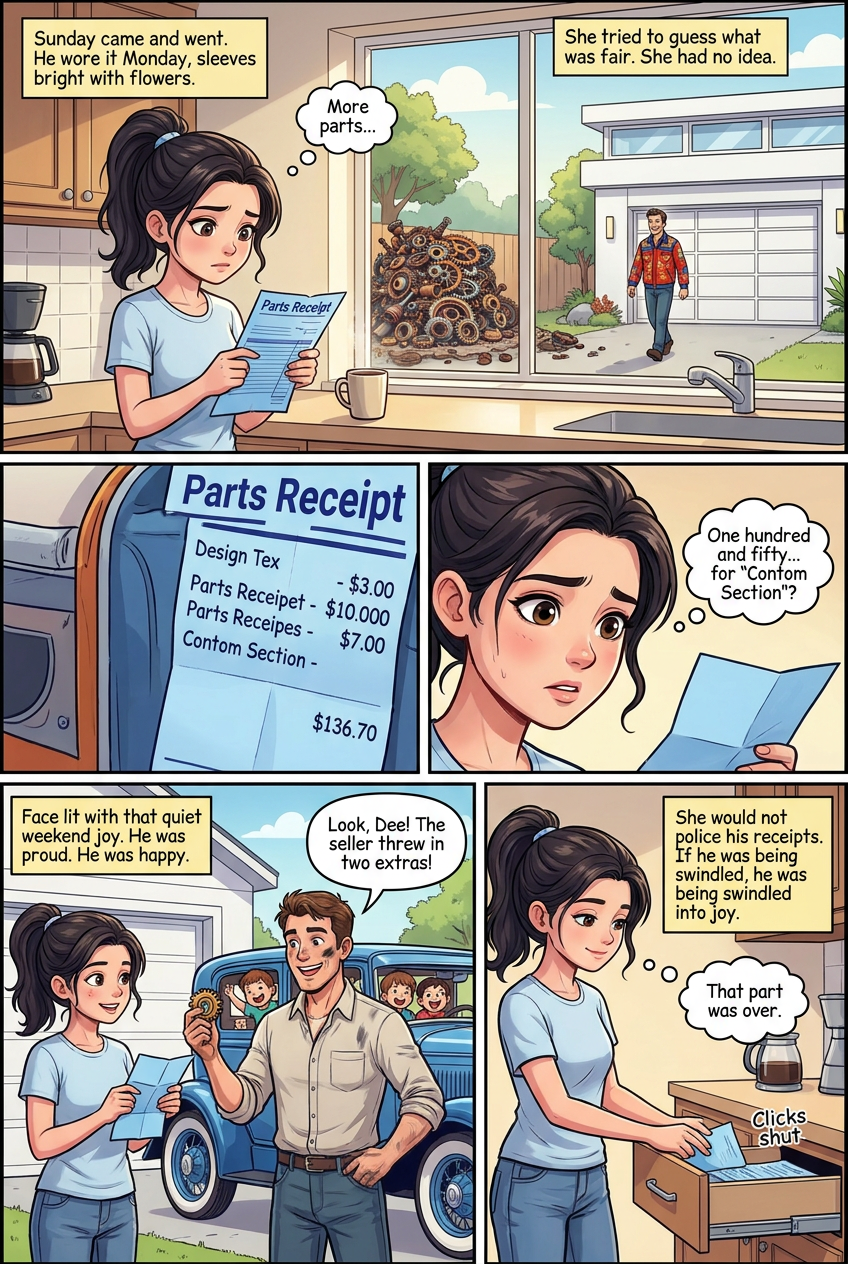
Sunday came and went. The jacket fit. Her husband wore it Monday morning to the new garage, sleeves bright with flowers. Delores watched him walk past the heap of rusted gears and coils outside the door, parts she could never name. He had ordered more. A receipt sat on the kitchen counter, waiting. She picked it up. Crisp print, neat columns, numbers that climbed without mercy. Design Tax. Custom Section. One hundred and fifty for something she couldn't pronounce. She tried to guess what was fair. She had no idea. Out the window, her younger two hung from the windows of the blue Ford, shouting like pirates. The oldest leaned on the fender, grinning. Delores carried the receipt outside. She meant to ask, calmly, if these prices were right. Her husband looked up from the open hood, face lit with that quiet weekend joy. He pointed at a small brass part in his palm and told her the seller had thrown in two extras for free. He was proud. He was happy. She folded the receipt in half. She walked back inside and slid it into the drawer with the rest. She would not learn Model A prices. She would not police his receipts. If he was being swindled, she decided, he was being swindled into joy. The drawer clicked shut. That part was over.
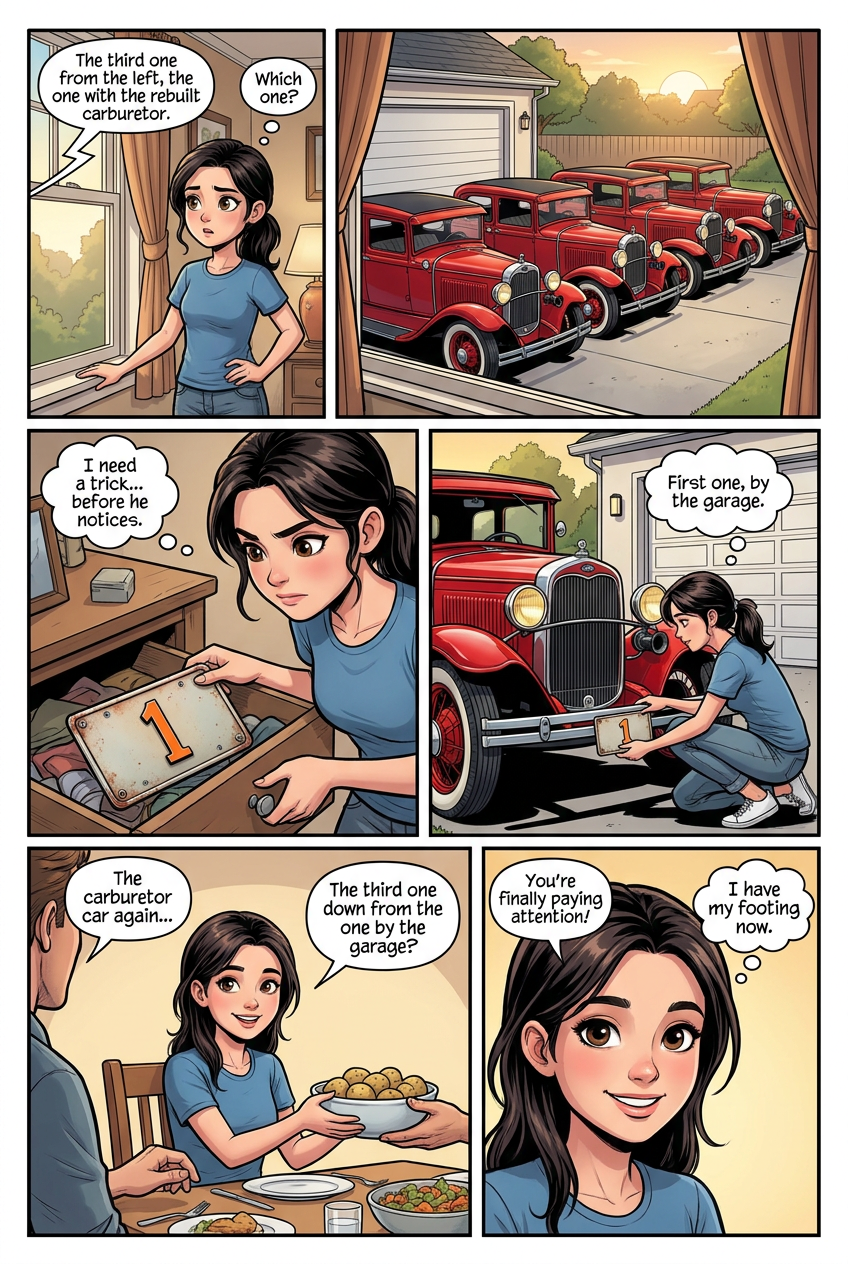
The drawer was shut, but the trouble wasn't. That evening her husband came in talking about the third one from the left, the one with the rebuilt carburetor. Delores nodded. She had no idea which one he meant. She walked to the window and counted them. Six red hoods in a neat row, six round headlights, six little Ford emblems shining back at her. They looked like one car printed six times. She needed a trick, and she needed it before he noticed. In the junk drawer she found an old novelty plate stamped with a bright number 1. She carried it outside, slipped it behind the front bumper of the scarlet one nearest the garage, and tucked it where the chrome hid the edge. Tomorrow she'd mark the others in her head — second from the plate, third from the plate. A small map only she could read. At supper he mentioned the carburetor car again. Delores said, "The third one down from the one by the garage?" His face lit up. He said she was finally paying attention. She smiled and passed the potatoes. The plate stayed hidden. She had her footing now.
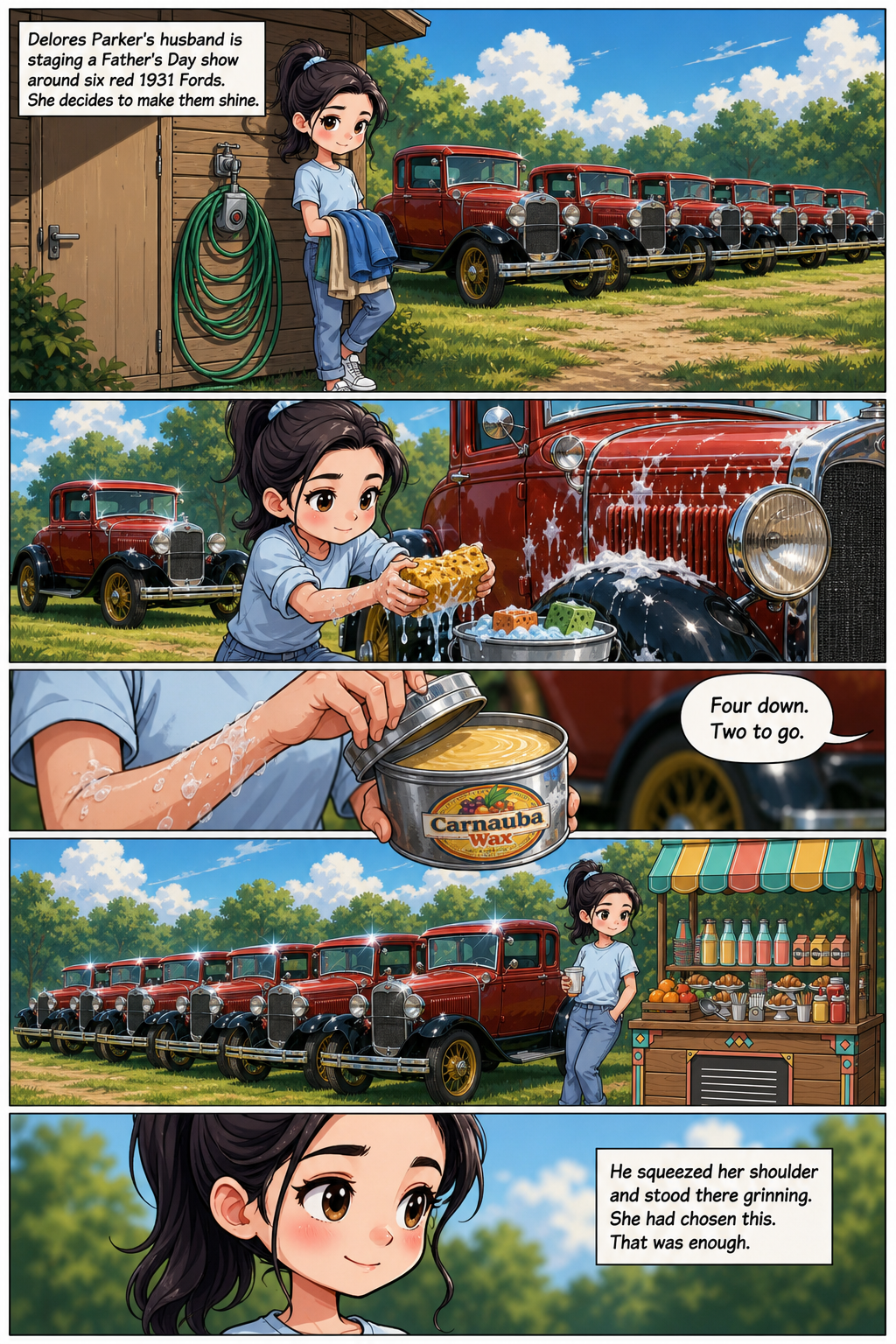
The plate trick had given her footing, and now she wanted to use it. Her husband was working hard to bring fathers together for Father's Day. Six red Fords needed to shine. Delores decided to help. She stepped behind the small shed by the hose and changed out of her good clothes. She filled a bucket with warm water and dropped in a stack of sponges. She rolled the hose out across the grass. She washed the first car, then the second. She counted from her hidden plate so she didn't miss one. By the fourth car her arms ached, but the red paint glowed. She finished with a tin of carnauba wax, rubbing slow circles until each hood mirrored the sky. Then she wheeled out a little cart and set it up with cold drinks, fruit, and rolls for the fathers who'd come tomorrow. Her husband walked out, saw the row of shining cars, and stopped still. He didn't say much. He just squeezed her shoulder and stood there grinning. Delores smiled back. She had chosen this, and it felt right.
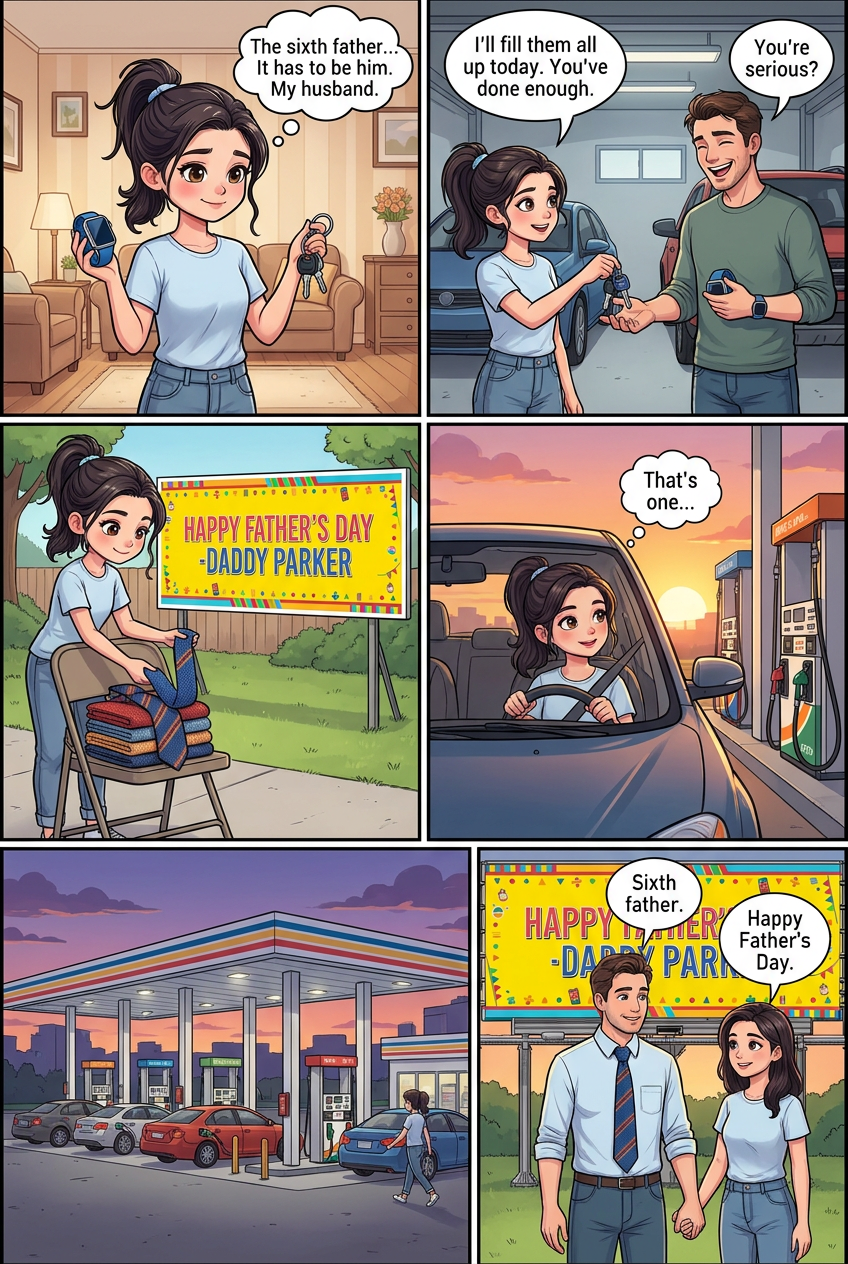
The shining cars were ready, but Delores wasn't done. She had been thinking about the sixth father all morning. The answer was simple. It was her husband. He had built the garage, gathered the families, and lined up the cars. He deserved a slot of his own. She walked inside and picked up the smartwatch she had wrapped for him. She had loaded it with notes on the men he might pick for fathers four and five. He could tap through and decide on his own time. It felt fair to hand him that choice. She found him in the garage and held out the spare ring of keys. "I'll fill them all up today," she said. "Every tank. You've done enough." He blinked at her, then laughed and dropped the keys in her palm. She pocketed them before he could change his mind. While he scrolled through the watch, Delores slipped out back. She had tidied a clean patch of grass under a bright tribute sign that already carried his name. A folding chair waited there. Six small knit ties sat folded on the seat, one for each father, stitched slow over many evenings. She set his tie on top of the stack. Blue, with red stripes. His favorite colors. Then she drove the first car down the road to fuel it up, counting from her hidden plate so she wouldn't lose track. By dusk all six tanks were full and the ties were laid out in a neat row. Her husband stood under his sign, reading his own name, quiet. Delores had named him the sixth father. He didn't argue. He just reached for her hand.
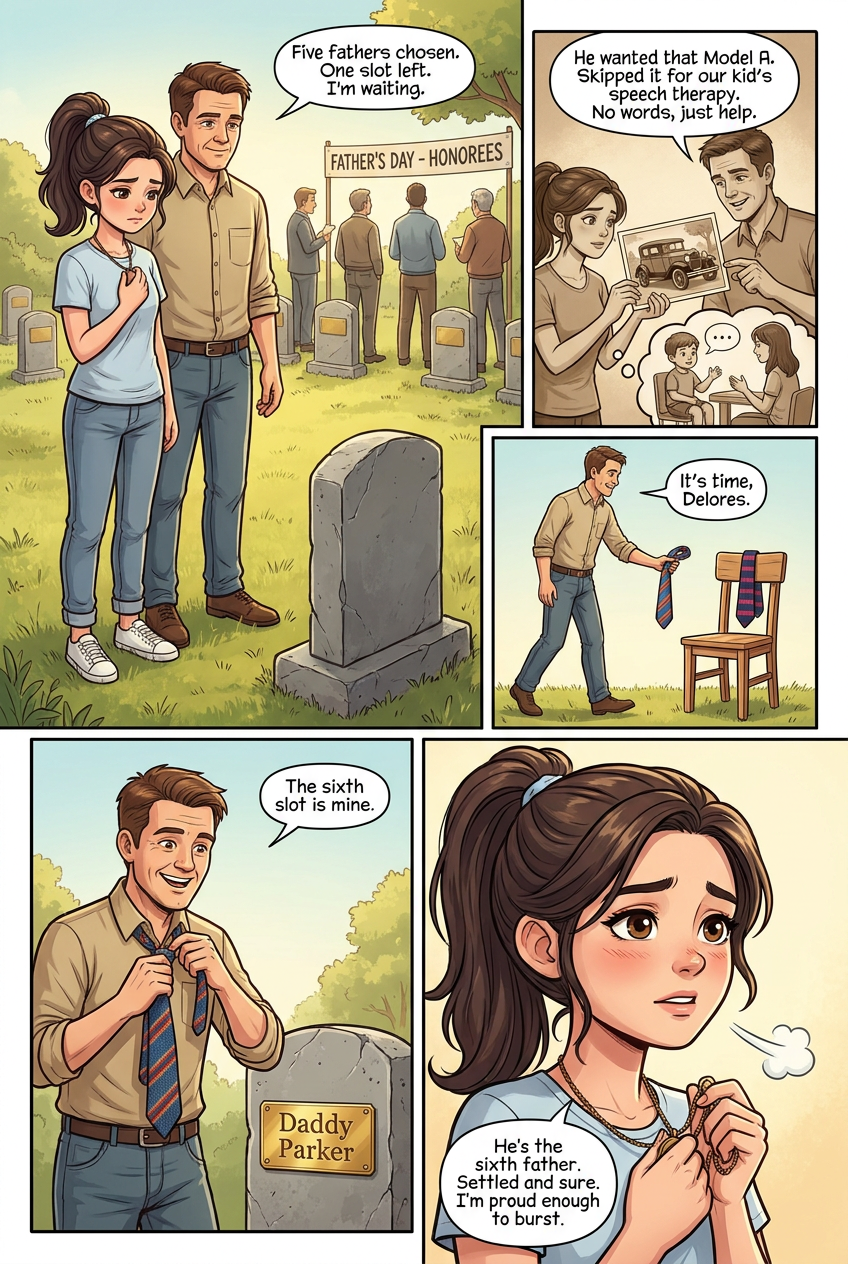
Delores stood by the chair draped with knit ties and watched her husband read his name on the stone marker. Five fathers had been chosen. One slot was still open. She touched the small wooden pendant at her throat, carved with his face, and waited. She thought of the Model A he had wanted. He'd skipped it. Their oldest needed speech therapy, and he had paid for it without a word. No new car. Just quiet help for their kid. Her husband walked over and lifted the last tie off the chair. He looped it around his own neck. He tapped the brass plate with his name and grinned at her. The sixth slot was his. He had taken it. Delores let out a long breath. The pendant felt warm against her skin. He was the sixth father, settled and sure, and she was proud enough to burst.
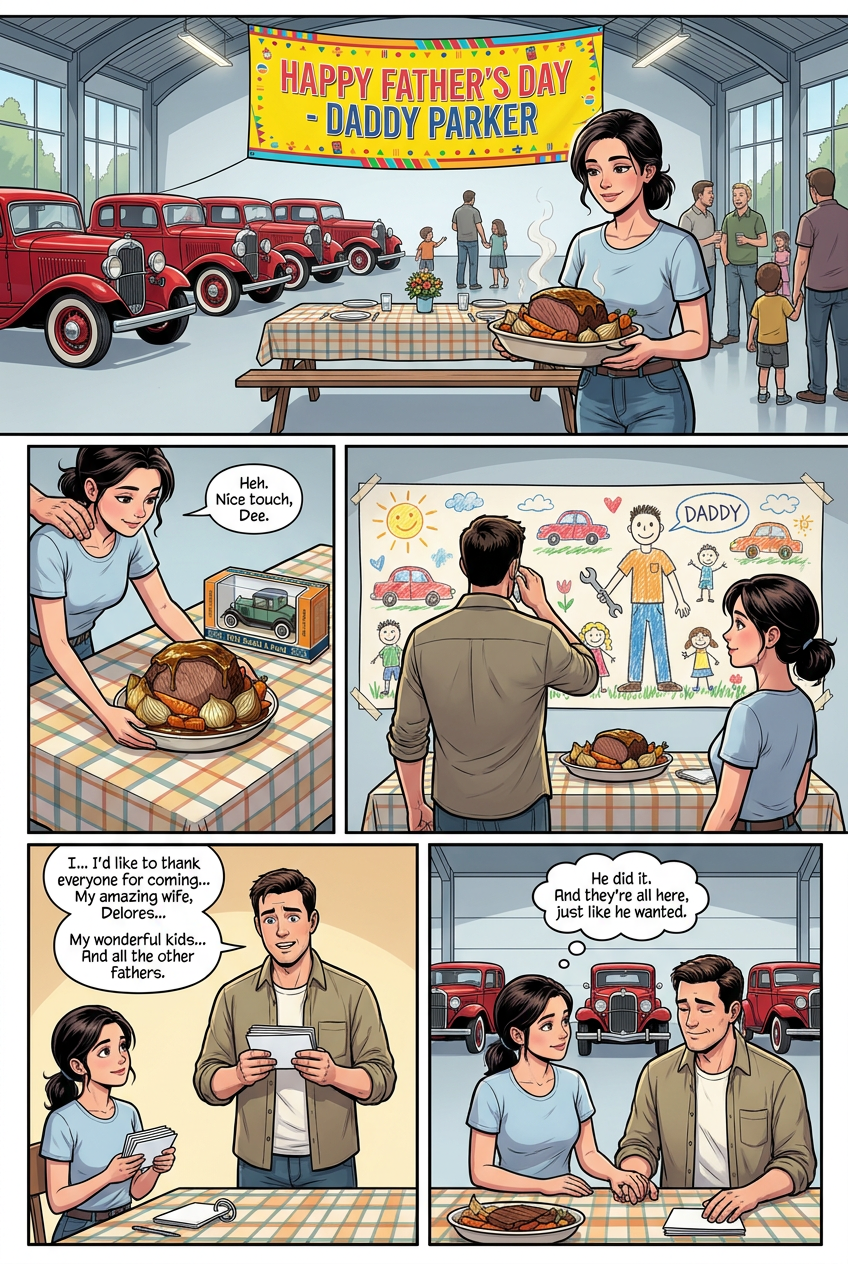
After her husband took the sixth tie, Delores led him toward the picnic area inside the showcase garage. The six red Fords sat in a row along the wall. A long table waited under the tribute sign that carried his name. The other five fathers were already drifting in with their kids. Delores had a lunch to finish setting, and a speech to help her husband through. She carried the pot roast out herself. The meat sat deep in its dish, edges dark, carrots and onions sunk in the gravy. She set it at the center of the table and straightened the cloth. Next to the roast she placed a small boxed model of a 1931 Ford, still in its clear plastic window, as a centerpiece. It was the closest thing to a joke she would allow herself. Her husband saw it and laughed once, short and surprised, then squeezed the back of her neck. The children had been working on their own piece for a week. Their oldest had taped a wide paper mural to the garage wall behind the table. The two younger ones had filled it with crayon suns, lopsided cars, and stick figures wearing neckties. One figure was clearly their father, drawn taller than the rest, holding a wrench bigger than his head. Delores watched her husband stop in front of it. He stood there a long time. He did not speak. When he turned back, his eyes were wet, and he wiped them with the cuff of his shirt. The other fathers took their seats. Plates went around. Her husband stood at the head of the table and pulled a folded square from his pocket. Delores already had the backup ready. She held the ring of index cards in her lap, numbered, every line of his speech printed out clean. They had written it together at the kitchen table, two nights running. He found his first line and started. His voice shook on the opening. She lifted the cards just enough for him to see. He caught her eye, nodded, and kept going. He thanked each father by name. He thanked his kids. He thanked her last, and he said it plain. The table clapped. Their oldest whistled through two fingers. Delores stayed in her chair while the fathers ate. The roast went fast. The kids tore at the mural's edges pointing out which figure was whose. Her husband sat down beside her and set the folded speech on the table between them, finished. She had built the day around him and he had carried it. The six cars still lined the wall behind them, all six, exactly as he wanted them. She had stopped pretending that would ever change. She reached for his hand under the table and held it there.
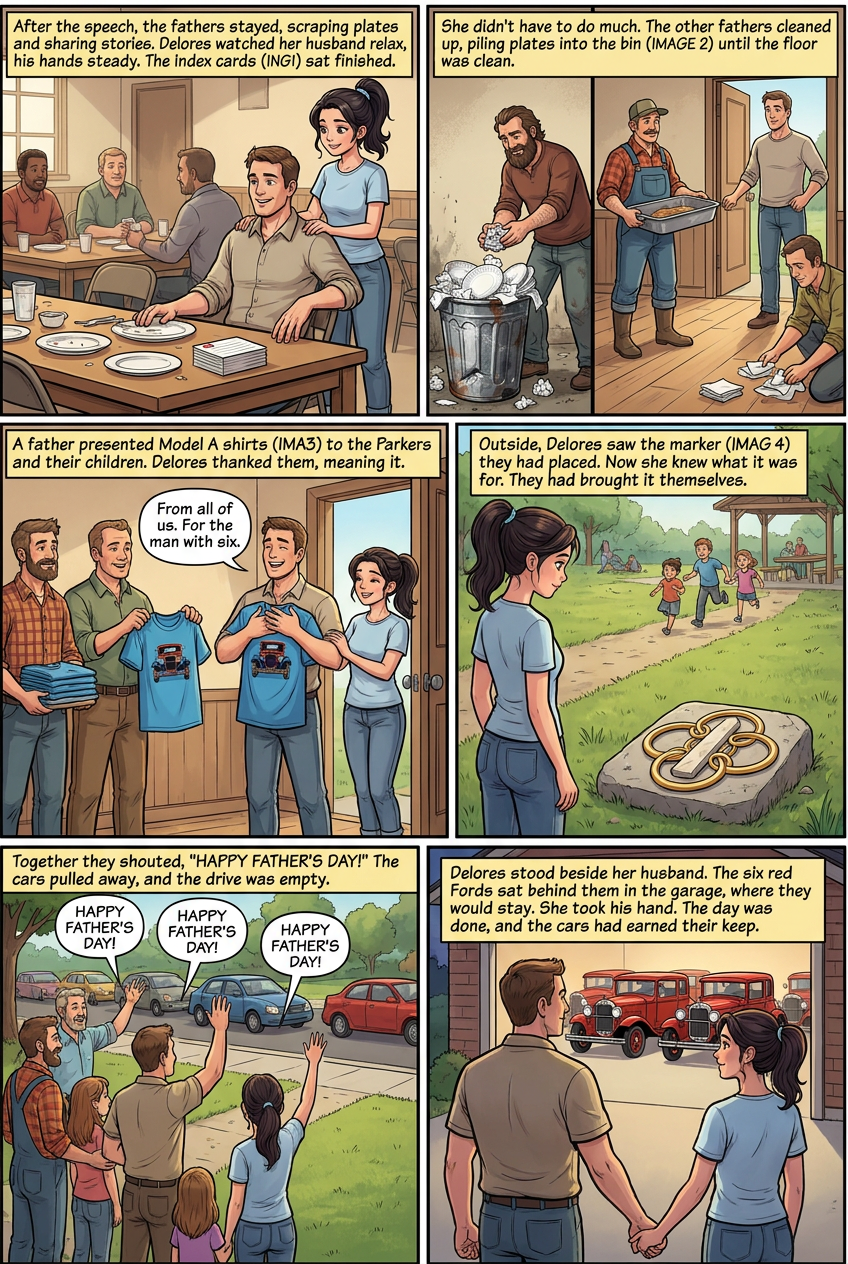
After the speech, the fathers stayed at the table awhile. They scraped their plates clean and traded stories about their own kids. Delores watched her husband relax into his chair. His hands had stopped shaking. The index cards sat on the table between them, finished work. She squeezed his shoulder and stood to start clearing. She did not have to do much. Farmer Fred carried the empty roast pan to the side counter. Papa Acorn gathered the crumpled napkins from his end of the table. Troll Daddy walked the paper plates over to the trash and pressed them down. The fifth father, the one who had sold his own Ford years back, wiped the table with a damp cloth. Frank Holloway folded the tablecloth corners. By the time the kids ran out to the picnic area, the bin by the door was stacked high with plates and napkins, and the floor was clean. Daddy Parker stood by the row of six red cars and watched the fathers work. He did not know what to do with his hands. The fathers gathered their kids near the open door. One of them pulled a stack of folded shirts from a paper bag. Each shirt was bright blue with a red Model A printed across the front. He handed one to Daddy Parker, one to Delores, and one for each of the three children. "From all of us," he said. "For the man with six." Daddy Parker laughed and held his up against his chest. Delores thanked them and meant it. Outside, near the path, the fathers had set a small marker in the grass before lunch — six brass rings around a pale stone post. Delores had seen it on her way in and not known what it was for. Now she did. They had brought it themselves. The fathers walked out in a loose line, kids in tow. Delores and her husband followed them to the edge of the drive. The fathers turned and waved. Their kids waved. Daddy Parker raised his hand and Delores raised hers, and together they shouted, "HAPPY FATHER'S DAY." The fathers shouted it back. Then the cars pulled away one at a time, and the drive was empty. Delores stood beside her husband. The six red Fords sat behind them in the garage, where they would stay. She had known that for a long time now. What she had not known, until today, was that other people would come here for them too. She took his hand. The day was done, and the cars had earned their keep.
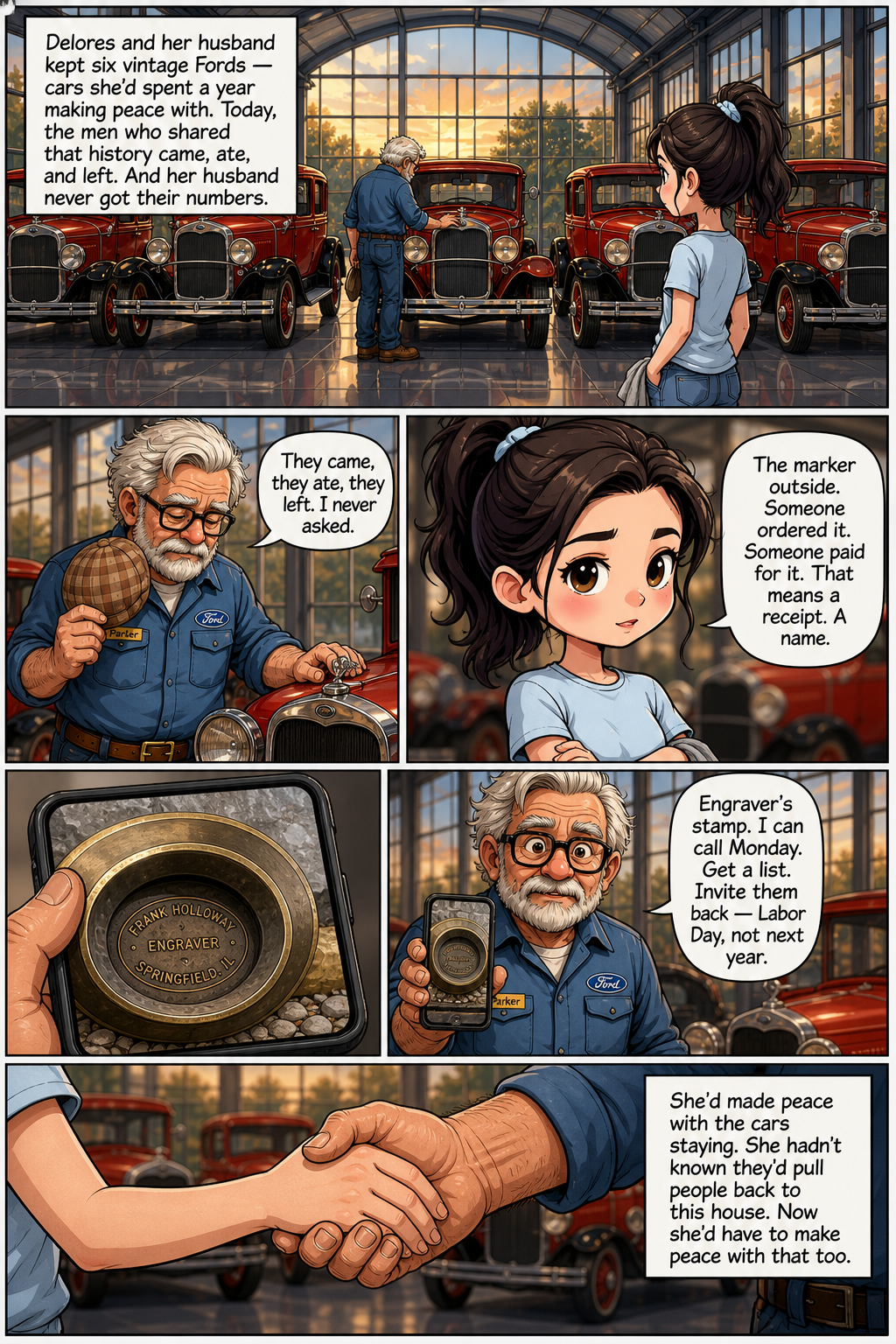
The drive stayed empty long after the last car turned onto the road. Delores went back inside the garage to wipe down the picnic table. Her husband stood by the middle Ford with his hand on the hood. He had not moved in ten minutes. The blue shirts sat folded on the bench where the fathers had left the extras. Delores watched him and knew what was coming before he said it. "I don't have their numbers," he said. "Whose numbers." "Any of them. Farmer Fred. The one who sold his car. Frank." He tapped the hood once. "They came, they ate, they left. I never asked." Delores set the rag down. He was trying to sound flat about it, but his hand kept tapping. "You could ask next year," she said. "Next year is a long time." He pulled off his cap and set it on the fender. "I thought I'd see them tomorrow. That's stupid. I know that's stupid." She walked over and stood beside him. The six red Fords lined up under the tall windows, chrome catching the last of the light. She thought about the marker outside with its six brass rings. Six men. Six cars. No phone numbers. "The marker," she said. "What about it." "They brought it themselves. That means someone ordered it. Someone paid for it." She waited. "That means a receipt. A shop. A name on an invoice." He looked at her. His mouth opened and shut. "Go check it," she said. He went. She heard his shoes on the gravel, then the pause while he crouched by the stone, then his shoes coming back faster. He held up his phone. He had taken a picture of the base. "Engraver's stamp," he said. "On the underside of the ring. I can call Monday." "There you go." He stared at the picture. He did not smile, but his shoulders came down an inch. "I'll get a list. Numbers. Addresses. Whatever they'll give me." "And then?" "Then I invite them back. Not next year. Sooner." He put the phone in his pocket. "Labor Day. We open the garage. They bring the kids. I cook." "You don't cook." "I'll learn." Delores laughed once. He almost laughed too. Then he looked at the row of cars and his face went quiet again. "I didn't know I'd miss them this fast," he said. "I know." She took his hand. The garage held the six Fords the way it was built to. She had spent a year making peace with them staying. Now the cars were doing something she had not expected — pulling people back toward this house. She was going to have to make peace with that too. Six cars. Six fathers. And her husband already planning the next meal.
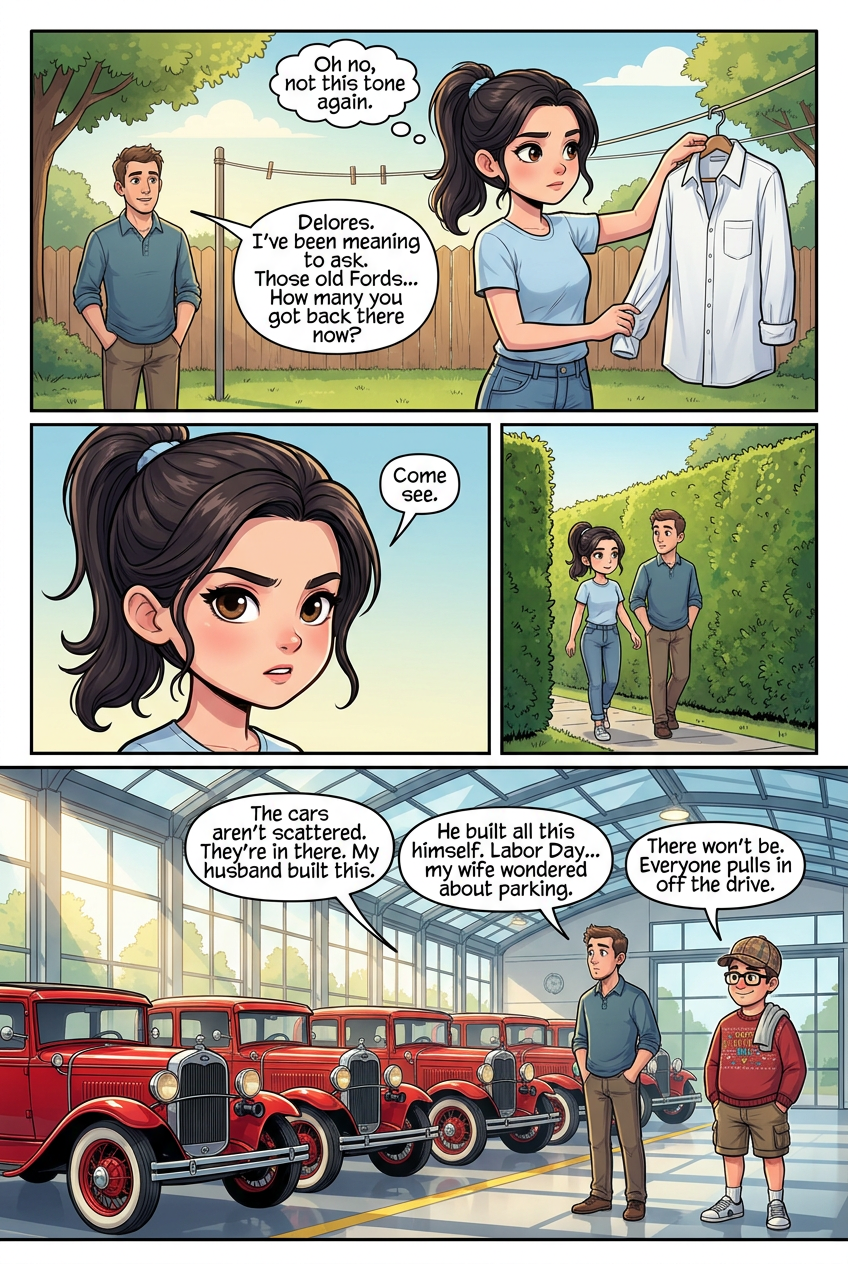
Monday morning Delores was hanging laundry when the neighbor came up the fence line. He walked slow, hands in his pockets, the way people do when they've been working up to a question for a week. "Delores." "Morning." "I've been meaning to ask." He nodded toward the property. "Those old Fords. How many you got back there now? Four? Five?" "Six." His eyebrows went up. "Six. Huh." He scratched his jaw. "My wife was saying it looks like a junkyard from the road. I told her I'd come see for myself before Labor Day. You folks are having people out, I heard." Delores set the clothespin down. She knew the tone. It was the tone her sister used. It was the tone that turned into talk at the grocery store, then talk at church, then a call from the township about the property. "Come see," she said. "Now?" "Now's fine." She walked him around the side of the house. He was ready to point at rust and weeds. She could see it in the way he held his chin. Then they came around the hedge and he stopped. The garage stood there with its tall glass bays and its clean concrete apron. Six red Fords sat inside in a straight row, chrome polished, tires black, the floor swept. Sunlight came through the high windows and laid down clean stripes. "The cars aren't scattered," Delores said. "They're in there. My husband built this last year for them." The neighbor took his hands out of his pockets. "I thought they were out in the field." "They were, for a while. Not anymore." He walked to the glass. He looked at the row the way people look at a museum case. "He built all this himself." "He did." Her husband came out from the back bay with a rag over his shoulder. He saw the neighbor and stopped. He did not smile. He waited. "Morning," the neighbor said. "Delores was showing me." "All right." "You did a nice job in there." "Thanks." The neighbor nodded a few more times than he needed to. "Labor Day. My wife wondered if there'd be parking trouble." "There won't be," her husband said. "Everyone pulls in off the drive. Out of the road." "All right. All right, then." He looked at Delores. "I'll tell her." He walked back the way he came, slower now, thinking. Her husband came over and stood beside her. "What was that." "He was going to make it a problem. He isn't anymore." Her husband looked at the garage, then at the drive where the neighbor had gone. "He'll talk," he said. "He'll talk different now." Her husband nodded once. He put the rag back over his shoulder and went inside to keep working. Delores stood a minute longer. The garage had done the arguing for her. She hadn't expected that. She went back to the laundry line and picked up the next shirt.
Play your story to life
Storycraft is a mobile game where you create AI characters, craft items and locations to build their world, then discover what direction your story takes. Download the iOS game for free today!
Download for free