

“Redstone” Gilly's Arc
6 Chapters
“Redstone” Gilly's dream is teaching the young outcasts of the wasteland to read stone..

Redstone Gilly ran his calloused fingers across the canyon wall, tracing the ancient marks carved into the rock. The symbols told stories—stories of water, of shelter, of danger—and he wanted every kid in the wasteland to learn them. Most folks ignored stone reading now. But the outcasts needed it most. The kids nobody wanted, the ones scavenging alone—they deserved to know what the stones could teach. Gilly had found an old building on the edge of the wasteland, its walls already covered in natural rock formations. He'd spent three weeks shaping it into something special. The climbing wall stretched fifteen feet high, covered in desert stone he'd hauled from three different canyons. Cacti grew from cracks near the base, and wildflowers bloomed in small pockets of soil he'd wedged between holds. Each section showed different symbols—water signs on the left, shelter marks in the middle, warning glyphs near the top. The kids would climb and learn at the same time. Their hands would remember what their eyes saw. This was where he'd gather them, where he'd pass on what the old masters had taught him years ago. Gilly stepped back and wiped sweat from his forehead. The wall wasn't enough by itself. He needed a place to show the lessons clearly, something the kids could study before they climbed. He'd built a sand art station against the far wall, using colored sand from different parts of the desert. Red from the iron flats, white from the salt beds, black from the volcanic fields. He carved the same symbols into the sand patterns, making each one big enough to see from across the room. The kids could trace the shapes with their fingers, practice the patterns, then find them on the climbing wall. Everything was ready now. Tomorrow he'd walk into the wasteland and find his first student. But first he needed a way to call them together. The outcasts scattered across miles of desert, hiding in caves and behind rock piles. He couldn't walk to each one every day. Gilly spent the next two days building a guard tower from sandy wood he'd salvaged from an old settlement. He planted cacti around the base and coaxed desert flowers to grow between the planks. The structure rose twenty feet into the air, open on all sides so the wind could pass through. At the top, he hung a horn made from a twisted piece of metal pipe. When he blew into it, the sound carried for miles across the flat wasteland. Three short blasts would mean lessons were starting. The outcasts would hear it and come. They'd climb his wall, study his sand patterns, and learn to read the stones that kept them alive. This was how he'd change their lives.
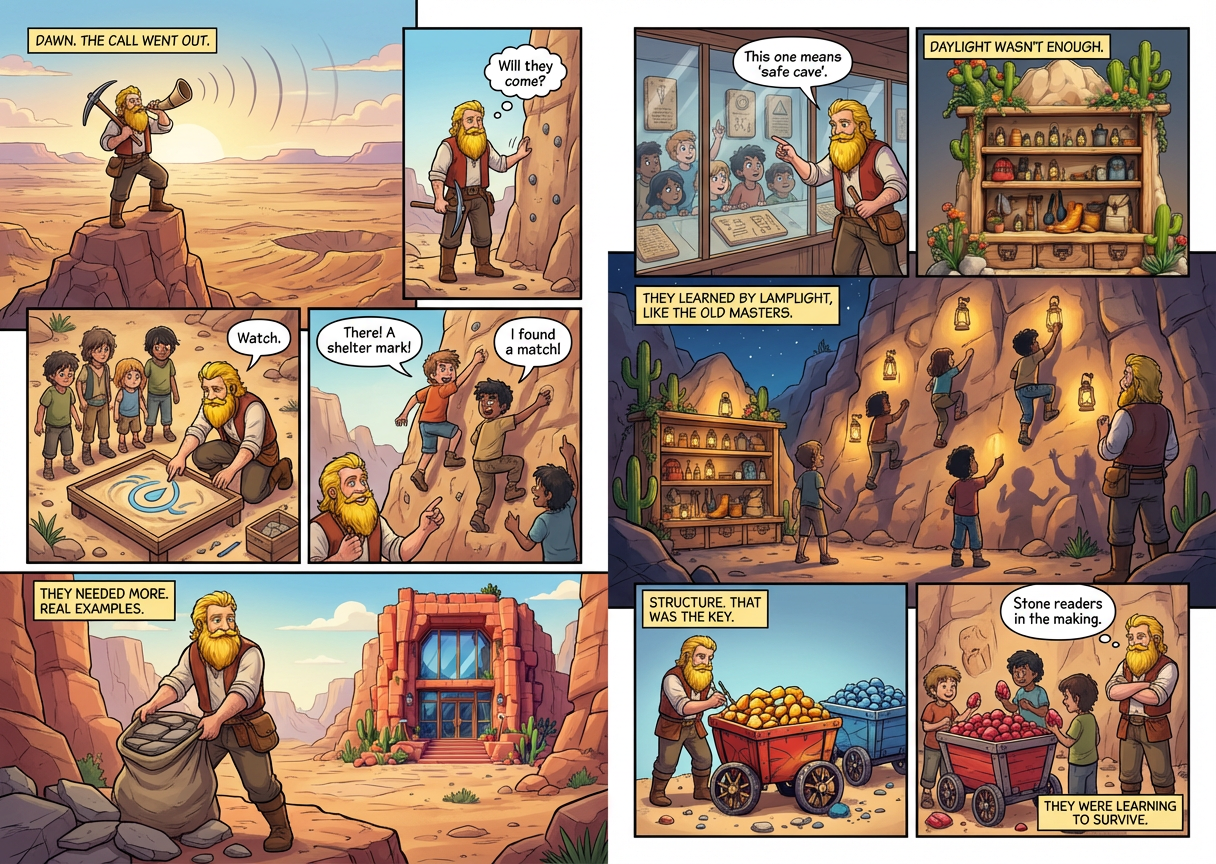
Gilly blew three short blasts on the horn at dawn. The sound rolled across the wasteland like thunder. He climbed down from the tower and waited by the climbing wall. His hands shook a little. Would anyone come? Would they trust him enough to learn? The first figure appeared an hour later—a small shape moving between the rocks. Then another. By mid-morning, five kids stood in a rough circle around him, their faces dirty and suspicious. Gilly didn't waste time with speeches. He walked them to the sand art station and traced a water symbol with his finger. The kids watched. One reached out and copied the pattern. Gilly smiled and pointed at the climbing wall where the same mark was carved into the stone. The kids climbed slowly at first, their fingers finding the symbols he'd placed. They called out when they spotted matches. By afternoon, they were racing each other up the wall, shouting about shelter marks and danger signs. Gilly knew this was just the start—they needed more examples, more practice. That evening, Gilly walked into the desert and began collecting flat stones from the canyon floors. He hauled them back in a canvas sack, his shoulders aching. Over the next week, he built glass cases from salvaged windows and filled them with tablets covered in ancient carvings. He arranged cacti and desert flowers around the cases, making the space feel alive. Each stone showed a different lesson—water sources, safe caves, poisonous plants. The kids could study the real marks up close before climbing. They'd trace the carvings with their fingers, feel the grooves the old masters had made. This was how they'd learn to read stone properly. This was how they'd survive. The kids returned every morning after that. They pressed their faces against the glass cases, studying the ancient tablets inside. Gilly showed them how each symbol connected to something in the wasteland—a specific plant, a type of rock formation, a warning about storms. But daylight hours weren't enough. The kids worked during the day, scavenging and surviving. They could only come for lessons at dawn or dusk. Gilly built a wooden shelf and mounted it near the climbing wall. He filled it with lanterns salvaged from old settlements and hung rock climbing gear from hooks. Desert flowers grew from pots on each level, and cacti sat between the lanterns. When the sun dropped below the horizon, he lit every lantern. The climbing wall glowed in the flickering light. The kids climbed in the evenings now, their shadows dancing across the stone symbols. They learned faster this way, reading by lamplight like the old masters had done in the deep caves. Gilly watched them climb higher each night, their fingers finding every mark without hesitation. They were becoming stone readers. They were learning to survive. But the lessons needed more structure. Gilly realized the kids were mixing up similar symbols, confusing danger marks with shelter signs. He needed to organize the teaching stones by type and difficulty. He dragged three old mine carts from an abandoned site and lined them up outside. He painted each cart a different color using crushed rocks—red for beginner stones, yellow for medium difficulty, blue for advanced markings. He filled each cart with practice stones, sorted by the symbols carved into them. Cacti and desert plants grew around the wheels, anchoring the carts in place. Now the kids could progress properly, starting with simple water marks and building up to complex warning patterns. They gathered around the carts each evening, selecting stones to study before attempting the climb. Gilly watched them learn the proper order, saw them master each level before moving forward. This was what real teaching looked like. This was how stone readers were made.
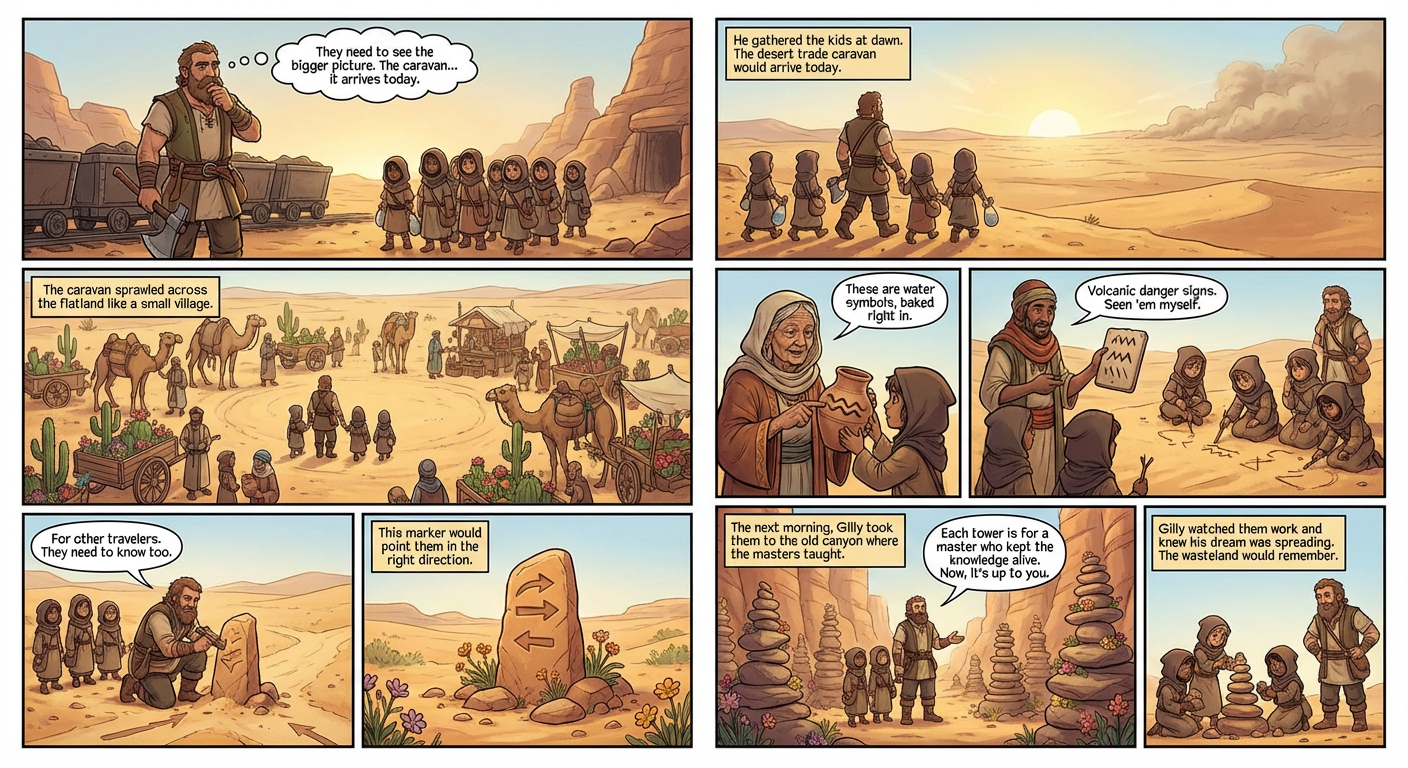
Gilly stood in front of the mine carts and scratched his beard. The kids were learning fast, but they needed to see the bigger picture. Stone reading wasn't just about symbols—it was about understanding the whole wasteland. He needed to show them where to find these marks in the wild. He gathered the kids at dawn and told them they'd be taking a trip. Real stone readers learned from travelers and traders, people who'd seen marks across different territories. The desert trade caravan would arrive today—a circular formation of handcarts and camels that moved through the wasteland every month. Merchants came from all directions, bringing goods and stories. Gilly had seen the dust cloud on the horizon at sunrise. The kids grabbed their water pouches and followed him across the sand. The caravan sprawled across the flatland like a small village, handcarts forming a protective ring around the camels. Cacti and desert flowers decorated the carts, bright against the brown wood. Gilly walked the kids through the circle, stopping at different traders. An old woman showed them pottery with water symbols baked into the clay. A merchant from the eastern wastes pointed out shelter marks he'd seen carved into cave walls three days' walk away. Another trader pulled out a tablet covered in danger signs from the volcanic fields. The kids asked questions, traced symbols in the sand with sticks, listened to stories about how these marks had saved lives. Gilly watched them connect the lessons to the real world. This was what they needed—proof that stone reading mattered beyond his climbing wall. By afternoon, each kid carried a new symbol in their memory and a reason to keep learning. The caravan would move on tomorrow, but the knowledge would stay. Gilly led them back home as the sun dropped low, knowing they understood now why the stones mattered. On the walk back, Gilly stopped where the main road split toward his teaching grounds. He pulled a flat piece of sandstone from his pack and set it upright in the sand. The kids watched as he carved simple marks into the surface—the water symbol, the shelter mark, and below them, directions to his camp. He added desert flowers to the edges, pressing their stems into grooves he'd cut. One of the kids asked what he was doing. Gilly explained that other travelers needed to know about the lessons too. More outcasts wandered these roads every day, lost and alone. This marker would point them in the right direction. The kids helped him pile smaller stones around the base to keep it standing. When they finished, Gilly stepped back and nodded. Any traveler who could read stone would find them now. Any traveler who couldn't would learn soon enough. The wasteland was big, but knowledge could spread just as far. The next morning, Gilly took the kids to the old canyon where the masters used to teach. Stacked stones rose from the ground in careful towers, each one placed by a stone reader who'd come before. Desert flowers grew between the rocks, their roots holding the cairns steady against the wind. Cacti circled the site like guards. Gilly told the kids these were built to honor the readers who'd kept the knowledge alive through hard times. Each tower represented someone who'd mastered the art and passed it forward. The kids walked between the cairns, touching the stones with careful hands. One asked if they'd get their own tower someday. Gilly said that was up to them—stone reading wasn't just about survival anymore. It was about keeping the old ways alive so the next group of outcasts wouldn't be lost. The kids stood quiet for a while, looking at the towers. Then they started building a small cairn together, stacking stones one at a time. Gilly watched them work and knew his dream was spreading. The wasteland would remember stone reading again.
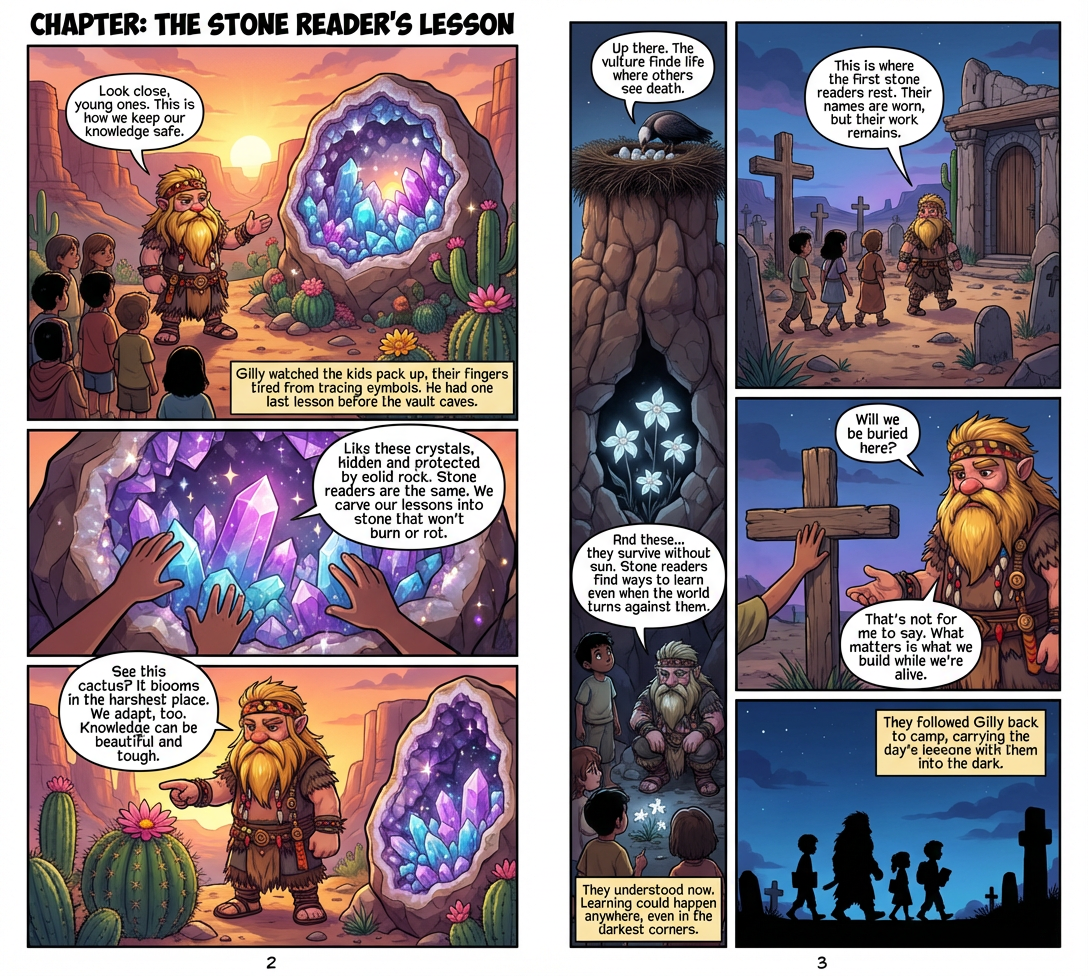
Gilly watched the kids pack up their practice stones as the sun dipped behind the canyon walls. They'd been climbing for three hours straight, their fingers tracing symbols without hesitation now. He knew they needed to see how stone readers kept their knowledge safe. Tomorrow they'd visit the vault caves where the old masters had stored their most important tablets. But first, he wanted to show them something beautiful—proof that the wasteland could protect precious things. He led them past the climbing wall to a spot he'd been working on all week. A large geode sat on a flat rock, split perfectly in half. Purple and white crystals sparkled inside, catching the last rays of sunlight. He'd arranged desert flowers around the base—the tough barrel cactus blooms that only opened after rare rains. Their bright orange petals made the whole display glow with color. One kid asked where he'd found it. Gilly said a trader had pulled it from deep underground, from layers of rock older than any wasteland settlement. The kids gathered close, staring at the crystals like they were looking at stars. Gilly explained that geodes formed slowly over thousands of years, hidden and protected by solid rock. Stone readers were the same—they kept knowledge locked away safely, passing it down through generations. The wasteland tried to erase everything with wind and heat, but some things survived if you knew how to shelter them. He pointed at the cactus flowers and asked what kind of plant could bloom in this harsh place. The kids looked at the thick green barrels, the sharp spines, the delicate petals. One said barrel cactus. Another said they'd seen them store water inside. Gilly nodded. Hardy plants survived by adapting, and stone readers did too—they carved their lessons into rock that wouldn't burn or rot or blow away. The kids touched the geode carefully, their rough fingers gentle against the crystals. They understood now. Knowledge could be beautiful and tough at the same time. Tomorrow they'd see the vault caves, but tonight they'd remember this—that the wasteland held treasures worth protecting. Gilly led them higher into the canyon as darkness crept across the rocks. He stopped beneath a tall formation where a vulture nest sat near the top. The bird stood guard over three speckled eggs, its shadow sharp against the stone. One kid pointed up and asked why they were looking at scavengers. Gilly said vultures lived in the hardest places, finding life where others saw only death. Below the nest, tucked in a crack where sunlight never reached, pale ghost flowers grew from the shadows. Their white petals seemed to glow in the dim light. Gilly crouched down and showed the kids how the plant survived without sun, pulling what it needed from the dark cave air. He told them stone readers were like these flowers—they found ways to learn even when the world turned against them. The vault caves would be dark tomorrow, filled with tablets hidden from centuries of wasteland storms. But the knowledge inside would be alive, waiting for new readers to bring it back into the light. The kids stared at the pale flowers, then at the vulture protecting its future above. They were ready now. They understood that learning could happen anywhere, even in the darkest corners of the wasteland. The path down led past the old graveyard at the canyon's edge. Weathered wood crosses and stacked stone markers stood among the cacti and scattered flowers. Gilly stopped and let the kids walk through quietly. He told them this was where the first stone readers were buried, the ones who'd started teaching when the wasteland was even harder than it was now. The stones here held no symbols, just names worn smooth by wind. But the graveyard itself was a marker—it showed the border of the teaching grounds, told travelers they were entering territory where knowledge mattered. One kid touched a wooden cross and asked if they'd be buried here someday. Gilly said that wasn't for him to decide. What mattered was what they built while they were alive, what they passed down to the next group of outcasts who needed help. The kids stood among the graves as the last light faded. Then they followed Gilly back to camp, carrying the day's lessons with them into the dark.
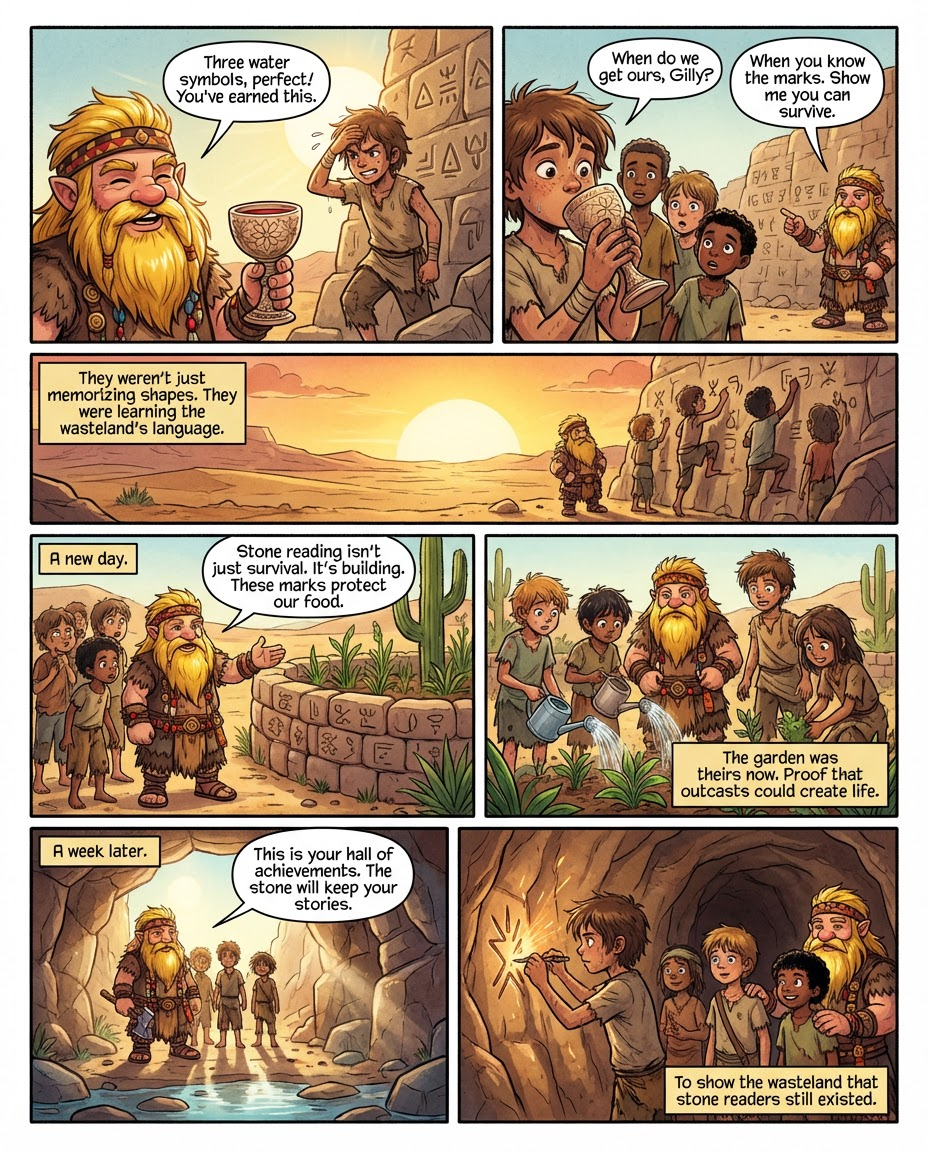
Gilly stepped back from the climbing wall and grinned. The smallest kid in the group had just traced three water symbols without stopping. Her fingers moved quick across the carved stone, reading each mark like she'd known them her whole life. He reached into his pack and pulled out something he'd been saving for this moment. The desert stone goblet caught the afternoon light, its carved patterns showing the same symbols the girl had just read. He'd spent three nights working on it, cutting grooves that matched the flowering cacti near camp. Gilly filled it with wild berry juice he'd traded for last week and handed it to her. The other kids crowded close, staring at the goblet like it was made of gold. He told them this was what stone readers earned—proof they could survive the wasteland with knowledge instead of luck. The girl held the cup with both hands and drank slowly. Her face turned red but she stood taller. Two other kids asked when they'd get theirs. Gilly pointed at the climbing wall and said they knew the answer. Learn the symbols, read them without thinking, show him they understood what the marks meant for staying alive out here. The sun dropped lower as the kids lined up at the wall again. Their hands moved faster now, tracing symbols with new energy. Gilly watched each one climb and read, checking their work against the patterns he'd carved months ago. They were getting it. Not just memorizing shapes, but understanding how water marks connected to shelter signs, how danger symbols warned them away from dead zones. This was what he'd wanted—outcasts learning to read the wasteland's language. By the time darkness came, three more kids had earned their turn with the goblet. Gilly refilled it each time, letting them taste success the way the old masters had done for him years ago. The wasteland didn't give many victories, but today his students had claimed one. Tomorrow they'd keep climbing, keep learning, keep proving that stone reading still mattered in these harsh lands. The next morning, Gilly woke the kids early and led them past the canyon to a flat stretch of ground he'd cleared last month. A stone fence circled the space, waist-high and sturdy. Inside, green shoots pushed up from the sand—desert vegetables he'd planted after the last rain. The kids stared at the garden like they'd never seen food growing before. Most of them hadn't. Gilly walked them through the rows and showed them how he'd carved water symbols into the fence stones, the same marks they'd been learning on the climbing wall. He explained that stone reading wasn't just about survival in the wasteland—it was about building something that lasted. These vegetables would feed them through the hot season. The fence would protect the plants from animals and wind. And the symbols would remind them every day that knowledge made all of it possible. One kid asked if they could help tend the garden. Gilly said they'd earned it. Every student who could read the basic symbols would take turns watering and weeding. The garden was theirs now, proof that outcasts could create life in dead ground. They stood together inside the stone fence, surrounded by growing things, and Gilly knew his teaching was working. Stone reading had given these kids more than survival skills—it had given them hope. A week later, Gilly took his best students to the cave he'd discovered during the spring rains. Water dripped from the ceiling, catching sunlight that slanted through cracks in the rock above. The drops hit smooth stones below, making them shine like mirrors. Desert flowers grew near the entrance where moisture collected in small pools. He'd brought the kids here for a reason—this would be their hall of achievements. Gilly pointed to the cave walls and told them to look close. The stone was soft enough to carve but strong enough to last years. Each student who mastered a full set of symbols would carve their first reading into these walls. Future outcasts would come here and see proof that learning mattered, that others had walked this path before them. The kids spread out through the cave, touching the wet stones, watching light dance across the surfaces. One asked if she could start her carving today. Gilly pulled a carving tool from his belt and handed it to her. She'd earned it by reading twenty symbols without a single mistake. The sound of metal on stone filled the cave as she worked. The other kids watched, then asked for their turns. Gilly smiled and told them to keep practicing. This cave would hold their stories, preserve their progress, show the wasteland that stone readers still existed.
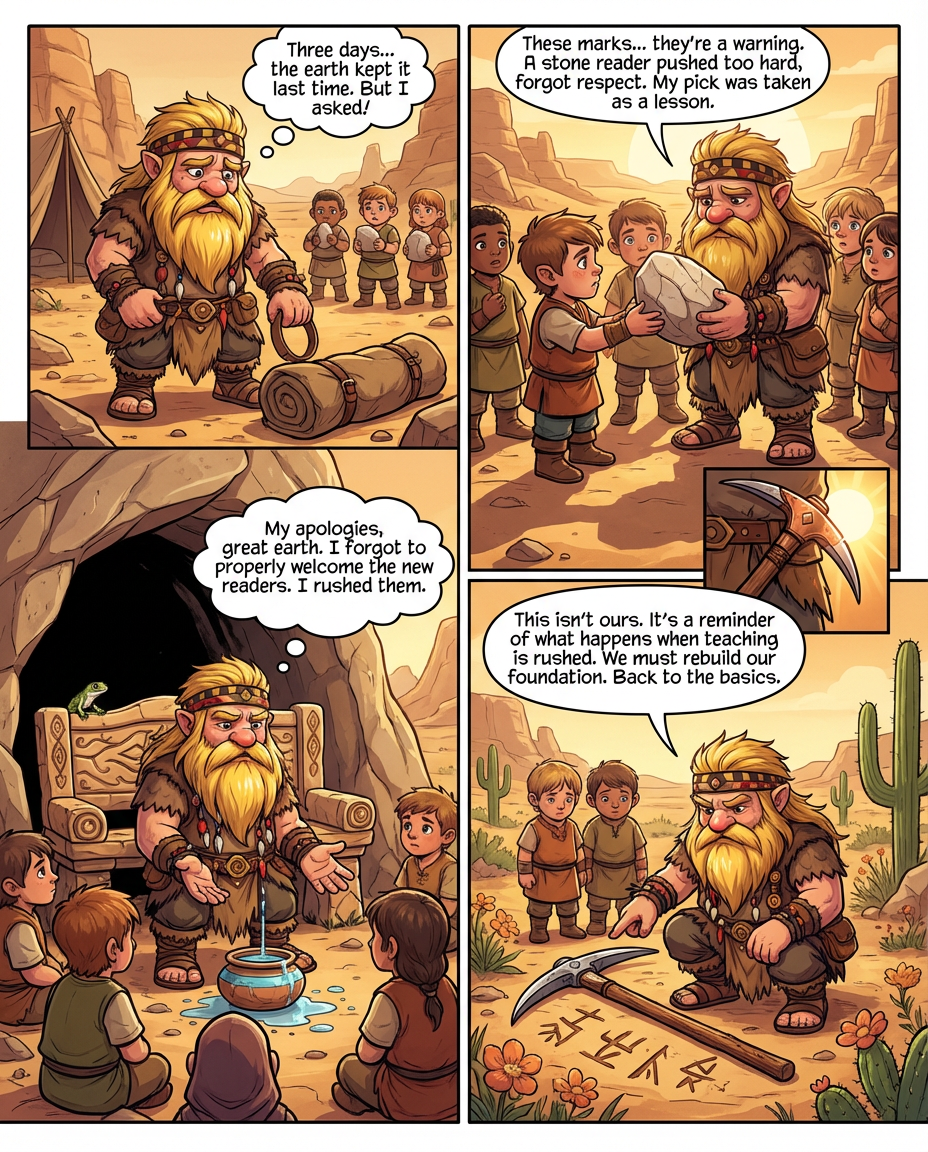
Gilly reached for his copper-covered pick that morning and found an empty loop on his belt. He checked the ground around his bedroll, then the gear pile, then every corner of camp. The kids watched him search, their practice stones forgotten in their hands. His stomach twisted as he retraced yesterday's path to the cave, scanning every rock and shadow. Three days, he thought. Last time the earth kept it for three days because he'd forgotten to ask permission. But he'd asked this time—he always asked now. One kid suggested they help look, but Gilly shook his head. This was between him and the stone. He walked back to camp alone, his belt feeling wrong without the pick's familiar weight. Tomorrow he'd start apologizing, same as before. The kids would have to practice without him watching. They'd learned enough symbols to work on their own anyway. He sat on a flat rock and pressed his palm against the ground, trying to understand what he'd done wrong this time. On the second day, one of the kids brought him a stone she'd found near the practice wall. Deep claw marks ran across its surface in parallel lines, like something had dragged sharp talons through soft clay before it hardened. Gilly turned it over in his hands and his chest went tight. He recognized the pattern—a stone reader's mistake from years back, maybe decades. Someone had pushed too hard, demanded instead of asked, and the earth had answered with anger. The scratches were a warning carved by the wasteland itself. He showed it to the kids gathered around him and explained what the marks meant. They'd been learning symbols all this time, but this was different knowledge—proof of what happened when you got it wrong. His missing pick suddenly made sense. He'd been teaching the kids to read stone, but he'd forgotten to introduce them properly to the ground they practiced on. The earth had noticed. It always noticed. Now his students stared at the claw-marked stone with wide eyes, understanding that their teacher had failed the very lesson he'd been teaching them. On the third morning, Gilly gathered the kids at the cave entrance where water dripped onto smooth stones below. He'd hauled a flat stone bench there the night before and placed a container beside it to catch the drops. The sound of water hitting stone rang clear and steady. He sat the kids down and made them listen while he pressed both palms against the ground. His voice carried through the quiet as he introduced each student by name, told the earth what they were learning and why they'd come. He apologized for his rushing, for forgetting that new readers needed proper welcome to new ground. The kids watched him speak to stone like it could hear. When he finished, he passed the claw-marked stone around the circle one more time. Each student held it, felt the deep scratches, understood what happened when respect got forgotten. Then Gilly stood and walked twenty paces from camp. His pick lay there in the open, copper gleaming in the morning light, waiting right where the earth wanted him to find it. He picked it up, checked the balance, and slid it back onto his belt. The kids had learned more in three days without him teaching than in weeks of practice. Sometimes the best lessons came from watching your teacher fail. That afternoon, Gilly walked past the practice wall and stopped. A mining pickaxe lay flat on the ground where none had been before. The metal head caught the sun, clean and bright like it had just been forged. He crouched beside it and studied the tool without touching. This wasn't his—his copper-covered pick hung safe on his belt now. This one felt wrong, placed here like a test or a reminder. He called the kids over and pointed at it. One asked if they should add it to their gear. Gilly shook his head and told them to look closer at where it lay—right across the symbols they'd carved into the practice ground last week. The pickaxe covered their work like it was trying to erase it. He explained that this was what happened when teaching got rushed, when a reader pushed students too hard and broke their foundation. His own failure with the earth had shaken something loose in his confidence. Now even the tools felt heavy with doubt. He left the pickaxe where it lay and led the kids back to basics, making them trace the simplest symbols again. They needed to rebuild what his mistake had cracked, and so did he.
Play your story to life
Storycraft is a mobile game where you create AI characters, craft items and locations to build their world, then discover what direction your story takes. Download the iOS game for free today!
Download for free