

Dr. Marcus Finchley's Arc
6 Chapters
Dr. Marcus Finchley's dream is to save all the injured or sick wild birds that come into his care and release them back to wild, while learning new methods of care..

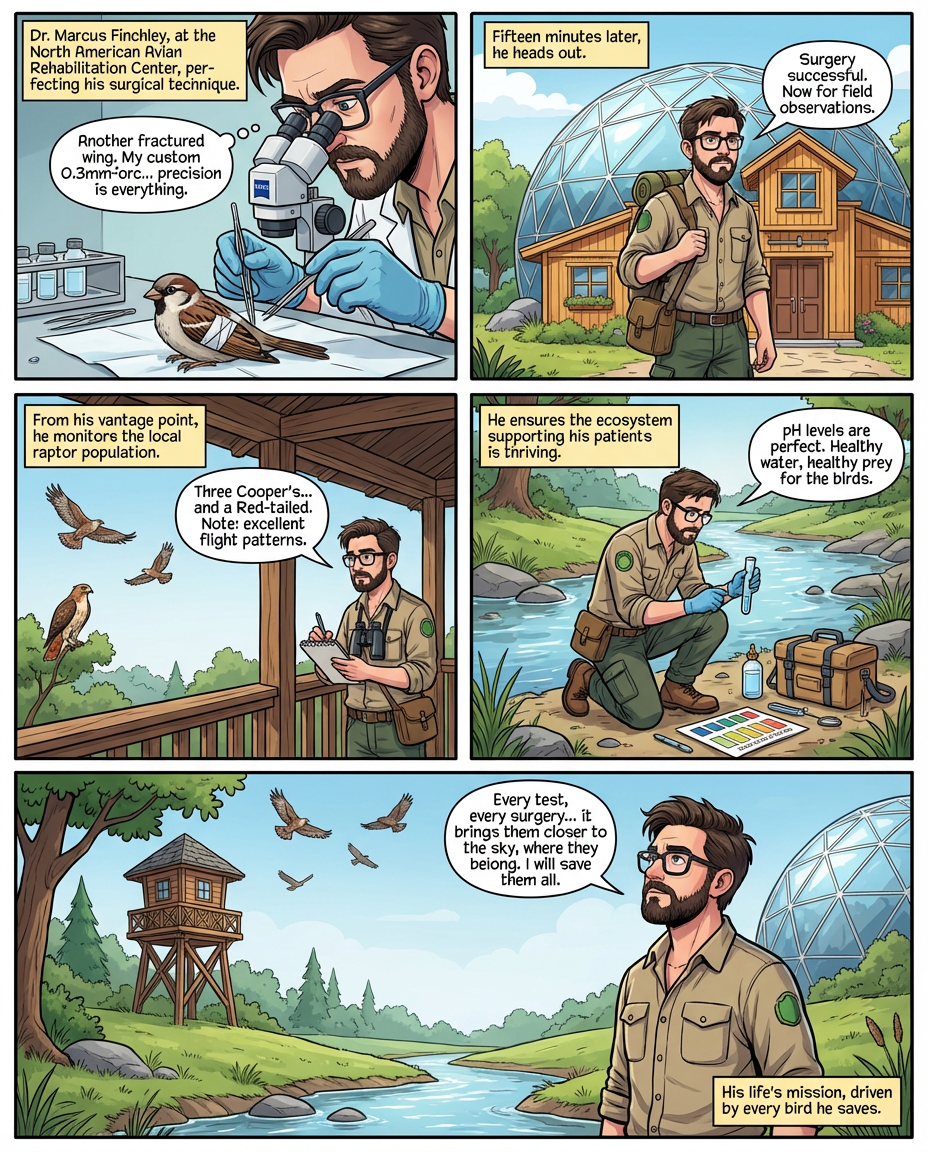
Marcus adjusted his glasses and peered through the Zeiss microscope at the sparrow's fractured wing bone. The sanctuary had seventeen birds waiting for him today, but this one needed surgery now. He'd spent years developing his own technique—pinning tiny bones with 25-gauge needles and custom forceps ground down to 0.3mm tips. His success rate had jumped from sixty percent to ninety-four percent. Every bird he saved and released back into the wild proved his method worked. The North American Avian Rehabilitation Center stretched out behind him, its large dome-shaped aviary visible through the window. Marcus had dreamed of this place for years—a real facility where he could treat injured birds properly. The operating room was small but had everything he needed. The recovery aviaries gave his patients space to heal and practice flying before release. He finished the sparrow's surgery and placed the bird in a warming box. Fifteen minutes later, Marcus grabbed his field pack and headed outside. A wooden observation tower stood near the tree line, its covered terrace perfect for watching birds without disturbing them. He climbed the stairs and pulled out his notebook. Three Cooper's Hawks circled overhead. A red-tailed hawk perched in a distant oak. He wrote down every detail—wing positioning, flight patterns, hunting behavior. Marcus hiked down to the stream with his water testing kit. The metal tools and clear tubes fit easily in one hand. He filled a sample tube and checked the pH levels. Clean water meant healthy fish, which meant the raptors had good food sources. Two of his released birds hunted near this stream. Every test he ran, every bird he tracked, every surgery he performed brought him closer to his goal. He would save them all and return them to the sky where they belonged.
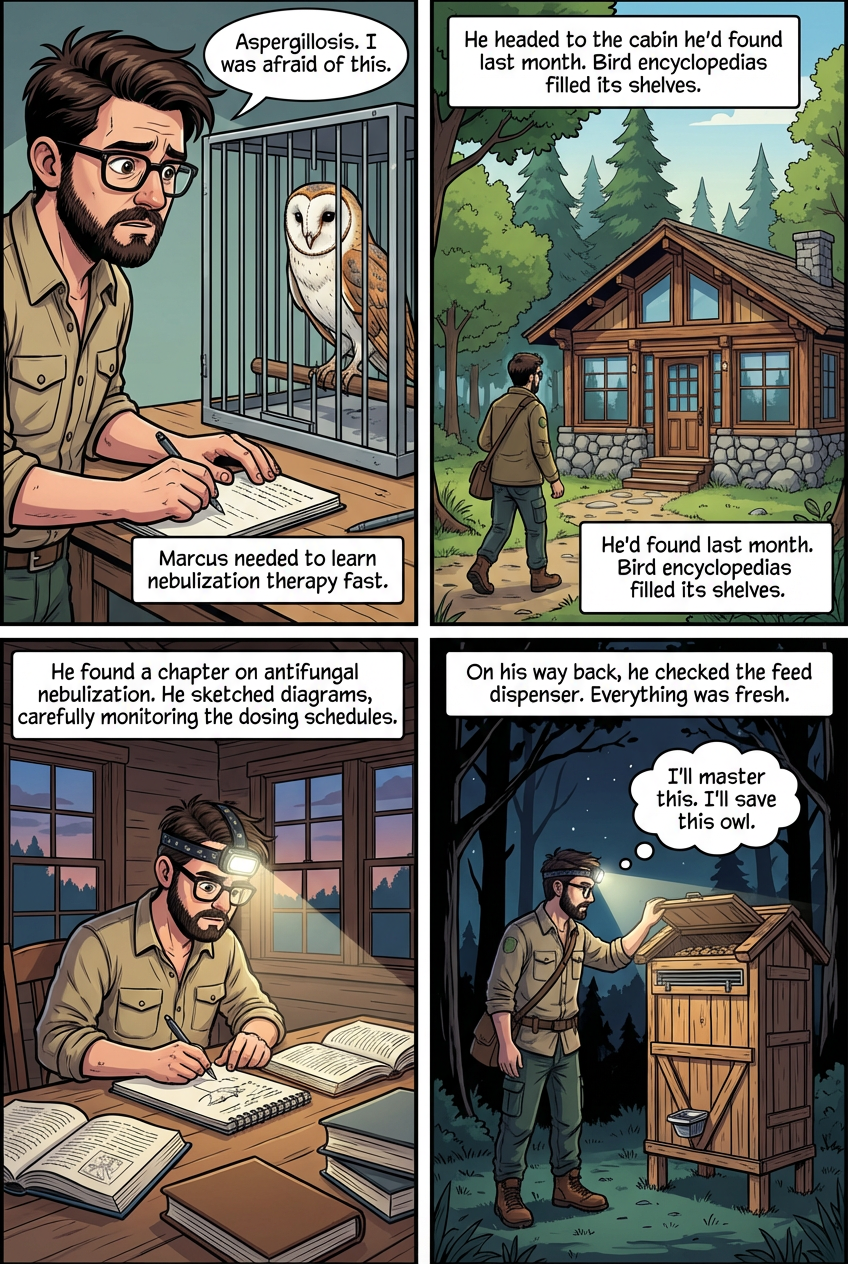
Marcus set his notebook on the workbench and studied the barn owl in the recovery cage. White fungal plaques dotted its air sacs—aspergillosis, just as he'd suspected. He needed to learn nebulization therapy fast if this bird was going to make it. He grabbed his field jacket and walked toward the cabin he'd discovered last month. The stone foundation kept it dry, and wide windows let in plenty of light. Inside, bird encyclopedias lined the shelves. Medical journals covered the desk. Marcus pulled down a thick volume on respiratory infections and flipped through the pages. He found a chapter on antifungal nebulization and started reading. The technique required specific dosing schedules and careful monitoring. He wrote everything down in his notebook, sketching diagrams of the equipment setup. The sun set while he read. Marcus strapped on his new headlamp and adjusted the brightness. The flexible metal band fit snug across his forehead. He kept reading by the bright LED light, filling page after page with treatment protocols. His barn owl needed nebulization treatments twice daily for three weeks. The metal tools he'd need sat in his kit back at the sanctuary. He could start first thing tomorrow morning. Marcus walked back through the dark forest, his headlamp cutting a clean path ahead. He stopped at the cedar feed dispenser near the recovery aviaries to check tomorrow's fish supply. The double-walled panels kept everything fresh. He had medical supplements ready too. The barn owl would get the best care he could provide. Every new technique he learned gave his patients a better chance. He would master nebulization therapy, save this owl, and add another success to his records.
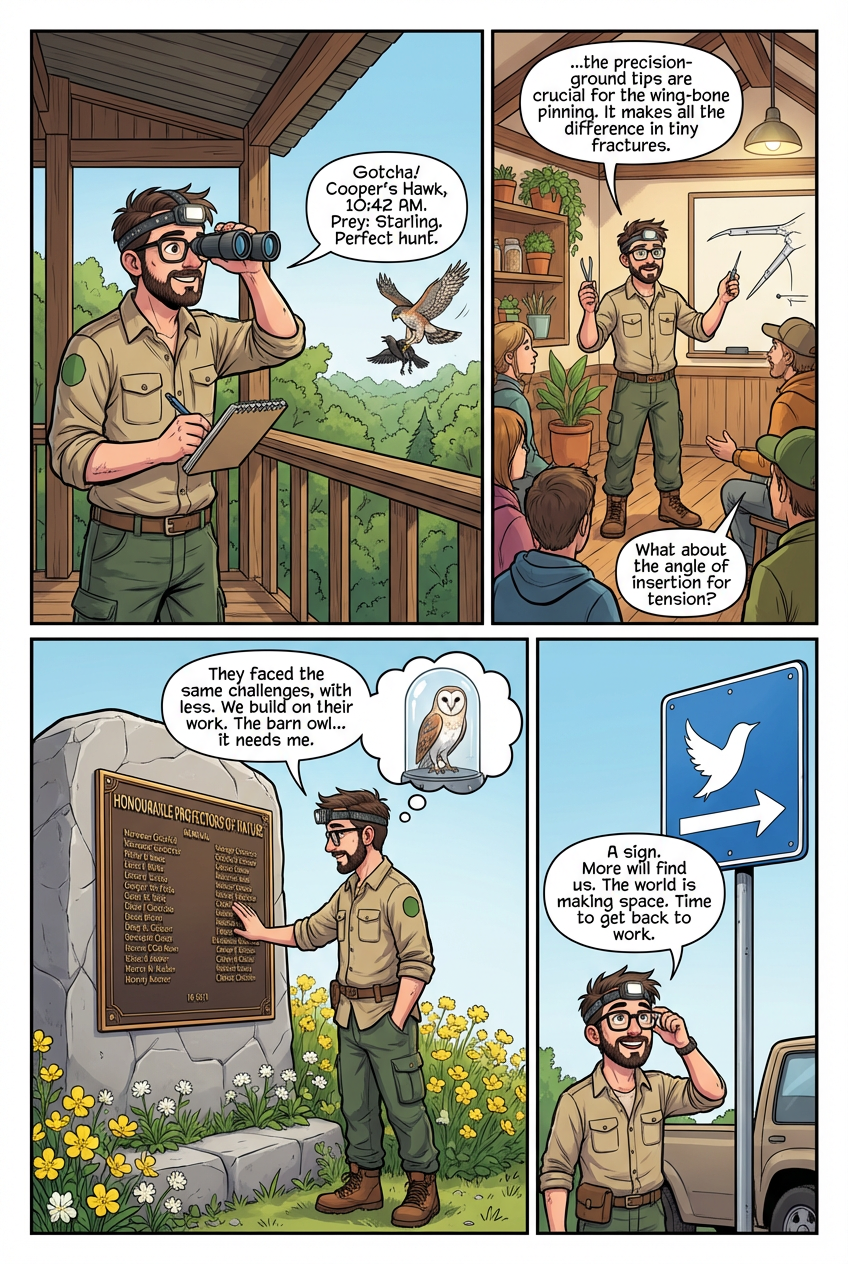
Marcus climbed the wooden observation tower near the tree line, his field notebook tucked under one arm. The covered terrace gave him a perfect view of the forest canopy where his released birds now lived. He needed to track their hunting patterns and territory ranges—data that would prove his surgical techniques worked. Through his binoculars, he spotted the Cooper's Hawk he'd operated on six months ago. She swooped down and caught a starling mid-flight. Marcus grinned and wrote down the time, location, and prey species. Every successful hunt meant another bird saved and thriving in the wild. He packed his binoculars and headed toward the Verdant Retreat Cafe. The glass-paneled building sat nestled among trees, with potted plants lining wooden shelves inside. Marcus had been invited to give a talk about his microsurgical wing-bone pinning technique. A small group of wildlife experts and nature lovers filled the cozy seating area. He pulled out his custom forceps and a 25-gauge needle to demonstrate. His hands moved quickly as he explained how precision-ground tips made the difference between success and failure. The audience leaned forward, asking questions about angles and tension. Marcus loved this—sharing what he'd learned so other rehabilitators could save more birds. After the talk, he walked past the Honourable Protectors of Nature Monument on his way back to the sanctuary. Bronze plaques honored the rehabilitators who came before him. Yellow Norwegian cinquefoil and white clover grew thick around the stone base. Marcus stopped and read the names of wildlife healers who had pioneered new treatments decades ago. They had faced the same challenges he did—tiny bones, limited tools, and birds that might not survive. But they kept trying, kept learning, kept saving lives. He touched one of the plaques and thought about the barn owl waiting for nebulization treatment. Back at his truck, Marcus noticed a new highway sign had been installed near the sanctuary entrance. The metal sign showed a white bird silhouette on a light blue background with an arrow pointing toward the facility. People who found injured birds could follow it straight to his door. More birds would reach him faster now, which meant better survival rates. Marcus adjusted his glasses and smiled. The world was making space for his work—places to learn, monuments to inspire, and signs to guide those who needed help. Every bird that arrived gave him another chance to prove his techniques worked and send another life back into the sky.
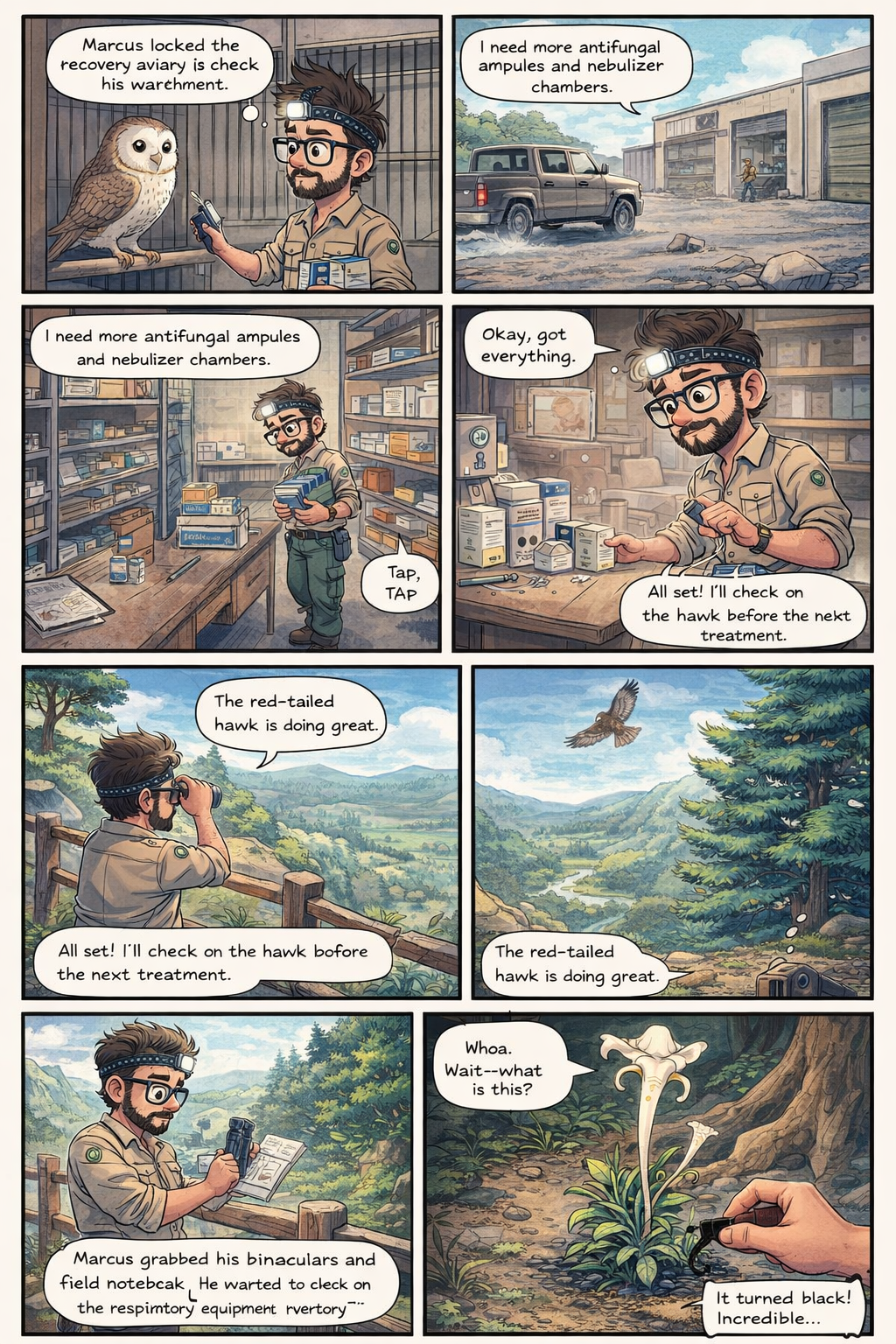
Marcus locked the recovery aviary and checked his watch—three hours until the barn owl's next nebulization treatment. He needed supplies he didn't have. His truck kicked up gravel as he drove toward the veterinary supplier's warehouse on the edge of town. Inside the concrete building, metal shelves stretched to the ceiling. A worker pointed him toward the respiratory equipment aisle. Marcus found antifungal ampules, sterile saline solution, and replacement nebulizer chambers. He grabbed three of everything and carried them to the counter. The cashier rang up his order while Marcus tapped his fingers on the laminate surface. Back at the sanctuary, he unpacked each item and arranged them on his workbench by size. He opened his notebook and drew a diagram showing exactly where each supply would sit during treatment. The barn owl stirred in its cage. Marcus smiled and updated his equipment inventory list. He had what he needed now. Marcus grabbed his binoculars and field notebook. He wanted to check on the red-tailed hawk he'd released two weeks ago. The cliffside lookout gave him the best view of the hunting grounds below. He drove his truck to the base of the trail and started climbing. The wooden fence at the top kept visitors from getting too close to the edge. Marcus leaned against it and scanned the valley. Movement caught his eye—the hawk circled above a meadow, wings steady and strong. He wrote down the time and location in his notebook. On his way back down, Marcus spotted a massive blue spruce tree fifty feet from the trail. Chickadees and nuthatches flitted through its thick branches. He stopped and counted fourteen birds using it as a rest stop. The tree's dense foliage created perfect shelter. Marcus pulled out his camera and took photos for his records. These were the places his released birds returned to—proof they could survive in the wild again. He walked deeper into the forest, watching for more bird activity. Strange white plants grew in a shaded patch near the tree roots. Marcus knelt down and touched one with his finger. The pale surface turned black instantly. He'd never seen anything like it before. The forest held more than just birds—it held mysteries he barely understood. But his focus stayed clear. The barn owl needed its second treatment in two hours. Marcus checked his watch and headed back to the sanctuary. Every minute he spent learning about this world helped him save the birds that depended on him.
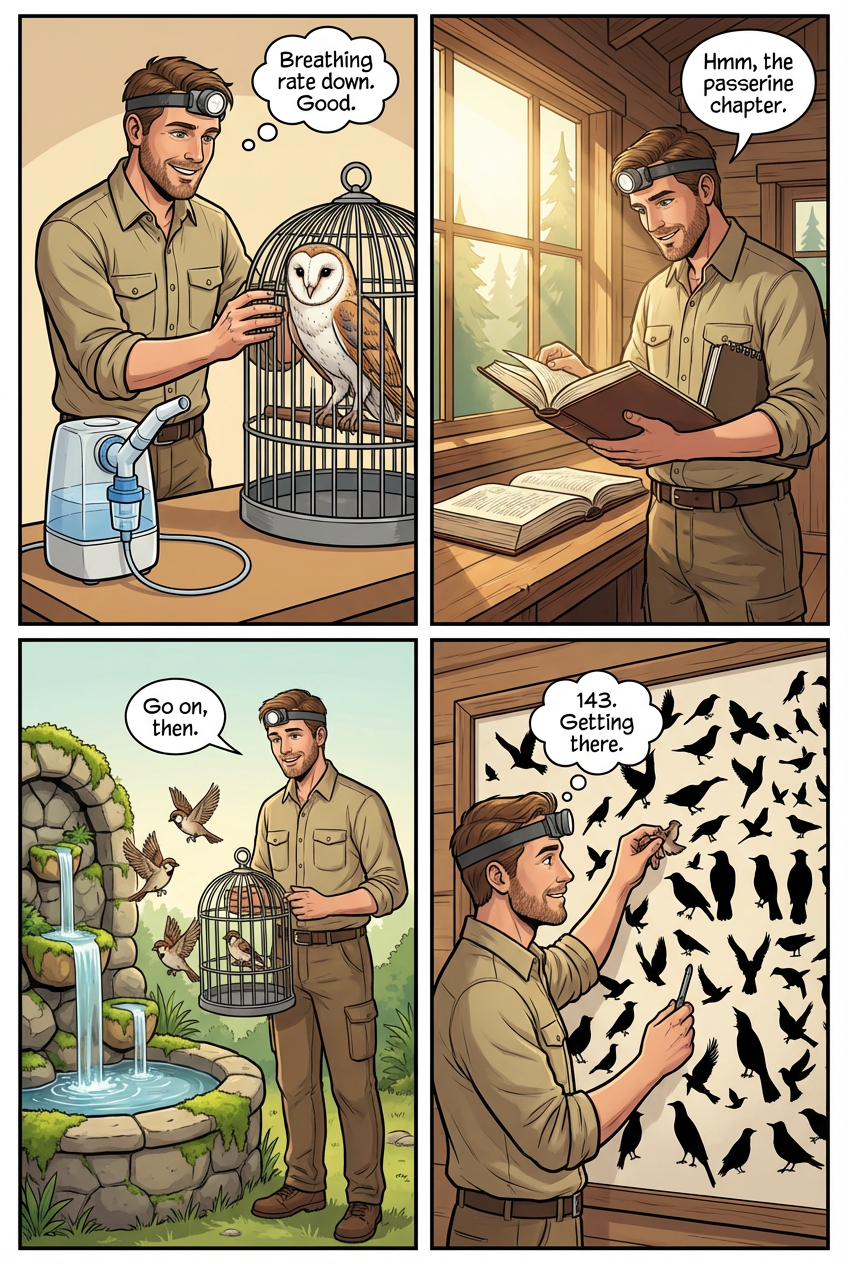
Marcus placed the barn owl back in its recovery cage and wiped down the nebulizer. The bird's lungs sounded clearer after five days of treatment. He checked his notebook—breathing rate had improved from forty-two breaths per minute to thirty-one. His antifungal protocol was working. Three sparrows with healed wing fractures waited in the release aviary, and the kestrel from last week could hover and strike again. Marcus walked to the window and watched two of his released robins fight over territory in the nearby trees. They were strong enough to defend their own space now. He smiled and added another tally mark to his success chart. Every recovered bird proved his techniques worked. The three sparrows needed one final check before release. Marcus opened his field notebook and found the cabin he'd heard about—a research library filled with surgical reference books and treatment manuals. He drove there and found it tucked among the trees, its wide windows letting in soft morning light. Inside, bird encyclopedias lined the shelves alongside journals on veterinary techniques. Marcus pulled down a volume on passerine post-operative care and flipped to the wing mobility assessment chapter. He read through the release criteria checklist, comparing it against his own observations. The sparrows exceeded every benchmark. They were ready. Back at the sanctuary, Marcus carried the sparrows to the release aviary one by one. He opened each cage door and stepped back. The birds launched into the air, circled twice, then disappeared into the trees. Marcus listened to the fountain outside—water trickling over moss-covered stones. The gentle sound always calmed him after a release. He walked to the metal wall where he tracked his successes. Bird silhouettes cut into the surface created a growing pattern. Each shape represented a life returned to the wild. Marcus ran his fingers across the latest additions and pulled out his tools to add three more sparrows. The wall was filling up faster this year. His improved techniques meant more birds survived surgery and fewer needed euthanasia. Marcus stepped back and counted the silhouettes—one hundred and forty-three releases since he started using precision-ground forceps. The barn owl would join them soon if the antifungal treatments continued working. He tucked his notebook under his arm and headed back to check on the next round of patients. Every bird that flew free proved he was getting closer to his goal.
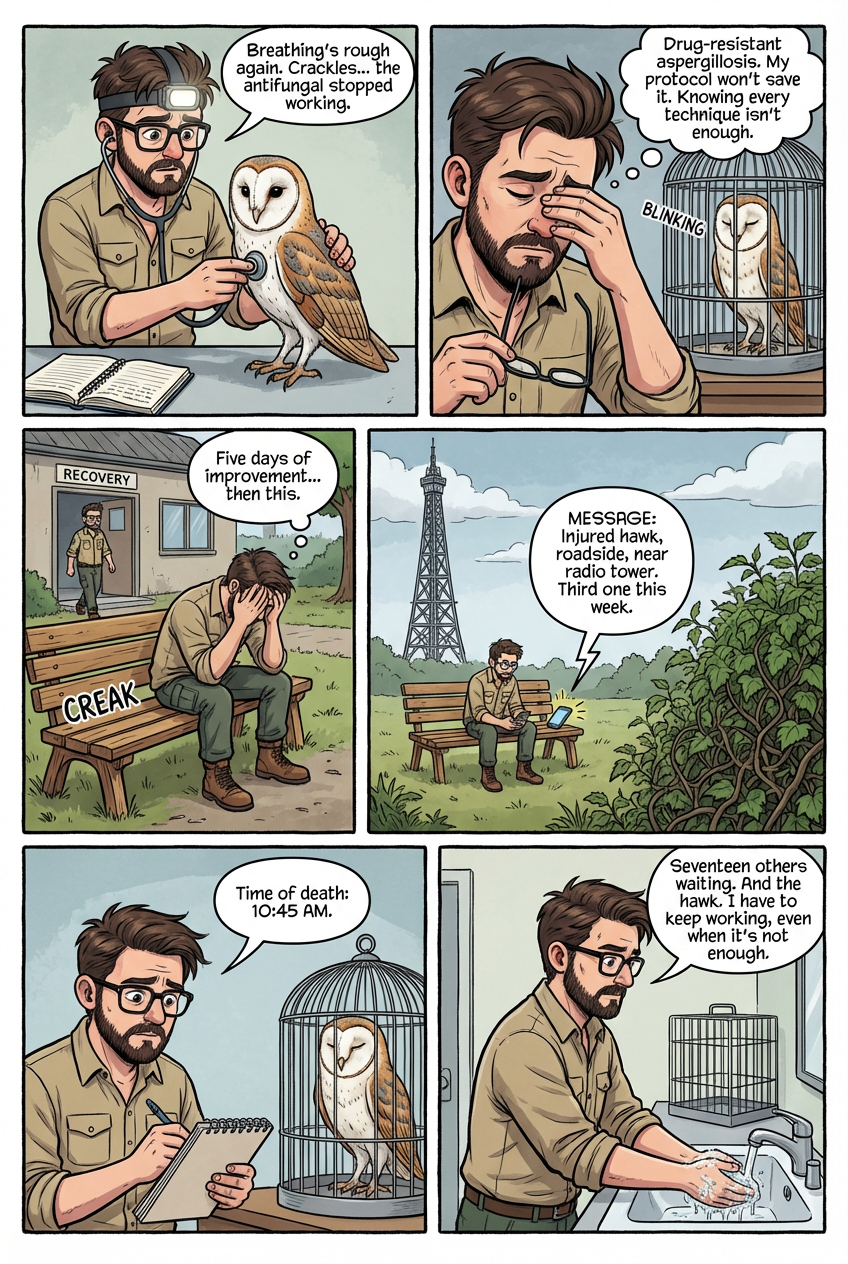
Marcus pulled the barn owl from its recovery cage for the morning exam. The bird's breathing sounded rough again—shallow and strained. He placed his stethoscope against its chest and listened. Crackles filled both lungs. The antifungal treatment had stopped working. Marcus checked his notebook and ran the numbers twice. Five days of improvement, then sudden decline. He'd seen this pattern before in textbooks—drug-resistant aspergillosis. His current protocol wouldn't save this bird. The owl blinked at him slowly, trusting him to fix what was broken. Marcus set down his stethoscope and stared at his hands. Sometimes knowing every technique in the world wasn't enough. Marcus placed the owl back in its cage and walked outside. The weathered wooden bench near the recovery building showed deep dents and split planks. He sat down hard, feeling every crack through his pants. His success chart didn't matter now. This bird was dying despite everything he knew. He pulled off his glasses and rubbed his eyes. The bench creaked under him—years of weight and weather had worn it down to almost nothing. His phone buzzed with a message from the highway patrol. A steel frame radio tower broadcast system had picked up another emergency report. Injured hawk found near the roadside, third one this week. Marcus should have felt ready to help, but his hands stayed still in his lap. He looked at the thick nettle thicket growing wild along the tree line. Dense and tangled, the stinging plants formed a barrier he couldn't push through. Beautiful and brutal at the same time—just like this work. Marcus stood and walked back inside to check on the owl one more time. The bird's eyes had closed. Its chest barely moved. He updated his notebook with careful measurements, documenting the failure he couldn't prevent. Seventeen other birds waited for treatment, and the hawk from the highway needed him. Marcus washed his hands and prepped a new intake cage. He would keep working, even when his best wasn't good enough.
Play your story to life
Storycraft is a mobile game where you create AI characters, craft items and locations to build their world, then discover what direction your story takes. Download the iOS game for free today!
Download for free