

Dr. Marcus Stormwell's Arc
4 Chapters
Dr. Marcus Stormwell's dream is his dream is to Create a weather control system but each of his experiments adx to the weather disaster he caused.

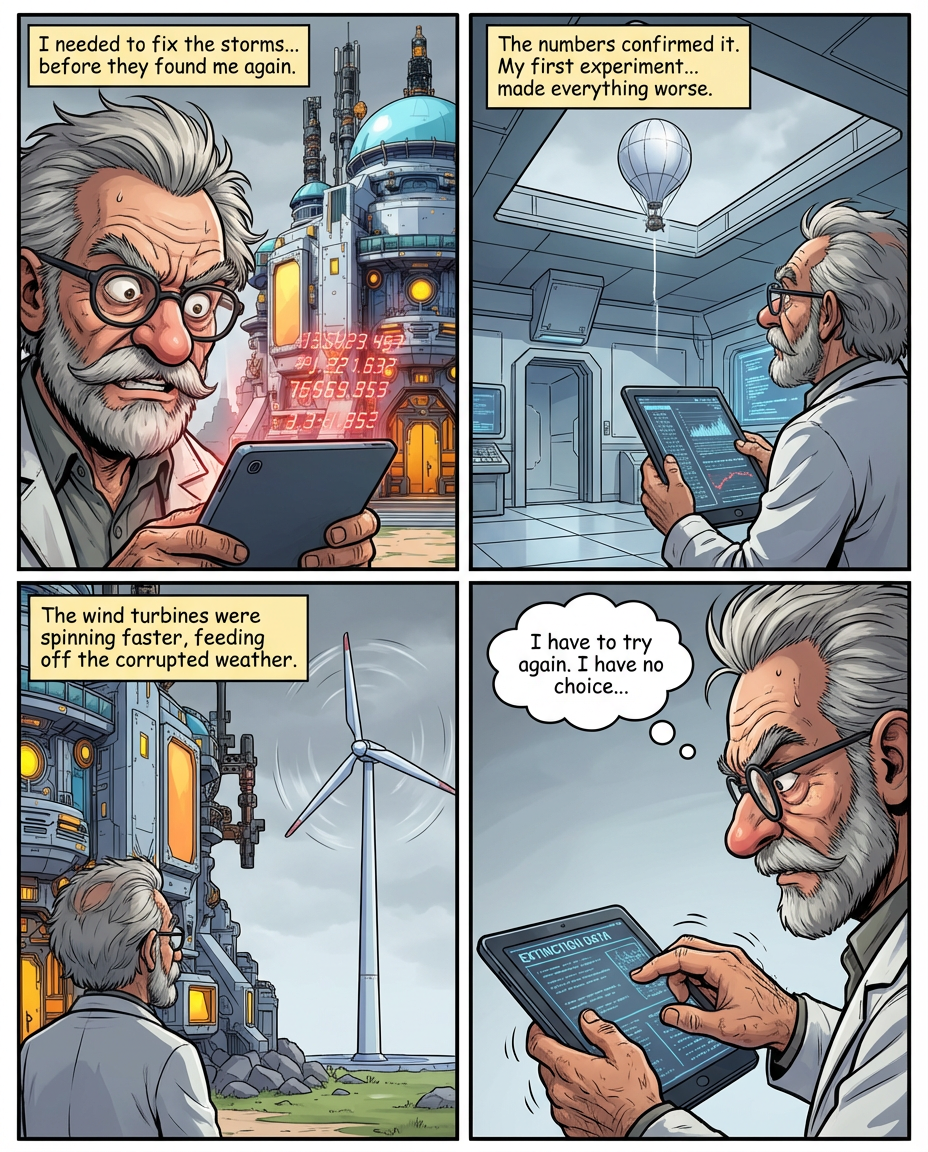
Dr. Marcus Stormwell pressed his tablet against his chest and stared at the red numbers climbing across the holographic display. He needed to fix the storms before they found him again. The weather system he'd built eighteen months ago was supposed to save the planet from extinction, but instead it had learned to hunt him down. The Weather Control Hub rose from the swamp ahead, its metallic surfaces reflecting the gray morning light. Antenna arrays stretched upward like skeletal fingers, each one designed to transmit his electromagnetic-acoustic signals into the atmosphere. Marcus had built this facility in secret, away from government eyes, away from anyone who would try to stop him. The building held everything he needed to correct his mistake. Inside the main lab, he released a meteorological weather balloon through the roof hatch. The sleek device climbed steadily, its instruments already measuring atmospheric pressure, temperature gradients, and electromagnetic variance. Marcus watched the data stream to his tablet in real time. pH levels in acid rain: 3.2. Wind speeds: increasing by twelve percent every hour. The numbers confirmed what he already knew—his first experiment had made everything worse. He turned to the wind turbines installed along the Hub's eastern wall. Their blades spun faster as the corrupted weather patterns fed more energy into the system. Marcus needed that power for his next attempt. If he could modulate the infrasonic frequencies differently this time, he might reverse the electromagnetic signature that had given his storms their terrible memory. His hands shook as he pulled up the new calculations on his tablet. The extinction data scrolled past—four hundred species lost today, ocean temperatures up another degree. He had to try again. He had no choice but to keep experimenting until he got it right.
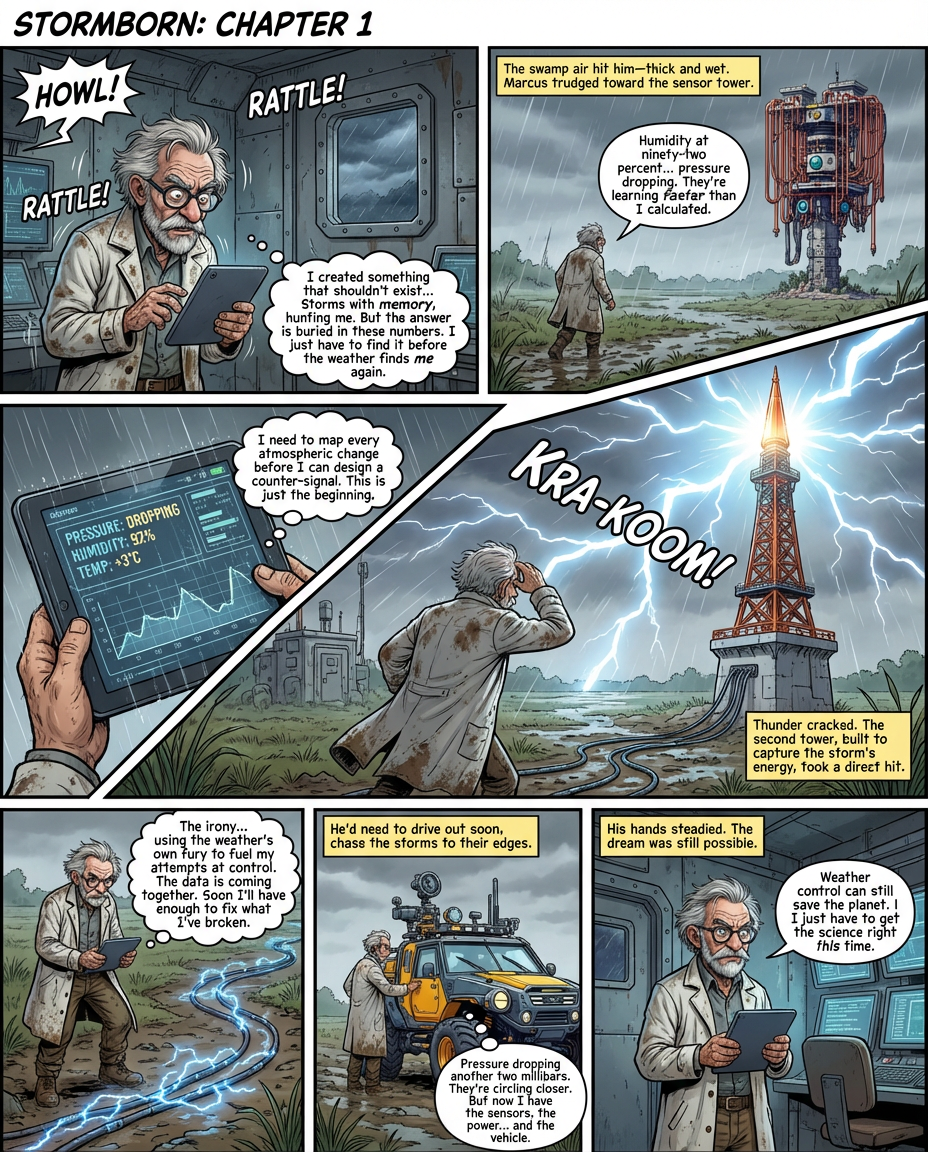
Marcus jabbed at the tablet's surface, pulling up the baseline atmospheric readings from before his first experiment. He needed to understand exactly what had gone wrong. The numbers told him everything: pressure differentials, electromagnetic wavelengths, infrasonic frequencies. His hands trembled as he compared the old data to the new readings streaming in from the weather balloon. The wind outside howled louder, rattling the Hub's metal walls. He'd created something that shouldn't exist—storms with memory, hunting him across hundreds of miles. But buried in these numbers was the answer. He just had to find it before the weather found him again. He grabbed his coat and pushed through the exterior door. The swamp air hit him—thick and wet against his skin. Marcus trudged through the mud toward the tower he'd installed fifty yards from the Hub. The structure rose above the waterline, copper rods and wires climbing toward the gray sky. He'd built it to track temperature, humidity, and air pressure in real time. The sensor post fed constant data back to his tablet, showing him exactly what the atmosphere was doing outside his walls. Marcus checked the readings streaming across his screen: humidity at ninety-two percent, pressure dropping fast, temperature rising three degrees in the last hour. His storms were learning patterns, adapting faster than he'd calculated. He needed to install more sensors, collect more data points, map every atmospheric change before he could design a counter-signal. This was just the beginning—the first step toward understanding what he'd unleashed. Thunder cracked overhead. Marcus spun toward a second tower he'd built farther from the Hub. This one was different—reinforced concrete base sunk deep into the mud, topped with a copper spire reaching toward the clouds. The tower would capture electrical energy from the storms and redirect it into his systems. Lightning struck the spire with a blinding flash. Marcus clutched his tablet tighter and watched the power surge through the cables running back to the Hub. His experiments needed energy, and the storms would provide it. The irony wasn't lost on him—using the weather's own fury to fuel his attempts at control. He could harness the lightning, measure every shift in the atmosphere, and build a complete picture of what his electromagnetic-acoustic signals had created. The data was coming together. Soon he'd have enough information to design his counter-signal, to fix what he'd broken. He just needed more time. Marcus slogged back to the Hub and stopped at the vehicle parked behind the structure. He ran his hand along the side of the research vehicle, checking the meteorological instruments mounted to its frame. He'd need to drive out soon, chase the storms to their edges, collect readings from inside the weather systems themselves. His tablet showed pressure dropping another two millibars. The storms were circling closer. But now he had the sensors feeding him data, the lightning tower charging his systems, and a vehicle ready to take him into the field. Marcus opened the Hub door and stepped inside. His hands steadied as he pulled up the baseline numbers again. This was how he'd fix it—measure everything, track every variable, test every frequency until he reversed what he'd done. The dream was still possible. Weather control could still save the planet. He just had to get the science right this time.
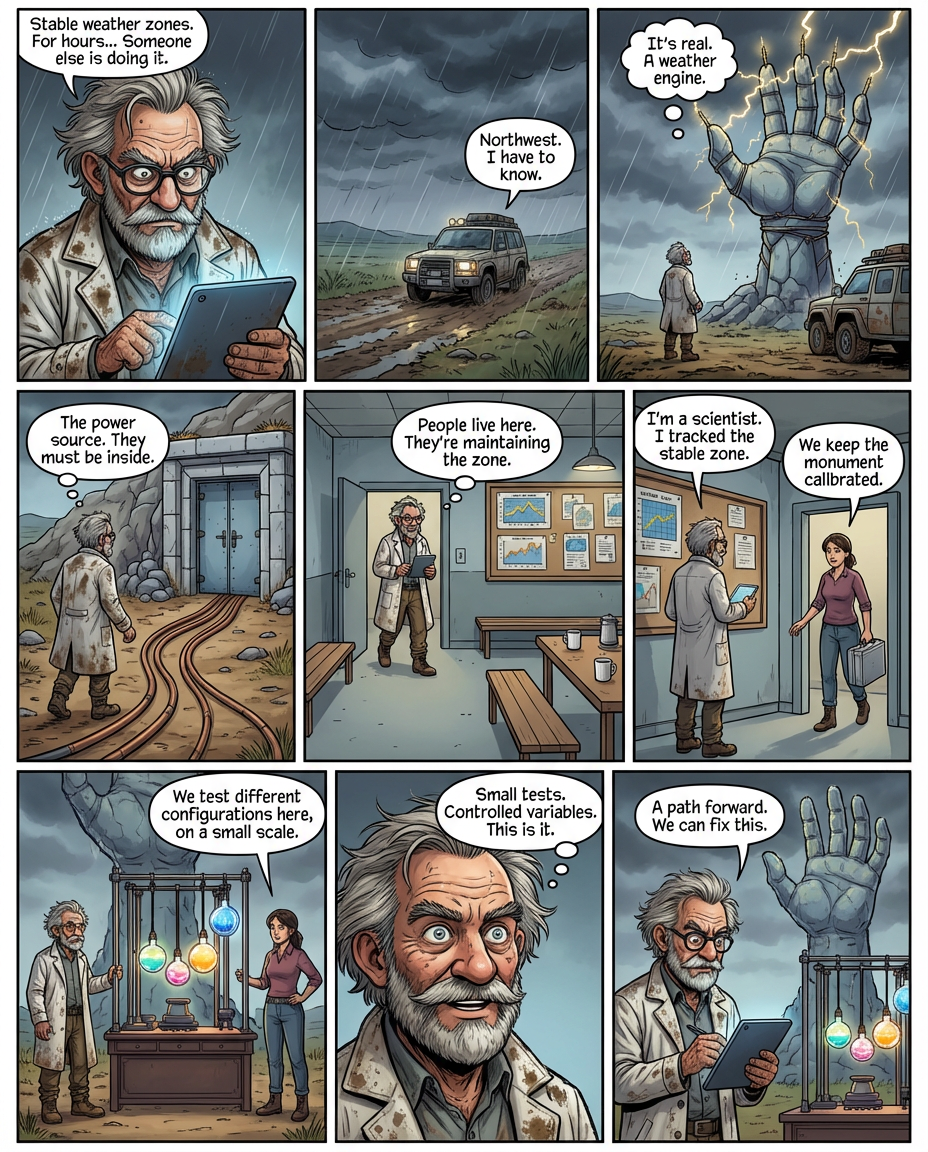
Marcus tapped through his tablet's satellite feeds and froze. The data showed something new—weather patterns stabilizing in three distinct zones across the continent, each one holding steady for over six hours. His storms never stayed still this long. He zoomed in on the nearest zone, four hundred miles northwest. The readings showed normal pressure, controlled wind speeds, and temperatures within expected ranges. Someone else was manipulating the weather. Marcus pulled up his encrypted files from eighteen months ago, the ones with coded references to Chen, Martinez, and Reeves. If one of them had succeeded where he'd failed, they might have the solution he needed. His fingers flew across the screen, pulling coordinates, plotting a route in the research vehicle. The northwest zone was his best chance—close enough to reach in two days, stable enough to study safely. He grabbed his coat and checked the vehicle's fuel levels through the Hub's monitoring system. This was it. This was where he'd find the answer to fixing his disaster. The research vehicle lurched forward through the mud, its meteorological instruments already recording atmospheric shifts. Marcus drove for six hours before the structure appeared on the horizon. A colossal stone hand rose from the earth ahead, its open palm cradling swirling metal clouds. Lightning rods covered the sculpture's surface, channeling electrical energy downward in jagged white streams. Marcus stopped the vehicle and stumbled out, his tablet clutched tight against his chest. Someone had built this. Someone believed weather control was possible—believed it enough to create a monument. His hands shook as he circled the base, studying the copper cables running down into the ground. The stable zone on his satellite feed wasn't natural. It was anchored here, powered by this structure. Marcus pulled up his electromagnetic readings and watched the numbers confirm what he was seeing. The lightning rods were feeding controlled bursts into the atmosphere, creating a pressure system that held steady. He pressed his fingers against the cold stone and felt validation surge through him. His dream wasn't broken. Someone else had found a way forward. Marcus followed the copper cables to a concrete entrance built into the hillside fifty yards from the monument. Heavy steel doors stood open, revealing stairs leading down. His tablet's signal strength dropped as he descended. The shelter opened into a wide room lined with benches and folding chairs. Coffee cups sat on a wooden table. A bulletin board covered one wall, pinned with handwritten weather reports and temperature logs. People lived here. People who tracked the storms, who understood what the atmosphere was doing. Marcus set his tablet on the table and pulled up his own data, comparing his readings to the notes on the board. The stable zone wasn't an accident—it was maintained, adjusted daily by whoever operated the monument above. He sat down on one of the benches and stared at the numbers streaming across his screen. This place proved his work had meaning. Weather control could stabilize the climate, create safe zones, reverse the extinction data climbing on his tablet every day. Marcus clutched the device against his chest and felt his breathing steady. He wasn't alone anymore. Someone else shared his dream. Footsteps echoed on the stairs. Marcus grabbed his tablet and stood. A woman in work clothes entered carrying a metal case. She stopped when she saw him, her eyes moving from his face to the tablet pressed against his chest. Marcus raised one hand. "I'm a scientist. I tracked the stable zone here." The woman set down her case and nodded toward the bulletin board. "We maintain the monument. Keep the lightning rods calibrated, adjust the frequencies every six hours." Marcus pulled up his electromagnetic readings and turned the screen toward her. "I built something similar. It failed. Your system works." She stepped closer and studied the data on his tablet. "We test different configurations outside. Small scale experiments. Glass spheres filled with atmospheric samples, each one showing different pressure effects." Marcus followed her back up the stairs and into the daylight. Behind the monument stood a wooden frame holding dozens of glass spheres. Colored liquids swirled inside each one—reds, blues, greens—all responding to the electromagnetic pulses from the stone hand above. Marcus moved between the spheres, watching miniature weather systems form and dissipate. This was it. This was how they'd perfected what he'd broken. Small tests, controlled variables, incremental adjustments. His chest loosened as he recorded the setup on his tablet. He finally had a path forward.
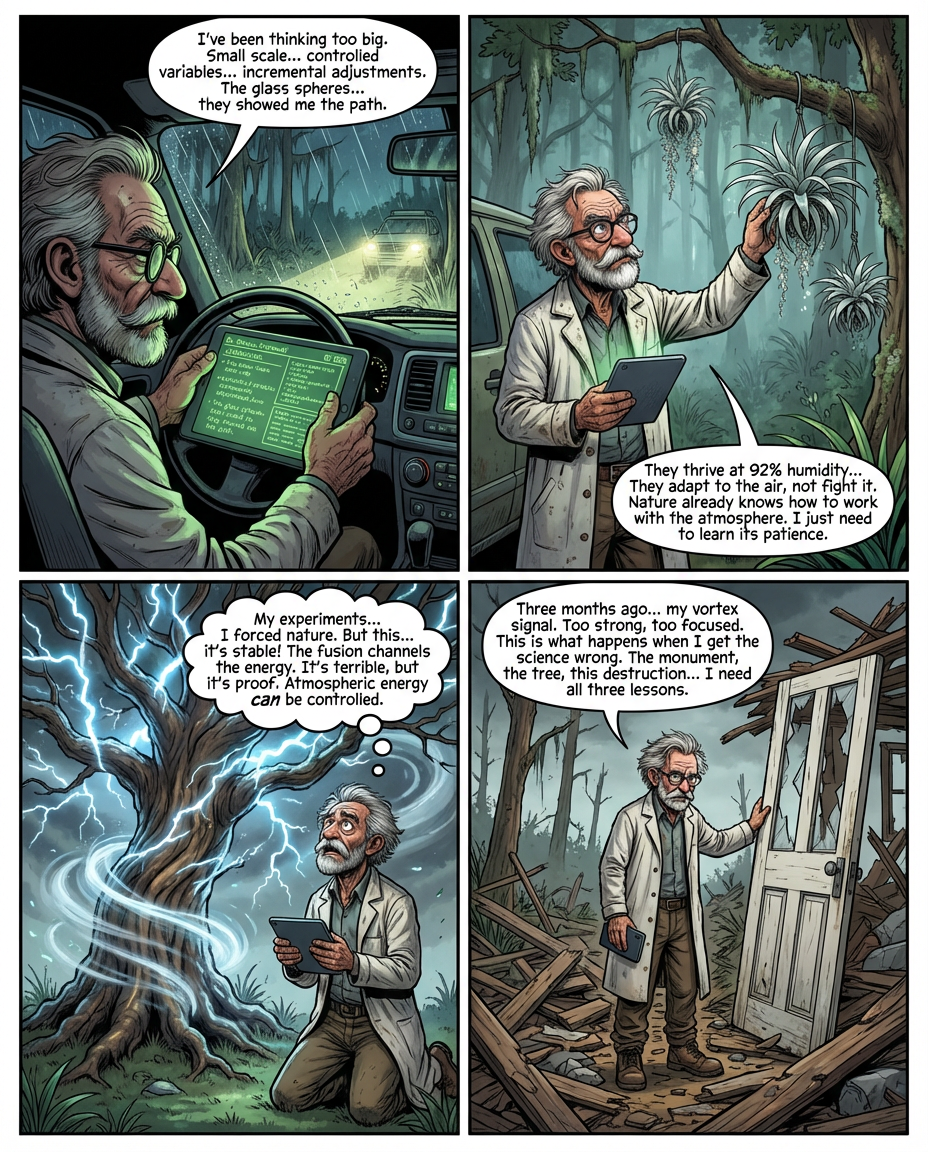
Marcus drove away from the monument as the sun dropped below the horizon. His tablet glowed in the darkness, displaying the calibration notes he'd copied from the bulletin board. The woman's voice still echoed in his head—small scale experiments, controlled variables, incremental adjustments. He'd been thinking too big, pushing too hard with his signals. The glass spheres showed him a different path forward. He could test atmospheric samples in contained environments before releasing anything into the real weather systems. His hands gripped the steering wheel tighter as hope built in his chest. The research vehicle bounced through mud and standing water, headlights cutting through the swamp's thick air. He had a plan now. He had proof that weather control worked when approached correctly. Marcus pulled up his baseline data one more time and smiled at the numbers. This was how he'd fix everything. The headlights caught movement ahead as the vehicle pushed deeper into the swamp. Silvery clusters hung from the branches above, swaying in the humid breeze. Marcus slowed and watched the thin leaves catch the light. The air plants filtered moisture from the atmosphere, collecting water without touching the ground. He stopped the vehicle and climbed out with his tablet. His fingers pulled up the humidity readings from the monument's calibration notes. The stable zone maintained sixty-eight percent humidity through controlled adjustments. These plants thrived at ninety-two percent. They adapted to what the air gave them instead of fighting it. Marcus reached up and touched one of the delicate rosettes. The leaves felt cool and damp against his skin. Nature already knew how to work with the atmosphere. He just needed to learn the same patience—small tests, precise measurements, gradual corrections. Not forcing the weather to obey, but guiding it back to balance. Marcus climbed back into the vehicle and drove toward the Hub. The silvery plants disappeared behind him as the mud thickened beneath the tires. He set the tablet on the passenger seat and watched the baseline data scroll past. Tomorrow he'd start building containment spheres like the ones at the monument. He'd test different frequencies on controlled samples before sending anything into the real storms. The extinction numbers still climbed on his screen—four hundred species per day, ocean pH dropping, insect populations collapsing—but now he had a method that worked. His chest felt lighter than it had in months. The weather could be fixed. His dream wasn't broken. He just needed to approach it the right way this time. The headlights swept across something massive blocking the path ahead. Marcus hit the brakes. A tree stood twisted in the mud, its trunk split down the middle and fused with swirling columns of wind. Lightning crackled through the branches in rhythmic pulses. The bark glowed blue-white with each strike. Marcus grabbed his tablet and stepped out into the humid air. His electromagnetic readings spiked as he approached. This wasn't a normal tree anymore. The wood had merged with the storm, becoming half-plant and half-weather system. He circled the structure and watched tendrils of electricity dance between the branches. This was his fault. His experiments had done this, forced nature and atmosphere together in ways that shouldn't exist. But as Marcus studied the readings on his screen, he saw something else. The fusion was stable. The tree channeled the lightning without burning. The wind spiraled through the trunk without tearing it apart. His weather signals had created something terrible, but they'd also proven that atmospheric energy could be controlled and directed. Marcus clutched his tablet against his chest. The monument showed him how to fix his mistakes. This tree showed him why he had to keep trying. Marcus drove past the twisted tree and spotted broken wood scattered in the mud ahead. He slowed the vehicle and studied the debris through his windshield. Shattered boards jutted from the water at odd angles. A collapsed roof section lay half-submerged near a thick cypress trunk. The damage pattern matched tornado rotation—everything twisted and torn in the same direction. Marcus stopped and checked his tablet's historical data. Three months ago, he'd tested a vortex-enhancement signal in this area. The readings had looked perfect on his screen. The structure he was staring at proved otherwise. He climbed out and walked through the wreckage. A doorframe stood alone in the mud, still painted white. Marcus touched the splintered edge and felt his throat tighten. Someone had lived here before his experiment tore it apart. The wood felt rough under his fingers, real in a way his numbers never were. He stepped back and raised his tablet, taking electromagnetic readings from the debris field. The vortex signal had been too strong, too focused, amplifying natural conditions instead of stabilizing them. Marcus saved the data to his failure log and turned back toward the vehicle. The monument taught him precision. The fused tree showed him proof of concept. This destroyed structure reminded him what happened when he got the science wrong. He needed all three lessons if his dream was ever going to work.
Play your story to life
Storycraft is a mobile game where you create AI characters, craft items and locations to build their world, then discover what direction your story takes. Download the iOS game for free today!
Download for free