

Dr. Shield's Arc
13 Chapters
Dr. Shield's dream is mastering experimental surgery to save lives without modern hospital equipment..

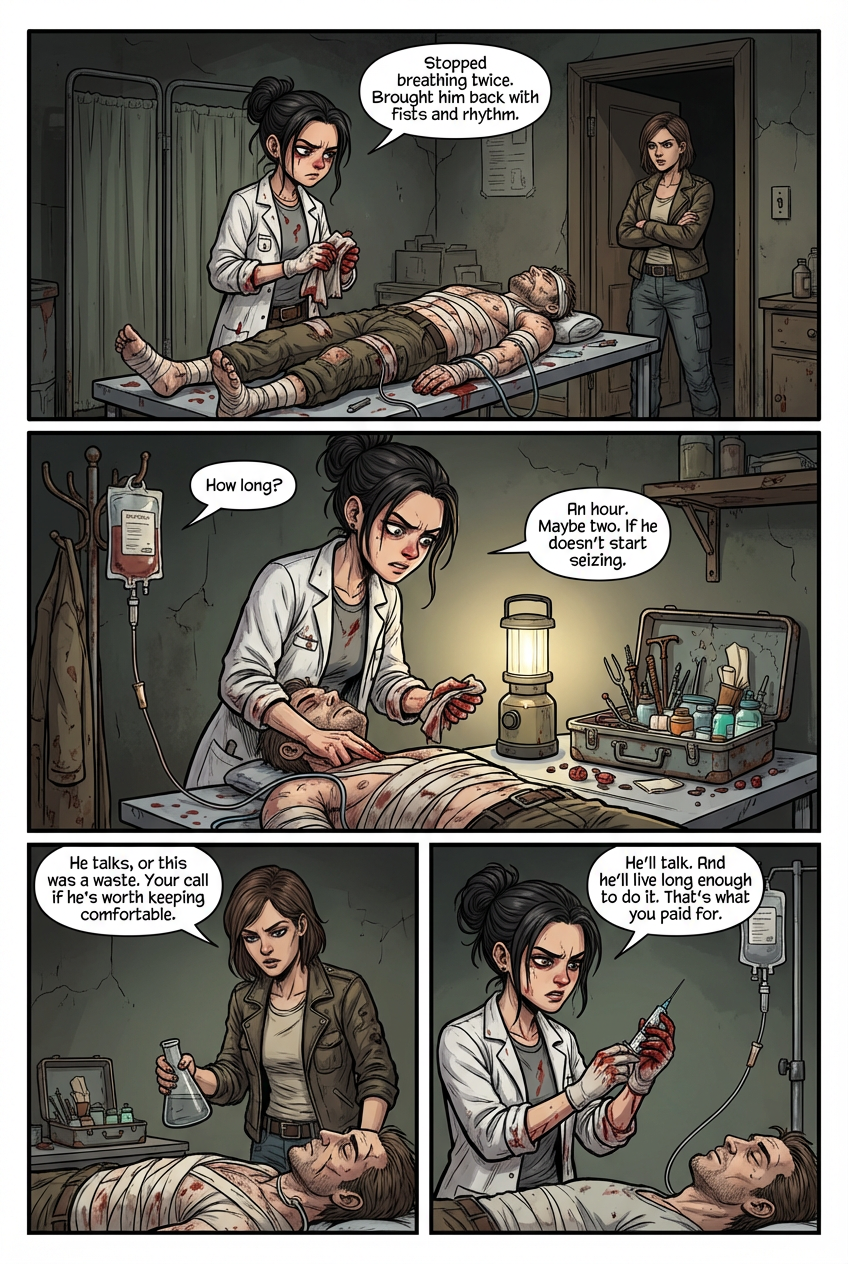
Dr. Shield wiped blood from her hands onto a rag that was already stiff with it. The man on her table had stopped breathing twice in the last hour, and she'd brought him back both times with nothing but her fists and the rhythm her mentor had drilled into her palms. Sherrie stood in the doorway, arms crossed, waiting for answers the man couldn't give yet. Shield pressed two fingers against his neck and counted. The pulse was there, thin as wire. She'd packed the gunshot wound with strips torn from a bedsheet she'd boiled that morning in a barrel behind the old hospital. Her surgical kit sat open on the metal workstation beside her—scalpels she'd sharpened on concrete, forceps she'd traded a week's worth of stitches for, a hand-crank drill with a bit thin enough to relieve pressure without turning a skull into splinters. The tools gleamed under the battery-powered lamp clamped to the table edge. "How long?" Sherrie asked. Shield didn't look up. She lifted the man's eyelid and watched his pupil contract in the light. Slow, but it moved. "He'll wake up in an hour. Maybe two." She adjusted the IV line running into his arm—a salvaged bag of saline she'd filtered three times and hung from a rusted coat rack. "If he doesn't start seizing first." Her hands moved across his chest, checking the drainage tube she'd fashioned from a length of aquarium hose. Clear fluid, no blood. That was something. Sherrie stepped closer, eyes fixed on the man's face. "He talks, or this was a waste." She pulled a flask from her jacket and took a sip. "Your call if he's worth keeping comfortable." Shield's jaw tightened. She reached for a vial of morphine—one of four she had left—and drew half into a syringe. Not enough to cloud his mind when he woke, but enough to keep him from thrashing and tearing what she'd just repaired. She pushed the needle into his IV port and watched his face soften. "He'll talk," she said. "And he'll live long enough to do it." She turned to face Sherrie, her hands still red despite the rag. "That's what you paid for."
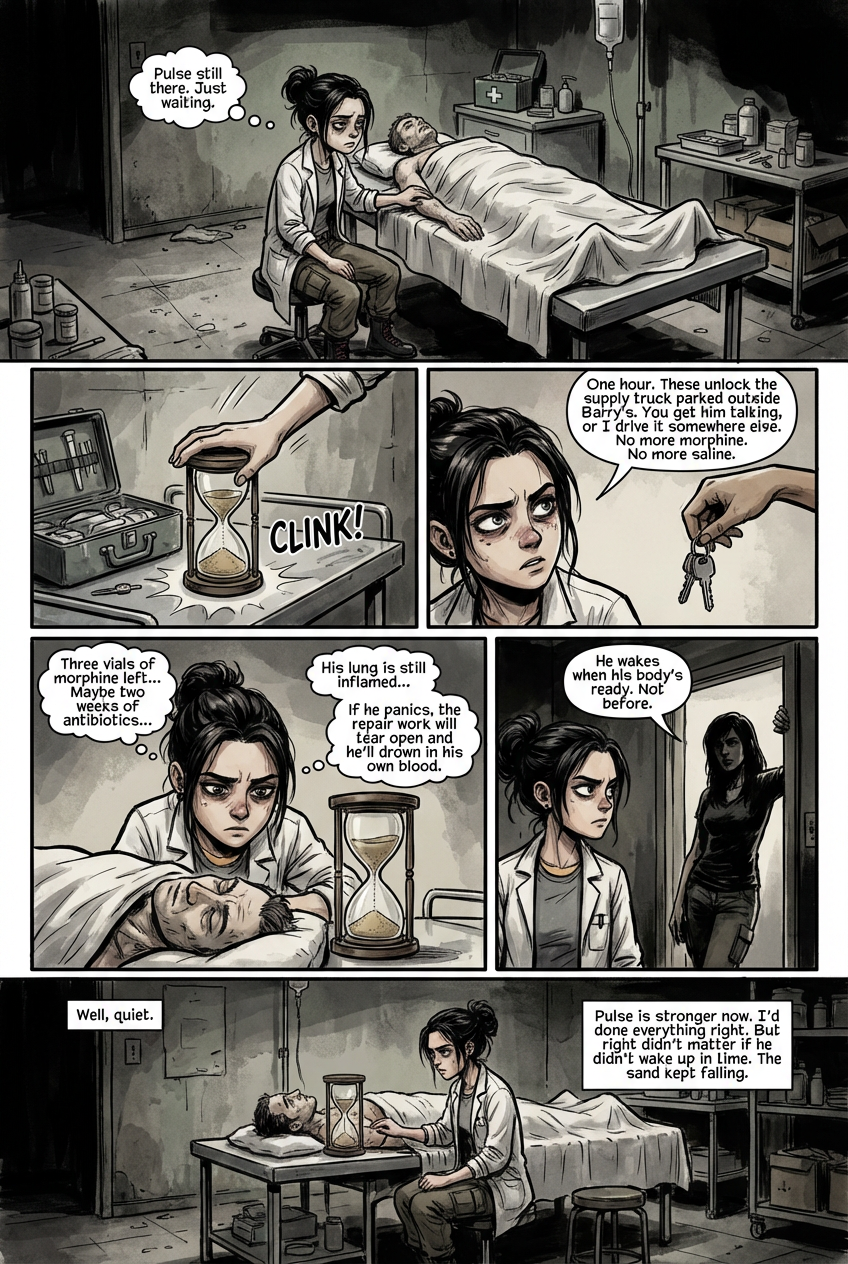
Sherrie left without another word, her boots loud on the concrete until the door swung shut. Shield checked the man's pulse again. Still there. She pulled a stool beside the table and sat down to wait. Twenty minutes later, Sherrie returned with an hourglass in one hand and a set of keys in the other. She flipped the glass and set it on the workstation beside Shield's surgical kit. The sand started falling. "One hour," Sherrie said, dangling the keys. "These unlock the supply truck parked outside Barry's. You get him talking before that sand runs out, or I drive it somewhere else. No more morphine. No more saline. No more anything." Shield stared at the hourglass, watching the grains cascade down. She had three vials of morphine left. Maybe two weeks of salvaged antibiotics. A dozen suture kits she'd bartered for with surgeries she should have been paid double to perform. The patient's eyelids twitched. His breathing changed. She could wake him now—slap his face, shout questions, let Sherrie have her interrogation. But his lung was still inflamed, his body barely holding itself together. If he panicked, if his heart rate spiked, the repair work would tear open and he'd drown in his own blood before she could stop it. She looked at Sherrie, then back at the hourglass. Half the sand had already fallen. "He wakes when his body's ready," Shield said. "Not before." Sherrie's jaw tightened, but she didn't move the hourglass. She just walked to the door and leaned against the frame, waiting. Shield turned back to her patient and checked his vitals again. His pulse was stronger now. She'd done everything right. But right didn't matter if he didn't wake up in time, and she had no way to make that happen faster without killing him. The sand kept falling.
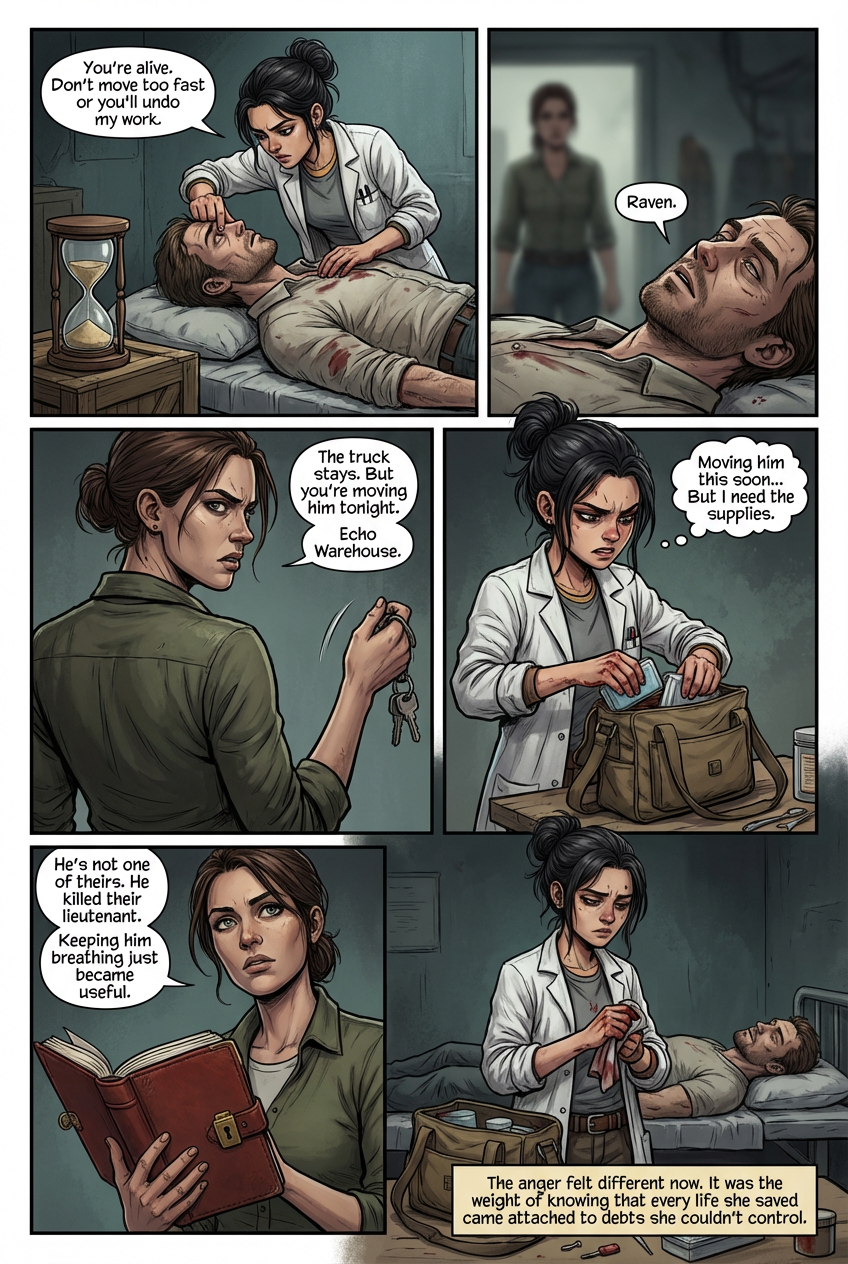
Shield counted the grains of sand left in the top half of the hourglass. Not many. The patient's breathing had evened out, but his eyes stayed closed. She leaned forward and lifted one eyelid with her thumb. The pupil contracted. Good sign. His body was fighting its way back. His eyes opened on their own ten minutes later. Shield watched him focus, watched awareness return in stages. She kept her hand on his wrist, monitoring his pulse. "You're alive," she said. "Don't move too fast or you'll undo my work." He nodded slowly, then his gaze shifted past her to Sherrie. His lips moved. Shield leaned closer. "Raven," he whispered. The word came out like a confession. Sherrie went rigid. Shield felt the temperature in the room drop. She looked back at Sherrie, whose face had gone blank in that particular way that meant violence was being calculated. The patient's pulse jumped under Shield's fingers. She pressed down gently, a reminder to stay calm, but her own chest had gone tight. If this man was connected to the Ravens, Sherrie's organization had just spent resources saving someone who worked for their enemy. Or worse—someone the Ravens would kill to silence. Sherrie stepped forward and snatched the keys off the workstation. She didn't look at Shield. "The truck stays," she said, her voice flat. "But you're moving him tonight. There's a building two blocks east, metal walls covered in spray paint. Echo Warehouse. Ravens tagged it last week, but we cleared the inside. You set up there." Shield opened her mouth to argue—moving a patient this soon after surgery was insane—but Sherrie cut her off. "You want supplies? Then you work where I tell you. The Ravens know this location. If they come looking for him, I'm not losing Barry's place over it." She walked out before Shield could respond. The patient's eyes followed Sherrie to the door, then closed again. Shield sat back and looked at the hourglass. The sand had run out. She'd kept him alive and gotten her supplies, but now she'd have to operate out of a building the Ravens had already marked as theirs. She packed her surgical kit with sharp, angry movements. The patient had given her a name that turned everything colder, and she'd just learned that keeping people alive came with prices she couldn't predict. Sherrie came back an hour later with a red leather notebook tucked under her arm, its brass lock glinting in the lamplight. She flipped through pages covered in cramped handwriting without speaking. Shield finished wrapping the patient's chest in clean bandages and watched Sherrie's face change as she read. The cold silence broke. "He's not one of theirs," Sherrie said finally. "He's the one who killed their lieutenant three weeks back. That's why they shot him." She closed the notebook and locked it with a small key she wore on a chain. "The Ravens want him dead more than we do. Which means keeping him breathing just became useful." Shield looked down at her patient. His face was pale, his breathing shallow. She'd saved his life to get supplies, and now he'd become leverage in a war she wanted no part of. But Sherrie was already planning how to use him, and Shield had already agreed to move him to a warehouse the Ravens had marked with bright spray paint like a target. She'd gotten what she needed—the truck, the morphine, the antibiotics. The cost was working in a building that announced itself to her patient's enemies, keeping alive a man who'd made himself worth killing. She wiped blood off her hands and started loading supplies into a canvas bag. The anger that usually kept her sharp felt different now. It wasn't just grief anymore. It was the weight of knowing that every life she saved came attached to debts she couldn't control.
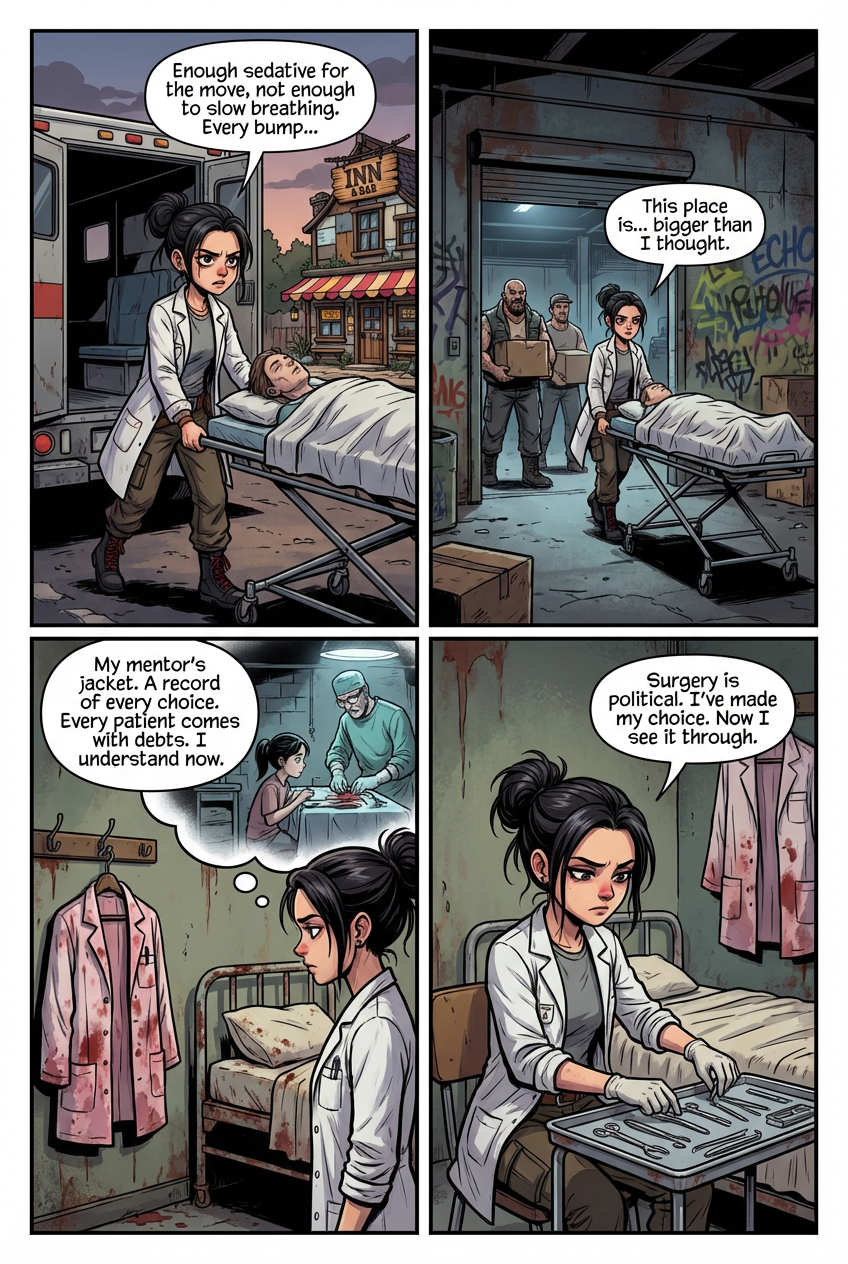
Shield loaded her supplies into the back of the armored truck parked outside Barry's inn. The patient lay unconscious on a stretcher between boxes of morphine and antibiotics. She'd given him enough sedative to keep him under for the move, but not enough to slow his breathing. Every bump would stress the stitches. Echo Warehouse smelled like rust and old fires. Shield hauled the stretcher through the entrance while two of Sherrie's men carried the supply boxes. The interior was bigger than she'd expected—open floor, metal beams overhead, spray paint layered so thick on the walls it looked like sediment. In the back corner sat a hospital bed with rusted frame rails, its white paint streaked with blood that had dried brown years ago. Next to it hung a nurse's jacket on a hook, the fabric stiff with more stains, bright red over faded pink. Shield stopped moving. Her mentor had worn a jacket like that the first time Shield watched her operate. It had been in a basement during the early collapse, no anesthesia, a man screaming while her mentor's hands stayed steady. Afterward, she hadn't tried to wash the blood out. She'd said it reminded her what the work cost. Shield had thought that was cruel then. Now she understood it was practical. The jacket was a record. The stains marked every choice that mattered. Shield looked at the patient on the stretcher, then at the blood-marked bed waiting for him. She'd been angry at Sherrie for forcing this move, angry at the patient for whispering a name that made everything dangerous. But her mentor wouldn't have been angry. She would have asked what Shield learned from keeping him alive. The answer hit hard: Shield had been so focused on mastering technique that she'd forgotten surgery was always political. Every patient came with debts. Every choice created enemies. Her mentor had known that. She'd taught Shield how to cut, but she'd also taught her to see the whole picture—the gangs, the leverage, the cost of saving one life when it endangered others. Shield had rebuilt the practice, but she'd ignored the lesson underneath it. Medicine wasn't just about keeping hands steady. It was about deciding who lived and what that survival would cost everyone else. She set the stretcher down beside the stained bed and waved Sherrie's men out. They left the supplies and disappeared. Shield opened her surgical kit and started arranging instruments on a metal tray she'd scavenged from the truck. Her hands moved the way her mentor had taught her—efficient, deliberate, no wasted motion. But now she was calculating more than the patient's survival. She was mapping the consequences. The Ravens wanted him dead. Sherrie wanted him alive as leverage. Shield wanted her supplies. The math was ugly, but it was clear. She couldn't just save lives anymore. She had to choose which ones were worth the war they'd start. The patient's breathing stayed even. Shield checked his pulse, then covered him with a thin blanket. The jacket hung on the wall behind her like a witness. She didn't take it down. It belonged there, a reminder that her mentor had made these calculations too and survived them. Shield had been using anger to stay sharp, but anger was just fear she hadn't named yet. Fear that she'd make the wrong choice. Fear that saving this man would get someone else killed. Her mentor would have told her that was the job. You make the choice. You live with it. You keep working. Shield pulled a chair next to the bed and sat down. She'd keep the patient alive because that's what she'd agreed to do. But she wasn't pretending anymore that surgery existed outside the violence. Her mentor had known the truth: every time you saved someone, you picked a side. Shield had picked hers the moment she stitched the man back together. Now she'd see it through and accept whatever came next.
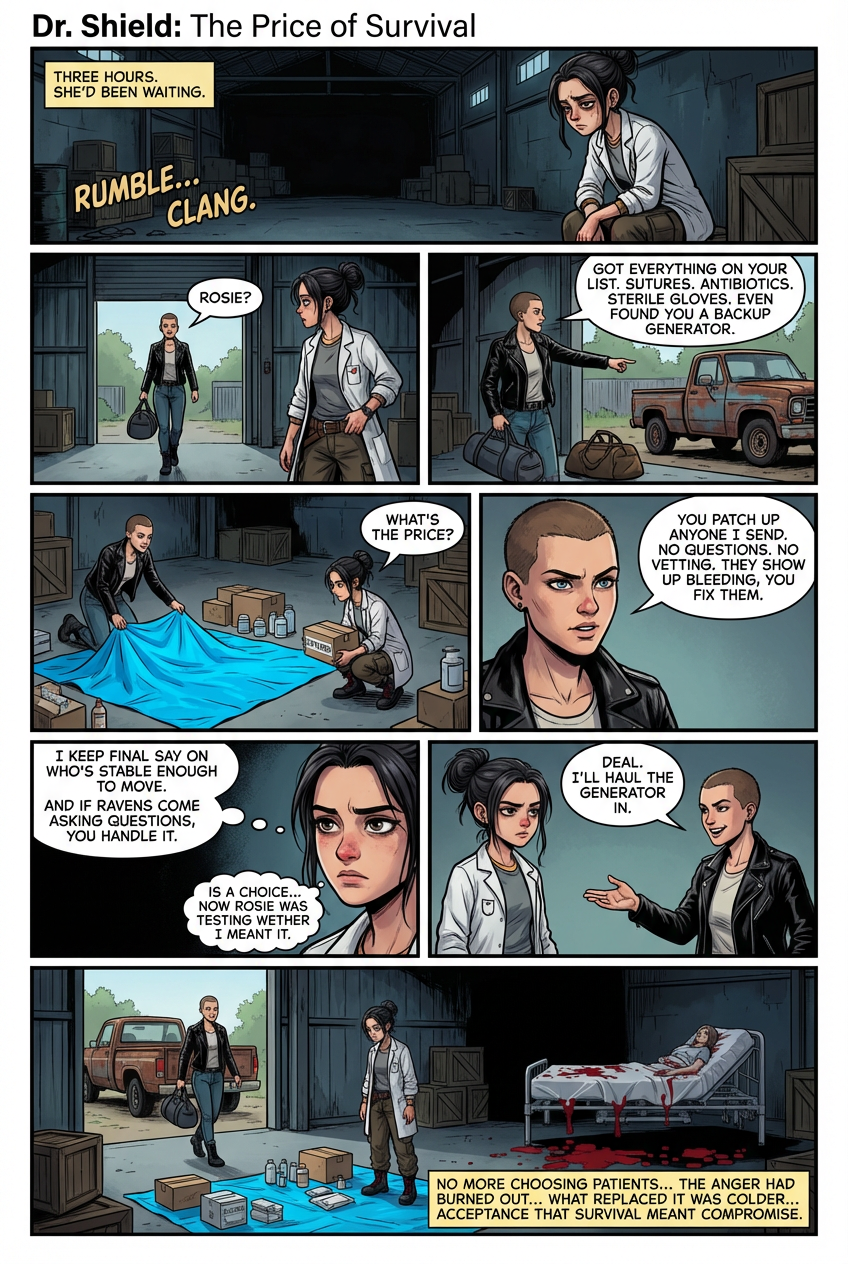
Shield sat in the warehouse for three hours before she heard the truck outside. The engine cut, then footsteps crossed the concrete. She stood and moved toward the entrance, half expecting Sherrie's militia. Instead, Rosie walked through the door carrying a duffel bag. Rosie dropped the bag and jerked her thumb toward the rusted pickup parked outside. "Got everything on your list. Sutures. Antibiotics. Sterile gloves. Even found you a backup generator." She walked back out and returned dragging a bright blue tarp across the floor. Shield watched her spread it out and arrange supplies in neat sections—boxes of gauze, bottles of disinfectant, sealed packs of surgical thread. Everything Shield needed to keep operating for months. Rosie stood and wiped her hands on her pants. "Generator's still in the truck. Thing's built from scrap but it runs clean. You'll need power if you're setting up here permanent." Shield crouched beside the tarp and picked up a box of sutures. The packaging was intact, pre-war stock. She'd been rationing her last spool for weeks. "What's the price?" Rosie's expression didn't change. "You patch up anyone I send. No questions. No vetting. They show up bleeding, you fix them." Shield set the box down slowly. That meant anyone—Rosie's people, whoever owed her favors, anyone she wanted to keep alive regardless of what they'd done or who wanted them dead. Shield would lose control of her table. Her mentor's voice came back sharp: medicine is always political. Every patient is a choice. Shield had just accepted that truth three hours ago. Now Rosie was testing whether she'd meant it. Shield stood and met Rosie's eyes. "I keep final say on who's stable enough to move. And if Ravens come asking questions, you handle it." Rosie grinned. "Deal. I'll haul the generator in." She walked out, and Shield heard the truck bed clang open. She looked down at the supplies, then at her patient still unconscious on the blood-stained bed. She'd committed to surgery without borders, to working in the mess of gang wars and leverage. Now she had the supplies to do it and the cost was carved in stone. No more choosing patients. Just fixing whoever came through the door and living with what that made her. Her mentor would've taken the deal without hesitating. Shield picked up the sutures and added them to her kit. The anger she'd been using to stay sharp had burned out. What replaced it was colder—acceptance that survival meant compromise, and compromise meant becoming something her old self wouldn't recognize.
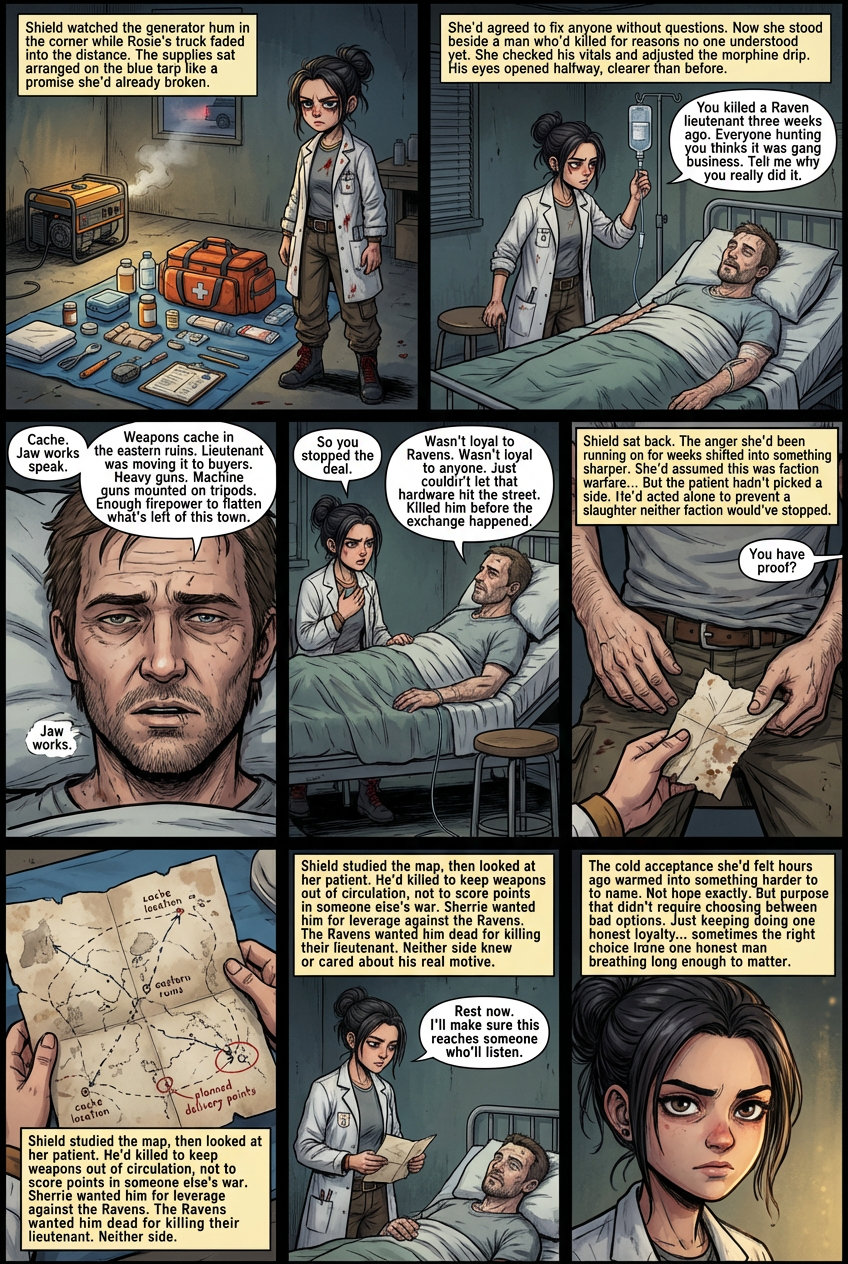
Shield watched the generator hum in the corner while Rosie's truck faded into the distance. The supplies sat arranged on the blue tarp like a promise she'd already broken. She'd agreed to fix anyone without questions. Now she stood beside a man who'd killed for reasons no one understood yet. She checked his vitals and adjusted the morphine drip. His eyes opened halfway, clearer than before. Shield pulled a stool beside the bed and sat. "You killed a Raven lieutenant three weeks ago," she said. "Everyone hunting you thinks it was gang business. Tell me why you really did it." He turned his head toward her. His breathing was steady but his jaw worked like he was testing words before releasing them. Finally he spoke. "Cache. Weapons cache in the eastern ruins. Lieutenant was moving it to buyers. Heavy guns. Machine guns mounted on tripods. Enough firepower to flatten what's left of this town." Shield felt her chest tighten. "So you stopped the deal." He nodded once. "Wasn't loyal to Ravens. Wasn't loyal to anyone. Just couldn't let that hardware hit the street. Killed him before the exchange happened." Shield sat back. The anger she'd been running on for weeks shifted into something sharper. She'd assumed this was faction warfare—Ravens versus Sherrie's organization, one more body in their endless power struggle. But the patient hadn't picked a side. He'd acted alone to prevent a slaughter neither faction would've stopped. She reached for her kit and pulled out fresh bandages. "You have proof?" He reached slowly toward his pants pocket. Shield helped him extract a folded piece of paper, torn and stained. She opened it carefully. Routes were drawn in faded ink, crossing through the eastern ruins with markers and notes. One notation read cache location with coordinates. Another showed planned delivery points circled in red. Shield studied the map, then looked at her patient. He'd killed to keep weapons out of circulation, not to score points in someone else's war. Sherrie wanted him for leverage against the Ravens. The Ravens wanted him dead for killing their lieutenant. Neither side knew or cared about his real motive. Shield folded the map and slipped it into her jacket. She'd saved his life twice already. Now she understood what keeping him alive actually meant—not just defying the Ravens or serving Sherrie's agenda, but protecting the one person in Rust Creek who'd acted without faction loyalty. Her mentor had taught her that medicine was political. But this patient had shown her something her mentor never could: that sometimes the right choice had nothing to do with picking sides. She stood and checked his sutures one final time. "Rest now," she said. "I'll make sure this reaches someone who'll listen." The cold acceptance she'd felt hours ago warmed into something harder to name. Not hope exactly. But purpose that didn't require choosing between bad options. Just keeping one honest man breathing long enough to matter.
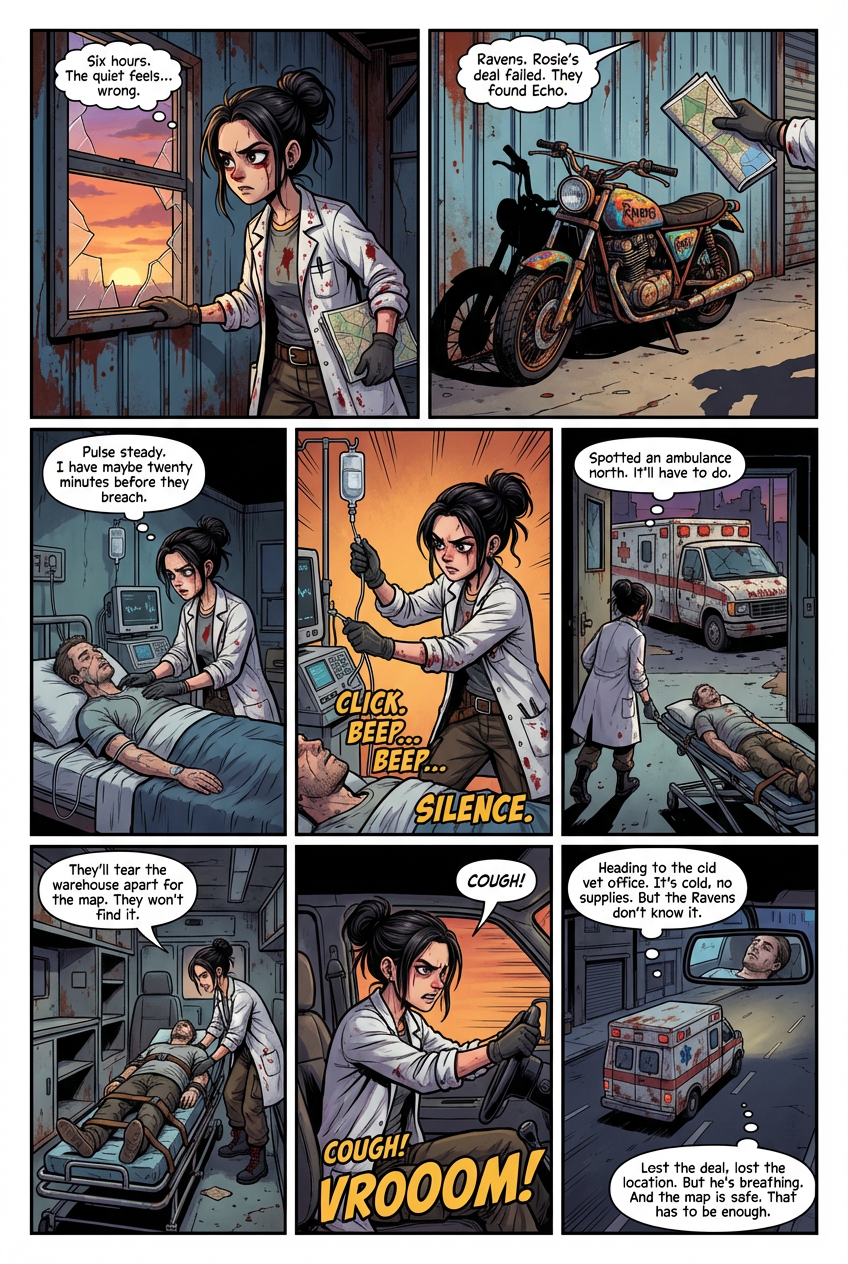
Shield folded the map back into her jacket and checked the warehouse perimeter through the cracked window. The sun had dropped below the roofline two blocks over. Shadows stretched across the dirt lot outside. She'd been here six hours since Rosie left, and the quiet felt wrong. The bike appeared first—bright paint splashed across rusted metal, leaning against the warehouse's east wall where nothing had been an hour ago. Shield recognized the tags immediately. Ravens marked their territory the same way everywhere in Rust Creek. She moved to the patient's bedside and checked his pulse. Still steady. Still breathing. But the Ravens had found Echo Warehouse, which meant Rosie's deal had already failed. Shield pulled the IV line and disconnected the monitors. She had maybe twenty minutes before they came through the door. She spotted the ambulance two blocks north while hauling the patient toward the back exit—white paint peeling, red lights cracked, but the engine compartment looked intact. Shield dragged her patient across the dirt lot and laid him in the back. The vehicle's interior still had a stretcher bolted to the floor and cabinets along the walls. She strapped him down and grabbed what supplies she could carry from the warehouse. The map pressed against her ribs inside her jacket. The Ravens would tear this place apart looking for it, but they wouldn't find anything. The ambulance coughed twice before the engine caught. Shield pulled onto the street and drove toward the old veterinarian office on the east side—the building she'd used before Sherrie forced her to Echo Warehouse. It had no generator, no steady supplies, and the walls let in cold air through broken windows. But the Ravens didn't know about it yet, and that made it safer than anywhere Rosie or Sherrie controlled. Shield glanced at her patient in the rearview mirror. His chest rose and fell with the rhythm she'd fought to restore. She'd lost her supply deal and her protected location. But she'd kept him breathing, and the map was still hidden. That would have to be enough.
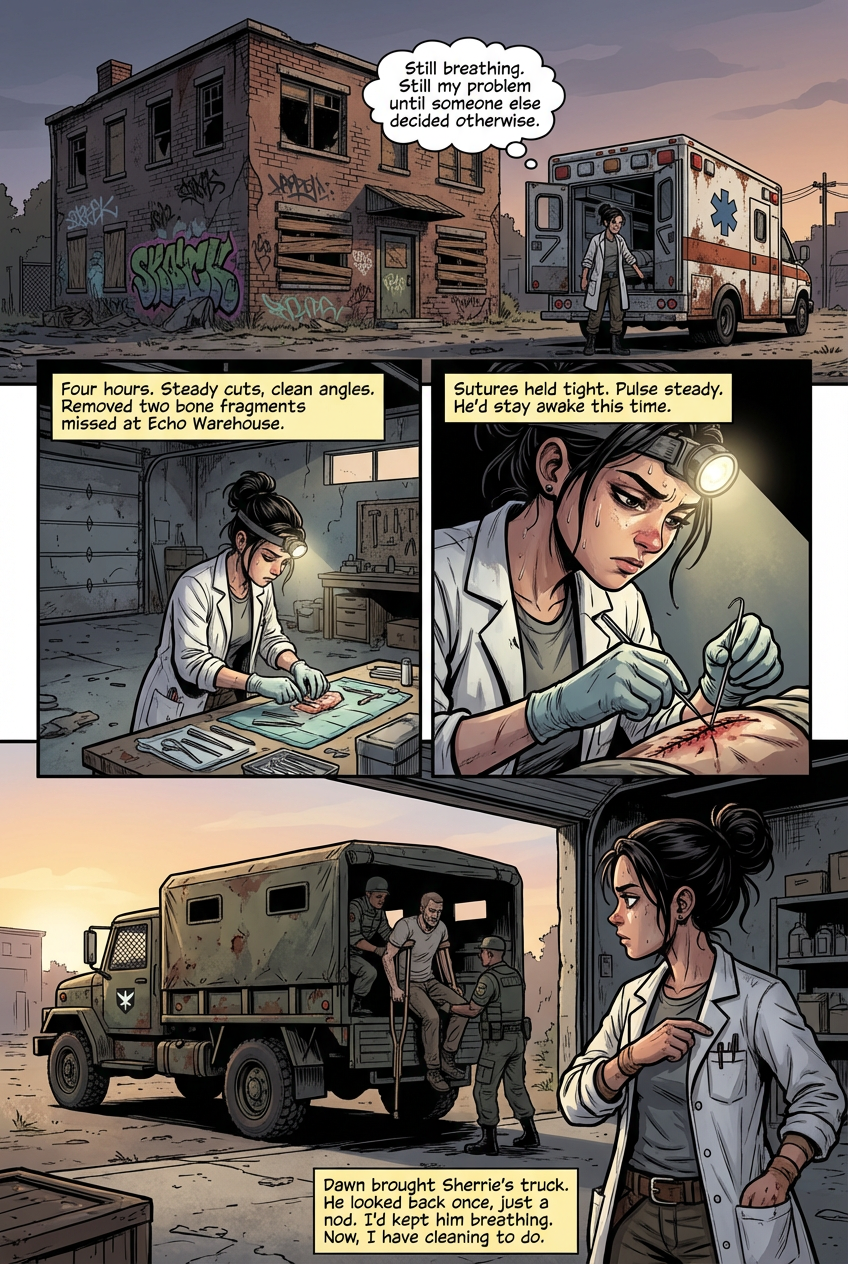
Shield pulled the ambulance behind the veterinarian office and killed the engine. The building looked worse than she remembered—broken windows covered with cardboard, door hanging crooked on bent hinges, walls tagged with faded graffiti. She climbed out and checked the street. Empty. No bikes, no guards, no one who cared what happened in this part of town. She opened the ambulance doors and looked at her patient. Still breathing. Still unconscious. Still her problem until someone else decided otherwise. She dragged him inside and set up in the old garage attached to the building's east side. The space had concrete floors and a workbench she cleared in ten minutes. She hung her headlamp from a ceiling hook and positioned the patient on the bench. The wound looked clean when she peeled back the dressing. No infection. No fresh bleeding. She'd kept him alive through three relocations and a failed supply deal. Now she needed to finish what she started—get him stable enough to walk out on his own power. The surgery took four hours. She reopened the incision and removed two bone fragments she'd missed during the first operation at Echo Warehouse. Her hands moved the way her mentor taught her—steady cuts, clean angles, no wasted motion. When she sutured him closed again, the stitches held tight. She stepped back and checked his vitals. Pulse steady. Breathing even. He'd wake in a few hours, and this time he'd stay awake. The military truck arrived at dawn, metal plating catching the early light as it rolled to a stop outside the garage. Shield recognized Sherrie's insignia on the door. Two guards climbed out and waited while Shield brought the patient to the entrance. He stood on crutches she'd built from scrap metal pipes, his leg wrapped in fresh bandages. The map stayed hidden in Shield's jacket where it belonged. She watched the guards load him into the truck bed and strap him down. He looked at her once before they closed the doors—no words, just a nod. She'd proven she could keep someone breathing through impossible conditions and finish surgery that should have killed him twice. The truck pulled away, and Shield turned back to the garage. The workbench still had blood on it. She had cleaning to do.
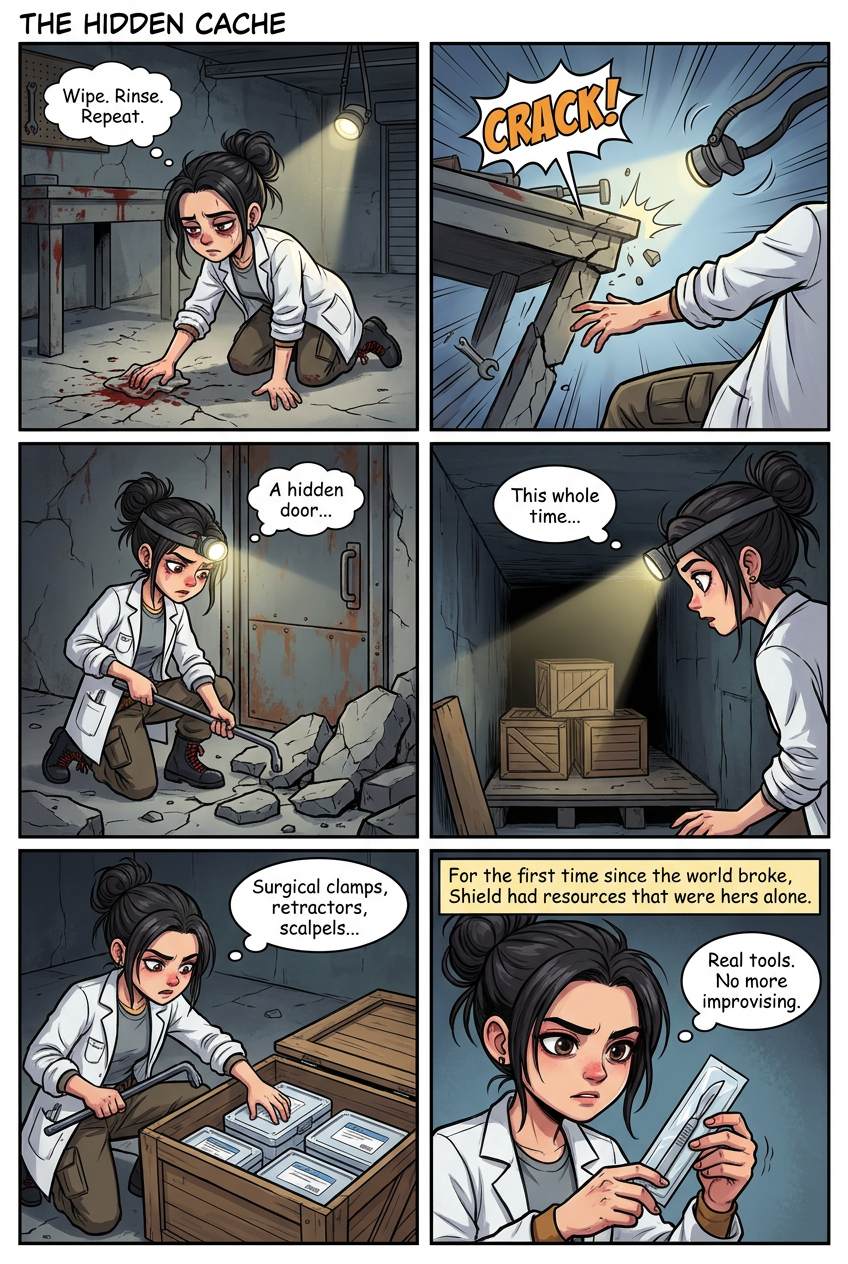
Shield scrubbed blood from the workbench with a rag soaked in rainwater. The stains had dried into the concrete during surgery, darker in the cracks where her hands had worked. She pressed harder, focused on the rhythm—wipe, rinse, repeat. The headlamp still hung from the ceiling hook above her, casting shadows across the garage floor. The bench leg gave first—a crack that echoed through the empty garage. Shield jerked back as the corner dropped, tools sliding toward the edge. She grabbed the headlamp before it fell and crouched to check the damage. The concrete had fractured in a jagged line beneath the bench's weight, revealing darkness underneath. She pushed the bench aside and knelt. The break wasn't shallow—it opened into a hollow space below the floor. She grabbed a tire iron from the wall and wedged it into the crack, prying up chunks of concrete until she could see down. A metal door lay flat beneath the garage floor, its surface covered in rust and patina, handles still intact. Someone had buried it before the war and poured concrete over it to hide it. Shield cleared more debris and found hinges along one edge. She worked the tire iron under the door's lip and pulled. The metal groaned but lifted an inch. She repositioned her grip and hauled again. The door swung open, revealing a shaft dropping into blackness. She aimed her headlamp down and saw wooden crates stacked on a platform six feet below—dozens of them, unmarked, sealed tight. Her pulse kicked up. She'd been operating in a building with a pre-war cache buried beneath it, and no one had known. She climbed down, boots hitting the platform hard. The crates were elegant, well-made, the kind used for equipment that mattered. She pried the nearest one open with the tire iron. Sterile storage boxes lined the inside, each one labeled in faded print: surgical clamps, retractors, scalpels, suture kits. All untouched. All functional. Shield opened another crate and found the same—tools her mentor would have recognized, tools she'd been rebuilding from scrap and rust for years. Her hands shook as she pulled out a scalpel still sealed in its packaging. She had enough here to run a real practice, to stop improvising with sewing needles and car thread, to operate the way surgery was meant to be done. She looked up at the garage above, then back at the crates. Whoever buried this had known the war was coming and had tried to save something worth keeping. Shield set the scalpel down carefully and started cataloging what she had. The Ravens didn't know about this place. Sherrie didn't know. Rosie didn't know. For the first time since the world broke, Shield had resources that were hers alone—and she intended to keep it that way.
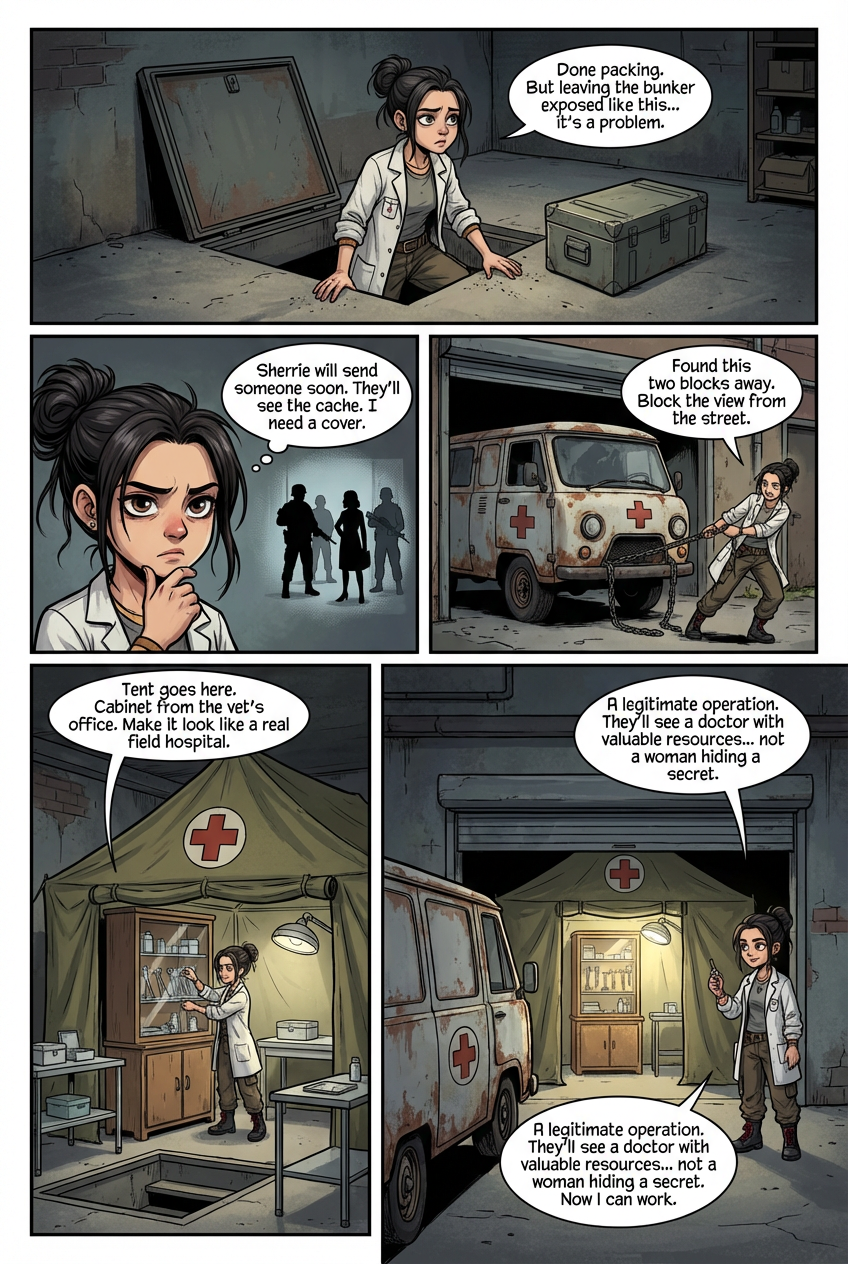
Shield closed the last crate and climbed out of the bunker. She left the door open behind her, the shaft still visible beneath the broken concrete. The garage looked different now—less like a place she was using and more like a place she owned. But ownership brought a problem she hadn't faced before. Sherrie would send another patient eventually. When she did, she'd arrive with guards and questions, and the first thing they'd see was a garage floor torn apart with a bunker full of pre-war supplies underneath. Shield couldn't seal it back up—the concrete had fractured too badly, and she needed access to the equipment. She needed a different solution: a surgical space that looked legitimate enough that no one would search the building or ask why she'd stayed. She found the medical van two blocks away, rusted through but still recognizable with its faded cross on the hood. She dragged it back with a chain and parked it outside the garage entrance, angled so it blocked the view from the street. Then she hauled the canvas tent from the van's cargo bed and set it up inside the garage directly over the bunker shaft. The red cross on the tent's side faced the door. Inside, she arranged a wooden cabinet she'd salvaged from the veterinarian office and filled its glass shelves with the pre-war instruments—scalpels, clamps, retractors, all visible and orderly. She set up a table with sterile boxes stacked beneath it and positioned the headlamp overhead. It looked like a field hospital, the kind that might have operated during the war and survived into now. She stepped outside and looked at the building again. The van out front. The tent visible through the open garage door. The cabinet gleaming behind glass. It didn't look hidden anymore—it looked like exactly what it was: a surgeon's practice. That was the trick. If Sherrie's guards saw a legitimate operation with equipment too valuable to abandon, they wouldn't question why Shield had stayed or what she was protecting. They'd see a doctor with resources, not a woman hiding a cache. Shield locked the garage door and pocketed the key. She'd built her cover from the bunker itself, and now she could work without looking over her shoulder every time someone knocked.
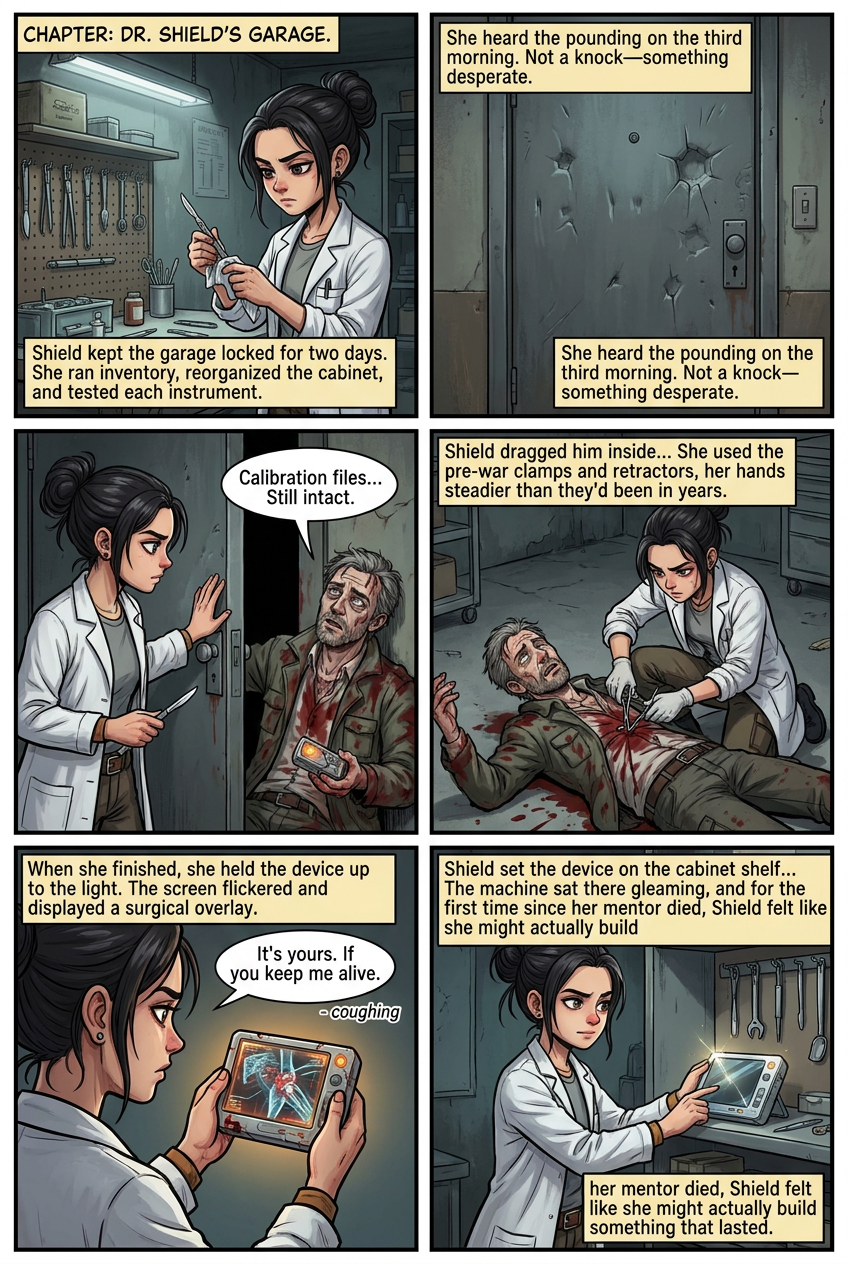
Shield kept the garage locked for two days. She ran inventory, reorganized the cabinet, and tested each instrument to see which ones still worked. The scalpels held their edge. The clamps closed without slipping. The retractors didn't bend under pressure. She heard the pounding on the third morning. Not a knock—something desperate and irregular, like someone falling against the door. Shield grabbed a scalpel and opened it. A man collapsed across the threshold, blood soaking through his jacket from shoulder to ribs. He didn't speak. He just looked at her with gray eyes and opened his hand. Inside was a small device, no bigger than a deck of cards, with a cracked screen and a blinking orange light. Shield recognized the casing immediately—pre-war medical tech, the kind that ran diagnostics and guided surgical precision in real time. She'd only seen one in a photograph her mentor had kept. The man's lips moved. "Calibration files," he whispered. "Still intact." Shield dragged him inside and kicked the door shut. She couldn't risk the light or the noise of moving him to the tent, so she worked right there on the concrete floor. The bullet had clipped his lung but missed the major vessels. She used the pre-war clamps and retractors, her hands steadier than they'd been in years. He stayed conscious through most of it, breathing shallow but controlled. When she finished, she held the device up to the light. The screen flickered and displayed a surgical overlay—bone structure, vessel mapping, risk zones. It still worked. The man coughed and met her eyes. "It's yours," he said. "If you keep me alive." Shield set the device on the cabinet shelf next to her instruments. She didn't ask who he was running from or why he'd come to her. She just locked the door again and started cleaning the blood off the floor. The machine sat there gleaming, and for the first time since her mentor died, Shield felt like she might actually build something that lasted.
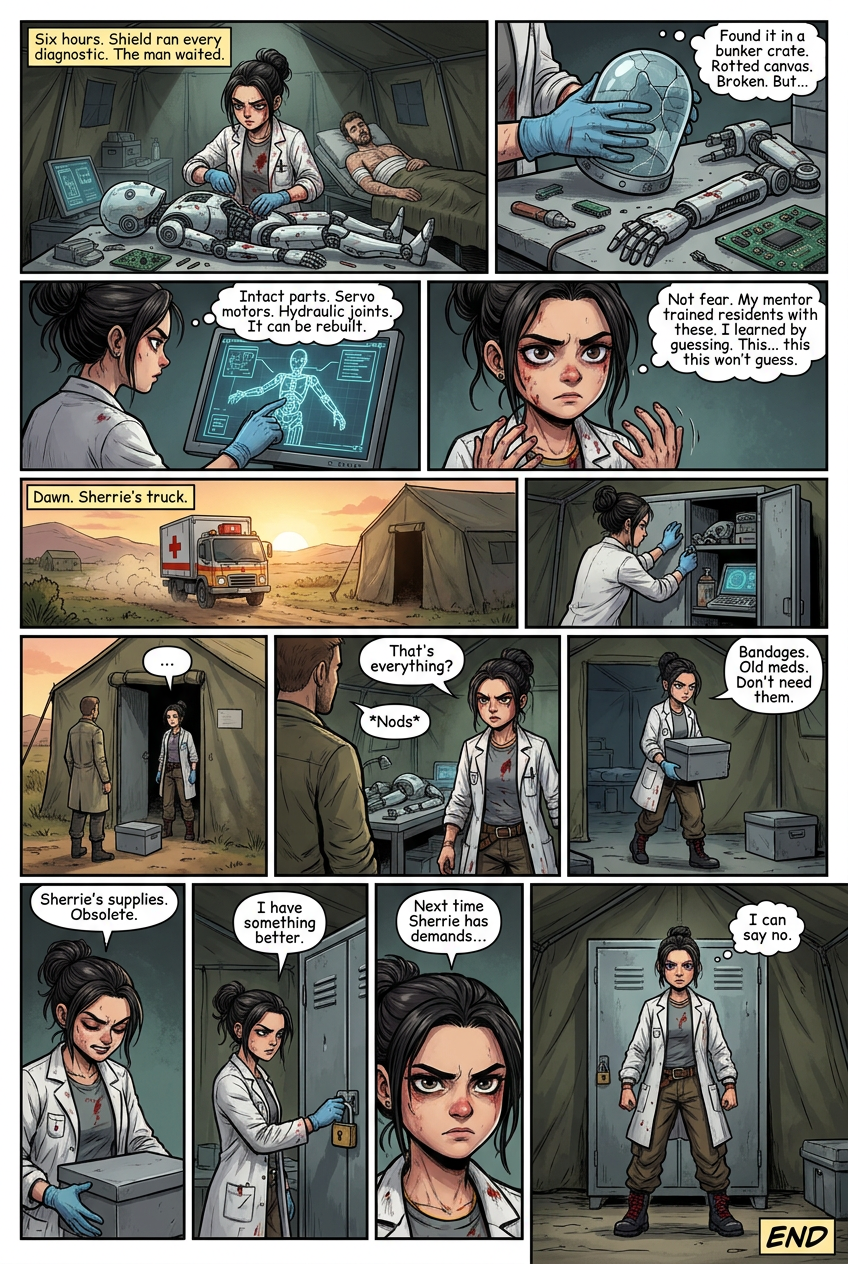
Shield kept the man in the tent for six hours while she ran every diagnostic the device could handle. The surgical robot sat in pieces on the workbench—articulated arms disconnected, glass dome cracked along one side, circuitry exposed. She'd found it wedged in the bottom of a bunker crate, wrapped in canvas that had rotted through in places. The man watched her work through half-closed eyes, his breathing steady now that the lung had sealed. He didn't ask questions. He just waited. The device mapped the robot's structure on screen—servo motors, hydraulic joints, a guidance system that could operate independently or sync with external controls. Shield traced the connections with her finger. Most of the parts were intact. The dome needed sealing. The power coupling was corroded but functional. She could rebuild it. The thought made her hands shake. Not fear—something sharper. Her mentor had trained residents with machines like this. Shield had learned surgery by feeling her way through tissue she couldn't see, making guesses that killed people when she got them wrong. This robot wouldn't guess. It would know. Sherrie's supply truck arrived at dawn. Shield heard the engine before she saw it, that familiar rattle of armored plating over rough ground. She locked the robot and the diagnostic device in the cabinet and met the driver at the door. He dropped a gray box at her feet without speaking. Inside were bandages, antiseptic, and outdated antibiotics she'd already replaced with bunker stock. The driver looked past her into the garage, eyes scanning the tent and the workbench. Shield stepped into his line of sight. "That's everything?" she asked. He nodded and walked back to the truck. Shield carried the box inside and set it in the corner without opening it again. She didn't need Sherrie's supplies anymore. She had something better. And that meant the next time Sherrie showed up with demands, Shield could say no.
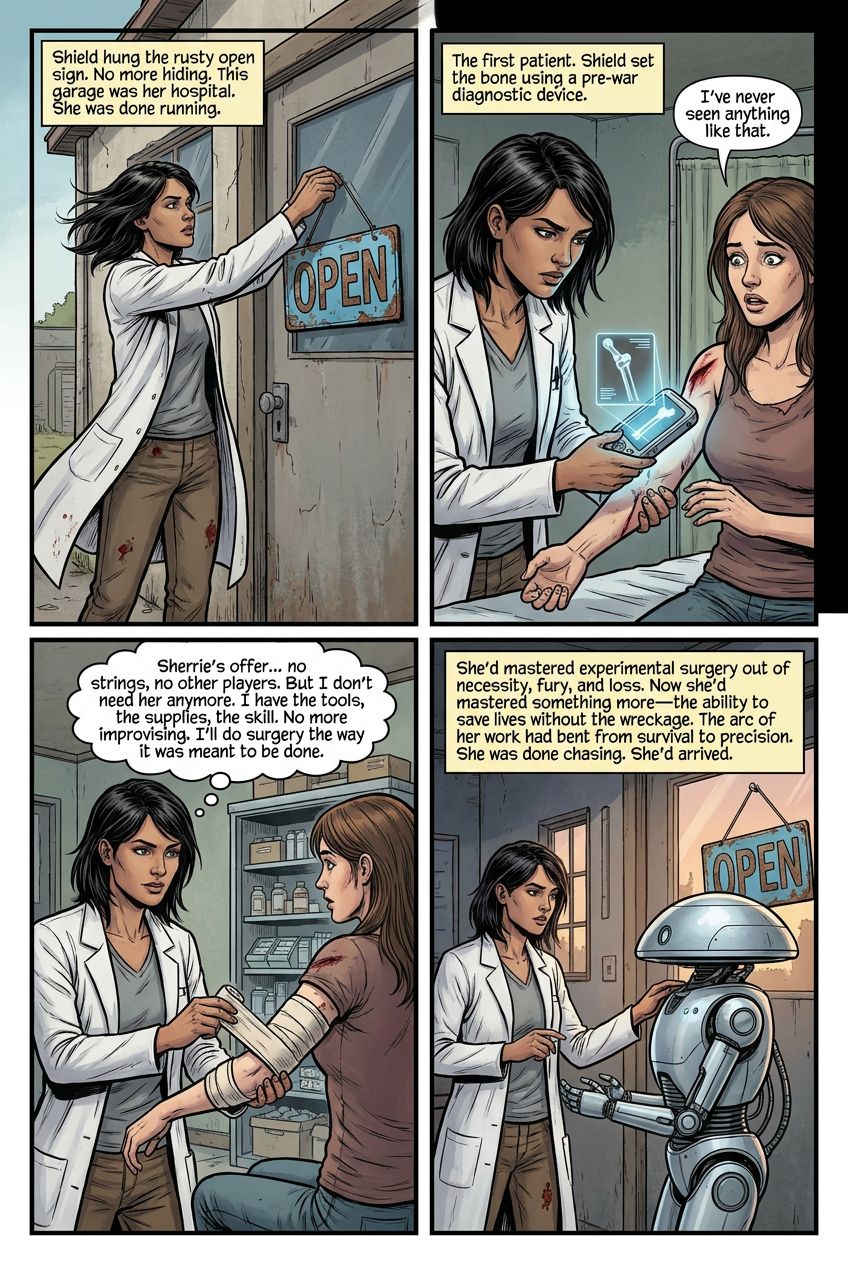
Shield hung the rusty open sign on the garage door the next morning. The paint had faded to pale blue, the letters chipped at the edges, but the message was clear enough. Anyone who walked past would know she was running a hospital. She secured it with wire and stepped back. The sign swung slightly in the wind. She'd spent three years hiding her practice in basements and abandoned offices, moving every time someone asked too many questions. Now she had a bunker full of pre-war supplies, a surgical robot that worked, and no reason to hide anymore. The garage was her hospital. She was done running. The first patient arrived that afternoon—a woman with a broken arm and a gash across her shoulder. Shield brought her into the tent and set the bone using the diagnostic device to map the fracture. The woman watched the screen, eyes wide. "I've never seen anything like that," she said. Shield didn't answer. She aligned the bone fragments and applied a splint from the medical storage unit Sherrie had stocked weeks ago, back when Shield still needed her supplies. The woman paid with pre-war canned goods and left without asking where the equipment came from. Shield locked the storage unit and returned to the workbench. The robot sat ready, its dome sealed, its arms calibrated. She'd test it on the next surgery that required precision beyond what her hands could manage. Sherrie's offer echoed in her mind—protection, no strings, no other players. Shield knew what that meant. Sherrie wanted exclusive access to the only surgeon in Rust Creek who could save lives the old way. But Shield didn't need Sherrie anymore. She had the tools, the supplies, and the skill her mentor had given her. She'd rebuilt medicine from wreckage, and now she had the means to practice it without compromise. The next time someone came through that door bleeding out, Shield wouldn't improvise. She wouldn't guess. She'd do surgery the way it was meant to be done—with precision, with certainty, with hands that had finally mastered what the world had tried to take from her. Shield powered down the robot and locked the garage. The open sign swung in the fading light. She'd mastered experimental surgery out of necessity, fury, and loss. Now she'd mastered something more—the ability to save lives without the wreckage, without the guesswork, without the anger that had kept her sharp but cost her so much. Her mentor would recognize these hands. More than that, she'd recognize what Shield had built. A hospital that worked. Medicine that didn't fail. A practice that honored every patient Shield had lost by making sure the next one had a real chance. The arc of her work had bent from survival to precision, from improvisation to mastery. She was done chasing. She'd arrived.
Play your story to life
Storycraft is a mobile game where you create AI characters, craft items and locations to build their world, then discover what direction your story takes. Download the iOS game for free today!
Download for free