

Dr. Tessa's Arc
6 Chapters
Dr. Tessa's dream is establishing the world's most comprehensive research center for bird conservation.

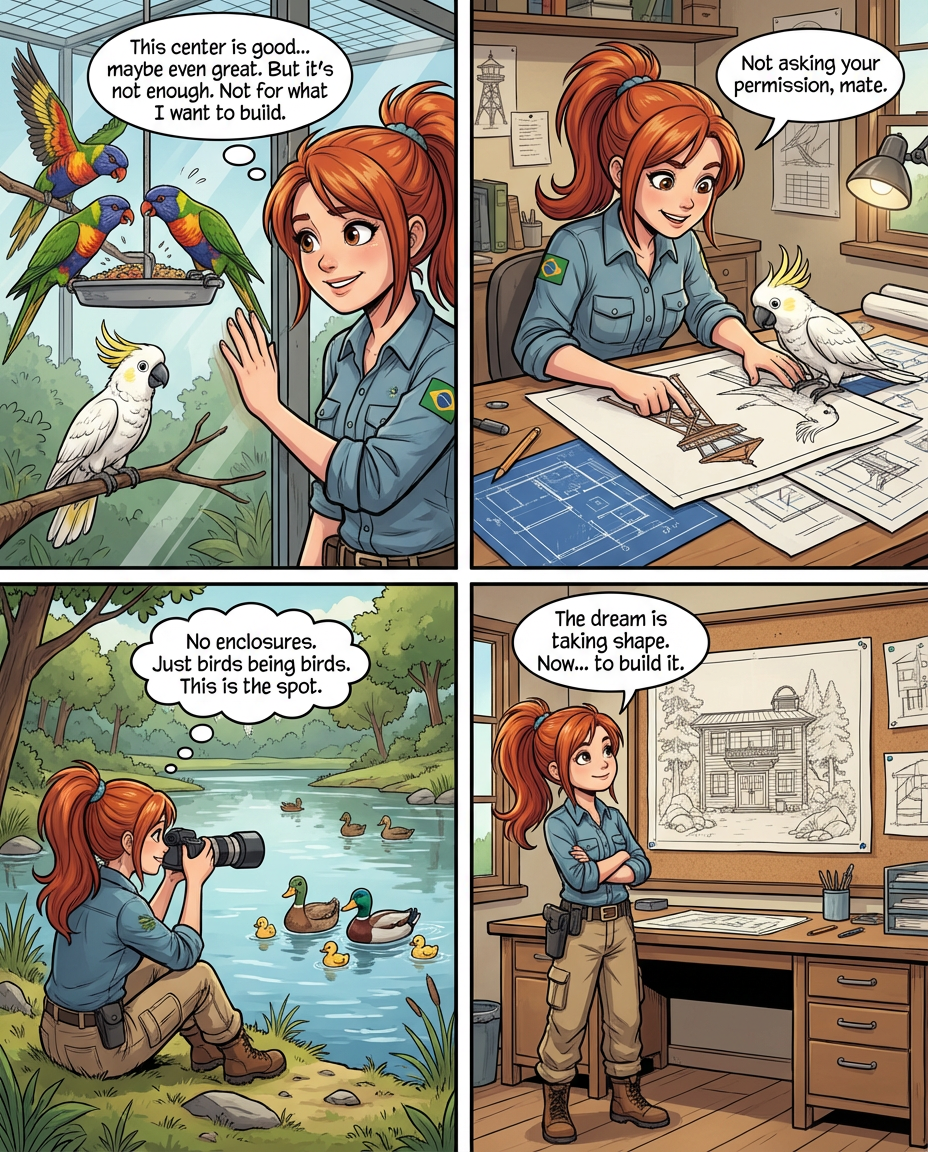
Dr. Tessa Shortfeather pressed her palm against the glass observation wall and grinned. Inside the enclosure, three rainbow lorikeets fought over a feeder while a sulphur-crested cockatoo—Nigel—strutted across a branch like he owned the place. This conservation center was good, maybe even great, but it wasn't enough. Not for what she wanted to build. The world's most comprehensive research center for bird conservation would need better equipment, more space, and funding that didn't run out every fiscal year. She tapped her notebook three times against her leg—her own signal that meant no, not yet, not good enough—and watched Nigel dance on his perch. He knew something was coming. So did she. The observation tower plans were spread across her desk when she got back to the lab. Wooden railings, glass-enclosed top, panoramic views of the migration routes overhead. She traced the sketch with one finger. This would let her track populations moving through, record patterns the crows hadn't shown her yet. Nigel landed on the blueprints and tapped twice with his beak. She laughed. "Not asking your permission, mate." But she was showing off a little, and they both knew it. The woodland pond was her favorite part of the design. Ducks would come—mallards, wood ducks, maybe even the rare freckled variety she'd read about. A family of them gliding across still water while she sat ten feet away with her camera. No glass walls. No enclosures. Just birds being birds, close enough to count their feathers. She'd already picked the spot, measured the depth, calculated the drainage. Dr. Martinez would call it obsessive. Tessa called it thorough. The research station sketches made her chest tight. She held up the drawing—wooden frame, metal roof, windows that wrapped around the observation wing. This would be headquarters. The place where every bird conservation program in the world would want to partner. Where the lyrebird data would finally make sense, where the crow experiments could expand, where Nigel could retire in style. She pinned it above her desk and stepped back. The dream was taking shape, one structure at a time. Now she just had to build it.
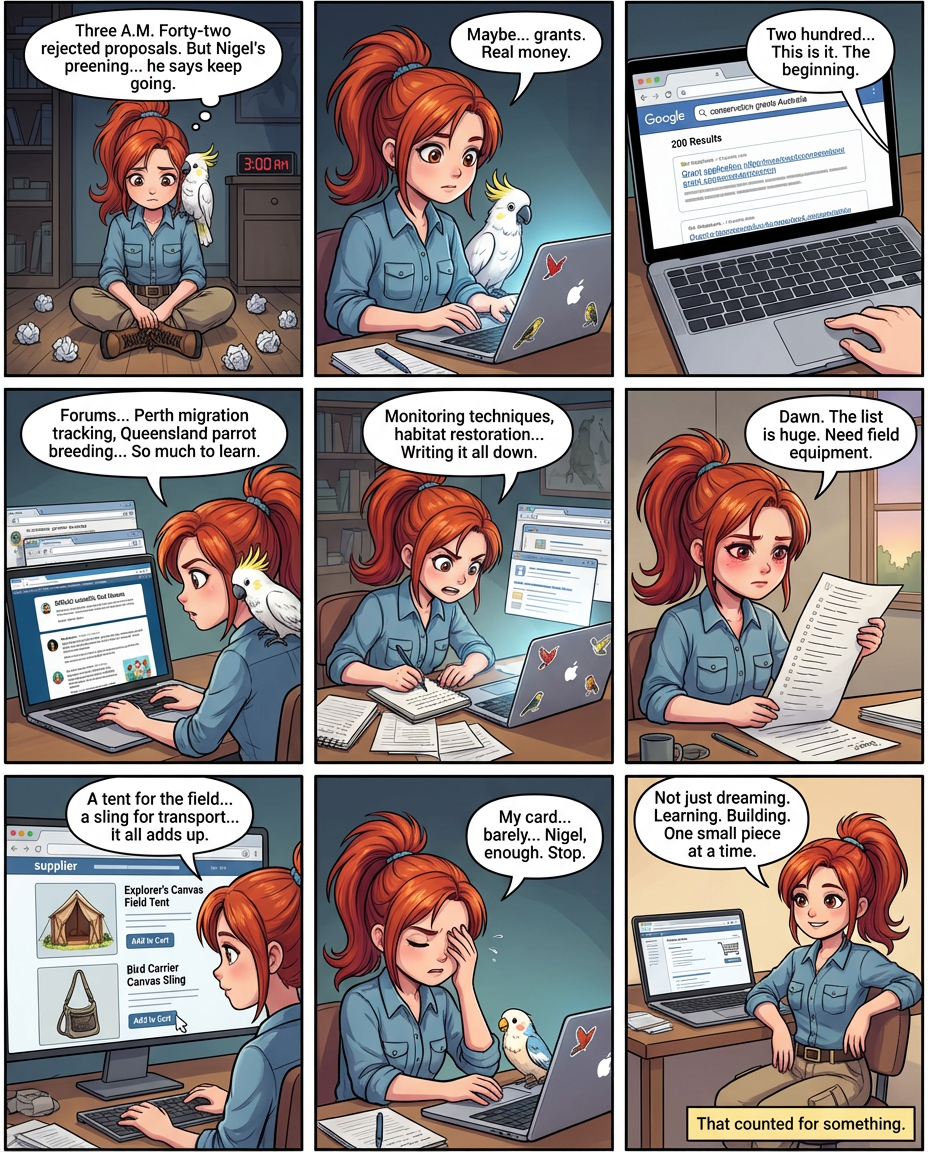
Tessa sat cross-legged on her lab floor at three in the morning, surrounded by forty-two balled-up budget proposals. Nigel perched on her shoulder, preening her hair gently—his signal for yes, keep going. The numbers didn't lie. A comprehensive research center needed money, lots of it, and her current salary wouldn't cover the pond filtration system, let alone the observation tower. She grabbed her laptop and typed "conservation grants Australia" into the search bar. Two hundred results appeared. Her finger hovered over the first link. This was it—the actual beginning. Not dreams on blueprints, but forms to fill out, questions to answer, funding to chase. She clicked. The application asked for project scope, timeline, and estimated costs. She had all three memorized. The screen glowed in the dark lab. She scrolled through scientific forums, each one packed with researchers posting about endangered species protocols and field research methods. Someone in Perth had tracked migration patterns using audio recording. Another team in Queensland successfully bred threatened parrots in captivity. Tessa opened seven tabs, then twelve, then twenty. Her brain buzzed. Every post was a piece of the puzzle—monitoring techniques, breeding programs, habitat restoration. She grabbed her notebook and started writing. The MacBook's bird stickers caught the light as she typed faster. This information existed. She just had to learn it all. By dawn, her eyes burned but her list had grown to three pages. She needed field equipment—a canvas tent with a desk surface for processing samples outdoors before bringing them inside. A carrier sling with mesh panels to stabilize injured birds during transport. Basic tools she'd overlooked while dreaming about towers and ponds. The unsexy stuff that actual conservation required. She pulled up supplier websites and added items to her cart. Forty-seven dollars here, eighty-two there. Small purchases, but they added up. Her credit card could handle it. Barely. Nigel tapped three times on her keyboard. No, stop, enough. She leaned back against the desk leg and rubbed her face. The grant application sat half-finished in another window. The forum threads kept multiplying. The shopping cart total climbed higher. But her chest felt lighter than it had in weeks. She wasn't just dreaming anymore. She was learning, buying, building—one small piece at a time. The comprehensive research center was still years away, maybe decades, but this morning she'd started. That counted for something.
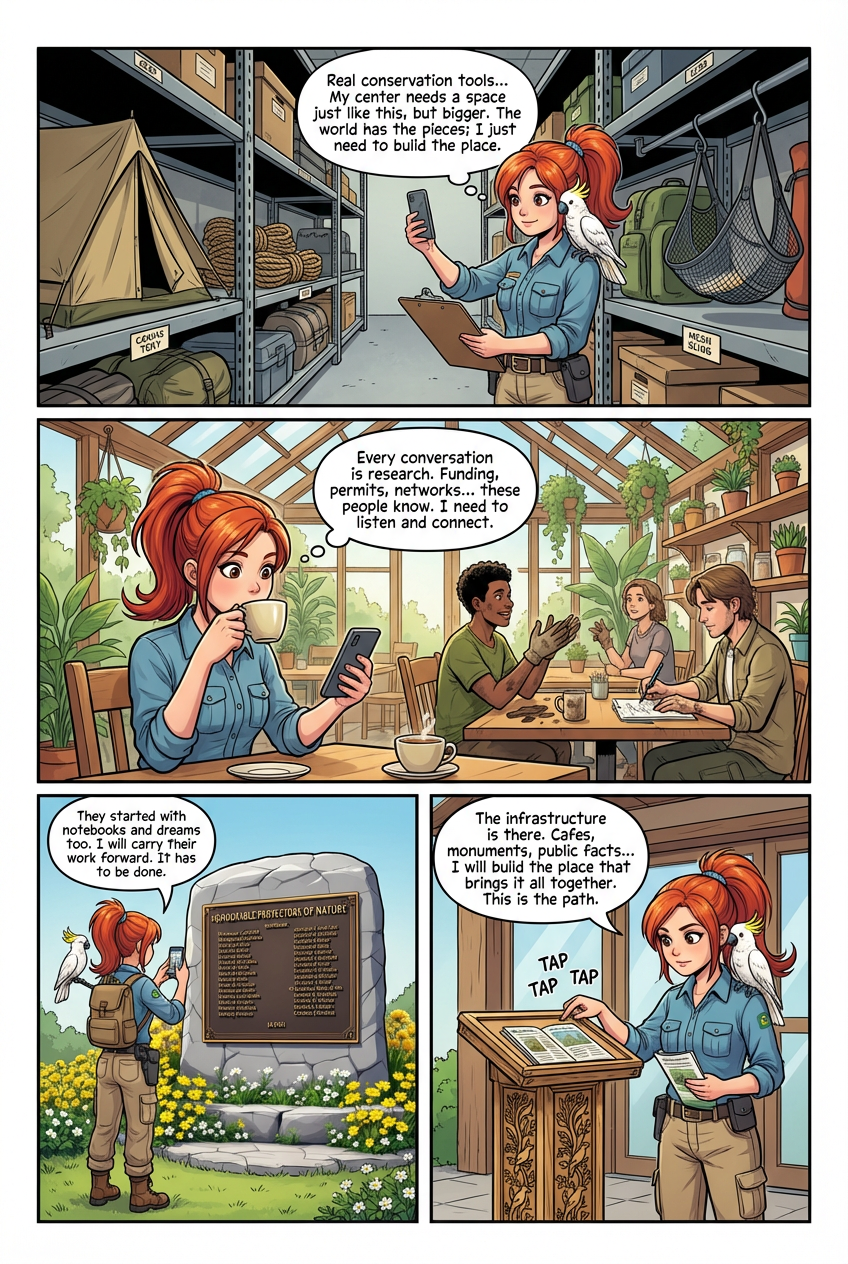
Tessa walked through the center's supply warehouse, her boots echoing on concrete. Rows of metal shelves stretched overhead, packed with equipment she'd only read about in forums. A canvas tent folded tight in its bag sat next to coiled rope and field markers. She ran her hand along a mesh carrier sling, the kind designed for transporting injured birds without stressing them further. This place held everything real conservationists used—the actual tools, not just the dream sketches pinned above her desk. Nigel shifted on her shoulder and preened her hair gently. Yes, this matters. She pulled out her phone and photographed the shelving units, the equipment labels, the organized chaos of supplies ready to deploy. Her research center would need a space exactly like this, maybe three times larger, stocked with gear for every possible field situation. She grabbed a clipboard from the nearest desk and started making lists. The world already had the pieces. She just needed to build the place that could use them all. She left the warehouse and headed toward town, her notebook tucked under one arm. The streets hummed with researchers and visitors, people who cared about conservation enough to show up. A cafe sat ahead, all glass panels and wooden shelves packed with potted plants. The Verdant Retreat Cafe, according to the sign. She pushed through the door. Inside, a woman with dirt-stained gloves talked about pollinator corridors while another person sketched habitat maps on a napkin. Tessa ordered tea and sat near them, listening. These people knew things—funding sources, permit processes, collaboration networks. She pulled out her phone and opened her notes app. Every conversation was research. Every connection mattered. After an hour of listening and three pages of notes, she walked to the monument she'd spotted on her way in. Bronze plaques lined a stone base, each one honoring scientists who'd changed bird protection forever. Names she'd read in textbooks, faces she'd seen in documentaries. They'd started somewhere too, probably with notebooks and dreams and not enough funding. Nigel danced on her shoulder—his signal for plotting something big. She photographed each plaque, reading the dates and accomplishments. Her research center would carry this work forward. It had to. Back at the center's entrance, she found a wooden lectern with bird engravings carved along its post. Someone had left conservation pamphlets on top, facts about local species and migration times. She picked one up and read it twice. This was how you brought people in—daily updates, public facts, visible commitment. Her center would need something like this, maybe bigger, announcing events and research findings where anyone could see them. She traced the carved birds with one finger. The world already had the infrastructure for what she wanted to build. Researchers gathering in cafes. Monuments honoring the work. Public spaces for sharing knowledge. She just had to create the place that brought it all together, that made it permanent. Nigel tapped twice on the lectern's edge. Yes. This was the path forward.
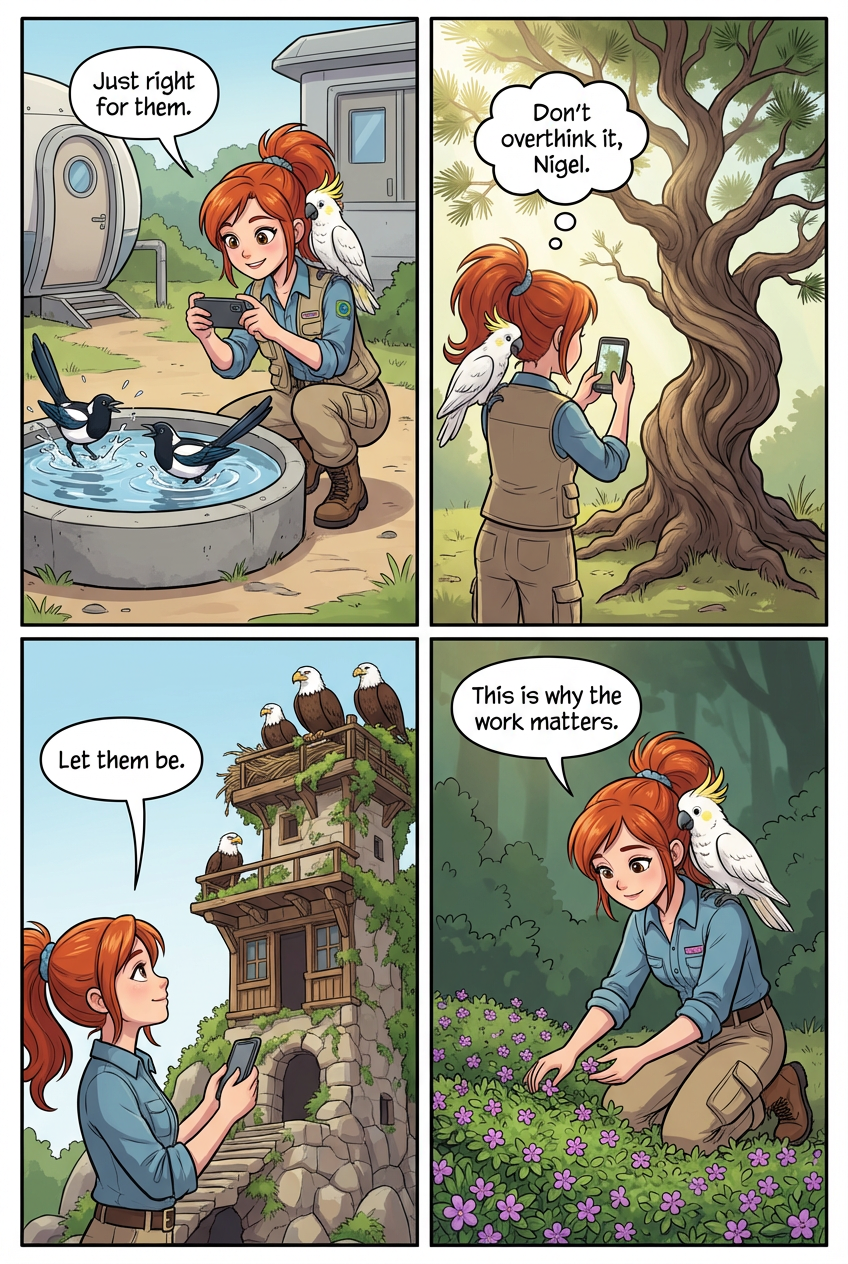
Tessa crouched beside a concrete birdbath outside the center's eastern research pod, watching two magpies splash in the shallow water. Nigel bobbed on her shoulder, his crest rising and falling with each splash the wild birds made. She pulled out her phone and snapped three photos of the bath's simple design—rounded edges, textured bottom for grip, just deep enough for safety. Her research center would need dozens of these, maybe a hundred, scattered across the grounds where birds could drink and bathe while she observed their behavior. One magpie shook itself dry and flew to a nearby branch. The other lingered, tilting its head at Tessa before following its companion. She stood and brushed dirt from her knees, already sketching birdbath placements in her mind. She walked toward the forest edge where a gnarled larch tree stood, its sparse needles catching afternoon light. The branches twisted at different heights, each one a possible nesting spot for different species. Smaller birds could take the thin upper branches. Larger ones could claim the thick middle sections. She circled the trunk twice, photographing the bark texture and branch angles. Her center needed trees like this—natural, varied, offering options. Nigel tapped three times on her collarbone. No, don't overthink it. She laughed and kept walking. A stone tower rose ahead through the trees, its base covered in vines and moss. The wooden railings at the top had broken away years ago, leaving gaps in the structure. She stepped closer and spotted movement near the summit—a bald eagle shifted on a massive nest built across the old observation platform. Another eagle landed beside it, talons gripping the weathered stone. This place had been built for watching birds decades ago, maybe longer. Now the birds had claimed it completely. She raised her phone but stopped. The eagles didn't need documenting. They just needed to be left alone. The path back curved through shade where creeping thyme spread between the trees, tiny purple flowers dotting the ground cover. The scent hit her—sharp and green. She knelt and touched the leaves, soft and dense beneath her fingers. This was the kind of detail that mattered. Not just the big structures or the dramatic features, but the quiet growth in forgotten corners. Her research center would have spaces like this too, places where things grew without anyone directing them. Places where she could walk and think and remember why the work mattered. Nigel preened her hair gently. Yes, exactly this.
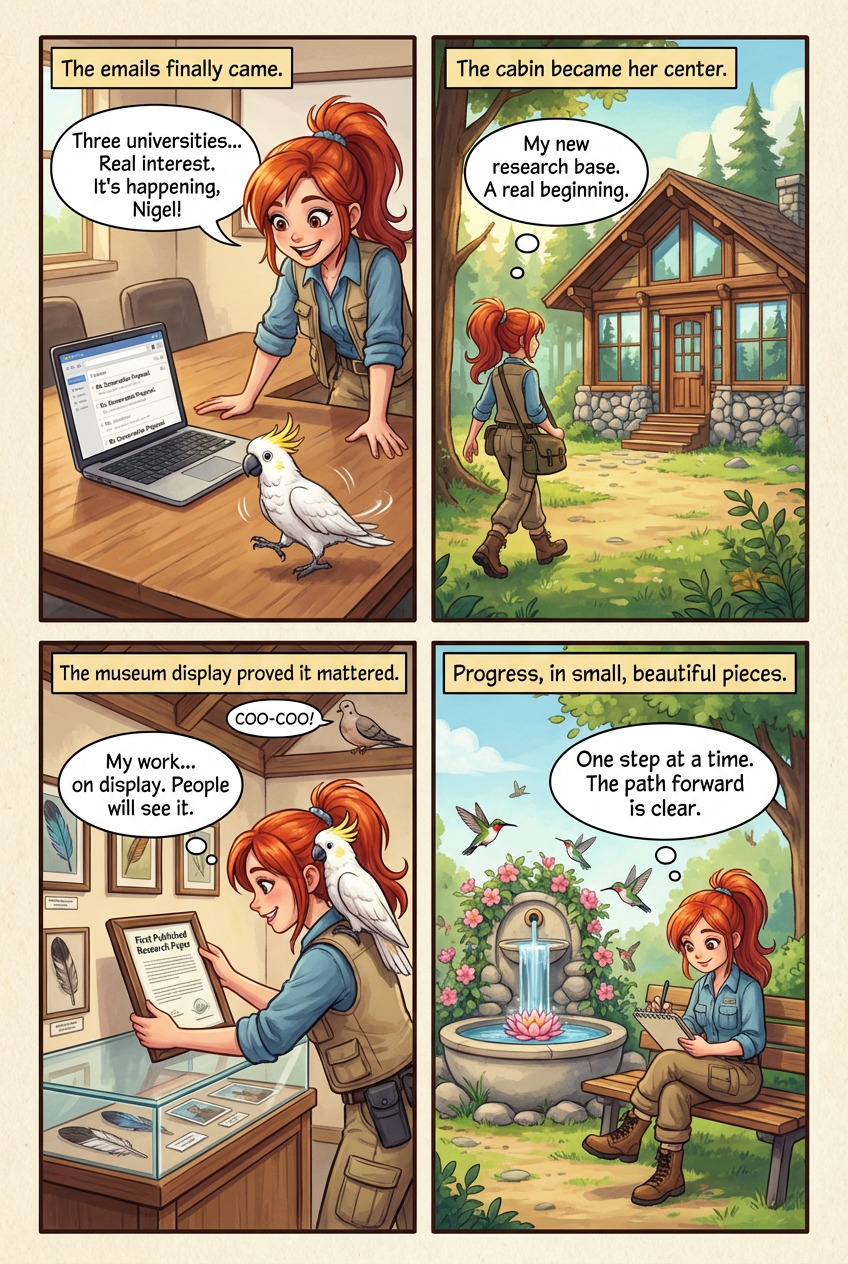
Tessa leaned against the center's main conference table, grinning at the laptop screen in front of her. Three universities had responded to her research proposal—not commitments yet, but interest. Real interest. One professor wanted to discuss collaboration frameworks. Another asked about her field methodology. She read each email twice, then screenshot them for her records. Nigel danced on the table beside the laptop, his feet tapping out the rhythm that meant they were onto something big. She'd sent forty-seven emails over the past two weeks, pitching her vision for comprehensive bird conservation research. Three responses meant people were listening. Her center wasn't just a dream anymore—it was becoming a conversation. She grabbed her field bag and headed toward the cabin she'd been using to organize her research materials. The stone foundation kept it cool inside, and the wide windows let her watch birds while she worked. Shelves lined every wall, packed with bird encyclopedias and printed studies. She'd started keeping all her field notes here, sorted by species and behavior patterns. A desk near the largest window held her current project—a database tracking seventeen different courtship behaviors she'd documented. She pulled up the file and added notes from yesterday's observations. The cabin felt like the beginning of something permanent, a place where her work could actually grow instead of staying scattered across notebooks and laptop folders. The town museum had offered her a display case last week, and today she'd finally brought over her preserved specimens and field artifacts. The wooden building smelled like old paper and polish. A mourning dove cooed somewhere above the entrance as she arranged her collection—feather samples labeled with collection dates, photographs of nesting sites, her first published research paper in a simple frame. The curator helped her position everything behind the glass. People could see this now. Her work wasn't just sitting in storage anymore. Nigel preened her hair gently. Yes, this mattered. She stepped back and looked at the display. It wasn't much yet, but it proved she'd already contributed something real to bird conservation. She walked back toward the research area and found workers installing a fountain near one of the observation paths. Water trickled down smooth stones into tiered basins, each one shallow enough for small birds to use. Hummingbirds already hovered near the lotus flowers planted around the base. Sweet pea vines climbed a small trellis beside it. Tessa sat on a nearby bench and pulled out her notebook, sketching the fountain's design and watching how different species approached the water. The sound alone would probably attract birds she hadn't documented yet. She'd ask if she could set up a camera here tomorrow. Progress felt like this—not one massive breakthrough, but dozens of small pieces clicking into place. Her research center would need features like this fountain, spaces designed specifically for observation and data collection. She already had the proposal. She had university interest. She had her work on public display. The path forward was becoming clearer every single day.
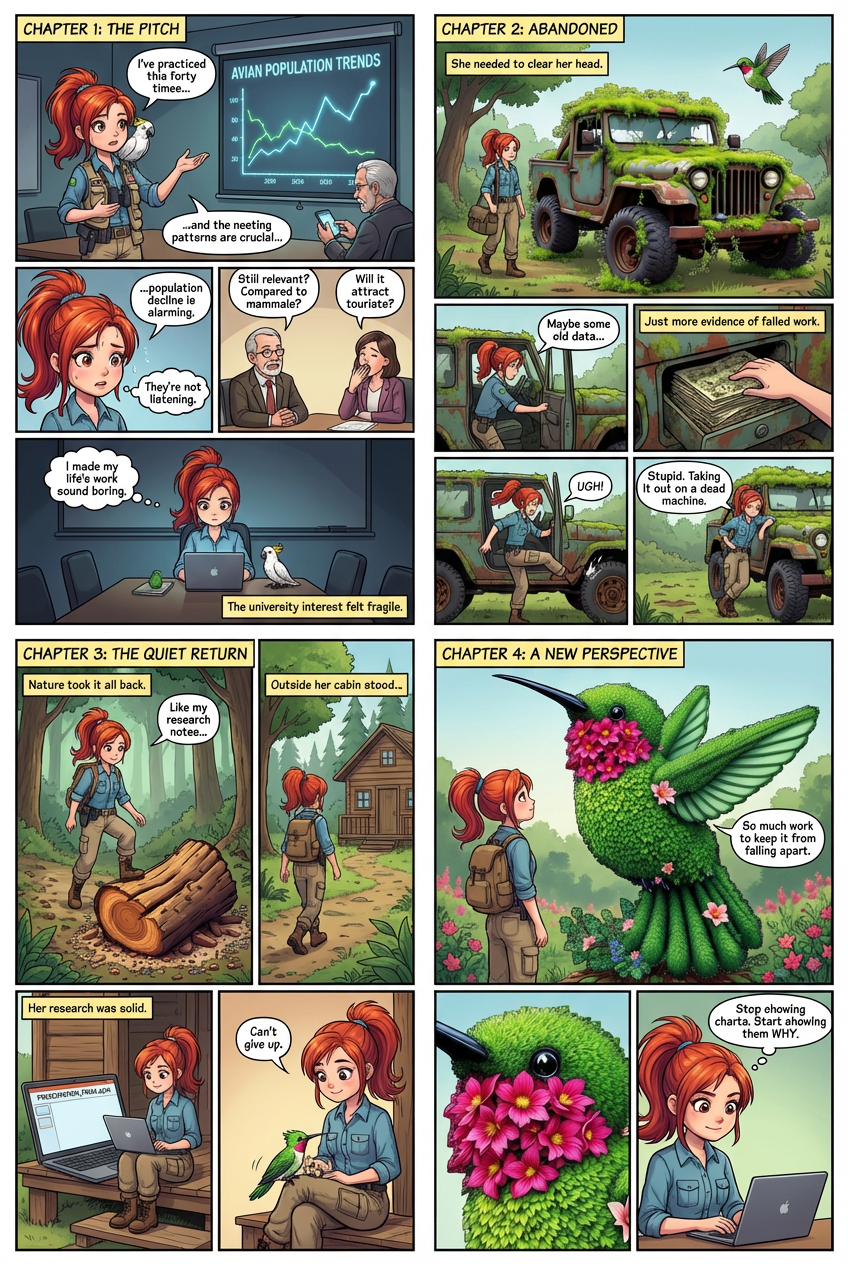
Tessa stood in front of seven potential donors in the center's conference room, her presentation slides glowing on the screen behind her. She'd practiced this pitch forty times. Her research data was solid. Her conservation center plans were thorough. But halfway through her third slide, she noticed the older man in the back checking his phone. The woman beside him stifled a yawn. Tessa talked faster, throwing in extra statistics about nesting patterns and migration routes. She showed photographs of rare species and charts tracking population decline. Nothing landed. When she finished, the silence stretched too long. One donor asked if bird conservation was "still relevant" compared to larger mammals. Another wanted to know if her center would attract tourists. They thanked her politely and left without making commitments. Nigel tapped three times on her shoulder. No, it hadn't worked. She sat alone in the empty room, staring at her laptop screen. All those emails, all that preparation, and she'd somehow made her life's work sound boring. The university interest suddenly felt fragile, like something that could disappear if she couldn't learn to make people care. She needed to clear her head. She grabbed her field bag and drove to the old waterbird site where the center had run expeditions three years ago. The rusted jeep still sat there, moss thick across its hood, vines wrapped around the wheels. Someone said they'd left field data in the glove box before the project got abandoned. Tessa pulled the door open and dug through wet papers and broken equipment. Nothing useful. Just more evidence of failed work, research that went nowhere because funding dried up. She slammed the door shut and kicked the tire, then immediately felt stupid for taking her anger out on a dead vehicle. The walk back toward her car took her past a log that had fallen across the path, its wood crumbling into pieces, ants crawling through the rot. Everything here showed what happened when projects died—nature took it all back. She thought about her cabin full of research notes and her museum display that three people had probably looked at. Her university emails felt like they'd come from someone else, someone confident who knew how to make people listen. Outside her cabin stood a topiary shaped like a hummingbird, its throat covered in pink-ruby flowers someone had carefully planted. She'd walked past it a hundred times and never really noticed how much work it took to maintain something that specific. How much effort went into keeping it from falling apart. She sat on her cabin steps and opened her laptop. The presentation file stared back at her, full of facts that apparently didn't matter to anyone but her. Nigel settled beside her and tapped once, twice, three times on her knee. No, she couldn't give up. But she also couldn't keep doing the same thing and expect different results. Her research was solid. Her data was real. She just hadn't figured out how to make anyone else feel what she felt when she watched birds. The university emails sat in her inbox, still waiting for follow-up. She closed the laptop and looked at the hummingbird topiary again, at all those careful flowers arranged just right. Maybe she needed to stop showing people charts and start showing them why any of this mattered in the first place.
Play your story to life
Storycraft is a mobile game where you create AI characters, craft items and locations to build their world, then discover what direction your story takes. Download the iOS game for free today!
Download for free