

Lauren Martin's Arc
5 Chapters
Lauren Martin's dream is creating an invention that revolutionizes how the Trade Post does business.

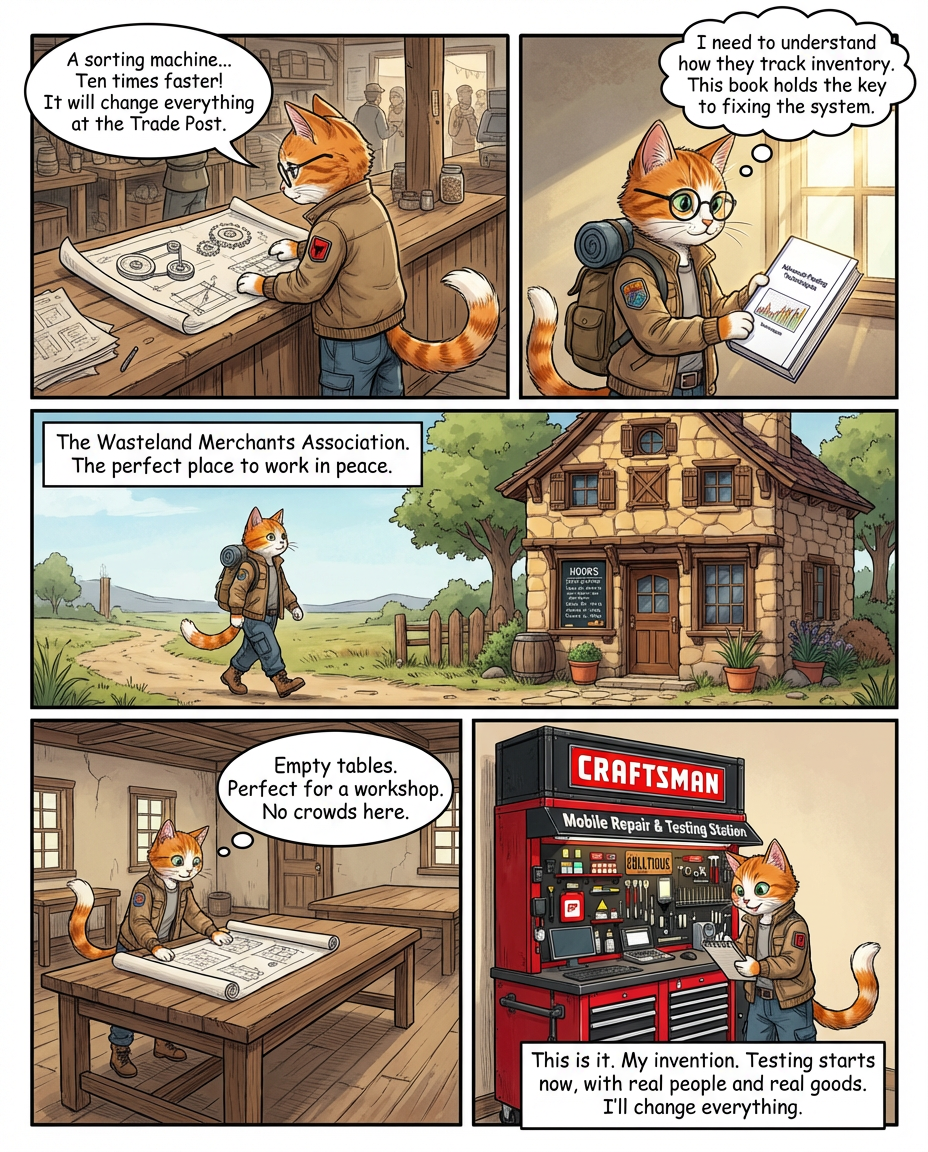
Lauren Martin adjusted her glasses and spread her blueprints across the worn wooden counter. The orange cat worked at the Trade Post in Fort Orynth, where merchants complained daily about slow deliveries and lost packages. She dreamed of building something that would change everything—a sorting machine that could process goods ten times faster than any worker. Her tail swished with excitement as she sketched gears and pulleys, imagining the day the Trade Post would run like clockwork because of her invention. The morning sun filtered through the dusty windows as Lauren packed her supplies. She stuffed the blueprints into her jacket pocket and grabbed a white book from the shelf. The cover showed a trading chart with lines and numbers. Inside were diagrams of scales and measuring devices—equipment that could weigh goods down to the smallest unit. She needed to understand how merchants tracked their inventory before she could fix the system. Lauren walked down the dirt road toward the stone building at the edge of town. The Wasteland Merchants Association met there every week to talk about trade problems. She pushed open the heavy wooden door and stepped inside. Empty tables filled the main room. Perfect. She could set up her workshop here, away from the crowds at the Trade Post. This would be where she built her machine. She unrolled her blueprints on the largest table and studied the gears again. But her invention needed testing—real people handling real goods. Lauren pictured a mobile station with black and red metal panels, something she could wheel around town. She could show merchants how the machine worked and make adjustments based on their feedback. Her paws trembled as she made notes. This was it. This was how she would change everything.
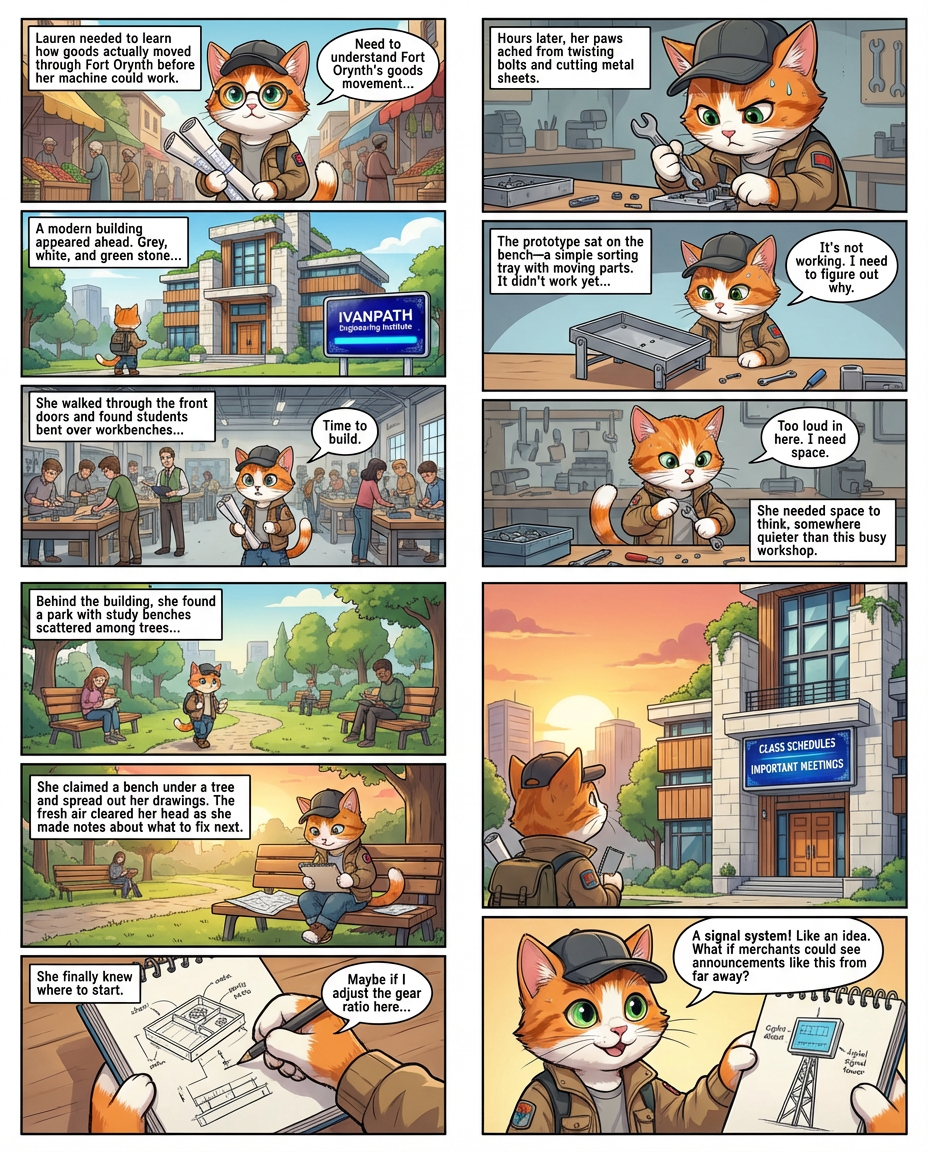
Lauren stepped outside the association building and breathed in the cool morning air. She needed to learn how goods actually moved through Fort Orynth before her machine could work. Her paws gripped the blueprints tighter as she headed toward the market district. The road curved past shops and stalls until a modern building appeared ahead. Grey, white, and green stone formed its walls, with wooden beams supporting the upper floors. A sign near the entrance read "Ivanpath Engineering Institute." Lauren's ears perked up. This was where inventors learned their craft. She walked through the front doors and found students bent over workbenches, soldering metal parts and testing gears. The smell of oil and sawdust filled the air. A teacher glanced at her blueprints and nodded toward an empty station in the back. Lauren set down her papers and picked up a small wrench. Time to build her first prototype. Hours later, her paws ached from twisting bolts and cutting metal sheets. The prototype sat on the bench—a simple sorting tray with moving parts. It didn't work yet, but she could see the problems now. She needed space to think, somewhere quieter than this busy workshop. Lauren gathered her tools and stepped outside. Behind the building, she found a park with study benches scattered among trees and flower beds. Students sat sketching designs on large white boards. She claimed a bench under a tree and spread out her drawings. The fresh air cleared her head as she made notes about what to fix next. The sun began to set as Lauren packed her supplies. She looked up at the building's entrance where a digital sign displayed class schedules in bright colors. Her mind sparked with an idea. What if merchants could see announcements like this from far away? A signal system to let everyone know when important meetings started. She added a quick sketch to her notes. Today she learned that building an invention meant more than drawing plans. It meant testing, failing, and discovering new problems to solve. Her machine would take time, but she finally knew where to start.
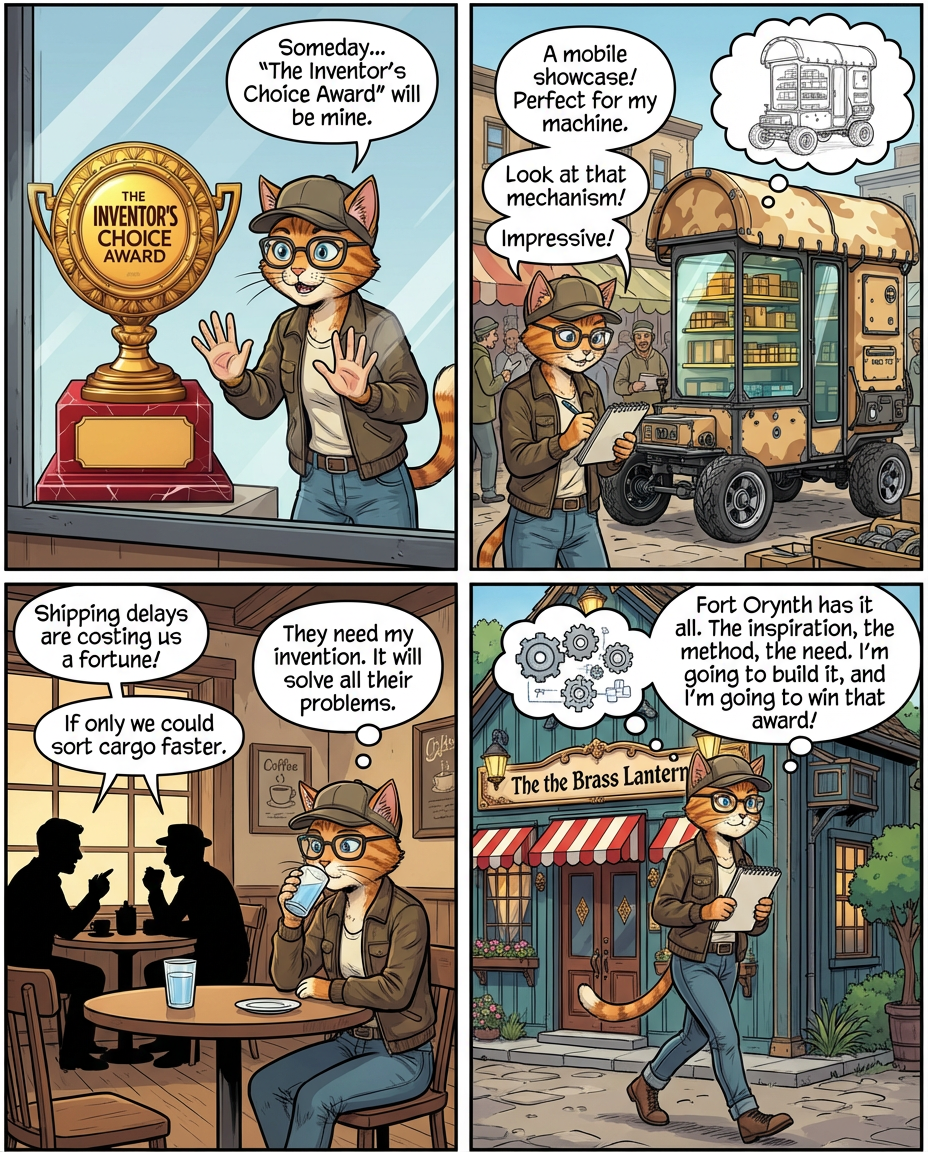
Lauren walked through Fort Orynth's western district where the warehouses stood. She needed to see where merchants stored their goods before delivery. Her machine would live here someday, sorting packages faster than any crew could manage. The dream felt closer now that she knew which buildings could house her invention. She turned down a side street and spotted something that made her stop. A gold and bronze award sat in a display case mounted on a red marble base. The plaque read "The Inventor's Choice Award." Lauren pressed her nose to the glass. This award went to inventors whose creations changed how people traded. Names were carved into the base—people who had actually done what she dreamed of doing. Her chest tightened. If she finished her machine, maybe her name would appear here too. Lauren continued walking until she reached the merchant quarter. A mobile wagon stood beside the road, its desert camo awning stretched over glass display cases. Inside the cases sat working prototypes of different tools and devices. Merchants gathered around, pointing at the items and asking questions. Lauren watched as the wagon's owner demonstrated each invention. This was exactly what she needed—a way to show her machine to traders before they decided to buy it. She pulled out her notebook and sketched the wagon's design. The afternoon sun beat down hard, and Lauren's throat felt dry. She spotted a coffee house ahead with a painted sign that read "The Brass Lantern." Through the windows she could see merchants sitting at tables, papers spread between them as they talked. Lauren pushed through the door and ordered water. She sat near a group discussing shipping routes and listened. These were the people her invention would help. Every complaint they mentioned was a problem her machine could solve. She finished her water and headed back outside, her mind buzzing with ideas. Fort Orynth had everything she needed—awards to chase, places to demonstrate her work, and people who would understand why her invention mattered.
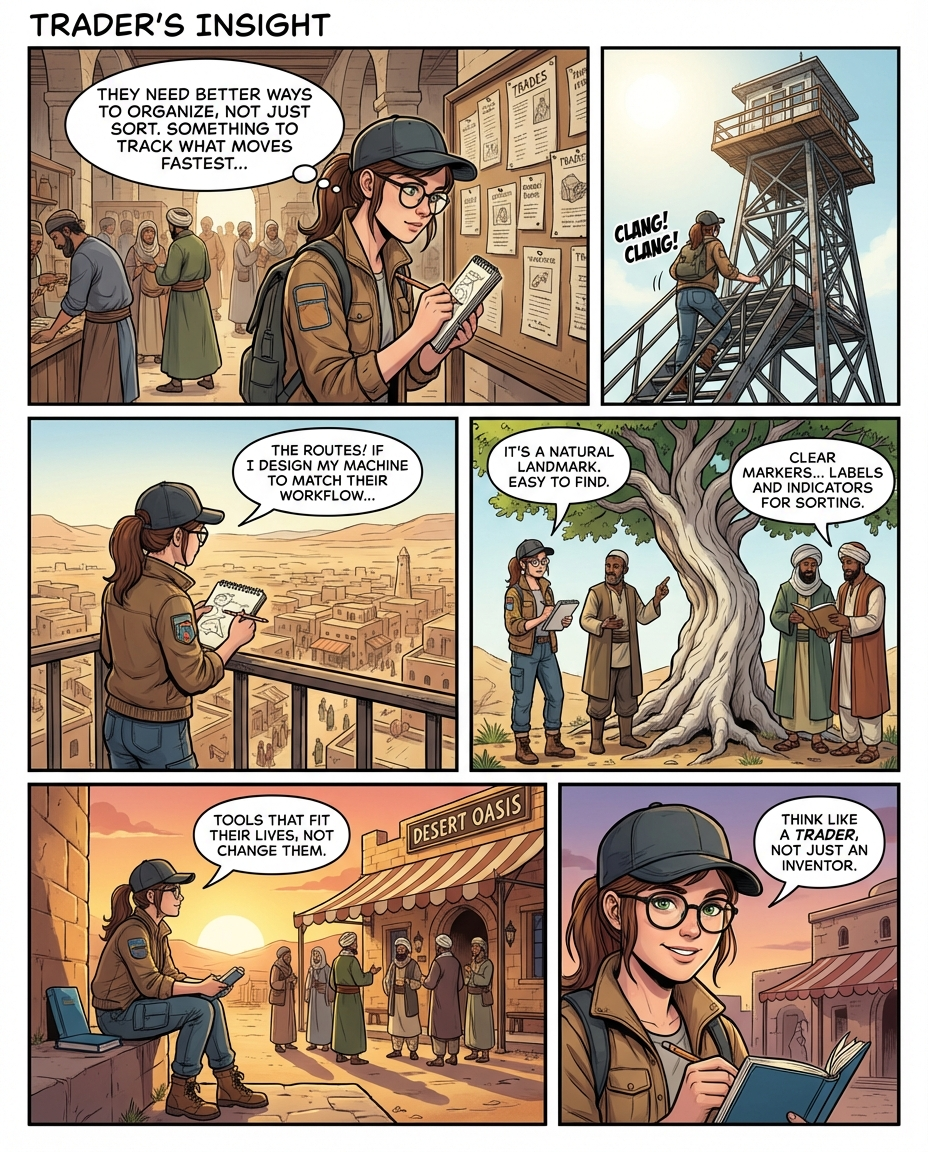
Lauren set her notebook on the workbench and flipped to a fresh page. The warehouse district had given her good ideas about where her sorting machine could live, but she needed to understand how traders actually made decisions. She walked to the merchants' hall where a bulletin board covered one wall. Notices about shipments and trade routes filled every inch of space. Her ears twitched as she read through the posts. Traders needed better ways to organize information, not just sort boxes. She pulled a pencil from her belt and started sketching a new feature for her machine—something that could track which goods moved fastest. The idea felt right, like a puzzle piece finally clicking into place. She left the hall and walked past a towering structure that caught her attention. The observation deck stood high above the ground, its metal frame weathered but solid. Lauren climbed the stairs, each step clanging under her boots. At the top, she could see the entire trade district spread below. Her eyes followed the paths merchants took between buildings. She pulled out her notebook and drew rough maps showing how traders moved from one place to another. If she understood their routes, she could design her machine to match their workflow. The view made everything clearer, like seeing all the pieces of her invention laid out at once. Back on the ground, Lauren spotted a tree with pale bark and twisted branches. Its unusual shape made it easy to remember. She walked toward it and noticed merchants using it as a meeting point. Two traders stood beneath its shade, examining a ledger together. Lauren approached and asked if they always met here. One trader nodded and explained that the tree's unique look made it a natural landmark. Lauren scribbled notes about navigation and reference points. Her machine would need clear markers too—labels and indicators that helped workers know exactly where each sorted item should go. The sun hung lower now, casting long shadows across the courtyard where more merchants gathered under a wide awning. The space felt designed for conversation, with traders sharing news about shipments and prices. Lauren sat on a low wall nearby and watched them work. These people needed tools that fit into their daily routines, not machines that forced them to change everything. She closed her notebook and stood up, feeling the weight of her blue logbook against her belt. Today taught her that invention meant more than building something clever. It meant watching, listening, and designing around the way people actually lived. Her sorting machine would work because she was learning to think like a trader, not just like an inventor.
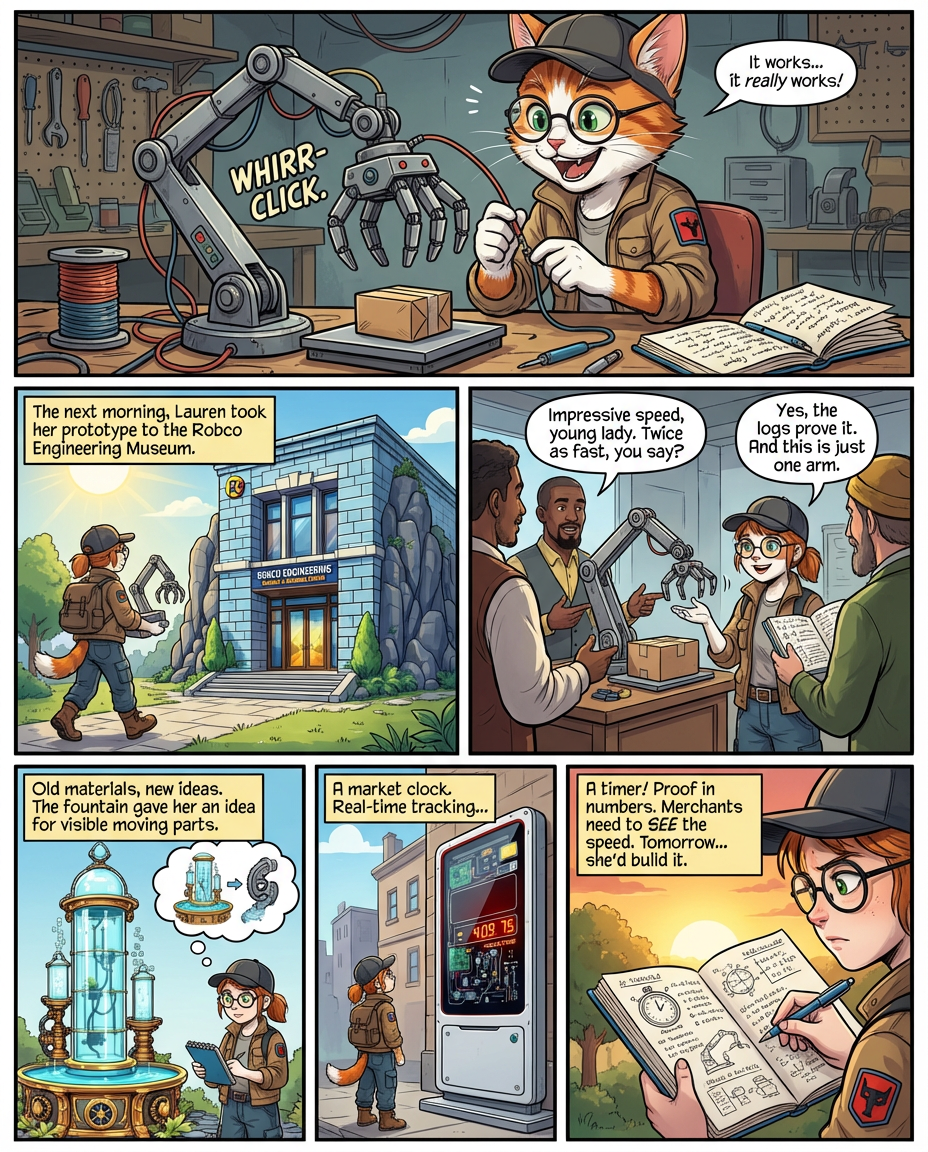
Lauren's hands shook as she connected the final wire on her prototype sorting arm. The mechanism whirred to life, its metal fingers opening and closing in smooth rhythm. She'd spent three days building this piece, and now it actually worked. Her tail swished behind her as she placed a small package on the testing platform. The arm's sensors detected the weight, calculated the size, and moved the package to the correct slot. Perfect. She grabbed her blue notebook and wrote down the success, her handwriting messier than usual because she couldn't stop grinning. This was real progress—not just an idea anymore, but something she could touch and demonstrate. If one arm could sort packages this well, a full machine with multiple arms would change everything for the merchants. She set down her pencil and watched the arm complete another cycle, feeling that quiet hope in her chest grow just a little bit louder. The next morning, Lauren carried the sorting arm to the Robco Engineering Museum and Learning Center. The building's blue and gray stone caught the sunlight as she pushed through the entrance doors. Inside, display cases lined the walls, filled with early prototypes from other inventors. Her chest felt tight as she set her sorting arm on the demonstration table they'd given her. A museum worker helped her connect it to power. When the arm activated and began moving packages between slots, three merchants stopped to watch. One asked how fast it could sort. Lauren showed them her notebook logs—the arm processed items twice as fast as manual sorting. The merchants nodded and asked more questions. By the time she packed up to leave, two of them had requested follow-up meetings. Lauren walked outside and spotted a fountain made of glass tubes and brass trim. Water flowed through the tubes in patterns that shifted and changed. She stood watching it for several minutes, her mind racing. The fountain combined old materials with new ideas, just like her sorting arm used salvaged parts and fresh thinking. She pulled out her notebook and sketched the flowing water design. Maybe her next prototype could include visible moving parts—something merchants could watch working, just like this fountain. The idea felt right. On her way back to the workshop, Lauren passed a large clock mounted outside a building. Its glass panels showed the wires and circuit boards inside, and a digital screen displayed numbers that counted down transaction times. She stopped and stared. The clock proved that machines could track business activity in real time. Her sorting arm already recorded package weights and sizes. If she added a timer like this clock had, merchants could see exactly how much faster her invention worked compared to manual methods. Lauren wrote furiously in her notebook, filling two pages with calculations and diagrams. Her prototype had proven the basic idea worked. Now she could build features that showed merchants the actual numbers—the proof they needed to trust her invention. She tucked the notebook back into her belt and headed home, already planning what she'd build tomorrow.
Play your story to life
Storycraft is a mobile game where you create AI characters, craft items and locations to build their world, then discover what direction your story takes. Download the iOS game for free today!
Download for free