

Environment Bug's Arc
7 Chapters
Environment Bug's dream is keeping the environment clean.

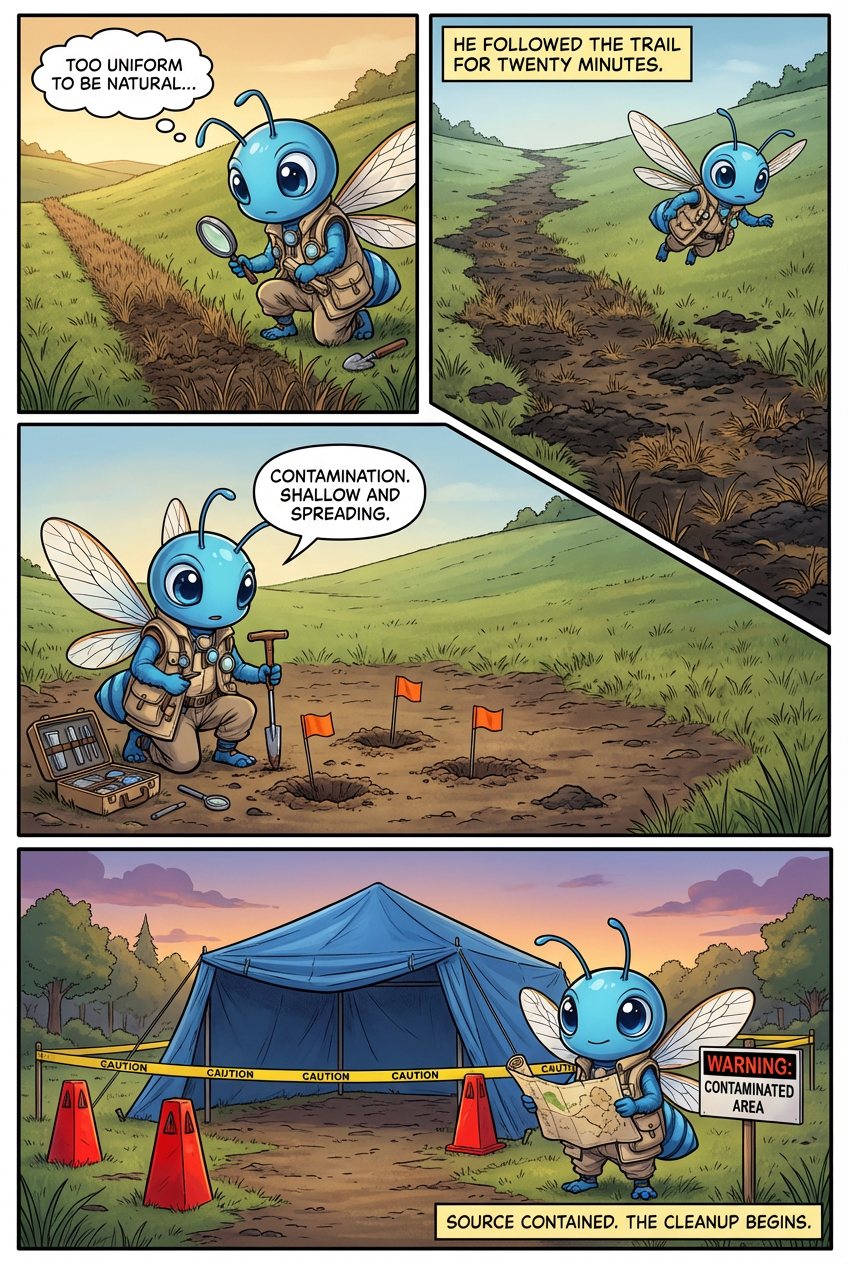
Environment Bug crouched beside a line of brown grass that cut through the green hillside. The blades crumbled when he touched them. He pulled his magnifying lens from his pack and scanned the ground. The dead strip ran downhill in a straight path, too uniform to be natural. Something was killing the vegetation from below. He followed the trail for twenty minutes, watching it widen as he moved. More plants withered along the edges. The soil darkened in patches. He stopped where the trail ended at a flat clearing and pulled out his soil probe. Three test holes confirmed it — contamination, buried shallow, spreading outward through the groundwater. He unpacked his field kit and laid out the safety equipment in rows on the ground. Yellow tape marked the perimeter. Orange flags marked each test point. His hazard marker stood at the center, bright red against the brown earth. This wasn't debris he could handle alone. By evening, a temporary structure rose over the contamination site. The old warehouse framework held tarps that kept rain from washing toxins further downhill. He'd flagged the location with the regional environmental team and posted warning signs on every approach. The source was contained. Now the real cleanup could begin.

The trucks arrived three days later. Environment Bug met them at the contamination site and watched the crew unload testing equipment. The lead technician ran new probes at wider intervals than Bug had marked. Each one came back positive. The contamination spread twice as far as his original tests showed. By noon, the crew had stopped drilling. They stood in a loose circle around the mobile command unit, speaking in low voices. Environment Bug walked over and waited. The lead technician finally turned to him, holding a printout. The contamination ran thirty feet deep in some areas. Remediation would require excavation equipment they didn't have on site. They'd need to bring in specialists and resurvey the entire hillside before any cleanup could start. Environment Bug looked at the rows of hazmat suits laid out beside the command unit, ready but unused. He thought about the temporary shelter he'd built, now barely covering a fraction of the actual contamination zone. His containment had worked for what he could see. But the real problem had been spreading underground for months, maybe years. He pulled out his map and marked the new boundaries the technician showed him. The dead strip of grass was just a symptom. The source went deeper than any surface test could reach. The crew packed up their testing gear and loaded the barrels they'd used as depth markers back onto the trucks. They'd return in two weeks with a full remediation team. Environment Bug stayed behind and expanded his warning perimeter, placing flags at the new boundaries. The site was contained again, but differently now. He wasn't waiting for cleanup to begin. He was waiting for someone to figure out how deep the damage actually went.

Environment Bug stood at the edge of the expanded perimeter two days before the specialists were scheduled to arrive. He ran one more test on the northern boundary, pushing the probe into the soft hillside soil. The sample came back streaked with something different this time. He set up a compact lab near the command site and ran the soil through a separation process. Under magnification, the contamination showed tiny fragments mixed throughout—microplastics, broken down and spread through every layer the chemical pollution had touched. The remediation crew coming in two days had equipment for toxins and fuel spills, not microscopic particles that required different containment protocols entirely. Environment Bug assembled a display board outside the lab with enlarged images from the microscope. He mounted photos of the soil samples at different magnifications, showing how the fragments appeared invisible to the eye but filled every grain when viewed up close. A few hikers passed by on the trail above and stopped to look. One asked what the colored specks were. Bug explained they were plastic pieces, too small to filter out with standard cleanup methods. The hiker stared at the images for a long moment, then walked on without responding. Bug installed red and white barriers around the updated contamination zone, marking it clearly for the specialists. He wrote a detailed report explaining the microplastic discovery and left it in the command unit with his test results. The crew would arrive in two days expecting one kind of problem. They'd find two. Bug packed his testing kit and moved to the next section of the perimeter. The site was contained, but the solution had just gotten more complicated.

Environment Bug walked the southern edge of the perimeter the next morning, checking the barrier posts he'd set the day before. A hiker stopped near the display board and studied the magnified soil samples for several minutes. Bug approached with a glass test tube containing soil and water. He shook it gently, and the liquid clouded with particles. The hiker squinted at it. "Is that from here?" Bug nodded and explained that the fragments came from the hillside just beyond the barriers. The hiker asked if it was dangerous. Bug said it depended on what you meant by dangerous—the pieces wouldn't kill you today, but they'd be here for decades, moving through soil and water. The hiker thanked him and walked away without another word. Bug returned to the small stone lodge he'd been using as a field station. Inside, he logged the morning's tests and updated his maps. A second hiker appeared at the open door and asked if she could see what he was working on. Bug showed her the microscope setup and explained how the contamination had two layers—the chemicals the crew would handle, and the fragments that required different methods. She asked if there was a plan for the second problem. Bug said he'd flagged it, but the crew coming tomorrow had tools for toxins, not plastics. She asked what happened if no one dealt with it. Bug said it would keep spreading. The woman pulled out a notebook and wrote down the site coordinates. She said she worked with a university research team studying soil contamination and asked if she could share his findings with them. Bug handed her a copy of his report. She read through it quickly, then asked if she could return with her team in a few days to collect samples. Bug said yes. She left with the report in hand. Bug sat back and looked at the barriers outside. The first problem had a crew. The second one had just found someone who wanted to solve it.

Bug sat at the stone counter in the lodge the next afternoon, organizing sample tubes by location. He heard footsteps outside and looked up. The researcher from the university stood in the doorway alone, earlier than expected. She set a leather briefcase on the counter and pulled out a folder. Her institution wanted to claim the site for a long-term study, she said. They'd handle the microplastics and the chemical contamination. Bug asked when her team would arrive. She said they wouldn't—not for remediation. The university planned to seal the area and monitor it as a research project. Public access would be restricted. Bug stared at her. He asked about cleanup. She said containment was more valuable than removal for their data. Bug walked outside to the perimeter. A wooden fence had already been installed along the eastern section, and workers were unloading posts for the rest. A new sign stood near the trailhead: University Testing Site—Keep Away. Bug returned to the lodge. The researcher was labeling sample tubes. He told her the regional crew was scheduled to arrive tomorrow with equipment for full cleanup. She said her institution had already contacted them to cancel. The site was now under academic jurisdiction. Bug picked up his own report from the counter and read through his findings. He'd flagged the contamination, documented both problems, and found someone who wanted to solve it. But he hadn't asked what solving meant to them. He closed the folder and looked at the researcher. He told her he'd forward her institution's claim to the regional team for review, but he wouldn't remove his barriers or stop logging the spread. She said that was fine—her team would be taking over monitoring within the week. Bug said nothing. He'd done his part correctly, but the site wouldn't be cleaned. It would be studied while it kept spreading.

Bug left the lodge at dawn and followed the dead vegetation strip uphill, past the new fence. He carried his probe and a notebook. The strip narrowed near a patch of cracked earth. In the center sat a heavy metal disc, half-buried, etched with old geometric patterns. He dug around its edge with his probe. The soil beneath stank of chemicals. He pried the disc up. A shaft dropped into darkness, lined with old pipe. The pipe ran sideways, not down. Bug followed its direction across the ridge, through brush, until he reached a clearing he had never mapped. A rusted shipping bin sat there, packed with leaking barrels marked with hazard symbols. The pipe fed straight into the ground beneath it. Bug climbed onto the bin and found a weathered logbook wedged behind the barrels. The pages listed dumping dates going back nine years. The header showed a faded logo from a closed drive-in theatre down the valley. The university had not caused this. Neither had any recent crew. The drive-in's old operators had buried their waste here and walked away. Bug photographed every page, then climbed down and sealed the bin with his warning tape. The site was no longer a research puzzle. It was a crime, with a name attached. He tucked the logbook into his pack and started back toward the lodge to file a new report — this time to someone with the authority to act.

Bug stopped halfway down the trail and opened the logbook again. One entry near the back named a building still standing at the old drive-in site. A projection shed. He turned around and hiked back over the ridge. The drive-in sat quiet in the valley, screen leaning, paint peeling. Tall weeds had swallowed the parking lanes for years. Bug pushed through them and reached the small shed behind the screen. The door hung loose on one hinge. Inside, the air was thick and sour. Bug shone his light across the floor. Behind a stack of old reels sat three more barrels, rusted, untouched. Green liquid pooled around their bases and soaked into the wood. The operators had never moved them. They had simply locked the door and left. Bug stepped back fast. He did not touch the barrels. This was past his training. He pulled his warning tape from his pack and crossed the doorway twice. He photographed each barrel, each seam, each stain. He wrote the shed's location beside the matching logbook entry. Then he sealed the building from the outside with a posted hazard notice. Bug shouldered his pack and started down the valley road. The logbook had named the place. The place had given up its last secret. Now he carried enough evidence to put real authorities on the ground — and the drive-in's hidden harm would not stay hidden one more day.
Play your story to life
Storycraft is a mobile game where you create AI characters, craft items and locations to build their world, then discover what direction your story takes. Download the iOS game for free today!
Download for free