

Cassie Bridger's Arc
7 Chapters
Cassie Bridger's dream is building a world where all of the ideas in her imagination can come to life.

Cassie Bridger pressed her paintbrush against the blank canvas and frowned. She wanted to build a world where everything in her head could become real. Her flower crown slipped forward as she leaned closer. The rainbow tutu swished around her boots. The bedroom felt too small for big ideas. She set down her brush and walked to the window. Outside, behind the vegetable garden, stood an old weathered shed. Gray paint peeled from the wooden walls in long strips. Weeds grew tall around the doorway. Cassie touched the glass with her fingertips. That shed could be her creative space. It had room for paints and paper and all the things she needed. She could make it perfect for building worlds. Cassie ran downstairs and out the back door. Her boots thumped across the grass. The shed door stuck hard, then scraped open with a loud creak. Dust floated through the afternoon light. Cobwebs hung thick in every corner. Old pots and rusty tools lined the walls. She pulled off her flower crown and placed it on a dusty workbench. This was it. This was where she would create everything. She spun around once, her tutu flaring out wide. The shed would become her workshop. Here, all the creatures and places in her mind could finally become real. She grabbed a broom from the corner and got to work. Three hours later, the shed looked different. Cassie had swept the floors and wiped down the walls. She painted the outside in soft pastel colors. Pink, yellow, and pale blue covered the gray wood. The flower crown sat back on her head now. She carried in her paints, brushes, and stacks of paper. Against the back wall, she set up a small plastic easel with chunky rounded legs. It sparkled just a little in the sunlight. On it, she placed her first blank canvas. The shed felt warm and ready. This was her space now. This was where her imagination would come to life. She dipped her brush in bright green paint and made the first stroke. The green paint swirled into a tree on the canvas. Then came purple flowers and a yellow sky. Cassie painted for hours without stopping. When the light grew dim, she stepped back and smiled. The painting showed a place she had seen only in her head. Now it lived outside of her too. She looked around the whimsical garden shed and knew this was just the start. Tomorrow she would build a shelf from weathered wood to hold glass jars. People could write their dreams on paper and place them inside. She would find a way to show her work where others could see it. This shed was more than just a room. It was the beginning of something bigger. A place where imagination turned into something real. Cassie cleaned her brushes and closed the shed door behind her. Her world was starting to grow.
Cassie opened the shed door the next morning and took a deep breath. The smell of fresh paint still hung in the air. She had her creative space now, but she needed to learn how to really use it. Her brushes sat ready on the workbench. The canvas from yesterday leaned against the wall, dry and complete. Today was different though. Today she would practice making her ideas stronger and clearer. She opened the first book and studied the pages about mixing colors. The pictures showed how blue and yellow made green. Red and white turned into pink. She tried each combination on a small piece of paper. The colors came out just like the book showed. Hours passed as she practiced brush strokes and shading. When the sun started to set, darkness crept into the shed. She couldn't see her paper anymore. Cassie walked to the corner and found an old glass jar covered in dust. She cleaned it with her sleeve and carried it outside. In the tall grass near the garden, fireflies drifted through the air. She caught seven of them gently and placed them inside the jar. Their soft glow lit up the glass with warm golden light. Back in the shed, she set the jar on her workbench. The firefly lantern cast enough light to keep working. She picked up her brush again and painted until the moon rose high. Her ideas were getting clearer. Her hands were getting steadier. She was learning how to build her world one small step at a time. The next day brought rain. Fat drops drummed against the shed roof. Cassie needed a better way to store her supplies. Water might leak through the walls. She found an old metal toolbox behind the garden fence. Rust covered the corners, but it was still strong. She carried it inside and set it on the floor. With leftover paint from the walls, she covered the toolbox in pastel colors. She added simple shapes with her smallest brush. Stars. Moons. Little flowers. When it dried, she packed her extra brushes and tubes of paint inside. The toolbox closed tight and would keep everything safe. Cassie stood back and smiled. Her shed had light for the dark hours. Her supplies had protection from the weather. She was building more than just paintings now. She was building the tools she needed to make her imagination real. By the end of the week, Cassie realized something important. She needed more than practice and tools. She needed ideas from beyond her own head. During her walk through town, she spotted old wooden boards near a construction site. The workers said she could take them. She dragged the boards home and spent two days building. She hammered and painted until a small castle stood at the end of her street. It had crooked turrets and mismatched angles. Soft pastel colors covered every surface. Tiny flags waved from the pointed tops. She placed books inside that she had already read. Other people could leave books too. Now she had a place to discover new stories and learn how other people brought their worlds to life. Cassie stepped back and adjusted her flower crown. Her imagination was growing stronger every day.
Cassie stood in her shed and looked at everything she had built so far. The painted walls glowed soft in the morning light. Her supplies filled the decorated toolbox. The firefly jar sat empty on the workbench, waiting for night. She had her space and her tools, but something was missing. Her world needed more than just one small room. She grabbed her sketchbook and stepped outside. The town spread out before her like a map she had never really studied. If she wanted her imagination to grow, she needed to find the places that would help it happen. She walked past the little castle library at the end of her street and kept going. Three blocks down, she found a community garden with beds of vegetables and flowers. People worked together there, sharing ideas and seeds. Further on, an art supply shop had a bulletin board covered in colorful flyers about classes and gallery shows. At the edge of town, an empty lot stretched wide and flat, perfect for outdoor projects. Cassie wrote down each location in her sketchbook. These places could give her what she needed. New skills. New people. New ways to make her ideas real. She walked back home as the sun climbed higher. Her world was bigger than her shed now, and it would keep growing. The next morning, Cassie found an old wooden board in the garage. She carried it to her workbench and painted carefully across the surface. The letters came out crooked but clear: "Cup o' tea 25¢." She added small yellow flowers around the edges and let it dry. When she set up two chairs on the grass with a thermos of sweet tea, a woman with gray hair stopped first. They talked about gardens and favorite colors. A boy on a skateboard came next and told her about a comic book he was drawing. Each person brought a new idea or story. Cassie filled three pages in her sketchbook with notes and drawings. The tea stand became more than just drinks. It was a place where creative minds could meet and share what they imagined. By sunset, she had learned about five new projects she wanted to try and met people who promised to come back. Her world wasn't just growing in size anymore. It was growing with voices and dreams that weren't only hers. The woman with gray hair returned two days later with something in her hands. She gave Cassie pieces of cardboard and colored markers. Together they made a new sign for the little castle library. Cassie drew swirls and stars on the mismatched pieces. She wrote "The Reel Masheen" across the top in crooked letters. The woman helped her tape it all together. When they hung it near the castle's door, it seemed to glow just a little in the afternoon light. Now people would know when fresh stories waited inside. Cassie stepped back and adjusted her flower crown. The tea stand had brought her new friends. Those friends had helped her build something she couldn't make alone. Her world was becoming real because other people wanted to help it grow. She wasn't building by herself anymore. The next week, Cassie gathered all the cardboard boxes she could find. She stacked them in the empty lot at the edge of town. Each box got covered in crayon drawings and pencil notes. She added stickers to the corners and painted pastel colors over the brown surface. The structure grew taller and wider each day. People stopped to watch and started bringing their own boxes to add. By the end of the week, a crooked cardboard building stood in the lot with a soft glow coming from a window in the center. Cassie placed a sign on the front that read "Ideas Become Real Here." Inside, people left drawings and stories and little objects they had made. The town now had a place that showed how imagination could turn into something everyone could touch and see. Cassie sat on the grass and opened her sketchbook. Her world wasn't just in her head or her shed anymore. It lived in the spaces between people, in the things they built together, and in every story they chose to share.
Cassie walked through town with her sketchbook tucked under her arm. The cardboard building in the lot had shown her something important. Her world needed more places where imagination could take shape. She stopped at the park and watched children climb on the old metal playground. Their laughter echoed across the grass. She sat on a bench and opened her sketchbook. The park had been there her whole life, but she had never really looked at it before. Dirt paths crisscrossed the grass in every direction. Some curved around trees. Others connected the playground to the picnic tables. She walked along one path that split into five different directions. The shape reminded her of something. She knelt down and traced the pattern with her finger. It was a star. Years of footsteps had worn the dirt into five points that met in the center. Moss grew along the edges in soft green patches. In spring, the moss would turn bright and thick. In fall, it would fade to brown. The path changed with the seasons, making new art each time the weather shifted. Cassie pulled out her pencil and sketched the star pattern into her notebook. She added notes about the moss and the way different paths connected at strange angles. The park already held imagination in its ground. People had walked these routes so many times that nature had turned their steps into something beautiful. She didn't need to build anything new here. She just needed to help people see what was already there. Cassie stood and brushed dirt from her knees. Her world was growing because she was learning to notice the art that existed all around her. Sometimes imagination didn't need to be built from scratch. Sometimes it just needed someone to point it out and say, "Look at what we made together without even trying." She walked to the edge of the park where wildflowers grew thick near the fence. Purple petals mixed with bright yellow ones. Red leaves hung from low branches. She found a plastic cup half-buried in the grass and rinsed it at the water fountain. Then she gathered what she could use. A twig with rough bark. A smooth gray stone. Three different flowers with stems still wet. A leaf shaped like a heart. She dropped each item into the cup and held it up to the light. The colors looked almost painted already. Back at her bench, she dipped the stone in puddle water and dragged it across a blank page. It left a dark gray streak. The flower made a purple smudge. The leaf pressed a green outline. She worked through the cup, testing each piece. Nature had given her tools that no art store could sell. Her sketchbook filled with marks and colors that came straight from the ground. When the cup was empty, she looked at the pages and smiled. Her world didn't always need paint and brushes. Sometimes it just needed her to pay attention to what was already growing wild. The afternoon sun climbed higher as Cassie left the park. She walked until she spotted a tall structure rising above the other buildings. Someone had stacked boxes and crates and old furniture into a tower that leaned slightly to one side. Paint covered every surface in bright colors and patterns. Flags made from torn fabric flew from the top. It looked like something a child would build while pretending to be royalty in a castle. Cassie stood at the base and looked up. The tower was crooked and strange, but everyone in town knew exactly where it was. People gave directions using it as a marker. Her sketchbook now held three new pieces of her world. The star path showed how art could form without anyone planning it. The cup of nature's tools proved that imagination lived in simple things. And this tower reminded her that the best creations didn't need to be perfect. They just needed to be bold enough that people couldn't ignore them. Cassie adjusted her flower crown and headed home. Her world was full of landmarks now, each one teaching her something different about how ideas became real.
Cassie taped her newest sketch to the shed wall and stepped back to look at it. The drawing showed the star-shaped path from the park with notes about the moss growing along its edges. Her world was taking shape in ways she could see and touch now. She wanted to share what she had found with everyone who walked through town. In the garage, she dug through a pile of old wood until she found a window frame with six empty panes. The wood felt smooth under her fingers. She carried it to her workbench and wiped away the dust. This frame could hold her drawings where people would see them every day. She slid her park sketch behind the glass and stepped back. The star path looked important now, like art in a museum. She made five more drawings that week. Each one showed a different piece of her world. The cardboard building. The crooked tower. The teacup filled with flowers and leaves. When all six panes held a drawing, the frame looked complete. Cassie carried the window frame outside and leaned it against the fence where the sidewalk met her yard. People walking past stopped to look. A man pointed at the star path drawing and smiled. Two kids pressed their faces close to see the details. By evening, three people had knocked on her door to ask about the art. Her imagination wasn't hidden in her shed anymore. It lived out in the open where the whole town could see it. Cassie sat on her front steps and watched the last bit of sunlight hit the glass. Her world was becoming real, one window pane at a time. The woman with gray hair returned the next morning with an armful of scarves. She spread them across Cassie's front yard in bright reds and deep purples and soft yellows. Together they tied the fabric to four wooden posts and draped more scarves between them. The material hung loose and moved with the wind. Light passed through the layers and made colored shadows on the grass below. By afternoon, they had built a small pavilion that looked like something from a dream. People gathered underneath to look at more of Cassie's drawings spread across a folding table. A girl traced her finger over a sketch of the cardboard building. An old man asked questions about the crooked tower. Everyone wanted to know where these places were and how they could visit them. Cassie handed out small maps she had drawn that showed each location in town. The pavilion became a meeting spot where her ideas could live and breathe and grow bigger. Visitors stayed for hours, talking about their own projects and sharing stories about things they wanted to build. By sunset, Cassie stood inside the pavilion and looked out through the colored fabric. Her world had moved from her head to her shed to her yard and now into this space where the whole community could gather. She had shown everyone that imagination didn't have to stay invisible. It could become real through wood and glass and fabric and sharing. People were seeing what she saw now. They were helping her world grow in ways she couldn't do alone. She adjusted her flower crown and smiled at the visitors still talking under the scarves. This was what success felt like. Not finished, but moving forward. Not perfect, but real enough to touch. The little castle library needed something special to match all she had built. Cassie spent the next afternoon folding old book pages into butterfly shapes. She creased each wing carefully until the paper stayed in place. She made seven butterflies total and painted their edges with yellow marker so they seemed to glow. Back at the library, she hung them near the door with fishing line. They turned slowly in the breeze, pages spreading like real wings. A mother and her daughter stopped to watch them spin. The girl reached up to touch one and laughed when it bobbed away from her fingers. The library entrance looked like the start of a story now, the kind where magic waited just inside. Cassie stepped back and checked her sketchbook. Her world had landmarks and meeting places and small touches of wonder. Each piece proved that ideas didn't have to stay locked in her head. They could fly free where everyone could see them.
The storm arrived on Tuesday and turned everything gray. Rain pounded the scarves of Cassie's pavilion until the fabric sagged and pooled with water. By morning, two posts had fallen over and the whole structure lay collapsed in the mud. Cassie stood in her yard and stared at the mess. The scarves lay twisted around broken posts. Mud covered the bright colors until they looked brown and dead. She pulled one scarf free and water poured out of it. The fabric tore where it had been tied too tight. All that work with the woman who brought the scarves was gone. She picked up pieces of wood that had snapped in half. Her hands shook as she gathered what she could save. Most of it went into the trash bin by the garage. The folding table had blown into the fence and cracked down the middle. Her drawings were missing, probably blown into someone else's yard or dissolved into pulp somewhere in the grass. She walked back to her shed and sat on the floor. Her world had felt so real under that pavilion, but the storm proved how fragile it all was. Inside the shed, she found her old stuffed bear wedged between two boxes. Its arm had torn off months ago and she had sewn it back on with pink thread. The stitches were crooked and visible. She had wrapped the arm in a cast made from cardboard and tape after the repair. The bear looked wounded but loved. She set it on her workbench and stared at it. The bear had broken and she had fixed it, but the repair showed. The cast and stitches proved that something had gone wrong. Maybe that was okay. Maybe her world needed to show the broken parts too, not just the pretty ones. She picked up her sketchbook and drew the bear with its cast and messy stitches. Underneath she wrote a note about how imagination needed care, just like anything real. The pavilion was gone, but the lesson wasn't. She could rebuild, and this time she would make it stronger. The next day she walked through the puddles in her yard looking for pieces she could use again. A broken post lay near the fence. Scraps of fabric hung from the bushes like flags. She gathered metal springs, plastic bottles, and a dented bucket the storm had blown in from somewhere else. Back at her workbench, she started fitting pieces together. The bucket became a body. Springs became arms that bounced when she touched them. Bottle caps made eyes that caught the light. By afternoon, she had built a small figure that looked like a robot made by a child. It was rough and silly and held together with wire, but it stood on its own. She carried it outside and set it near where the pavilion used to be. Water from yesterday's rain had collected in a low spot in the grass. The figure reflected in the puddle, its bottle-cap eyes shining back double. Even broken things could make something new. Even storms couldn't wash away what she had learned. Her world would keep growing because she knew how to build it back, scars and all. She brought the repaired bear outside and set it next to the junk sculpture. Then she went back to the shed and found her old stuffed bunny and cat. She arranged all three on a crate facing the sculpture like they were listening to a story. Before she tried to rebuild the pavilion for real people, she needed to test her ideas on an audience that wouldn't judge her mistakes. She spent the rest of the week building small structures in front of the stuffed animals. Some collapsed right away. Others stood for a day before falling apart. Each time something failed, she sat with the animals and talked through what went wrong. The bear with its cast reminded her that repairs were part of the process. The junk sculpture proved that beauty came from broken pieces. And her quiet audience taught her that failing in private was how she learned to succeed in public. When she finally knew how to build something that would last through the next storm, she would be ready to share it with the town again.
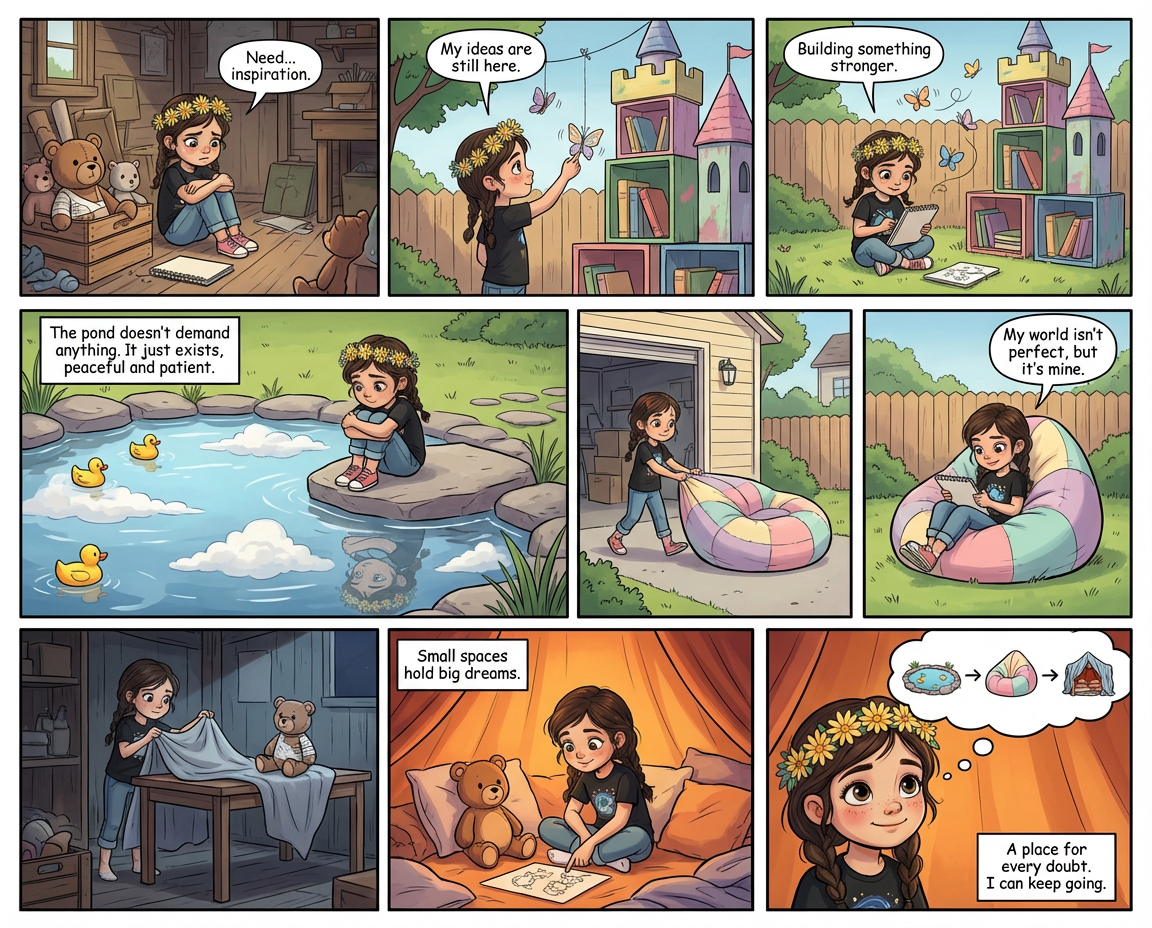
Cassie sat on the floor of her shed with her sketchbook closed on her lap. The stuffed animals stared at her from the crate, but they didn't make her feel better today. She needed to go somewhere that reminded her why she started building her world in the first place. She stood up and walked to the little castle library she had made weeks ago. The paper butterflies still hung near the door, turning slowly in the breeze. She reached out and touched one. It spun away from her fingers just like it had done for the little girl. The butterfly kept moving even after she let go. Her ideas were still here, still working, still bringing small moments of wonder to people who passed by. She sat down on the grass in front of the library and opened her sketchbook to a blank page. The butterflies danced above her head while she drew a new plan for something stronger than before. Her pencil stopped moving halfway through a sketch of a new structure. The doubt was still there, sitting heavy in her chest. She needed more than just the library today. She walked past the shed and through the gap in the back fence until she found the shallow pond she had discovered last week. Smooth stones bordered the water's edge, and soft mud squished under her boots as she stepped closer. The surface reflected the clouds above like a mirror. She sat down on the largest flat stone and hugged her knees to her chest. The water was so still that she could see her flower crown reflected perfectly below. This place felt quiet in a way that made her thoughts slow down and spread out. She stayed there for a long time, watching the reflections shift when the breeze touched the water. The pond didn't demand anything from her. It just existed, peaceful and patient, waiting for her to remember what mattered. When she finally stood up, her boots left prints in the soft mud, but the water smoothed itself back to glass. She walked home with her sketchbook tucked under her arm, ready to try again. Back in her yard, she pulled an old bean bag chair from the garage and dragged it to the spot where the pavilion used to stand. The fabric was faded pastel patches stitched together years ago. It slouched when she dropped it on the grass. She sat down and the bean bag wrapped around her like a hug. From here she could see the junk sculpture and the stuffed animals and the little castle library in the distance. All the things she had made were still standing, still real, even after the storm. The pond had shown her that some places just exist without trying to be anything else. The bean bag gave her a spot to sit when the doubt came back. She opened her sketchbook and looked at the half-finished sketch from earlier. This time her pencil moved across the page with confidence. She drew a new structure with stronger posts and fabric that could be taken down before storms arrived. Her world wasn't perfect, but it was hers, and she would keep building it one idea at a time. That evening, she gathered old blankets from her closet and carried them to the wooden table in her shed. She draped them over the edges until they touched the floor on all sides. She crawled underneath and sat cross-legged in the dim space. The fabric walls glowed orange from the light outside. She brought the stuffed bear with the cardboard cast and set it beside her. This blanket fort felt safe in a way the big pavilion never had. When her ideas felt too hard to build, she could come here and remember that small spaces could hold big dreams. She traced her finger over the sketch in her lap. The pond taught her to be still. The bean bag gave her a place to rest. And this fort reminded her that sometimes she needed to go small before she could build big again. She had places now for every kind of doubt, and that meant she could keep going no matter what came next.
Play your story to life
Storycraft is a mobile game where you create AI characters, craft items and locations to build their world, then discover what direction your story takes. Download the iOS game for free today!
Download for free