

Leo Chen's Arc
3 Chapters
Leo Chen's dream is building a crime lab that becomes the standard for every ranger team.

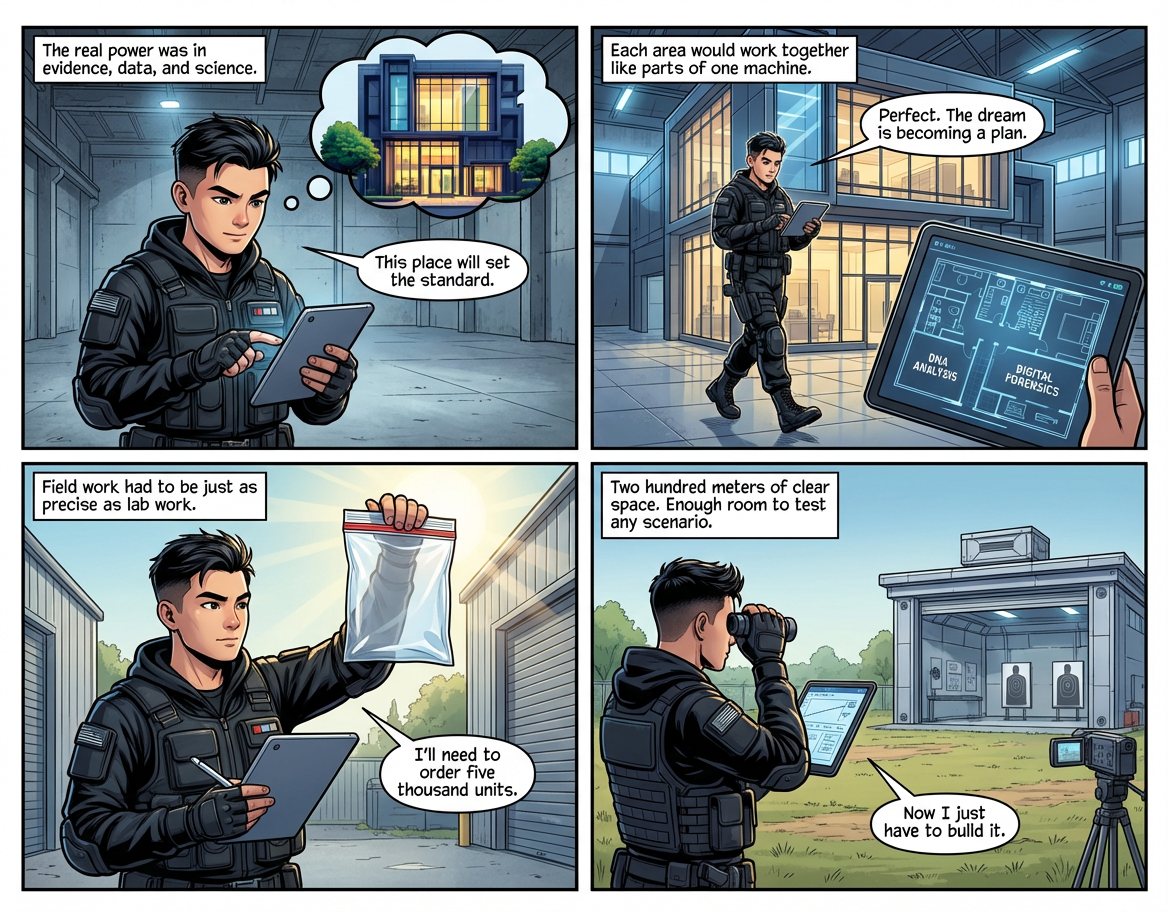
Leo Chen adjusted his tactical gloves and stepped into the empty warehouse that would become his dream. He wanted to build the best crime lab any ranger team had ever seen. Other teams fought monsters with weapons and muscle. Leo knew the real power was in evidence, data, and science. This place would set the standard. He pulled out his tablet and started mapping the space, already imagining where each station would go. He sketched out sections on the screen with quick swipes of his finger. The forensic evidence analysis lab would line the east wall with sleek steel and glass. Intricate instruments would fill every station. LED panels would light the whole space with a clean, bright glow. Leo looked up from the tablet and walked the length of the warehouse. His boots echoed on the concrete floor. The space was bigger than he thought. Perfect for what he needed. He marked another section for DNA analysis, then one for digital forensics. Each area would work together like parts of one machine. Rangers from every team would come here to learn. They would see how real investigation worked. Leo saved his design and smiled. The dream was becoming a plan, and the plan was becoming real. Outside, Leo paced the back lot behind the warehouse. He needed more than just indoor labs. Crime scenes happened everywhere, and rangers had to know how to handle evidence in the field. He pulled a transparent bag from his vest pocket and held it up to the light. The tamper-evident seal ran along the top edge. Simple, but critical. Rangers would use these forensic evidence bags to collect and protect materials at outdoor locations. Leo made a note on his tablet to order five thousand units. Field work had to be just as precise as lab work. He walked further out to the empty field beyond the lot. This space would become the forensic science gun range. Rangers needed to understand weapon trajectories and impact patterns. The facility would have advanced ballistic testing areas where teams could study how projectiles moved and hit targets. Leo measured the distance with his eyes and then his rangefinder. Two hundred meters of clear space. Enough room to test any scenario. He typed the measurements into his tablet and checked his design one more time. Every piece was coming together. The warehouse for analysis, the bags for collection, the range for ballistics. This lab would change how every ranger team worked. Leo looked back at the warehouse and nodded. The standard was set. Now he just had to build it.
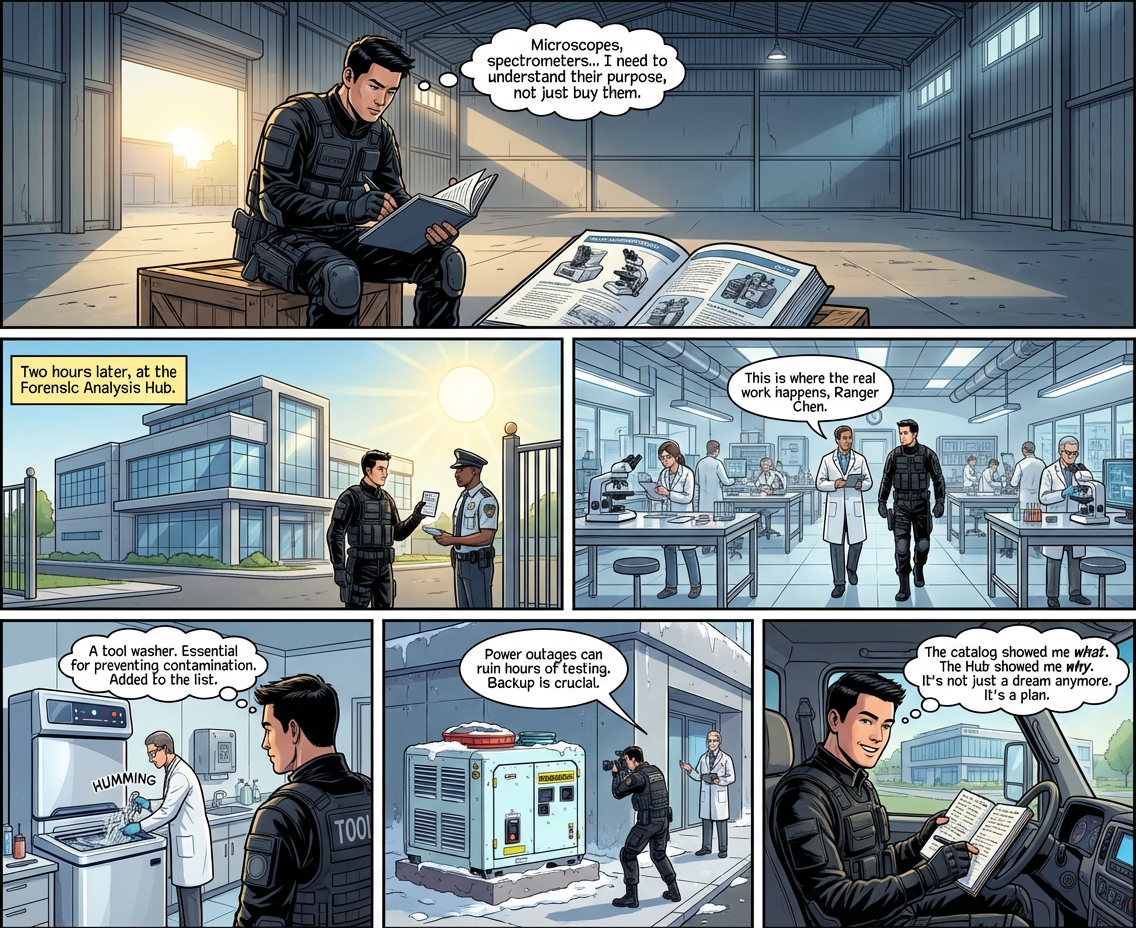
Leo stepped through the warehouse doors at dawn, a heavy equipment catalog tucked under his arm. The design was done. Now he needed to learn what actually went inside a crime lab. He flipped open the catalog to the first marked page. Microscopes, spectrometers, centrifuges—each tool had a purpose he needed to understand. He couldn't just buy equipment and hope it worked together. Real forensic scientists trained for years to master these instruments. Leo had ranger training and determination, but that wasn't enough. He sat on an empty crate and started reading. Each page showed complex machines with technical specifications he barely understood. He wrote notes in the margins, circling terms to research later. This was the first real step. Learning what the tools did, how they connected, and why they mattered. The dream needed knowledge before it needed steel and glass. Two hours later, Leo locked the warehouse and drove across town. He needed to see a real crime lab in action. The Forensic Analysis Hub sat behind a security gate, all steel and glass under the morning sun. Leo showed his ranger credentials at the desk. A technician in a white coat led him through the main lab floor. Chrome tables held rows of microscopes. Computer screens displayed chemical formulas. Scientists moved between stations with labeled evidence bags and careful hands. Leo watched everything, taking mental notes. This was what his warehouse needed to become. The technician showed him a side room where a tool washer hummed quietly against the wall. Between tests, every instrument had to be cleaned to prevent contamination. Leo watched a scientist rinse tweezers and scalpels under the steady stream of water. Simple, but critical. He added it to his list. His lab would need the same station for preparing tools between different evidence samples. Outside, Leo noticed a generator sitting near the building's back corner. The technician explained that power outages couldn't stop forensic work. Sensitive machines needed constant electricity or hours of testing could be lost. Leo photographed the setup with his phone. His warehouse would need backup power too, something reliable that could run through any storm. He thanked the technician and walked back to his truck. The catalog had shown him what to buy. The Forensic Analysis Hub showed him why it all mattered. Leo started the engine and pulled out his notebook. The list was growing, and so was his understanding. The crime lab wasn't just a dream anymore. It was becoming a plan he could actually build.
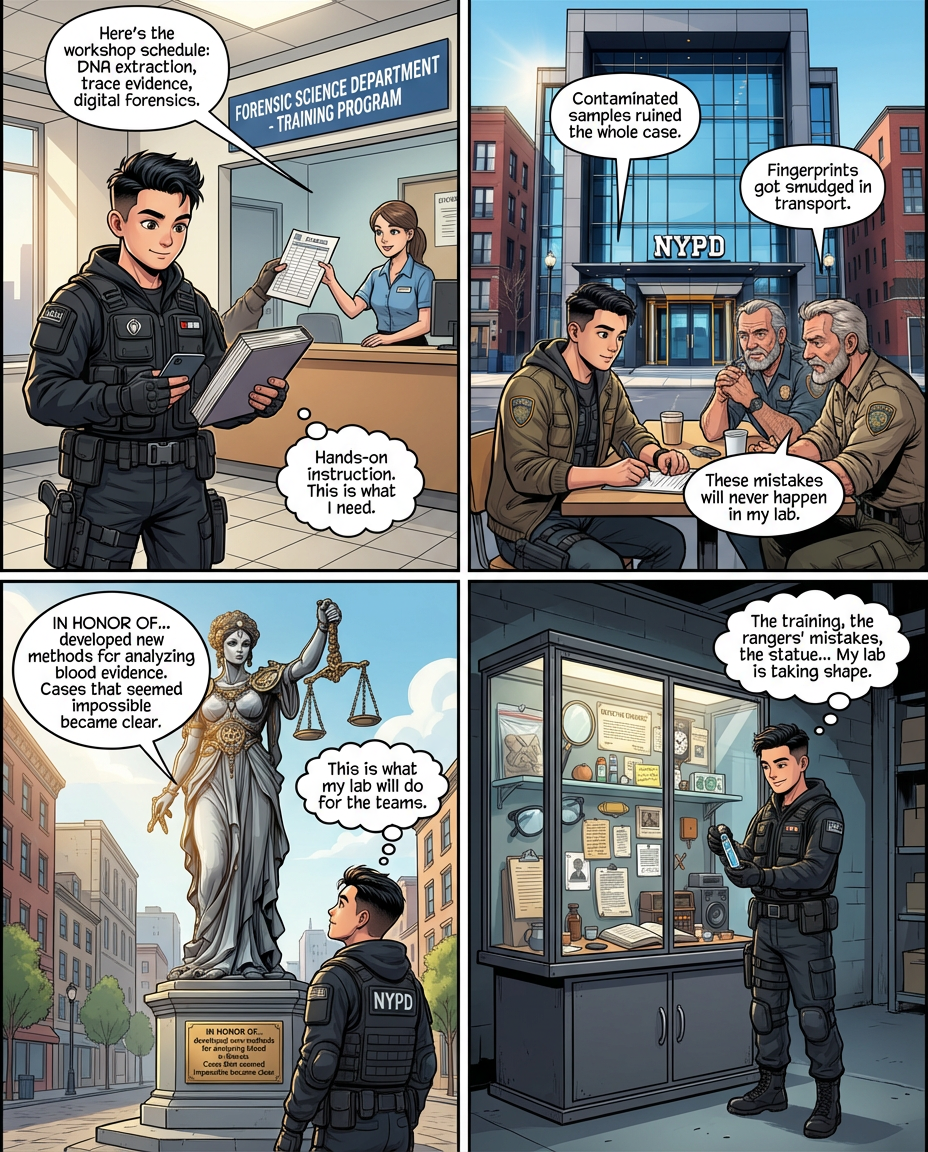
Leo pulled into the university parking lot and checked the address on his phone. The Forensic Science Department ran a training program that taught law enforcement teams how to use advanced lab equipment. He needed more than catalogs and observation now. He needed hands-on instruction from people who actually ran crime labs every day. Inside the main building, he found the registration office and signed up for the next available workshop. The clerk handed him a schedule showing classes on DNA extraction, trace evidence analysis, and digital forensics. Leo folded the paper and slipped it into his vest pocket. This place would teach him what he couldn't learn alone. When he walked back to his truck, he felt the weight of the catalog under his arm differently now. Soon he would know exactly how to use everything inside it. The next morning, Leo drove downtown to meet with veteran rangers at the Manhattan Precinct Office. The blue-glass facade caught the sunlight as he approached. Inside, officers and rangers sat around tables drinking coffee and talking about their cases. Leo listened as they described crime scenes that had gone wrong because evidence wasn't collected properly. One ranger mentioned contaminated samples that ruined an entire investigation. Another talked about fingerprints that got smudged during transport. Leo took notes on everything they said. These mistakes would never happen in his lab. After the meeting, Leo walked through the city center and stopped at a statue in the town square. The Victorian Clockwork Justice Statue stood tall, all gray stone and intricate gears. A plaque at the base honored a scientist who had changed forensic investigation decades ago. Leo read how the scientist had developed new methods for analyzing blood evidence. Courts started using science instead of just witness statements. Cases that seemed impossible to solve became clear. Leo stepped back and looked up at the statue. This was exactly what his lab would do for ranger teams. By evening, Leo returned to the warehouse with a new piece for the entrance. He set up the Detective Evidence Display Case just inside the door where visiting teams would see it first. Inside the sleek case, he arranged sample evidence bags, analysis reports, and photographs showing how proper forensics worked. Each item told a story about careful collection and precise testing. When ranger teams came to learn, they would see this display and understand what real investigation looked like. Leo locked the case and stepped back. The training would give him knowledge. The rangers' mistakes would teach him what to avoid. The statue reminded him why it all mattered. His lab was taking shape, one piece at a time.
Play your story to life
Storycraft is a mobile game where you create AI characters, craft items and locations to build their world, then discover what direction your story takes. Download the iOS game for free today!
Download for free