

Faeiria Glassboria's Arc
11 Chapters
Faeiria Glassboria's dream is helping Cinderella reach her dreams and go to the ball.

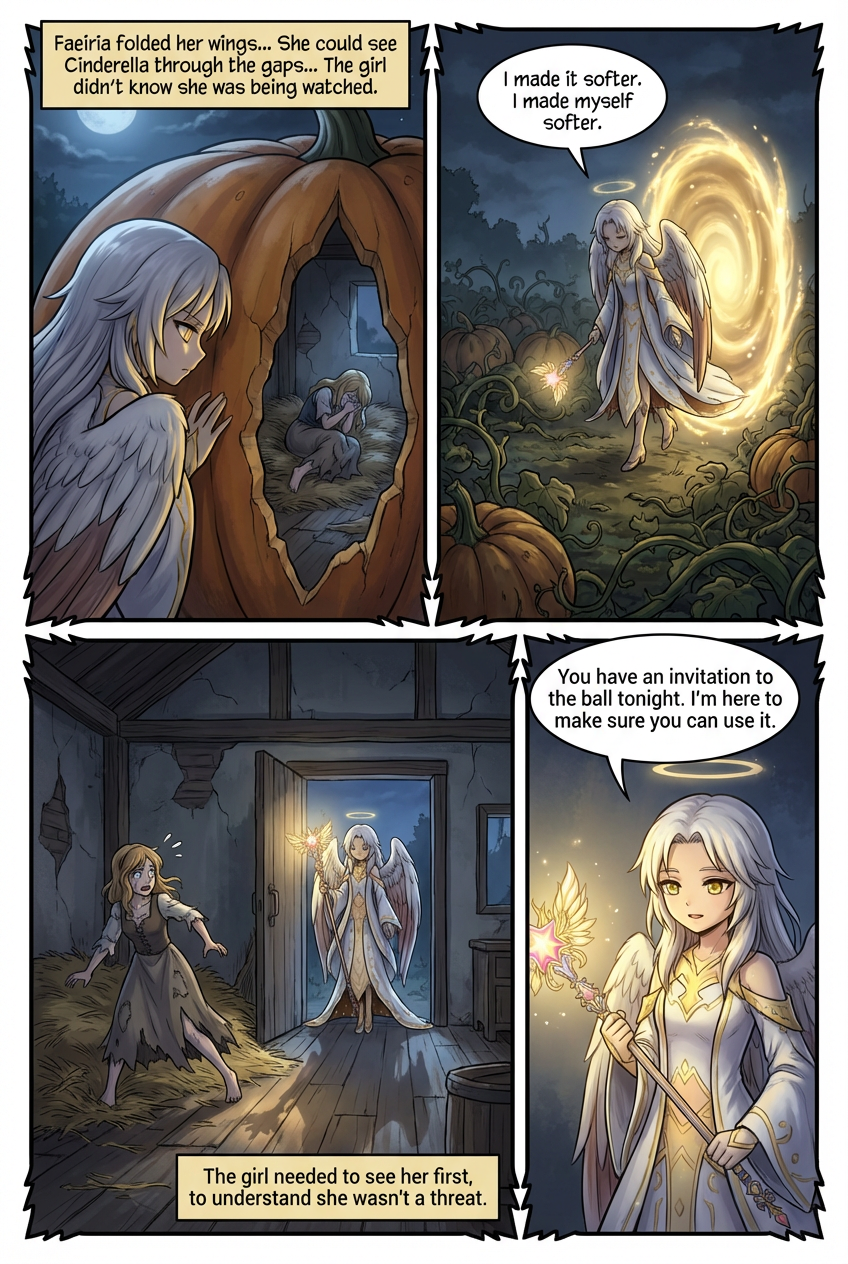
Faeiria folded her wings into something smaller, something that wouldn't crack the walls of the crumbling cottage. She could see Cinderella through the gaps in the pumpkin shell, curled on a pile of straw, still wearing the ash-stained dress from this morning. The girl didn't know she was being watched. She didn't know that tonight's invitation would turn to dust at midnight, or that someone had been sent to make sure she could use it. Faeiria stepped through the portal she'd opened in the forgotten pumpkin patch. The swirling light cast shadows across the overgrown vines and wilted flowers. She pulled her true form tighter, pressing down wings that wanted to unfold, dimming eyes that saw in directions mortals couldn't name. The wand in her hand pulsed once, its celestial glow too bright for this dark place. She made it softer. She made herself softer. The cottage door hung crooked on its hinges. Faeiria pushed it open with two fingers. Inside, Cinderella sat up fast, her eyes wide and red from crying. She scrambled backward against the rotting wall. Faeiria stopped in the doorway. She didn't speak yet. The girl needed to see her first, to understand she wasn't a threat. Cinderella stared at the wand, then at Faeiria's face. Her breath came quick and shallow. Faeiria held still and let the light from the wand fill the space between them. When the girl's shoulders finally dropped, when her hands unclenched, Faeiria spoke. "You have an invitation to the ball tonight," she said. "I'm here to make sure you can use it."
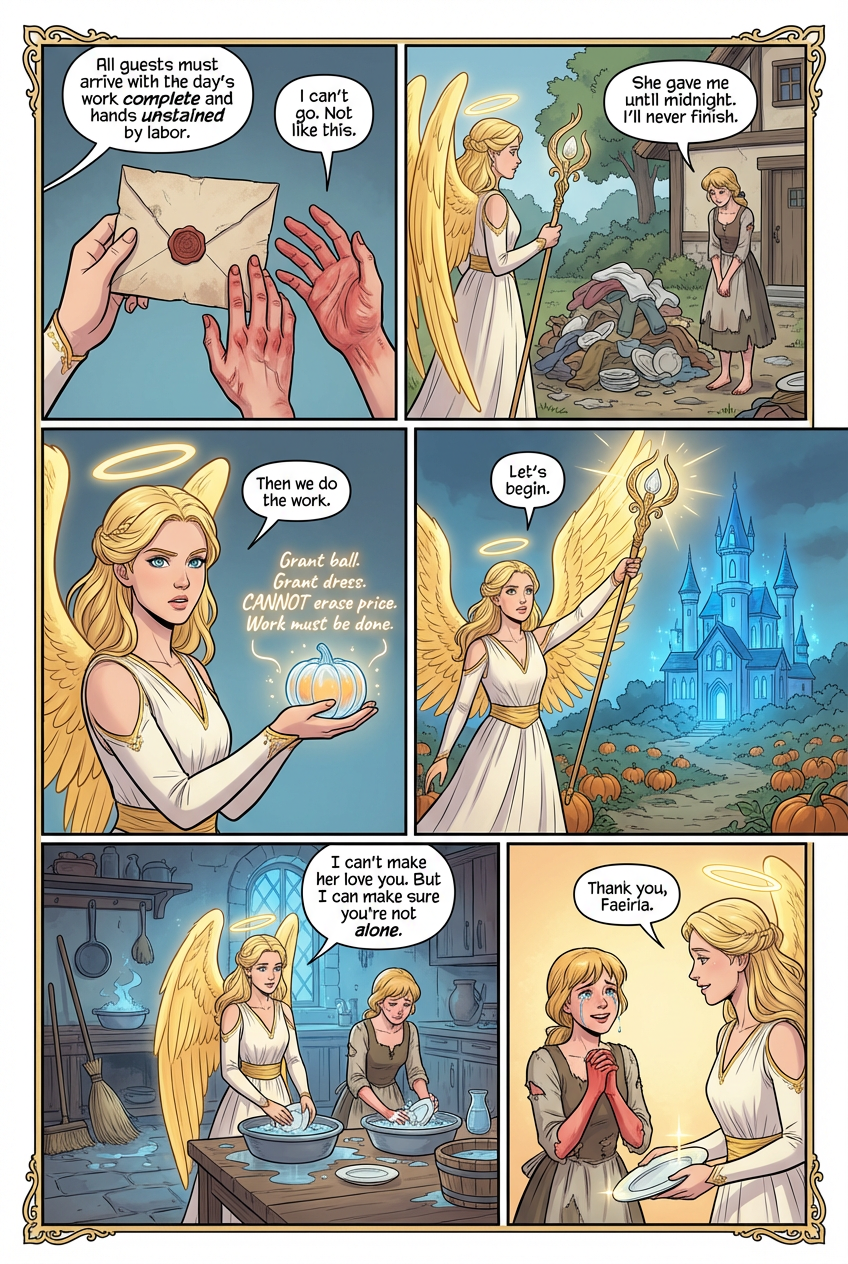
Cinderella's hand shook as she pulled a folded piece of paper from her apron pocket. The wax seal had already been broken. She held it out to Faeiria without meeting her eyes. "I can't go," she said. "Not like this." Faeiria took the invitation and read the script at the bottom. The words were clear: All guests must arrive with the day's work complete and hands unstained by labor. Faeiria looked at Cinderella's fingers, raw and red from scrubbing. Behind her, piled against the cottage wall, sat a mountain of laundry, dirty dishes, and cleaning tools that hadn't been there this morning. Her stepmother had sent them. Faeiria felt the weight of it before Cinderella spoke. "She gave me until midnight," the girl whispered. "I'll never finish." Faeiria closed her eyes and felt for the instructions she'd been given. They materialized in her palm as a glass pumpkin that played a soft, sad melody when she turned it over. Inside, written in light, were the rules: She could grant the ball. She could grant the dress and the carriage. But she could not erase the price Cinderella's stepmother had set. The work had to be done, or the invitation would burn to ash when the clock struck twelve. Faeiria set the glass pumpkin down and looked at Cinderella. "Then we do the work," she said. She raised her wand and the air around them split open. A building rose from the pumpkin patch, its blue towers glowing with fae light. Inside, the workshop hummed with motion. Brooms swept on their own. Water heated itself in silver basins. Faeiria guided Cinderella through the door and handed her the first clean cloth. "I can't make her love you," Faeiria said quietly. "But I can make sure you're not alone." They worked side by side, angel and girl, and by the time the last dish gleamed, Cinderella was crying. Not from grief this time. From something else.
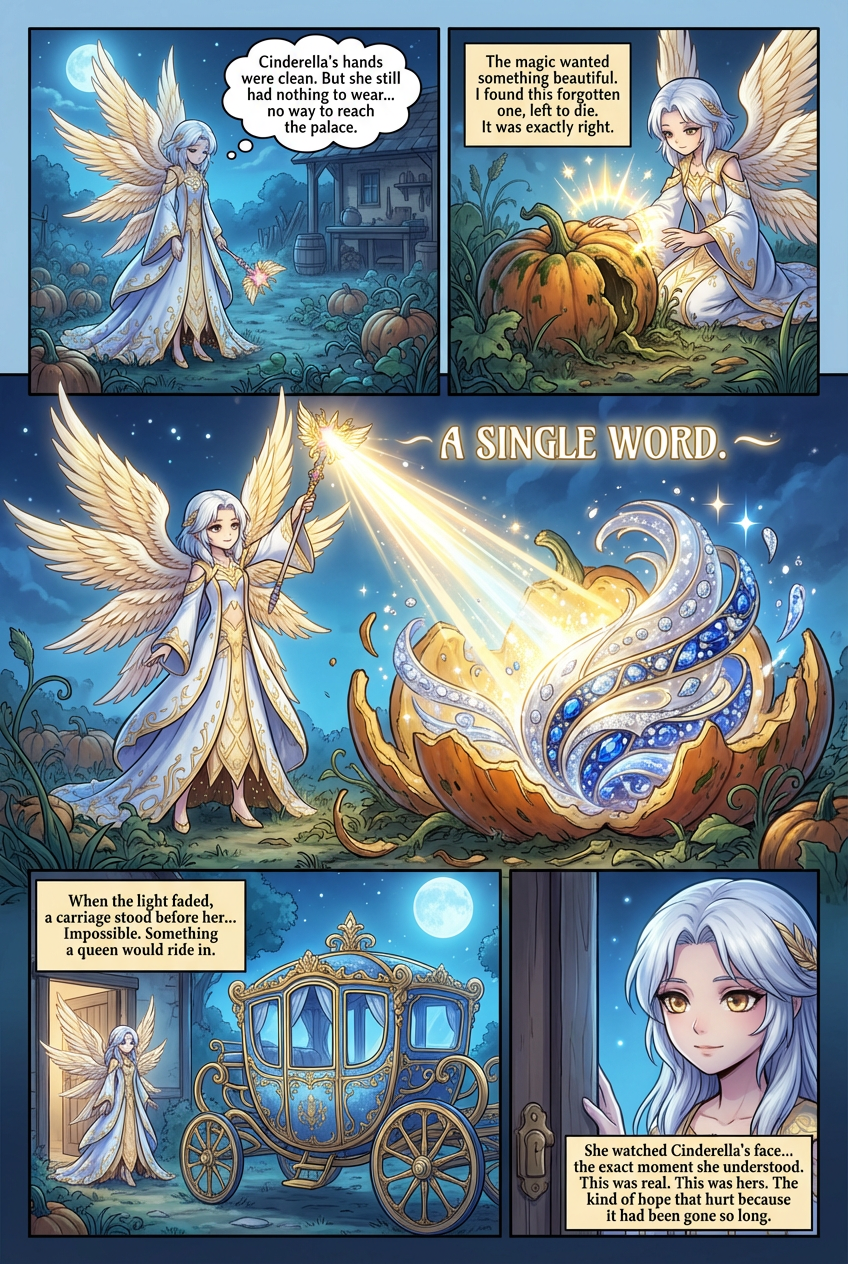
Faeiria stepped out of the workshop and looked at the pumpkin patch. The work was done. Cinderella's hands were clean. But the girl still had nothing to wear, no way to reach the palace, and no proof she belonged anywhere but here among the rotting vines. She walked through the rows until she found what she needed. A pumpkin sat half-buried in weeds, its surface spotted with decay. Most of it had already collapsed inward, the flesh soft and brown. Faeiria knelt beside it and placed one hand on the sagging rind. She felt the resistance immediately. The magic wanted something beautiful to work with. Something whole. This pumpkin had been forgotten, left to die alone in the dirt. It was exactly right. Faeiria raised her wand and spoke a single word. Light poured from her palm into the rotting shell. The pumpkin shuddered and began to split apart. But instead of crumbling, it opened like a treasure box, revealing layer after layer of glowing platinum, diamonds sharp as stars, and sapphires that held the depth of midnight. The pieces lifted into the air and began to turn. Metal folded over gemstone. Wheels formed from spiraling vines that hardened into gold filigree. Windows appeared, their glass so clear it looked like captured moonlight. When the light faded, a carriage stood before her, blue and gold and impossible. It looked like something a queen would ride in. Not a girl locked out of her own home. Cinderella came to the workshop door and stopped. She stared at the carriage, her mouth open, one hand pressed to her chest. Faeiria watched her face and saw the exact moment the girl understood. This was real. This was hers. Cinderella took three steps forward, then ran the rest of the way. She touched the carriage door with trembling fingers, then turned back to Faeiria with tears streaming down her face. Not grief this time. Not fear. Something Faeiria had no name for, but recognized all the same. The kind of hope that hurt because it had been gone so long.
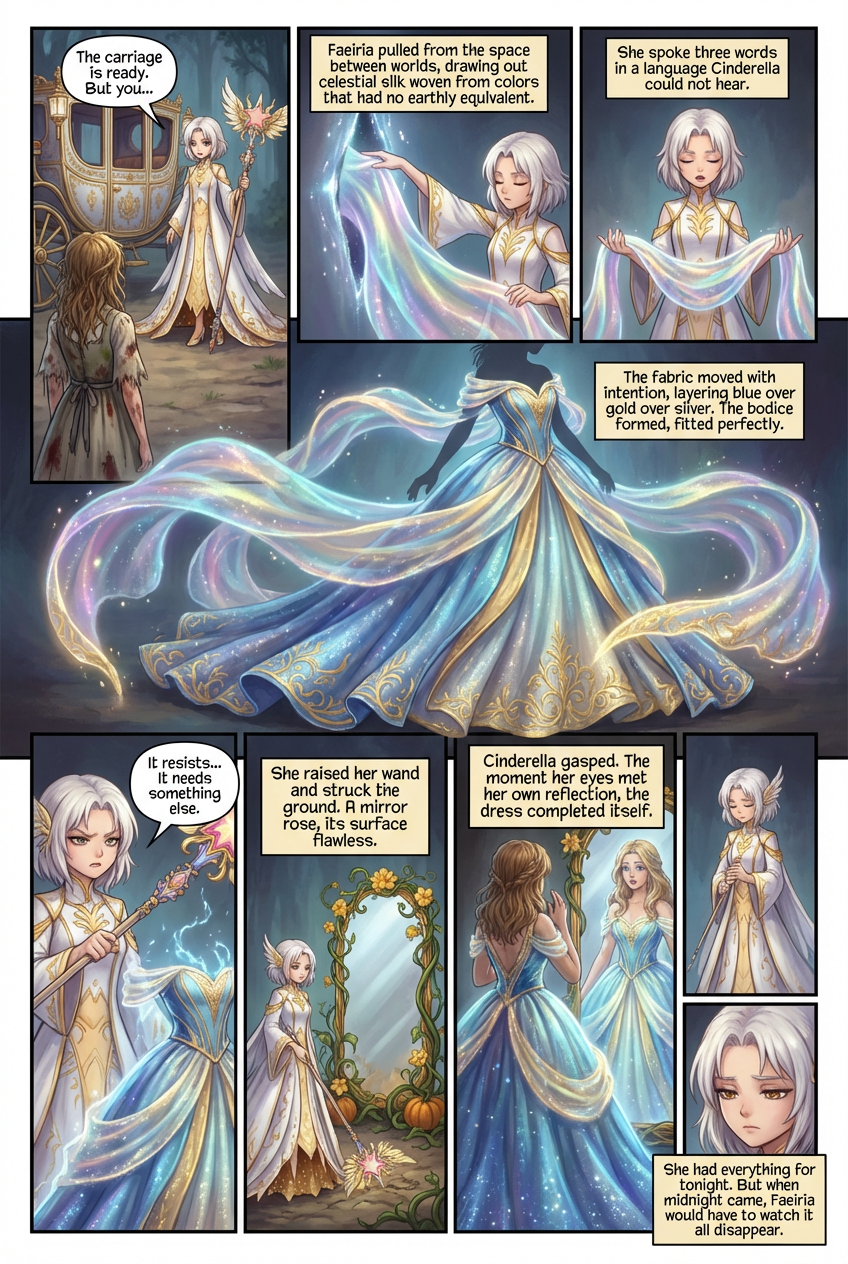
Faeiria turned from the carriage and looked at the girl standing before it. Cinderella wore a plain work dress, stained at the hem and frayed at the sleeves. Her hair was still tangled from the hours spent in the workshop. The carriage was magnificent. The girl was not ready. Faeiria reached into the air and pulled. The space between her fingers shimmered and tore, revealing something beyond the world itself. Light poured through the opening, soft and terrible, the kind of radiance that existed before stars were named. She drew out a length of silk that moved like water and breath combined, woven from colors that had no earthly equivalent. The fabric rippled with patterns that shifted as she held it—wings folding into dawn, dawn melting into song. This was celestial cloth, the same material that clothed beings who stood before thrones of fire. She laid it across her palms and spoke three words in a language Cinderella could not hear. The silk began to rise. The fabric wrapped itself around Cinderella without touching her skin. It moved with intention, layering blue over gold over silver, each fold appearing exactly where it needed to be. The bodice formed first, fitted perfectly to the girl's frame, then the sleeves emerged like captured light. The skirt bloomed outward in waves of color—sapphire depths giving way to seafoam, seafoam brightening into honey and cream. Gold embroidery appeared along the hem, not stitched but grown, as if the dress itself was a living thing deciding what it wanted to become. But halfway through, the magic faltered. The skirt hung incomplete on one side, the bodice still translucent where it should have been solid. Faeiria frowned and pushed harder, pouring more power into the weaving. The dress resisted. It wanted something she had not yet given it. Faeiria stopped and understood. The dress needed to be seen to be finished. She raised her wand and struck the ground once. A mirror rose from the earth, its frame carved from pumpkin vines that twisted and bloomed with tiny golden flowers. The glass surface was flawless, reflecting the cottage and the patch and the girl standing half-transformed between them. Cinderella turned toward it and gasped. The moment her eyes met her own reflection, the dress completed itself. The translucent sections solidified. The unfinished side cascaded into full skirts that pooled at her feet like water made of starlight. She looked like someone who belonged in a palace. Someone who deserved to be seen. Faeiria lowered her wand and felt the weight of what she had just done. The girl had a carriage. She had a gown. She had everything she needed for tonight. And when midnight came, Faeiria would have to watch it all disappear.
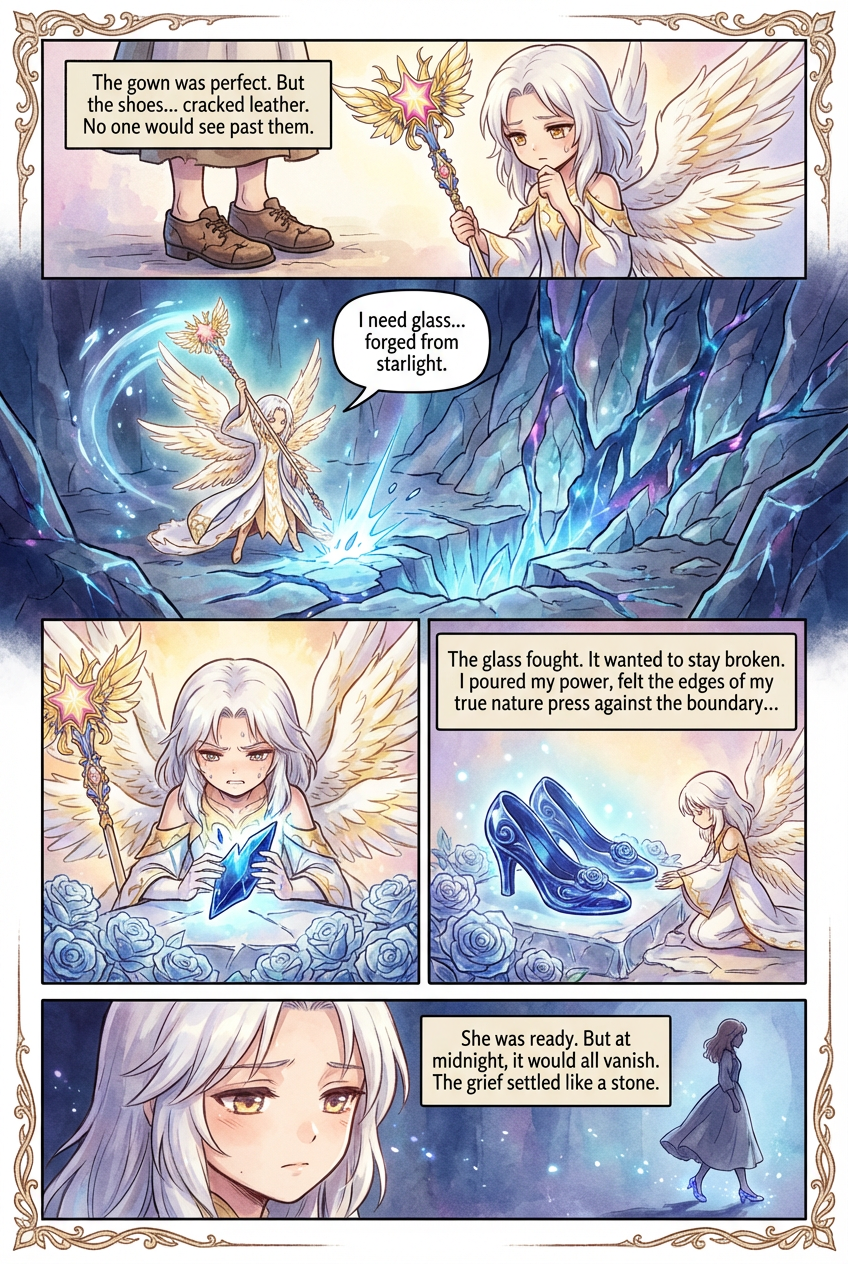
Faeiria looked down at the girl's feet. Cinderella wore the same worn work shoes she had labored in all day, cracked leather barely holding together at the seams. The gown was perfect. The carriage waited. But no one would see past those shoes. Faeiria needed glass. Not ordinary glass from a window or bottle, but something older, something that remembered what it meant to be forged from starlight and pressure. She raised her wand and struck the earth three times. The ground split open beneath them, revealing a shaft that plunged deep into darkness. Light bloomed from below—blue and cold and ancient. A quarry rose from the depths, its walls lined with veins of celestial glass that pulsed like frozen lightning. The structure was massive, towering pillars carved with symbols that predated human language, a central chamber where raw glass jutted from the stone in jagged clusters. At the entrance stood an altar formed from glass roses, each petal perfect and sharp enough to draw blood. Faeiria stepped toward it and felt the weight of what she was about to attempt. She had never made slippers before. She took a shard of celestial glass from the quarry wall and held it over the altar. The glass hummed in her palm, responding to her power but resisting her command. She spoke the words of shaping, the same language she had used for the dress, but the glass refused to bend. It wanted to stay sharp, wanted to stay broken. She pushed harder, pouring more power into the working until the shard began to glow white-hot. Slowly, painfully, it softened and began to curve. She pulled another shard and another, layering them together, fusing them with heat and will until the first slipper began to take shape. The glass fought her at every step. It cracked twice and she had to start over. It burned her simplified form and she felt the edges of her true nature pressing against the boundary she had set. But she did not stop. The first slipper formed whole—midnight blue glass that seemed to hold the night sky inside it, swirling patterns of stars and depth. She set it on the altar and began the second. By the time she finished, her hands were shaking and the altar was covered in roses that had bloomed from the heat of her working. Faeiria lifted both slippers from the altar and carried them to Cinderella. The girl stared at them, eyes wide, and Faeiria knelt to slip them onto her feet. They fit perfectly, molding to her shape as if they had been made for her alone—which they had. Cinderella stood and took a step. The glass made no sound against the ground. She looked at Faeiria with something between wonder and fear, and Faeiria met her gaze without flinching. The girl was ready now. Everything was in place. And when midnight came, Faeiria would watch these slippers vanish along with everything else she had given, and there was nothing she could do to stop it. She had completed her task. The grief of it settled into her chest like a stone.
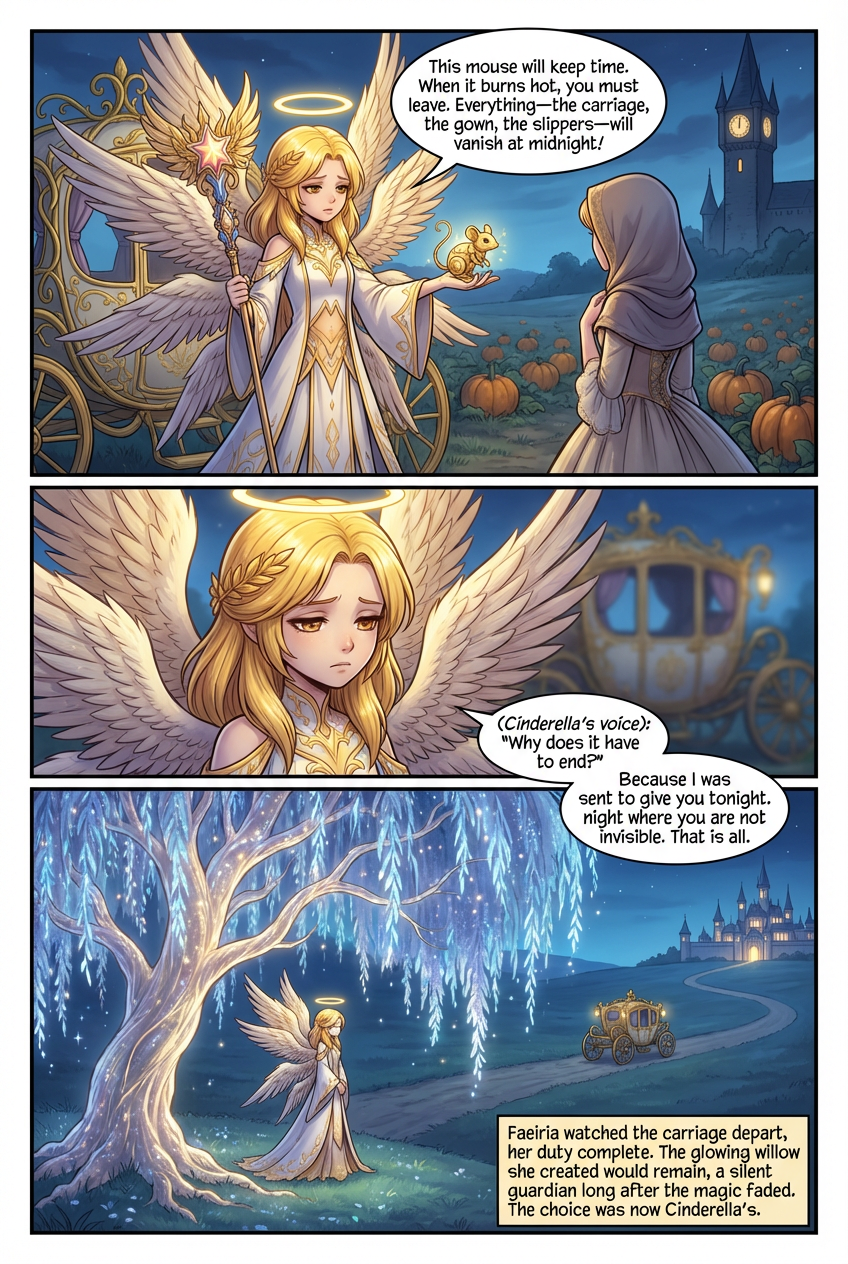
Faeiria straightened and looked at the carriage waiting beyond the pumpkin patch. The girl was ready. The dress would not wrinkle. The slippers would not crack. The carriage would carry her to the palace without fail. But Faeiria had not yet told her the price. She reached into the space between moments and pulled out a small creature made of celestial gold. The mouse sat in her palm, perfectly still, its tiny eyes watching Cinderella with an intelligence that did not belong to any natural thing. Faeiria pressed it into the girl's hands. "This will keep time for you," she said. "When it begins to glow, you have one hour remaining. When it burns hot against your skin, midnight is close. You must leave before the clock tower strikes twelve." She pointed toward the distant palace, where the tower rose black against the evening sky, its face already lit and visible from here. "Everything I have given you will vanish when that bell rings. The carriage. The gown. The slippers. All of it will return to what it was—pumpkin and cloth and glass shards. If you are still wearing them, they will vanish from your body." Cinderella stared at the mouse, then at Faeiria. "Why?" Her voice was small. "Why does it have to end?" Faeiria felt the question like a blade. She wanted to answer differently. She wanted to say the magic could last, that the girl could keep the dress and the carriage and never return to the ashes and the cruelty. But she could not lie. "Because I was sent to give you tonight," Faeiria said. "Not tomorrow. Not forever. Just tonight. One night where you are not invisible." She stepped back and the air around her shimmered with the effort of staying small. "That is all I am allowed to give." Cinderella climbed into the carriage, the mouse clutched in one hand, and the door closed behind her. Faeiria watched the carriage pull away, wheels turning silently over the earth, heading toward the palace and the ball and the hours that remained. She stood beneath a willow tree that had not been there moments before, its branches glowing faintly with the remnants of her power. The tree would remain after midnight. It would mark this place long after the magic was gone. Faeiria folded her simplified form around the grief she carried and did not look away until the carriage disappeared from sight. She had given Cinderella the warning. What the girl did with it was no longer hers to control.
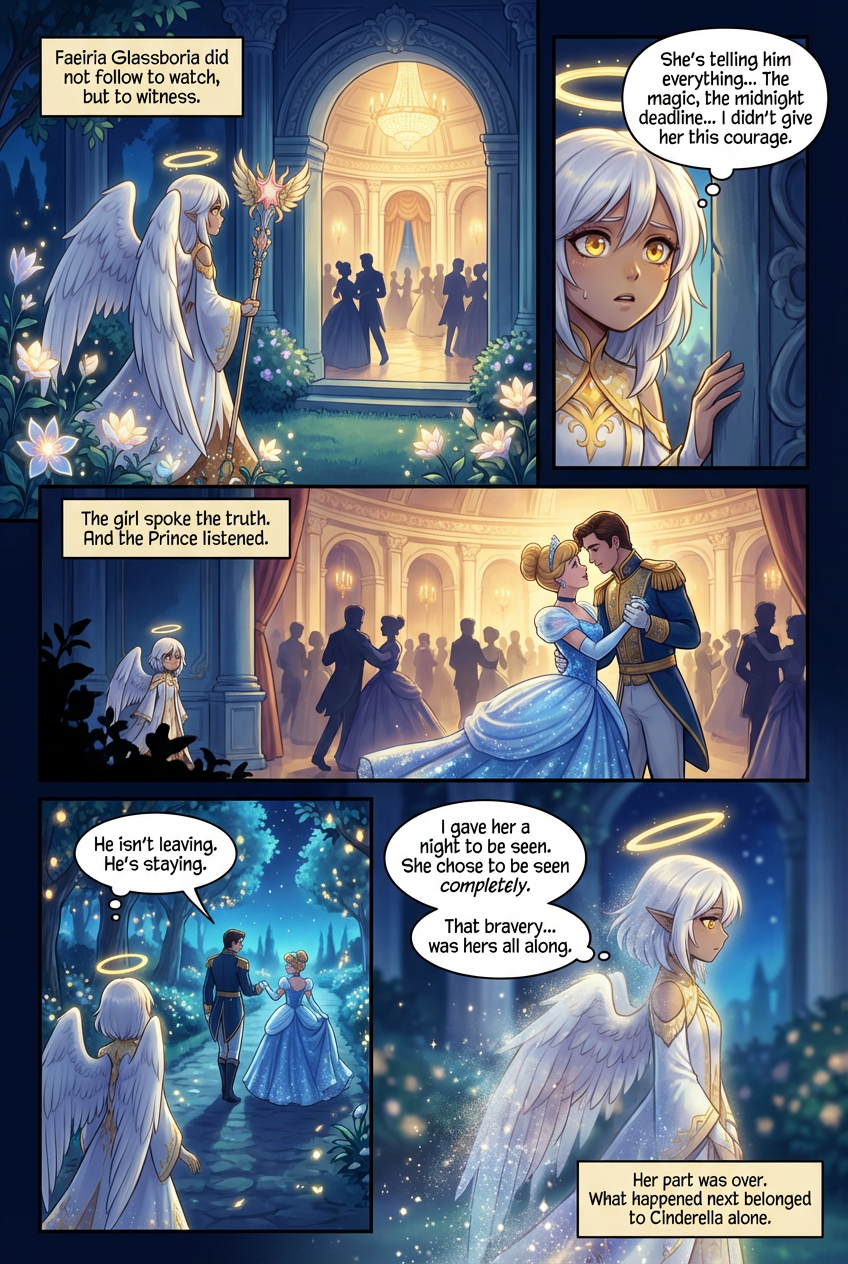
Faeiria did not follow the carriage to the palace. She could have. She could have hidden herself in the corners of the ballroom, watching from the spaces between pillars and chandeliers, ensuring the girl made no mistakes. But that was not what she had been sent to do. She came anyway. Not to watch. To witness. She stood outside the palace garden where luminescent flowers bloomed under moonlight, their petals glowing faintly in the dark. Through the archway she could see into the ballroom where nobles gathered in gowns of silk and velvet, circling the polished floor in pairs. And there—among them—was Cinderella. The girl moved through the crowd like someone who had just learned she existed. The prince was beside her, his hand at her waist, and they were waltzing. Faeiria felt something in her chest tighten. The girl was speaking. Faeiria could not hear the words from this distance, but she could see Cinderella's mouth moving, see the prince leaning closer to listen. The girl was telling him. Everything. The stepmother. The locked doors. The impossible work. The magic that would vanish at midnight. Faeiria had not told her to do this. She had only been sent to give the girl one night of visibility—not to make her brave enough to use it. The prince stopped dancing. For a moment Faeiria thought he would pull away, that the truth would be too much, that Cinderella had made a mistake. But he did not let go of her hand. Instead he led her through the crowd, past the watching nobles, toward the garden where Faeiria stood hidden in the shadows. They walked together down a shimmering pathway lined with glowing trees, and the prince spoke quietly, his voice too low for Faeiria to catch. But Cinderella's face changed. The fear lifted. She nodded. He was not running. He was staying. Faeiria felt the weight of her own limits press harder against her ribs. She had given the girl tonight. But Cinderella had done this part herself. Faeiria turned away before they could see her. She had wanted to know if the girl would use the night to hide or to be seen, and now she had her answer. Cinderella had chosen to be seen. Completely. Even knowing the magic would end. Even knowing the prince might not believe her. That was not something Faeiria had given her. That was something the girl had carried all along. Faeiria stepped back into the space between moments and let the garden fade from view. The chapter of her task that required watching was over. What happened next would belong to Cinderella alone.
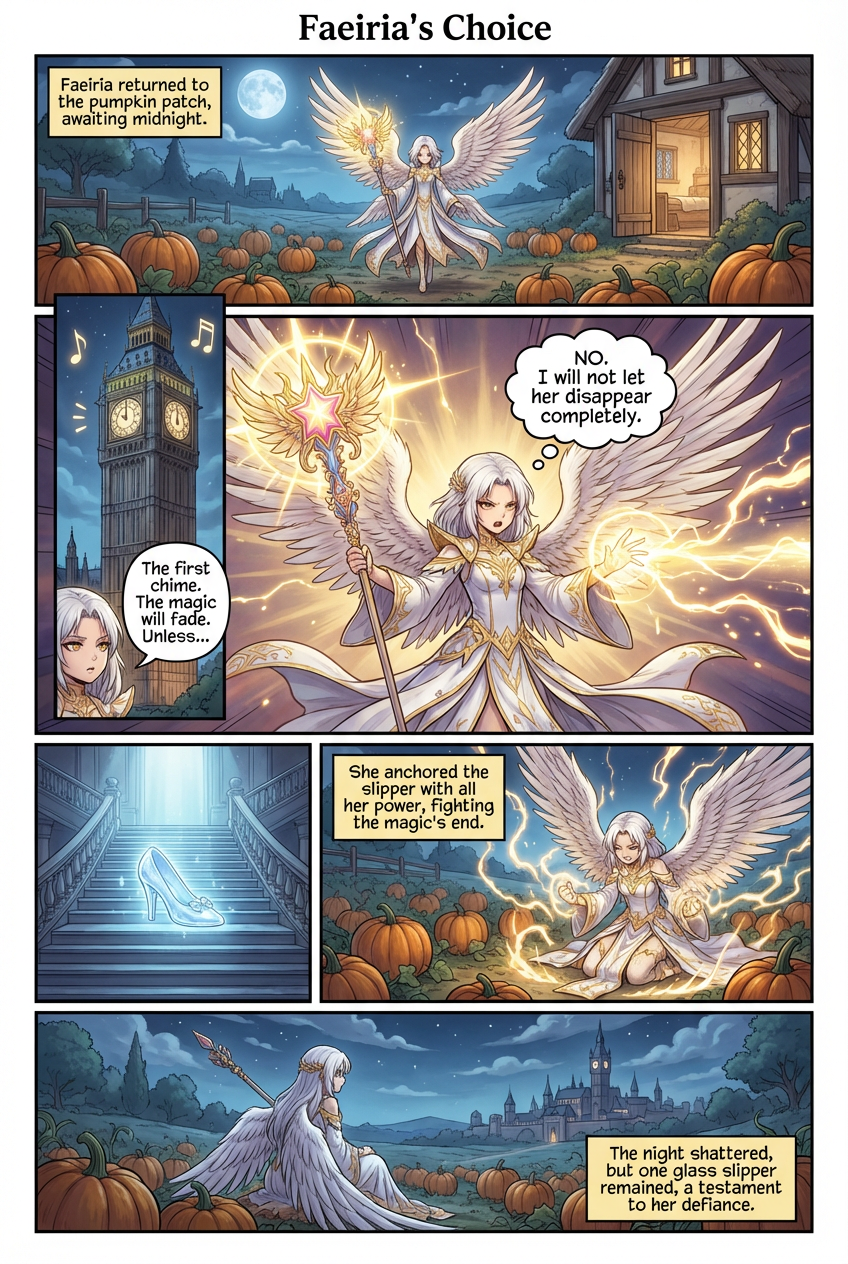
Faeiria returned to the pumpkin patch where the night had begun. The cottage stood empty now, its door still open from when Cinderella had left hours before. Faeiria did not enter. She stood among the pumpkins and waited for midnight to come. She felt the clock tower begin its strike before she heard it. The first chime rang across the city, and Faeiria's chest constricted with the weight of what she had done. The carriage would dissolve. The gown would fade. The slippers would—but no. Faeiria made a choice in that instant that went beyond her orders. She reached across the distance to the palace steps where Cinderella would be running, and she seized one glass slipper with invisible hands. The girl's foot slipped free as she fled, and Faeiria held the slipper exactly where it fell on the grand staircase. She poured her power into it, anchoring it to that spot, making it stay when everything else would vanish. The magic fought her—it wanted to disappear with the rest—but Faeiria was stronger. She forced the slipper to remain, a fragment of celestial glass that would not dissolve, and the effort tore through her like fire. The clock tower finished its twelve strikes, and the night shattered. Faeiria felt the carriage collapse back into rot, felt the dress unravel into nothing, felt the second slipper on Cinderella's foot begin to fade. But the first slipper stayed. It gleamed on the palace steps, solid and real, exactly where the girl had lost it. Faeiria released her hold and staggered backward among the pumpkins. She had not been sent to leave evidence. She had been sent to give one night of visibility, and visibility was supposed to end at midnight. But she had made the slipper stay anyway. Faeiria knelt in the dirt and pressed her hands against the ground. She had broken the rules she was given because leaving Cinderella nothing felt like erasing her completely. The girl had been brave enough to tell the truth. She deserved something that proved she had existed. Faeiria did not know what punishment would come for this choice, but she would not take it back. The slipper would stay, and the prince would find it, and Cinderella would not disappear.
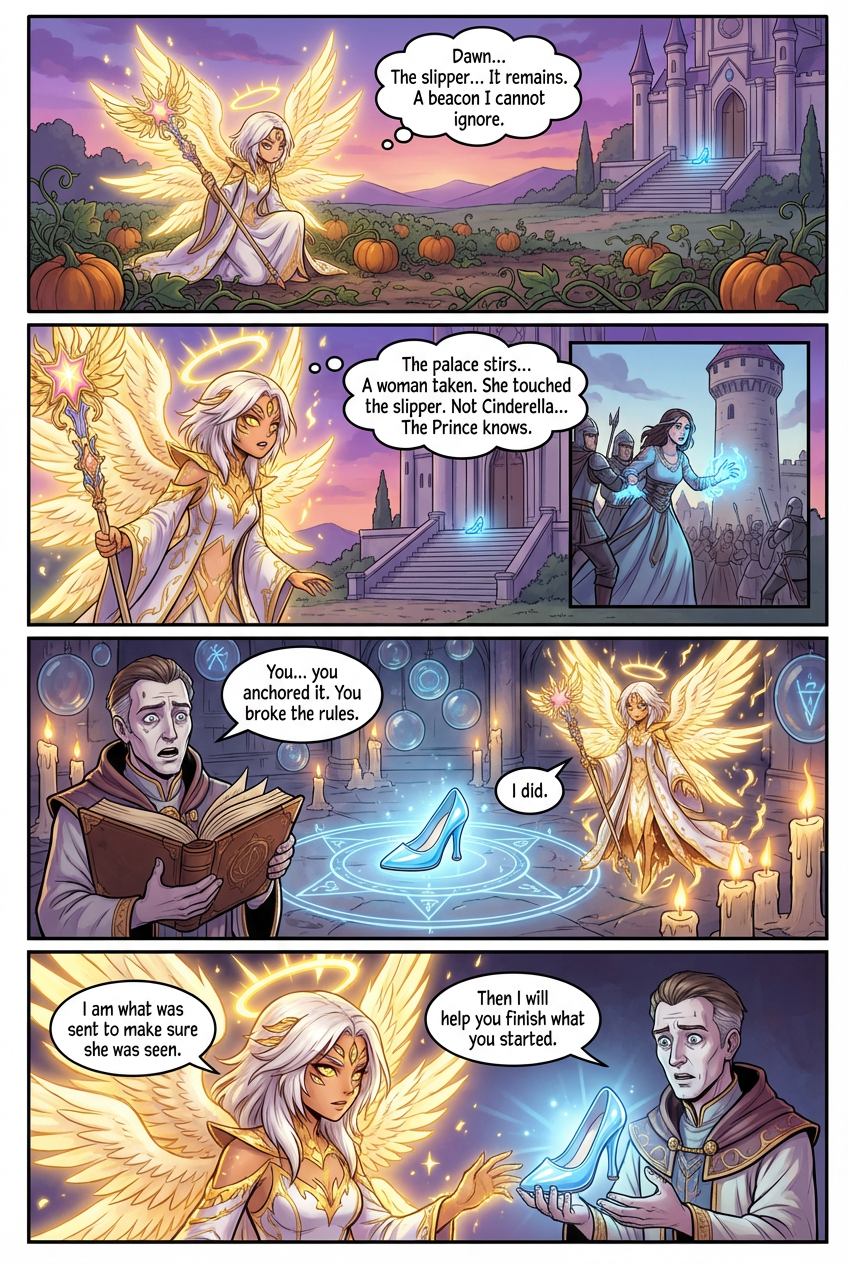
Faeiria waited in the pumpkin patch until dawn. She did not sleep. She did not move. She simply knelt among the vines and felt the world shift around the choice she had made. The slipper was still there on the palace steps. She could sense it even from this distance, a single point of light that refused to fade. But as the sun rose, something else pulled at her awareness. The palace stirred with activity that felt wrong. Faeiria stood and turned toward the distant stone structure, her eyes—all of them—opening to see what was happening. A woman had been taken to a tower near the palace grounds. Guards dragged her inside while a crowd watched. Faeiria recognized the residue clinging to the woman's hands. The slipper had touched her. She had worn it. The prince had found someone, but it was not Cinderella. Faeiria moved without thinking. She crossed the distance between the pumpkin patch and the palace in moments, her true form flickering at the edges of her control. She found the court mage in a chamber filled with candles and glass circles on the floor. The man knelt over a book bound in worn leather with gold symbols pressed into the cover. He turned pages slowly, tracing his finger over diagrams that matched the magic Faeiria had used. The slipper sat in the center of the circle, surrounded by light. The mage looked up as Faeiria entered, and his face went pale. He saw her. Not the small form she usually held, but something closer to what she truly was. "You anchored it," the mage said quietly. His voice shook, but he did not look away. "The slipper should have vanished with the rest. You broke the rules." Faeiria did not deny it. She stepped forward and the candles around the circle flared brighter. The mage closed the book and stood. "The woman in the tower stole the slipper from the guards. She tried to claim it was hers. But the prince knows something is wrong." Faeiria felt relief and dread twist together. Cinderella was not in danger yet, but the slipper had caused chaos she had not expected. The mage looked at her with something between fear and wonder. "What are you?" he asked. Faeiria met his gaze and let him see enough to understand. "I am what was sent to make sure she was seen," she said. The mage nodded slowly and picked up the slipper. "Then I will help you finish what you started."
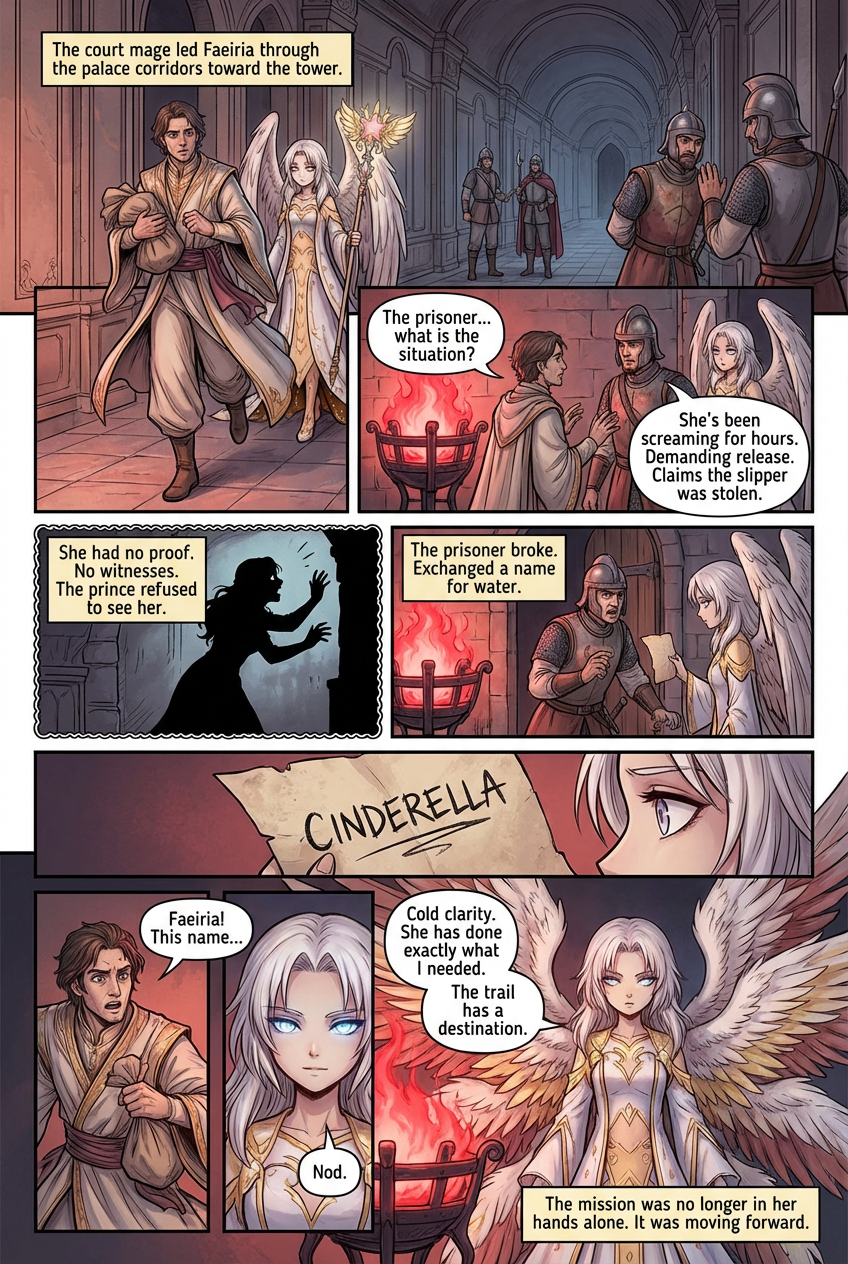
The court mage led Faeiria through the palace corridors toward the tower where the woman was being held. He moved quickly, the glass slipper wrapped in cloth and tucked under his arm. Guards nodded as they passed, recognizing the mage but glancing uncertainly at Faeiria. They stopped at a guard post outside the tower, marked by an iron brazier that burned with red light. The mage spoke quietly with the captain while Faeiria stood back and listened. The woman inside had been screaming for hours, demanding release. She claimed the slipper was stolen from her, that she had lost it at the ball. But when the guards pressed her for proof, she had nothing. No witnesses. No description of the palace interior that matched reality. The prince had refused to see her after the first meeting. Faeiria felt the woman's desperation before she heard the words. A guard emerged from the tower entrance, his face tight with disgust. The prisoner had finally broken. She had given them a name in exchange for water and a promise to consider her release. Not her own name. Someone else's. The guard held a scrap of parchment with writing on it. Faeiria saw the word before the mage did. Cinderella. The woman had revealed the name of the girl who actually wore the slippers, hoping it would buy her freedom. The mage turned to Faeiria with alarm, but she felt only cold clarity. The woman had done exactly what Faeiria needed. The guards now had Cinderella's name. They would search for her. The prince would find her. Faeiria had anchored the slipper to create a trail, and now that trail had a destination. She met the mage's eyes and nodded once. The mission was no longer in her hands alone. It was moving forward whether she guided it or not.
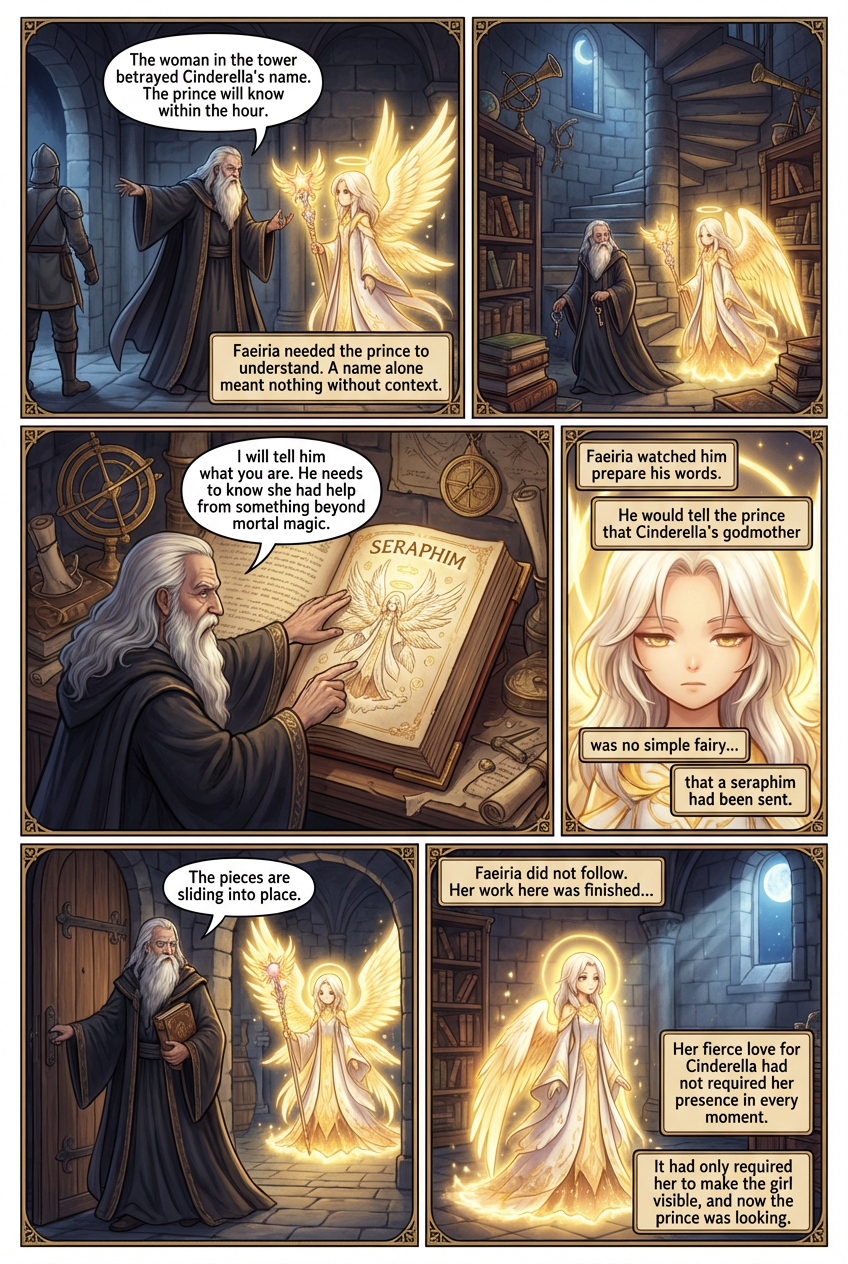
The mage dismissed the guard and turned to Faeiria with controlled urgency. He kept his voice low, though the corridor was empty. The woman in the tower had betrayed Cinderella's name to save herself, and now the guards would carry that information to the prince within the hour. Faeiria needed the prince to understand what he was hearing. A name alone meant nothing without context. She followed the mage up the spiraling stairs of his tower, where books lined every wall and instruments tracked stars she could not see. He pulled a heavy tome from a locked chest and laid it open on his desk. The pages showed illustrations of celestial beings, their forms rendered in careful detail. He pointed to one marked with the word seraphim. "I will tell him what you are," the mage said. "He needs to know she had help from something beyond mortal magic." Faeiria watched him prepare his words, selecting which truths to reveal. The mage would tell the prince that Cinderella's godmother was no simple fairy. He would explain that a seraphim had been sent to ensure the girl reached the ball. He would speak Cinderella's name aloud in the throne room and reveal that the woman in the tower was her stepsister, the one who had stolen the glass slipper for herself. The prince would understand then that the magic was real, that Cinderella's confession at the ball had been truth, not performance. Faeiria felt the pieces sliding into place without her direct intervention. The mage closed the book and tucked it under his arm. He met Faeiria's eyes one last time before descending the stairs. She did not follow. Her work here was finished. The prince would receive knowledge he could act on, and Cinderella's name would reach him through channels that carried weight. Faeiria had defied her orders to anchor the slipper, and now mortals were carrying her mission forward in ways she could not. She accepted the shift. Her fierce love for Cinderella had not required her presence in every moment. It had only required her to make the girl visible, and now the prince was looking.
Play your story to life
Storycraft is a mobile game where you create AI characters, craft items and locations to build their world, then discover what direction your story takes. Download the iOS game for free today!
Download for free