

Farmer Fred's Arc
10 Chapters
Farmer Fred's dream is making something from nothing.

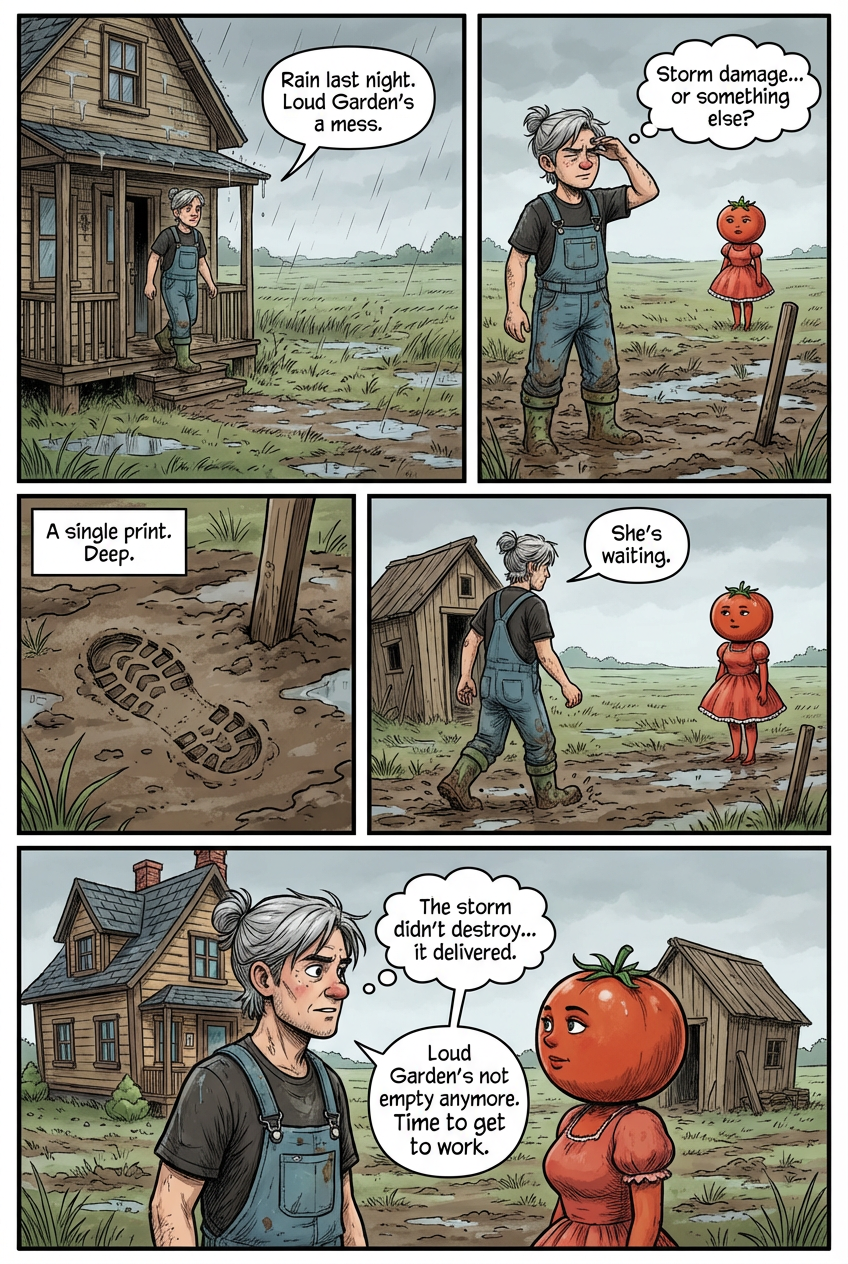
Farmer Fred stepped out of the farmhouse and stopped. Rain had swept through overnight, leaving mud and bent grass across the barren stretch he'd called Loud Garden for forty years. He squinted at the damage, wondering if starting over meant dealing with storms too. Then he saw her. A woman shaped like a tomato in a short frilly dress, standing near a wooden stake driven into the mud. The stake hadn't been there yesterday. Neither had she. A single shoe print marked the spot where she stood, pressed deep into the wet ground. Fred walked closer, boots squelching. He'd built a toolshed last week, the first real structure on the land. It sat behind him now, weathered and crooked but standing. The woman didn't move. She was waiting for him. He understood then. The storm hadn't destroyed anything. It had delivered someone. Loud Garden wasn't empty anymore, and neither was the work ahead of him.
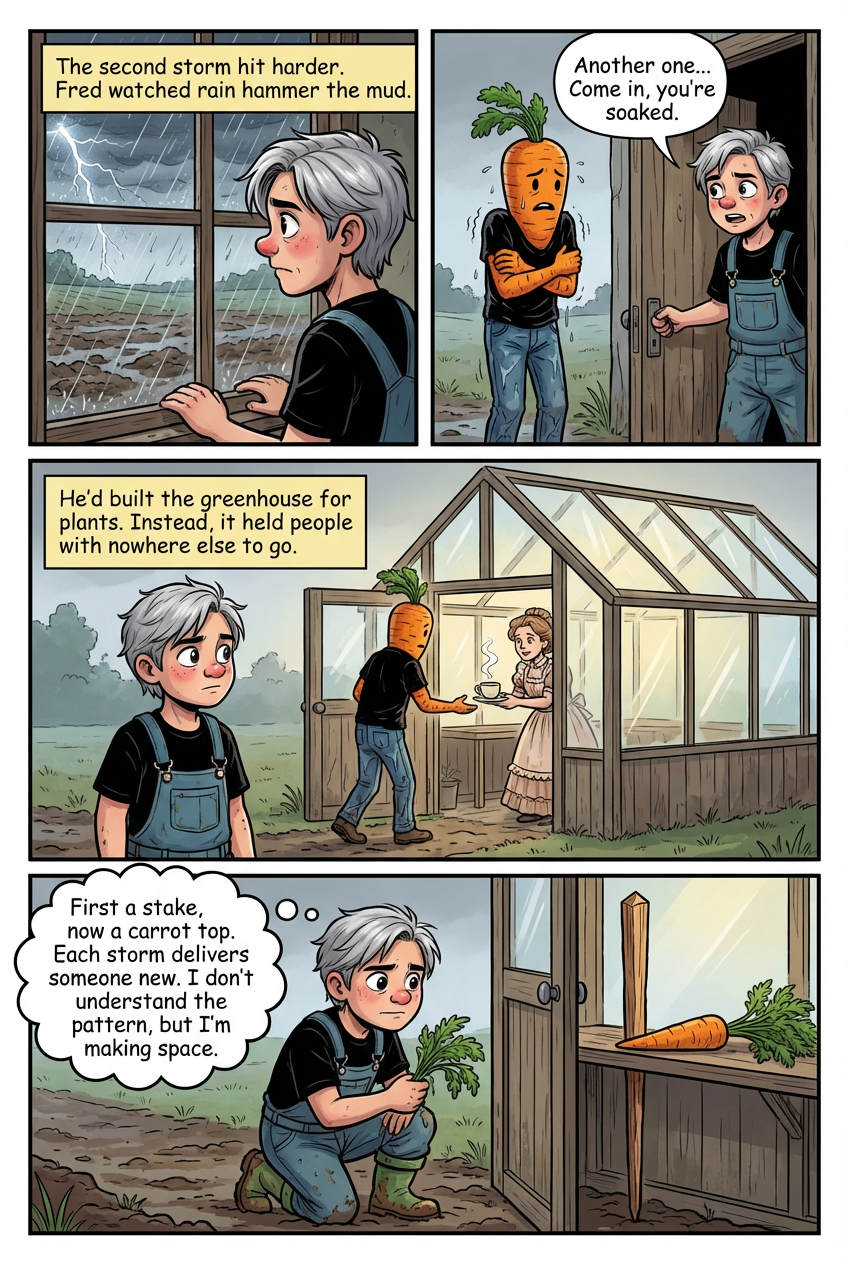
The second storm hit harder than the first. Fred stood at the window and watched rain hammer the mud. Morning came cold and gray. When he opened the door, another visitor stood outside, shivering in the wet. This one looked like a carrot, wearing jeans and a black shirt soaked through. Fred led him toward the small greenhouse he'd built between storms. Glass panels caught the pale light, showing rows of empty shelves inside. The woman in the frilly dress met them at the door with a cup of tea already steaming in her hands. She pressed it into the carrot's grip without a word. Fred watched the exchange and felt something shift. He'd built the greenhouse thinking it would hold plants. Instead it held people who arrived with nowhere else to go. Outside, a tuft of green carrot leaves sat half-buried in the mud where the visitor had been standing. Fred picked it up and turned it over in his hand. The first woman had left a shoe print and a wooden stake. This one left a carrot top. Each storm delivered someone new, and each arrival left a mark. He didn't know what the pattern meant, but he could see it taking shape. Fred set the carrot top on the greenhouse shelf beside the wooden stake. Two arrivals. Two storms. He didn't need to understand it all at once. What mattered was making space for what came next, whether he felt ready or not. The greenhouse wasn't just shelter anymore. It was the first real answer to a question he'd been avoiding for forty years.
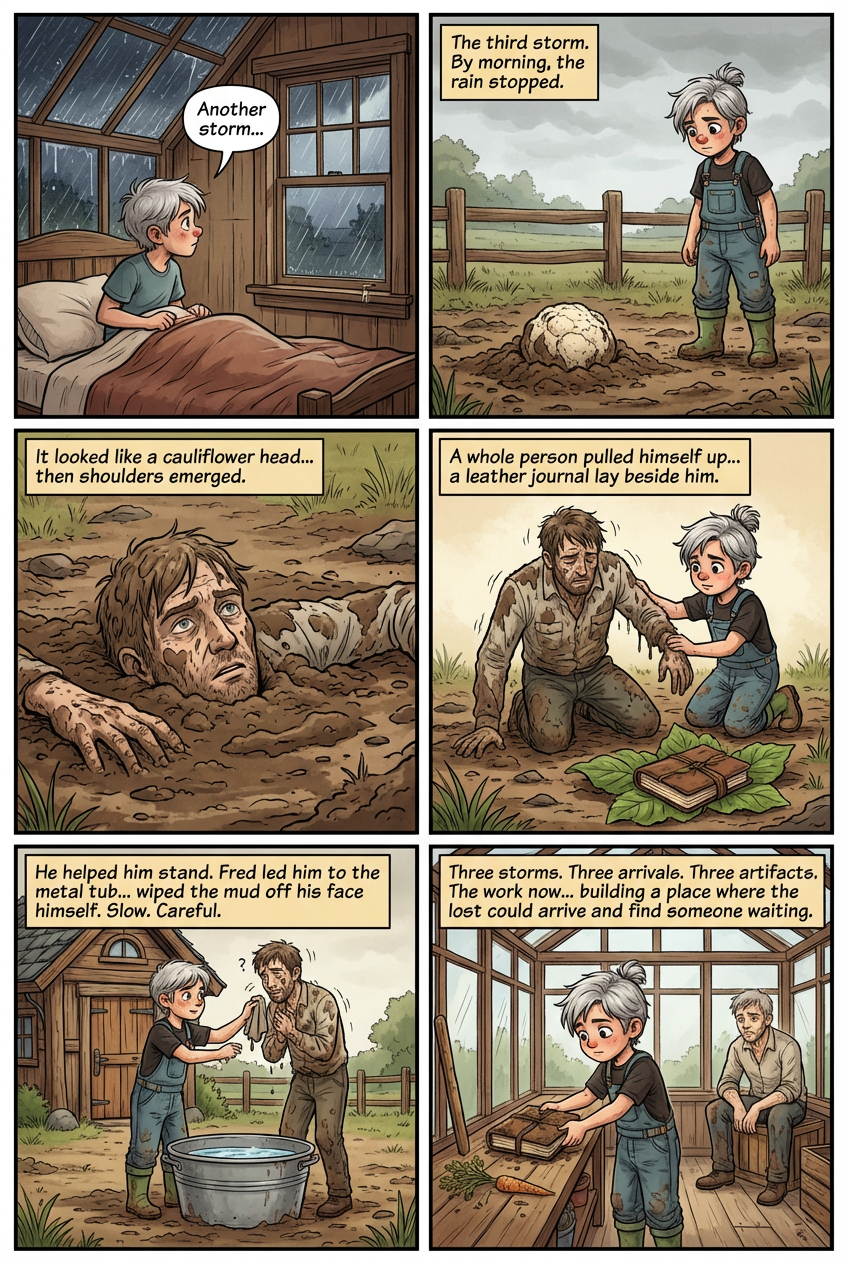
The third storm hit overnight. Fred woke to the sound of wind rattling the greenhouse glass. By morning, the rain had stopped. He walked outside and saw something green pushing up through the mud near the fence. It looked like a cauliflower head, pale and rounded, covered in dirt. Fred crouched down and watched. The head shifted, then shoulders emerged. Arms followed. A whole person pulled himself up out of the ground like a plant. Mud caked his skin and clothes. A leather journal lay beside him in the disturbed earth, wrapped in fresh cauliflower leaves. Fred reached down and helped him stand. The man was shaking. Fred led him to the metal tub he'd set up behind the farmhouse after the second storm. He filled it with water from the pump and handed the man a rag. The cauliflower visitor stood there looking at the tub like he didn't know what to do with it. Fred took the rag back and wiped the mud off the man's face himself. Slow. Careful. The way you'd clean something fragile. When the mud was gone, Fred picked up the journal from where it had fallen. The leather was soft and worn, the pages stained with ink. He carried it to the greenhouse and set it on the shelf next to the wooden stake and carrot top. Three storms. Three arrivals. Three artifacts. Fred didn't need to understand the pattern anymore. He just needed to keep making room for whoever came next. That was the work now. Not farming dead ground. Building a place where the lost could arrive and find someone waiting.
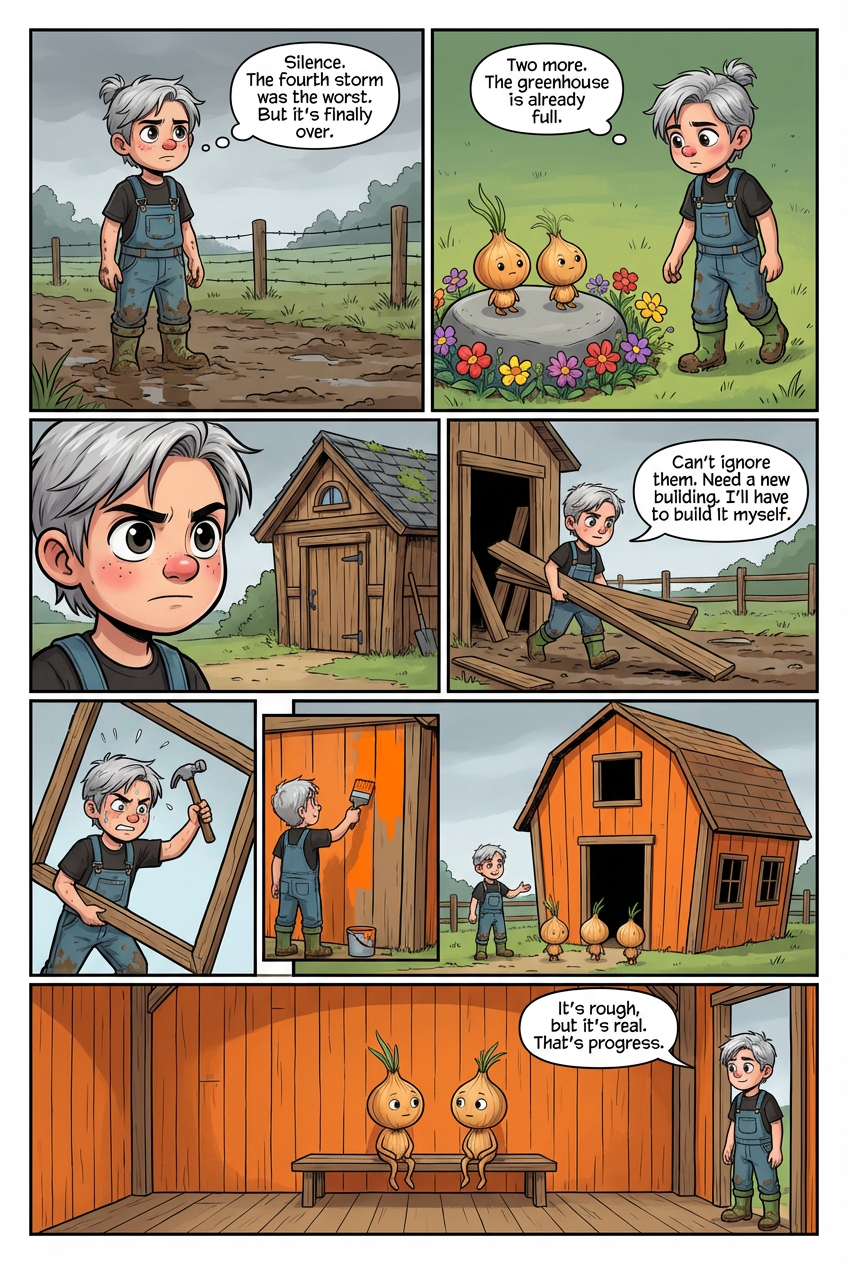
Fred woke to silence. The fourth storm had been louder than the others, wind tearing at the roof all night. He pulled on his boots and walked outside. The mud was churned up worse than before. Near the fence line, two figures stood waiting. They looked like onions. Same papery skin, same rounded heads with wispy tops like green hair. They stood close together on a smooth gray stone that hadn't been there yesterday. Flowers ringed the stone in bright colors—reds and yellows and purples—like something had bloomed overnight just to mark the spot. Fred walked closer. The two onion people didn't move. They just stood there, hands almost touching, staring at the farmhouse like they were waiting for permission to approach. Fred needed a real building. The greenhouse was full now—three visitors packed in tight with barely room to move. He couldn't keep adding people to a space meant for plants. But he didn't know how to build a barn, didn't have plans or lumber or any idea where to start. He stood there looking at the two onion people, feeling the familiar pull to walk away and pretend he hadn't seen them. But his feet didn't move. Instead, he went to the toolshed and dragged out every plank and beam he'd been ignoring for forty years. It took him three days to raise the frame. The structure was crooked in places, the doors didn't hang quite right, but it stood. He painted it orange to match the wood tones and added windows where he could. Inside, he built simple benches and left space in the middle. The two onion people watched him work the whole time, patient and still. When he finally opened the barn doors and gestured them inside, they walked in together and sat down side by side. Fred looked at what he'd made—lopsided and rough, but real. He'd built something that could hold more than one person at a time. That was progress he could see.
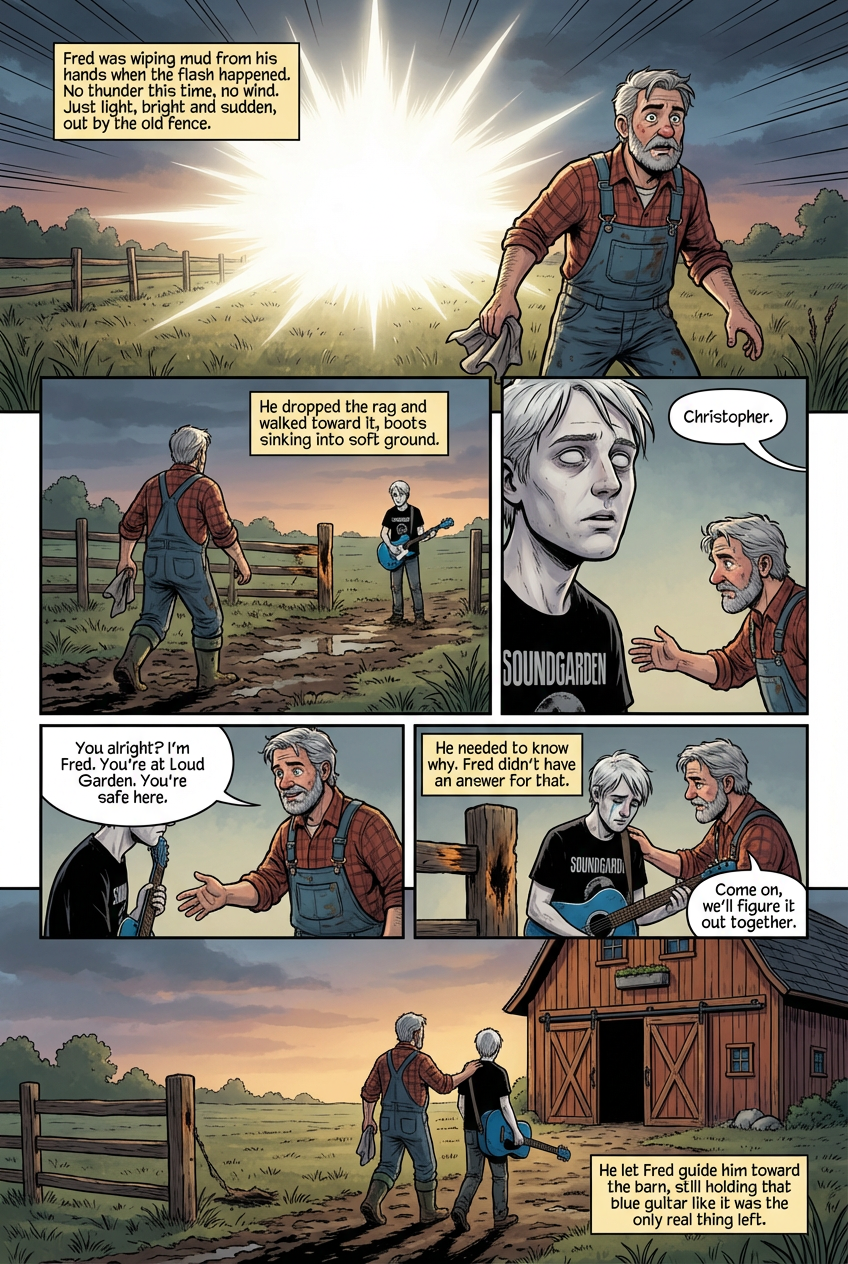
Fred was wiping mud from his hands when the flash happened. No thunder this time, no wind tearing at the roof. Just light, bright and sudden, out by the old fence. He dropped the rag and walked toward it, boots sinking into soft ground with each step. A man stood there, pale as milk, clutching an electric blue guitar against his chest. He wore a black t-shirt with bright letters across the front that spelled out SOUNDGARDEN in colors that hurt to look at. The fence behind him had a scorch mark running along one plank, like someone had dragged a hot iron across the wood. The man's eyes were wide and unfocused. His mouth moved but no sound came out. Fred stepped closer. "You alright?" The man flinched, pulled the guitar tighter. Fred recognized that look—the same confusion the others had worn when they first arrived. But this one seemed younger, more fragile somehow. Fred tried again. "I'm Fred. You're at Loud Garden. You're safe here." The man's grip loosened just slightly. His lips formed a word: Christopher. Fred nodded. "Alright, Christopher. Let's get you inside." But Christopher didn't move. He stared at the guitar in his hands like he'd never seen it before, then looked back at the fence, at the scorch mark, at Fred. His mouth opened again and this time sound came—a low, broken note that might have been a question or might have been a sob. Fred understood then. This one needed more than shelter. He needed to know why. Fred didn't have an answer for that. He never had. But he reached out anyway and put a hand on Christopher's shoulder. "Come on," he said. "We'll figure it out together." Christopher's shoulders sagged. He let Fred guide him toward the barn, still holding that blue guitar like it was the only real thing left in the world. Fred had given him something—not an answer, but company in the not knowing. That would have to be enough for now.
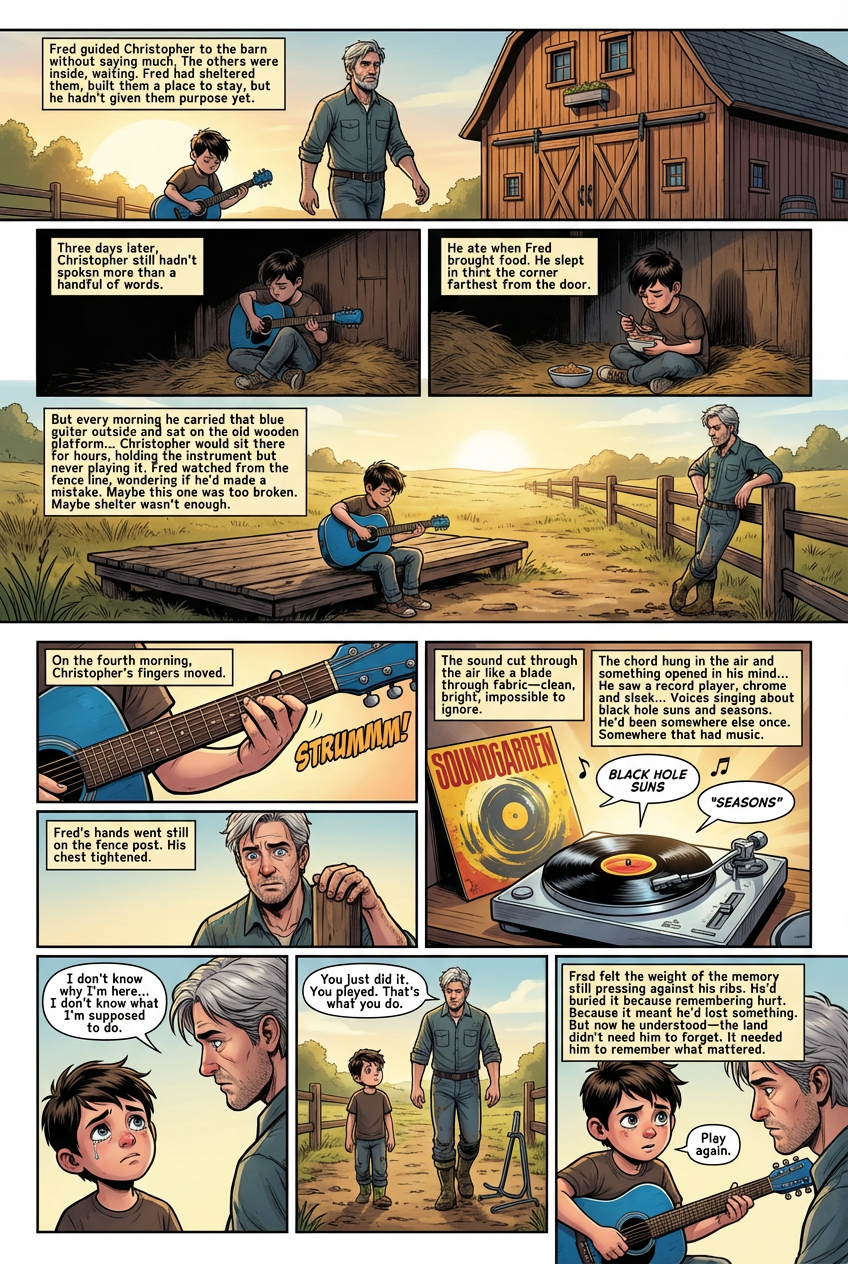
Fred guided Christopher to the barn without saying much. The others were inside, waiting. Fred had sheltered them, built them a place to stay, but he hadn't given them purpose yet. Christopher clutched that guitar like it mattered more than breathing. Three days later, Christopher still hadn't spoken more than a handful of words. He ate when Fred brought food. He slept in the corner farthest from the door. But every morning he carried that blue guitar outside and sat on the old wooden platform Fred had built years ago—back when he thought stages were for crops, not people. Christopher would sit there for hours, holding the instrument but never playing it. Fred watched from the fence line, wondering if he'd made a mistake. Maybe this one was too broken. Maybe shelter wasn't enough. On the fourth morning, Christopher's fingers moved. He pressed them against the strings and struck a single chord. The sound cut through the air like a blade through fabric—clean, bright, impossible to ignore. Fred's hands went still on the fence post. His chest tightened. The chord hung in the air and something opened in his mind, something he'd kept sealed for forty years. He saw a record player, chrome and sleek, spinning in a room full of light. A yellow album cover with red letters. Voices singing about black hole suns and seasons. He'd been somewhere else once. Somewhere that had music. Christopher played the chord again, then looked up at Fred with wet eyes. "I don't know why I'm here," he said. His voice cracked. "I don't know what I'm supposed to do." Fred walked toward the platform, his boots heavy on the dirt. He stopped a few feet away and nodded at the guitar stand Christopher had set up beside him—a simple metal frame that held the instrument when he wasn't playing. "You just did it," Fred said. "You played. That's what you do." Christopher stared at him, confused. Fred felt the weight of the memory still pressing against his ribs. He'd buried it because remembering hurt. Because it meant he'd lost something. But now he understood—the land didn't need him to forget. It needed him to remember what mattered. "Play again," Fred said. Christopher's hands moved to the strings. This time, he didn't stop at one chord.
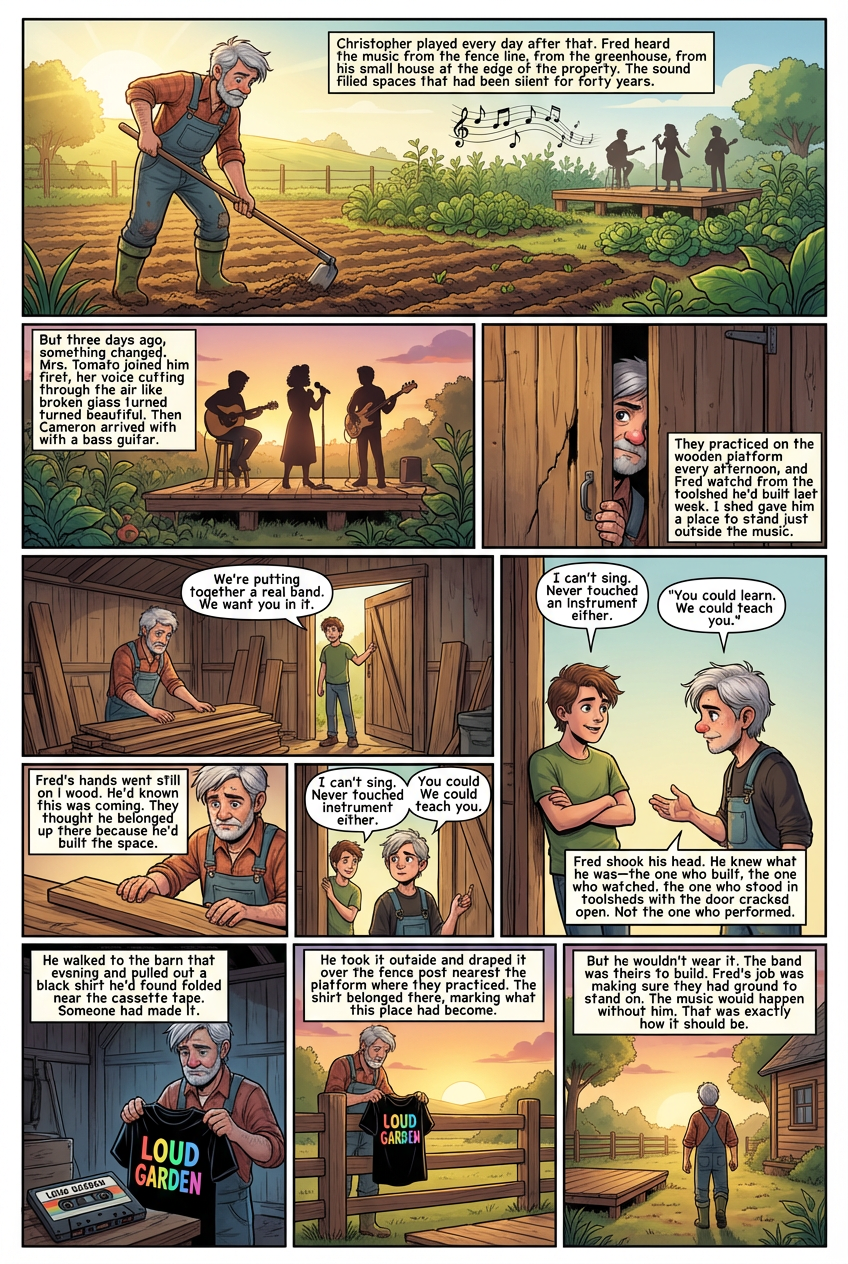
Christopher played every day after that. Fred heard the music from the fence line, from the greenhouse, from his small house at the edge of the property. The sound filled spaces that had been silent for forty years. But three days ago, something changed. Christopher stopped playing alone. Mrs. Tomato joined him first, her voice cutting through the air like broken glass turned beautiful. Then Cameron arrived with a bass guitar that appeared the same way Christopher's had—clutched tight, delivered by light. They practiced on the wooden platform every afternoon, and Fred watched from the toolshed he'd built last week. He kept the door cracked open so he could hear without being seen. The shed gave him a place to stand just outside the music, close enough to feel it but far enough to stay invisible. Yesterday he'd found an old cassette tape on the platform after they'd finished—worn label, clear plastic showing the magnetic tape inside. Someone had written "LOUD GARDEN" across it in black marker. The name fit. The music was loud. The garden was theirs now. This morning Christopher walked toward the shed while Fred was inside sorting through old wood planks. He knocked twice on the doorframe. "We're putting together a real band," Christopher said. His voice was steadier than it had been two weeks ago. "We want you in it." Fred's hands went still on the wood. He'd known this was coming. He'd felt it building every time Christopher looked his way during practice, every time Mrs. Tomato nodded at him from the platform. They thought he belonged up there because he'd built the space. Because he'd given them shelter. But building a stage wasn't the same as standing on one. "I can't sing," Fred said. "Never touched an instrument either." Christopher leaned against the doorframe. "You could learn. We could teach you." Fred shook his head. He knew what he was—the one who built, the one who watched, the one who stood in toolsheds with the door cracked open. Not the one who performed. He walked to the barn that evening and pulled out a black shirt he'd found folded near the cassette tape. Someone had made it—printed LOUD GARDEN across the front in bright letters that looked like they belonged on an album cover. He took it outside and draped it over the fence post nearest the platform where they practiced. The shirt belonged there, marking what this place had become. But he wouldn't wear it. He'd tell Christopher tomorrow that the answer was no. The band was theirs to build. Fred's job was making sure they had ground to stand on while they did it. He looked at the shirt one more time, then walked back toward his house. The music would happen without him. That was exactly how it should be.
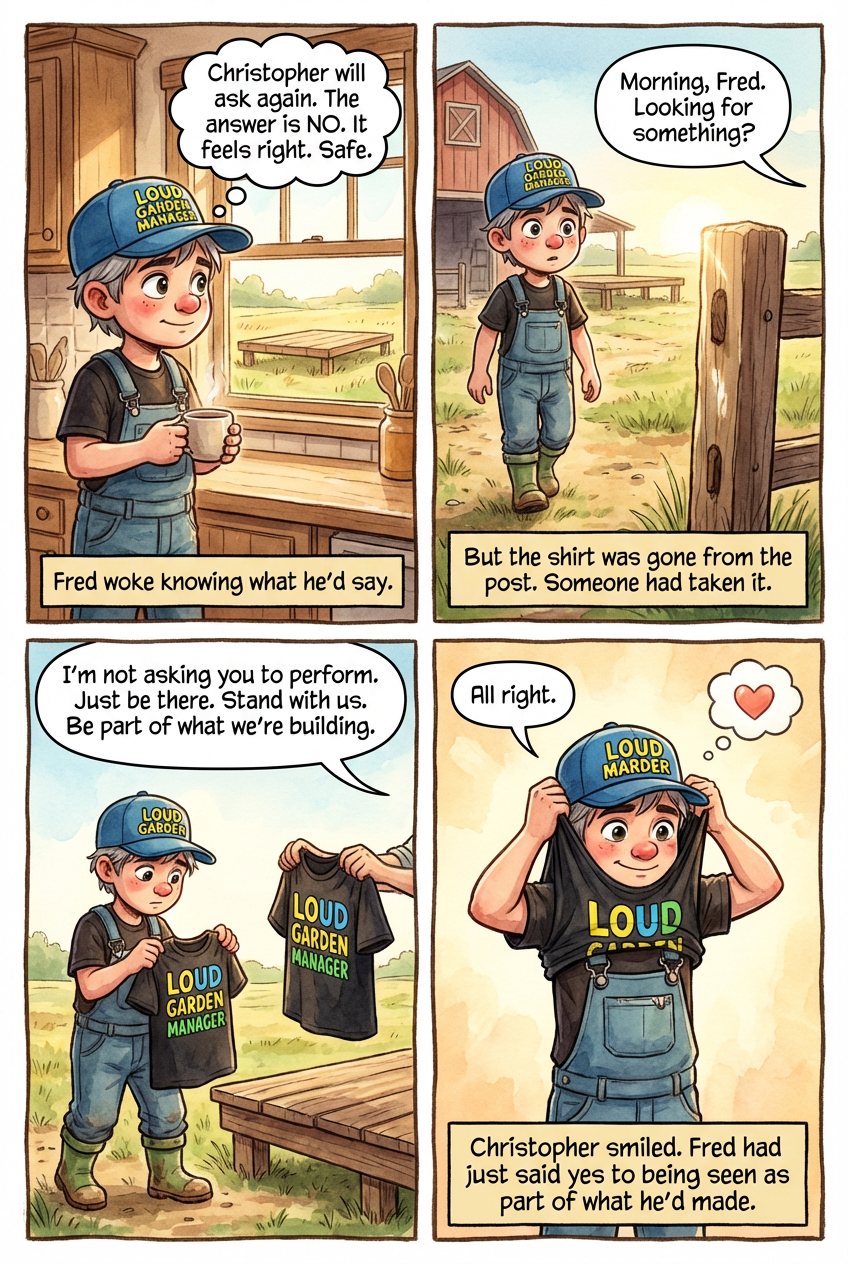
Fred woke the next morning knowing what he'd say. Christopher would ask again—today, probably, or tomorrow—and Fred would tell him no. The answer felt right. It felt safe. He poured water into a cup and drank it standing at the window, watching the platform where they'd be practicing later. But when he stepped outside an hour later, the shirt was gone from the fence post. Fred stopped walking. The weathered planks stood bare, the morning light catching the grain of the wood where the black fabric had been draped. He looked toward the platform, then the barn, then back at the fence. Someone had taken it. Christopher, probably. Or one of the others. He found Christopher sitting on the edge of the platform with the shirt folded in his lap. The bright letters looked sharper in daylight—yellow and blue and green against the black. Christopher stood when Fred approached. "I'm not asking you to perform," he said. He held out the shirt. "I'm asking you to be part of what we're building. You don't have to sing or play. Just be there. Stand with us." Fred took the shirt. The fabric was softer than he'd expected, worn in like something that had been loved before it arrived here. Christopher wasn't offering him a stage. He was offering him a place to stand while others performed—the same thing Fred had been doing from the toolshed, but visible instead of hidden. Fred pulled the shirt over his head. It fit. "All right," he said. Christopher smiled, and Fred realized he'd just said yes to something he'd spent forty years avoiding: being seen as part of what he'd made.
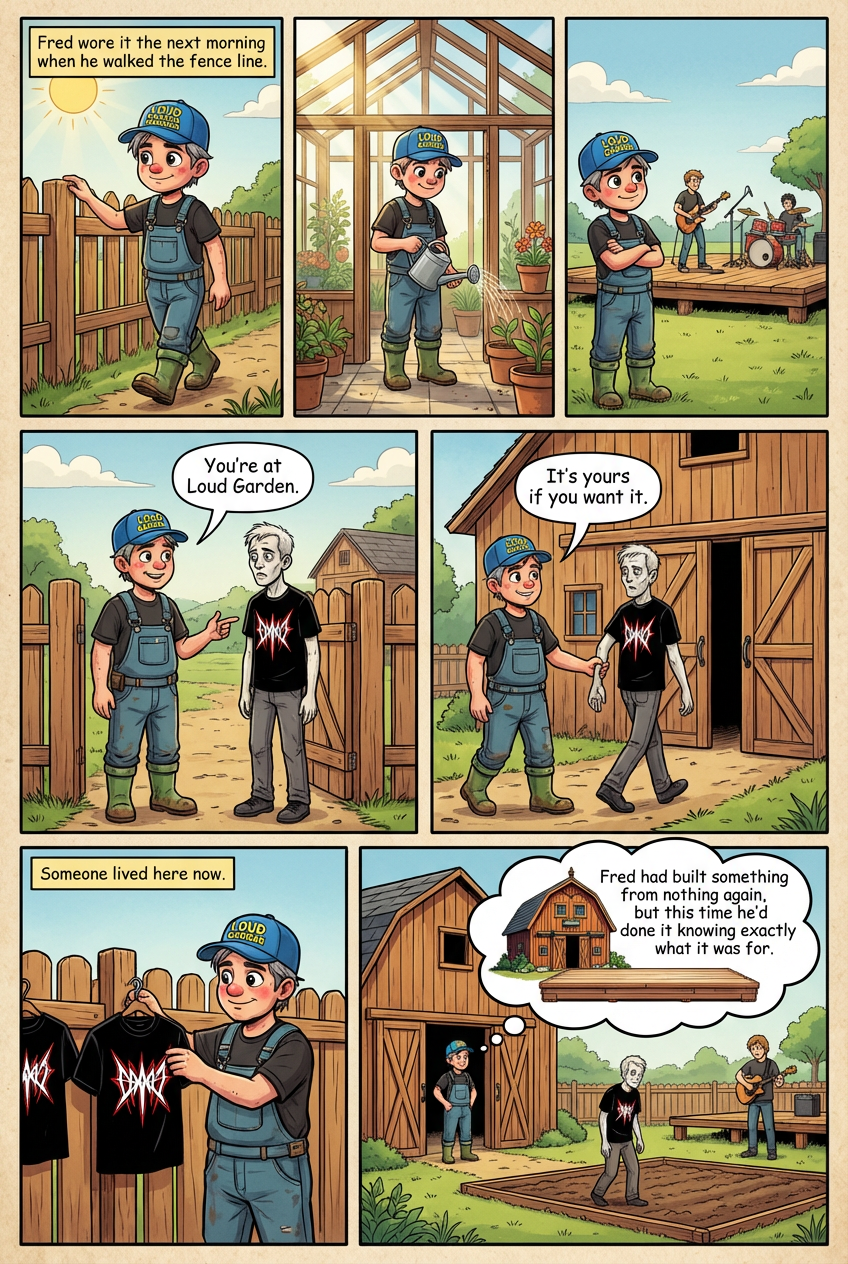
The shirt stayed on. Fred wore it the next morning when he walked the fence line, checking for storm damage that hadn't come. He wore it when he carried water to the greenhouse and when he stood watching Christopher's band practice from the edge of the platform. But the next arrival came differently. No storm preceded it. Fred was walking the back fence when he saw a man standing at the gate, pale and disoriented, wearing a shirt marked with a band's symbol—sharp lines in red and white against black fabric. The man looked at Fred without recognition, the way Christopher had when he first arrived. Fred opened the gate. "You're at Loud Garden," he said. The man nodded slowly, and Fred realized he'd have to offer more than shelter this time. He'd have to offer a place. Fred led him to the old garage he'd converted months ago, thinking someday someone would need it. The structure still smelled of fresh soundproofing and paint. "It's yours if you want it," Fred said. The man stepped inside, running his hand along the wall. Fred left him there and walked back to the fence line, where he hung a second shirt—identical to the one the man had arrived in—on the gatepost. It marked the corner lot the same way the wooden platform marked the band's space. Someone lived here now. The man emerged an hour later and stood looking at the shirt on the post. He didn't take it down. Fred watched from the barn doorway as the man walked the perimeter of his new lot, slow and deliberate, like someone learning the boundaries of something they'd been given. Fred turned back toward the platform where Christopher was tuning his guitar. The garage wasn't empty anymore. The corner lot had someone in it. Fred had built something from nothing again, but this time he'd done it knowing exactly what it was for.
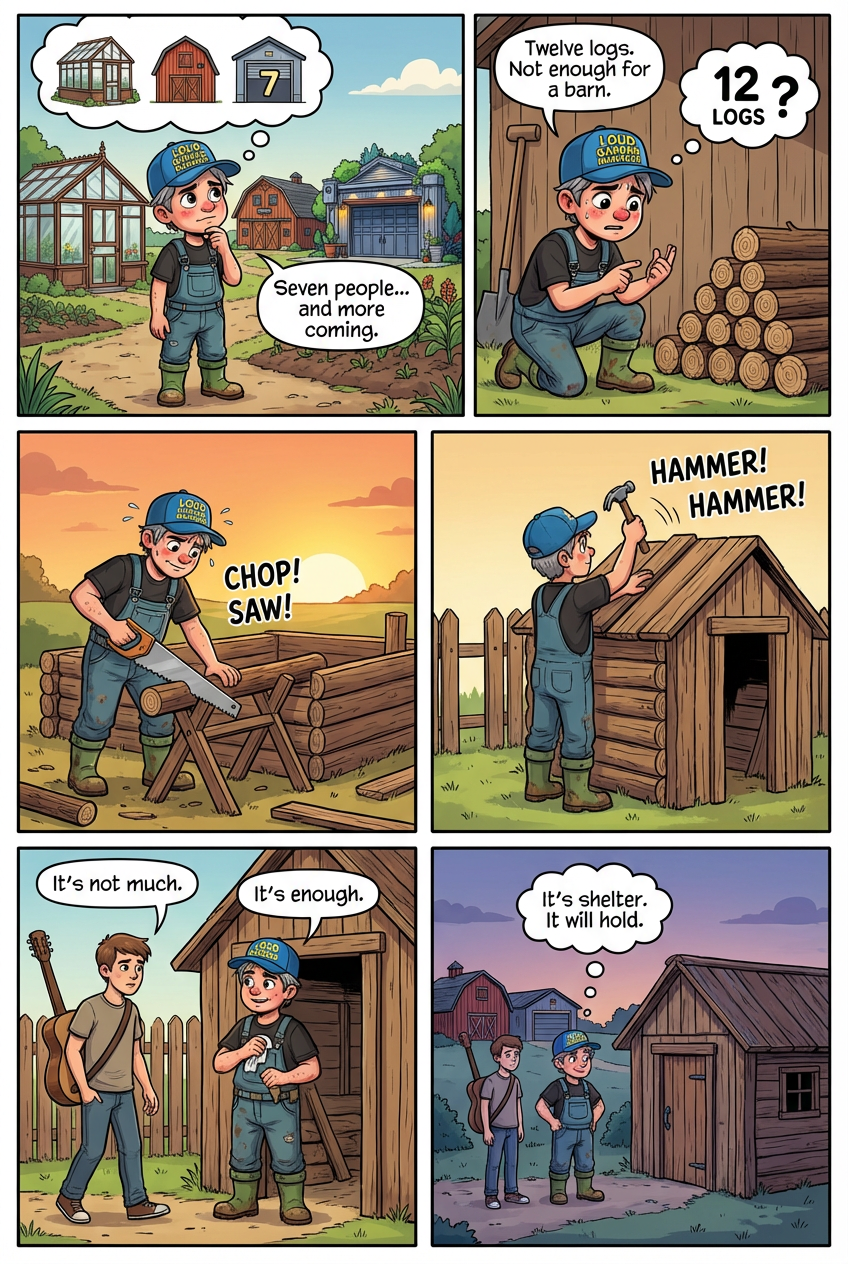
Fred counted the buildings each morning now. The greenhouse held three. The barn held two. The converted garage held one. Christopher's band practiced on the wooden platform, but they slept in the barn. Seven people total, and more would come. Fred knew it the way he knew storms. He walked to the wood pile behind the toolshed and stopped. Twelve logs remained, stacked against the back wall. He'd used everything else on the barn, the platform, the garage conversion. Twelve logs wouldn't build another barn. They wouldn't even build a proper room. Fred crouched and counted them again, as if the number might change. It didn't. He needed shelter for at least three more people, maybe five. But he had twelve logs. Fred started building anyway. He chose a spot near the fence line, far enough from the barn to be separate but close enough to share the path. He worked alone, cutting and fitting each log with care he hadn't used before. No waste. No extra cuts. By sunset he had four walls standing, rough and low, but solid. The roof took the last six logs and part of the fence he pulled down and re-cut. When he finished, the shed stood barely taller than his shoulders. One door. No windows. But it was shelter. Christopher walked over as Fred hammered the last board into place. He looked at the small wooden shed, then at Fred. "It's not much," Fred said. Christopher shook his head. "It's enough." Fred stepped back and studied what he'd built. The wood pile was gone. The fence had a gap. But Loud Garden had one more place for someone to sleep. He'd made something from almost nothing, and that would have to hold until the next storm brought more than just people.
Play your story to life
Storycraft is a mobile game where you create AI characters, craft items and locations to build their world, then discover what direction your story takes. Download the iOS game for free today!
Download for free