

Molly Malone's Arc
9 Chapters
Molly Malone's dream is expanding her fish stall into the town's most prosperous market.<.

Molly Malone hauled the wooden crate onto her small fish stall and wiped her hands on her apron. The morning air smelled of coal smoke and salt. She arranged the cod and mackerel in neat rows, their silver scales catching the gray light. Her stall was barely big enough for two customers to stand at once. But it wouldn't always be this way. One day she would own the finest market in all of Whitechapel. She'd have fresh oysters and lobsters, maybe even exotic catches from distant waters. For now, she had her father's old cart and a dream that burned brighter than any lamp in London. She stepped back and looked at the cramped space. The wood was worn and splintered at the edges. No paint, no decoration, just bare planks that sagged under the weight of her fish. But in her mind, she saw something different. She saw intricate woodwork carved along the frame. She saw colorful signs hanging above, announcing the day's catch. She saw customers lined up three deep, coins in hand, waiting for the freshest fish in town. The vision was so clear it made her chest tight. She pulled a stub of pencil from her pocket and found a scrap of paper. Her hand moved quickly, sketching out her dream. A proper Victorian market stall, grand and beautiful. She would build it, piece by piece, sale by sale. Starting today.
Molly opened her father's old ledger and stared at the empty pages. The leather cover was cracked and soft from years of use. She needed to learn the numbers first. How much did each fish cost her? How much could she sell it for? Her father had kept it all in his head, but that wouldn't work for a proper business. She dipped her pen in ink and started writing. Cod: bought for threepence, sold for sixpence. Mackerel: bought for twopence, sold for fourpence. The numbers looked small on the page, but they were real. They were the start of something bigger. She closed the book and tucked it under her arm. Tomorrow she would track every sale, every penny. That was how empires began. The next morning, Molly walked past her stall and kept going. She had fish to sell, but today she needed something more valuable. The Whitechapel Merchants Guild stood three streets over, an impressive stone building with carved details around the doorway. Grand arched windows lined the front, letting light spill onto the street. Molly had walked past it a hundred times but never went inside. Today was different. She climbed the stone steps and pushed open the heavy door. Inside, men in dark coats stood around tables covered with papers and ledgers. They looked up at her. She held her father's book tight against her chest and walked to the nearest table. "I need to learn how to run a proper market business," she said. Her voice didn't shake. One man with gray whiskers glanced at her apron, still smelling of fish. He nodded once and pulled out a chair. The man spread open his own ledger and tapped a column of numbers. He showed her how to track costs against sales, how to spot the fish that made the most profit, how to plan for slow days and busy ones. Molly wrote everything down in her father's book. After an hour, he closed his ledger and looked at her. "Numbers are half the battle," he said. "The other half is keeping your product fresh." He told her about market tents with water baskets, how the best sellers rinsed their fish throughout the day to keep them bright and clean. Molly walked back to her stall with her head full of new knowledge. She stopped at a weathered tent nearby, its fabric tattered but still standing. Inside sat baskets of grain and onions, and she saw how the setup worked. She would need something like that. A proper tent, baskets for water, a system to keep everything fresh. She opened her ledger and added a new line: Equipment needed. The list was growing, but so was her plan.
Molly stood at the corner of Whitechapel Market and watched the fishmongers work their stalls. The best ones had loyal customers who came back every week. She needed to understand why. One stall had a painted sign showing a smiling cod. Another kept their fish on beds of crushed ice that sparkled in the morning light. She walked to the end of the market row where a butcher worked behind a dark wooden meat stall. The wood was weathered and shabby, but the carved details along the frame caught her eye. Above the stall hung a brass plaque that read "Established 1867." This trader had been here for over twenty years. The stall showed the marks of time but also care. Fresh sawdust covered the ground beneath it. The display shelf gleamed despite the worn wood. Customers lined up three deep, just like in her vision. Molly stepped closer and studied the carved corners and the way the canopy provided shade for the meat. A small painted sign showed a pig and a cow, simple but memorable. This was what she needed to build. Not something new and shiny, but something solid that would last decades. She pulled out her ledger and sketched the frame design, noting how the wood curved at the top. She wrote down measurements with her stub of pencil. A stall like this cost money, but it was an investment. The butcher glanced at her and nodded once, then went back to serving his customers. Molly tucked the ledger under her arm and headed back to her own cart. She knew what came next. Save every penny, plan every detail, and build something that would stand for twenty years or more.
Molly counted her coins on the wooden counter of her cart. She had seventeen shillings saved, more than she'd ever held at once. The money sat in a small cloth pouch her father had used for market days. She needed to know where to spend it wisely. The butcher's stall stayed in her mind, solid and lasting, but she couldn't build that yet. First, she needed the right connections, the people who knew where to find good timber and fair prices. She tucked the pouch into her apron pocket and felt its weight against her side. This was the foundation of everything to come. The next morning, Molly walked to the Thames docks before sunrise. She needed to see where the timber came from, where the fishmongers arrived with their catch each day. The dock workers hauled crates from barges while gulls circled overhead. Along the water's edge stood a London plane tree with dark green leaves that created thick shade. Molly stopped beneath its branches and watched the workers stack wood planks near the loading area. One pile looked like oak, another like pine. She approached a dock worker rolling a barrel and asked who sold the timber. He pointed to a man in a brown coat checking his ledger near the tree. Molly walked over and waited until he looked up. She told him she needed wood for a market stall, nothing fancy, just solid and built to last. He quoted her twelve shillings for oak planks, eight for pine. She thanked him and wrote the prices in her ledger. The oak would cost most of her savings, but it would hold up for decades. She tucked the book away and walked back through the morning crowds. The connections were forming, and her plan was taking shape. On her way back to Whitechapel, Molly passed a patch of grass pushing through the cracks in the cobblestones. Dandelions grew there, their seed heads ready to scatter in the morning breeze. She stopped and looked at them. They grew in the hardest places, where nothing should survive. Her father used to point them out when times got hard at the market. Life finds a way, he'd say. Molly pulled her ledger out and checked the timber prices again. Twelve shillings for oak meant she'd have five left for everything else. It wasn't much, but it was enough to start. She closed the book and walked faster. The stall wouldn't build itself, but now she knew exactly what it would cost and where to get what she needed. The path was clear. By afternoon, Molly reached the town square where the bandshell stood. The wrought iron structure rose high above the market stalls, its detailed metalwork forming loops and curves that caught the light. People gathered near it every Sunday for music, and traders used it as a meeting spot during the week. Molly sat on the stone steps at its base and opened her ledger one more time. She had the timber price, the equipment list, and her savings counted down to the last penny. Everything was ready. She looked up at the bandshell, the most recognized landmark in town, and thought about her own stall standing in the market for twenty years or more. People would know it. They would come back to it. She closed the ledger and stood up. Tomorrow she would return to the docks and order the oak. The foundation was laid, and now it was time to build.
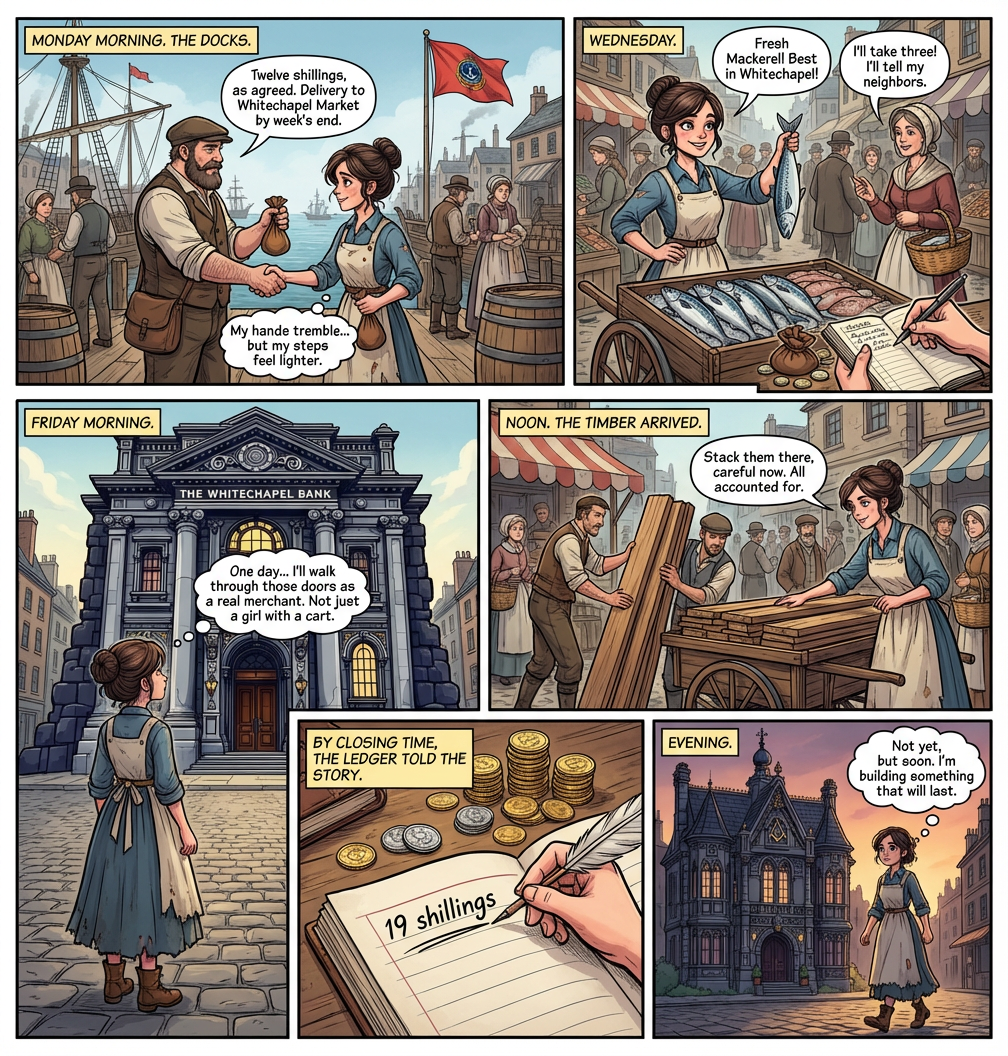
Molly placed her order at the docks on Monday morning. The timber merchant shook her hand, and she paid him twelve shillings from her pouch. He promised delivery to Whitechapel Market by week's end. Her hands trembled as she walked away, but her steps felt lighter than before. By Wednesday, customers noticed the change in her. She stood taller behind her cart, her voice clearer when she called out prices. A woman bought three mackerel and said she'd tell her neighbors about the fresh catch. Two more customers came that afternoon asking for her by reputation. Molly wrote each sale in her ledger with careful strokes. The coins clinked into her pouch, rebuilding what she'd spent on timber. She counted them twice that night and smiled at the growing pile. On Friday morning, she walked past the Whitechapel Bank on her way to market. The dark stone walls rose high above the street, solid and permanent. She stopped and stared at the intricate stonework, the heavy doors, the brass fixtures that gleamed in the early light. One day she would walk through those doors with her ledger full of records. She would show them years of steady sales, customer loyalty, proof that her stall earned its place. The bank would see her as a real merchant, not just a girl with a cart. She touched the pouch at her side and felt the weight of this week's earnings. The timber would arrive today. Her foundation was ready. The oak planks came at noon, stacked on a delivery cart. Molly directed the workers to set them behind her fish cart. She ran her hand along the smooth wood, counting each piece. All there, exactly as ordered. Three customers waited while she signed for the delivery, and she served them quickly, her hands steady and sure. By closing time, she'd sold more fish than any other day that week. She counted nineteen shillings in her pouch, seven more than she'd spent on timber. The numbers in her ledger told the story better than words ever could. Each sale built on the last one, each satisfied customer brought another. She walked home past the Victorian Masonic lodge with its dark grey stone and tall windows. The building stood silent in the evening light, but she could picture herself there one day, ringing the bell outside to mark another successful year. Not yet, but soon. The timber waited for her, and her customers kept coming back. She was building something that would last.
Molly stood at her cart Monday morning and watched a stray dog knock over her display board. The fish scattered across the cobblestones, some sliding into the gutter. She rushed to gather them, but three mackerel were covered in mud and street waste. A regular customer walked up, saw the mess, and turned away without a word. Molly's chest tightened as she salvaged what she could. By noon, she'd lost half her stock and made only four shillings. The timber sat behind her cart, still waiting to become something more. She looked at the coins in her hand and felt the weight of what she'd spent on wood she couldn't use yet. The setback stung worse than any cold morning at the docks. By Tuesday afternoon, word had spread. Three customers mentioned the spoiled fish from the day before. One woman said her neighbor had seen the whole mess and refused to buy from Molly's cart anymore. Molly tried to explain what happened, but the woman walked away mid-sentence. Near the market entrance, someone had written complaints about bad fish on a blackboard where a professor usually taught math problems to street children. Molly's name sat at the top of the list in white chalk. Her face burned as she read it. She scrubbed at the words with her sleeve, but the chalk only smeared. Four more customers passed her cart without stopping. On Wednesday morning, Molly walked past Whitechapel Bank to clear her head before market hours. The gothic metal street sign for Dorset Street stood tall near the entrance, its detailed ironwork still striking despite the rust along its edges. She remembered when her father used to point out the sign as proof that good work lasted. Beyond it, a Victorian hearse sat abandoned in the bank's side yard, its black horse long gone and its woodwork cracking in the weather. The sight made her stomach drop. Beautiful things could fall apart if nobody tended them. She touched the coins in her apron pocket. Six shillings left from last week's nineteen. The timber behind her cart felt like a mistake now, wood she'd never use. Molly returned to her cart and counted the fish she had left. Enough for maybe two days if customers came back. She opened her ledger and stared at the numbers. The loss from Monday, the slow sales Tuesday and Wednesday. Her savings were nearly gone. She closed the book and looked at the oak planks stacked behind her. They could still become something, but not today. Today she needed to rebuild trust, one customer at a time. She straightened her apron and called out her prices to the morning crowd. Her voice cracked at first, then steadied. A woman stopped and examined a cod. Molly showed her the clear eyes and firm flesh. The woman bought it and paid fair price. One sale. Then another. By closing time, Molly had made eight shillings. Not enough to recover, but enough to keep going. She packed up her cart and touched the timber one last time before heading home. The foundation was still there, just buried under harder days than she'd planned for.
Molly walked through Whitechapel's narrow streets until she reached the old stone church at the edge of the market district. She pushed open the heavy wooden door and stepped inside. Sunlight streamed through the stained glass windows, painting colored patterns across the worn pews. She sat in the back row and let the silence settle around her. Her father used to bring her here when she was small, before he died. He'd told her that when things felt impossible, she should find a quiet place to remember why she started. She closed her eyes and pictured her expanded stall—not just a cart, but a real structure with her name painted across the front. The image felt distant after this week's losses, but it was still there. She opened her eyes and stood up. The church bells rang noon as she walked back outside. Her cart waited for her, and so did the timber. Tomorrow she'd try again. She walked toward the market but stopped at a shop window along the way. A photograph sat in a wooden frame behind the glass. The sepia tones showed a young merchant standing beside his cart, his clothes simple but his shoulders square. The scalloped edges gave it an old-fashioned look. She'd seen the image before but never really looked at it. The merchant in the picture had started small too, just like her. Now his name hung on signs across three different markets. She pressed her palm against the cool glass and studied his face. He looked determined, not happy, not sad. Just steady. That's what she needed to be. The afternoon sun hung low as she followed a wooden sign that pointed toward the river. The carved letters read "To the River" in elegant script. She hadn't walked this way in months. The path led her down to the waterside where the tide had pulled back, leaving dark mud and scattered stones. Small crabs moved sideways across the exposed riverbed. Shells glinted in the wet sand. She watched the water's edge and remembered her father bringing her here to show her where the best catches lived. The river gave and took away, but it always kept moving. She picked up a smooth stone and turned it over in her hand before dropping it back into the mud. On her way home, she passed a coffeehouse with black painted walls and large arched windows. The ironwork above the door twisted into patterns that caught the fading light. She could hear voices inside, the low rumble of conversation between people who understood hard work. She pushed open the door and stepped inside. The smell of coffee filled the air. Three merchants sat at a corner table, their ledgers spread out between them. One looked up and nodded at her. She ordered a cup and sat near the window. The warmth of the drink spread through her chest. Tomorrow she'd return to her cart with clearer eyes. The timber would still be there, and so would she.
Molly arrived at her cart before dawn on Thursday. She lit her lantern and unpacked her fish, arranging each one with care. The scales caught the lamplight, throwing small flashes across the cobblestones. She stepped back and studied her display. Everything looked fresh and clean. A man stopped on his way to work and bought two haddock. Then a woman came for cod. By mid-morning, Molly had sold more than the previous three days combined. She touched the timber behind her cart and felt something shift inside her chest. The wood wasn't a mistake. It was a promise she'd made to herself, and today she'd proven she could still keep it. At noon, she walked to the Fishmongers' Guild to ask about expanding her business. The clerk showed her a shiny black telephone mounted on the front desk. He explained that merchants could use it to send inquiries to coastal fishing villages for bulk orders. Molly ran her fingers along the glossy surface. With this, she could reach suppliers directly instead of waiting for middlemen at the docks. The clerk also pointed to a wooden wall phone near the entrance. Restaurant owners and merchants used it to place urgent orders, even after guild hours closed. Molly wrote down the information in her ledger. These tools could help her grow faster than she'd imagined. Outside the guild building, she noticed a small wooden hatch built into the wall. The clerk had mentioned it stored emergency ice for members during heat waves. Molly thought about the fish she'd lost on Monday, spoiled in the summer warmth. With access to extra ice, she could keep her stock fresh longer and waste less. She asked about membership costs. The clerk quoted a price that made her stomach tighten, but he added that new members could pay in installments. She looked at the hatch again, then at the telephone inside. The guild offered more than just ice and communication. It offered a path forward. Molly walked back to her cart with her head high. She had made thirteen shillings today, her best earnings in two weeks. The timber behind her cart would become her permanent stall, but first she needed to join the guild. She counted the coins in her apron pocket and did the math in her head. Three more weeks of strong sales would cover the first payment. She straightened her remaining fish and called out to the afternoon crowd. A customer stopped, then another. By closing time, she had sold everything. She locked her cart and headed home as the sun set over the rooftops. The foundation she'd been building was finally starting to hold.
Molly stood at her cart Friday morning and counted her earnings from the week. She had enough for the guild's first payment with a little extra left over. She walked to the Fishmongers' Guild and handed the clerk her coins. He wrote her name in the registry and gave her a membership card. She held it in both hands, feeling the weight of what it meant. Access to ice, telephones, and wholesale connections—everything she needed to stop scraping by. She walked back to the market and looked at the timber stacked behind her cart. Next week she'd hire a carpenter to build her permanent stall. The foundation was set. Now the real work could begin. Monday morning, Molly hung a new scale from a hook on her cart. The metal dial caught the light as she tested it with a small cod. Customers had sometimes questioned her prices, and she'd lost sales because of it. Now they could watch the needle move and see the weight for themselves. A woman stopped and pointed at the mackerel. Molly placed it on the scale and showed her the reading. The woman nodded and paid without argument. By noon, three more customers had asked to see fish weighed before buying. The scale was already earning back what it cost. Tuesday afternoon, she walked to the docks to talk with the stevedores about bulk deliveries. A thick-shouldered man in a flat cap stood near a wooden crane, directing barrels onto a wagon. She explained that she'd need help moving crates once her permanent stall opened and wholesale orders came through. He looked her over, then quoted a fair price for his labor. She shook his hand and wrote his name in her ledger. When her first big shipment arrived, she'd know who to call. Wednesday morning, a girl no older than ten appeared at Molly's cart. She wore a patched dress and carried a wicker basket. She asked if Molly needed someone to shout out the day's catch and prices to people passing by. Molly studied her for a moment. The girl's voice was clear and strong when she spoke. Molly gave her two pence and told her to walk up and down the market row, calling out the specials. Within an hour, four customers came to the cart asking for the discounted haddock the girl had announced. Molly paid her another penny at day's end and told her to come back tomorrow. The pieces were falling into place. The scale built trust. The stevedore would handle the heavy work. The girl brought in customers. Everything Molly needed to grow was now within reach.
Play your story to life
Storycraft is a mobile game where you create AI characters, craft items and locations to build their world, then discover what direction your story takes. Download the iOS game for free today!
Download for free