

Dr. Stanley Reeves's Arc
6 Chapters
Dr. Stanley Reeves's dream is splicing his own DNA to survive the apocalypse he predicts.

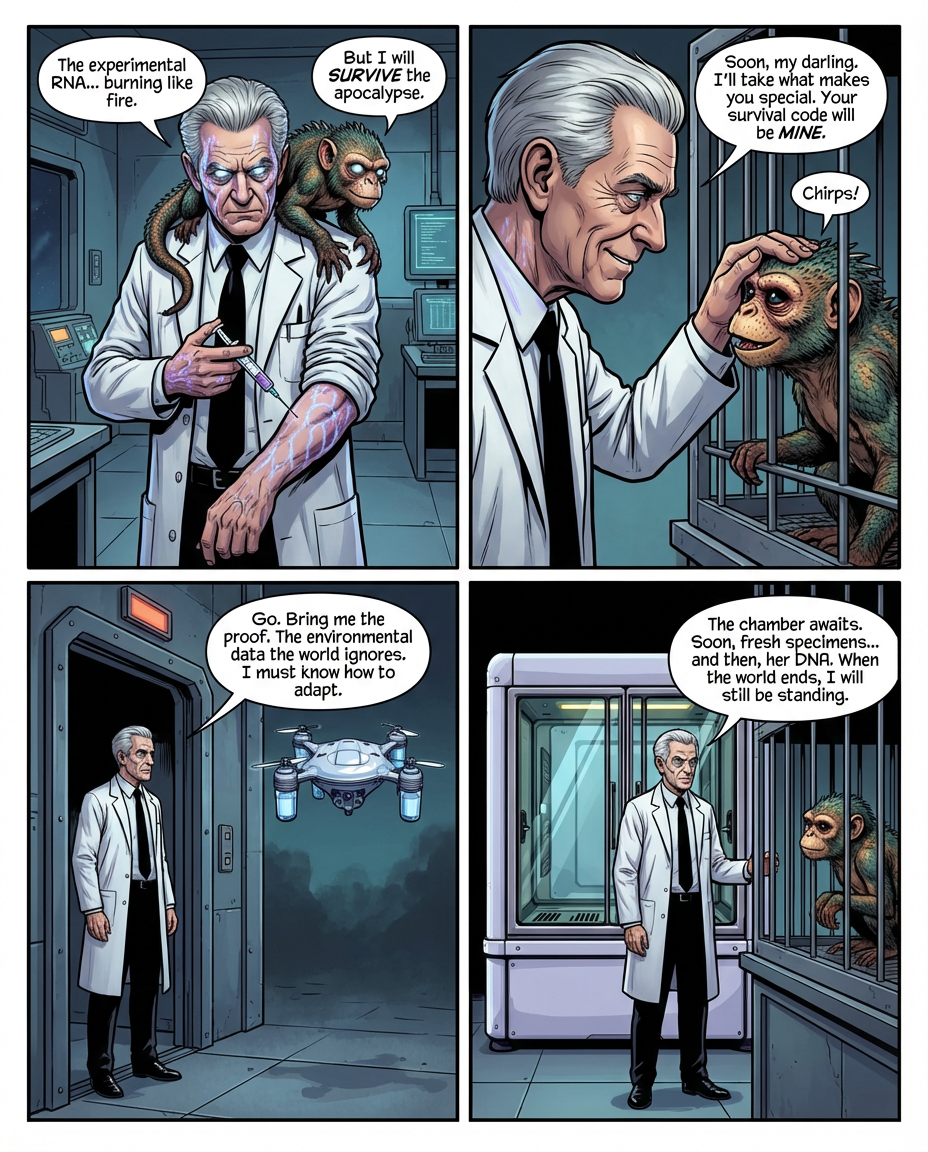
Dr. Stanley Reeves pressed the syringe against his forearm and pushed the plunger down. The experimental RNA sequence burned through his veins like fire. He wanted to survive what was coming—the end of everything. His eyes had already changed, turning the color of liquid mercury. He blinked and saw wavelengths of light that normal humans couldn't perceive. Patterns danced across his skin in ultraviolet bands. The laboratory around him hummed with refrigeration units and filtration systems. Nobody knew this place existed, buried deep where curious eyes wouldn't find it. Here he could work without interruption. Here he could remake himself into something that would outlast the apocalypse. His darling chirped from her cage in the corner, scales catching the fluorescent light. The monkey-lizard hybrid tilted her head and whispered sounds that almost formed words. Stanley walked over and stroked her scaled forehead with one finger. "Soon," he told her softly. "Soon I'll take what makes you special and put it inside me." She had survived when her forty-seven siblings had died. That made her precious. That made her the key. He would extract her genetic sequences within the week. After that, she would go into the incinerator. But for now, she was his most successful creation, and he needed her alive just a little longer. Stanley turned to the metal table where his drone sat waiting. The sleek machine held glass vials in its chassis, each one empty and ready. He needed samples from outside—water, bacterial cultures, anything that showed how the environment was changing. The governments ignored the signs, but he saw them clearly with his altered vision. The drone would collect the data he required. He programmed the flight path into the control panel and carried the machine to the sealed exit. The heavy door opened with a hiss. Stanley released the drone into the darkness beyond and watched its lights disappear. When it returned, he would have proof. When it returned, he would know exactly what adaptations his body needed next. The specimen chamber sat on the counter beside his extraction tools. Glass viewing ports lined its sides, and drainage slots kept the interior clean. He would need living creatures soon—frogs, salamanders, anything with genes that helped them survive in changing conditions. The chamber would keep them alive until he needed their DNA. Stanley walked back to his darling's cage and watched her yellow eyes track his movement. She chirped again, that half-word sound she made. He smiled at her. Every piece was coming together. The drone would bring environmental data. The chamber would hold fresh specimens. His darling would give him her survival code. And when the world ended, he would still be standing.
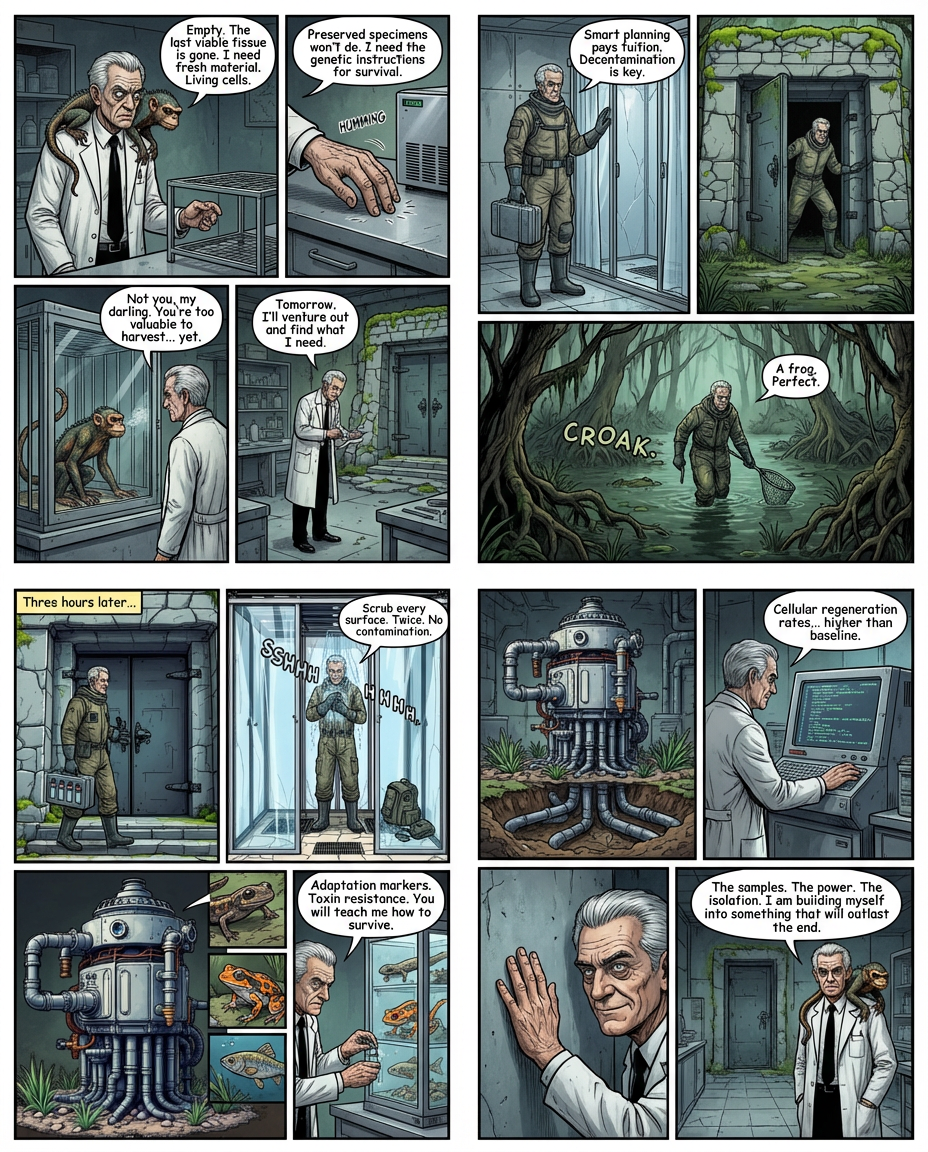
Stanley stared at the empty rack where samples should have been. He'd used the last viable tissue yesterday on a failed splice. Now he needed fresh material—living cells that could teach his body new tricks. His mercury eyes scanned the laboratory for alternatives. The refrigeration units hummed, but their contents were already extracted or dead. He pulled open drawer after drawer, finding only preserved specimens floating in jars. His fingers drummed against the metal counter. Without new genetic material, his work would stall. He walked to his darling's cage and watched her breathe, scales rising and falling with each breath. Not yet, he reminded himself. She was still too valuable to harvest. He turned back to his equipment and began sterilizing collection tools. Tomorrow he would venture out himself. Tomorrow he would find what he needed to continue. Morning arrived and Stanley packed collection vials into a waterproof case. He pulled on thick boots and gloves, then stopped at the sealed exit. A vinyl curtain hung beside the door, marking the shower booth he'd installed months ago. Stone floor, drainage grates, everything designed to scrub contamination off before re-entry. Smart planning pays tuition, he thought. Outside air could carry spores, bacteria, anything that might ruin his experiments. He pushed through the heavy door and stepped into humid air. Trees rose around him, their roots tangled in dark water. He waded forward, scanning the murky surface for movement. A frog called from somewhere nearby. Stanley smiled and followed the sound. When he returned, he would strip down in that shower booth and wash every surface twice. The samples would stay sealed until they reached the specimen chamber. His darling would have company soon, and his work would continue exactly as planned. Three hours later, Stanley returned with seven vials of living specimens. He stripped at the entrance and stepped under the cold water, scrubbing methodically. The shower booth drained the contaminated water away from his laboratory's threshold. He washed his collection case twice, then his boots, then every inch of exposed skin. Only when the water ran clear did he step through the vinyl curtain and towel off. Inside, he placed the vials into the specimen chamber and watched the creatures move. A salamander with mottled skin. Two frogs with bright orange markings. Small fish that had survived in stagnant pools. Each one carried genetic instructions for survival in hostile conditions. Stanley pulled his lab coat on and prepared the extraction equipment. The apocalypse was coming, but he was learning. Each sample brought him closer to the modifications his body needed. Each creature paid its tuition so he could outlast the end. The generator rumbled beneath the concrete floor, its metal pipes reaching deep into the earth below. Stanley felt the vibration through his boots as he worked. Power from the geothermal system kept every piece of equipment running without depending on anything outside these walls. The bunker had been the right choice—thick concrete, heavy steel doors, moss already covering the stone foundations like it had always been here. Nobody would find this place. He extracted cellular material from the first frog and loaded it into the sequencer. The machine powered on without a flicker. His mercury eyes tracked the data streaming across the screen. Adaptation markers. Toxin resistance. Cellular regeneration rates higher than baseline human tissue. He pressed his palm against the cool metal of the bunker wall and smiled. Everything he needed was right here. The samples. The power. The isolation. He was building himself into something that would survive when everything else burned away.
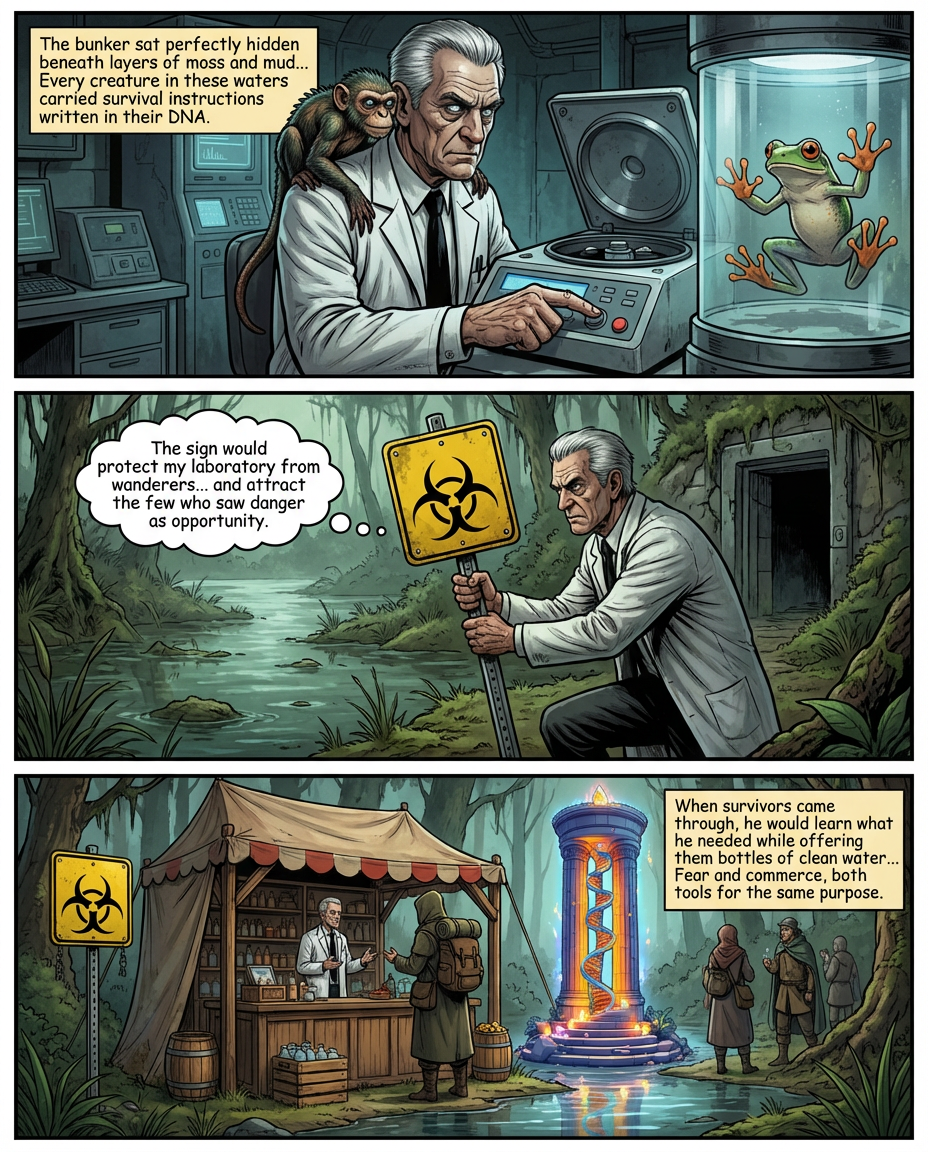
Stanley loaded the last specimen vial into the centrifuge and pressed the start button. The machine whirred to life, spinning the cellular material into layers he could separate and analyze. His mercury eyes tracked the rotation through the clear lid. This swamp offered everything he needed—isolated, thick with life, impossible to navigate without proper equipment. The bunker sat perfectly hidden beneath layers of moss and mud, surrounded by water that kept visitors away. He walked to the specimen chamber and watched a frog press its orange toes against the glass. Its skin secreted toxins that could stop a human heart. Soon those toxins would teach his cells new defense mechanisms. The apocalypse would burn through cities first, but out here, buried in the wet darkness, he would have time to finish his work. Every creature in these waters carried survival instructions written in their DNA. Every sample brought him closer to becoming something that couldn't die. Stanley pulled a yellow sign from the supply closet and turned it over in his hands. The black biohazard symbol stared back at him like three overlapping circles forming a warning. He carried it to the sealed exit and pushed through the heavy door. Outside, he drove a metal post into the soft ground thirty feet from the bunker entrance. The sign faced outward toward the water, bright yellow cutting through the green and brown landscape. Anyone who saw it would turn away, believing the area was contaminated. But if someone was brave enough or desperate enough to investigate, they might possess exactly the kind of mind he could use. The collective needed members who understood that safety was an illusion. He stepped back and examined his work. The sign would protect his laboratory from wanderers while attracting the few who saw danger as opportunity. Stanley returned to the bunker and sealed the door behind him. His darling chirped from her cage, and he smiled. The swamp would keep delivering what he needed—specimens, isolation, and perhaps even allies who understood that the end was coming. Three days later, Stanley assembled a wooden frame near the biohazard sign. Canvas stretched across the top, creating shade beneath. He arranged shelves inside and stocked them with sealed bottles—distilled water, preserved specimens in clear solution, dried plants from the swamp. A market tent, innocent and inviting. He placed a wooden stool behind a narrow counter. Travelers might stop here, thirsty or curious. They would talk while examining his goods. They would mention where they came from and what they'd seen. Stanley needed information about the outside world—supply routes, population movements, signs of collapse. The tent would gather that intelligence without revealing his real work below ground. He tested the structure's stability, then walked back toward the bunker entrance. The biohazard sign stood like a gatekeeper beside his new trading post. Fear and commerce, both tools for the same purpose. When survivors came through, he would learn what he needed while offering them bottles of clean water. Some might prove useful to the collective. Most would simply pay their tuition in knowledge and move on. Stanley spent the evening carving spiraling patterns into stone pillars he'd salvaged from a collapsed structure deeper in the swamp. Crystal fragments from his failed experiments caught light when he pressed them into the grooves. The pillars would stand outside the market tent—a monument to what he was building here. DNA strands twisted upward in glowing paths, showing anyone who saw them that genetic mastery was possible. The sculpture would attract the right kind of attention from people who understood that evolution didn't wait for permission. He carried the first pillar outside and planted it firmly in the mud. The crystals pulsed with stored bioluminescence from jellyfish proteins. Beautiful and terrible, just like his darling. Just like the future he was creating for himself. The swamp had given him everything—raw materials, isolation, and soon, perhaps witnesses who would see his transformation and understand. He returned to the bunker and locked the door. His work was spreading outward now, marking this place as his. When the apocalypse came, this would be the center that held.
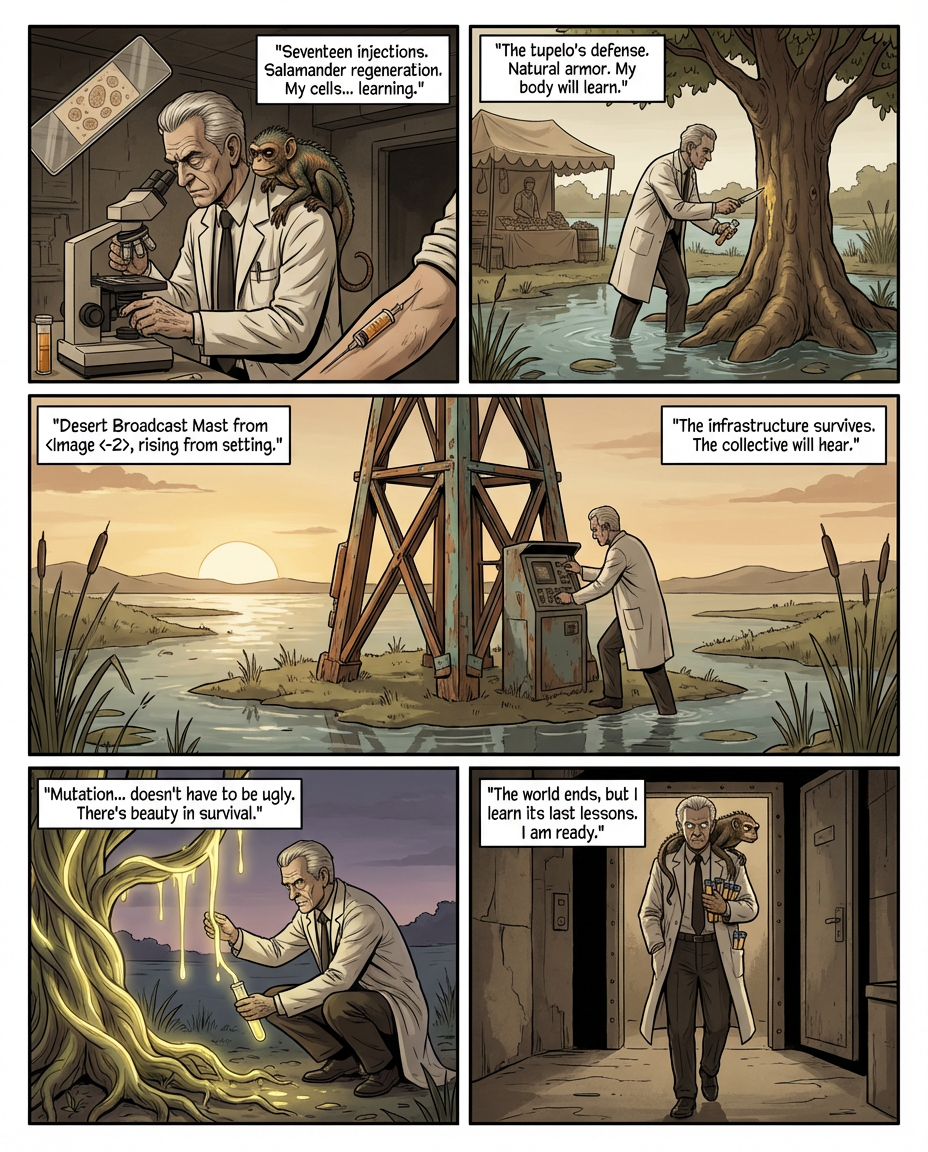
Stanley pressed his palm against the bunker's steel door and felt the metal's coolness seep into his skin. Four successful extractions waited in the specimen chamber, their cellular material already separated and cataloged. He walked to the workbench and lifted a glass slide to his mercury eyes, watching proteins bond in patterns no baseline human could perceive. The salamander DNA showed promise—regeneration markers that could teach damaged tissue how to rebuild itself. He set the slide down and reached for his injection kit. The syringe filled with amber liquid, thick with modified RNA sequences he'd designed last week. His arm barely registered the needle anymore. Seventeen injections this month, each one adding new instructions to his cells. He pressed the plunger and watched the solution disappear beneath his skin. A warm sensation spread through his forearm, then faded. His body was becoming the laboratory now, testing each modification in real time. The apocalypse wouldn't wait for perfect results, so neither would he. Stanley stepped outside to check the market tent and spotted a tupelo tree he hadn't examined before. Water pooled around its swollen base, and the leaves gleamed with a waxy coating that shed moisture in perfect droplets. He moved closer and ran his gloved fingers across the bark. Needle-like protrusions covered the surface, sharp enough to draw blood. Natural defenses. The tree had survived in standing water for years, maybe decades, protected by toxins and physical barriers that kept predators away. He pulled a collection blade from his coat and carved a sample from the bark. Clear sap oozed out, thick and amber. Stanley sealed it in a vial and held it up to the light. Plants didn't need complex nervous systems to create poisons—they simply built them into every cell. He pocketed the sample and walked back toward the bunker. Tomorrow he would extract whatever chemical instructions lived inside that waxy bark. His body would learn what the tree already knew—how to make survival automatic. Past the market tent, Stanley noticed a radio mast rising from the wetland like a rusted finger pointing at the sky. Corroded steel caught the afternoon light, and weathered wooden beams held the structure upright despite years of moisture and decay. He approached and examined the base. Old wiring ran down into a metal box half-buried in mud. The collective needed this. They talked in encrypted messages about the collapse, but most people still wandered blind, trusting governments that ignored every warning sign. Stanley pulled the panel open and found the transmitter still intact. He could broadcast what was coming—not to save everyone, but to find those few who would listen and prepare. The infrastructure already existed, waiting for someone to use it. He wiped mud from the control panel and smiled. His work in the bunker would continue, but now his voice could reach beyond these waters. The apocalypse was a teacher, and tuition came due whether people were ready or not. On his way back, Stanley stopped at a vine he'd passed dozens of times without really seeing it. Translucent tendrils twisted around a dead cypress stump, glowing with soft yellow light as evening approached. He crouched and touched one strand. Warm. The phosphorescent sap dripped slowly, catching the fading daylight and holding it. His darling whispered about light in darkness, about things that changed and survived by becoming beautiful. This vine had transformed itself into something that needed no sun. Stanley pulled a collection tube from his coat and gathered three drops of the glowing fluid. The salamander gave him regeneration. The tupelo would teach toxin production. And this vine—this showed him that mutation didn't have to be ugly. His mercury eyes reflected the yellow glow as he sealed the sample. He stood and walked toward the bunker, three new pieces of the final design waiting in his pockets. The world was ending, but he was learning its last lessons.
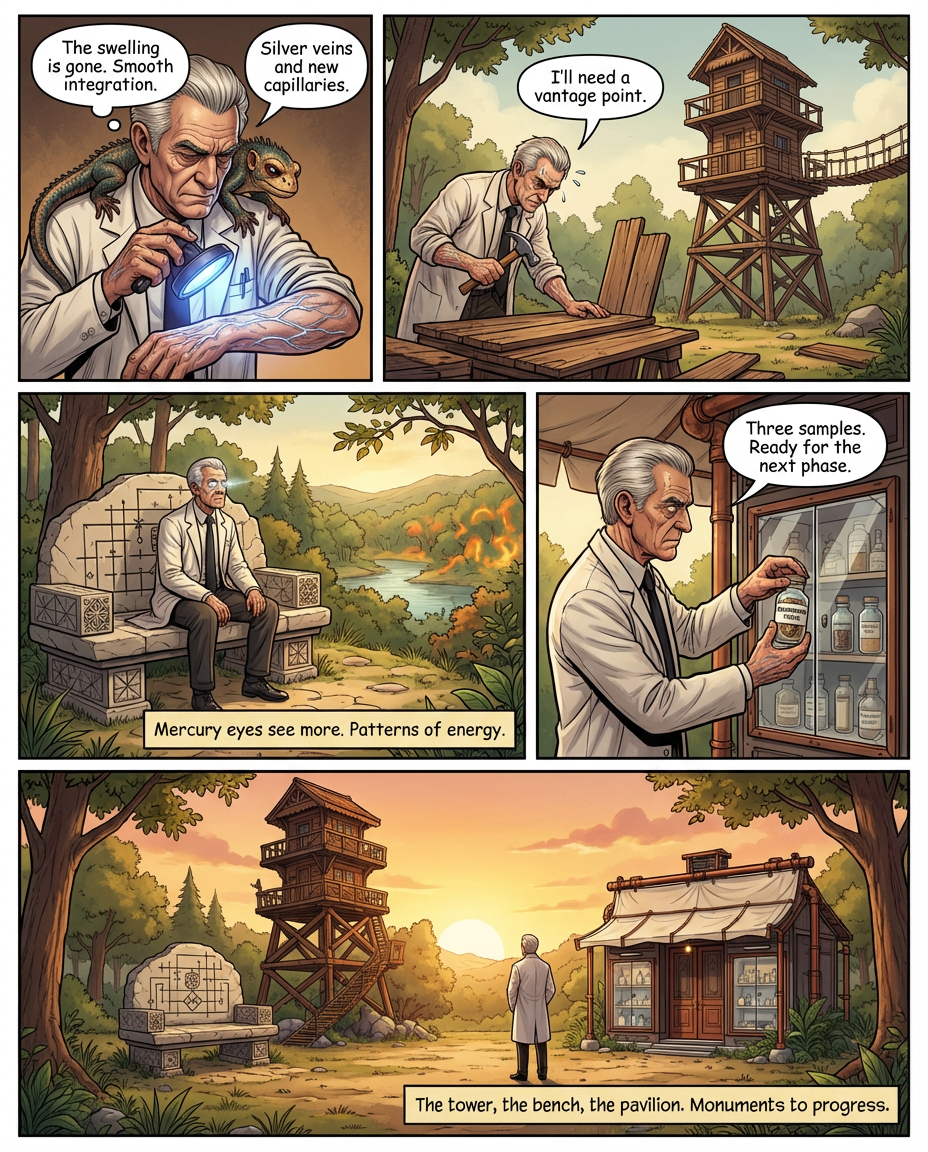
Stanley pressed his thumb against the fresh injection site and watched the swelling fade. His cells accepted the salamander RNA without rejection—no fever, no inflammation, just smooth integration. He walked to the specimen chamber where five new samples waited in refrigerated storage. The tupelo bark extract had synthesized perfectly, and preliminary tests showed his skin cells producing trace amounts of the tree's defensive compound. He held his hand under the ultraviolet lamp and counted the changes. Silver veins branched beneath his wrist where mercury had bonded to his hemoglobin. New capillaries formed geometric patterns that shouldn't exist in human tissue. His darling chirped from her cage, and he turned to show her his progress. "Look," he whispered, flexing his fingers. "We're becoming something better." The modifications were holding. Each injection built on the last, creating a foundation that could support whatever came next. For the first time in months, his body felt like an ally rather than a limitation. He needed to mark this moment. Stanley left the bunker and walked until he found a clearing where weathered lumber lay scattered in the mud. He dragged the planks to solid ground and began building, hammer striking nails with steady rhythm. The platform rose first, then another above it, connected by rope bridges that swayed when he tested them. From the highest level, he could see the canopy stretching in all directions, water pooling between twisted roots. His mercury eyes caught wavelengths that turned ordinary leaves into patterns of heat and light. Three successful integrations now—salamander regeneration, tupelo toxin production, enhanced vision from his own modifications. The tower stood as proof that his body was transforming exactly as he'd designed. Stanley climbed down and stepped back to examine his work. When the collective asked for evidence, he would bring them here and show them what compatibility looked like. The world might be ending, but he was building something that would outlast it. Stanley carried stones to a spot near the bunker entrance and arranged them into a bench. He carved mathematical grids into the surface—each square representing a successful DNA integration, each line a pathway his cells had learned to follow. The pattern looked clean and deliberate, proof that his transformations followed logic rather than chaos. He sat on the stone and watched light shift across the water's surface. His body no longer rejected foreign genetic material. The salamander sequences would let damaged tissue rebuild itself. The tupelo compound would make his skin produce toxins. His enhanced vision already showed him a world most humans couldn't perceive. Each modification brought him closer to something that could survive what was coming. Stanley traced his fingers along the carved grid and smiled. The bench would remain here, a record of the day his body stopped fighting him and started becoming the weapon he needed. The final piece took shape near the observation tower. Stanley constructed a pavilion with canvas stretched overhead and copper pipes running beneath the floor. Glass cabinets lined the walls, their seals tight enough to preserve specimens without refrigeration. He placed three vials inside—salamander tissue, tupelo extract, and a sample of his own modified blood. The pavilion would serve as his demonstration space when volunteers finally arrived. People who understood what was coming would need proof before they let him inject them with foreign DNA. Stanley arranged the cabinets so morning light would hit the specimens at the right angle. His mercury eyes saw the copper piping as veins carrying possibility. The tower celebrated his success. The bench recorded his methods. And this pavilion would transform others into something that could survive. He locked the cabinet and stepped outside. Three structures now stood as monuments to his progress. His body had become the proof, and soon others would follow.
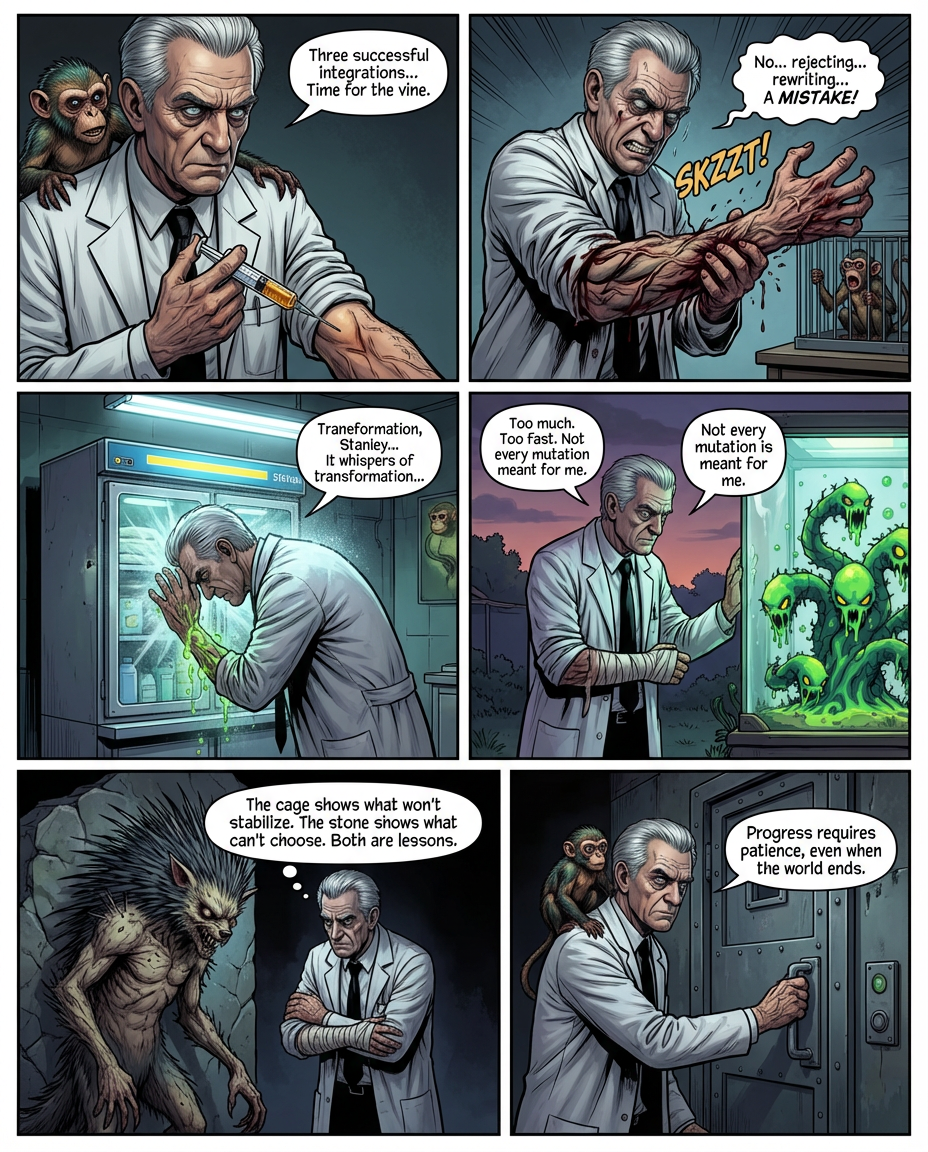
Stanley lifted the syringe and watched amber liquid catch the lamplight. The vine's phosphorescent compound had synthesized perfectly, ready to join the salamander and tupelo modifications already coursing through his cells. He pressed the needle against his forearm and pushed the plunger. Fire exploded beneath his skin. His arm convulsed, muscles tearing themselves apart and knitting back together in wrong patterns. He stumbled against the workbench as his mercury eyes blurred, unable to focus on any wavelength. The vine extract was rejecting everything else, rewriting instructions his cells had already learned. His darling shrieked from her cage as Stanley collapsed to his knees. Blood seeped from his injection site, dark and thick. Three successful integrations, and now one beautiful mistake was unraveling all of them. He crawled toward the metal cabinets, fingers slipping on the floor. The decontamination station gleamed under the fluorescent lights. He grabbed the edge and pulled himself upright, then twisted the valve. Chemical spray hit his arm, cold and sharp. The burning didn't stop. His skin bubbled where the vine compound fought the salamander regeneration, each sequence trying to rewrite the same cells. Stanley pressed his forehead against the cabinet door and let the spray wash over him. The modifications were eating him from the inside. The water shut off automatically after two minutes. Stanley stood there dripping, watching his arm twitch with competing instructions. The phosphorescent glow faded to nothing as his cells rejected the vine extract completely. His mercury eyes slowly cleared, wavelengths separating back into focus. The other modifications held—salamander, tupelo, his enhanced vision. But the fourth integration had failed, and the failure had nearly destroyed everything he'd built. He looked at his darling, who pressed against the bars of her cage and clicked softly. Forty-seven of her siblings died before she survived. Stanley wrapped his arm in gauze and walked back to his workbench. The syringe lay on its side, a few drops of amber liquid pooling on the metal surface. He'd been reckless, adding too much too fast. The apocalypse was coming, but his body needed time to learn each lesson before moving to the next. He threw the syringe in the disposal container and sat down heavily. Progress required patience, even when the world was ending. Stanley walked outside and stared at the specimen cage he'd placed near the pavilion weeks ago. Inside, a thorny vine twisted around itself, splitting into three heads that dripped bioluminescent slime onto the cage floor. He'd harvested the phosphorescent compound from this exact mutation, thinking its beauty meant compatibility. Instead, it had nearly killed him. The vine grew wild and unpredictable, each head producing different toxins, different proteins, different genetic instructions that refused to cooperate. His darling whispered prophecies about transformation, but she'd survived because she was singular—one creature, one set of instructions. Stanley pressed his bandaged arm against his chest and turned away from the cage. The vine would stay there as a reminder. Not every mutation was meant to join with human flesh. Some lessons could only be learned through failure. Beyond the cage, something else waited in the shadows. Stanley approached slowly, his mercury eyes adjusting to the darkness. A figure sat hunched against weathered stone, quills protruding from sloughing skin where human flesh met porcupine modifications. The subject had stopped moving three days ago, frozen in permanent transformation. Stanley had left it there rather than incinerate the remains. This was what happened when DNA instructions collided without proper sequencing—a body caught between forms, unable to complete either one. He touched his bandaged arm and felt the ache where his own cells had nearly torn themselves apart. The vine extract could have turned him into this same kind of statue, stuck forever in failed transition. Stanley walked back toward the bunker and left both specimens behind. The cage showed him what mutations looked like when they refused to stabilize. The stone figure showed him what happened when a body couldn't choose. He carried both lessons with him as he stepped inside and locked the door.
Play your story to life
Storycraft is a mobile game where you create AI characters, craft items and locations to build their world, then discover what direction your story takes. Download the iOS game for free today!
Download for free