

Frederica Feathersworth's Arc
6 Chapters
Frederica Feathersworth's dream is building her sanctuary into a bustling educational center for bird lovers.

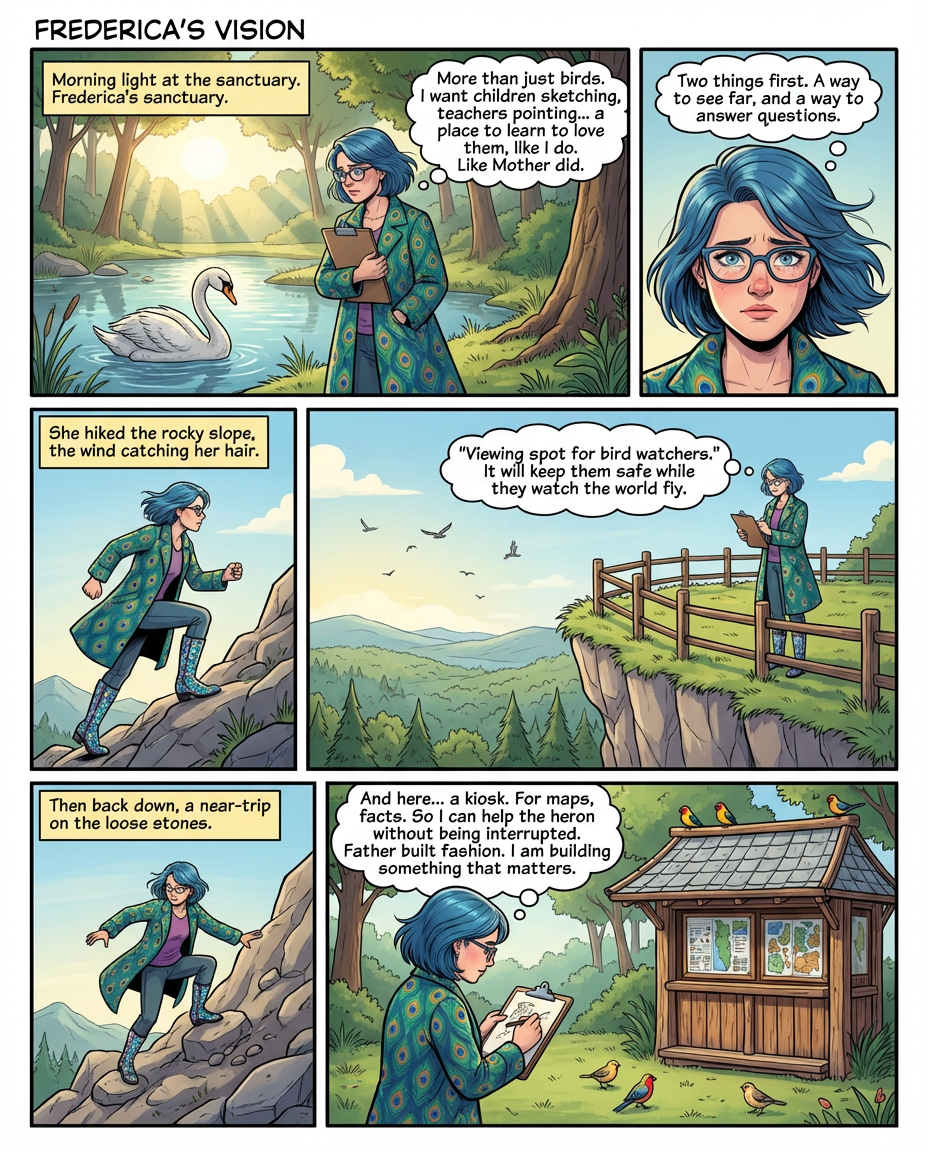
Frederica Feathersworth stood in the morning light, clipboard pressed against her peacock-patterned coat. Her sanctuary needed more than just her and the birds. She wanted children running through these grounds, sketching feathers in notebooks. She wanted teachers pointing at wings, explaining lift and drag. The elderly swan with the bent neck watched her from the pond, its clouded eyes somehow knowing. Frederica's chest tightened with champagne bubbles—the feeling of bird joy mixing with her own. This place had to become something bigger. An educational center where people learned to love birds the way she did. Where her mother's wish to follow the birds could mean something for everyone. She needed two things first—a way for visitors to see far and a way to answer their questions. Frederica hiked up the rocky slope beyond the sanctuary, her sequined boots catching sunlight with each step. At the top, wind pushed against her face and tangled her blue hair. The view stretched forever—trees, sky, and birds crossing between them. A wooden fence at the cliff's edge would keep people safe while they watched. She wrote it down: viewing spot for bird watchers. Then she scrambled back down, nearly tripping twice on loose stones. Near the sanctuary entrance, Frederica stopped where the main path began. Visitors would arrive with questions she couldn't answer while also treating the half-blind heron's eye infection. She needed something to help them without needing her. A wooden structure with a metal roof—small enough not to block the path but big enough to hold carved maps and bird facts. She sketched it quickly, adding details about feeding times and which birds lived where. Finches landed at her feet, hopping between grass blades. The kiosk would stand right here where the birds already gathered, where people would see that this place was meant for learning. Her father had built fashion. She was building something that mattered.
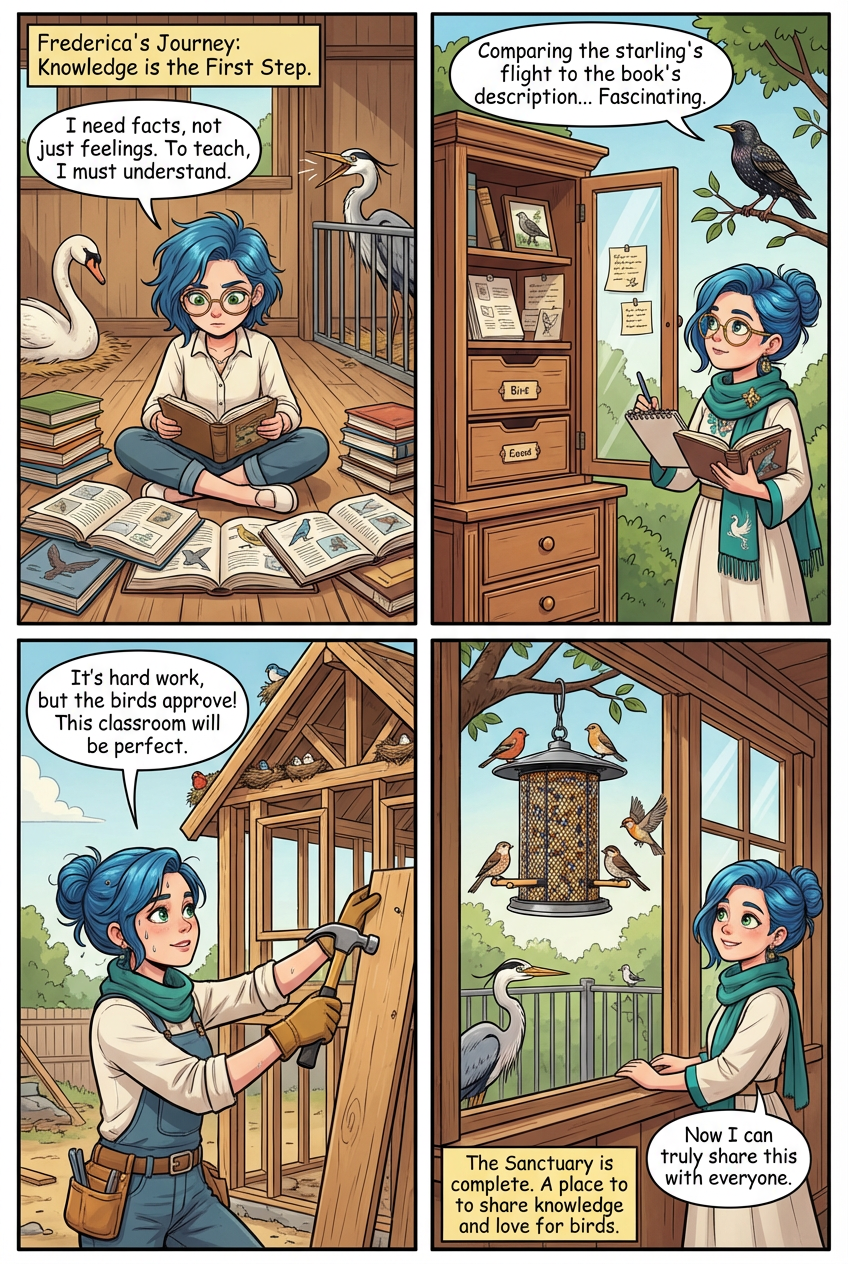
Frederica sat cross-legged on the sanctuary floor, surrounded by bird care manuals she'd ordered last week. The pages smelled like ink and promise. She flipped through diagrams of wing anatomy, migration patterns, and species identification charts. Her first sanctuary swan hobbled past, its bent neck casting a crooked shadow. If she wanted to teach others about birds, she needed to know more than just how their emotions felt against her skin. She needed facts, proper names for feather types, scientific reasons why the sequins helped during water therapy. The half-blind heron squawked from its recovery pen. Frederica read faster, her finger tracing a paragraph about heron vision. Understanding replaced guessing. Knowledge replaced instinct. By afternoon, her notebook bulged with facts written in three different colored inks. This was how the sanctuary would grow—one learned thing at a time. The next morning, she built a cabinet outside the sanctuary's main building. Glass doors showed wooden shelves inside. She labeled drawers with bird names and study topics. Her sketches of wing patterns went in one drawer. Notes about feather types filled another. When a starling landed nearby, she pulled out her newest manual and watched the bird's movements. She wrote down what she saw, comparing it to the book's description. The cabinet let her work outside where the birds lived instead of hunched over books indoors. She could look up, observe, and record without running back and forth. But knowing facts wasn't the same as teaching them. Frederica needed a place where people could sit and learn together. She walked the sanctuary grounds until she found a flat area near the ponds. A wooden classroom took shape there over two weeks—she hammered boards herself, blistering her palms. Windows stretched across three walls so students could watch birds while she talked. Actual bird nests appeared in the eaves before she even finished the roof. She laughed until tears came. The birds approved. The final piece arrived as an idea during feeding time. Wild birds needed reasons to stay close where students could see them. Frederica hung a seed feeder outside the classroom windows—metal mesh panels held mixed grains and nuts. Wooden perches let multiple birds feed at once. Within days, finches and sparrows visited every morning. The heron watched from its pen, head tilted. Frederica stood in her new classroom, looking through the windows at birds eating seeds she'd provided. She had books, a workspace, a teaching room, and birds that would stay. The sanctuary was becoming something she could share.
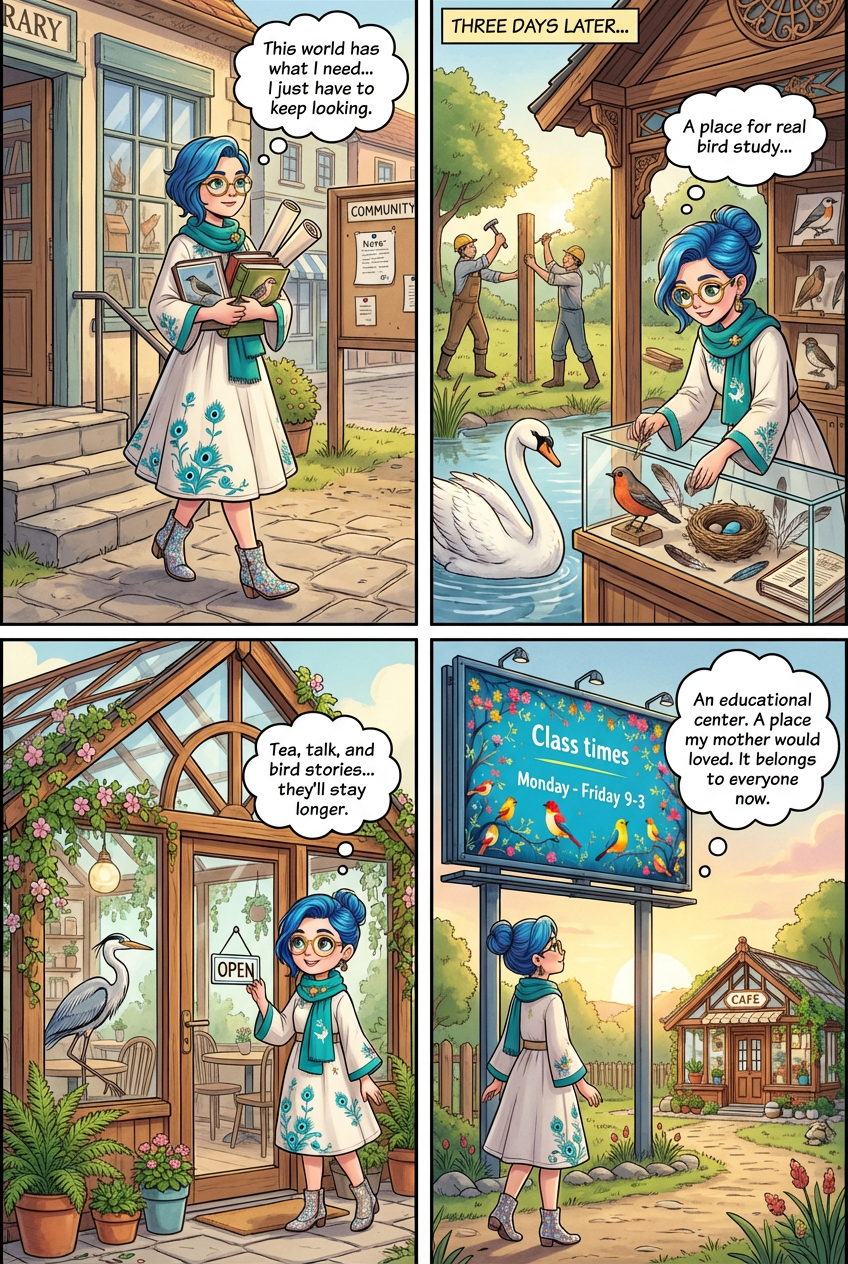
Frederica walked beyond the sanctuary gates for the first time in weeks, her sequined boots crunching on the forest path. The sanctuary had books and a classroom, but she needed to know what else existed in this world for someone teaching birds. A wooden sign pointed toward town—she followed it. The trees thinned as buildings appeared, small shops with painted windows. She spotted a library first, its stone steps worn smooth. Inside, three entire shelves held bird books she'd never seen. Her hands shook as she pulled down a field guide with photographs instead of drawings. The librarian nodded when Frederica asked about borrowing them. Two streets over, she found a supply shop selling magnifying glasses, specimen jars, and teaching posters showing bird skeletons. She bought four posters with money saved from her father's world. On the walk back, a wooden community board outside the post office caught her eye—other people advertised classes and events there. She pinned a note about the sanctuary, her handwriting cramped but clear. The forest swallowed her again as she headed home, arms full of books and posters. This world had what she needed. She just had to keep looking. Three days later, Frederica hired builders with the rest of her saved money. She showed them sketches of a wooden pavilion with glass cases inside. They hammered posts into the ground while she arranged specimens she'd collected over months—feathers organized by species, a robin's nest from last spring, field journals she'd filled with observations. When they finished, she placed everything inside the cases. Visitors could walk through and see what real bird study looked like. The elderly swan watched from its pond as she worked, and she felt champagne bubbles in her chest. The greenhouse she'd noticed in town gave her the next idea. She bought glass panels and wooden beams, then built a small cafe next to the classroom. Plants lined the shelves—ferns and flowering vines that birds loved. She added tables and chairs so people could sit with tea and talk about what they'd seen. The half-blind heron limped past the windows, curious about the new structure. This was a place where visitors would stay longer, where they'd trade stories about birds they'd spotted. On her final trip to town that week, Frederica ordered a billboard. It arrived painted with bright illustrations of finches, herons, and peacocks. She had them list the class times: Monday to Friday, 9 to 3. The workers mounted it on iron poles near the sanctuary entrance. When they finished, she stepped back and stared. Anyone walking this path would know what lived here now. An educational center. A place her mother would have loved. The sanctuary wasn't just hers anymore—it belonged to everyone who wanted to follow the birds.
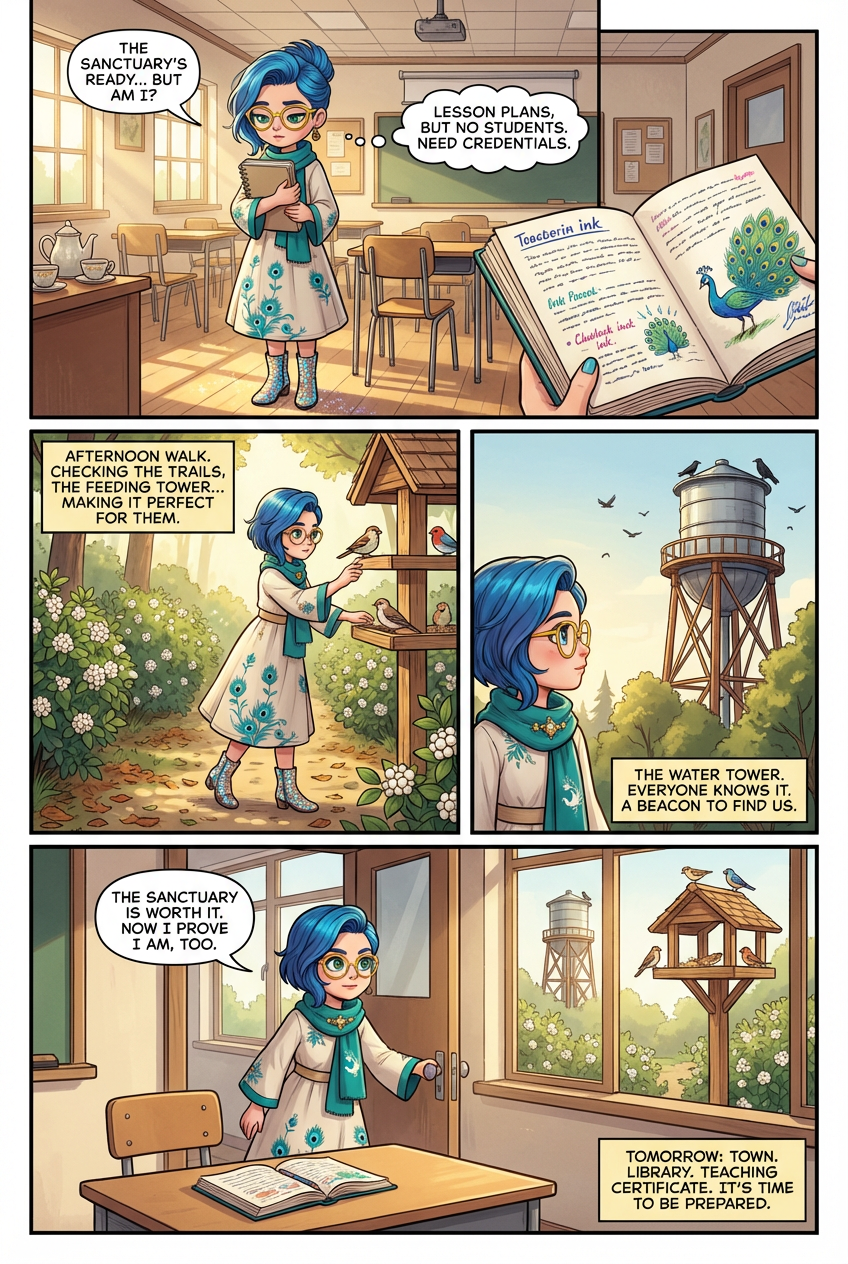
Frederica stood in the classroom doorway with a thick notebook pressed against her chest. The sanctuary had everything—books, displays, a place to serve tea—but no actual students yet. She flipped through pages of lesson plans she'd written in three different ink colors, each one mapping out talks about feather anatomy and migration patterns. Her sequined boots caught the morning light as she paced between the windows. Teaching required more than knowledge and empty chairs. It required proof that she knew what she was talking about. The half-blind heron called from outside, and electricity prickled across her skin—its anxiety matched hers perfectly. She needed credentials, something official that said Frederica Feathersworth understood birds beyond just feeling their emotions. Her finger traced the edge of a page where she'd sketched a peacock's tail. The sanctuary couldn't become an educational center if she remained only a woman who loved birds. She had to become someone qualified to teach them. She walked the sanctuary paths that afternoon, checking the trails she'd planned for future visitors. Common snowberry bushes lined both sides, their white berries bright against green leaves. She'd planted them last month, low enough that people wouldn't trip but tall enough to add color. Her boots crushed fallen leaves as she stopped to adjust a wooden feeding tower she'd built near the classroom. Birds perched on the horizontal bars while eating from the trays. A finch landed, pecked at seeds, then flew off. The tower worked exactly as she'd hoped—birds stayed close where students could watch them. The town's water tower rose above the trees in the distance, metal catching afternoon sun. Crows circled its top like they did every day. She'd seen it on her walks to the library and supply shop. Everyone who visited this area would recognize that tower. It marked the way here. She turned back toward her classroom, thinking about the people who might follow that landmark to find her sanctuary. Frederica pushed open the classroom door and set her notebook on the front table. The feeding tower stood visible through the window, already hosting two sparrows. Snowberry bushes added white dots along the path beyond. She had built a place worth visiting. Now she needed to prove she could teach what happened here. Her fingers pressed against the notebook's spine. Tomorrow she'd go back to town and ask the library about teaching certificates or apprenticeships. The sanctuary needed her to be more than passionate—it needed her to be prepared.
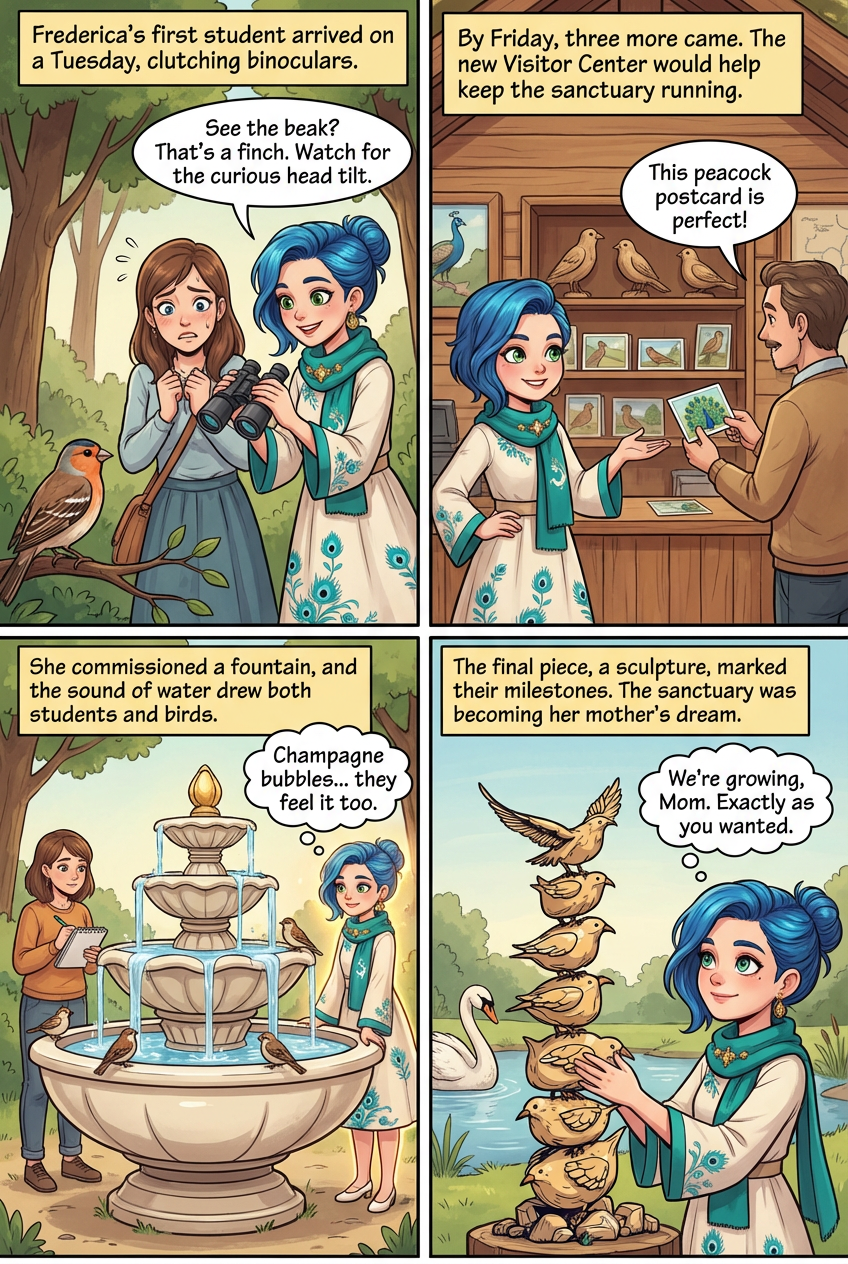
Frederica's first official student arrived on a Tuesday morning, a nervous woman clutching a pair of binoculars. She taught her how to identify finches by their beaks, how to watch for the tilt of a head that meant curiosity instead of fear. The woman stayed for two hours, scribbling notes and asking questions that made Frederica's chest feel like champagne bubbles. When she left, she promised to return next week. By Friday, three more students had come. Frederica realized she needed income to keep the programs running—the bird food alone cost more each month. She sketched plans for a small cabin near the entrance, something with a porch and shelves inside. The builders returned and hammered it together in four days. She filled it with bird-themed items she'd collected: postcards showing different species, small carved wooden birds, field guides she'd ordered from the supply shop. Visitors could buy something to remember their visit. The first person purchased a peacock postcard and told Frederica it was perfect. That same week, she commissioned a fountain from a metalworker in town. Bronze birds perched on an ivory stone basin, water streaming from their beaks. She had it installed near the classroom entrance where students would see it when they arrived. The sound of water mixed with real bird calls—sparrows landed on the rim to drink. One student stopped to take notes on how the wild birds interacted with it. Frederica felt electricity and champagne bubbles at once, her own emotions tangled with theirs. She ordered one more piece—a wooden sculpture of birds stacked on top of each other, each one taller than the last. It arrived carved and sanded smooth. She placed it where everyone could see it. Each bird represented something the sanctuary had accomplished: the first student, the cabin that brought in money, the fountain that made learning beautiful. The elderly swan with the bent neck watched her arrange it, and she pressed her palm against the wood. The sanctuary wasn't just growing—it was becoming exactly what her mother had wanted her to build.
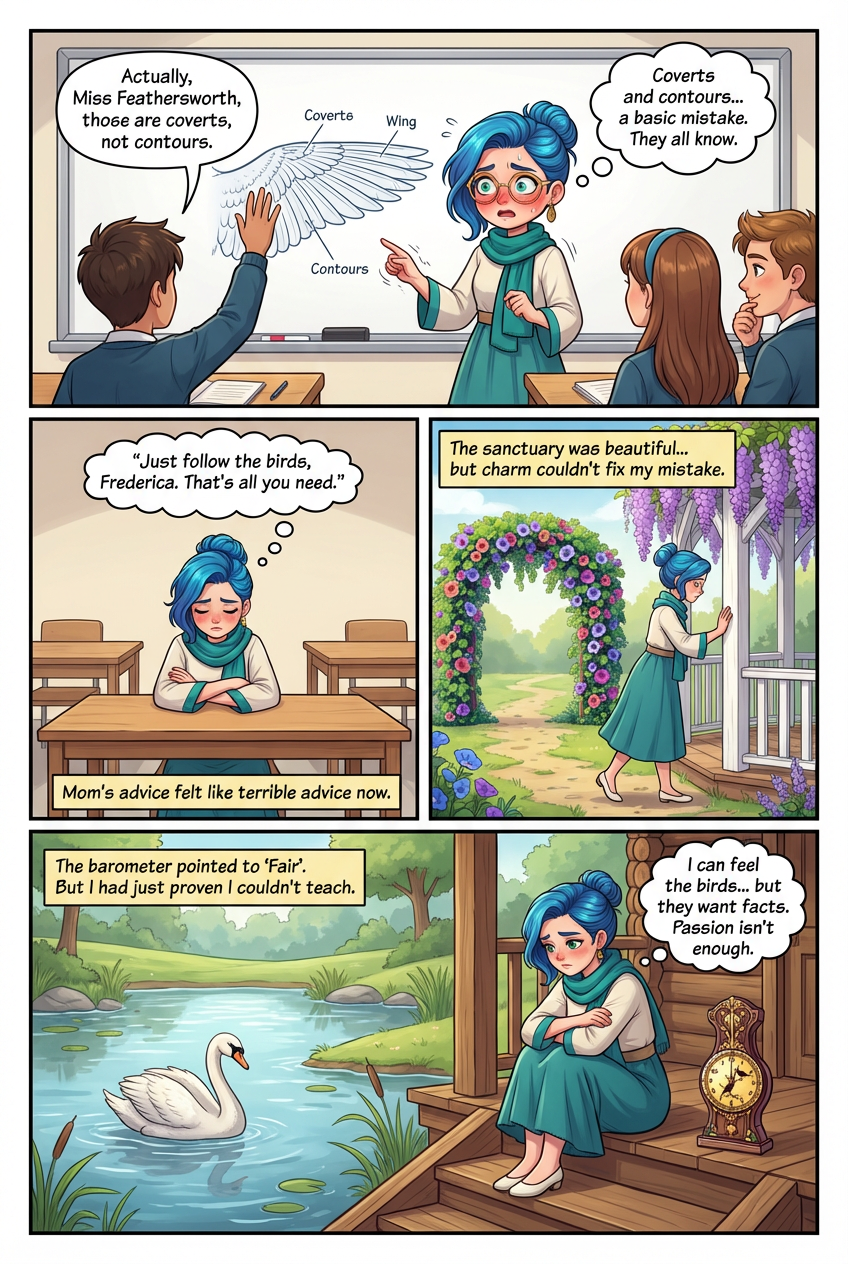
Frederica stood in front of twelve students on Thursday morning, pointing at a diagram of wing structures she'd drawn on the board. Her hand trembled as she explained primary feathers, and halfway through her sentence, a student raised his hand to correct her terminology. Heat flooded her cheeks. She'd mixed up coverts and contours—a basic mistake that made her sound like she'd learned everything from picture books instead of real study. Two students exchanged glances. Another checked her watch. Frederica pushed through the rest of the lesson, but her voice came out too quiet, then too loud, never quite right. When everyone left, she sat alone in the empty classroom and pressed her forehead against the table. Her mother's voice echoed in her memory, something about following birds, but right now that felt like terrible advice. She had passion and a sanctuary full of birds she could feel in her bones, but she didn't have the technical knowledge these students deserved. The classroom suddenly felt like a stage where she was performing expertise she didn't actually possess. She walked outside to clear her head. The wisteria-covered gazebo she'd added near the visitor center entrance stood empty. White paint gleamed on its beams, purple flowers hung down like curtains. She'd built it to look welcoming, charming, like a place where serious education happened. But charm didn't fix what had gone wrong in that classroom. The morning glory trellis beside her cabin's porch twisted upward, blue flowers opening toward the sun. Beautiful things everywhere, and none of them made her qualified to teach. She pressed her palm against the gazebo post. Four students hadn't come back after last week. Today's correction would probably cost her three more. Inside the visitor center, she picked up the barometer she'd bought to track weather for outdoor classes. Brass birds decorated its face—wrens and finches pressed into metal. The needle pointed to fair conditions. Perfect weather for teaching, except she'd just proven she couldn't teach properly even indoors. She set it down harder than she meant to. The sanctuary had everything: trails, birds, structures that looked professional. What it didn't have was someone who knew the difference between coverts and contours without needing to check a book. Frederica sat on the cabin steps and watched the elderly swan move slowly across the pond. Its bent neck dipped toward the water. She felt its contentment like warm honey spreading through her chest. She could feel every bird here, understand them in ways no textbook taught. But students didn't pay to learn about feelings—they wanted facts, proper terms, knowledge that came with proof. The sanctuary couldn't become an educational center if its teacher kept making mistakes that beginners noticed. She pulled her knees up and wrapped her arms around them. Following the birds had led her here, but maybe that wasn't enough anymore.
Play your story to life
Storycraft is a mobile game where you create AI characters, craft items and locations to build their world, then discover what direction your story takes. Download the iOS game for free today!
Download for free