

Gary ‘Gearhead’'s Arc
15 Chapters
Gary ‘Gearhead’'s dream is building a fortified scrapyard into a thriving marketplace for survivors.

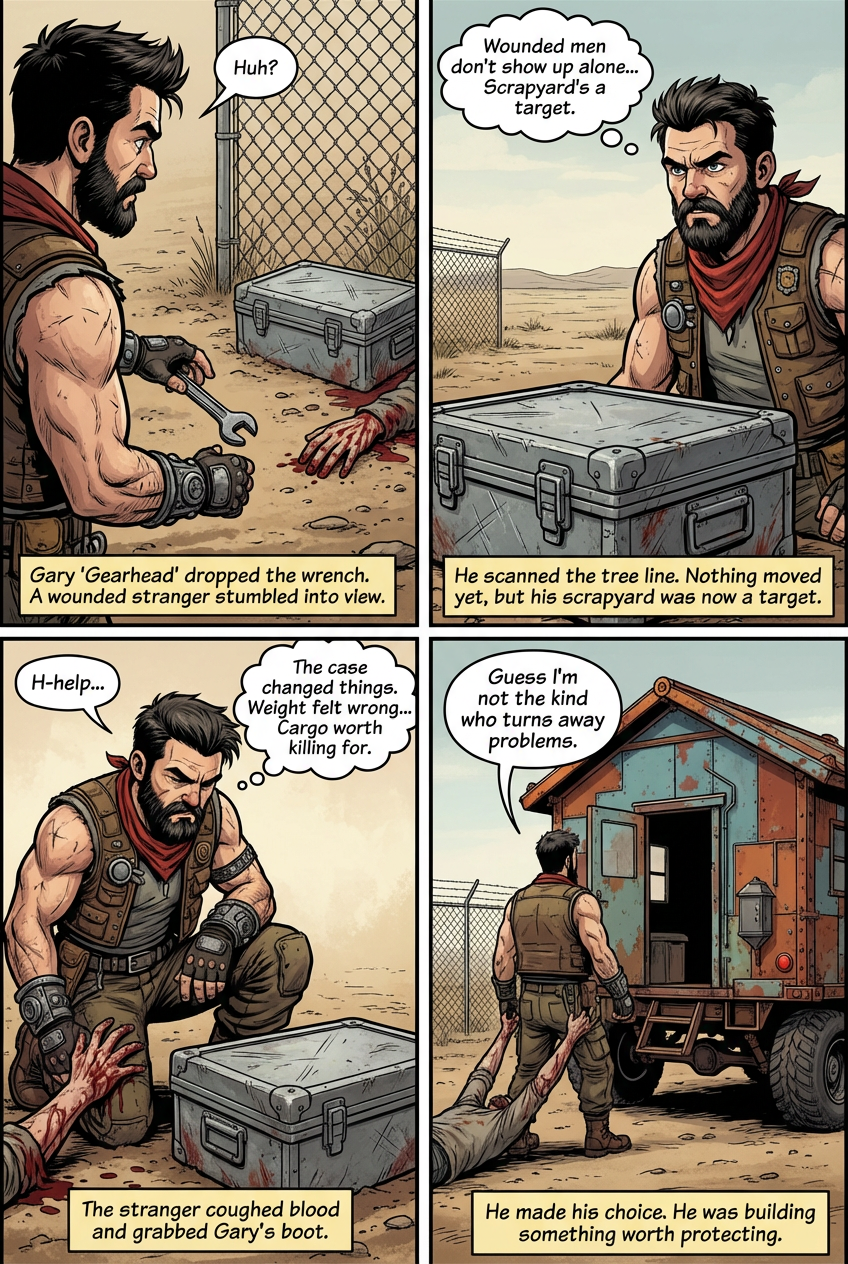
Gary dropped the wrench and turned toward the fence line. A man stumbled into view, one hand pressed against his side where blood seeped through his fingers. The stranger's other arm clutched a metal case tight against his chest. He took three more steps before his knees buckled and he went down hard in the dirt. Gary stood still and watched the tree line beyond the fence. Nothing moved yet, but wounded men didn't show up alone by accident. He scanned the horizon for dust clouds or the glint of metal, then looked back at the stranger sprawled near his property line. The case lay beside him in the dirt, scratched steel with heavy clasps. Gary had seen cargo worth killing for before. This looked like it. He grabbed a rusted wall panel from the scrap pile and dragged it toward the fence, metal scraping against concrete. It wouldn't stop bullets, but it might buy him a few seconds if someone came looking. The stranger groaned and tried to lift his head. Gary kicked the case closer to the panel, then crouched beside it. The clasps were locked, but the weight felt wrong—too light for ammunition, too heavy for paper. He looked at the blood trail leading into his yard, then at the open ground beyond. His scrapyard had been vulnerable yesterday. Today it was a target. The stranger coughed blood and grabbed Gary's boot. His eyes opened halfway. Gary pulled his foot back and stared at the man's face, then at the horizon again. He could drag the stranger inside his trailer and lock the door. He could leave him where he fell and pretend he never saw anything. But the case changed things. Whatever was inside had brought killers to his fence line, and now Gary had to decide if he was the kind of man who turned away problems or the kind who built something worth protecting. He lifted the stranger under the arms and started dragging him toward the trailer.
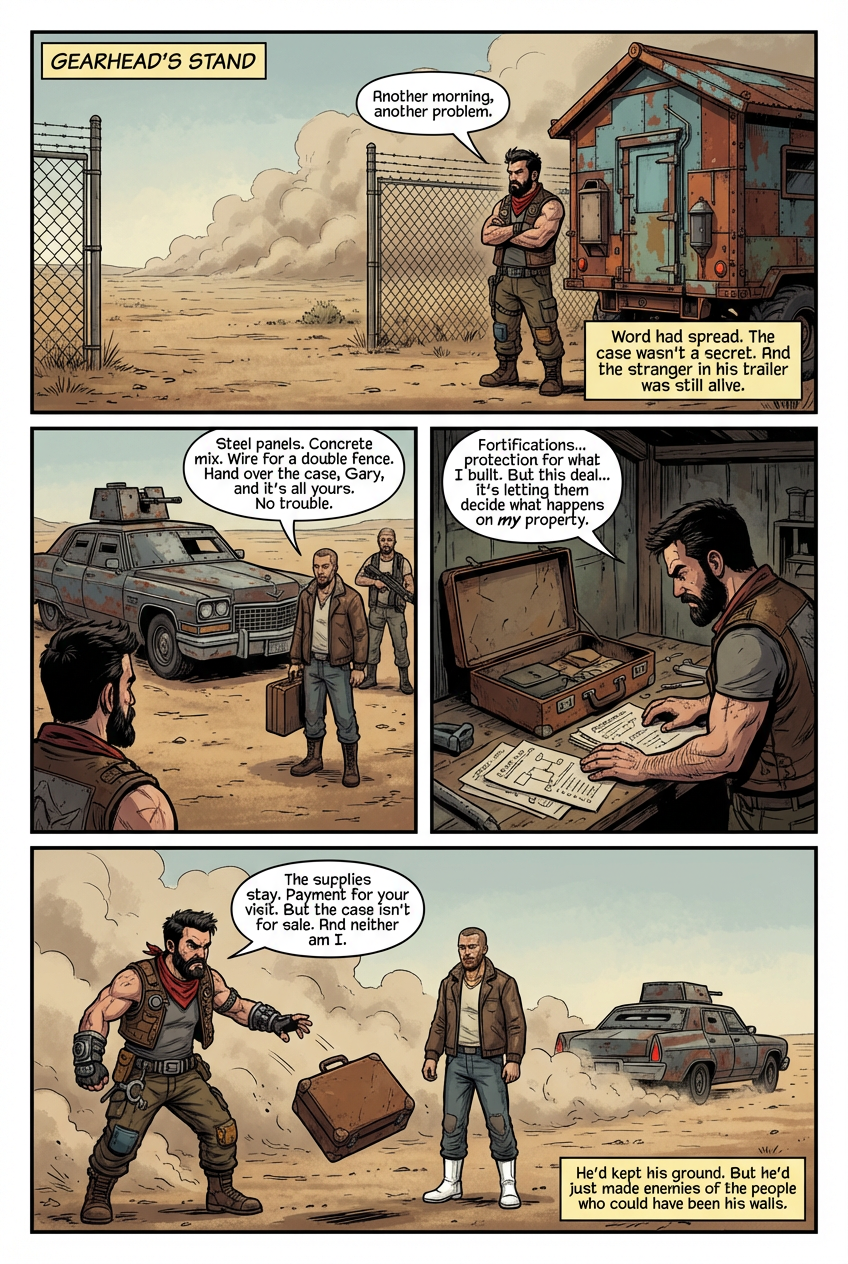
The stranger stayed alive through the night, which meant Gary's problems weren't going away. By morning, word had spread somehow—voices carried in the wasteland, and the case wasn't a secret anymore. Gary stood at the fence line watching a dust cloud approach from the east. The Cadillac rolled to a stop outside the fence, armored plating welded over the doors and gun ports cut into the windows. Two men climbed out but kept their distance. The one in front wore clean boots and carried a worn leather suitcase that looked older than the war. He set it down in the dirt between them and stepped back. Gary crossed his arms and waited. The man gestured at the suitcase without opening it. Steel panels, he said. Concrete mix. Enough wire to fence the whole property twice over. All Gary had to do was hand over the case and walk away from whatever trouble came with it. The man's voice stayed level, but his eyes kept moving past Gary toward the trailer. Gary picked up the suitcase and carried it to the scrap shed at the edge of the yard. He locked the door behind him and opened the clasps. Inside lay inventory lists, supply routes, delivery schedules—everything he'd need to fortify the scrapyard properly. He ran his fingers over the paper and thought about the stranger bleeding in his trailer and the locked metal case hidden under a tarp. The fortification materials would protect what he'd built. Handing over the case would end the threat before it grew worse. But taking this deal meant letting someone else decide what happened on his property, and Gary had built this place by making his own calls. He walked back outside and threw the suitcase at the clean-booted man's feet. The supplies stayed, he said. Payment for the trouble of having armed men show up at his fence. But the case wasn't for sale, and neither was his judgment about what happened in his own yard. The man's face went hard. He warned Gary that people were coming for that case, and when they arrived, there wouldn't be another offer. Gary watched the Cadillac kick up dust as it drove away, then turned back toward his trailer. He'd kept his ground, but he'd just made enemies out of the people who could have been his walls.
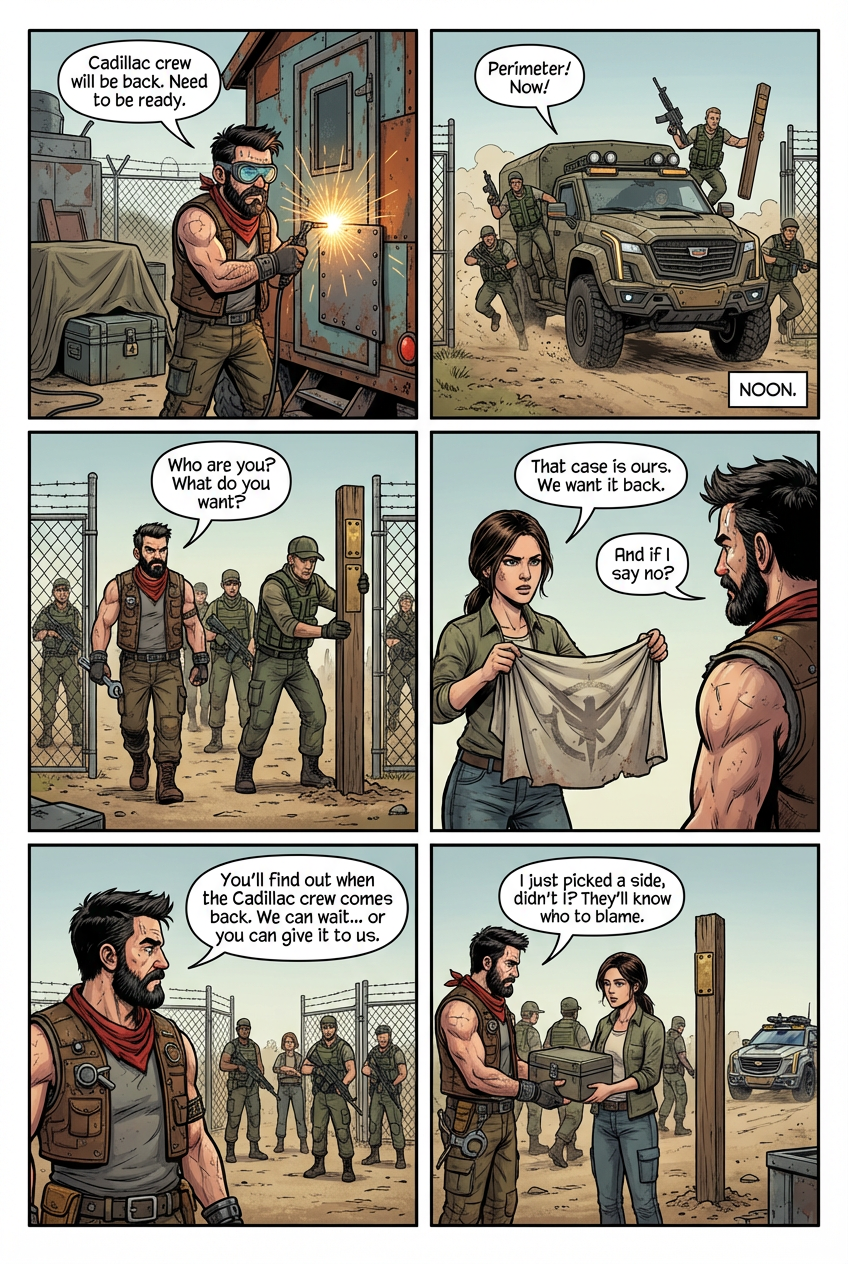
Gary spent the morning reinforcing the trailer door with scrap metal from the shed. The stranger still hadn't woken up, and the locked case sat exactly where he'd left it. He worked quietly, listening for engines. The Cadillac crew would come back eventually, but Gary didn't know when. The militia truck arrived just after noon, rolling through the open gate with six armed figures standing in the back. They wore matching vests and moved like they'd worked together a long time. The driver stayed behind the wheel while the others jumped down and formed a loose perimeter around the vehicle. One of them carried a wooden post with brass plates bolted to it and drove it into the ground near the fence line. Gary walked out to meet them, wrench still in his hand. The woman at the front pulled a folded cloth from her vest and shook it open. A symbol stitched in faded thread—the same one stamped on the locked case. She said the case belonged to Sherrie's people, and they wanted it back before the Cadillac crew returned. Gary asked what happened if he refused. She looked at the unfortified scrapyard, at the bare fence line and open gate, and said he'd find out when the Cadillac crew showed up with more than two men and a leather suitcase. Her people could wait here until then, or Gary could hand over the case and they'd be gone before anyone else arrived. Gary weighed it. The case had already brought armed strangers to his property twice, and neither group was going to stop coming. But giving it up to Sherrie's people meant the Cadillac crew would blame him for the loss, and keeping it meant fighting off whoever showed up next with no walls and no backup. He walked back to the trailer and pulled the case from under the tarp. When he handed it over, the woman nodded once and signaled her people back to the truck. They left the post standing in his yard—a marker that said Sherrie's organization had been here first. Gary watched the dust settle and realized he'd just chosen a side without meaning to. The next time someone came looking, they'd see that post and know exactly who to hold responsible.
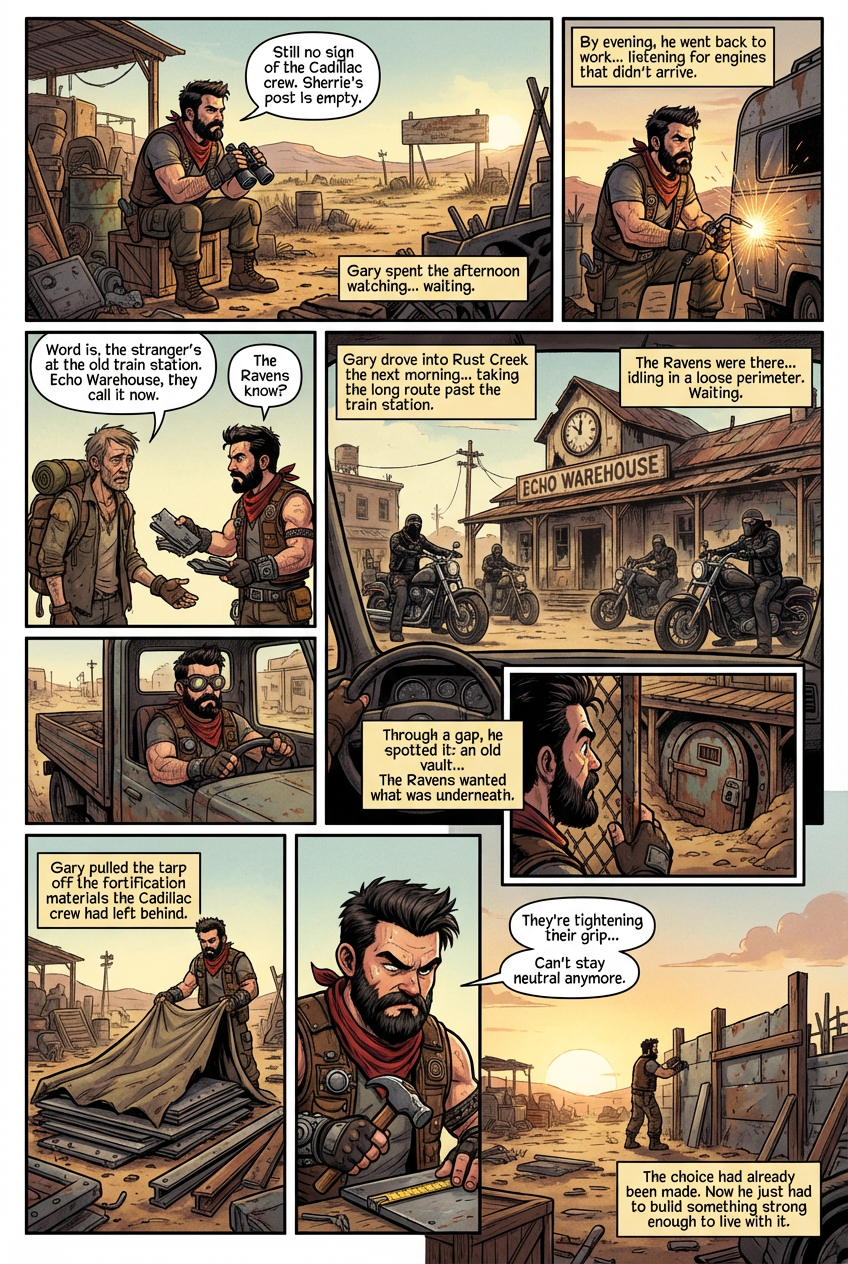
Gary spent the afternoon watching the post Sherrie's people had left behind, waiting for the Cadillac crew to show up and see it. They never came. By evening, he went back to work on the trailer reinforcements, listening for engines that didn't arrive. The word came two days later from a salvager passing through—the stranger had been moved to the old train station at the edge of Rust Creek. The building still had its sign and broken clock face, but everyone called it Echo Warehouse now because of how sound bounced off the empty platforms. Gary asked if the Ravens knew. The salvager said they'd been circling the place for three days straight, bikes lined up outside like they were waiting for something. Gary paid him in scrap and sent him on his way, then stood in his yard staring at Sherrie's post. The stranger wasn't his problem anymore, but the Ravens hunting near a building Sherrie was using meant the war was heating up, and he'd already picked a side. Gary drove his flatbed truck into Rust Creek the next morning, taking the long route past the train station. The Ravens were there—masked riders on heavy bikes, engines idling in a loose perimeter around the building. They weren't trying to get in. They were waiting for someone to come out. Gary slowed enough to see what they were guarding, and through a gap in the fence line he spotted it: an old vault built into the foundation, half-buried under the platform where passengers used to wait for trains that would never come again. The rust on its surface was thick enough to hide the lock, but the Ravens had cleared away enough debris that the door was visible. Whatever Sherrie's people had stashed in that building, the Ravens wanted what was underneath it. Gary drove back to the scrapyard and pulled the tarp off the pile of fortification materials the Cadillac crew had left behind. He'd kept them after refusing the deal, but now they carried a different weight. The Ravens were one block from Barry's bar and camped outside Echo Warehouse, which meant they were tightening their grip on Rust Creek. If Gary wanted his marketplace to survive, he couldn't stay neutral—and he'd already stopped being neutral the moment he handed over that case. He started unloading steel plates and posts from the pile, measuring where the first wall section would go. The choice had already been made. Now he just had to build something strong enough to live with it.
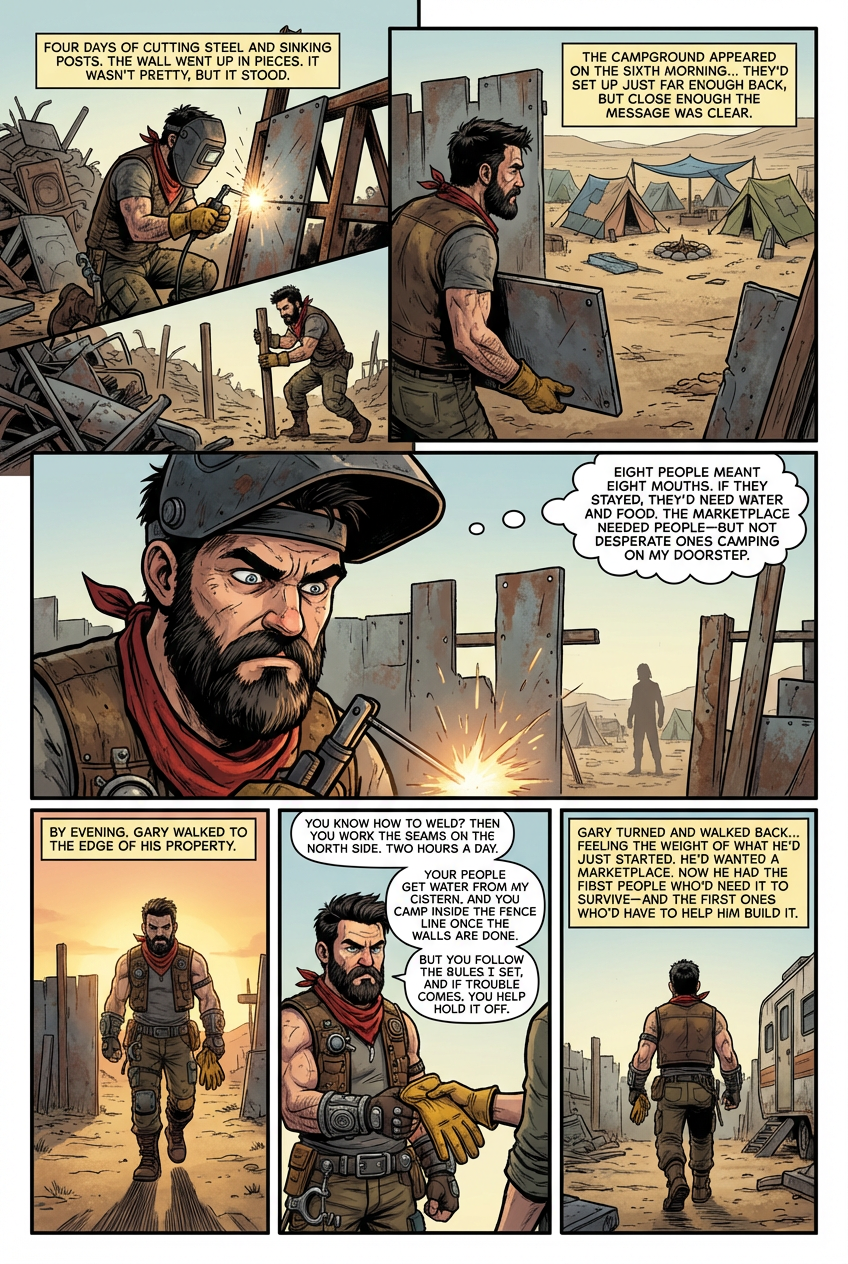
Gary spent four days cutting steel and sinking posts into the dirt around the scrapyard's perimeter. The wall sections went up in pieces—plates welded to frames, gaps filled with chain link and sheet metal. It wasn't pretty, but it stood. By the fifth morning, the fortifications were half-finished, running along the eastern edge and curving toward the trailer. He'd used most of the materials from the Cadillac crew's pile and pulled the rest from his own stock. The work left him filthy and tired, but he kept at it because the alternative was waiting for someone else to decide his scrapyard's future. The campground appeared on the sixth morning. Gary spotted it while carrying steel plates to the next wall section—four patched tents arranged in a loose circle outside his property line, centered around a fire ring built from salvaged bricks. A barrel and some crates sat near the largest tent. Someone had hung tarps between two scraggly trees for shade. There were maybe eight or ten people total, hard to count with some still inside the tents. They'd set up just far enough back that they weren't on his land, but close enough that the message was clear: they'd seen something being built and decided to wait. Gary lowered the steel plate and watched a woman in worn coveralls tend the fire. She looked up, met his eyes for a second, then went back to her work. No one approached the fence line. No one called out. They were just there, camping in his shadow like they'd already decided this was the safest spot left on the strip. Gary walked to the unfinished section of wall and set down the plate. The wire mesh sagged between the stone pillars he'd raised the day before, gaps still wide enough for a person to slip through if they wanted. He'd planned to finish this section by tomorrow, but now he had an audience watching every move. He picked up his welder and started on the frame, the torch flaring bright in the morning light. Behind him, someone from the camp coughed. A child's voice asked a question he couldn't make out. Gary kept his eyes on the weld, but his mind was running the numbers. Eight people meant eight mouths. If they stayed, they'd need water and food. If they didn't have either, they'd start asking. And if word spread that his scrapyard had fortifications going up, more would come. The marketplace he wanted to build needed people—but not desperate ones camping on his doorstep before he had walls to protect them. He finished the weld and stepped back. The frame held. The gaps didn't. By evening, Gary walked to the edge of his property with a pair of work gloves in his hand. They were old ones he'd found in a desk drawer inside the trailer—heavy yellow leather with a pre-war logo stamped on the cuffs, stained with grease and mud that wasn't his. The woman tending the fire stood when she saw him coming. Up close, she looked older than he'd first thought, with dirt under her nails and a scar across her knuckles that said she knew how to work. Gary stopped at the property line and held out the gloves. "You know how to weld?" he asked. She looked at the gloves, then at the half-finished wall behind him. "Enough to make it hold," she said. Gary nodded and tossed them to her. "Then you work the seams on the north side. Two hours a day. Your people get water from my cistern and you camp inside the fence line once the walls are done. But you follow the rules I set, and if trouble comes, you help hold it off." The woman pulled on the gloves and flexed her fingers, testing the fit. They were too big, but she didn't complain. "We can do that," she said. Gary turned and walked back toward the trailer, feeling the weight of what he'd just started. He'd wanted a marketplace. Now he had the first people who'd need it to survive—and the first ones who'd have to help him build it.
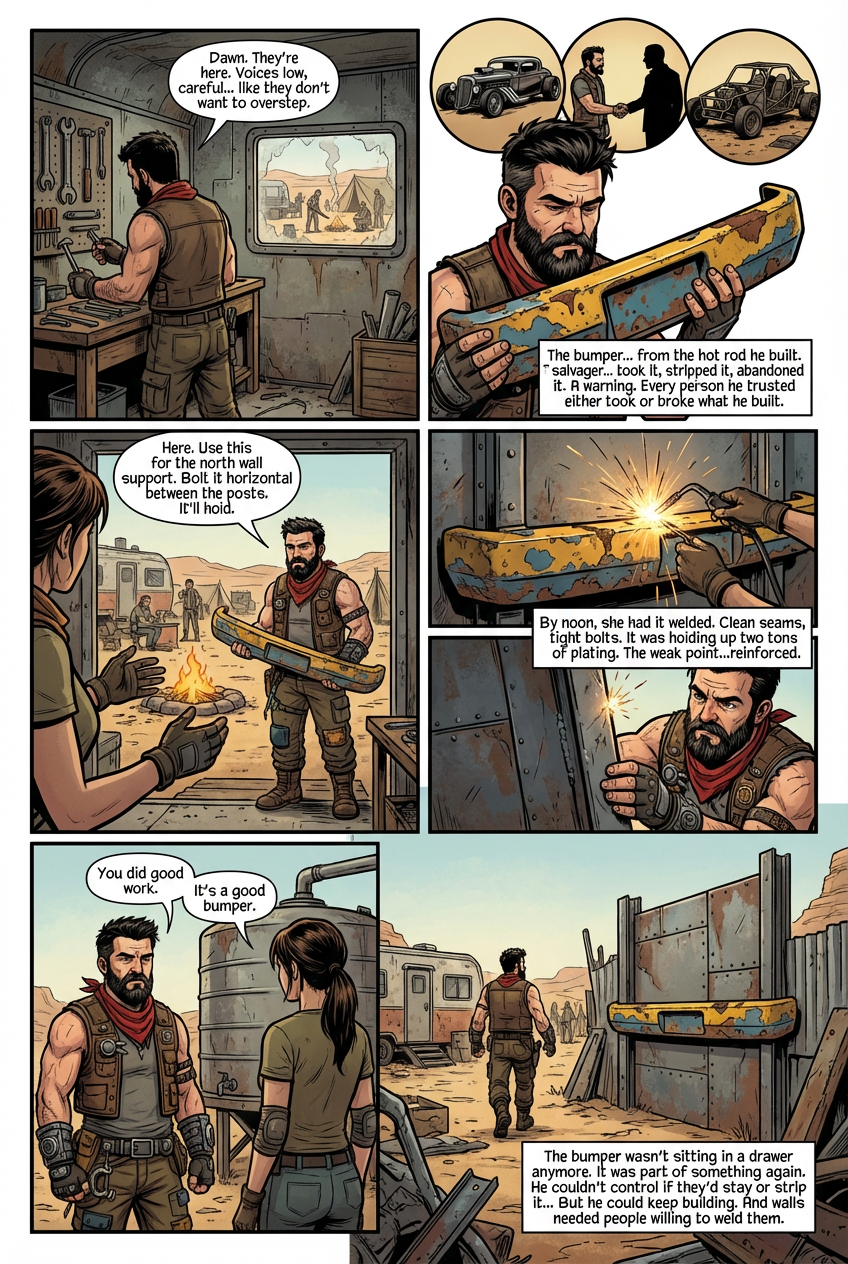
Gary stood inside the trailer the next morning, sorting through salvaged tools on the metal workbench. The woman and her people had moved through the gate at dawn, setting up near the cistern like he'd told them. He could hear voices outside—low and careful, the kind people used when they didn't want to overstep. He pulled open a drawer beneath the bench and stopped. A rusted bumper sat wedged inside, its yellow paint flaking off in patches that showed blue underneath. Gary lifted it out and turned it over in his hands. The bolt holes were still clean where he'd mounted it himself, back when the hot rod had been his best work—a sleek buggy with dual thrusters he'd built from nothing but scrap and late nights. He'd shown it to a salvager who said he needed reliable transport, who'd shaken Gary's hand and promised fair payment once he made his first run. The man had driven off and never came back. Gary had searched for two weeks before he found the buggy stripped and abandoned near the southern pass, everything valuable torn out and sold. The bumper was all he'd recovered. He set it on the bench and stared at it. The woman outside was waiting for tools. Her people were waiting for walls. He'd just handed them access to his water and his property because he needed help finishing what he'd started. But the bumper sat there like a warning—every person he'd ever trusted with something he built had either taken it or broken it. Gary picked up the bumper and carried it outside. The woman looked up from the fire ring as he approached, her borrowed gloves already streaked with fresh grease. He held out the bumper and watched her take it, testing the weight. "Use this for the north wall support," he said. "Bolt it horizontal between the posts. It'll hold." She nodded and turned it over, examining the mount points. Gary stepped back and looked at the camp—the tents, the people moving carefully around his property, the half-finished walls that would either protect them all or collapse under the weight of too much trust given too fast. He'd made his choice when he hired her. Now he had to see if this time would be different, or if he'd just handed someone else a piece of what he'd built. Either way, the bumper wasn't sitting in a drawer anymore. It was going into the wall. By noon, the woman had the bumper welded in place. Gary walked the perimeter and checked her work—clean seams, tight bolts, the rusted metal now holding up two tons of steel plating. She'd reinforced the weak point he'd been worried about all week. He found her by the cistern, filling canteens for her people. "You did good work," he said. She looked at him and shrugged. "It's a good bumper." Gary nodded and walked back to the trailer. The hot rod was gone. The salvager who'd stolen it was probably dead by now. But the bumper was part of something again, and this time Gary could see it every day from his front step. He couldn't control whether these people would stay or leave, whether they'd protect what he was building or strip it like the buggy. But he could keep building anyway. The marketplace needed walls before it needed anything else. And walls needed people willing to weld them.
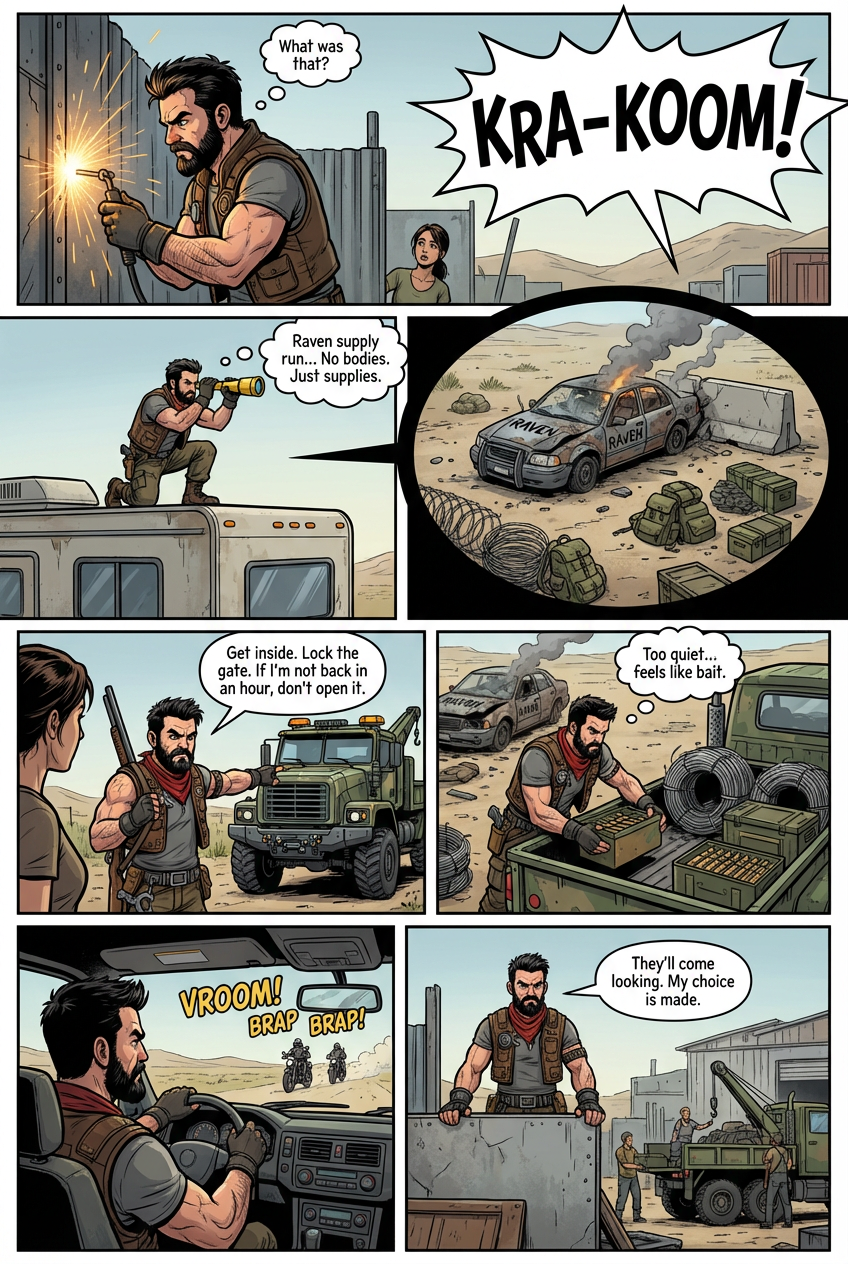
Gary was checking the welds on the south wall when he heard the explosion. The sound rolled across the scrapyard from somewhere beyond the perimeter—a low crack followed by metal tearing apart. He stopped and listened. The woman looked up from the cistern, her people going still. He grabbed the spyglass from his trailer and climbed onto the roof. A half-mile out, black smoke rose from the eastern strip. Gary focused the lens and found the wreck—a crumpled sedan with Raven markings, its front end accordion-folded against a concrete barrier. Cargo had spilled across the cracked asphalt. Military packs lay split open, their contents scattered. He could see rifle stocks, ammunition boxes, rolls of wire fencing. Supply run, he thought. Someone had hit them hard enough to flip the vehicle. The driver's door hung open, but Gary couldn't see bodies. He swept the spyglass across the wreckage and stopped on a canvas pack half-buried under debris. The weight of supplies sitting there unguarded made his chest tight. Those materials could finish his walls in two days instead of two weeks. But claiming Raven cargo meant painting a target on his gate, and leaving it meant someone else would take it before sundown. Gary climbed down and found the woman waiting by the trailer. "Raven wreck," he said. "Supply truck. Cargo's scattered." She glanced toward the smoke, then back at him. "You thinking about going out there?" Gary looked at his half-finished walls, then at the smoke rising in the distance. He could reinforce what he'd started, or he could watch someone else walk away with materials he needed. "Get your people inside the perimeter," he said. "Lock the gate behind me. If I'm not back in an hour, don't open it." He loaded his shotgun and walked to the tow truck. The wreck was worse up close. The sedan had rolled twice before it hit the barrier, scattering debris across fifty yards. Gary worked fast, loading wire fencing and ammunition into the truck bed. He found two rifles still strapped inside a pack and added them to the haul. The whole site felt wrong—too quiet, too clean. No blood, no bodies, just a wrecked vehicle and cargo left behind like bait. Gary was dragging the last pack toward the truck when he heard engines. Two motorcycles appeared from the south, Raven riders moving fast toward the wreck. Gary threw the pack into the bed and gunned the engine. He didn't look back until he cleared the first ridge. The riders had stopped at the wreck site, staring at the stripped cargo. Gary drove straight to his gate and honked twice. The woman pulled it open, and he rolled through. She locked it behind him while her people unloaded the truck. Gary walked to the north wall and looked out toward the smoke. The Ravens would know someone had taken their supplies. They'd come looking, and when they did, his walls would either hold or they wouldn't. He'd made his choice the moment he loaded that first pack. Now he'd find out what it cost him.
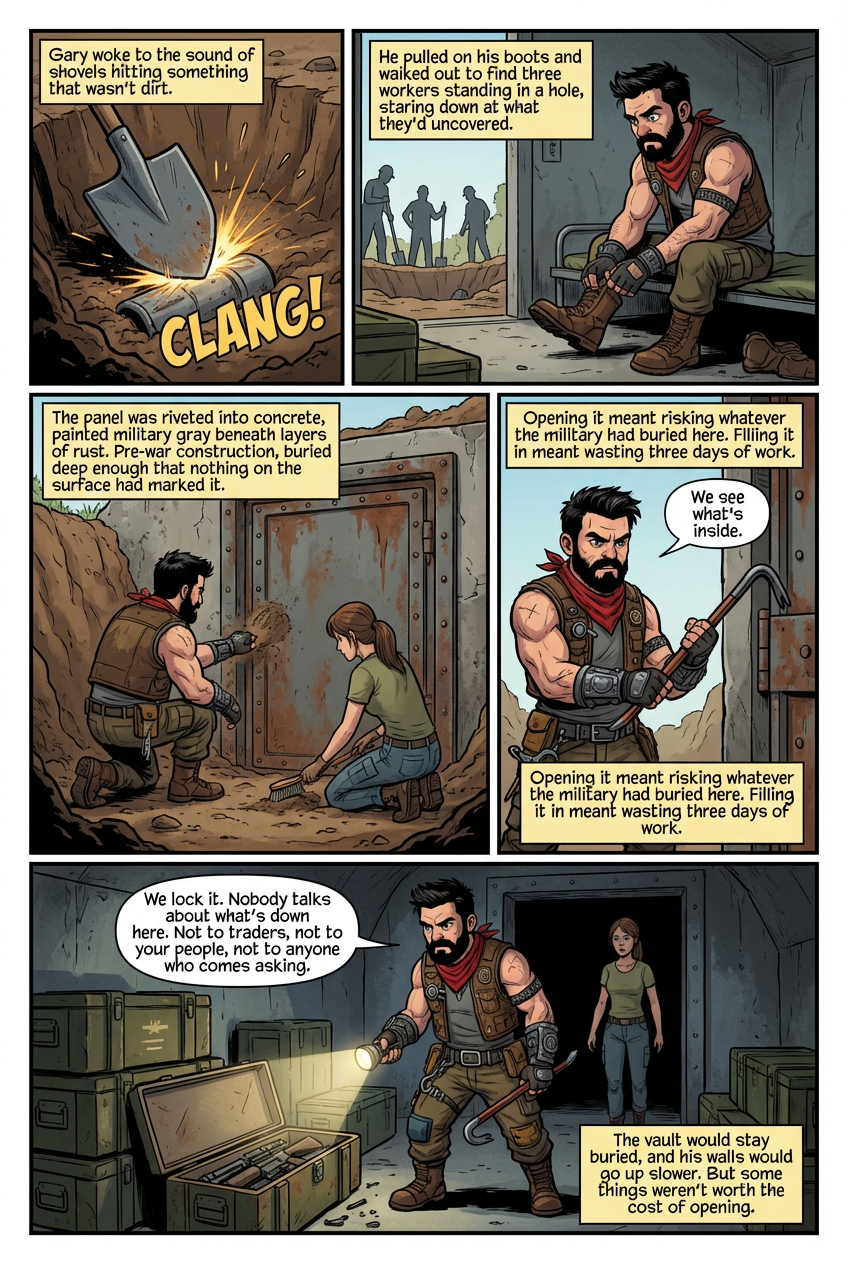
Gary woke to the sound of shovels hitting something that wasn't dirt. The crew had started work on the north wall foundation at first light, digging footings where the fence line would anchor into the ground. He pulled on his boots and walked out to find three workers standing in a hole, staring down at what they'd uncovered. The woman crouched at the edge of the excavation, brushing dirt off a steel panel. Gary climbed down beside her. The panel was riveted into concrete, painted military gray beneath layers of rust. He scraped more soil away and found a door frame built into a reinforced wall that ran parallel to his property line. Pre-war construction, buried deep enough that nothing on the surface had marked it. The woman looked at him. "What do we do?" Gary checked the door seam. It was sealed tight, but the hinges were exposed where the soil had washed away. He could pry it open or fill the hole back in and move the wall ten feet west. Opening it meant risking whatever the military had buried here. Filling it in meant wasting three days of work and losing the straightest section of his perimeter. He glanced back at his half-finished walls, then at the woman's people watching from the cistern. They'd come here because he was building something that could hold. He pulled a crowbar from his belt. "We see what's inside." The door groaned open on corroded hinges, revealing a concrete stairwell descending into darkness. Gary grabbed a flashlight and went down first. The stairs opened into a storage vault lined with metal shelves and weapon racks bolted to the walls. Most were empty, but three crates sat stacked in the corner, their seals still intact. Gary pried one open and found rifle parts packed in grease, ammunition boxes underneath. Military surplus, untouched since before the war. The woman came down behind him and whistled low. Gary did the math—enough weapons to arm everyone in the camp twice over, or enough trade value to finish his walls and buy six months of supplies. He looked at the empty racks and understood why someone had sealed this place. Rust Creek didn't need more guns flooding the market, and the Ravens didn't need to know what was buried under his property. He closed the crate and turned to the woman. "We lock it. Nobody talks about what's down here. Not to traders, not to your people, not to anyone who comes asking." She nodded. Gary climbed back up and told the crew to shift the foundation west. The vault would stay buried, and his walls would go up slower. But some things weren't worth the cost of opening.
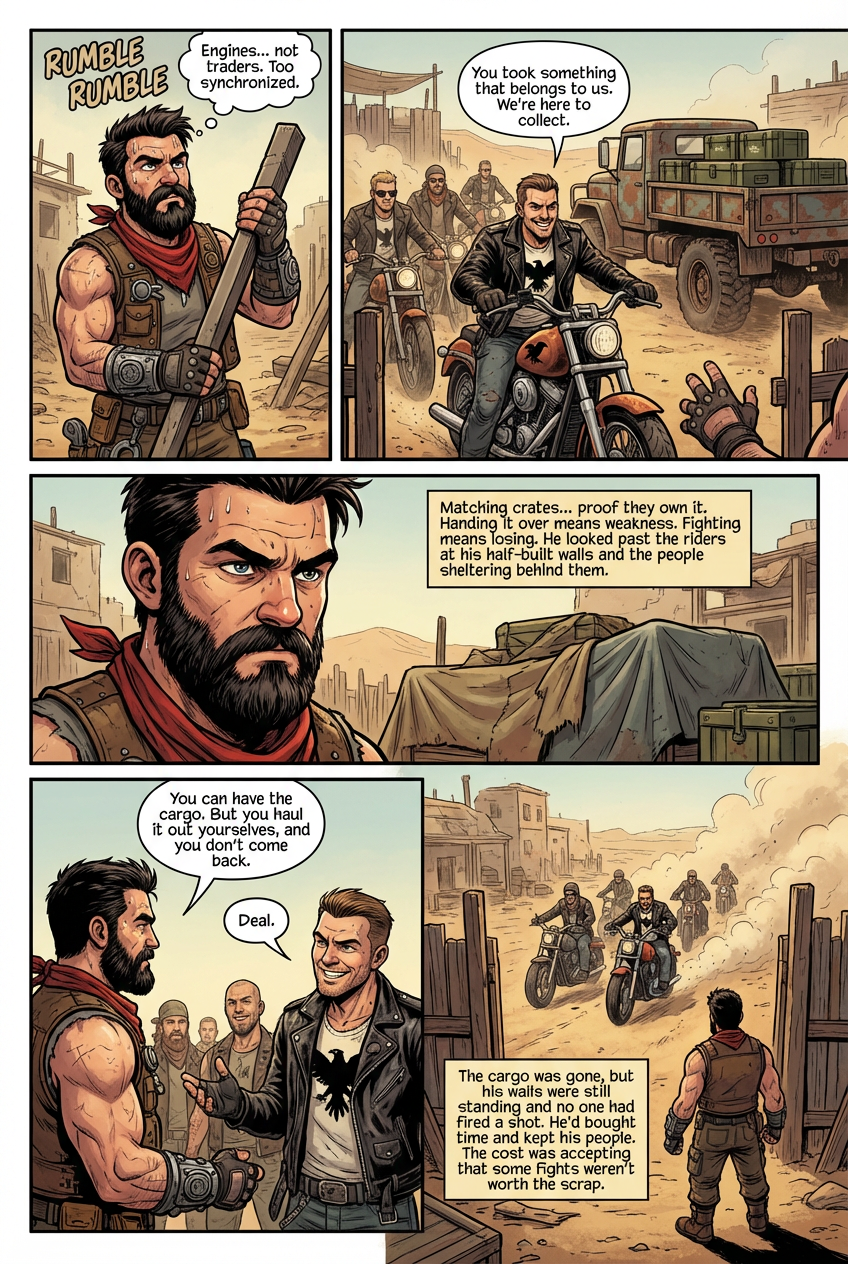
Gary was halfway through relocating the foundation stakes when the sound of engines cut through the morning air. Not traders—the rhythm was wrong, too synchronized. He straightened and saw dust rising from the eastern access road. Five bikes rolled up to his gate, riders in scuffed leathers with raven marks painted across their gas tanks. Behind them came a rusted militia truck, its flatbed loaded with salvage that matched the cargo Gary had hauled back yesterday—same crates, same military stamps. The lead rider cut his engine and pointed at the tarp-covered pile Gary had stashed near the welding station. "You took something that belongs to us. We're here to collect." Gary's crew stopped working and moved toward the walls. The woman grabbed a welding torch but didn't light it. Gary walked to the gate and kept his hands visible. He'd known this was coming the moment he'd loaded that cargo, but seeing the matching supplies on their truck changed the calculation. They hadn't just lost a wreck—they'd lost a shipment they could prove was theirs. Handing it over meant showing weakness. Keeping it meant starting a fight he couldn't win. He looked past the riders at his half-built walls and the people sheltering behind them. "You can have the cargo," Gary said. "But you haul it out yourselves, and you don't come back." The lead rider grinned and signaled his crew forward. They loaded the crates onto their truck while Gary's people watched in silence. When the last piece was secured, the rider leaned close to the gate. "Next time you see our colors on a wreck, you leave it alone." Gary nodded once. The convoy pulled away, and he turned back to his crew. The cargo was gone, but his walls were still standing and no one had fired a shot. He'd bought time and kept his people safe. The cost was accepting that some fights weren't worth the scrap.
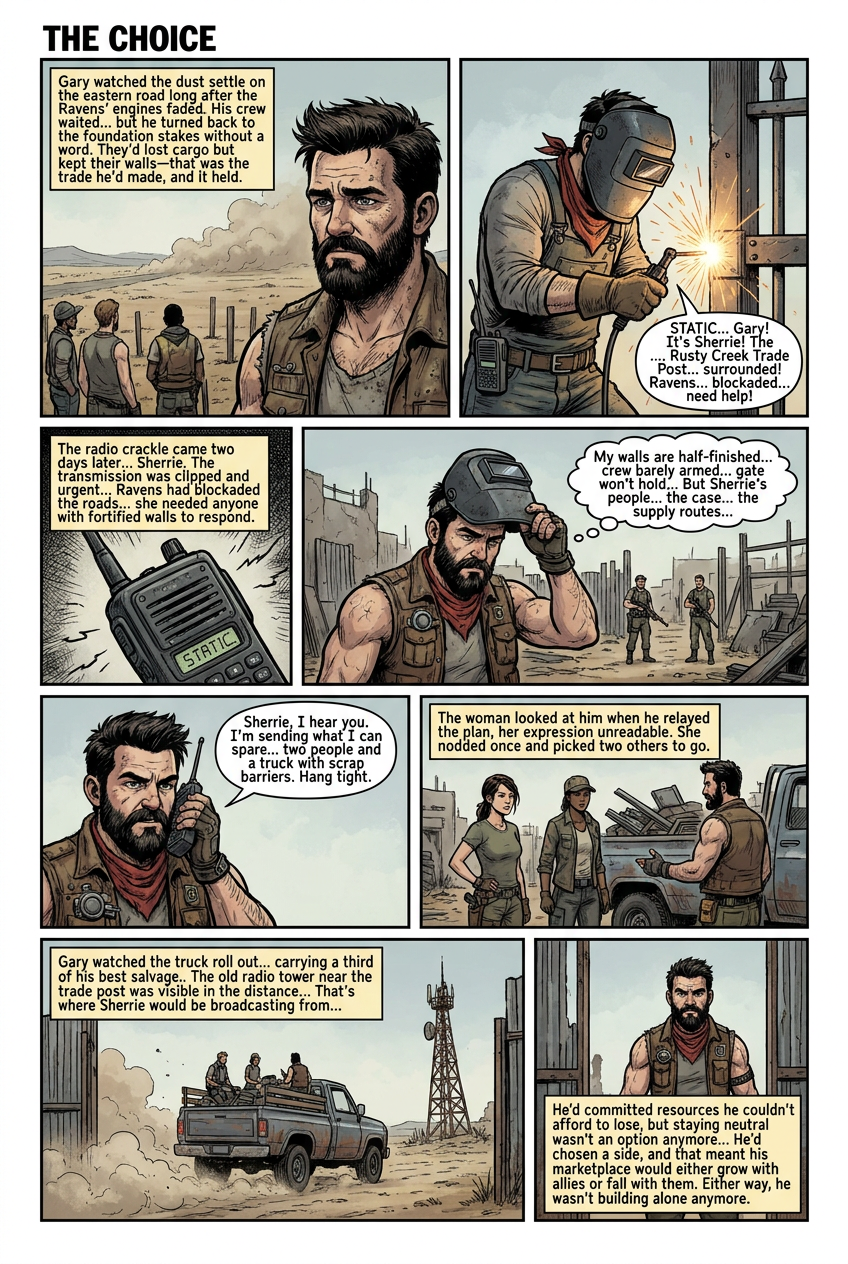
Gary watched the dust settle on the eastern road long after the Ravens' engines faded. His crew waited for him to say something, but he turned back to the foundation stakes without a word. They'd lost cargo but kept their walls—that was the trade he'd made, and it held. The radio crackle came two days later while Gary was welding support brackets to the east gate. Static, then a voice he recognized—Sherrie. The transmission was clipped and urgent, breaking through the usual trade channel chatter. The Rusty Creek Trade Post was surrounded. Ravens had blockaded the roads with bikes positioned in a wide perimeter, and she needed anyone with fortified walls to respond. Gary killed the torch and looked at his scrapyard. His walls were half-finished, his crew barely armed, and his gate wouldn't hold against a sustained push. But Sherrie's organization had brought him the case that started all this, and her supply routes fed the traders who might one day fill his marketplace. He picked up his radio and told her he'd send what he could spare—two people and a truck loaded with scrap metal barriers. It wasn't much, but it was something. The woman looked at him when he relayed the plan, her expression unreadable. She nodded once and picked two others to go. Gary watched the truck roll out carrying a third of his best salvage and two of his most reliable workers. The old radio tower near the trade post was visible in the distance, its rusted frame leaning like a broken spine against the sky. That's where Sherrie would be broadcasting from, coordinating whatever defense she could muster. He'd committed resources he couldn't afford to lose, but staying neutral wasn't an option anymore—not after the Ravens had come to his gate, not after he'd seen how they operated. His scrapyard was stronger for it. He'd chosen a side, and that meant his marketplace would either grow with allies or fall with them. Either way, he wasn't building alone anymore.
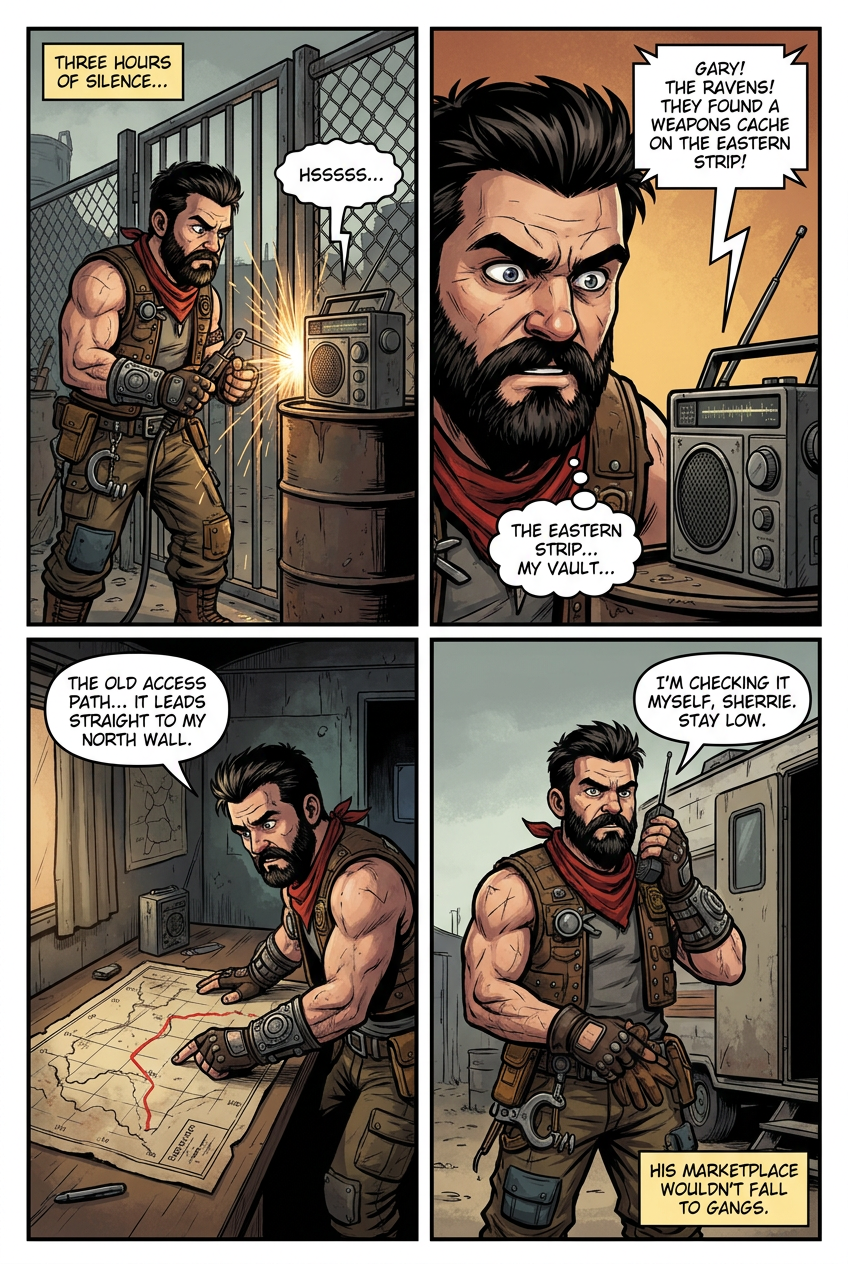
The radio stayed quiet for three hours after his truck left. Gary kept working the welds on the east gate, but his attention drifted to the static hiss every few minutes. When Sherrie's voice finally came through, it wasn't a report—it was a warning. Her people had intercepted Ravens hauling weapons on the eastern route—rotary guns with mounted tripods, still packed in military crates. The markings matched nothing in circulation except one cache buried years back on the eastern strip. Gary's chest tightened. He'd relocated his wall foundation to avoid the vault he'd found, but if Sherrie knew about a buried cache out here, the Ravens might too. He asked her to describe the site. She said her scout found a shovel still standing in disturbed earth near the old highway marker, two miles from his property line. The hole was fresh—dug within the last week. Gary cut the radio and walked to his trailer, pulling out the surveyor's map he'd used to mark his original foundation stakes. The eastern strip ran parallel to his scrapyard for miles, but only one section had enough cover to hide a dig site without being spotted from the road. He traced the line with his finger and stopped where it crossed the old access path he'd used for salvage runs. That path led directly to his north wall—the same wall he'd moved to avoid exposing the vault. The Ravens hadn't found his cache, but they'd been digging close enough to stumble onto it if they kept searching. He folded the map and locked it in his desk. His marketplace couldn't grow if armed gangs tore through his property looking for weapons. He picked up the radio and told Sherrie he'd check the site himself and report back what he found. She warned him to stay low—the Ravens were still patrolling the area.
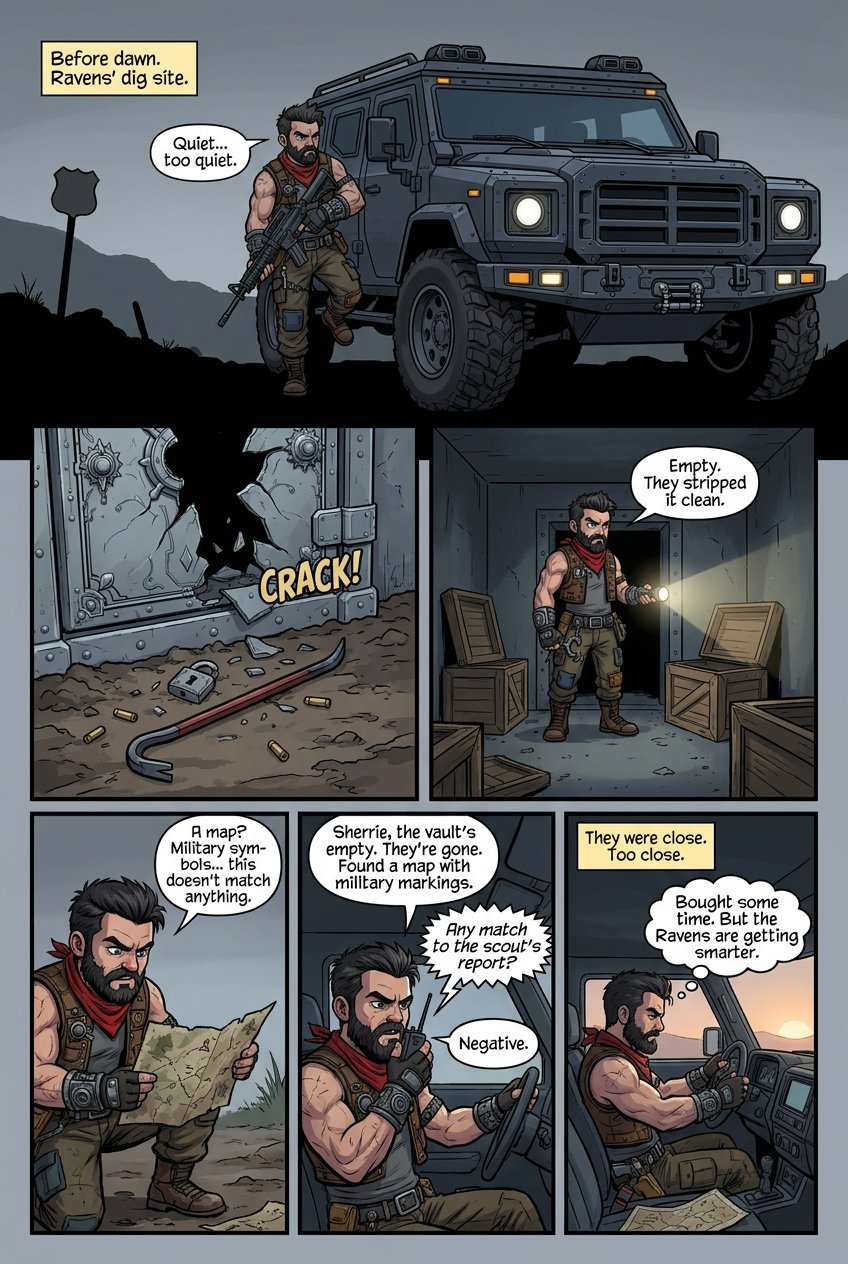
Gary left the scrapyard before dawn, driving the armored truck with his headlights off until he cleared the first ridge. The old highway marker sat two miles east, barely visible in the gray light. He slowed as he approached the access path and killed the engine, stepping out with his rifle across his chest. The dig site sprawled across thirty feet of disturbed ground, scarred with boot prints and scattered brass casings that caught the early light. A crowbar lay beside a shattered lock near the vault entrance—cracked open from the outside, metal peeled back like someone had forced it in a hurry. Gary crouched at the edge and studied the soil. Fresh digging, but no Ravens in sight. No bikes, no guards, no bodies. He moved closer to the vault and spotted a faded map half-buried in the dirt, its edges torn and stained with mud. The markings didn't match his surveyor's notes, but the symbols looked military. The Ravens had been here, found something, and cleared out fast. Gary circled the entrance and peered inside. Empty crates lined the walls, their lids pried off and contents stripped clean. Whoever opened this vault had taken everything worth carrying and left the rest behind. He stepped back and scanned the perimeter, counting the footprints—at least six people, maybe more. They'd worked the site thoroughly, then vanished without leaving a single bike track leading away. That didn't fit. The Ravens never moved weapons on foot, and they never abandoned a cache without posting watchers. Either they'd finished here and moved on, or something had spooked them into running. He radioed Sherrie and told her the vault was empty and the Ravens were gone. She asked if he'd found any markings that matched her scout's report. Gary described the map and the military symbols, then paused. The vault the Ravens had cracked sat a quarter mile from his own buried cache—close enough that if they'd kept searching, they would have found it. But they hadn't. They'd taken what they came for and left the area clean. His scrapyard was still hidden, still safe. He loaded the abandoned map into his truck and drove back, knowing he'd bought himself time but not security. The Ravens had proven they could dig up what they wanted, and next time, they might dig closer.
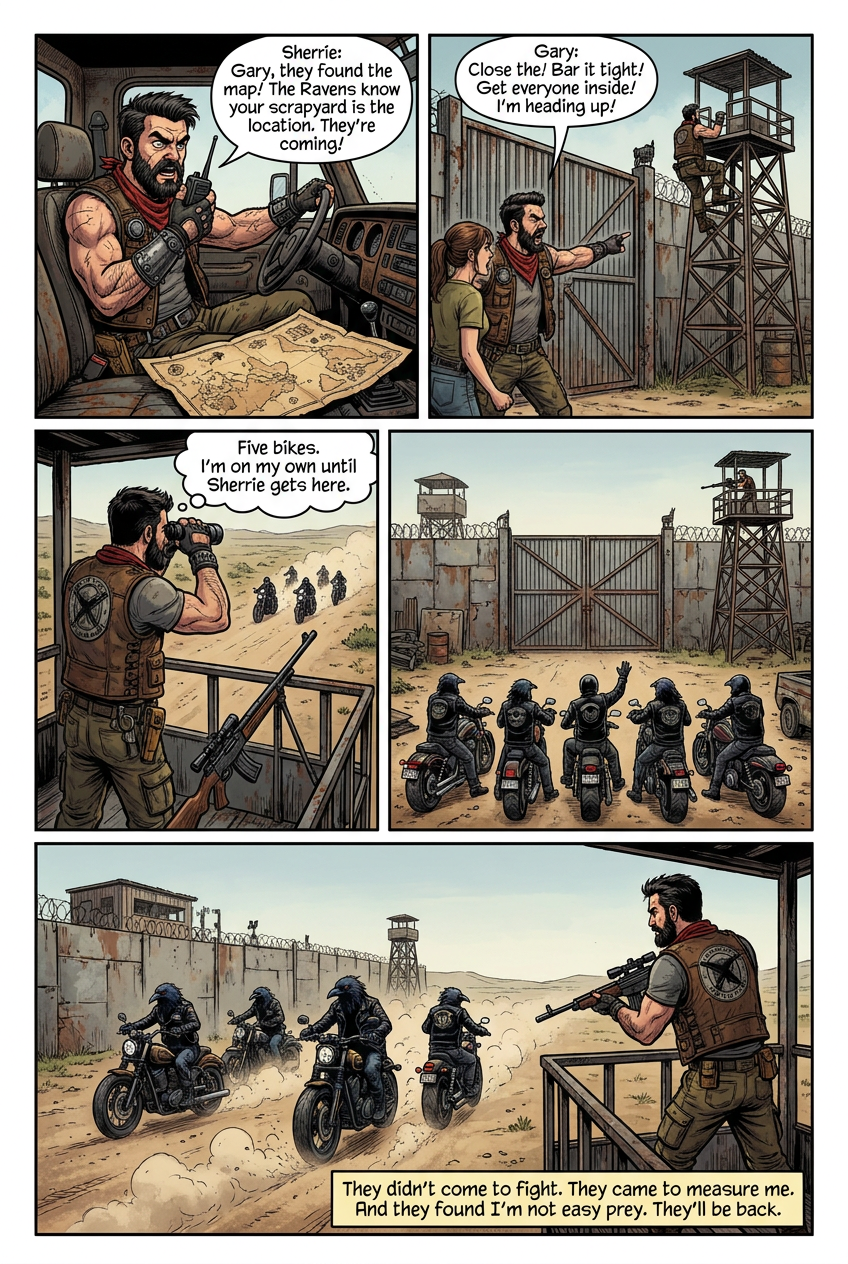
Gary pulled the truck back through the scrapyard gates just as his radio crackled. Sherrie's voice came through sharp and fast. She'd traced the military map he'd found at the dig site back to his scrapyard—the symbols matched old surveyor marks from his property line. The Ravens had figured it out too. Armed riders were already moving toward his gates. Gary killed the engine and grabbed his rifle. He shouted for the woman to get everyone inside the walls and bar the main gate. Then he climbed the makeshift watchtower he'd welded together from salvaged scaffolding and rusted steel beams three days earlier, scanning the eastern approach with binoculars. Dust rose in the distance—four bikes, maybe five, moving fast along the access road. They'd be here in minutes. He radioed Sherrie back and told her he needed backup or a distraction, anything to buy time. She said her people were already mobilizing but wouldn't reach him for at least twenty minutes. Gary locked the tower hatch behind him and positioned himself at the top rail, checking his rifle's chamber. The Ravens would hit his gates hard, and he'd have to hold them off alone until help arrived. He'd built these walls to protect a marketplace, but now they'd prove whether his scrapyard could survive as a fortress. The bikes stopped fifty yards out, engines idling in formation. Gary counted five riders, all armed, but none advancing. The lead rider held up a hand and the engines cut. Silence settled over the scrapyard. Gary's finger hovered near the trigger, waiting for the first move. But the Ravens just sat there, watching the walls, assessing the watchtower, measuring what Gary had built. Then the lead rider turned his bike around and the others followed, dust kicking up as they retreated east. Gary kept his rifle raised until the sound faded completely. They hadn't come to fight—they'd come to see if he was worth the cost. The Ravens had confirmed his scrapyard was real, fortified, and defended. They'd be back with a plan, but today he'd proven his walls could make them hesitate.
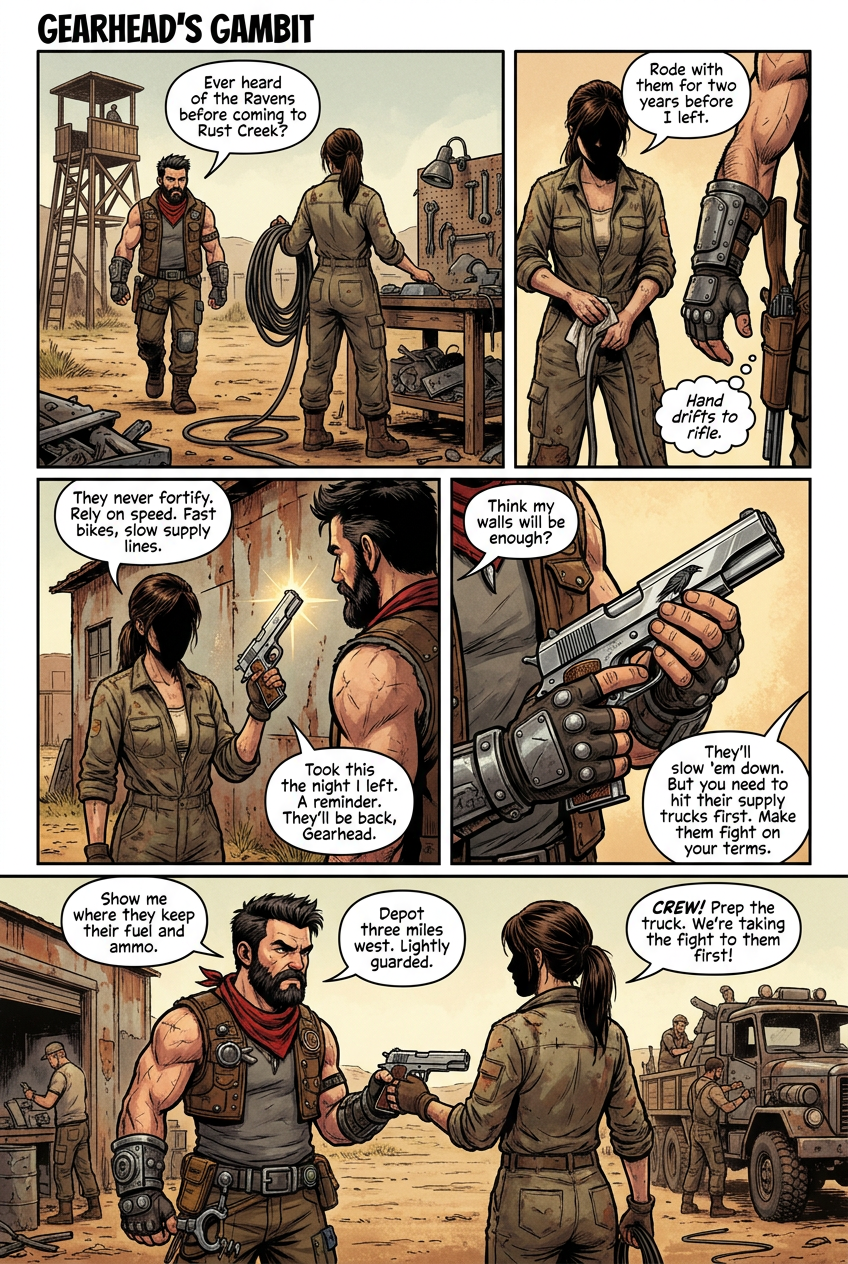
Gary climbed down from the watchtower and walked back to the welding station where the woman was coiling cable. She looked up when his shadow crossed her workbench. He asked if she'd ever heard of the Ravens before coming to Rust Creek. She set down the cable and wiped her hands on her pants. She told him she rode with them for two years before she left. Gary's hand drifted toward his rifle but she didn't move. She said the Ravens had a weakness—they never fortified their camps because they relied on speed and numbers instead of walls. Their bikes were fast but their supply lines were slow, and they couldn't hold territory if someone forced them to dig in and defend it. She walked to the rusted building she'd claimed as her workspace and came back with a pistol, raven etched into the grip, polished metal catching the light. She'd taken it the night she left and kept it as a reminder. Gary asked why she was telling him this now. She said because the Ravens would come back with more riders, and if he wanted his marketplace to survive, he needed to make them fight on his terms instead of theirs. Gary took the pistol and turned it over in his hands. The weight felt wrong—too balanced, too expensive for scrap work. He asked if she thought his walls would be enough. She said the walls would slow them down, but he'd need to hit their supply trucks before they could stage a real assault. Gary handed the pistol back and told her to show him where the Ravens kept their fuel and ammunition. She nodded and said there was a depot three miles west, lightly guarded because they never expected anyone to know about it. Gary called his crew together and told them to prep the truck. He'd spent weeks building walls to protect what he had, but now he'd learned the only way to keep the Ravens out was to take the fight to them first.
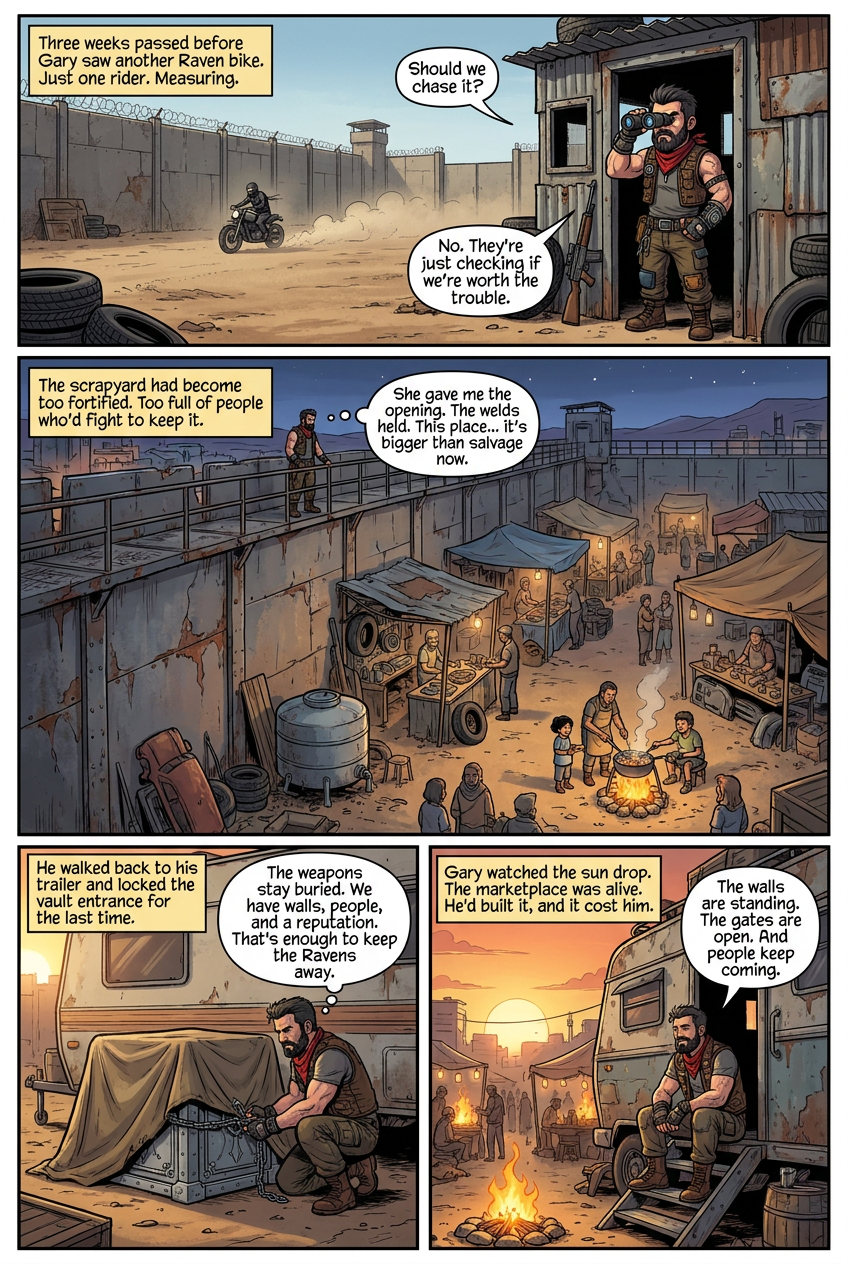
that mattered. She'd given him the opening he needed, and he'd used it to keep his walls standing. Three weeks passed before Gary saw another Raven bike on the horizon. This time it was just one rider, no white flag, cruising slow along the perimeter like they were measuring what he'd built. Gary watched from the checkpoint shack with his rifle propped against the doorframe. The bike circled once and disappeared. His crew asked if they should chase it down, but Gary said no. The Ravens had lost their supply line and their depot, and now they were just looking to see if he was still worth the trouble. He figured the answer was no. The scrapyard had become too fortified, too well-armed, and too full of people who'd fight to keep it. The marketplace had turned into something bigger than salvage and trade—it was a place people came to because they knew they could survive there. Gary stood at the north wall that evening and looked out over the stalls his crew had finished building. Traders were setting up tarps and tables, laying out food and tools and fabric. A family near the cistern was cooking over a fire, kids running between the car husks like they'd always been there. The woman's welds still held the wall together, rust starting to creep along the seams but the structure solid. Gary had lost people to build this place, but what he'd built would outlast all of them. He'd turned a scrapyard into a fortress and a fortress into a marketplace, and now it was running without him having to push it forward. He walked back to his trailer and locked the vault entrance under the tarp for the last time. The weapons would stay buried. The scrapyard didn't need them anymore—it had walls, it had people, and it had a reputation that kept the Ravens from coming back. Gary sat on the trailer steps and watched the sun drop behind the eastern strip. The marketplace was alive now, full of voices and deals and movement. He'd built what he set out to build, and it had cost him more than he wanted to pay. But the walls were standing, the gates were open, and people kept coming. That was enough.
Play your story to life
Storycraft is a mobile game where you create AI characters, craft items and locations to build their world, then discover what direction your story takes. Download the iOS game for free today!
Download for free